
Green Energy Graduate Diploma Facing the Information competitive
- Slides: 18
Green Energy Graduate Diploma Facing the Information competitive session environment. Department of graduate of Mechanical and Mechatronics Engineering recruitment Hosted by: Professor Roydon Fraser Professor Zhongchao Tan Professor Hamid Jahedmotlagh
Welcome Thank you for your interest in the Green Energy Graduate Diploma (GEGD). • Discover the value this program can have in your current position • Learn more about course content • Experience our state-of-the-art online learning environment
What is the GEGD? • An interactive and flexible new graduate program that provides technical knowledge and training in green energy systems • Allows working engineers to access professional development in areas like bioenergy, pollution management, and sustainable buildings
The Green Energy Graduate Diploma; What is in is for you? The value added from GEGD will be as individual as you are, however, in general it offers the following with regards to green energy engineering science, trends, and thinking: • • Provides applied knowledge and thinking Provides professional development updates Provides Canadian perspective Provides Canadian credential
Work Environment Applications Professional Engineering is “. . . any act of planning, designing, composing, evaluating, advising, reporting, directing or supervising that requires the application of engineering principles and concerns the safeguarding of life, health, property, economic interests, the public welfare or the environment, or the managing of any such act. ” • A working knowledge about green energy principles, engineering science, and systems has many direct links to the responsibilities of a professional engineer
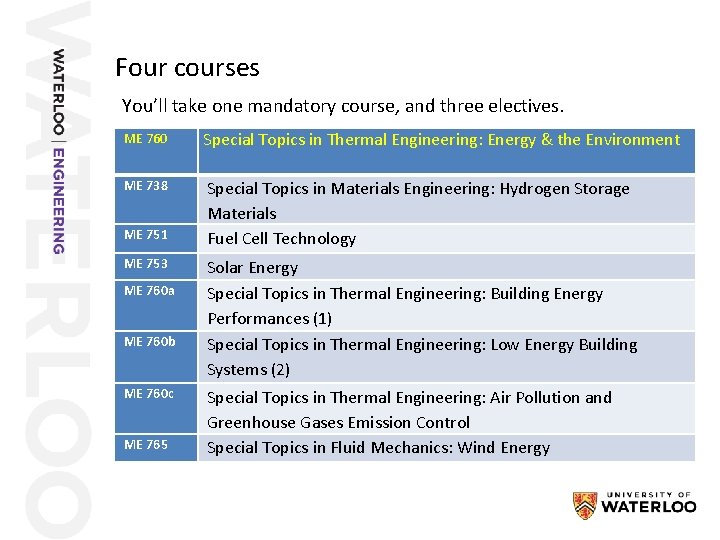
Four courses You’ll take one mandatory course, and three electives. ME 760 Special Topics in Thermal Engineering: Energy & the Environment ME 738 Special Topics in Materials Engineering: Hydrogen Storage Materials Fuel Cell Technology ME 751 ME 753 ME 760 a ME 760 b ME 760 c ME 765 Solar Energy Special Topics in Thermal Engineering: Building Energy Performances (1) Special Topics in Thermal Engineering: Low Energy Building Systems (2) Special Topics in Thermal Engineering: Air Pollution and Greenhouse Gases Emission Control Special Topics in Fluid Mechanics: Wind Energy
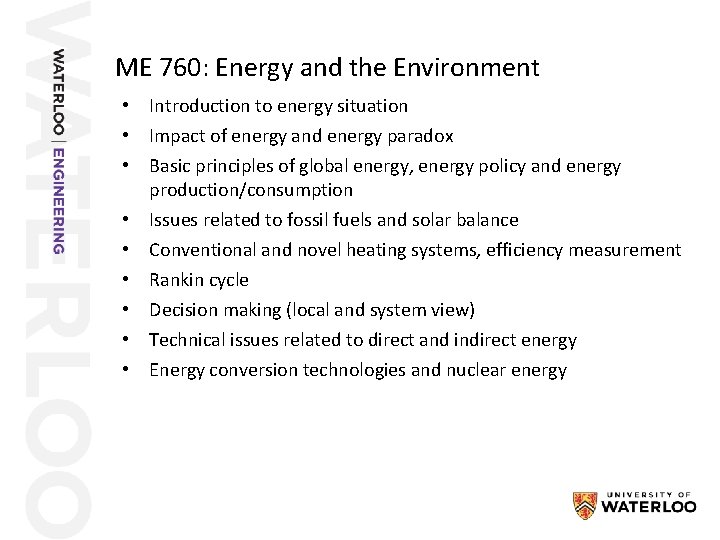
ME 760: Energy and the Environment • Introduction to energy situation • Impact of energy and energy paradox • Basic principles of global energy, energy policy and energy production/consumption • Issues related to fossil fuels and solar balance • Conventional and novel heating systems, efficiency measurement • Rankin cycle • Decision making (local and system view) • Technical issues related to direct and indirect energy • Energy conversion technologies and nuclear energy
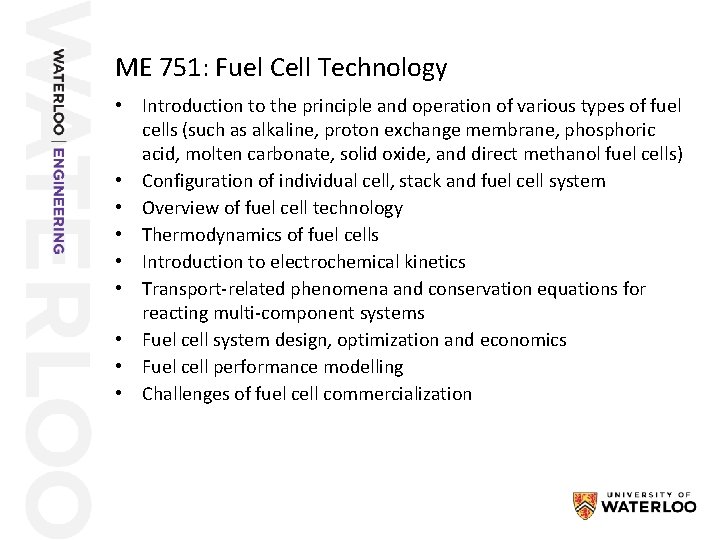
ME 751: Fuel Cell Technology • Introduction to the principle and operation of various types of fuel cells (such as alkaline, proton exchange membrane, phosphoric acid, molten carbonate, solid oxide, and direct methanol fuel cells) • Configuration of individual cell, stack and fuel cell system • Overview of fuel cell technology • Thermodynamics of fuel cells • Introduction to electrochemical kinetics • Transport-related phenomena and conservation equations for reacting multi-component systems • Fuel cell system design, optimization and economics • Fuel cell performance modelling • Challenges of fuel cell commercialization
ME 753: Solar Energy • Solar radiation • Radiative and optical properties of materials • Basic and advanced flat plate solar thermal converters, focusing converters, solar-electric converters, solar photovoltaic cells, thermal storage • Applications to building heating and cooling systems, industrial heat and central electric plants
ME 760 a: Building Energy Performances • An overview of energy use in buildings • Basic calculations of energy flows through exterior envelope • Basic energy calculations for mechanical/electrical equipment and systems, including HVAC, water heating, and lighting • Aspects of energy-use benchmarking, energy-auditing, and building energy simulation • Additional topics may include: − integrated design process − building energy codes − “green building” rating systems − measurement of energy use − building commissioning
ME 760 b: Low Energy Building Systems • An overview of concepts for designing energy-efficient HVAC systems for buildings: − design for efficient operation at part-load − variable-flow hydronic systems − ventilation heat-recovery systems − high-efficiency heating and cooling equipment − waste-heat recovery − aspects of air- and ground-source heat-pump systems • Additional topics may include: − aspects of building energy management systems − considerations for integration of future energy sources (i. e. solar-energy, cogeneration systems)
ME 760 c: Pollution and Greenhouse Gases Emission Control This course is designed for graduate students with mechanical, chemical and environmental engineering background. • Introduction to air, air quality and air pollution • Impact of air pollution and greenhouse gases on health and climate change • Fundamentals of fuel combustion and combustion related air emissions, and properties of air pollutants • Pre-combustion emission control strategies: fossil fuel cleaning/refinery and green energy • In-combustion emission control • Post-combustion air pollution control • Air dispersion modeling • GHG emission control technologies
ME 765: Wind Energy This course covers wind energy history, background, current state of the art, Canadian development. • The Wind as an Energy Source: energy extraction, boundary layers, turbulence, experimental measurements, instrumentation, wind modeling • Fundamentals of Wind Machines: dimensionless groups, scaling, performance parameters • Aerodynamics: momentum and Disc theory, Blade Geometry, Stall, Blade Design, Aeroacoustics, wind farm development The course will involve lectures, group discussion, guest lectures, independent study, and laboratory demonstrations.
Virtual classroom • • Live online delivery Live interaction with other students and the instructor Flexible in location Course recorded for future use
Admission requirements • Four year undergraduate degree in mechanical engineering, or a related field • Overall average of 75% in the last two years of this degree • Those with a non-related degree may apply if they have work experience in a related field • Two letters of reference, one of which must be academic • Applicants whose first language is not English must complete a language proficiency exam • i. BT (score of 80+) • IELTS (score of 6. 5+)
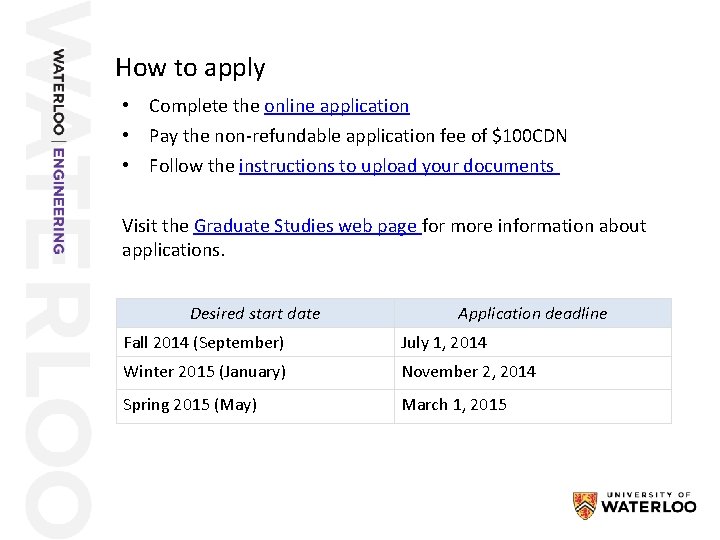
How to apply • Complete the online application • Pay the non-refundable application fee of $100 CDN • Follow the instructions to upload your documents Visit the Graduate Studies web page for more information about applications. Desired start date Application deadline Fall 2014 (September) July 1, 2014 Winter 2015 (January) November 2, 2014 Spring 2015 (May) March 1, 2015
Financing Domestic fees: $1, 277 per term International fees: $3, 504 per term Incidental fees: $36. 60 per term • Part-time registration only, with one course each term • Four terms to complete the program
Questions? Contact us Graduate Administrator Allison Walker (519) 888 -4567 x 33341 a 22 walker@uwaterloo. ca Associate Chair Grad Studies Professor H. Jahed (519) 888 -4567 x 37826 hjahed@uwaterloo. ca