
Green Computing The Environmental Impact of Desktop Computing


- Slides: 34
Green Computing: The Environmental Impact of Desktop Computing Catherine Steeves Associate Chief Librarian, ITS Gillian Maurice Sustainability Coordinator University of Guelph Presentation to OLA – February 1, 2007
What is Green Computing? n The positive (or least negative) relationship between the physical computer and its impact to the environments in which it moves through from cradle to grave
Green Computing – Why? n Growing public environmental awareness n Increasing impacts on environmental and human health n Corporate social responsibility
Cradle to Grave Approach n Full life-cycle analysis, not just the product on our desks n Looks at: Manufacturing l Use during lifetime l Disposal and reallocation l
Manufacturing – Fossil Fuels n Average desktop computer with monitor requires 10 times its weight in chemicals and fossil fuels to produce n 240 kg of fossil fuel for CRT monitor (United Nations University) n 266 kg of fossil fuel for LCD monitor (Williams, 2003)
Manufacturing – Monitors n CRT – lead and zinc leachate mean monitors are hazardous waste (Lee et al. , 2004) l Lead: bioavailable in soil - can attack proteins and DNA, as well as interfere with nervous system function (Bechara, 2004; Needleman, 2004) n LCD – 4 -12 mg mercury /unit (Williams, 2003) n Liquid crystals – polycyclic or halogenated aromatic hydrocarbons, 588 different compounds l 4% have potential for acute toxicity, but show no mutagenic effects in bacteria tests (Williams, 2003)
Manufacturing – Other Toxins n PBDE – similar structures to PCB and DDT l Bioavailable, environmentally persistent, biomagnifies in blood, fatty and liver tissue (Domingo, 2004) n Extraction impacts – refining of petroleum for energy and plastic, mining and smelting of metals n Solvents in microchip fabrication – hydrochloric acid, hydrofluoric acid, arsenic, benzene and hexavalent chromium (Williams, 2003)
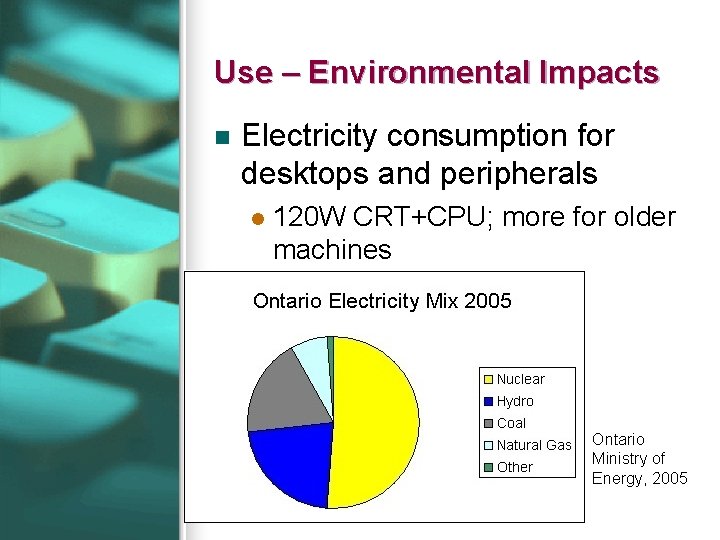
Use – Environmental Impacts n Electricity consumption for desktops and peripherals l 120 W CRT+CPU; more for older machines Ontario Ministry of Energy, 2005
Use – Environmental Impacts n Fossil fuel power – Greenhouse gas emissions, mercury atmospheric pollution, SOX and NOX lead to acid rain and smog formation n Nuclear power – difficulties with long term management of radioactive wastes
Disposal – Electronic Waste n Short product life expectancy (2 -4 years) n Same toxins in manufacturing process can cause environmental contamination n Human health risks n Lead, barium, chromium, CNS disruptors etc. (Baul, 2002) n Human rights problems – “Exporting harm”
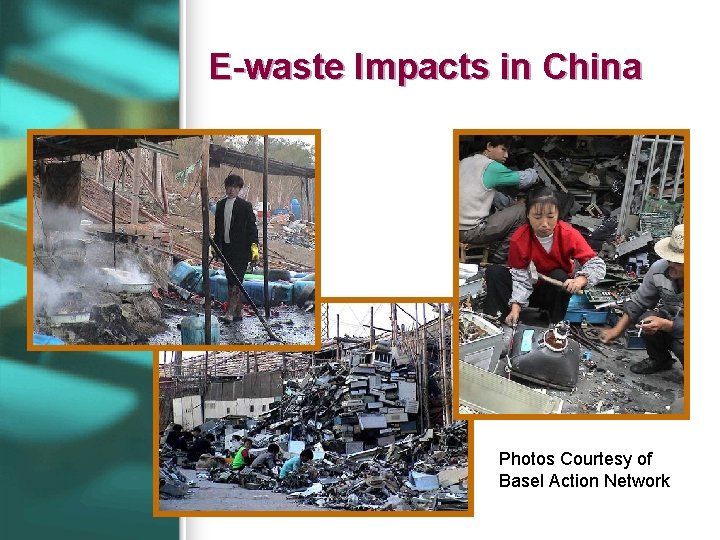
E-waste Impacts in China Photos Courtesy of Basel Action Network
Manufacturing – Good News n Greener technology PBDE-free plastic l lead-free soldering l fewer toxic solvents l Plastics labelled with recycling codes l Less material used l n Independent certification bodies e. g. TCO, Nordic Swan, EU Ecolabel
Use – Good News n New technology often more energy efficient l l l Laptop 15 W total LCD system: 80 W total CRT system: down to 120 W from 270 W n Independent certification bodies e. g. , TCO, Nordic Swan, EU Eco-label n Energy saver features are now standard
Waste – Good News n Recycling Metal recovery l Semi-precious metal recovery l n Stewardship pledge (Basel Action Network)
University of Guelph Campus n 110, 000 k. Wh of electricity n 4, 700 homes n 9. 2 million dollars 32, 800 tonnes of carbon dioxide per year, or over 7, 000 cars (in one year) n
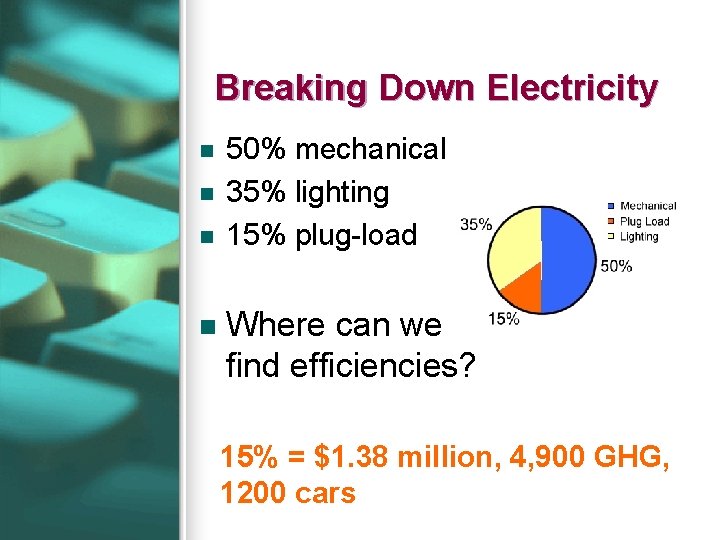
Breaking Down Electricity n n 50% mechanical 35% lighting 15% plug-load Where can we find efficiencies? 15% = $1. 38 million, 4, 900 GHG, 1200 cars
Finding Efficiencies n Sustainability Office commissioned study to look at environmental impacts of computers on campus n Report released: Environmental Impact of Computer Information Technology in an Institutional Setting: A Case Study at the University of Guelph n President asked the CIO to strike a task force
Green Computing Task Force n Terms of Reference ● Identify green computing best practices ● Examine computing procurement guidelines ● Identify energy conservation strategies and practices ● Identify equipment disposal procedures ● Recommend a campus awareness program
Task Force Members: n Aiden Abram, Student Representative to ISC n Gillian Maurice, Sustainability Coordinator, Physical Resources n Blair Nonnecke, Associate Professor, Computing and Information Science n Catherine Steeves, Chair, Associate Chief Librarian for Information Technology Services n Dale Stevanus, Manager, Purchasing Services n Jeff Walker, Systems Support Manager, Library
University of Guelph Policy on Environmental Protection n Acknowledges a responsibility for and a commitment to protection of the environment on a continuous improvement basis n Promotes and supports environmental management policies and environmentally responsible practices at every level and every department n Is committed to minimizing environmental impacts arising from the university’s activities University of Guelph - Environmental Health and Safety’s Policy on Health and Safety 851. 01
Best Practices – Policy n Northland College Sustainability Mission Statement n Sustainable Development Policy for the Association of Canadian Community Colleges International Institute for Sustainable Development Sustainable Campus Policy Bank
Recommendation – Campus Policy n Although beyond the scope of this task group, it is recommended that the University revisit its policies and consider the creation of an institutional environmental mandate to build a strong foundation for green policies, initiatives and program
Current Context – Computer Procurement n Typical computer procurement selection criteria : l functionality and specifications required by the user l commercial aspects that offer best value (best combination of functionality, price, service and other desired criteria) l compatibility with existing equipment and use
Best Practices – Computer Procurement n Trent University’s Environmental Procurement Policy n Mc. Master University’s Responsible Purchasing Statement/Commitment to Safety and the Environment
Recommendations – Computer Procurement n Purchasing Services develop a green purchasing policy for computers l l l Companies which manufacture and operate in environmentally sensitive ways Manufacture to electrical efficiency standards R&D to improve products’ environmental impact
Best Practice - Disposal n Current UG e-waste disposal program represents a best practice n E-waste is divided into two separate streams, CRT monitors and all other electronic equipment ● General e-waste is sent to Production Works where it is dismantled and redistributed to scrap companies and recyclers ● CRT monitors sent to an environment friendly Toronto-based company
Recommendations – Disposal Maintain current program, plus: n Obtain suitable space for storage of e -waste and monitors n Develop and implement methodology for tracking tonnage diverted from landfill n Formalize reuse and reallocation procedures and policies
Current Context – Guelph Environmental Awareness n Sustainability at U of G Website n Person to person workgroup presentations n Student to student presentations n Enviro Rep in-residence program n Tips and tools promotional materials n Campus media outlets
Recommendations – Awareness n Campus Awareness Program l Survey to gauge awareness of energy reduction and waste reduction practices and identify barriers to participation l Campaign development offering incentives and long-term behaviour modification strategies l Measure success and publicize success
Best Practices – Energy Conservation n Implementing power management options on machines n Reducing the overall “on” time of the system as a whole n Reducing the overall “on” time of the monitor in particular
Energy Conservation Strategies n Survey current computer power management policies and practices across campus n Coordinate participation of IT personnel in an energy reduction plan n Develop configuration standards, with IT personnel, to reduce energy consumption of computers
Conclusion: From Cradle to Grave n Top 3 priorities for Guelph: Energy conservation strategy l Campus awareness l Procurement guidelines l n What can your library do?
For More Information… n Environmental Impact of Computer Information Technology in an Institutional Setting: A Case Study at the University of Guelph n Report of the Green Computing Task Group Campus Computing and the Environment n Sustainability at U of G n Computer Professionals for Social Responsibility Resources on Computers and the Environment n Environmentally Preferable Purchasing-Electronics US Environmental Protection Agency n Electronics Product Stewardship Canada
Contact us: Gillian Maurice Sustainability Coordinator sustain@pr. uoguelph. ca Catherine Steeves Associate Chief Librarian, ITS csteeves@uoguelph. ca