
GREEN CHEMISTRY It is the branch of chemistry
GREEN CHEMISTRY It is the branch of chemistry concerned with developing processes and products to reduce or eliminate hazardous substances.
PRINCIPLES • • Prevention Atom Economy of reaction Less Hazardous Chemical Syntheses Designing Safer Chemicals Safer Solvents and Auxiliaries Design for Energy Efficiency Use of Renewable Feedstocks

• • • Reduce Derivatives Catalysis Design for Degradation Real-time analysis for Pollution Prevention Inherently Safer Chemistry for Accident Prevention
Poliakoff and colleagues have reported a mnemonic, PRODUCTIVELY, : • P – Prevent wastes • R – Renewable materials • O - Omit derivatization steps • D – Degradable chemical products • U – Use of safe synthetic methods • C – Catalytic reagents • T – Temperature, pressure ambient • I – In-process monitoring • V – Very few auxiliary substances • E – E-factor, maximize feed in product • L – low toxicity of chemical products • Y – Yes, it is safe
GOAL OF GREEN CHEMISTRY- • 1. To reduce the adverse environmental impact. • 2. To develop processes based on renewable feed. • 3. To minimize byproduct through redesign of reaction or in other words to achieve higher % atomic economy. • 4. To develop reaction involving less toxic raw materials. • 5. To develop processes which are hazardous free. • 6. To use the environment friendly solvent rather than organic solvents. • 7. To improve energy efficiency by developing low temperature, low pressure processes using improved catalyst. • 8. To develop reliable methods monitor and control processes. • 9. To develop eco-friendly products, which degrade more readily than current products
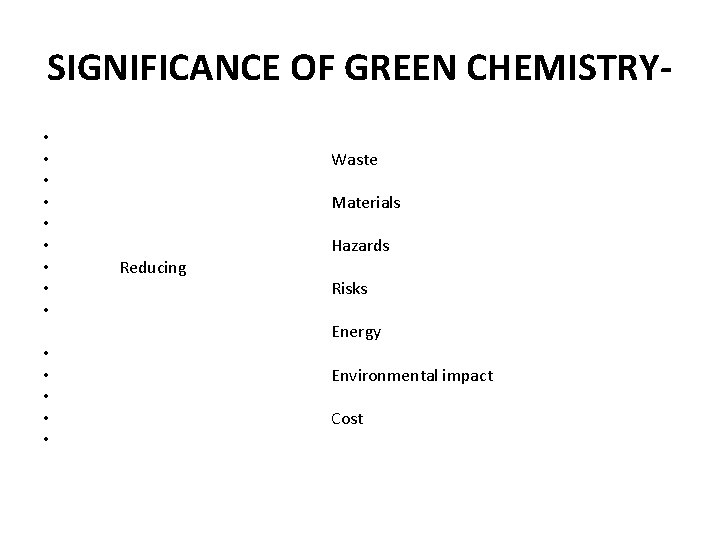
SIGNIFICANCE OF GREEN CHEMISTRY • • • Waste Materials Reducing Hazards Risks Energy • • • Environmental impact Cost
- Slides: 6