
Greek Volcanoes and Earthquakes By FlowyAnn FONCLAUD Debora
Greek Volcanoes and Earthquakes By: Flowy-Ann FONCLAUD Debora MANICORD Andriana PAPALANPROU

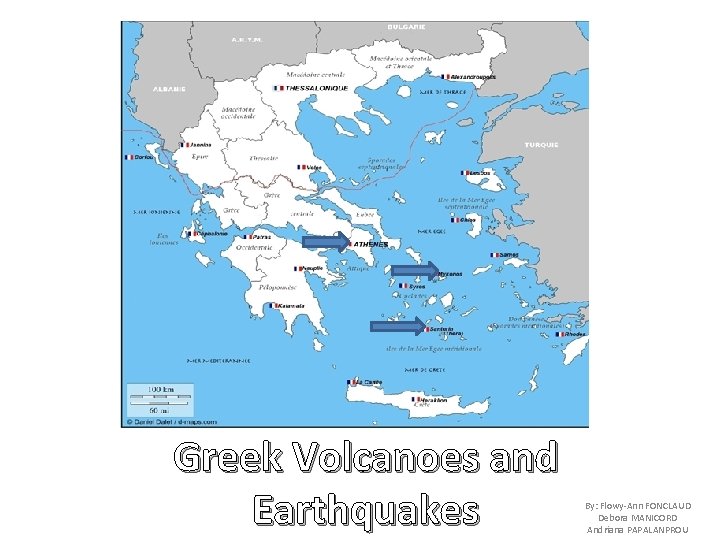
Greek Volcanoes • • Methana Kos Nisyros Poros Perissa Santorini(Nea Kameni) Yali Aegina
Geological Genesis • • Add vidéo
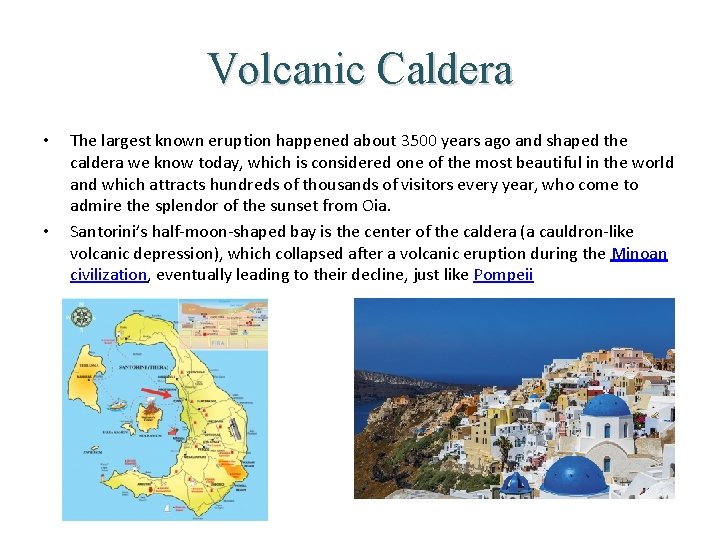
Volcanic Caldera • • The largest known eruption happened about 3500 years ago and shaped the caldera we know today, which is considered one of the most beautiful in the world and which attracts hundreds of thousands of visitors every year, who come to admire the splendor of the sunset from Oia. Santorini’s half-moon-shaped bay is the center of the caldera (a cauldron-like volcanic depression), which collapsed after a volcanic eruption during the Minoan civilization, eventually leading to their decline, just like Pompeii

Minoan Eruption
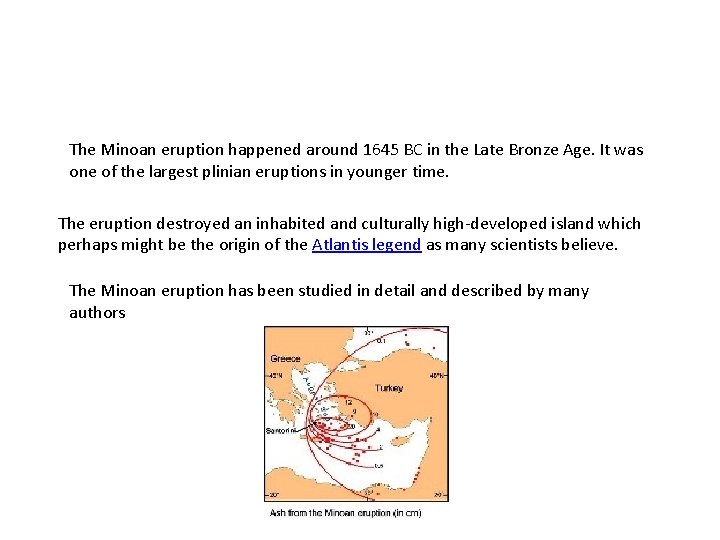
The Minoan eruption happened around 1645 BC in the Late Bronze Age. It was one of the largest plinian eruptions in younger time. The eruption destroyed an inhabited and culturally high-developed island which perhaps might be the origin of the Atlantis legend as many scientists believe. The Minoan eruption has been studied in detail and described by many authors
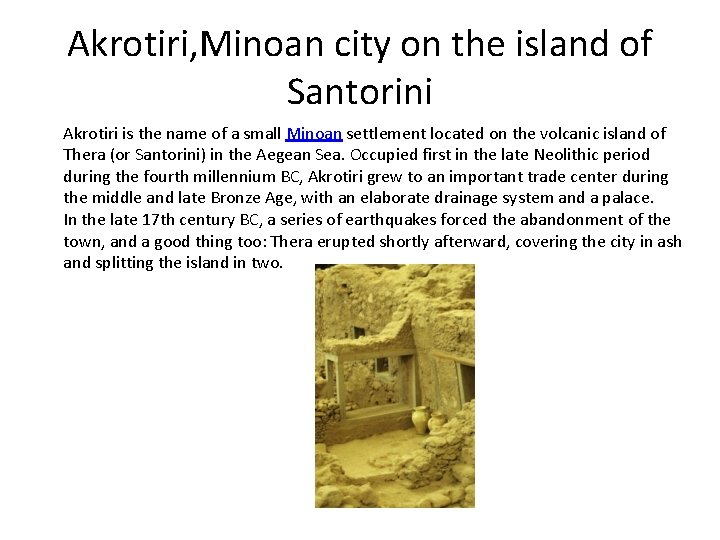
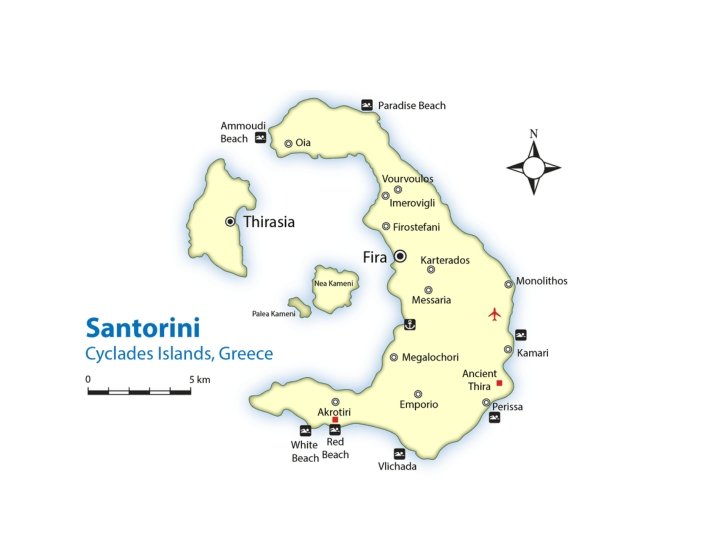
Akrotiri, Minoan city on the island of Santorini Akrotiri is the name of a small Minoan settlement located on the volcanic island of Thera (or Santorini) in the Aegean Sea. Occupied first in the late Neolithic period during the fourth millennium BC, Akrotiri grew to an important trade center during the middle and late Bronze Age, with an elaborate drainage system and a palace. In the late 17 th century BC, a series of earthquakes forced the abandonment of the town, and a good thing too: Thera erupted shortly afterward, covering the city in ash and splitting the island in two.
« The Mycenaean Pompei » • “pyroclastic flows” were released through a “split” in the cone wall, of limited area, generating a high velocity jet of tephra fluidized in a red hot gas stream. Such a jet is immensely destructive and lethal, causing death by pulmonary oedema. The shape (like a blowtorch) and course of the ash fallout, as measured by deep sea cores, shows that these passed over the eastern part of Crete, causing severe destruction and depopulation.
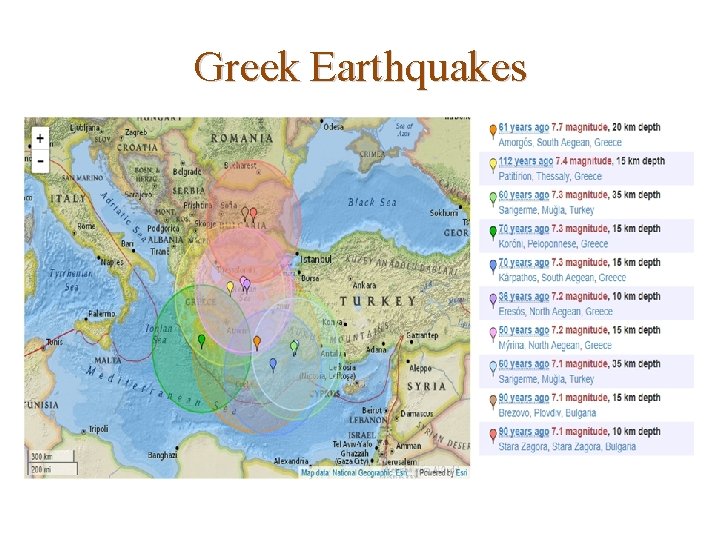
Greek Earthquakes
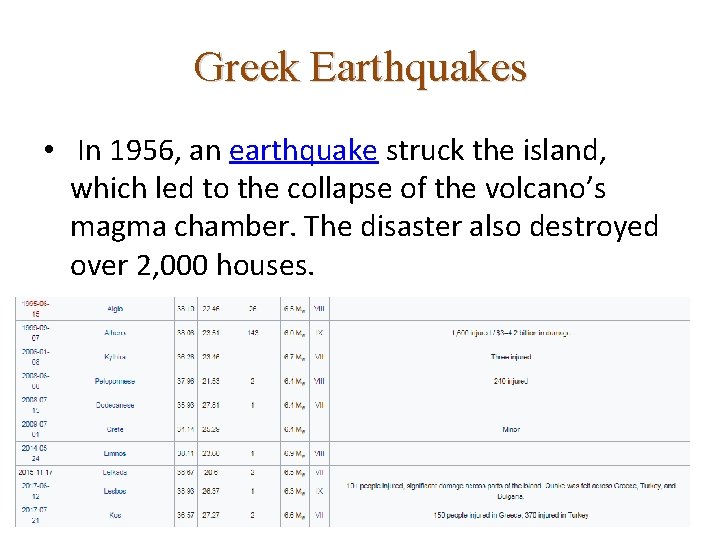
Greek Earthquakes • In 1956, an earthquake struck the island, which led to the collapse of the volcano’s magma chamber. The disaster also destroyed over 2, 000 houses.
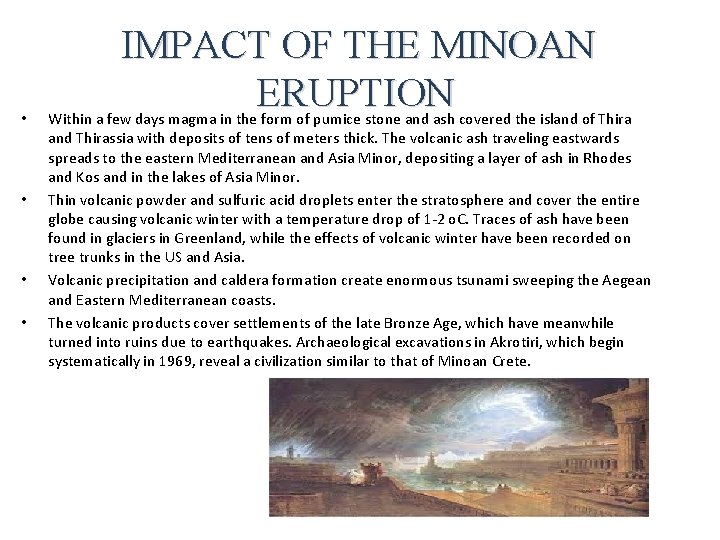
• • IMPACT OF THE MINOAN ERUPTION Within a few days magma in the form of pumice stone and ash covered the island of Thira and Thirassia with deposits of tens of meters thick. The volcanic ash traveling eastwards spreads to the eastern Mediterranean and Asia Minor, depositing a layer of ash in Rhodes and Kos and in the lakes of Asia Minor. Thin volcanic powder and sulfuric acid droplets enter the stratosphere and cover the entire globe causing volcanic winter with a temperature drop of 1 -2 o. C. Traces of ash have been found in glaciers in Greenland, while the effects of volcanic winter have been recorded on tree trunks in the US and Asia. Volcanic precipitation and caldera formation create enormous tsunami sweeping the Aegean and Eastern Mediterranean coasts. The volcanic products cover settlements of the late Bronze Age, which have meanwhile turned into ruins due to earthquakes. Archaeological excavations in Akrotiri, which begin systematically in 1969, reveal a civilization similar to that of Minoan Crete.
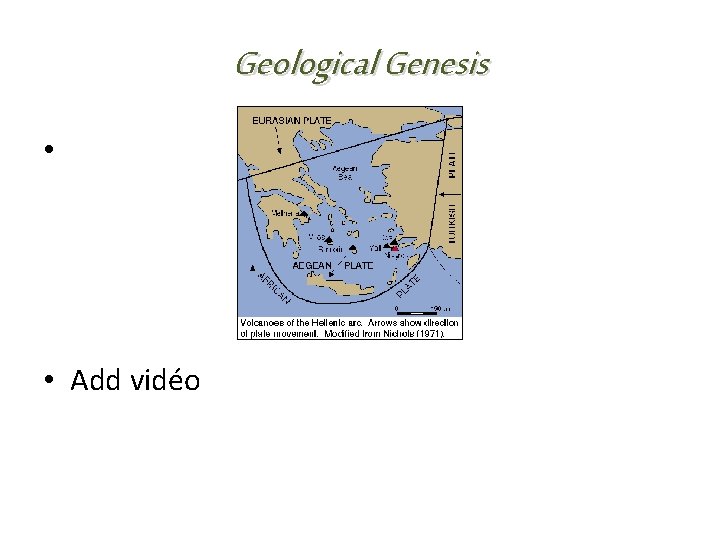
Geological Genesis of earthquakes • The high seismic activity of the country is due to the fact that it is located at the boundary of the Africa-Eurasia convergence. Within this framework, the Anatolian plate rotates counterclockwise(fig. 1). From the west, the Adria microplate rotates counterclockwise. As a consequence, the Aegean microplate moves fast towards SW. The external Aegean area is subject to a general compressional stress field and the inner Aegean area experiences a general extensional stress field. • Many of the quakes that strike Greece have their epicenters under the sea. While these can shake up surrounding islands, they rarely cause severe damage. The ancient Greeks attributed earthquakes to the God of the Sea, Poseidon, perhaps because so many of them were centered under the waters.
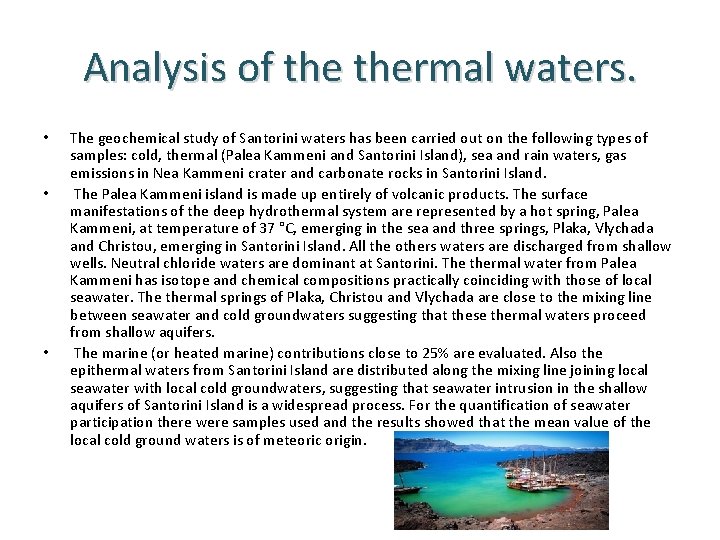
Analysis of thermal waters. • • • The geochemical study of Santorini waters has been carried out on the following types of samples: cold, thermal (Palea Kammeni and Santorini Island), sea and rain waters, gas emissions in Nea Kammeni crater and carbonate rocks in Santorini Island. The Palea Kammeni island is made up entirely of volcanic products. The surface manifestations of the deep hydrothermal system are represented by a hot spring, Palea Kammeni, at temperature of 37 °C, emerging in the sea and three springs, Plaka, Vlychada and Christou, emerging in Santorini Island. All the others waters are discharged from shallow wells. Neutral chloride waters are dominant at Santorini. The thermal water from Palea Kammeni has isotope and chemical compositions practically coinciding with those of local seawater. The thermal springs of Plaka, Christou and Vlychada are close to the mixing line between seawater and cold groundwaters suggesting that these thermal waters proceed from shallow aquifers. The marine (or heated marine) contributions close to 25% are evaluated. Also the epithermal waters from Santorini Island are distributed along the mixing line joining local seawater with local cold groundwaters, suggesting that seawater intrusion in the shallow aquifers of Santorini Island is a widespread process. For the quantification of seawater participation there were samples used and the results showed that the mean value of the local cold ground waters is of meteoric origin.
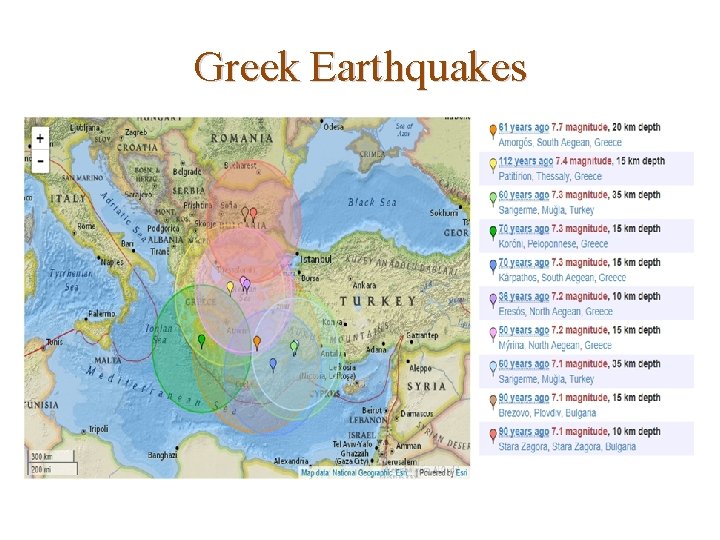
Greek Earthquakes
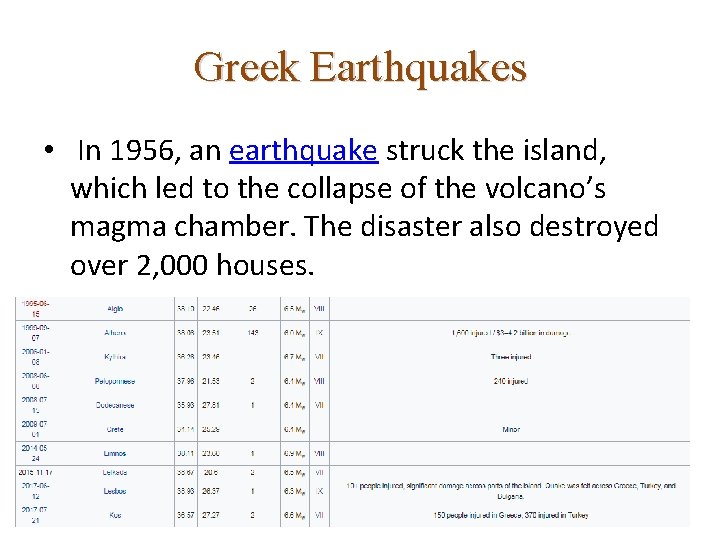
Greek Earthquakes • In 1956, an earthquake struck the island, which led to the collapse of the volcano’s magma chamber. The disaster also destroyed over 2, 000 houses.
Pyrgos earthquake analysis of 1993. • • On March 26, 1993, the major earthquake in Pyrgos Ilias occurred at 14: 10. The earthquake was divided into two earthquakes of 5. 5 and 5. 8 R and in terms of time 3 minutes of gap between the two major vibrations, so the damage was mitigated and that we have no victims. This sharing of the earthquake was a scientifically striking phenomenon. Long hours ago, small vibrations were taking place in the evenings, as a warning that the inhabitants had taken the elementary measures and were ready for the time of the great earthquake. It’s dramatic ending occurred at 2: 10 pm on the 26 th of March when the twin earthquake of magnitude 5, 5 and 5. 8 degrees of the Richter Scale, of small focal depth, and centered around the city, in the area of Dexamenis, caused considerable damage to the buildings of Pyrgos and some villages in the wider region. The interval between the two vibrations was three minutes. This time gap, as well as the sharing of seismic detonation in two vibrations instead of one, saved many human lives and the area from huge disasters. The phenomenon of the seismic sequence for more than a month and the twin earthquake that marked its peak was a scientifically striking phenomenon and has since been an example in the scientific literature. This, however, has prompted the inhabitants to take the basic measures and be on hand for the time of the great earthquake. There was only one victim, an old woman, who died due to a heart attack. Many old buildings in the city and surrounding villages were damaged and then demolished. The monumental buildings of the city, such as the Manolopoulio Hospital, the Metropolitan Palace, the churches of Agios Nikolaos, Agia Kyriaki and Agios Dionysios, suffered significant damage. The worst salvation of the city was attributed to the protector of Saint Charalambos, whose the presence of several residents. For this reason, the image of the Saint in the city was also perched. The years that followed were quite difficult, but they had significant economic growth and great reconstruction with anti-seismic constructions. Several listed buildings have been renovated, but others such as Manolopouleio and Papagianni House in Ermou street are still harshly wounded, reminding of the destruction of that day and the outrageous unreliability of the Greek State and the Local Government. After March 1993, Pyrgos acquired a new face, not necessarily more beautiful. The estimation of the earthquake in Mercalli scale is VI. Strong.
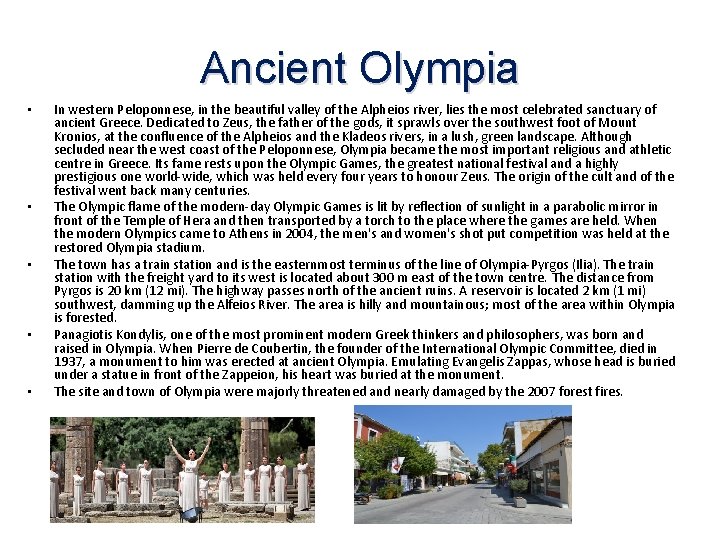
Ancient Olympia • • • In western Peloponnese, in the beautiful valley of the Alpheios river, lies the most celebrated sanctuary of ancient Greece. Dedicated to Zeus, the father of the gods, it sprawls over the southwest foot of Mount Kronios, at the confluence of the Alpheios and the Kladeos rivers, in a lush, green landscape. Although secluded near the west coast of the Peloponnese, Olympia became the most important religious and athletic centre in Greece. Its fame rests upon the Olympic Games, the greatest national festival and a highly prestigious one world-wide, which was held every four years to honour Zeus. The origin of the cult and of the festival went back many centuries. The Olympic flame of the modern-day Olympic Games is lit by reflection of sunlight in a parabolic mirror in front of the Temple of Hera and then transported by a torch to the place where the games are held. When the modern Olympics came to Athens in 2004, the men's and women's shot put competition was held at the restored Olympia stadium. The town has a train station and is the easternmost terminus of the line of Olympia-Pyrgos (Ilia). The train station with the freight yard to its west is located about 300 m east of the town centre. The distance from Pyrgos is 20 km (12 mi). The highway passes north of the ancient ruins. A reservoir is located 2 km (1 mi) southwest, damming up the Alfeios River. The area is hilly and mountainous; most of the area within Olympia is forested. Panagiotis Kondylis, one of the most prominent modern Greek thinkers and philosophers, was born and raised in Olympia. When Pierre de Coubertin, the founder of the International Olympic Committee, died in 1937, a monument to him was erected at ancient Olympia. Emulating Evangelis Zappas, whose head is buried under a statue in front of the Zappeion, his heart was buried at the monument. The site and town of Olympia were majorly threatened and nearly damaged by the 2007 forest fires.
- Slides: 18