
Greek Tragedy The Origin of Theatre Athenian tribes
Greek Tragedy
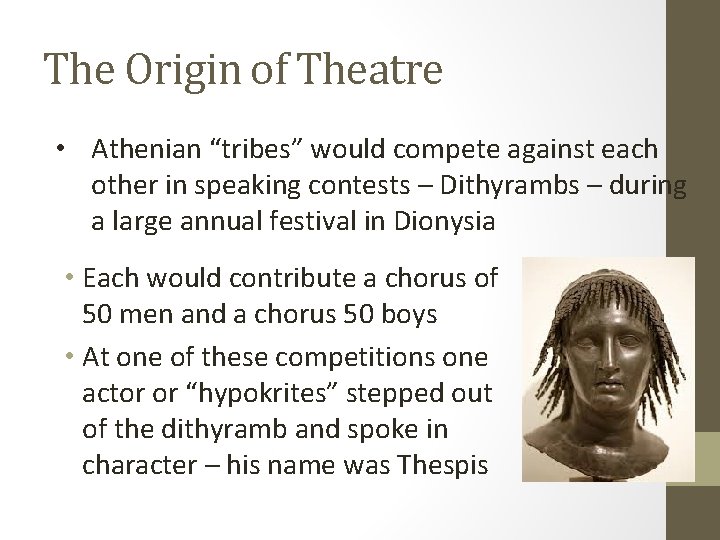
The Origin of Theatre • Athenian “tribes” would compete against each other in speaking contests – Dithyrambs – during a large annual festival in Dionysia • Each would contribute a chorus of 50 men and a chorus 50 boys • At one of these competitions one actor or “hypokrites” stepped out of the dithyramb and spoke in character – his name was Thespis
Theatre in Greece • Theatre became part of the fabric of Greek society and dramatic contests also became part of the festival in Dionysia • Wealthy members of society would take turns sponsoring one of the three tragedy playwrights preparing a production for the competition – it was considered their civic duty
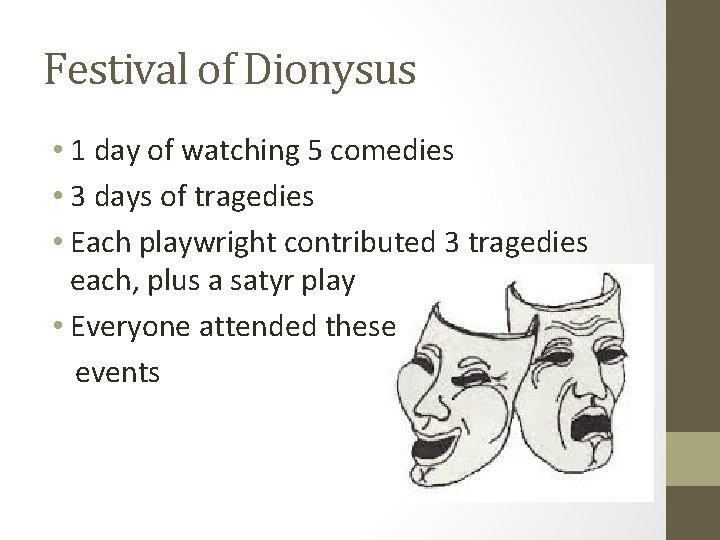
Festival of Dionysus • 1 day of watching 5 comedies • 3 days of tragedies • Each playwright contributed 3 tragedies each, plus a satyr play • Everyone attended these events
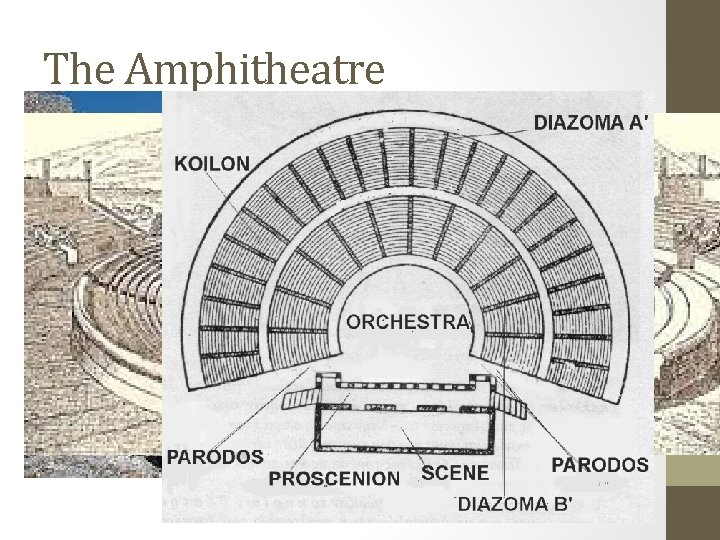
The Amphitheatre
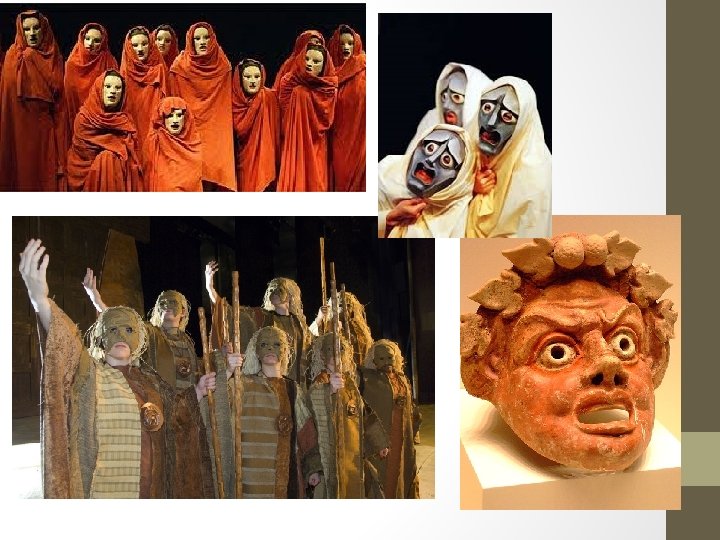
The Chorus • Very important part of Greek Tragedy • Standard was 15 members - all young, male, citizens – There were NO female performers at all in Greek theatre! • All wore identical masks • Sometimes a leader spoke for the chorus, but most of the time they all spoke and moved in unison • The chorus responds, witnesses, compares, draws moral conclusions, make private matters public, and try to make sense of the action of the play
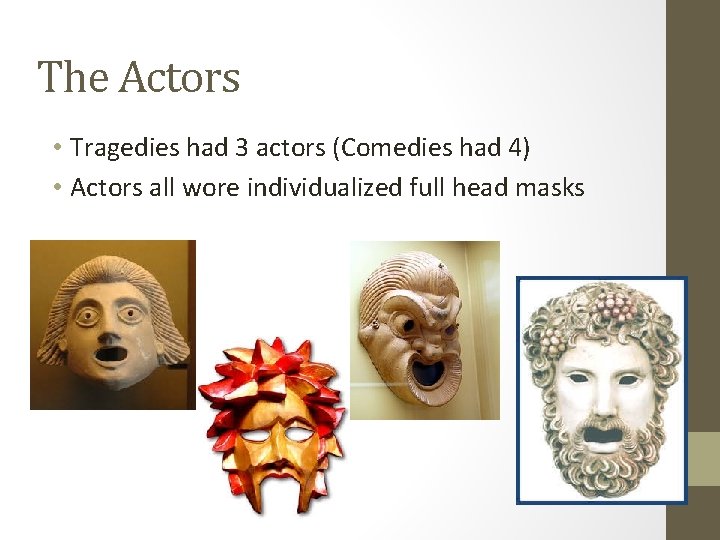
The Actors • Tragedies had 3 actors (Comedies had 4) • Actors all wore individualized full head masks
What’s the point? • Search for a natural order • Human place and purpose in the cosmos • Human relationship with the gods and morality • Featured an individual in a moment of crisis that is caused by HUMAN error • Deal with difficult and dark subjects • Focus on family conflict but have larger, civic implications
Aristotle (384 -322 BCE) and The Poetics (c. 335) • The Three Unities: • Time (24 hours) • Place (1 location) • Action (1 plot) • Catharsis • A purging of emotions Very focused writing • A late point of attack (when the play starts we are in the middle of the plot – a lot of things have already happened and we start just when things get interesting)
Six Elements of Tragedy 1. Plot • Peripeteia – reversal of fortune • Anagnorisis – recognition, moving from ignorance to knowledge • Pathos – destructive or painful acts • The plot must provoke fear or pity
Six Elements of Tragedy 2. Character • Protagonist cannot be purely good or purely bad • Must be somewhere in between • Misfortune comes not from wickedness, but from a mistake or weakness: Hamartia • Should be above the common level (Nobleman, King, Priest, Prince, etc)
Six Elements of Tragedy 3. Thought • Needs to deal with larger issues and ideas 4. Diction/Verbal Expression • Language and poetry should be elevated 5. Songs and 6. Spectacle • These last two are considered the least important for Aristotle – for him it is more important to hear the story than see it
Let’s Create a Modern Tragedy • Now that you know what makes up a tragedy it is your turn! • Remember you will need: - A chorus - A flawed protagonist who is not “common” - To inspire Catharsis - A late point of attack - 1 focused plot that happens in 1 day and in 1 location - Misfortune caused by weakness or mistake - Reversal of Fortune - Moment of recognition - A destructive or painful act
- Slides: 14