
Greek Tragedy Everything you wanted to know about
Greek Tragedy Everything you wanted to know about Greek tragedy but were afraid to ask
What are we going to talk about? l l l l The Origins of Tragedy Which Cities Performed Tragedy When Tragedy was Performed The Parts of a Greek Theaters Themselves The Major Playwrights The Way a Greek Tragedy Was Staged - number of actors - the costumes - the masks - the audience
The Origins of Tragedy from the dithyramb: a choral song in honor of Dionysos l Arion of Methymna (7 th century) was the first to write a choral song, practice it with a chorus, and perform it l Lasus of Hermione was the first to do it at Athens l Connected with the worship of Dionysos in Athens l Originated
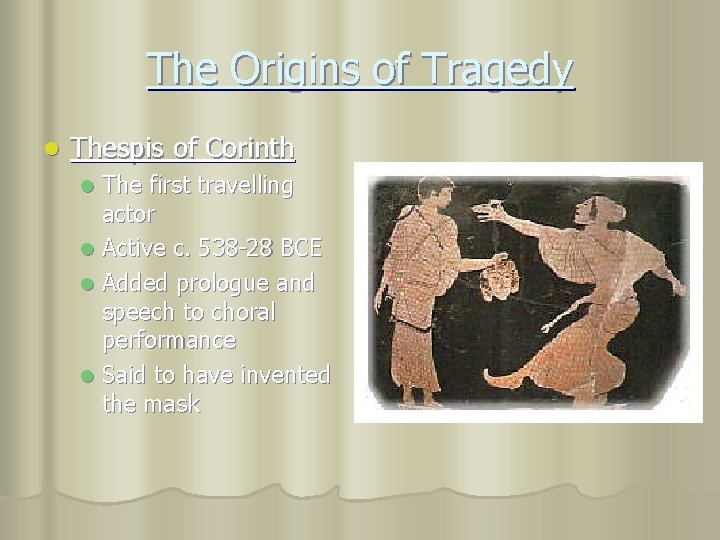
The Origins of Tragedy l Thespis of Corinth The first travelling actor l Active c. 538 -28 BCE l Added prologue and speech to choral performance l Said to have invented the mask l
Who Performed Tragedy? l Corinth: c. 600 (Arion) l Sicyon: c. 550 - Cleisthenes (not the Athenian) - Epigenes l Athens: c. 510 - only Athenian dramas left - “school of Hellas”
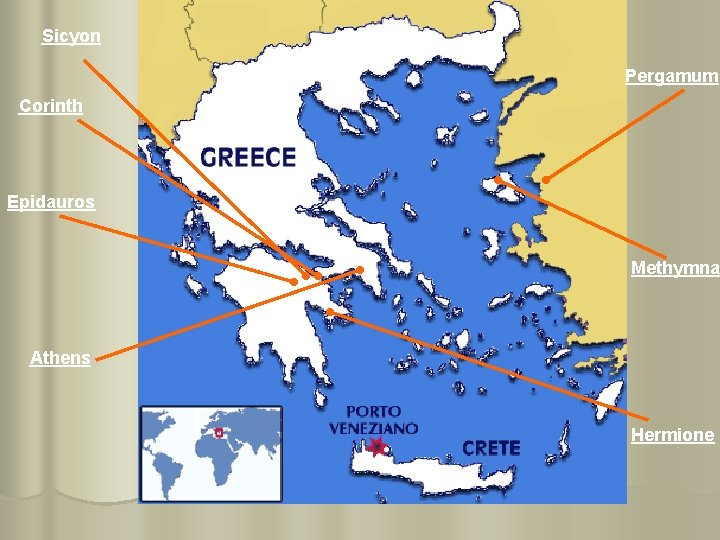
Sicyon Pergamum Corinth Epidauros Methymna Athens Hermione
When Was Tragedy Performed? City Dionysia @ Athens - aka “Greater Dionysia” - end of March l Rural Dionysia - different demes had performances - “off-Broadway” - various dates in December l The Lenaea - less prestigious - sometime in late January/early February l
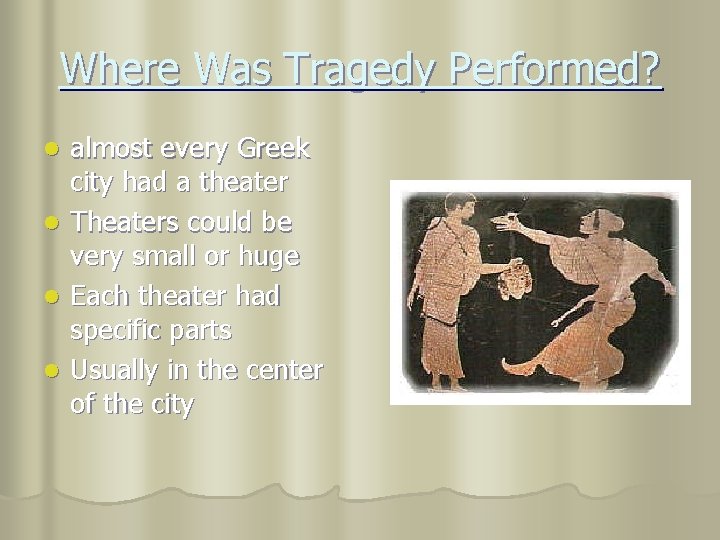
Where Was Tragedy Performed? l l almost every Greek city had a theater Theaters could be very small or huge Each theater had specific parts Usually in the center of the city
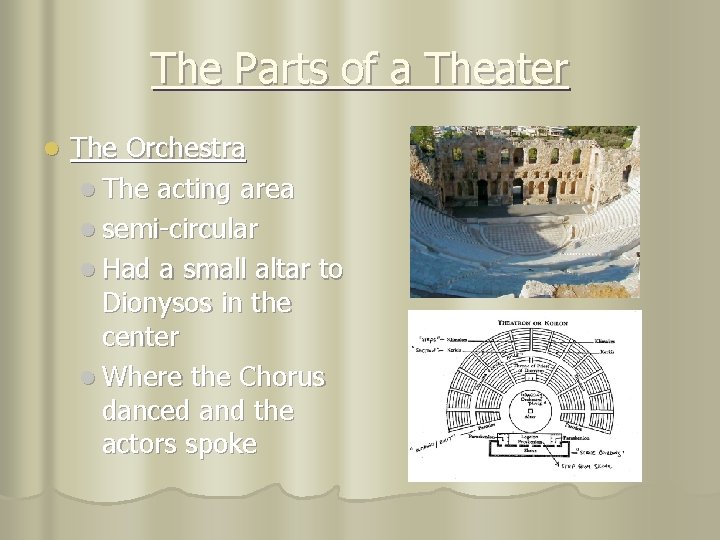
The Parts of a Theater l The Orchestra l The acting area l semi-circular l Had a small altar to Dionysos in the center l Where the Chorus danced and the actors spoke
The Parts of a Theater l The Skene l The large backdrop l Could be decorated with scenery l Where the action actually took place (hidden) l Roof was accessible l Originally one door in the center, but eventually had three doors
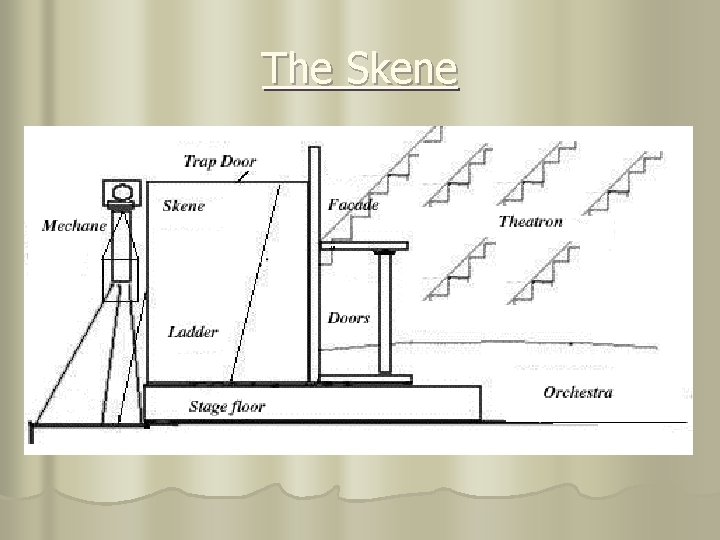
The Skene
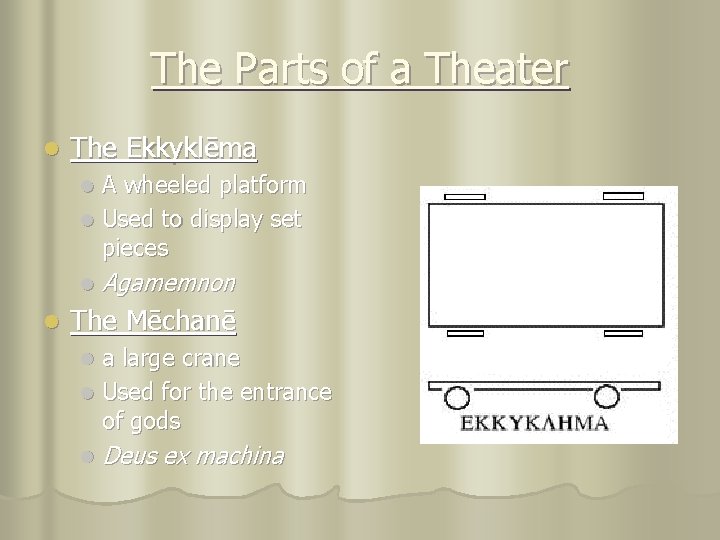
The Parts of a Theater l The Ekkyklēma A wheeled platform l Used to display set pieces l l l Agamemnon The Mēchanē a large crane l Used for the entrance of gods l l Deus ex machina
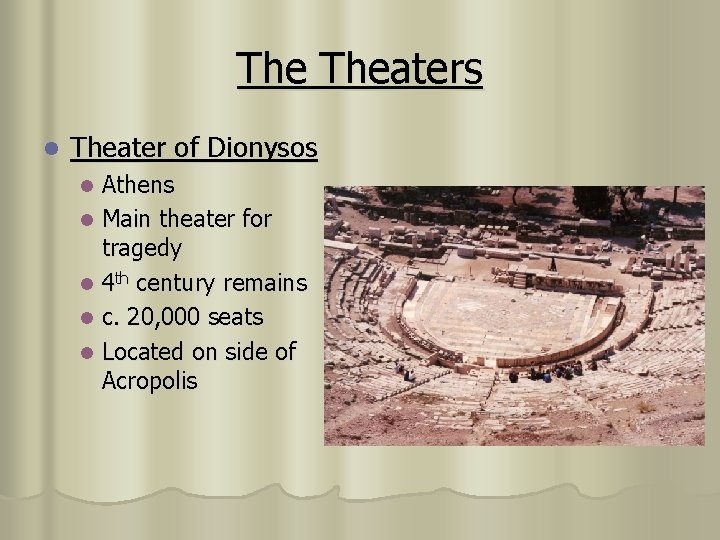
The Theaters l Theater of Dionysos Athens l Main theater for tragedy l 4 th century remains l c. 20, 000 seats l Located on side of Acropolis l
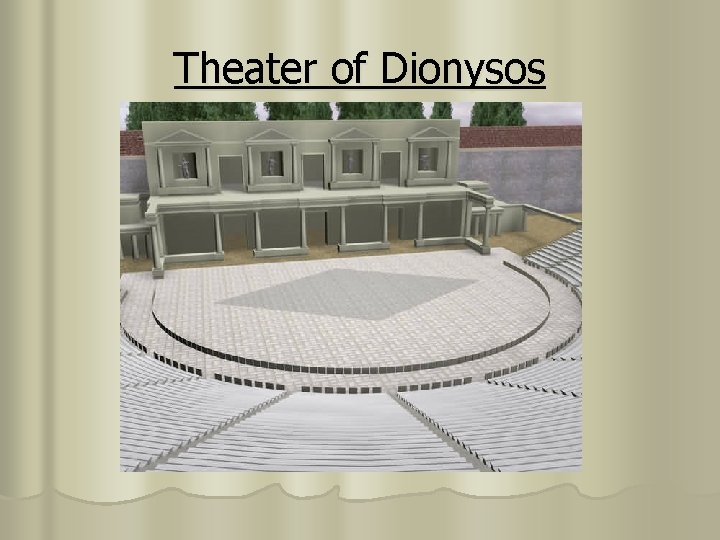
Theater of Dionysos
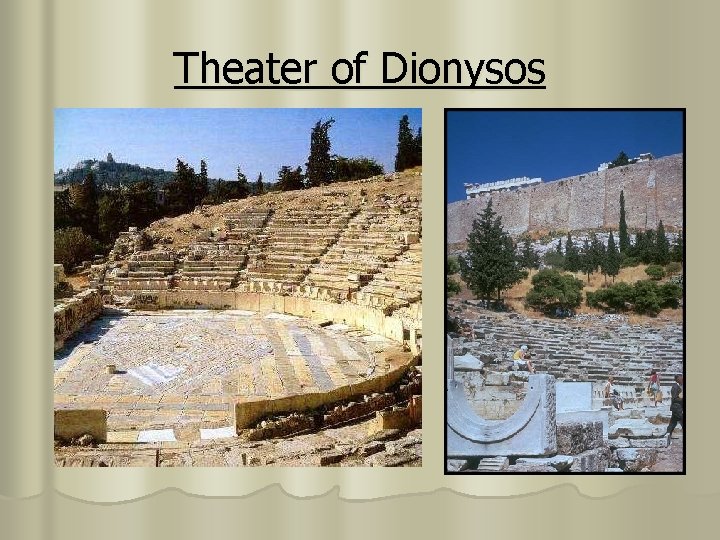
Theater of Dionysos
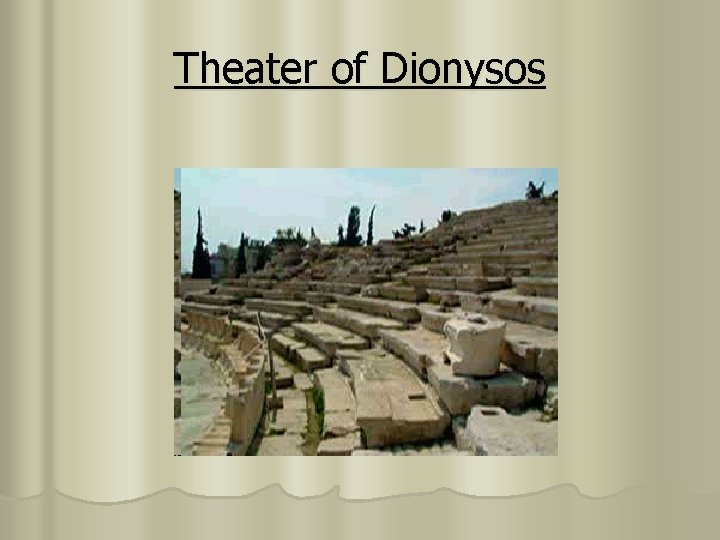
Theater of Dionysos
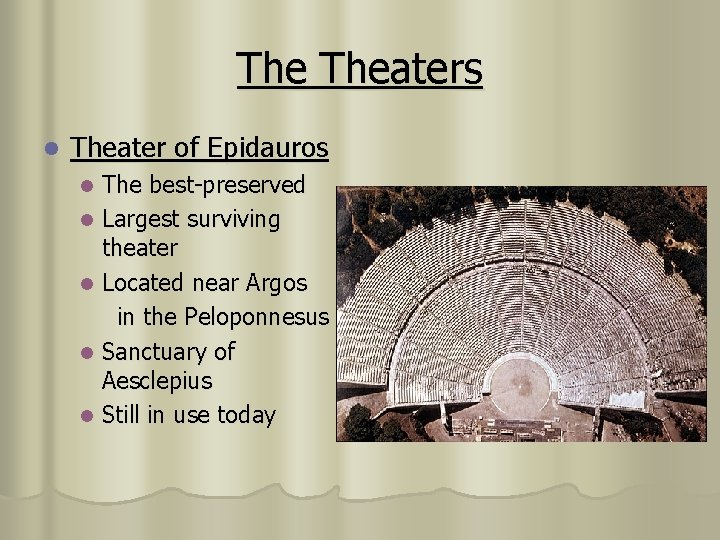
The Theaters l Theater of Epidauros The best-preserved l Largest surviving theater l Located near Argos in the Peloponnesus l Sanctuary of Aesclepius l Still in use today l
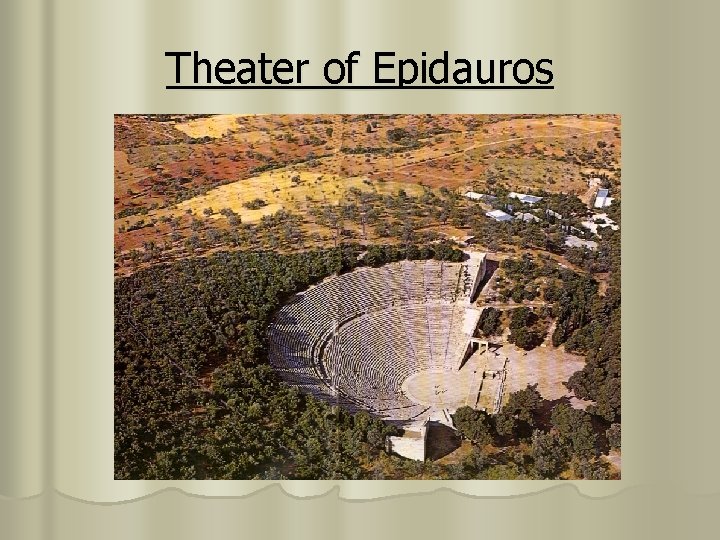
Theater of Epidauros
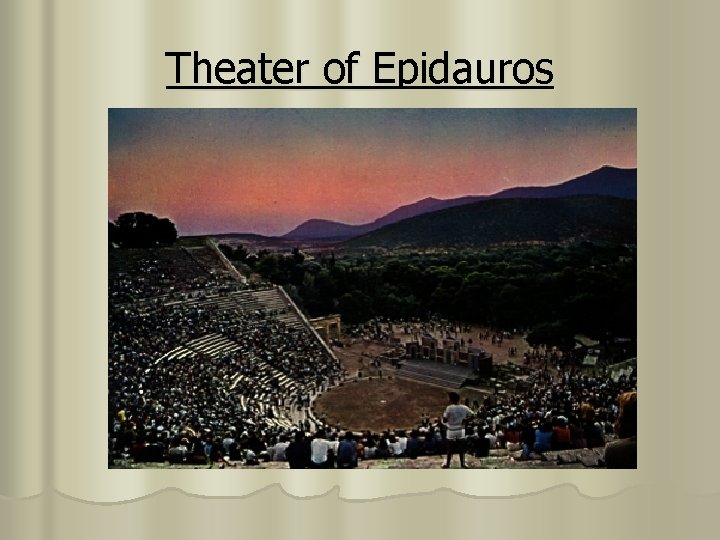
Theater of Epidauros
Theater of Epidauros
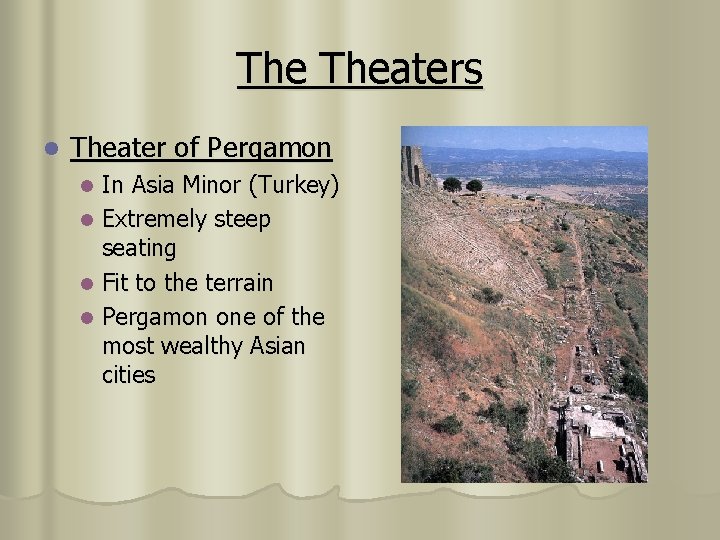
The Theaters l Theater of Pergamon In Asia Minor (Turkey) l Extremely steep seating l Fit to the terrain l Pergamon one of the most wealthy Asian cities l
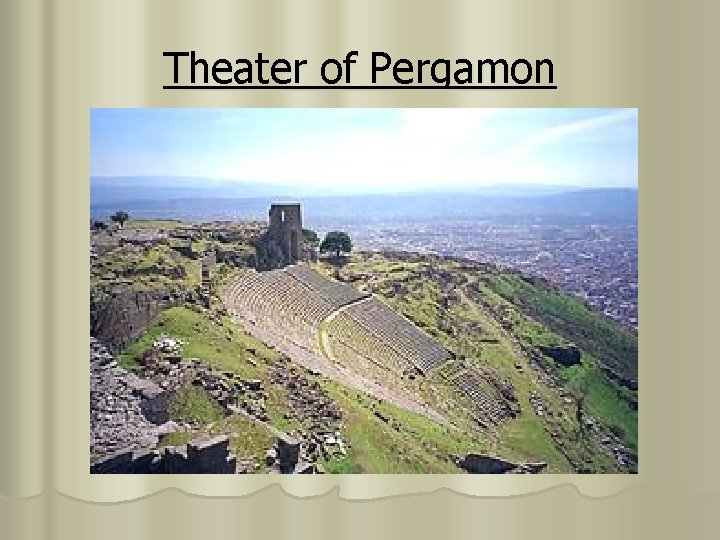
Theater of Pergamon
The Playwrights l Three major tragedians l Aeschylus l Sophocles l Euripides l All active in the 5 th century l All won first place in multiple competitions l Only Athenian plays survive
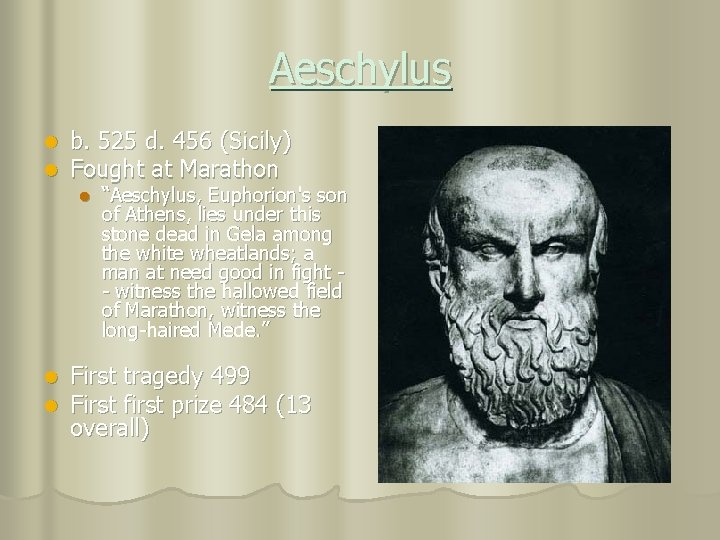
Aeschylus l l b. 525 d. 456 (Sicily) Fought at Marathon l l l “Aeschylus, Euphorion's son of Athens, lies under this stone dead in Gela among the white wheatlands; a man at need good in fight - witness the hallowed field of Marathon, witness the long-haired Mede. ” First tragedy 499 First first prize 484 (13 overall)
Aeschylus Introduced the second actor l Wrote over 70 plays (seven survive) l Always revered l Main interest is in situation and event rather than character l l Oresteia, Seven Against Thebes Pericles directed the chorus for Persians l Both sons were very successful playwrights l
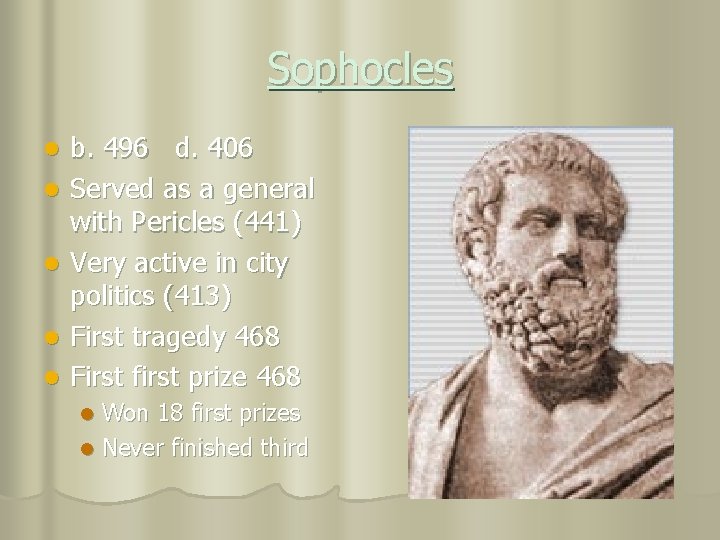
Sophocles l l l b. 496 d. 406 Served as a general with Pericles (441) Very active in city politics (413) First tragedy 468 First first prize 468 Won 18 first prizes l Never finished third l
Sophocles l Introduced the third actor l Wrote over 120 plays (seven survive) l The most successful of the Big Three l Challenged conventional mores l Introduced more dialogue between characters (less Chorus) l Oedipus Tyrannus, Oedipus at Colonus, Antigone, Electra
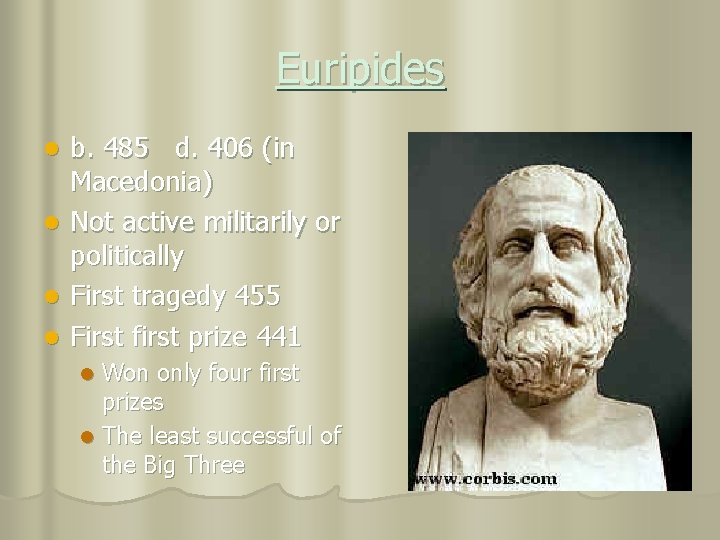
Euripides l l b. 485 d. 406 (in Macedonia) Not active militarily or politically First tragedy 455 First first prize 441 Won only four first prizes l The least successful of the Big Three l
Euripides l No innovations on the stage l Wrote ninety plays (19 survive) l Sophocles: “I present men as they ought to be, Euripides presents men as they are. ” l More realistic than the other two l Alcestis, Orestes Medea, Hippolytus, Bacchae,
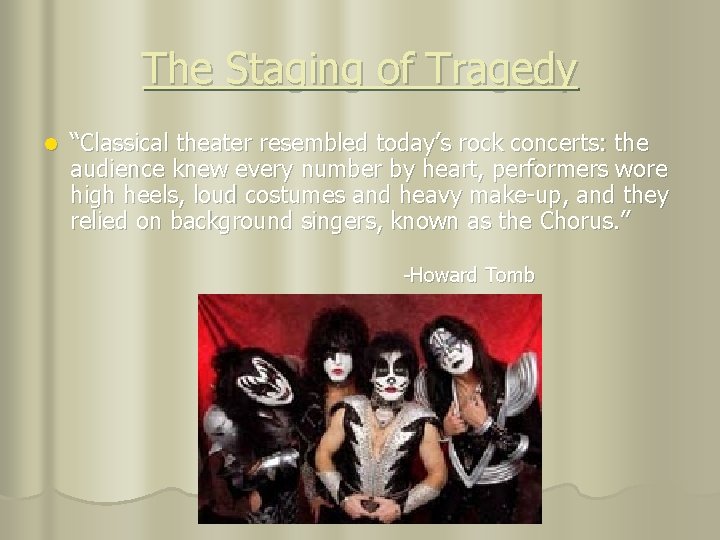
The Staging of Tragedy l “Classical theater resembled today’s rock concerts: the audience knew every number by heart, performers wore high heels, loud costumes and heavy make-up, and they relied on background singers, known as the Chorus. ” -Howard Tomb
The Staging of Tragedy l “The audience knew every number by heart…” l Most tragedies dealt with mythological themes l “Performers wore high heels, loud costumes and heavy make-up…” l They wore elaborate clothes, tall boots, and masks l “They relied on background singers, known as the Chorus. ” l Especially after the introduction of the third actor
The Staging of Tragedy - Actors l Maximum of three actors l Aeschylus second l Sophocles third l All roles played by men l Same group of actors for each set of plays for each author
The Staging of Tragedy - Actors l Playwrights did not act in their own plays after Sophocles l Chorus publicly funded l. A choregos would pay for and train the chorus l Viewed as a civic duty l Could be prosecuted for failing to do it wealthy enough l Choregos got a monument if his chorus won
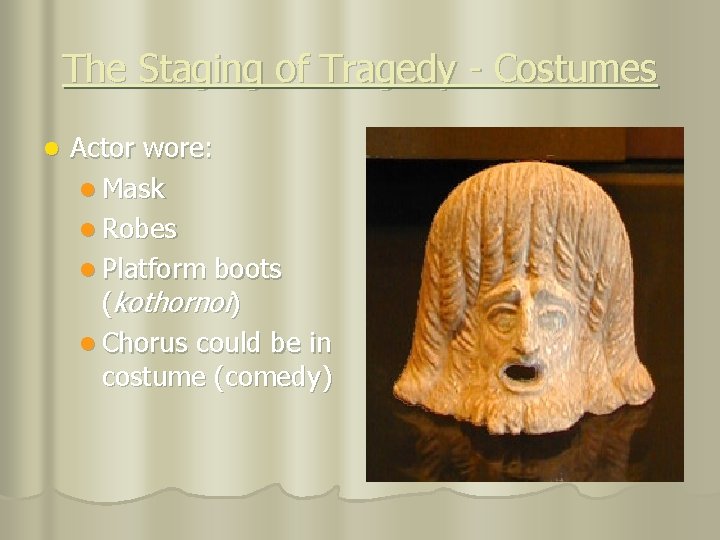
The Staging of Tragedy - Costumes l Actor wore: l Mask l Robes l Platform boots (kothornoi) l Chorus could be in costume (comedy)
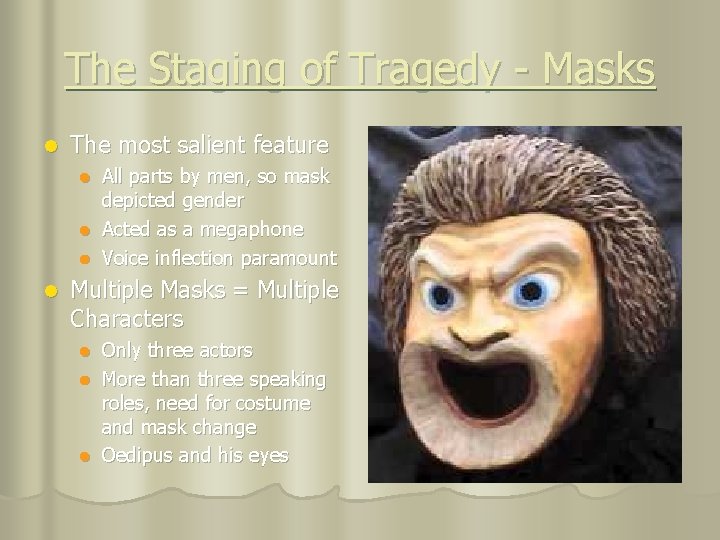
The Staging of Tragedy - Masks l The most salient feature All parts by men, so mask depicted gender l Acted as a megaphone l Voice inflection paramount l l Multiple Masks = Multiple Characters Only three actors l More than three speaking roles, need for costume and mask change l Oedipus and his eyes l
The Audience l Any male could attend l Women most likely able to attend l Aeschylus’ Furies l State funded attendance l Cost was the average daily wage of a laborer l Theoric Fund Never suspended, even when Athens in dire straights l Supplied public tickets l l “Must-see TV”
The Audience l Catharsis l “learning through suffering” l Moderation is to be sought in all things, even good things l The mighty fall so far that we admire them for being so high l A spiritual cleansing of the audience l Performances emotional
- Slides: 37