
Greek Science PLATO ARISTOTLE OBJECTIVES Know and understand
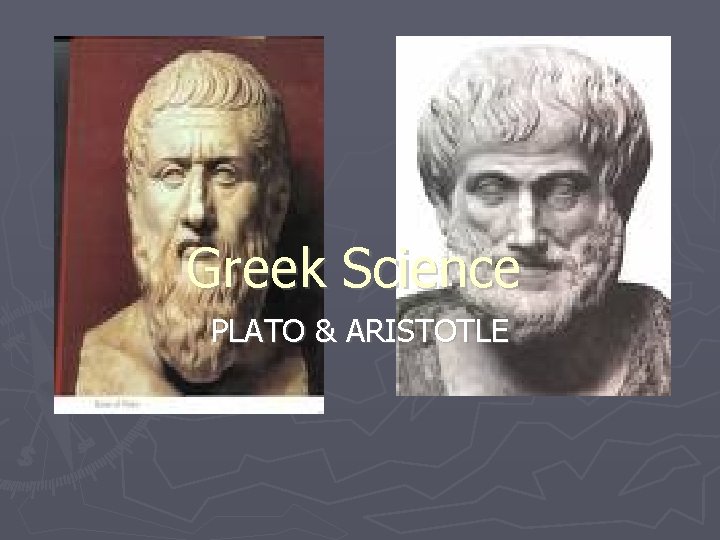
Greek Science PLATO & ARISTOTLE
OBJECTIVES ► Know and understand the basics of Plato's philosophy. ► Know and understand the basics of Aristotle's philosophy. ► Know the importance and influence of Plato and Aristotle's philosophy in the field of science and human thinking in general. ► Know the significance of Plato and Aristotle's philosophy in your daily life.
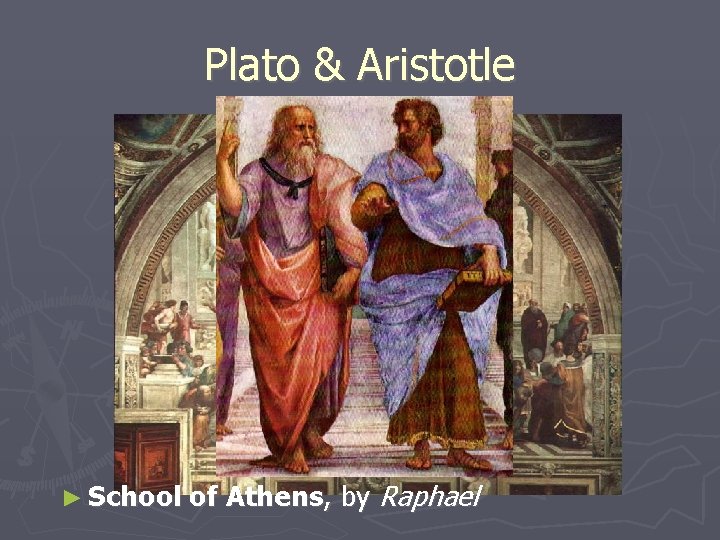
Plato & Aristotle ► School of Athens, by Raphael
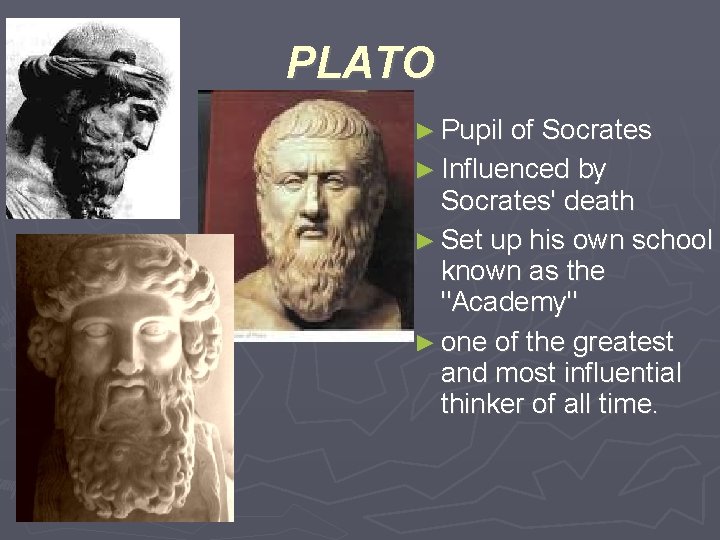
PLATO ► Pupil of Socrates ► Influenced by Socrates' death ► Set up his own school known as the "Academy" ► one of the greatest and most influential thinker of all time.
BACKGROUND OF HIS THOUGHT 1. From Natural Philosophy to Philosophy of Man and Society Natural Philosophy - Thales, Anaximenes, Anaximander, Parmenides, Heraclitus, Democritus - Main Question: "What is the underlying stuff of nature? " Philosophy of Man and Society - Sophists and Socrates - Main Questions: "Who are we? What is virtue? What is Justice? "
BACKGROUND OF HIS THOUGHT 2. Both Trends are concerned with the existence of the "eternal and immutable. " Natural Philosophy - "ONE in the many" Philosophy of Man and Society - "NORMS of the society" 3. Concern of Plato: He was also concerned with the relationship between what is "eternal and immutable", on the one hand, and what "flows", on the other. -Same as the Natural Philosophers and Humanists. -But he answered it differently.
HOW PLATO CAME UP WITH HIS IDEA ► "Although everything in the natural world "flows", there must nevertheless be "something" that never changes. " ► Now the question is, "where can we find that nonchanging 'something'? "
HOW PLATO CAME UP WITH HIS IDEA ► World of Things (Nature) Perceptible Perishable within time and space it flows
HOW PLATO CAME UP WITH HIS IDEA ► "where can we find that non-changing 'something'? " ► Obviously, "It must be beyond the realm of things. " ► -It must be perceived only by reason ► -immaterial and non-perishable ► -outside time and space ► -eternal and immutable ► For Plato, it is found in the realm of Ideas
PLATO'S DOCTRINE OF IDEAS ► For Plato all Material things are fashioned after their timeless "ideas or forms. " Despite their differences, why are toy horses all the same? Why is a toy horse? what is there in all toy horses that makes them all toy horses?
PLATO'S DOCTRINE OF IDEAS ► If you are to make toy horses: you use models of horses you have in your mind the "forms" of horses. ► this form or idea of a toy horse allows you to make several toy horses. ► despite their differences, all toy horses are toy horses. ► Therefore, what makes a toy horse is the idea of a toy horse.
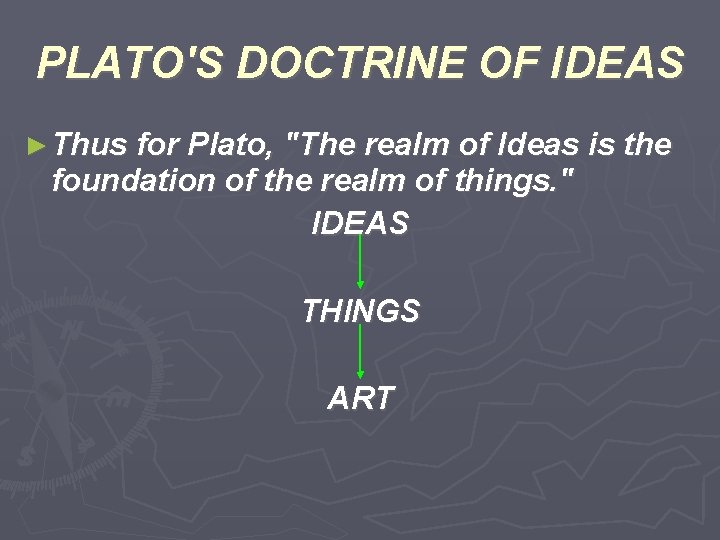
PLATO'S DOCTRINE OF IDEAS ► Thus for Plato, "The realm of Ideas is the foundation of the realm of things. " IDEAS THINGS ART
TRUE KNOWLEDGE ► what is known in the realm of things are mere "opinions" - we only use sense perception -ex. who is the most beautiful actress? ► what is known in the realm of ideas are "true knowledge" - we use reason -ex. mathematics, geometry, philosophical ideas ► "We can only have 'inexact conception' of things we perceive with our senses. But we can have 'true knowledge' of things we understand with our reason. "
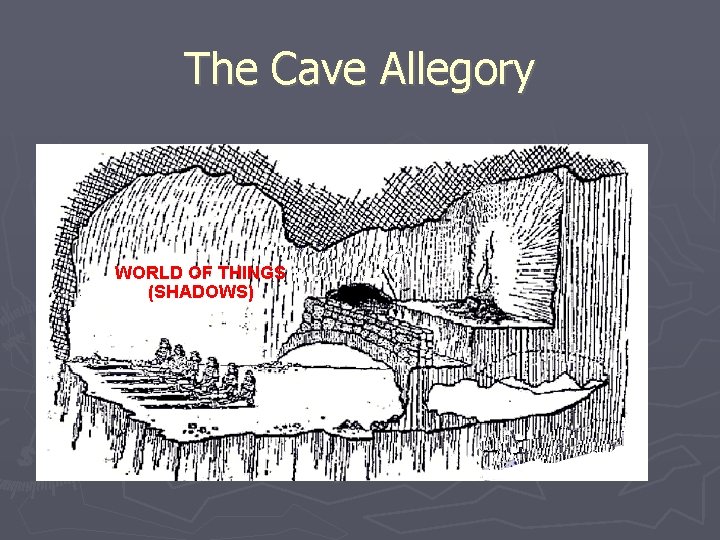
The Cave Allegory WORLD OF THINGS (SHADOWS)
The Cave Allegory ► things are but shadows of ideas or eternal forms ► we need to go beyond the shadows and dwell on the realm of ideas. ► ideas let us understand the natural world
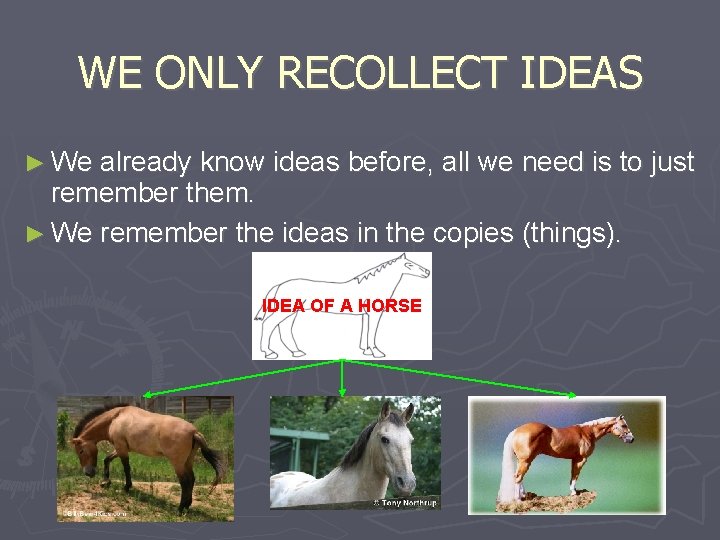
WE ONLY RECOLLECT IDEAS ► We already know ideas before, all we need is to just remember them. ► We remember the ideas in the copies (things). IDEA OF A HORSE
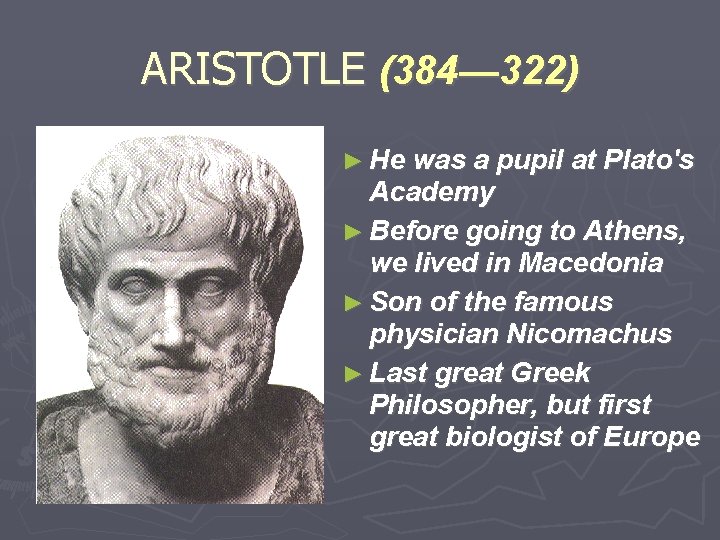
ARISTOTLE (384— 322) ► He was a pupil at Plato's Academy ► Before going to Athens, we lived in Macedonia ► Son of the famous physician Nicomachus ► Last great Greek Philosopher, but first great biologist of Europe
ARISTOTLE (384— 322) ► Unlike Plato, he was preoccupied with natural processes (world of things) and not with the world of ideas. ► He was "the great organizer. " ► He tutored (342—c. 339 ) Alexander the Great ► In 335 he opened a school in the Lyceum; some distinguished members of the Academy followed him.
NATURE IS THE REAL WORLD. . . ► The "idea" of something is simply a concept that we humans formed after seeing a certain number of that thing. ► “Ideas” are just the "common characteristics" of things belonging into a certain group. ► “Ideas” are just reflections of natural objects.
NATURE IS THE REAL WORLD. . . ► For Aristotle, "Nothing exists in the mind that has not first been experienced by the senses. " ► Simply, "There is no such thing as a separate world of ideas. "
CAUSALITY IN NATURE ► Modern/popular notion of cause: how something came to be ► example: RAIN - the moisture in the clouds cools and condenses into raindrops that are drawn to the earth by the force of gravity. ► For Aristotle, this is incomplete.
CAUSALITY IN NATURE ► THERE ALWAYS 4 CAUSES OF A THING: 1. Material Cause - material component 2. Efficient Cause - that which makes the thing (external agent) 3. Formal Cause - that which makes a thing what it is 4. Final cause - purpose for which the thing is made.
CAUSALITY IN NATURE ► Example: RAIN 1. Material Cause - moisture 2. Efficient Cause - cooling air 3. Formal Cause - form or nature of water - to fall to the earth 4. Final Cause - its purpose is to nourish the earth and its dwellers. * ► In modern thought the efficient cause is generally considered the central explanation of a thing, but for Aristotle the final cause had primacy.
EVERYTHING CAN BE CATEGORIZED ► Every object falls under a broader category and a certain subcategory ► This also applies in the sciences ► Science is divided into different branches and that such branches are parts of one coherent whole. ►Physics ►Biology ►Psychology ►Logic ►Ethics ►Politics ►Metaphysics
LOGIC ► One of Aristotle's major contribution to human knowledge ► Found in his Organon ► Logic is an instrument used for organizing our thoughts ► based on correlation of terms
LOGIC ► ex. (Syllogism) All creatures are mortals Gloria is a creature Gloria is a mortal ► Clear thinking that leads to a definitely true conclusion.
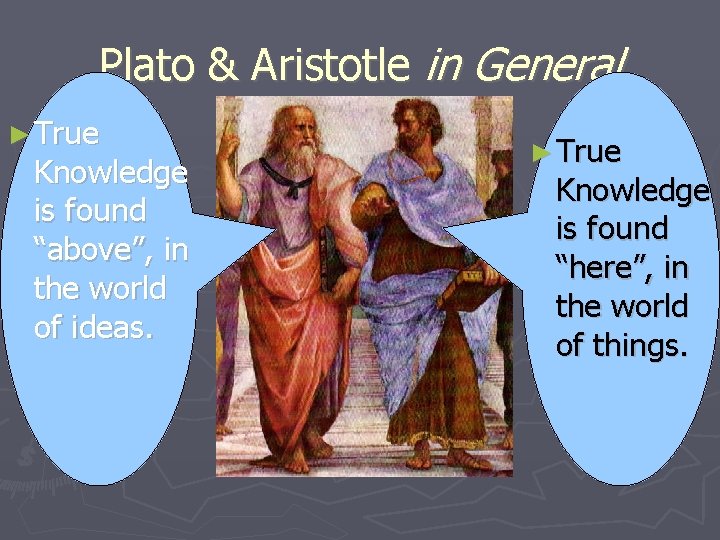
Plato & Aristotle in General ► True Knowledge is found “above”, in the world of ideas. ► True Knowledge is found “here”, in the world of things.
Questions to Ponder ► What are the contributions of the two great philosophers to science? ► How can we use their philosophies in our practical daily living?
- Slides: 28