
Greek Mythology 11 th Lesson 2 January 2020
- Slides: 13
Greek Mythology 11 th Lesson 2 January 2020
Learning Purposes Ø To revise the first lesson Ø To develop our knowledge of Dedalus, Theseus and the Minotaur Recap ØQuiz to follow Future Lessons ØEnhancing understanding of mythology. ØEnhancing reading and writing skills.
Recap – answer in full sentences Who was Prometheus? What did Prometheus do to incur the wrath of the gods? What is the name for this ‘weakness’? What was Prometheus’ punishment? Who was Pandora? Why did Zeus send her to mankind? What did Zeus send with her and what instructions had been given to her? • What was her ‘weakness’? • What is the Pandora myth used to explain? • •
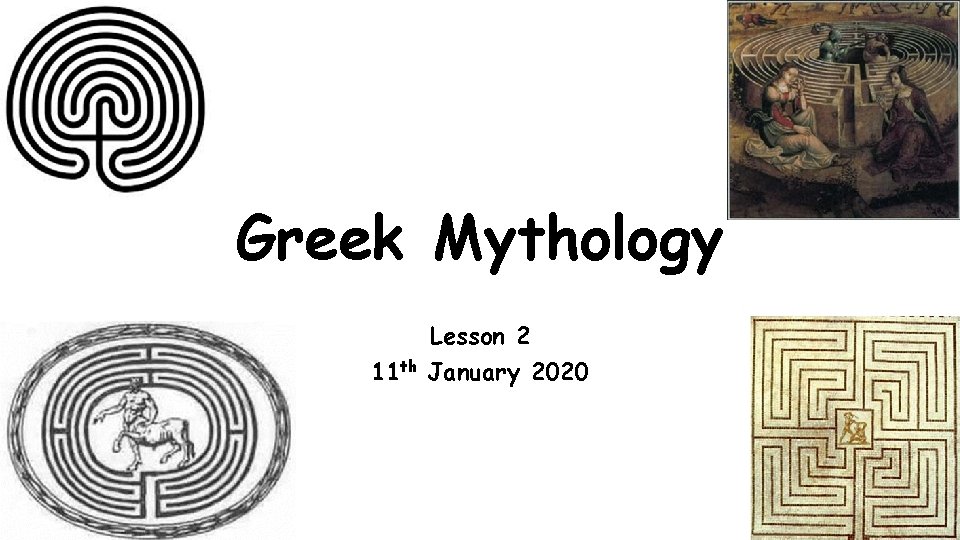
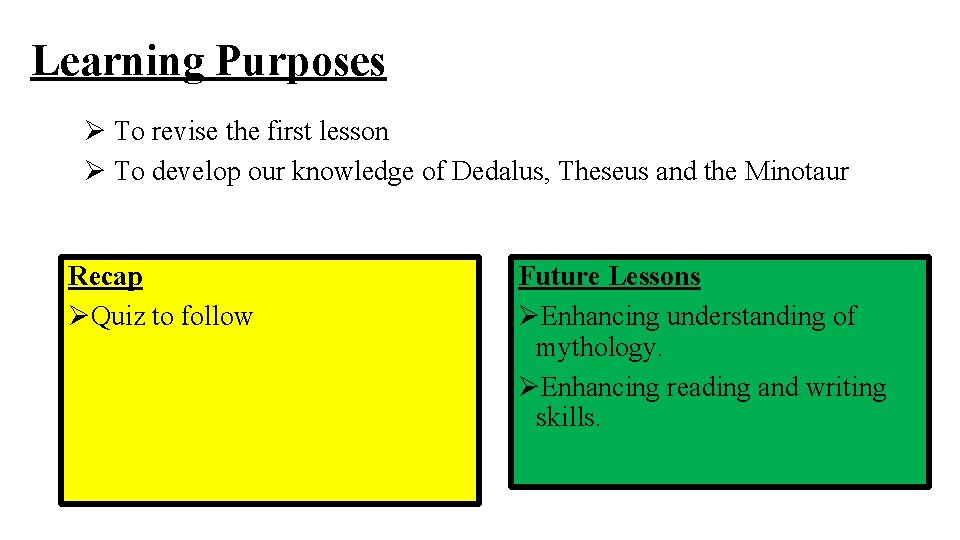
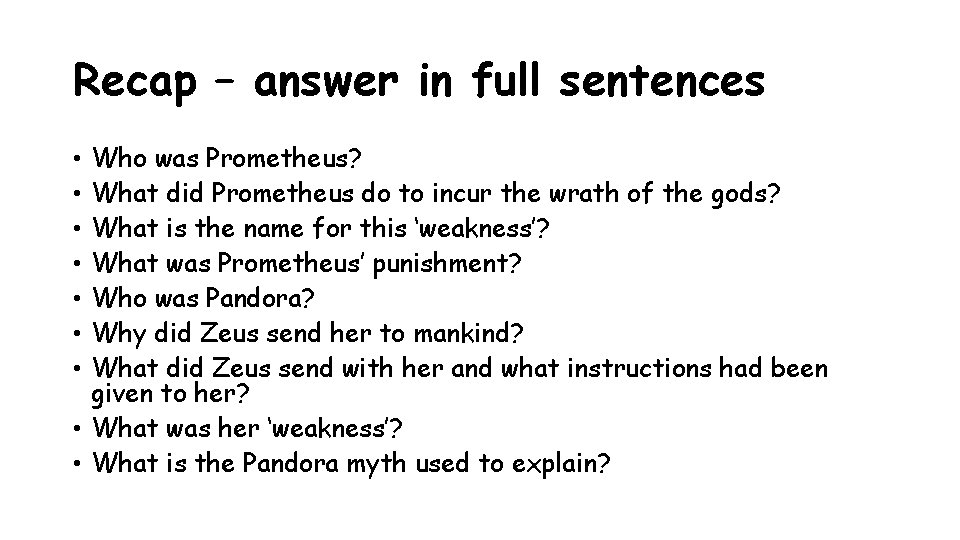
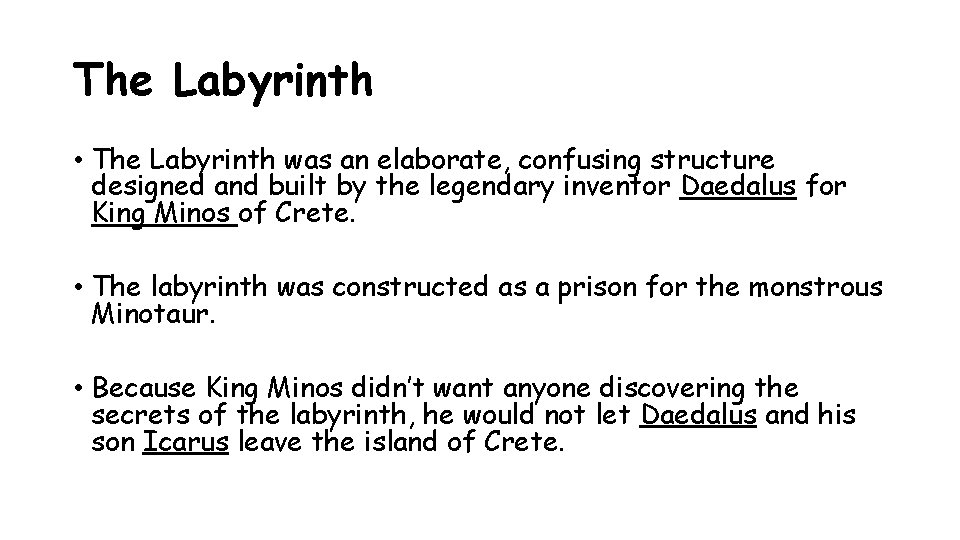
The Labyrinth • The Labyrinth was an elaborate, confusing structure designed and built by the legendary inventor Daedalus for King Minos of Crete. • The labyrinth was constructed as a prison for the monstrous Minotaur. • Because King Minos didn’t want anyone discovering the secrets of the labyrinth, he would not let Daedalus and his son Icarus leave the island of Crete.
Ovid’s Metamorphoses • The Metamorphoses is a Latin narrative poem, written in by the Roman poet Ovid, considered to be one of the most influential works of Western Literature. • It is made up of fifteen books and over 250 myths. • The poem chronicles the history of the world from its creation to the height of the Roman Empire. • On the next slide is an extract from the poem in the original Latin.
Daedalus interea Creten longumque perosus exilium tactusque loci natalis amore clausus erat pelago. 'terras licet' inquit 'et undas obstruat: et caelum certe patet; ibimus illac: omnia possideat, non possidet aera Minos. ‘ Can you work out what any of the Latin words mean in English?
But Daedalus abhorred the Isle of Crete-- and his long exile on that sea-girt shore, increased the love of his own native place. "Though Minos blocks escape by sea and land, “ he said, “the unconfined skies remain though Minos may be lord of all the world his sceptre is not regnant of the air, and by that untried way is our escape. " This is a translation of the Latin into English
Read the translated extract from Ovid’s Metamorphoses • Identify the vocabulary used to emphasise Daedalus’ skills as an inventor. Explore the connotations of this language. • Identify the vocabulary used to foreshadows Icarus’ fate. Explore the connotations of this language. Create a table in your books to record this information • What are the metaphorical implications of this story; what does it suggest to a modern audience?
Write down your answers 1. Who has more hubris, Daedalus or Icarus? Have you ever gotten yourself in trouble for reaching beyond your limits? 2. For trying to be like the gods, Daedalus lost his son. Was this a fair punishment? Do you think Daedalus would have learned his lesson with a lesser punishment? 3. Is humility (being humble) a "good" characteristic? Does it keep us safe, or does it hold us back from accomplishing great things? 4. Are the benefits of new technology worth the risk of its possible unforeseen consequences? Ultimately, would humans be better off without technology? 5. Can you think of other instances in the real world when a technology has been used for both good and evil?
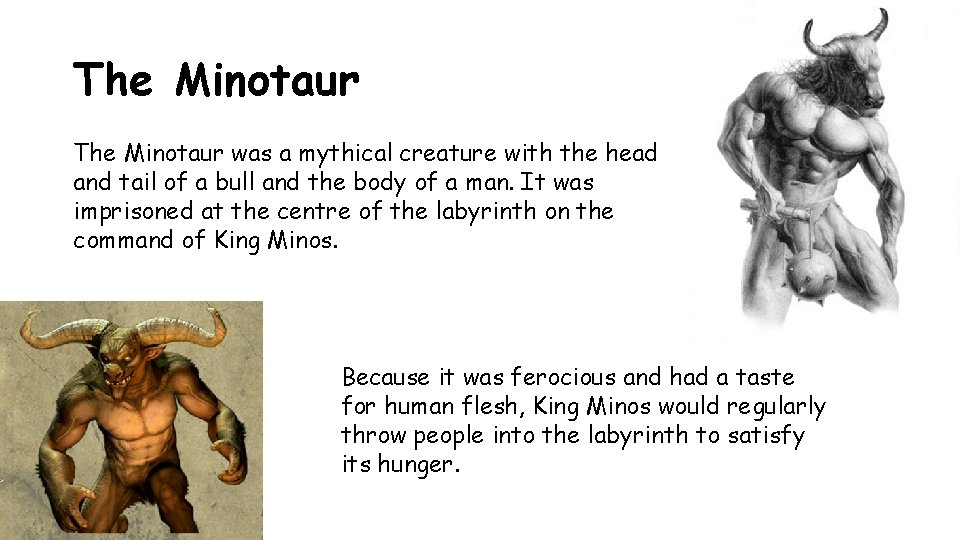
The Minotaur was a mythical creature with the head and tail of a bull and the body of a man. It was imprisoned at the centre of the labyrinth on the command of King Minos. Because it was ferocious and had a taste for human flesh, King Minos would regularly throw people into the labyrinth to satisfy its hunger.
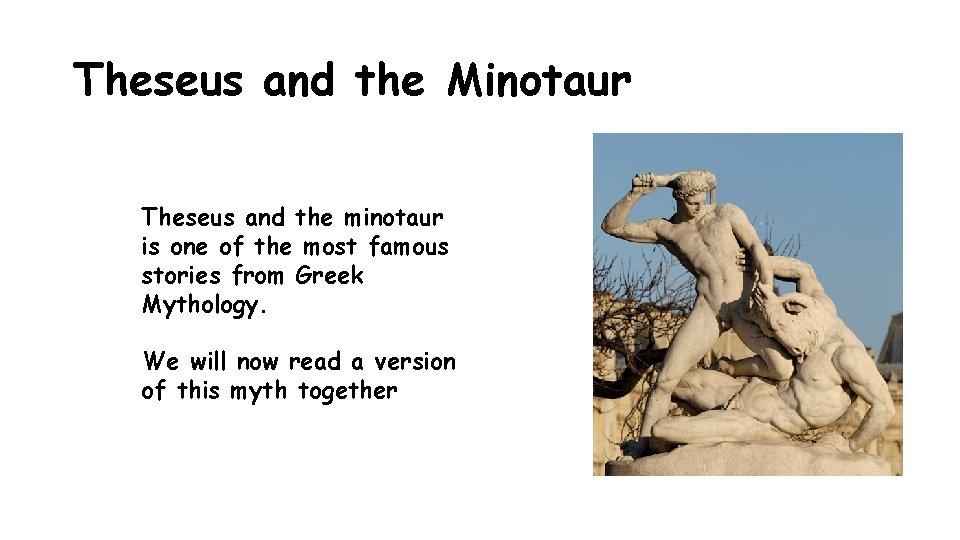
Theseus and the Minotaur Theseus and the minotaur is one of the most famous stories from Greek Mythology. We will now read a version of this myth together
Theseus How is Theseus characterised in the story? 1. Draw a picture of the legendary hero 2. Identify quotations from the text and write these around your picture. 3. Write down some notes next to the quotations showing what you can infer about his character Ext – do the same for the character of King Minos
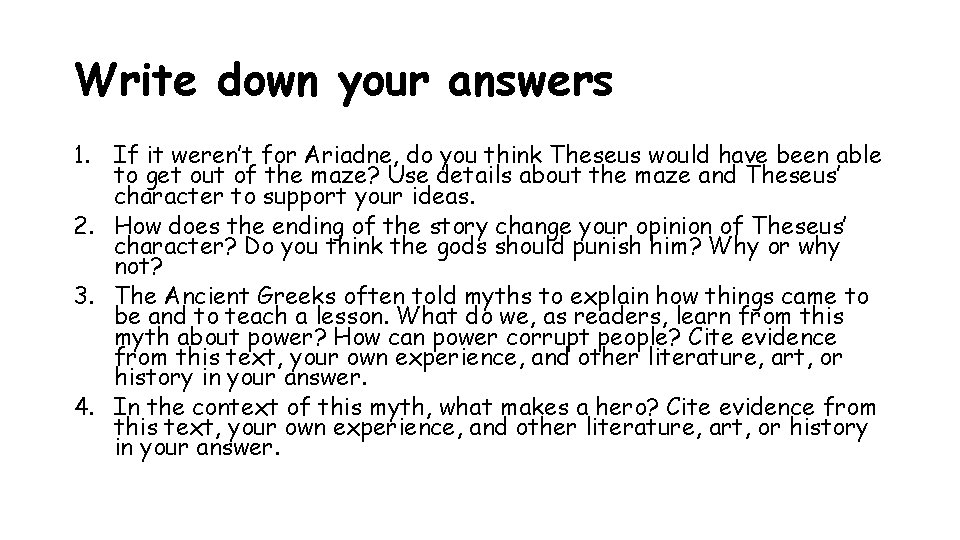
Write down your answers 1. If it weren’t for Ariadne, do you think Theseus would have been able to get out of the maze? Use details about the maze and Theseus’ character to support your ideas. 2. How does the ending of the story change your opinion of Theseus’ character? Do you think the gods should punish him? Why or why not? 3. The Ancient Greeks often told myths to explain how things came to be and to teach a lesson. What do we, as readers, learn from this myth about power? How can power corrupt people? Cite evidence from this text, your own experience, and other literature, art, or history in your answer. 4. In the context of this myth, what makes a hero? Cite evidence from this text, your own experience, and other literature, art, or history in your answer.