
Greek Model To understand the very large we
- Slides: 41
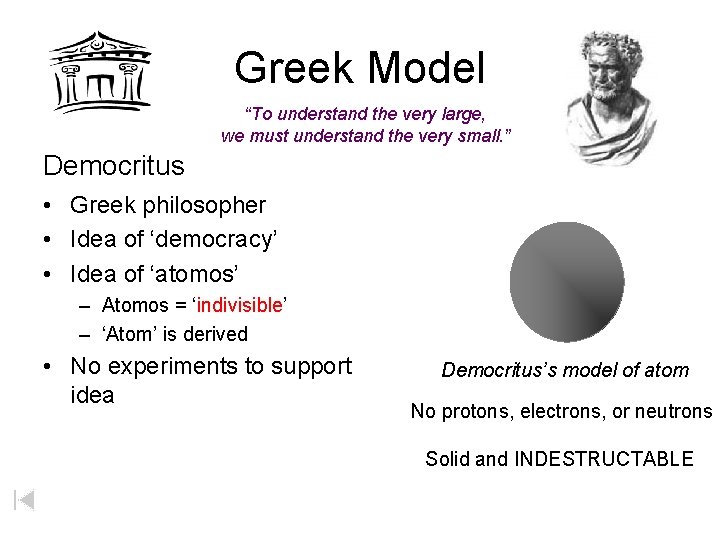
Greek Model “To understand the very large, we must understand the very small. ” Democritus • Greek philosopher • Idea of ‘democracy’ • Idea of ‘atomos’ – Atomos = ‘indivisible’ – ‘Atom’ is derived • No experiments to support idea Democritus’s model of atom No protons, electrons, or neutrons Solid and INDESTRUCTABLE
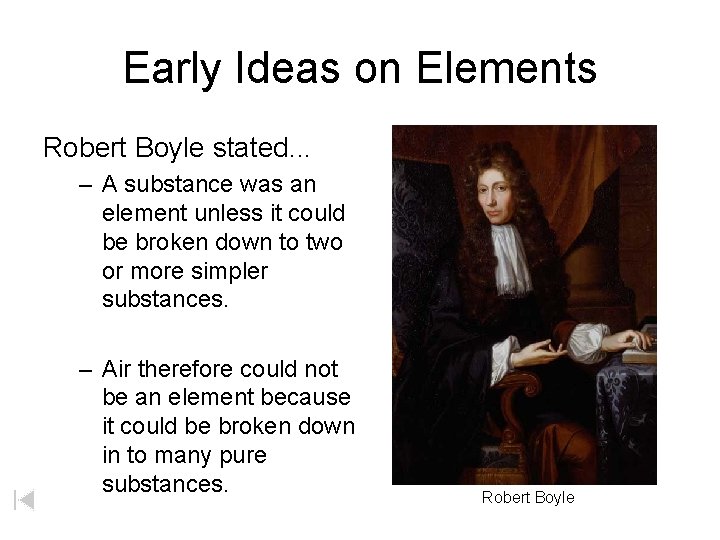
Early Ideas on Elements Robert Boyle stated. . . – A substance was an element unless it could be broken down to two or more simpler substances. – Air therefore could not be an element because it could be broken down in to many pure substances. Robert Boyle
Foundations of Atomic Theory Law of Conservation of Mass is neither destroyed nor created during ordinary chemical reactions. Law of Definite Proportions The fact that a chemical compound contains the same elements in exactly the same proportions by mass regardless of the size of the sample or source of the compound. Law of Multiple Proportions If two or more different compounds are composed of the same two elements, then the ratio of the masses of the second element combined with a certain mass of the first elements is always a ratio of small whole numbers.
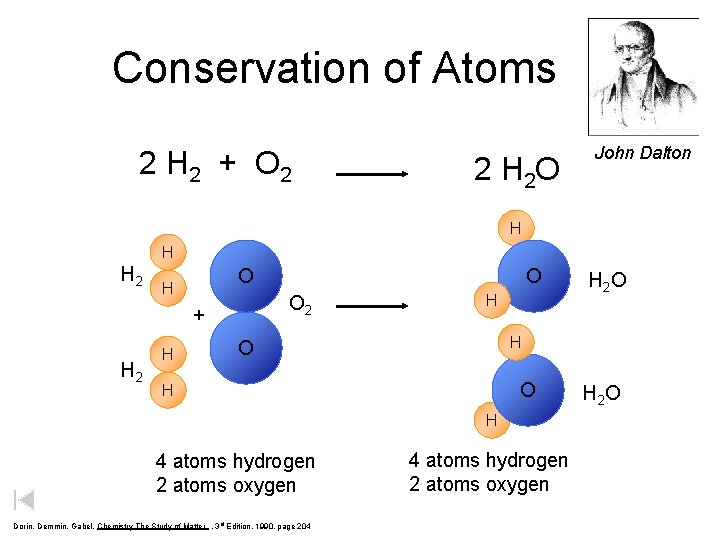
Conservation of Atoms 2 H 2 + O 2 2 H 2 O John Dalton H H H 2 O H O 2 + H 2 H O H 2 O H H 4 atoms hydrogen 2 atoms oxygen Dorin, Demmin, Gabel, Chemistry The Study of Matter , 3 rd Edition, 1990, page 204 4 atoms hydrogen 2 atoms oxygen
Law of Definite Proportions Joseph Louis Proust (1754 – 1826) • Each compound has a specific ratio of elements • It is a ratio by mass • Water is always 8 grams of oxygen for every one gram of hydrogen
The Law of Multiple Proportions • Dalton could not use his theory to determine the elemental compositions of chemical compounds because he had no reliable scale of atomic masses. • Dalton’s data led to a general statement known as the law of multiple proportions. • Law states that when two elements form a series of compounds, the ratios of the masses of the second element that are present per gram of the first element can almost always be expressed as the ratios of integers. Copyright © 2007 Pearson Benjamin Cummings. All rights reserved.
Law of Multiple Proportions John Dalton (1766 – 1844) If two elements form more than one compound, the ratio of the second element that combines with 1 gram of the first element in each is a simple whole number. e. g. H 2 O & H 2 O 2 water hydrogen peroxide Ratio of oxygen is 1: 2 (an exact ratio)
What? • Water is 8 grams of oxygen per gram of hydrogen. • Hydrogen peroxide is 16 grams of oxygen per gram of hydrogen. • 16 g to 8 g is a 2: 1 ratio • True, because you have to add a whole atom, you can’t add a piece of an atom.
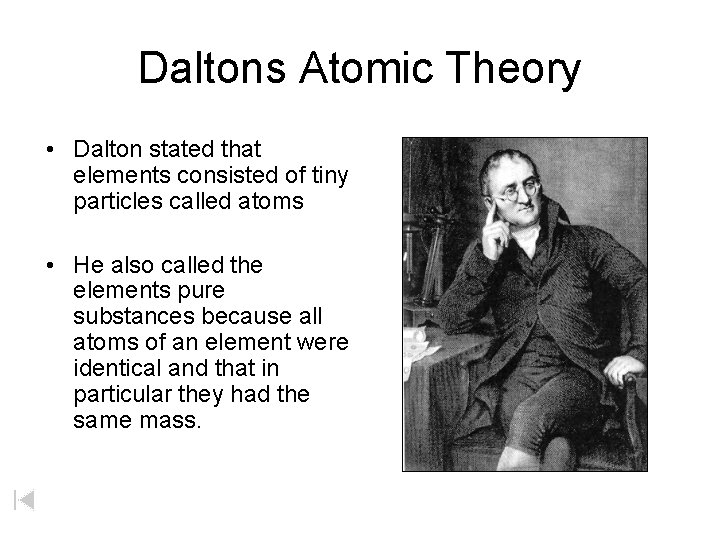
Daltons Atomic Theory • Dalton stated that elements consisted of tiny particles called atoms • He also called the elements pure substances because all atoms of an element were identical and that in particular they had the same mass.
Dalton’s Atomic Theory 1. All matter consists of tiny particles. Dalton, like the Greeks, called these particles “atoms”. 2. Atoms of one element can neither be subdivided nor changed into atoms of any other element. 3. Atoms can neither be created nor destroyed. 4. All atoms of the same element are identical in mass, size, and other properties. 5. Atoms of one element differ in mass and other properties from atoms of other elements. 6. In compounds, atoms of different elements combine in simple, whole number ratios.
The Atomic Theory of Matter • Dalton’s atomic theory is essentially correct, with four minor modifications: 1. Not all atoms of an element must have precisely the same mass. 2. Atoms of one element can be transformed into another through nuclear reactions. 3. The composition of many solid compounds are somewhat variable. 4. Under certain circumstances, some atoms can be divided (split into smaller particles: i. e. nuclear fission). Copyright © 2007 Pearson Benjamin Cummings. All rights reserved.
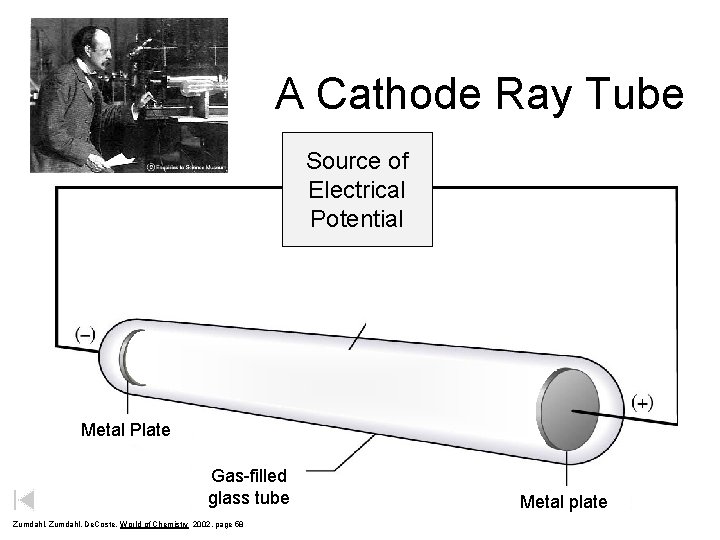
A Cathode Ray Tube Source of Electrical Potential Stream of negative particles (electrons) Metal Plate Gas-filled glass tube Zumdahl, De. Coste, World of Chemistry 2002, page 58 Metal plate
Background Information • • Cathode Rays Form when high voltage is applied across electrodes in a partially evacuated tube. Originate at the cathode (negative electrode) and move to the anode (positive electrode) Carry energy and can do work Travel in straight lines in the absence of an external field
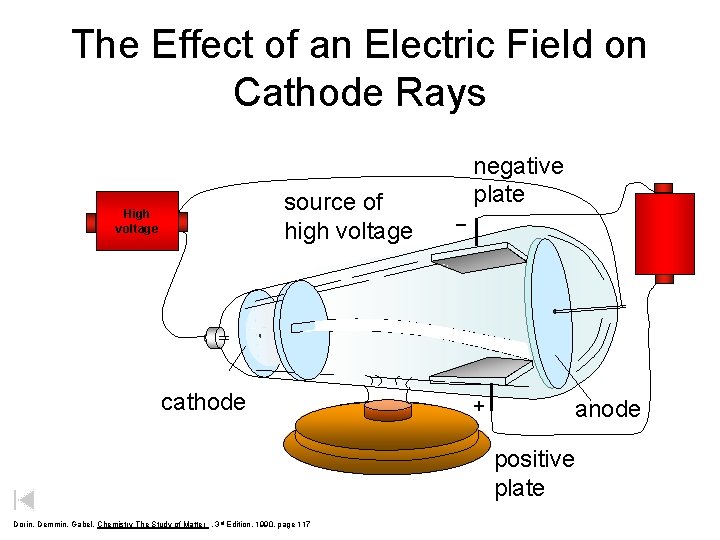
Cathode Ray Experiment 1897 Experimentation • Using a cathode ray tube, Thomson was able to deflect cathode rays with an electrical field. • The rays bent towards the positive pole, indicating that they are negatively charged.
The Effect of an Electric Field on Cathode Rays source of high voltage High voltage cathode _ negative plate + anode positive plate Dorin, Demmin, Gabel, Chemistry The Study of Matter , 3 rd Edition, 1990, page 117
Conclusions • He compared the value with the mass/ charge ratio for the lightest charged particle. • By comparison, Thomson estimated that the cathode ray particle weighed 1/1000 as much as hydrogen, the lightest atom. • He concluded that atoms do contain subatomic particles - atoms are divisible into smaller particles. • This conclusion contradicted Dalton’s postulate and was not widely accepted by fellow physicists and chemists of his day. • Since any electrode material produces an identical ray, cathode ray particles are present in all types of matter - a universal negatively charged subatomic particle later named the electron
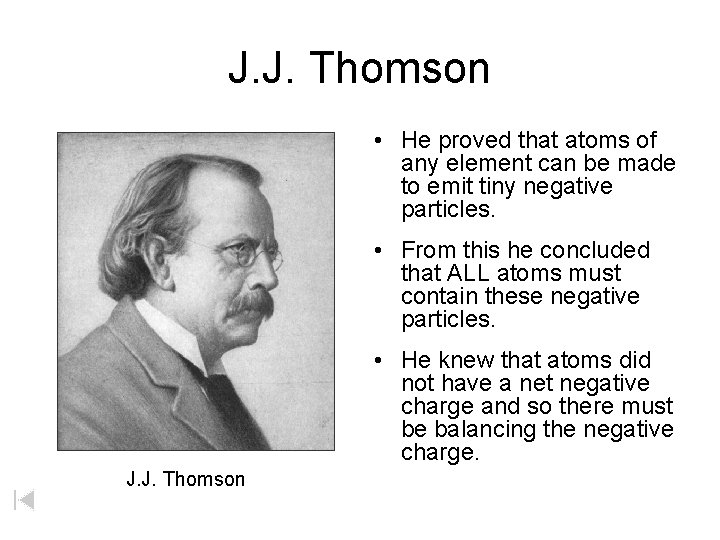
J. J. Thomson • He proved that atoms of any element can be made to emit tiny negative particles. • From this he concluded that ALL atoms must contain these negative particles. • He knew that atoms did not have a net negative charge and so there must be balancing the negative charge. J. J. Thomson
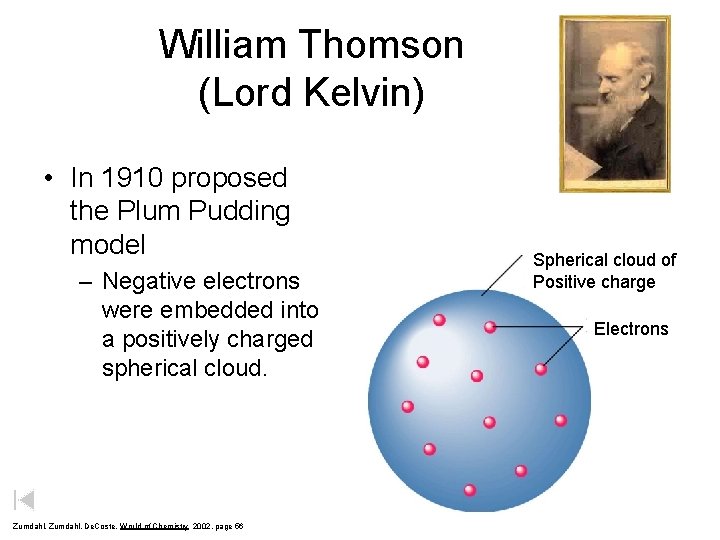
William Thomson (Lord Kelvin) • In 1910 proposed the Plum Pudding model – Negative electrons were embedded into a positively charged spherical cloud. Zumdahl, De. Coste, World of Chemistry 2002, page 56 Spherical cloud of Positive charge Electrons
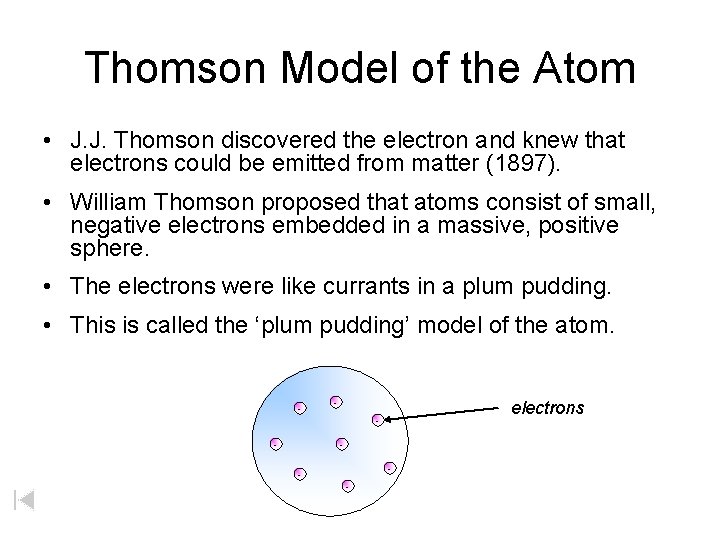
Thomson Model of the Atom • J. J. Thomson discovered the electron and knew that electrons could be emitted from matter (1897). • William Thomson proposed that atoms consist of small, negative electrons embedded in a massive, positive sphere. • The electrons were like currants in a plum pudding. • This is called the ‘plum pudding’ model of the atom. - - electrons - - -
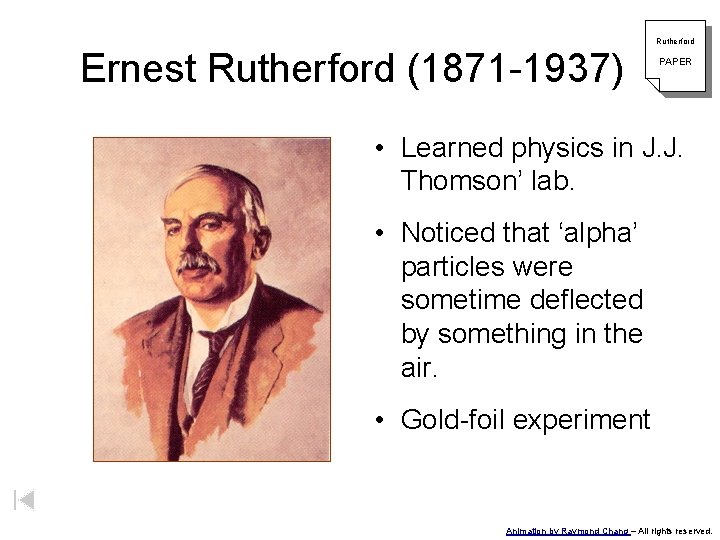
Ernest Rutherford (1871 -1937) Rutherford PAPER • Learned physics in J. J. Thomson’ lab. • Noticed that ‘alpha’ particles were sometime deflected by something in the air. • Gold-foil experiment Animation by Raymond Chang – All rights reserved.
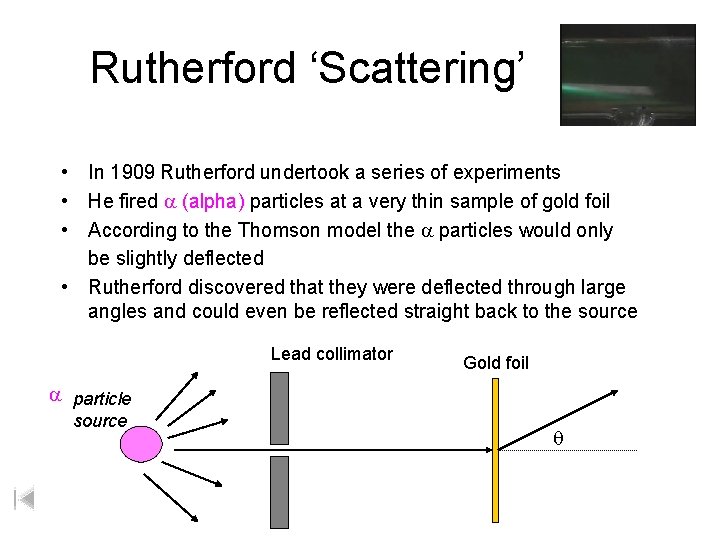
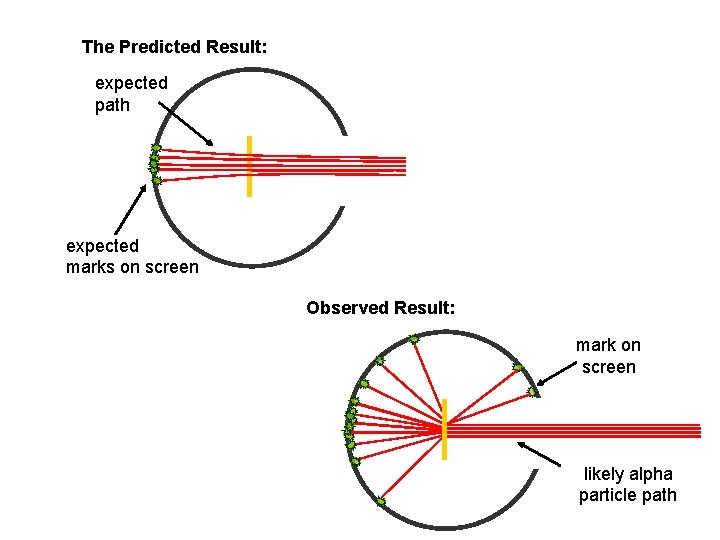
Rutherford ‘Scattering’ • In 1909 Rutherford undertook a series of experiments • He fired a (alpha) particles at a very thin sample of gold foil • According to the Thomson model the a particles would only be slightly deflected • Rutherford discovered that they were deflected through large angles and could even be reflected straight back to the source Lead collimator Gold foil a particle source q
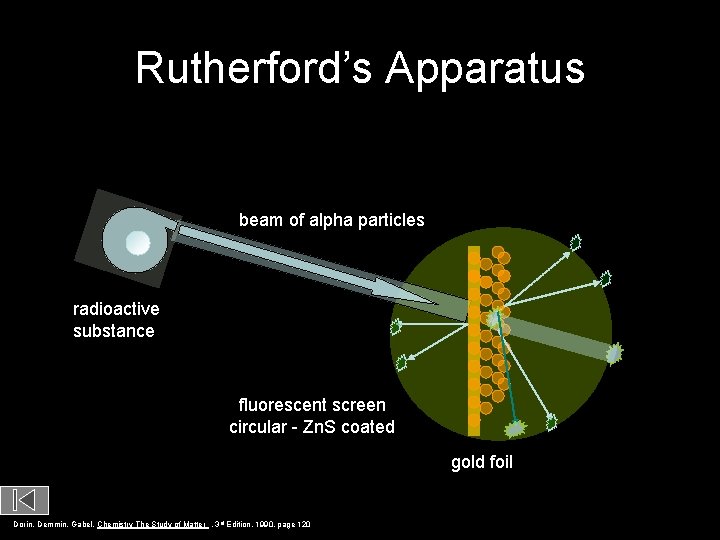
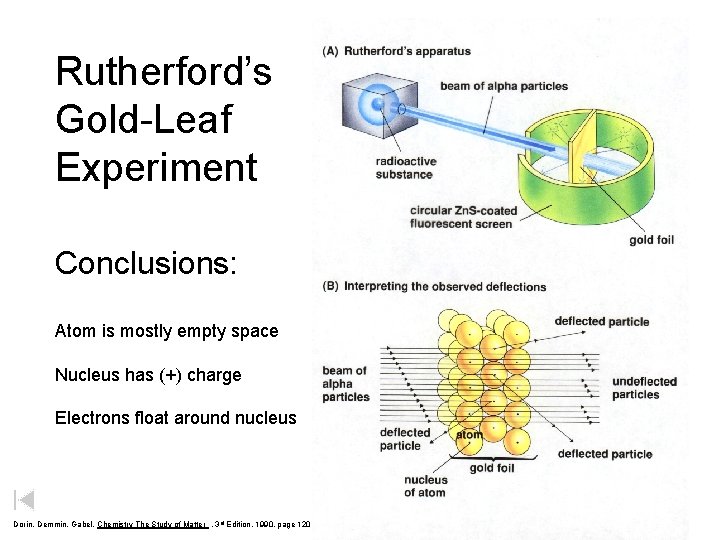
Rutherford’s Apparatus beam of alpha particles radioactive substance fluorescent screen circular - Zn. S coated gold foil Dorin, Demmin, Gabel, Chemistry The Study of Matter , 3 rd Edition, 1990, page 120
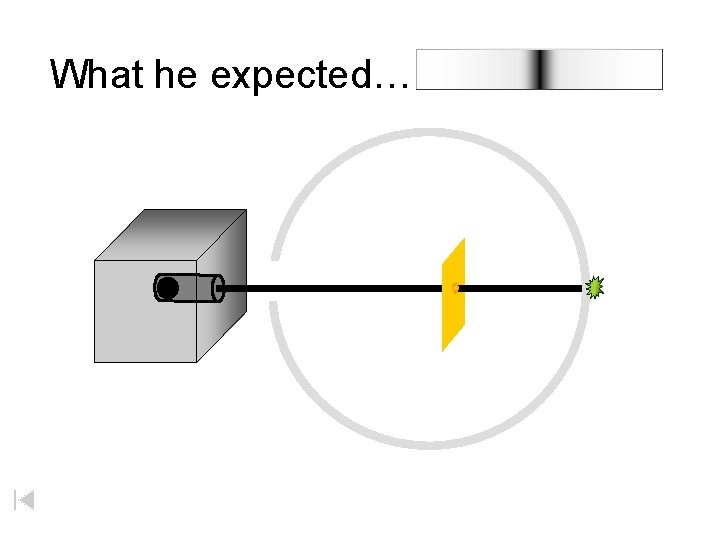
What he expected…
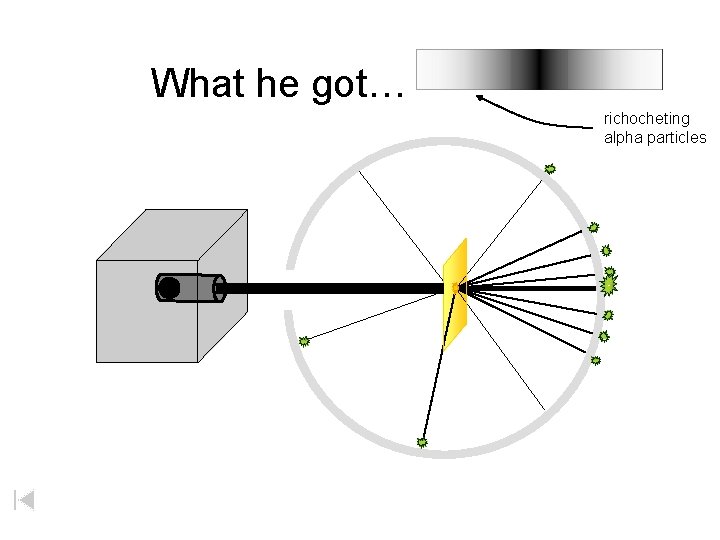
What he got… richocheting alpha particles
The Predicted Result: expected path expected marks on screen Observed Result: mark on screen likely alpha particle path
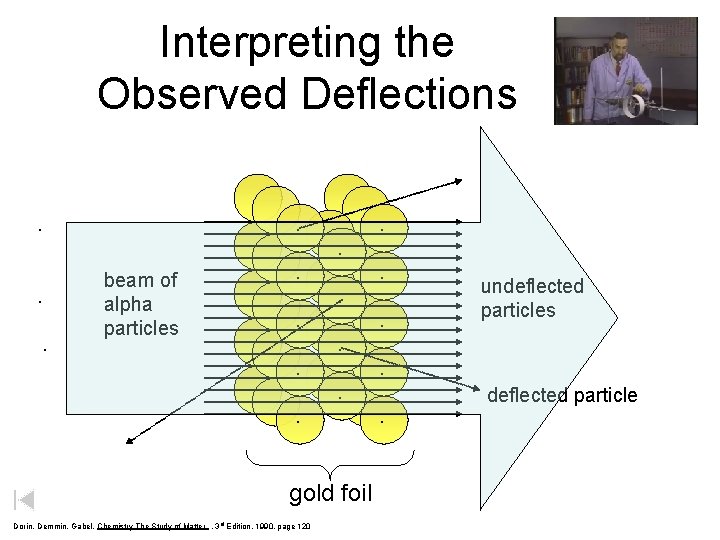
Interpreting the Observed Deflections. . beam of alpha particles . . . . gold foil Dorin, Demmin, Gabel, Chemistry The Study of Matter , 3 rd Edition, 1990, page 120 . . . undeflected particles . . deflected particle
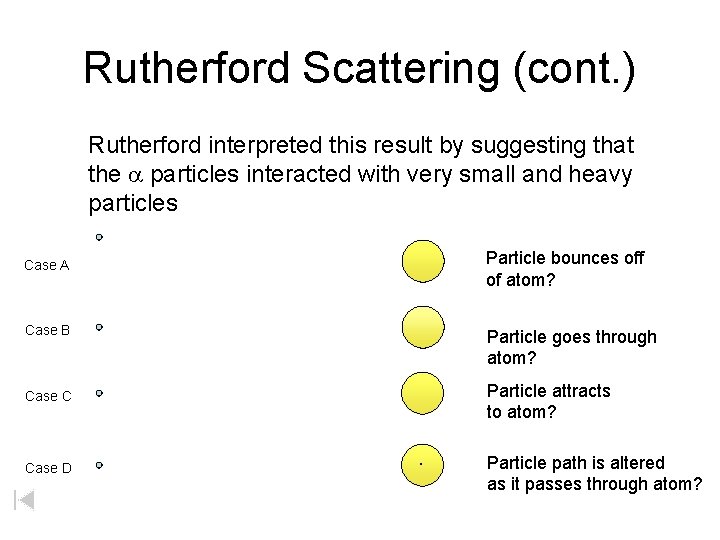
Rutherford Scattering (cont. ) Rutherford interpreted this result by suggesting that the a particles interacted with very small and heavy particles Particle bounces off of atom? Case A Case B Particle goes through atom? Particle attracts to atom? Case C Case D . Particle path is altered as it passes through atom?
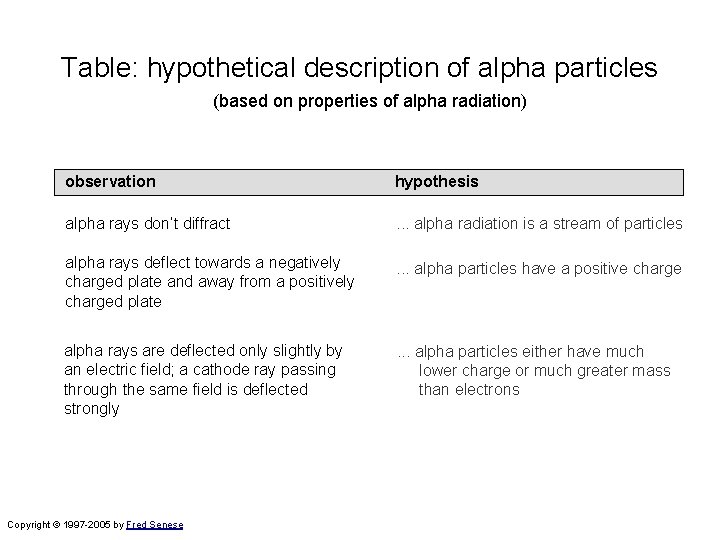
Table: hypothetical description of alpha particles (based on properties of alpha radiation) observation hypothesis alpha rays don’t diffract . . . alpha radiation is a stream of particles alpha rays deflect towards a negatively charged plate and away from a positively charged plate . . . alpha particles have a positive charge alpha rays are deflected only slightly by an electric field; a cathode ray passing through the same field is deflected strongly . . . alpha particles either have much lower charge or much greater mass than electrons Copyright © 1997 -2005 by Fred Senese
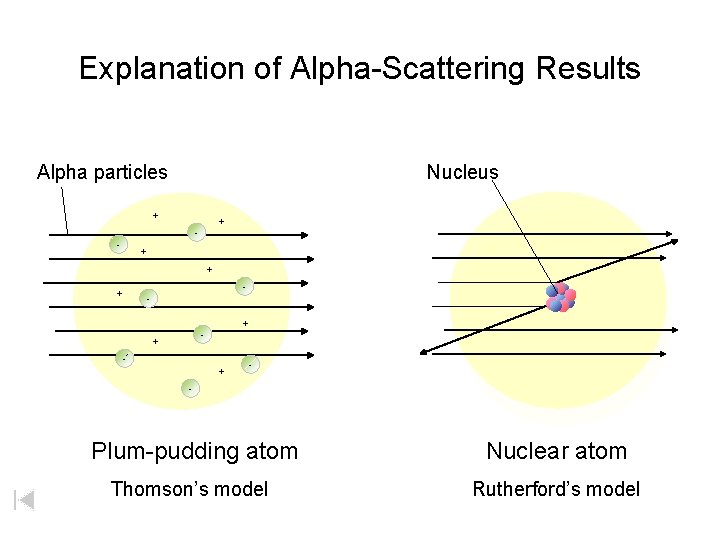
Explanation of Alpha-Scattering Results Alpha particles Nucleus + + - - + + - + - - Plum-pudding atom Nuclear atom Thomson’s model Rutherford’s model
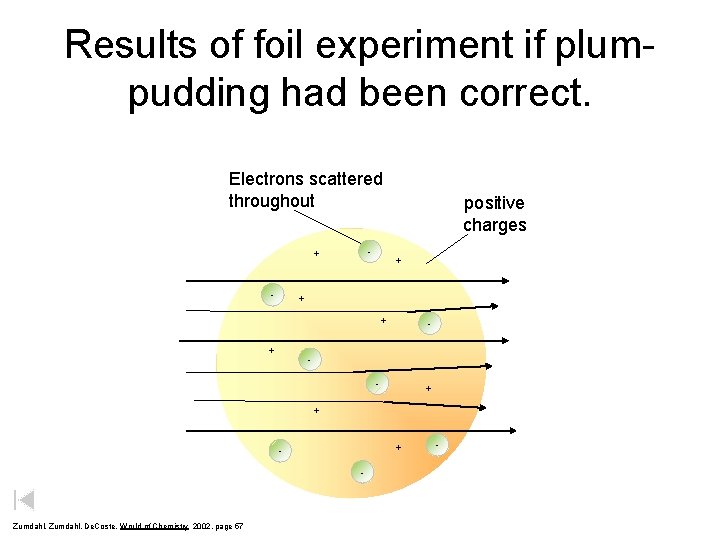
Results of foil experiment if plumpudding had been correct. Electrons scattered throughout - + - positive charges + + - - + + + - Zumdahl, De. Coste, World of Chemistry 2002, page 57 -
Rutherford’s Gold-Leaf Experiment Conclusions: Atom is mostly empty space Nucleus has (+) charge Electrons float around nucleus Dorin, Demmin, Gabel, Chemistry The Study of Matter , 3 rd Edition, 1990, page 120
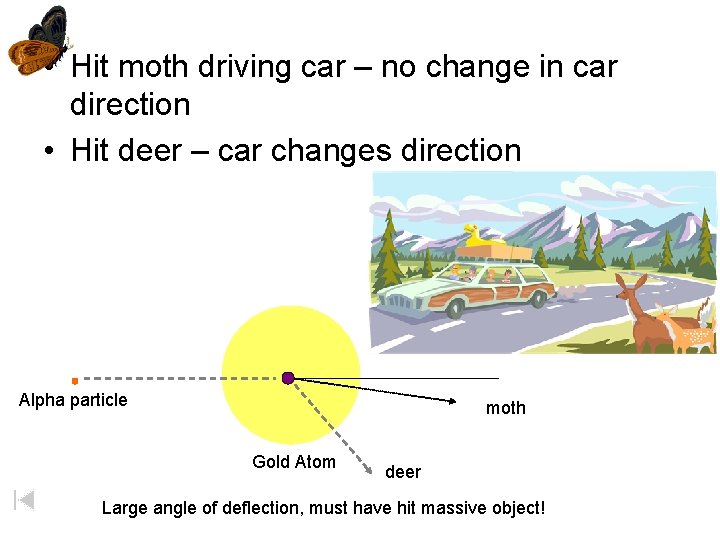
• Hit moth driving car – no change in car direction • Hit deer – car changes direction Alpha particle moth Gold Atom deer Large angle of deflection, must have hit massive object!
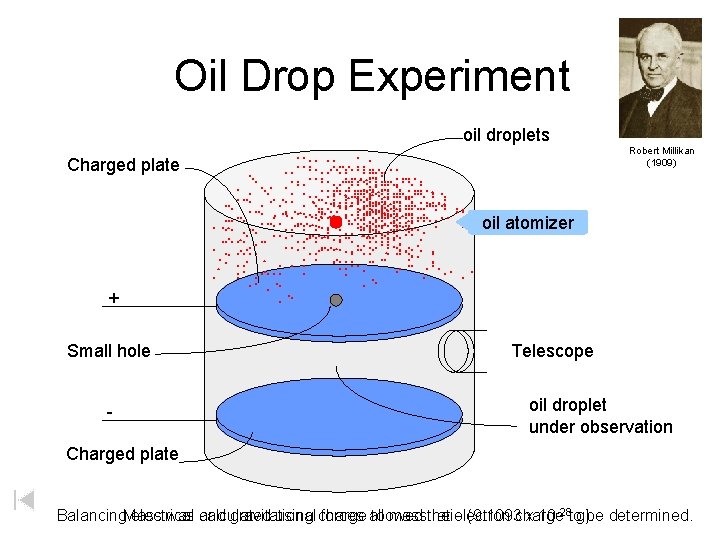
Oil Drop Experiment oil droplets . . . . . . . . . . . . oil atomizer. . . . . . . . . . . . . . . . . . . . . . . . . . . Charged plate Robert Millikan (1909) + Small hole - Telescope oil droplet under observation Charged plate was calculated using charge to massthe ratio (9. 1093 charge x 10 -28 tog). Balancing. Mass electrical and gravitational forces allowed electron be determined.
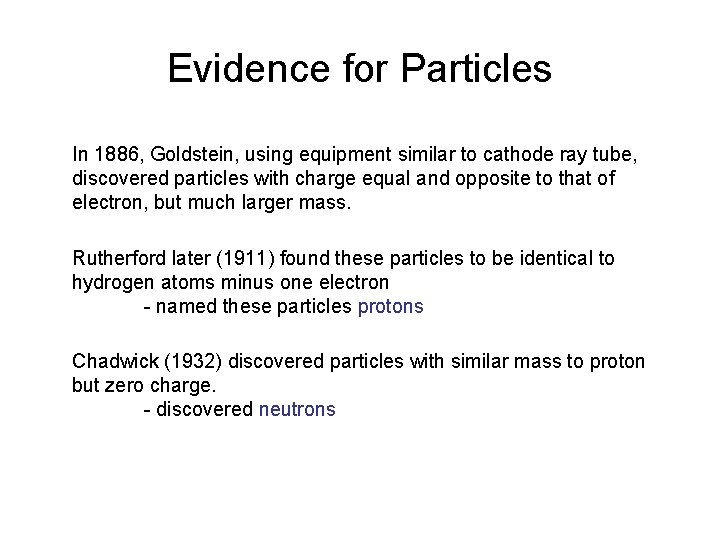
Evidence for Particles In 1886, Goldstein, using equipment similar to cathode ray tube, discovered particles with charge equal and opposite to that of electron, but much larger mass. Rutherford later (1911) found these particles to be identical to hydrogen atoms minus one electron - named these particles protons Chadwick (1932) discovered particles with similar mass to proton but zero charge. - discovered neutrons
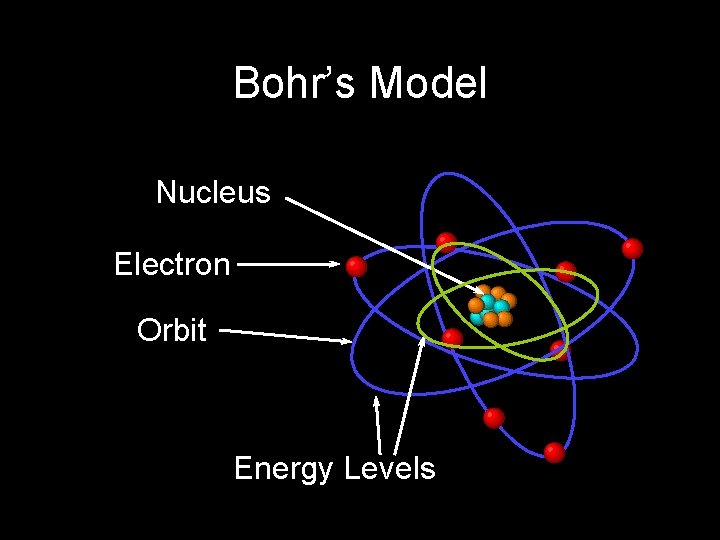
Bohr’s Model Nucleus Electron Orbit Energy Levels
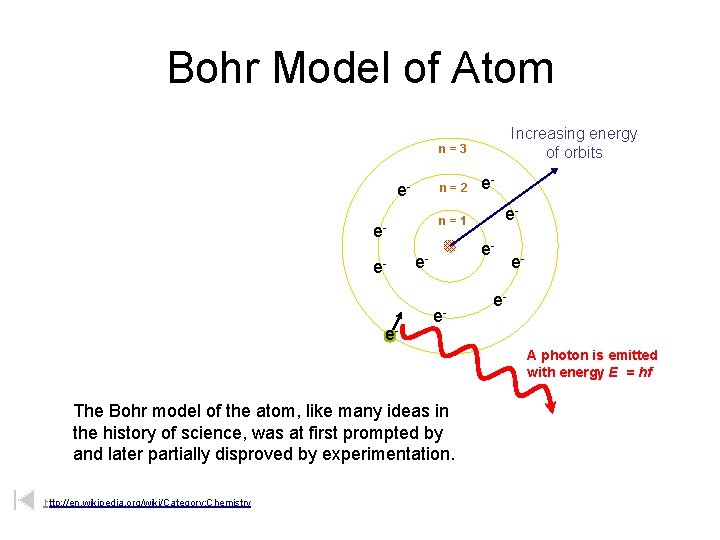
Bohr Model of Atom Increasing energy of orbits n=3 e- n=2 e- e- n=1 ee- e- e- e. A photon is emitted with energy E = hf The Bohr model of the atom, like many ideas in the history of science, was at first prompted by and later partially disproved by experimentation. http: //en. wikipedia. org/wiki/Category: Chemistry
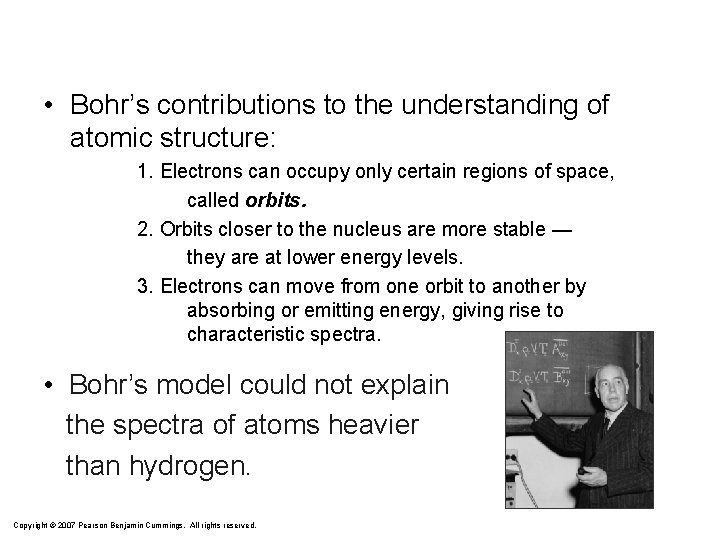
• Bohr’s contributions to the understanding of atomic structure: 1. Electrons can occupy only certain regions of space, called orbits. 2. Orbits closer to the nucleus are more stable — they are at lower energy levels. 3. Electrons can move from one orbit to another by absorbing or emitting energy, giving rise to characteristic spectra. • Bohr’s model could not explain the spectra of atoms heavier than hydrogen. Copyright © 2007 Pearson Benjamin Cummings. All rights reserved.
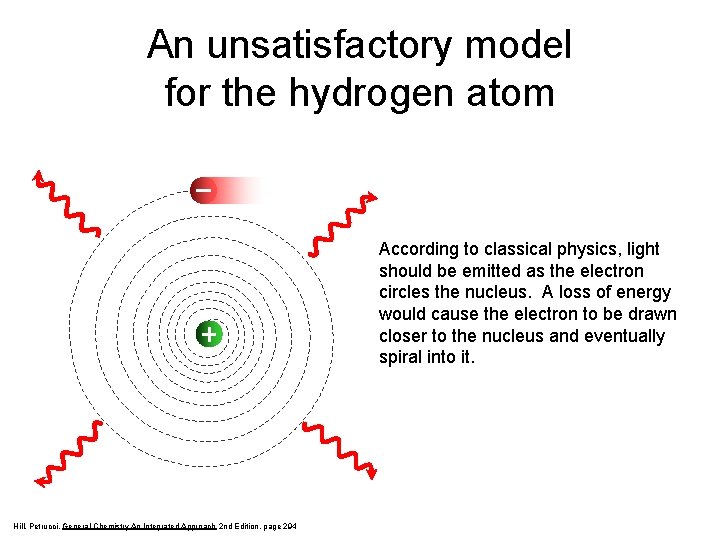
An unsatisfactory model for the hydrogen atom According to classical physics, light should be emitted as the electron circles the nucleus. A loss of energy would cause the electron to be drawn closer to the nucleus and eventually spiral into it. Hill, Petrucci, General Chemistry An Integrated Approach 2 nd Edition, page 294
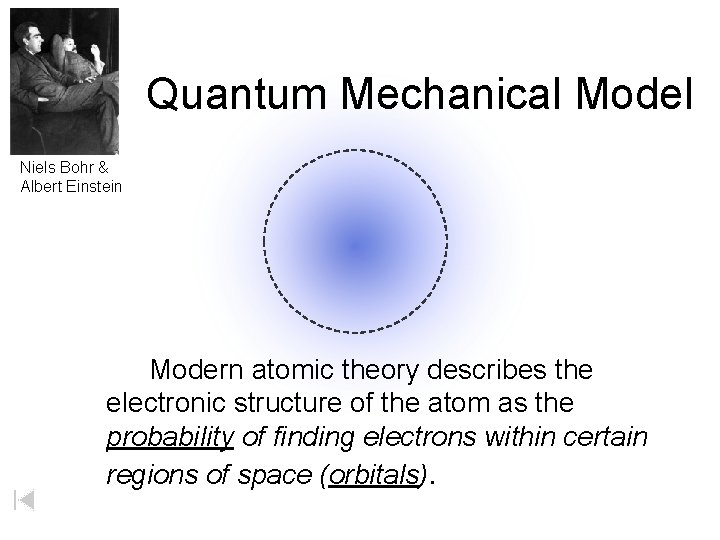
Quantum Mechanical Model Niels Bohr & Albert Einstein Modern atomic theory describes the electronic structure of the atom as the probability of finding electrons within certain regions of space (orbitals).
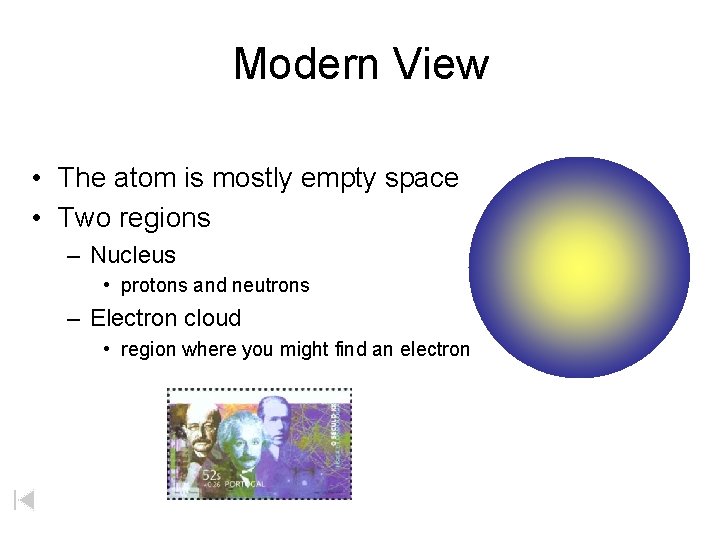
Modern View • The atom is mostly empty space • Two regions – Nucleus • protons and neutrons – Electron cloud • region where you might find an electron
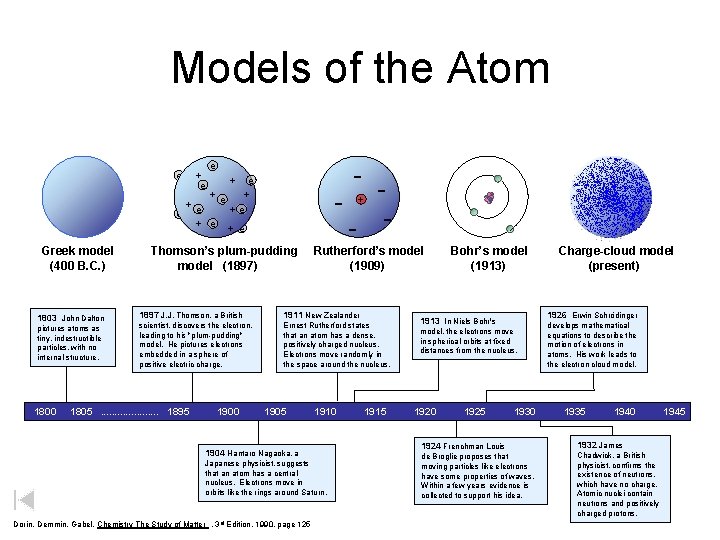
Models of the Atom e + e e - + e +e +e e + e Dalton’s model Greek model (1803) (400 B. C. ) 1803 John Dalton pictures atoms as tiny, indestructible particles, with no internal structure. 1800 - Thomson’s plum-pudding model (1897) - + Rutherford’s model (1909) 1897 J. J. Thomson, a British 1911 New Zealander scientist, discovers the electron, leading to his "plum-pudding" model. He pictures electrons embedded in a sphere of positive electric charge. Ernest Rutherford states that an atom has a dense, positively charged nucleus. Electrons move randomly in the space around the nucleus. 1805. . . . . 1895 1900 1905 1910 1904 Hantaro Nagaoka, a Japanese physicist, suggests that an atom has a central nucleus. Electrons move in orbits like the rings around Saturn. Dorin, Demmin, Gabel, Chemistry The Study of Matter , 3 rd Edition, 1990, page 125 1915 Bohr’s model (1913) 1926 Erwin Schrödinger 1913 In Niels Bohr's model, the electrons move in spherical orbits at fixed distances from the nucleus. 1920 1925 Charge-cloud model (present) 1930 1924 Frenchman Louis de Broglie proposes that moving particles like electrons have some properties of waves. Within a few years evidence is collected to support his idea. develops mathematical equations to describe the motion of electrons in atoms. His work leads to the electron cloud model. 1935 1940 1932 James Chadwick, a British physicist, confirms the existence of neutrons, which have no charge. Atomic nuclei contain neutrons and positively charged protons. 1945