
Greek Knowledge The Shape of the Earth The

- Slides: 9
Greek Knowledge
The Shape of the Earth The Greeks Assumed / Knew It Was Spherical Aristotle 1: The Shape of All Lunar Eclipse Shadows are arcs n Aristotle 2: Different Stars as One Goes South or North n Another Argument: The Hull Down Ship n
The Motion of the Earth Correct Method - Wrong Conclusion n Parallax: The apparent motion of an object due to the motion of the observer. The Greeks could not detect any parallax for the stars (or planets). Conclusion: – The Earth is not moving. OR – The Stars are too far away to measure parallax with crude instruments / eye. n The Greeks chose not moving.
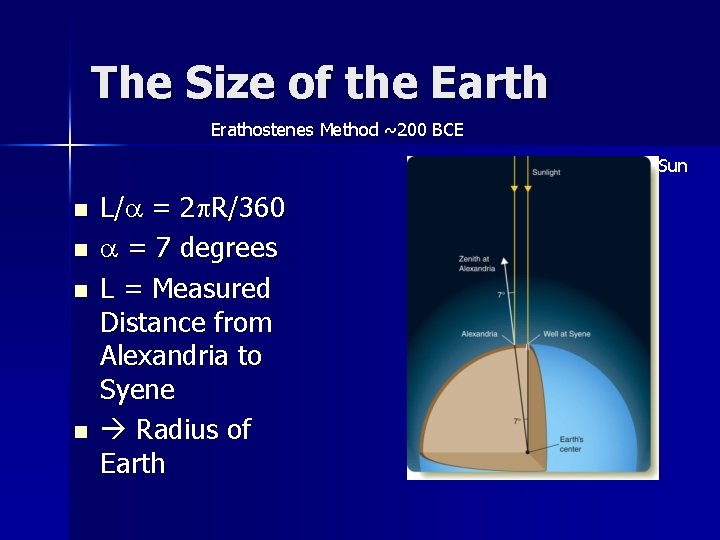
The Size of the Earth Erathostenes Method ~200 BCE To the Sun n n L/ = 2 R/360 = 7 degrees L = Measured Distance from Alexandria to Syene Radius of Earth Alexandria L Syene
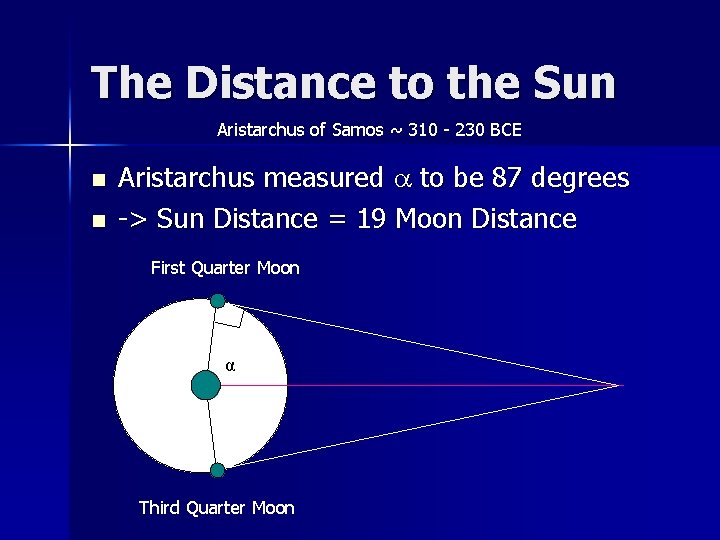
The Distance to the Sun Aristarchus of Samos ~ 310 - 230 BCE n n Aristarchus measured to be 87 degrees -> Sun Distance = 19 Moon Distance First Quarter Moon α Third Quarter Moon
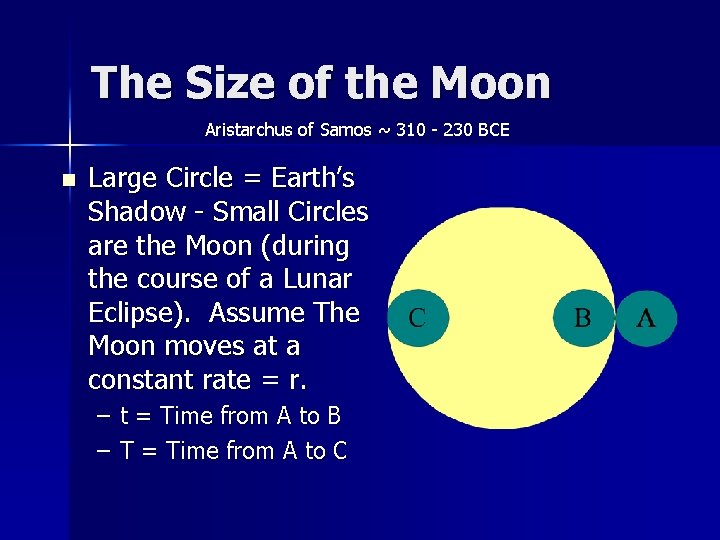
The Size of the Moon Aristarchus of Samos ~ 310 - 230 BCE n Large Circle = Earth’s Shadow - Small Circles are the Moon (during the course of a Lunar Eclipse). Assume The Moon moves at a constant rate = r. – t = Time from A to B – T = Time from A to C
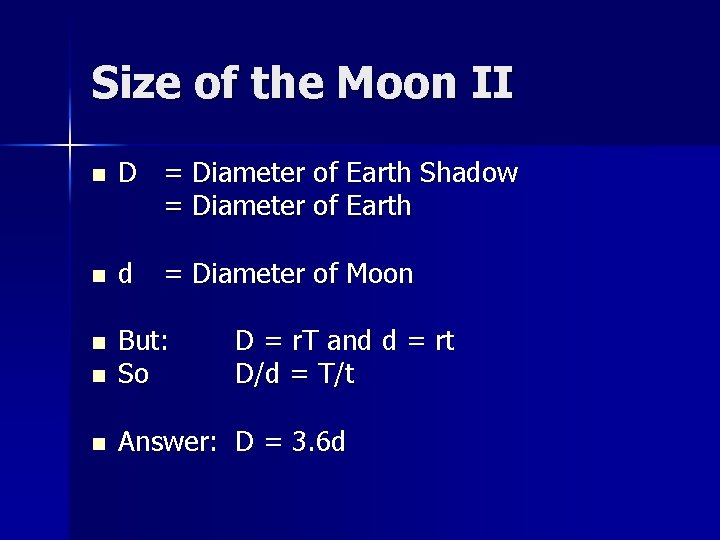
Size of the Moon II n D = Diameter of Earth Shadow = Diameter of Earth n d n n But: So n Answer: D = 3. 6 d = Diameter of Moon D = r. T and d = rt D/d = T/t
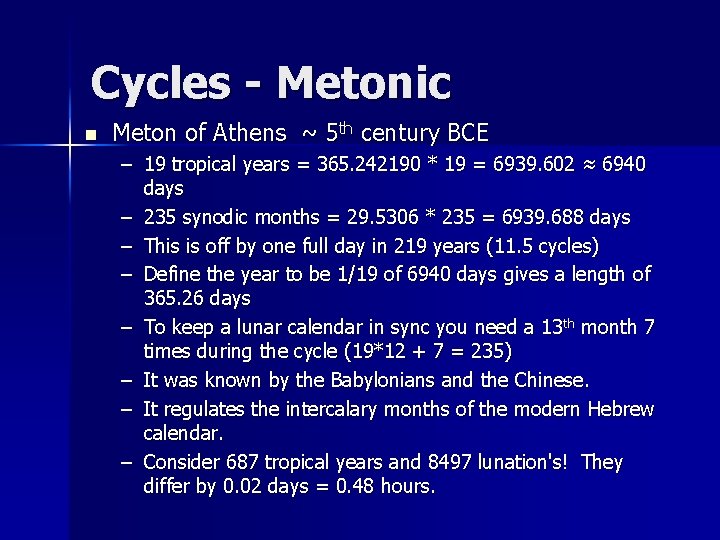
Cycles - Metonic n Meton of Athens ~ 5 th century BCE – 19 tropical years = 365. 242190 * 19 = 6939. 602 ≈ 6940 days – 235 synodic months = 29. 5306 * 235 = 6939. 688 days – This is off by one full day in 219 years (11. 5 cycles) – Define the year to be 1/19 of 6940 days gives a length of 365. 26 days – To keep a lunar calendar in sync you need a 13 th month 7 times during the cycle (19*12 + 7 = 235) – It was known by the Babylonians and the Chinese. – It regulates the intercalary months of the modern Hebrew calendar. – Consider 687 tropical years and 8497 lunation's! They differ by 0. 02 days = 0. 48 hours.
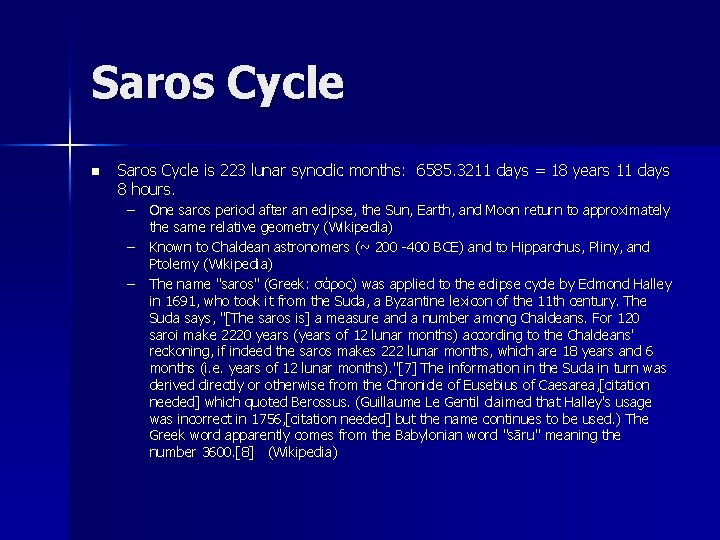
Saros Cycle n Saros Cycle is 223 lunar synodic months: 6585. 3211 days = 18 years 11 days 8 hours. – One saros period after an eclipse, the Sun, Earth, and Moon return to approximately the same relative geometry (Wikipedia) – Known to Chaldean astronomers (~ 200 -400 BCE) and to Hipparchus, Pliny, and Ptolemy (Wikipedia) – The name "saros" (Greek: σάρος) was applied to the eclipse cycle by Edmond Halley in 1691, who took it from the Suda, a Byzantine lexicon of the 11 th century. The Suda says, "[The saros is] a measure and a number among Chaldeans. For 120 saroi make 2220 years (years of 12 lunar months) according to the Chaldeans' reckoning, if indeed the saros makes 222 lunar months, which are 18 years and 6 months (i. e. years of 12 lunar months). "[7] The information in the Suda in turn was derived directly or otherwise from the Chronicle of Eusebius of Caesarea, [citation needed] which quoted Berossus. (Guillaume Le Gentil claimed that Halley's usage was incorrect in 1756, [citation needed] but the name continues to be used. ) The Greek word apparently comes from the Babylonian word "sāru" meaning the number 3600. [8] (Wikipedia)