
GREEK GOVERNMENT AND DEVELOPMENT OF DEMOCRACY IN ATHENS
- Slides: 16
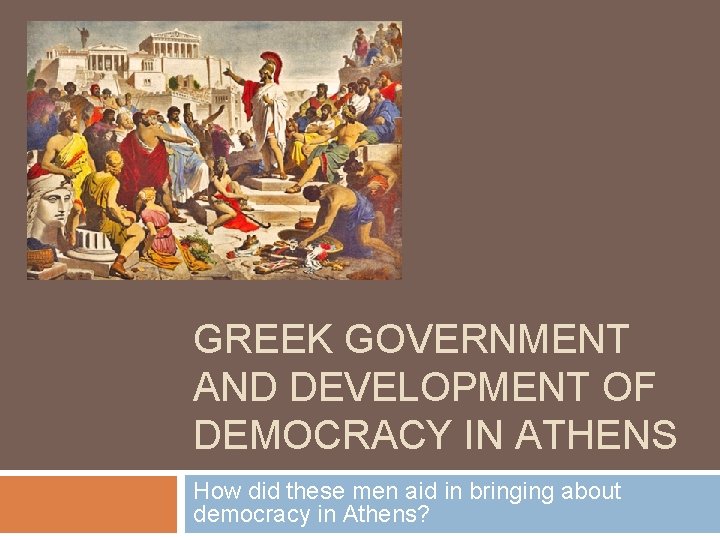
GREEK GOVERNMENT AND DEVELOPMENT OF DEMOCRACY IN ATHENS How did these men aid in bringing about democracy in Athens?
The ancient Greeks were particularly concerned with such fundamental questions as who should rule and how? The Greeks give us most of our modern political terms: � Autocracy: Auto – Krates (Self to rule) � Monarchy: Mono – Arkhos (One Ruler) � Oligarchy: Oligoi – Arkhos (Few Rulers) � Democracy: Demo – Kratia (People to rule) � Anarchy: An – Arkhos (Without Ruler)
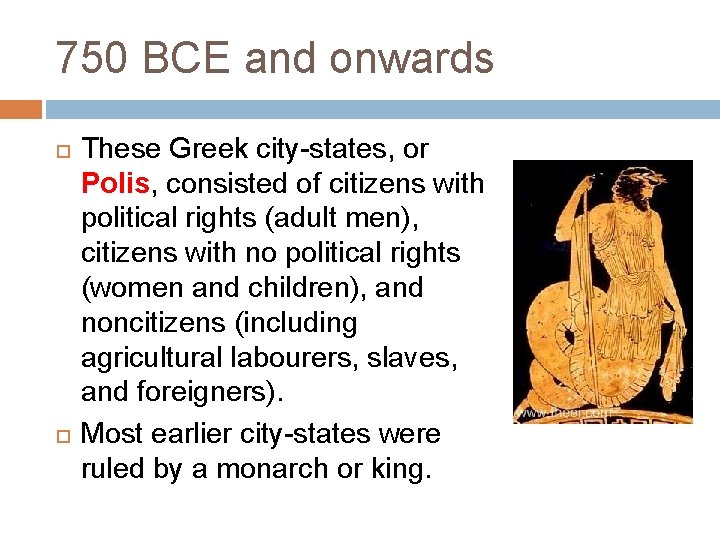
750 BCE and onwards These Greek city-states, or Polis, consisted of citizens with political rights (adult men), citizens with no political rights (women and children), and noncitizens (including agricultural labourers, slaves, and foreigners). Most earlier city-states were ruled by a monarch or king.
Athens and Oligarchy Kings eventually lost their power to wealthy land-owning aristocrats as the aristocrats gained wealth through trade. The position of Archon was created which allowed the wealthy to be appointed to office for life. This position was changed in 682 BCE to allow for a length of one year only. Power was divided up into three departments: Administration, War, and Religion.
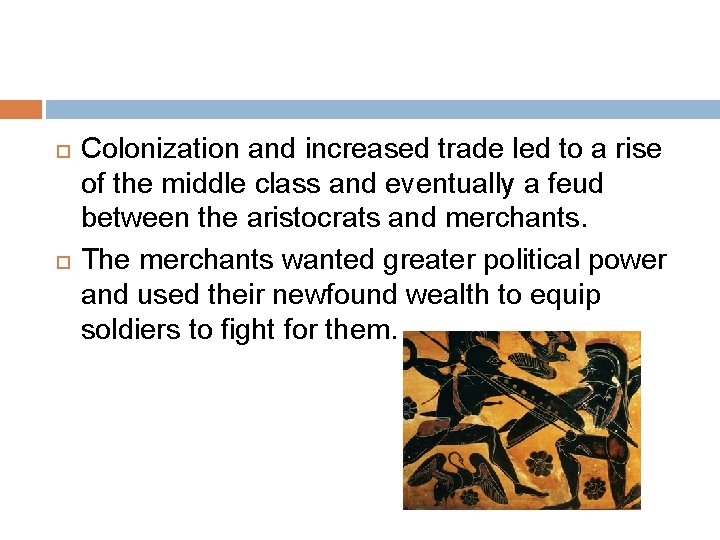
Colonization and increased trade led to a rise of the middle class and eventually a feud between the aristocrats and merchants. The merchants wanted greater political power and used their newfound wealth to equip soldiers to fight for them.
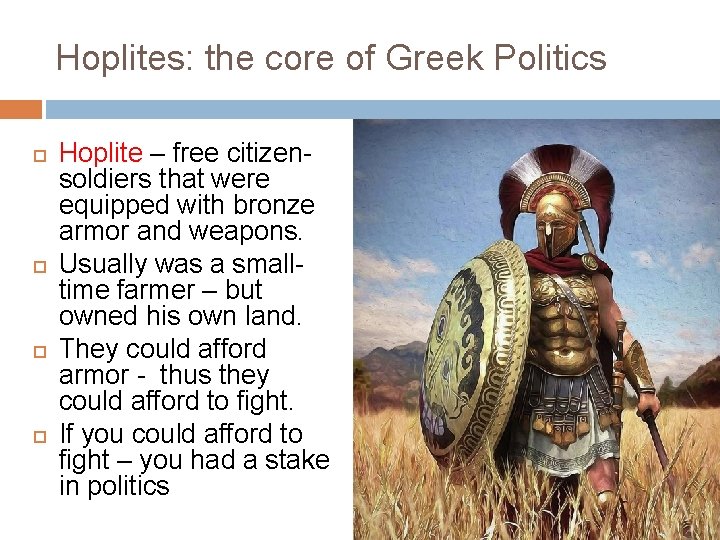
Hoplites: the core of Greek Politics Hoplite – free citizensoldiers that were equipped with bronze armor and weapons. Usually was a smalltime farmer – but owned his own land. They could afford armor - thus they could afford to fight. If you could afford to fight – you had a stake in politics
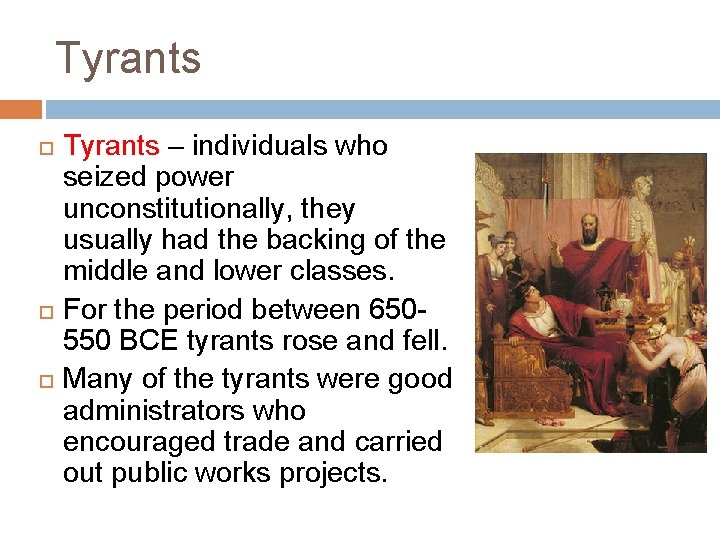
Tyrants Tyrants – individuals who seized power unconstitutionally, they usually had the backing of the middle and lower classes. For the period between 650550 BCE tyrants rose and fell. Many of the tyrants were good administrators who encouraged trade and carried out public works projects.
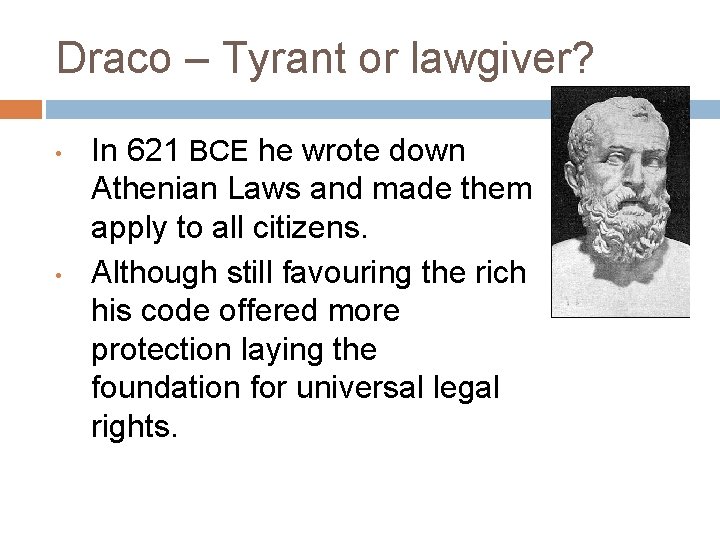
Draco – Tyrant or lawgiver? • • In 621 BCE he wrote down Athenian Laws and made them apply to all citizens. Although still favouring the rich his code offered more protection laying the foundation for universal legal rights.
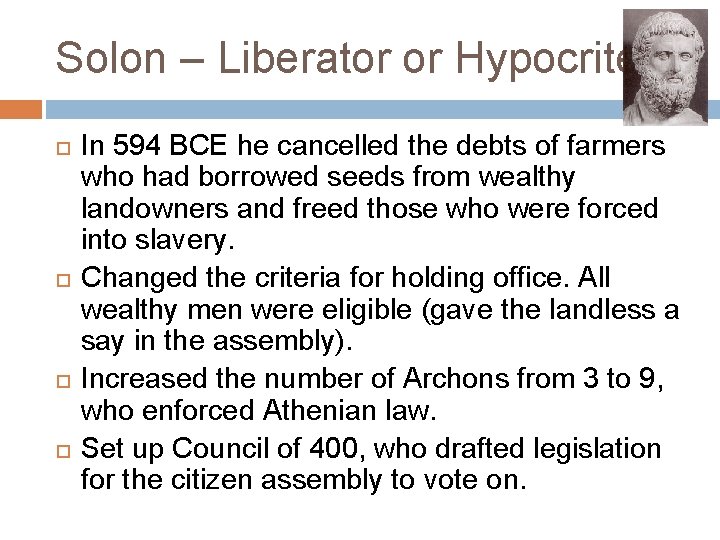
Solon – Liberator or Hypocrite? In 594 BCE he cancelled the debts of farmers who had borrowed seeds from wealthy landowners and freed those who were forced into slavery. Changed the criteria for holding office. All wealthy men were eligible (gave the landless a say in the assembly). Increased the number of Archons from 3 to 9, who enforced Athenian law. Set up Council of 400, who drafted legislation for the citizen assembly to vote on.
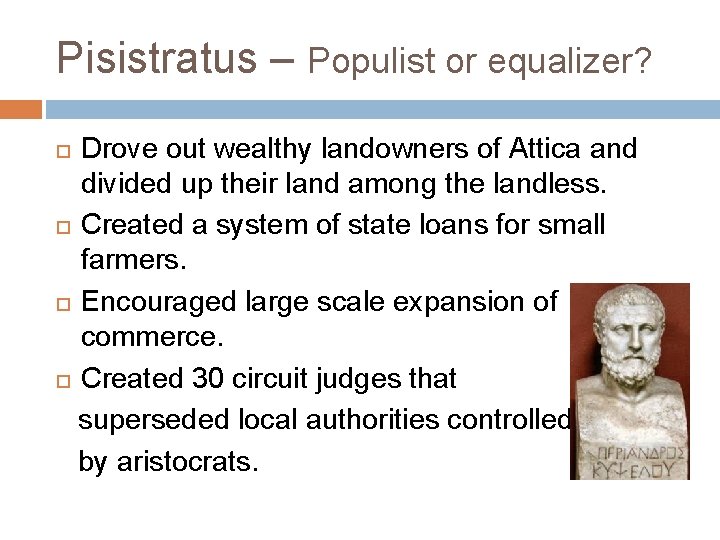
Pisistratus – Populist or equalizer? Drove out wealthy landowners of Attica and divided up their land among the landless. Created a system of state loans for small farmers. Encouraged large scale expansion of commerce. Created 30 circuit judges that superseded local authorities controlled by aristocrats.
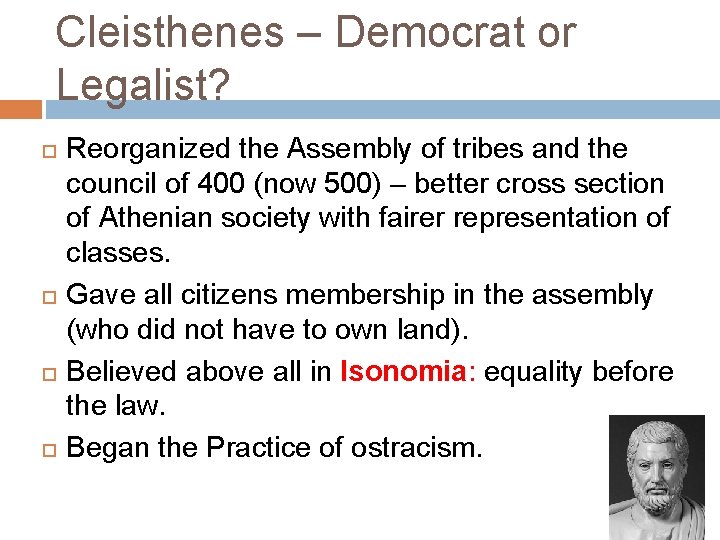
Cleisthenes – Democrat or Legalist? Reorganized the Assembly of tribes and the council of 400 (now 500) – better cross section of Athenian society with fairer representation of classes. Gave all citizens membership in the assembly (who did not have to own land). Believed above all in Isonomia: equality before the law. Began the Practice of ostracism.
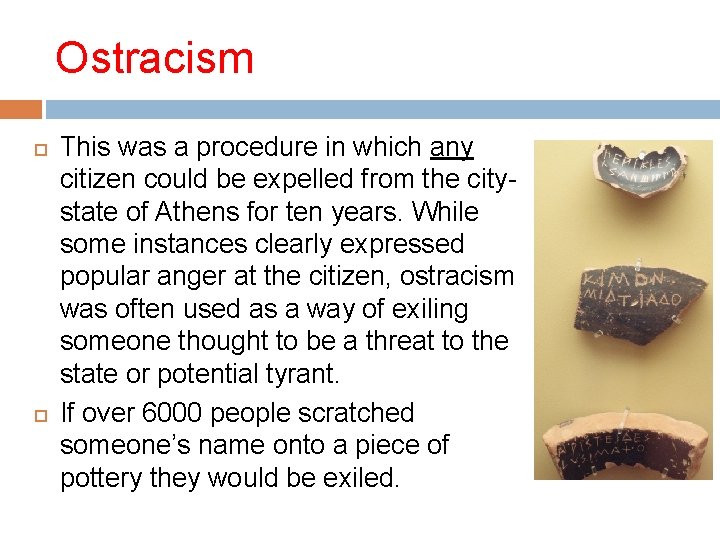
Ostracism This was a procedure in which any citizen could be expelled from the citystate of Athens for ten years. While some instances clearly expressed popular anger at the citizen, ostracism was often used as a way of exiling someone thought to be a threat to the state or potential tyrant. If over 6000 people scratched someone’s name onto a piece of pottery they would be exiled.
Democracy in Action What should your unit test be? Option A: Traditional Test Option B: “The Greek Gazette” Newspaper project Option C: Any other suggestions? (Must be an actual assignment)
Class Reading Activity Read Innovations on page 156 to see what a typical meeting of the Athenian Assembly would look like. Skim and Scan pages 155 to 158 and, in your notebook, compare the govt. of Athens to the govt. of Sparta. What are the advantages and disadvantages of both? (make note of the term oligarchy) Read Law and Justice on page 159 -160, answer questions 2 on page 160.
Journaling Guiding Question During class we learned about the growth of democracy in ancient Greece. With information to back up your opinion, which of the leaders that we learned about made the most significant contribution to democracy in ancient Athens?