
Greek Atomism as an early Version of the
- Slides: 50
Greek Atomism as an early Version of the Mechanist Philosophy Leucippus, Democritus, Epicurus All things are composed of eternal, uncreated, invisibly small, indivisible particles, called “atoms”. Atoms move randomly and without purpose in an infinite void, bumping into one another to form macroscopic objects, including living things.
Scholastic Arsitotelian Theory of Matter Material Bodies are composed of Primary matter (four elements) which exists only embodied in a quality-bearing Substantial form. The “form” of a thing provides its causal capacities.
Scholastic Arsitotelian Theory of Matter Secondary qualities: colors, sounds, odors, tastes, and tactile qualities such as hot and cold. They exist in objects as “real qualities” that are like instances or samples of the quality as experienced. A red thing possesses the quality red in just the same way it possesses a shape: we experience that very redness when we see a red object. The rabbit possesses properties such as the whiteness of its fur: this is a “real quality” of white inhering in each strand of hair.
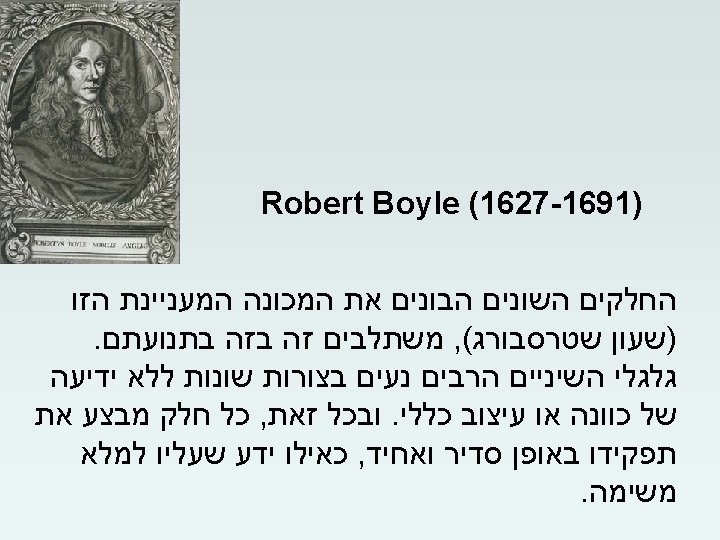
17 th Century Mechanical Theories of Matter Galileo Galilei (1570 -1619): Unified theory of inert matter in motion, blindly responding to mathematically formulated, universal laws. Pierre Gassendi (1592 -1655): Combined Atomism with Christian Dogma. Rene Descartes (1596 -1650): Matter as pure, infinitely divisible, “extension”. Anti-atomist. Robert Boyle (1627 -1691): Matter comprises impenetrable atoms. Matter is further divisible in thought or by God, but indivisible as far as natural processes are concerned.
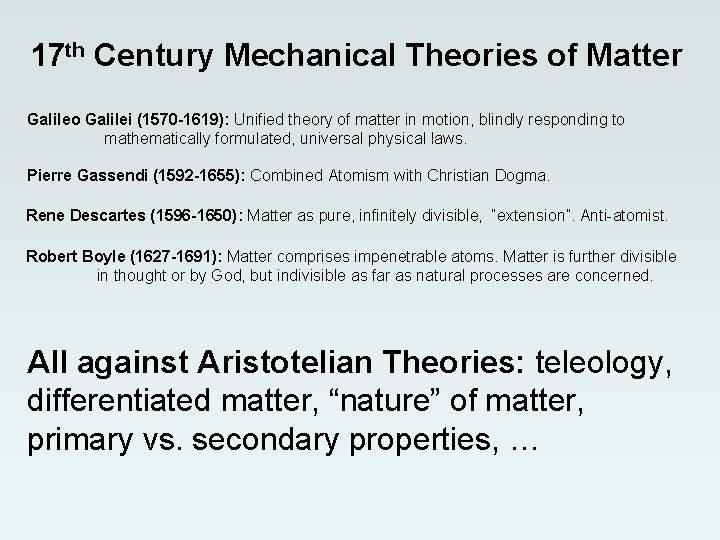
17 th Century Mechanical Theories of Matter Galileo Galilei (1570 -1619): Unified theory of matter in motion, blindly responding to mathematically formulated, universal physical laws. Pierre Gassendi (1592 -1655): Combined Atomism with Christian Dogma. Rene Descartes (1596 -1650): Matter as pure, infinitely divisible, “extension”. Anti-atomist. Robert Boyle (1627 -1691): Matter comprises impenetrable atoms. Matter is further divisible in thought or by God, but indivisible as far as natural processes are concerned. All against Aristotelian Theories: teleology, differentiated matter, “nature” of matter, primary vs. secondary properties, …
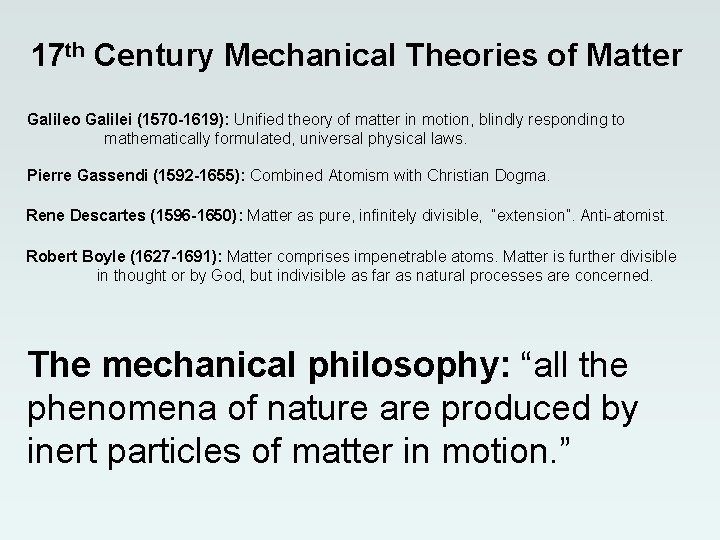
17 th Century Mechanical Theories of Matter Galileo Galilei (1570 -1619): Unified theory of matter in motion, blindly responding to mathematically formulated, universal physical laws. Pierre Gassendi (1592 -1655): Combined Atomism with Christian Dogma. Rene Descartes (1596 -1650): Matter as pure, infinitely divisible, “extension”. Anti-atomist. Robert Boyle (1627 -1691): Matter comprises impenetrable atoms. Matter is further divisible in thought or by God, but indivisible as far as natural processes are concerned. The mechanical philosophy: “all the phenomena of nature are produced by inert particles of matter in motion. ”
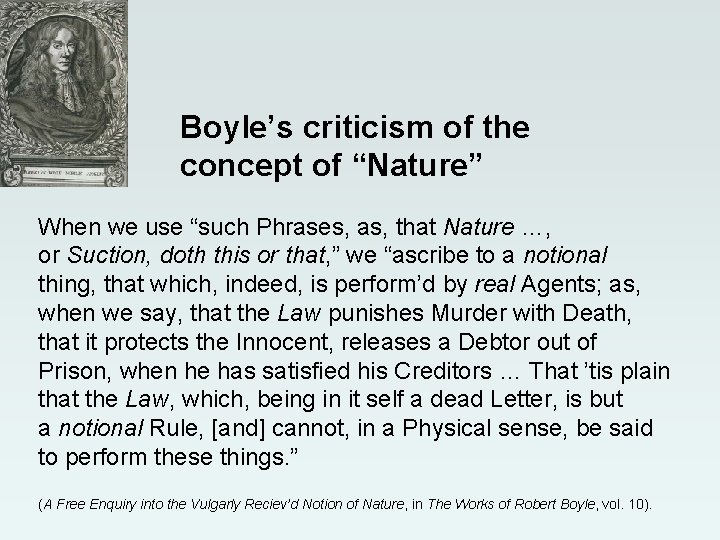
Boyle’s criticism of the concept of “Nature” When we use “such Phrases, as, that Nature …, or Suction, doth this or that, ” we “ascribe to a notional thing, that which, indeed, is perform’d by real Agents; as, when we say, that the Law punishes Murder with Death, that it protects the Innocent, releases a Debtor out of Prison, when he has satisfied his Creditors … That ’tis plain that the Law, which, being in it self a dead Letter, is but a notional Rule, [and] cannot, in a Physical sense, be said to perform these things. ” (A Free Enquiry into the Vulgarly Reciev’d Notion of Nature, in The Works of Robert Boyle, vol. 10).
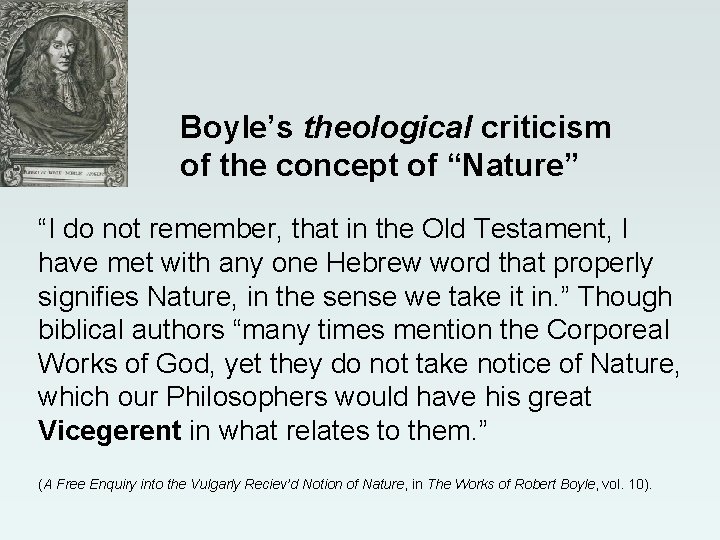
Boyle’s theological criticism of the concept of “Nature” “I do not remember, that in the Old Testament, I have met with any one Hebrew word that properly signifies Nature, in the sense we take it in. ” Though biblical authors “many times mention the Corporeal Works of God, yet they do not take notice of Nature, which our Philosophers would have his great Vicegerent in what relates to them. ” (A Free Enquiry into the Vulgarly Reciev’d Notion of Nature, in The Works of Robert Boyle, vol. 10).
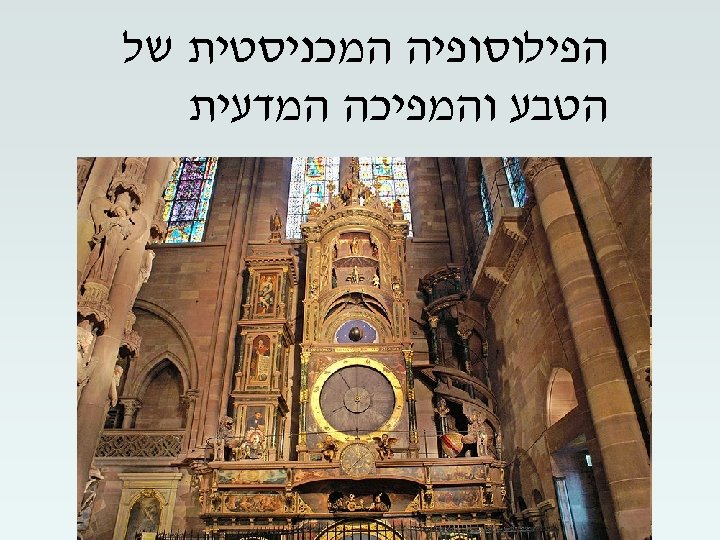
Boyle’s theological concept of the clockwork universe “Proponents of the vulgar conception of nature “seem to imagine the World to be after the nature of a Puppet, whose Contrivance indeed may be very Artificial, but yet is such, that almost every particular motion the Artificer is fain … to guide, and oftentimes over-rule, the Actions of the Engine; whereas, according to us, ’tis like a rare Clock, such as may be that at Strasbourg, where all things are so skilfully contriv’d, that the Engine being once set a Moving, all things proceed according to the Artificers first design, and the Motions of the little Statues, that at such hours perform these or those things, do not require, like those of Puppets, the peculiar interposing of the Artificer, or any Intelligent Agent imployed by him, but perform their functions upon particular occasions, by vertue of the General and Primitive Contrivance of the whole Engine”. (A Free Enquiry into the Vulgarly Reciev’d Notion of Nature, in The Works of Robert Boyle, vol. 10, pp. 464 and 457).
Boyle’s atomistic mechanicism • All properties of the material world are reducible to and arise as a consequence of the arrangements and motions of the underlying atoms. • Properties detectable by the senses, (color and taste), and those involved in the interaction of bodies with each other (elasticity and degree of heat), are to be explained in terms of the properties of atoms. • Properties of atoms (shape, size and motion and impenetrability) are the primary properties; more complex properties (secondary) are to be explained in terms of the fundamental laws that govern the motions of atoms.
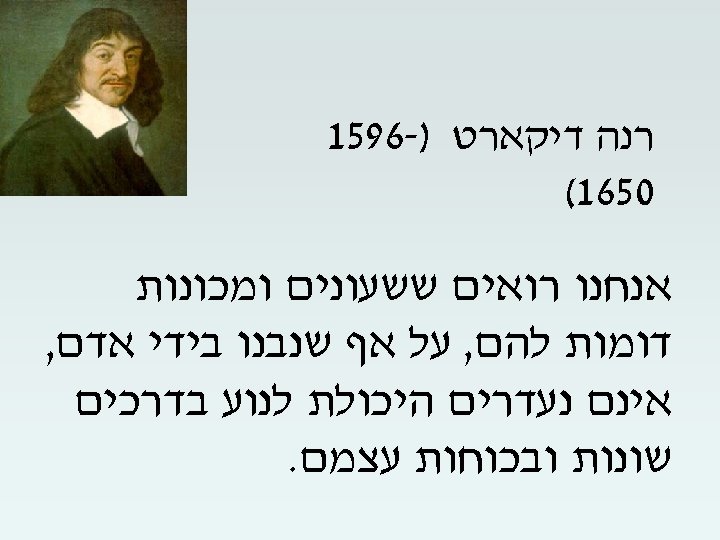
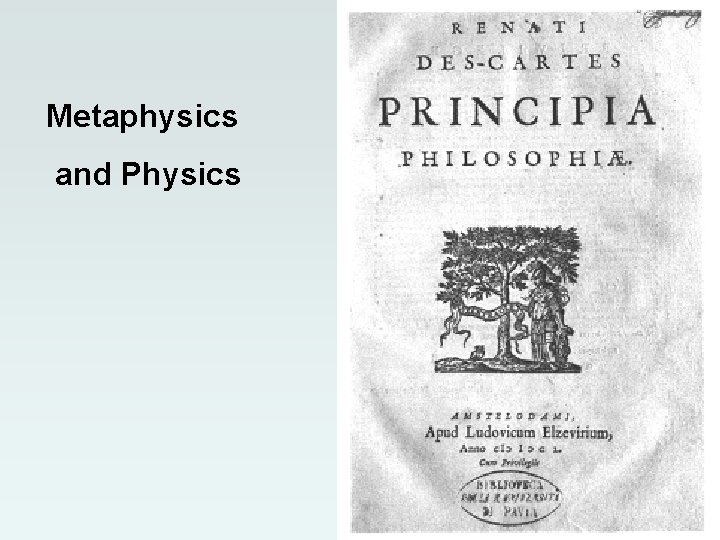
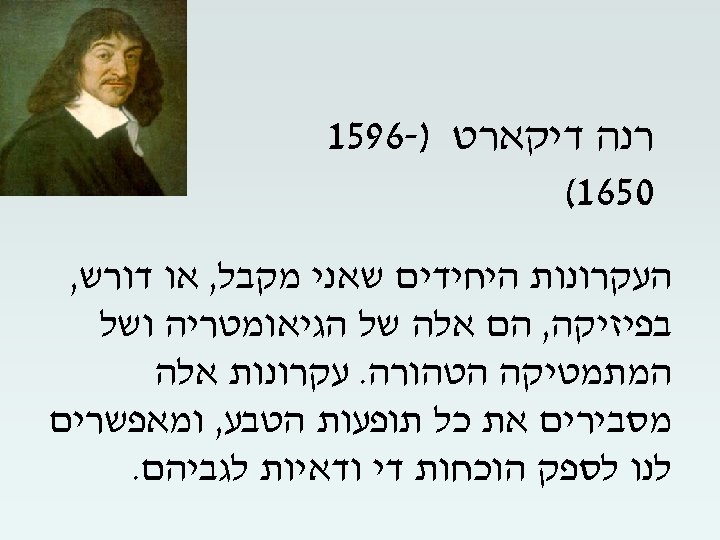
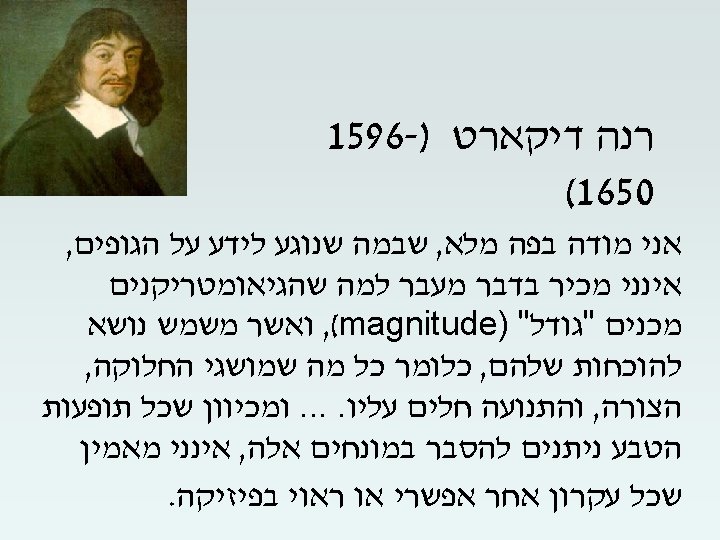
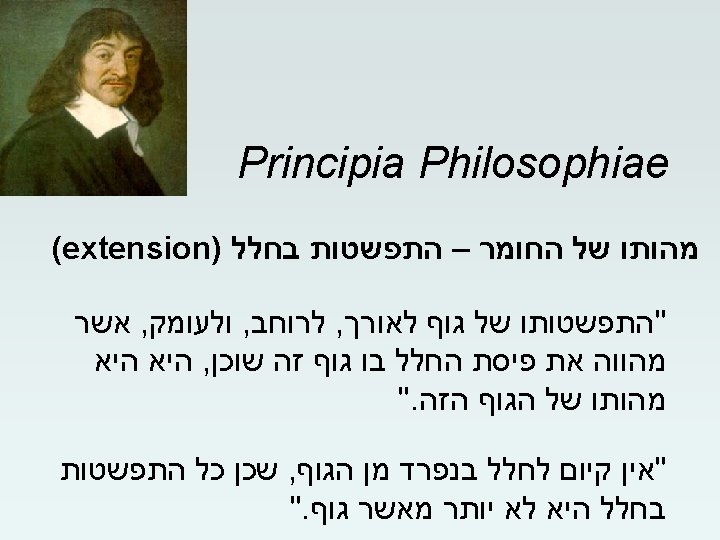
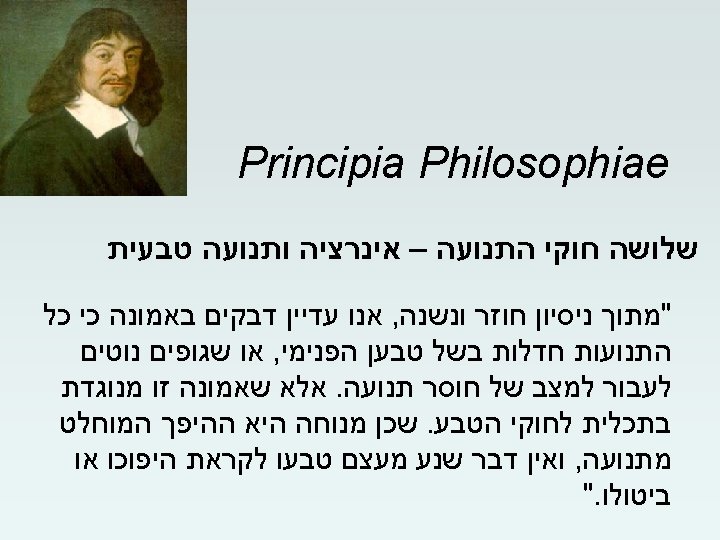
דיקארט רנה (1596 -1650) 1606 Jesuit Collège Royal Henry-Le-Grand (La Flèche) 1616: Law at University of Poitiers 1626– 1628: Rules for the Direction of the Mind). 1630: Le Monde (not published – heard about Galileo) 1637: Discours de la méthode (Discourse on the Method). 1641: Méditations Metaphysiques 1644: Principia philosophiae.
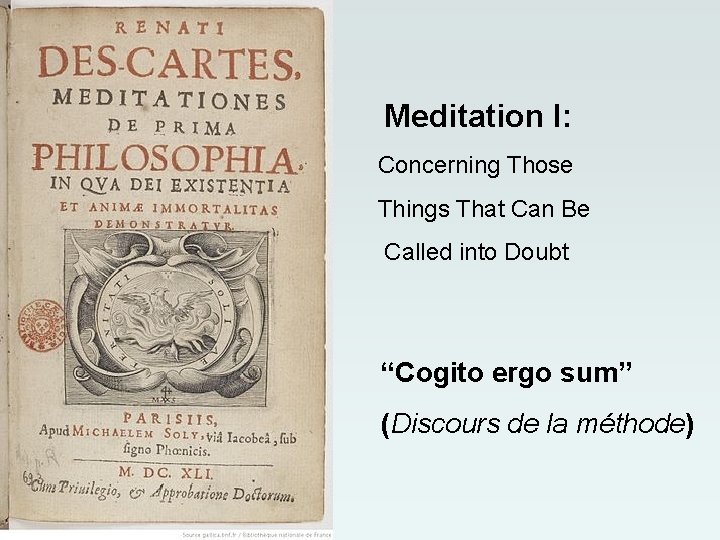
Meditation I: Concerning Those Things That Can Be Called into Doubt “Cogito ergo sum” (Discours de la méthode)
Descartes’ criticism of Aristotle’s “Empiricism” “There is nothing in the intellect that was not previously in the senses” … but the senses deceive us … Human intellect is able to perceive the nature of reality through a purely intellectual perception. In order to procure the fundamental truths of metaphysics, we must “withdraw the mind from the senses. ”
Descartes methodical doubt “Cogito ergo sum” “I have convinced myself that there is nothing in the world — no sky, no earth, no minds, no bodies. Doesn't it follow that I don't exist? No, surely I must exist if it's me who is convinced of something. But there is a deceiver, supremely powerful and cunning whose aim is to see that I am always deceived. But surely I exist, if I am deceived. Let him deceive me all he can, he will never make it the case that I am nothing while I think that I am something. Thus having fully weighed every consideration, I must finally conclude that the statement "I am, I exist" must be true whenever I state it or mentally consider it. ”
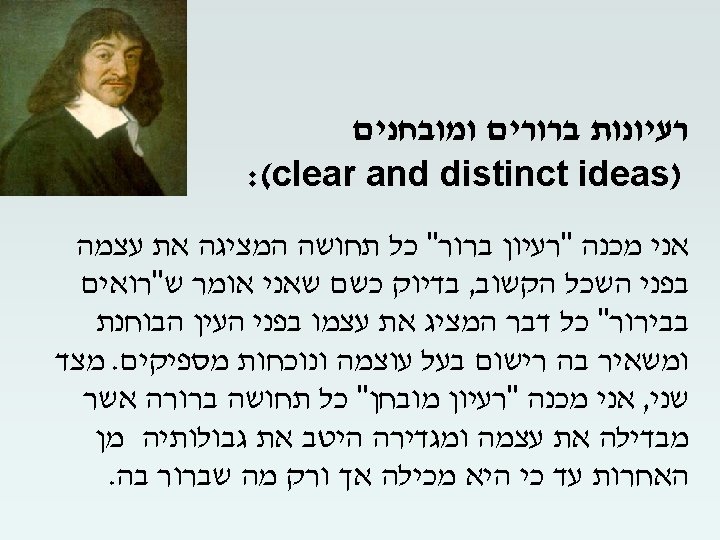
Descartes methodical doubt “Clear and Distinct Ideas” WAX: Wax isn't wax because of its color, texture or shape. All of these things can change and the substance still be wax. Wax is perceived "by the intellect alone“. When one understands the mathematical principles of the substance, such as its expansion under heat, figure and motion, the knowledge of the wax can be clear and distinct.
Descartes methodical doubt “Clear and Distinct Ideas” If a substance such as wax can be known in this fashion, then the same must be of ourselves. The self is not determined by what we sense of ourselves — these hands, this head, these eyes — but by simply the things one thinks. Thus, one "can't grasp anything more easily or plainly than [his] mind. "
Descartes methodical doubt “On the existence of God” • Something cannot come from nothing. • The cause of an idea must have at least as much formal reality as the idea has objective reality. • I have in me an idea of God. This idea has infinite objective reality. • I cannot be the cause of this idea, since I am not an infinite and perfect being. I don't have enough formal reality. Only an infinite and perfect being could cause such an idea.
Descartes methodical doubt “On the existence of God” • So God — a being with infinite formal reality — must exist (and be the source of my idea of God). • An absolutely perfect being is a good, benevolent being. • So God is benevolent. . . • So God would not deceive me, and would not permit me to err without giving me a way to correct my errors.
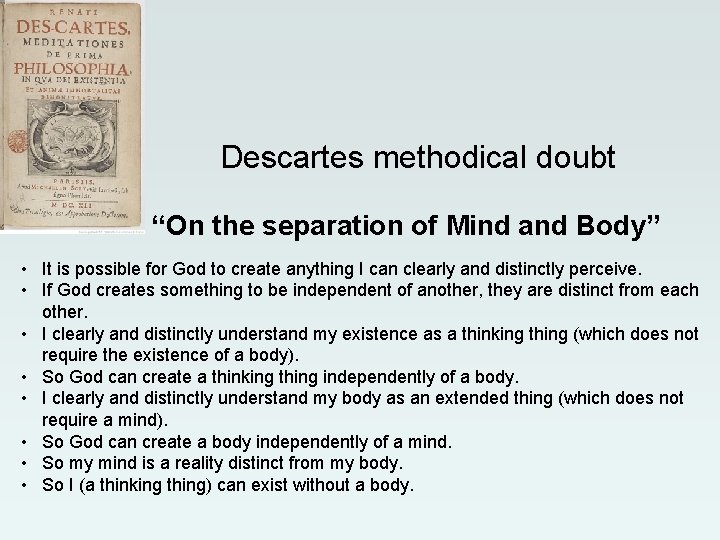
Descartes methodical doubt “On the separation of Mind and Body” • It is possible for God to create anything I can clearly and distinctly perceive. • If God creates something to be independent of another, they are distinct from each other. • I clearly and distinctly understand my existence as a thinking thing (which does not require the existence of a body). • So God can create a thinking thing independently of a body. • I clearly and distinctly understand my body as an extended thing (which does not require a mind). • So God can create a body independently of a mind. • So my mind is a reality distinct from my body. • So I (a thinking thing) can exist without a body.
Metaphysics and Science
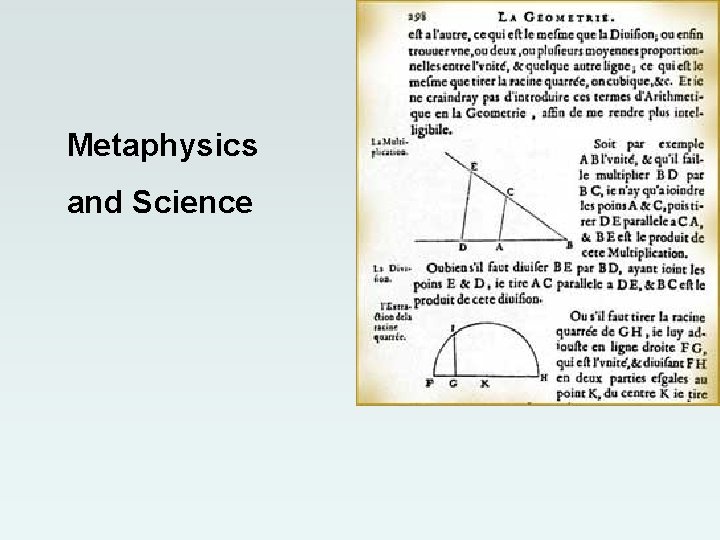
Metaphysics and Science
Metaphysics and Science
Metaphysics and Physics
Aristotle (Physics): three classes of motion • In place (local motion), • In quantity, or size (growth-diminution), • In quality (alteration)
Motion is the process that a substance goes through in which it loses one “accidental form” and gains another. Motion is the act of something that does not yet have, but is acquiring, the full act of a new accidental determination, a new quality, size or position.
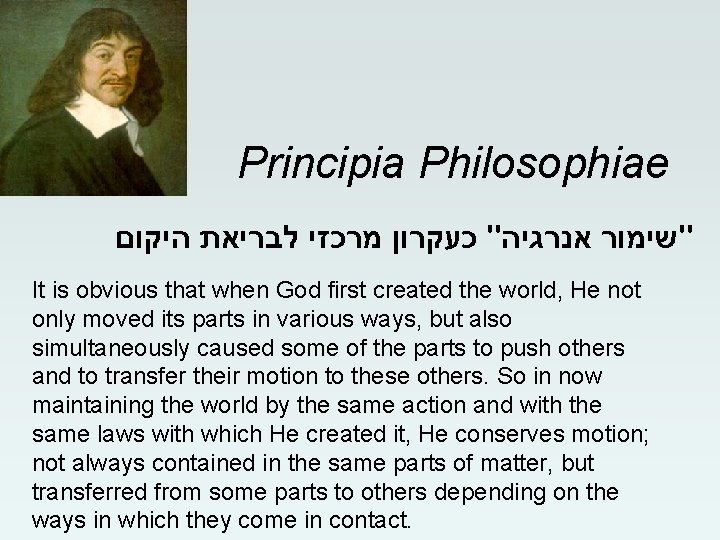
Principia Philosophiae "שימור אנרגיה" כעקרון מרכזי לבריאת היקום It is obvious that when God first created the world, He not only moved its parts in various ways, but also simultaneously caused some of the parts to push others and to transfer their motion to these others. So in now maintaining the world by the same action and with the same laws with which He created it, He conserves motion; not always contained in the same parts of matter, but transferred from some parts to others depending on the ways in which they come in contact.
Vortex Theory
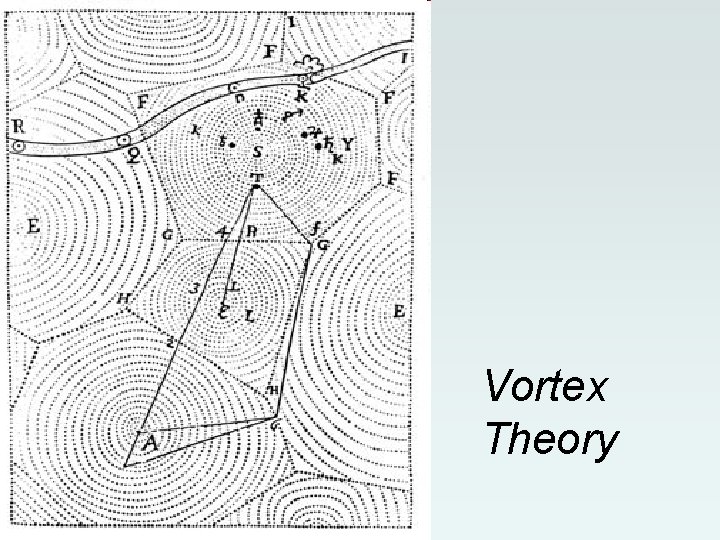
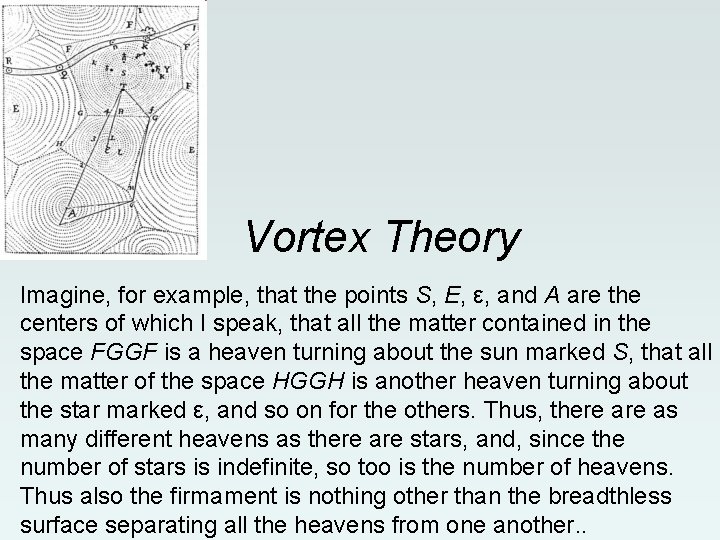
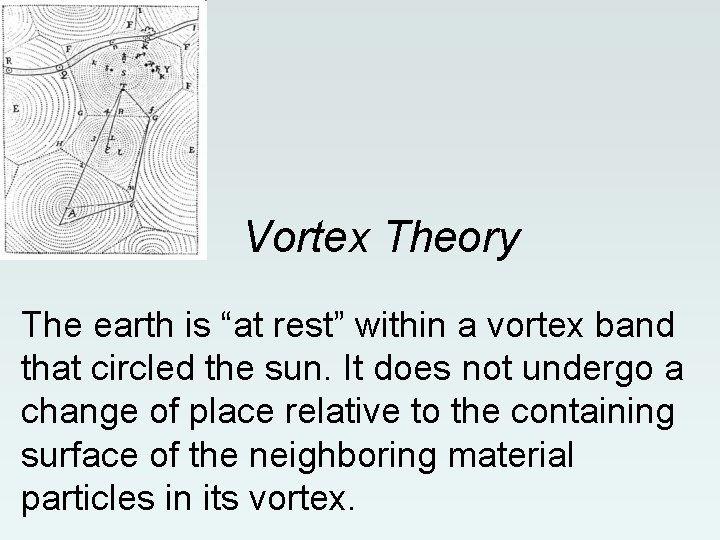
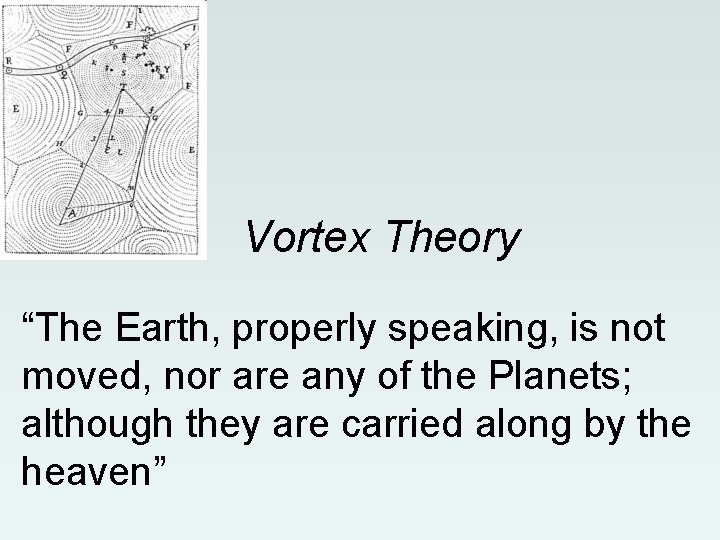
Vortex Theory Imagine, for example, that the points S, E, ε, and A are the centers of which I speak, that all the matter contained in the space FGGF is a heaven turning about the sun marked S, that all the matter of the space HGGH is another heaven turning about the star marked ε, and so on for the others. Thus, there as many different heavens as there are stars, and, since the number of stars is indefinite, so too is the number of heavens. Thus also the firmament is nothing other than the breadthless surface separating all the heavens from one another. .
Vortex Theory The earth is “at rest” within a vortex band that circled the sun. It does not undergo a change of place relative to the containing surface of the neighboring material particles in its vortex.
Vortex Theory “The Earth, properly speaking, is not moved, nor are any of the Planets; although they are carried along by the heaven”
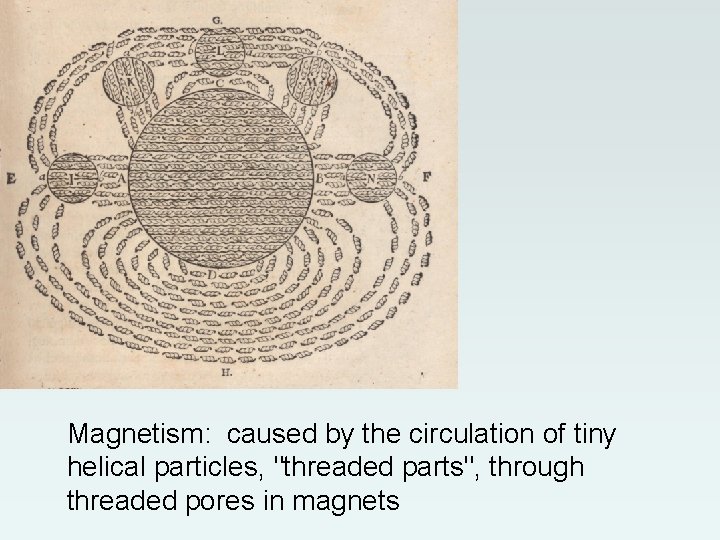
Magnetism: caused by the circulation of tiny helical particles, "threaded parts", through threaded pores in magnets
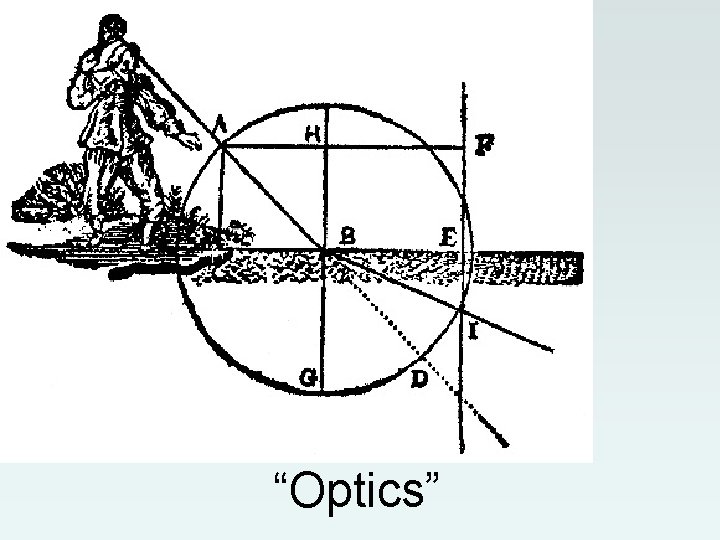
“Optics”