
Greek and Roman History In Regards To Modern
- Slides: 17
Greek and Roman History In Regards To Modern Society BY DANI DOMBI
Overview The purpose of this presentation is to demonstrate my personal understanding of the topics covered in Unit 3 This presentation will take the product of each person or thing relating to ancient Greek and Roman history and contrast how influential it is on todays society, by categorizing them as either “dead” works or “alive” works Subjects will be divided into 5 categories: people, wars, ages, and places, and events
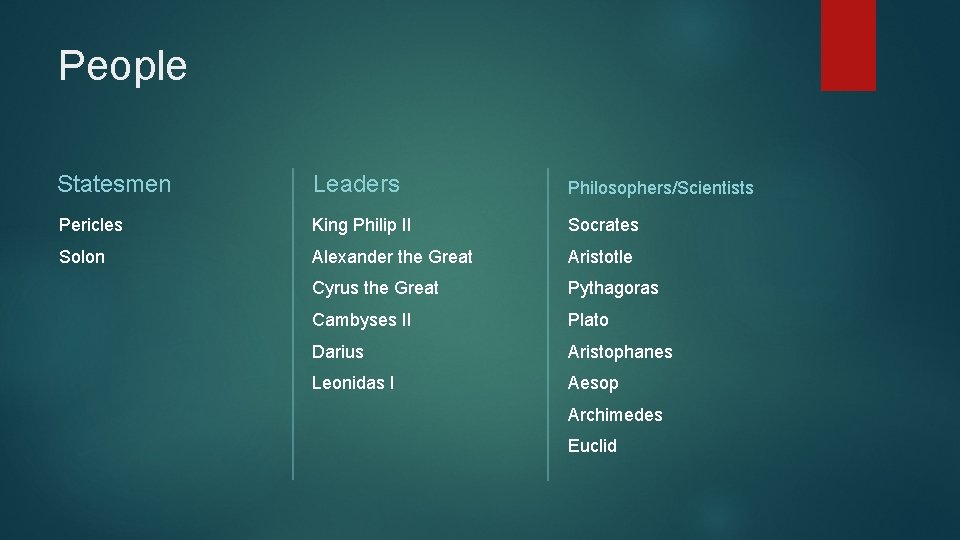
People Statesmen Leaders Philosophers/Scientists Pericles King Philip II Socrates Solon Alexander the Great Aristotle Cyrus the Great Pythagoras Cambyses II Plato Darius Aristophanes Leonidas I Aesop Archimedes Euclid
Statesmen Pericles -Responsible for development of Athenian democracy and Athenian empire in the later 5 th century bce. -Constructed the Acropolis (began in 447) Solon -One of the Seven Wise Men of Greece. -Ended exclusive aristocratic control of government, substituted with a plutocracy. -Also a noted poet.
Leaders Philip II King of Macedon from 359 BC until his assassination in 336 BC. Was a member of the Argead dynasty Father of Alexander the Great King of Macedon from 336 BCE until 323 BCE. Overthrew the Persian empire Cyrus the Great By 539 bce, his empire covered 2000 miles of land (from the Indus river to Anatolia). Respected the cultures of the people, and gave them the freedom to continue living their lives the way they were, while he maintained absolute power. Died fighting off nomadic invaders.
Leaders (cont. ) Cambyses II Cyrus’s son reigned 529– 522 bce Didn’t treat people with the same respect, and was cruel to the Egyptians, as he ordered to have every portrait of the Egyptian gods burned. Ruled for 8 years and died, rebellions popped up everywhere. Darius Under his rule, the Persian empire expanded to cover 2500 miles of land, but he failed to conquer Greece Separated the Persian Empire into 20 provinces Established satraps in the provinces. Developed road systems Manufactured metal coins Leonidas I Spartan king who stood against the invading Persian army Epitome of Greek heroism and bravery against overwhelming odds.
Scientists/Philosophers Socrates Influenced ancient and modern philosophy, considered controversial and was mocked in literature (refer to The Clouds of Aristophanes), and wrote nothing Plato’s Apology of Socrates purports to be the speech Socrates gave in trial. This document with its powerful advocacy of examined life and condemnation of Athenian Democracy have made it one of the central documents of Western thought and culture. Aristotle Author of a system that became framework for Christian Scholasticism and medieval Islamic philosophy; his concepts remained embedded in Western thinking through many revolutions. He had an understanding of a wide variety of topics Founder of formal logic Some of his work remained unsurpassed into the 19 th century
Scientists/Philosophers Pythagoras Philosopher, mathematician, and founder of the Pythagorean brotherhood. Influenced the thought of Plato and Aristotle, contributed to the development of mathematics and Western rational philosophy Plato Student of Socrates, teacher of Aristotle, and founder of the Academy The author of philosophical works of unparalleled influence. In metaphysics, he visioned a systematic, rational treatment of the forms and their interrelations. in ethics and moral psychology he developed the view that the good life requires habituation to healthy emotional responses, or harmony between the three parts of the soul (reason, spirit, and appetite) His works also contain discussions in aesthetics, political philosophy, theology, cosmology, epistemology, and the philosophy of language.
Scientists/Philosophers Aristophanes Representative of ancient Greek comedy and the one whose works have been preserved in greatest quantity. He is the only extant representative of the Old Comedy Aesop Supposed author of a collection of Greek fables, almost certainly a legendary figure Various attempts were made in ancient times to establish him as an actual personage Aesop was probably no more than a name invented to provide an author fables centering on beasts, so that “a story of Aesop” became synonymous with “fable. ”
Scientists/Philosophers Archimedes The most-famous mathematician and inventor in ancient Greece Especially important for his discovery of the relation between the surface and volume of a sphere and its circumscribing cylinder He is known for his formulation of a hydrostatic principle known as Archimedes’ principle, and the Archimedes screw Euclid The most prominent mathematician of Greco-Roman antiquity, best known for his work on geometry in the Elements.
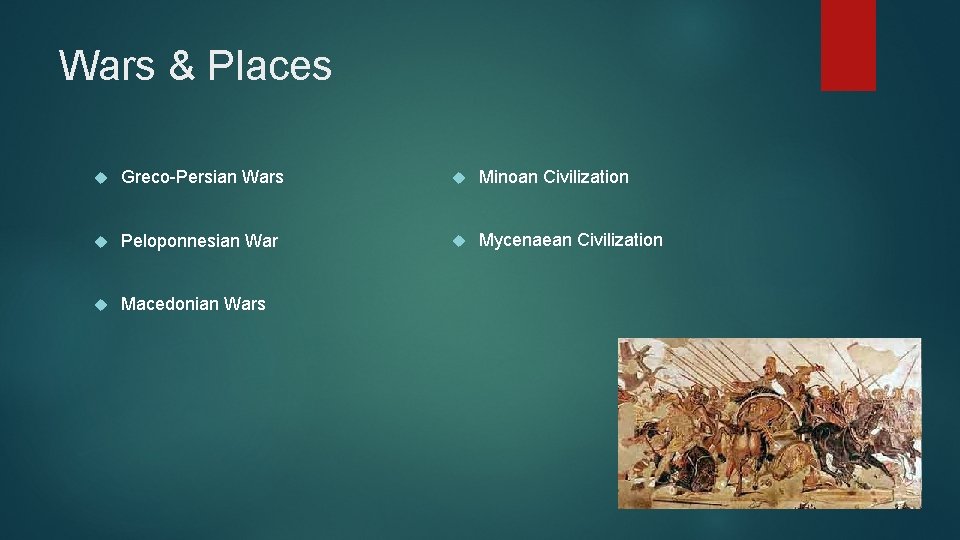
Wars & Places Greco-Persian Wars Minoan Civilization Peloponnesian War Mycenaean Civilization Macedonian Wars
Wars Greco-Persian Wars Series of wars fought by Greek states and Persia over a period of almost half a century Defense mounted by the Greeks overcame seemingly impossible odds and succeeded in liberating Greek city-states on the fringe of Persia The Greek triumph ensured the survival of Greek culture and political structures long after the demise of the Persian empire. Peloponnesian War Fought between Athens and Sparta Each stood at the head of alliances that included nearly every Greek city-state The fighting engulfed virtually the entire Greek world, and it was properly regarded by Thucydides, as the most momentous war up to that time. Macedonian War Four conflicts between the ancient Roman Republic and Macedonia. They caused increasing involvement by Rome in Greek affairs and helped lead to Roman domination of the entire eastern Mediterranean area.
Places Minoan Civilization Bronze Age civilization of Crete that thrived from about 3000 bc to about 1100 bc. Its name comes from Minos, either a dynastic title or the name of a particular ruler of Crete who has a place in Greek legend. Mycenaean Civilization Prehistoric greek city Told to be the capital of Agamemnon.
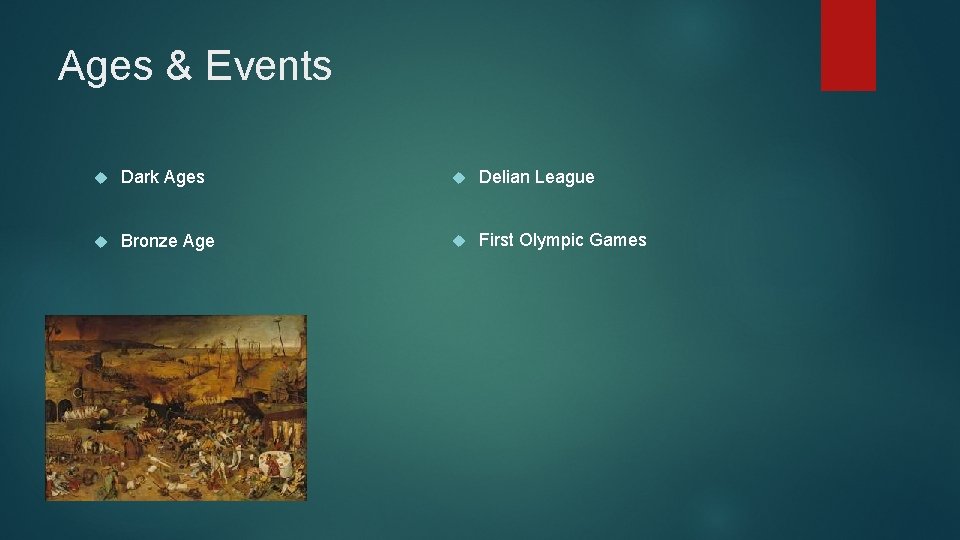
Ages & Events Dark Ages Delian League Bronze Age First Olympic Games
Ages Dark Age 13 th century bce, Aegean world came to a violent end Both internal dissension and foreign invasion seem to have played a part in this development. Small settlements in Mycenean and Minoan kingdoms couldn’t support luxuries of the bronze age, and the bronze age aesthetics were lost. Greece began recovering at the end of the 11 th century bce and secured a basis for all future developments. Bronze Age Third phase in the development of material culture among the ancient peoples of Europe, Asia, and the Middle East, following the Old Stone Age and New Stone Age. The term also denotes the first period in which metal was used. The date at which the age began varied with regions
Events Delian League Confederacy of ancient Greek states under the leadership of Athens, founded during the Greco-Persian wars All Greeks were invited to join to protect themselves from Achaemenian Persia, and money was to be received and controlled by 10 Athenian treasurers. Representatives of all member states, each with equal vote, met annually at Delos, where the league’s treasury was kept in the temple of Apollo. Included most of the Aegean islands, except Aegina, Melos, and Thera, most of the cities of Chalcidice, the shores of the Hellespont and Bosporus, some of Aeolia, most of Ionia, and a few eastern Dorian and non-Greek Carian cities. First Olympic Games 776 bce is the first year of the Olympic Games Computed by Hippias, named from a place where he is originally from.
Citations "The History of the Persian War. " Google Sites. N. p. , n. d. Web. 21 Dec. 2016. Yezpitelok, Maxwell, M. Asher Cantrell, Peter File, Henrik Magnusson, Blair Dodge, Ray Mc. Bride, Robert Evans, Rafi Sela, Adam Wears, CRACKED Staff, Richy Craven, Xavier Jackson, and Dustin Koski. "5 Ridiculous Myths You Probably Believe About the Dark Ages. " Cracked. com. CRACKED, 27 Sept. 2013. Web. 21 Dec. 2016.