
Greedy Algorithms The Change Making Problem A given
Greedy Algorithms
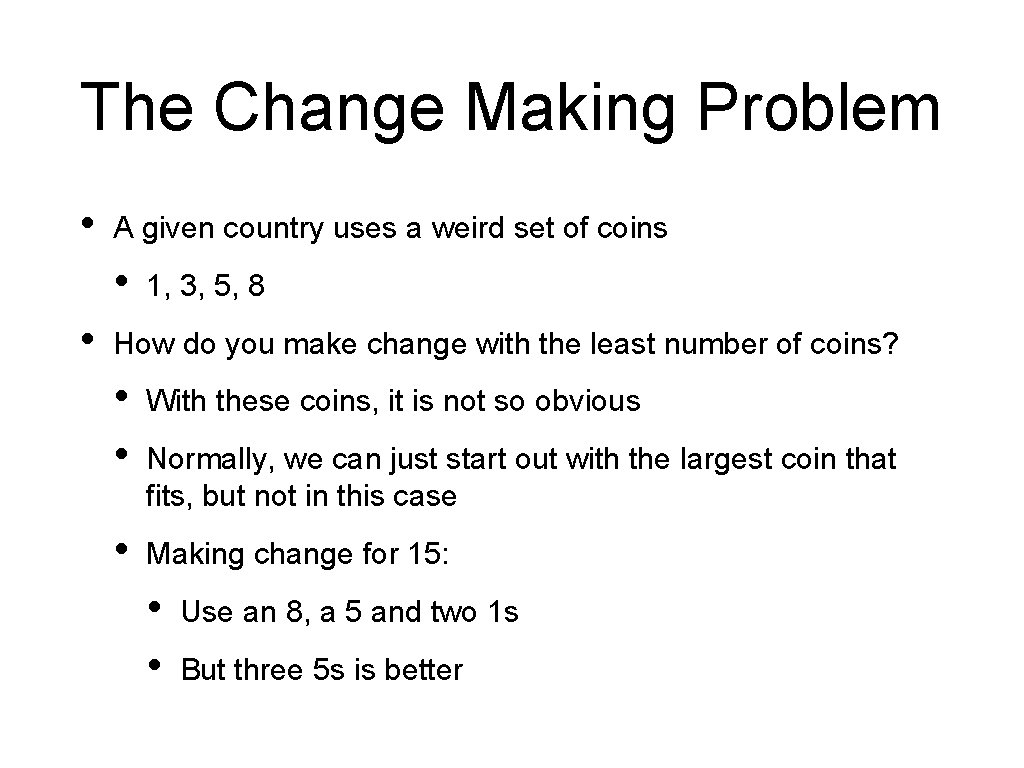
The Change Making Problem • A given country uses a weird set of coins • • 1, 3, 5, 8 How do you make change with the least number of coins? • • With these coins, it is not so obvious • Making change for 15: Normally, we can just start out with the largest coin that fits, but not in this case • • Use an 8, a 5 and two 1 s But three 5 s is better
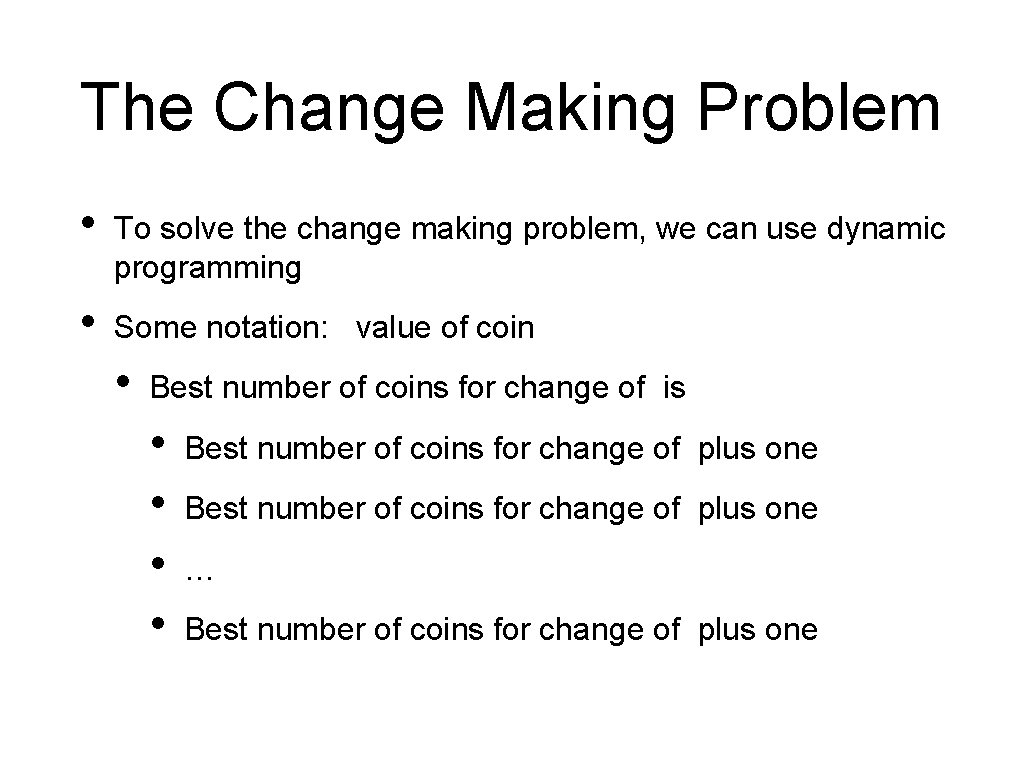
The Change Making Problem • To solve the change making problem, we can use dynamic programming • Some notation: value of coin • Best number of coins for change of is • • Best number of coins for change of plus one … Best number of coins for change of plus one
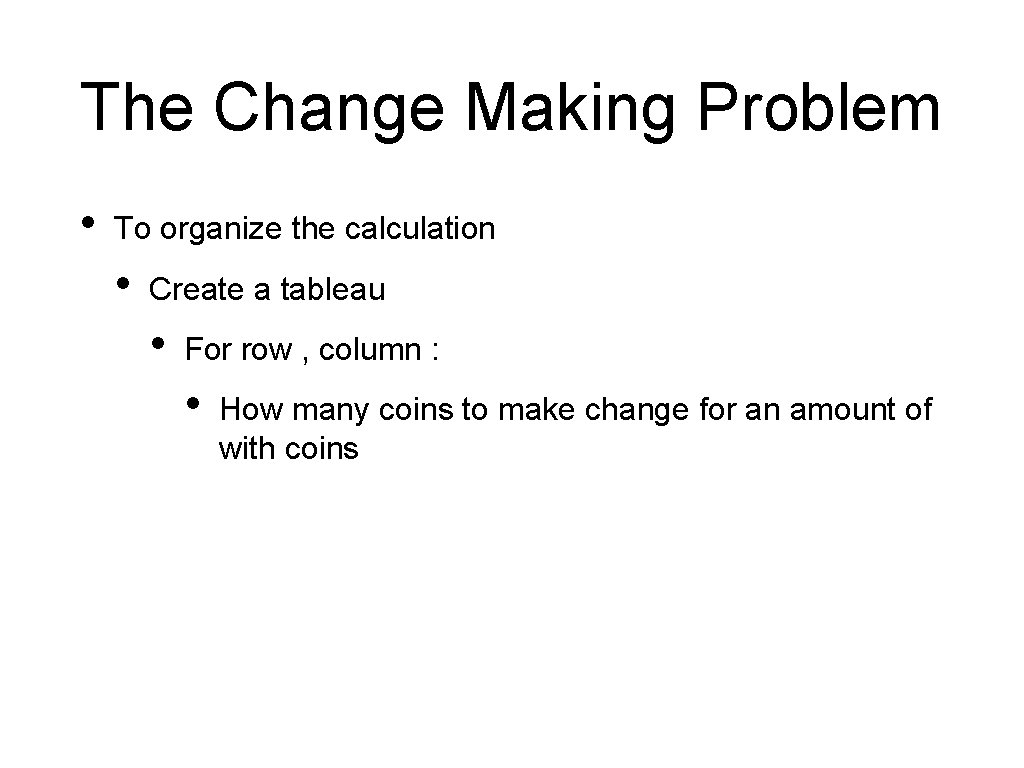
The Change Making Problem • To organize the calculation • Create a tableau • For row , column : • How many coins to make change for an amount of with coins
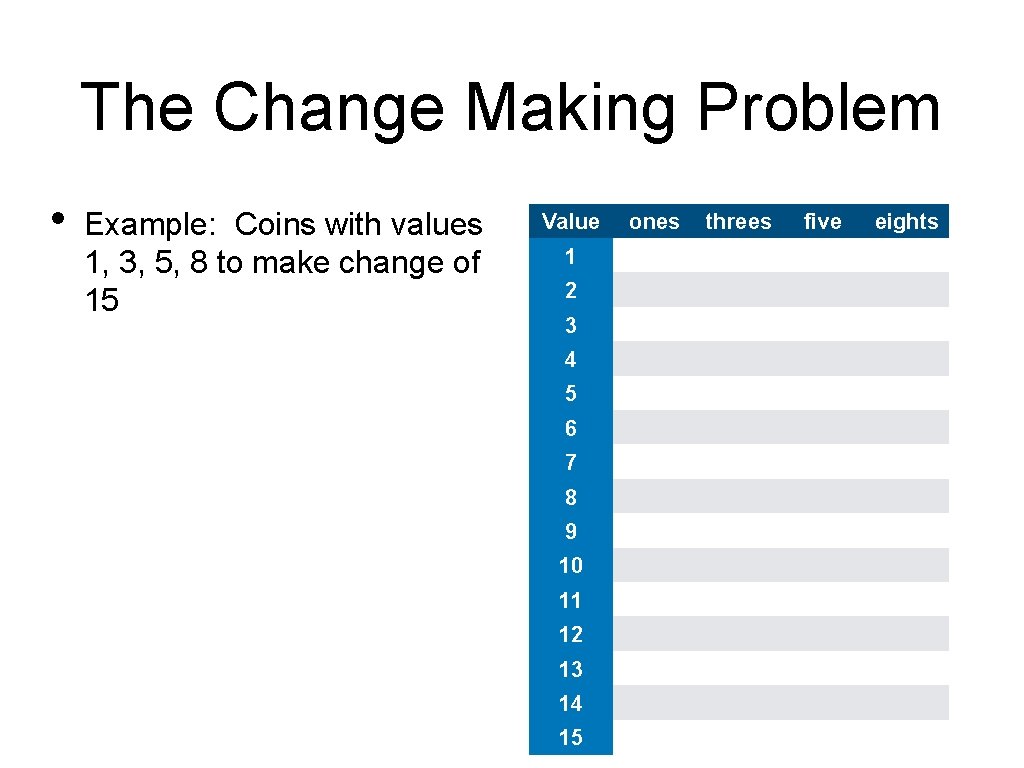
The Change Making Problem • Example: Coins with values 1, 3, 5, 8 to make change of 15 Value 1 2 3 4 5 6 7 8 9 10 11 12 13 14 15 ones threes five eights

The Change Making Problem • • Example: Coins with values 1, 3, 5, 8 to make change of 15 First column is easy Value ones 1 1 2 2 3 3 4 4 5 5 6 6 7 7 8 8 9 9 10 10 11 11 12 12 13 13 14 14 15 15 threes five eights
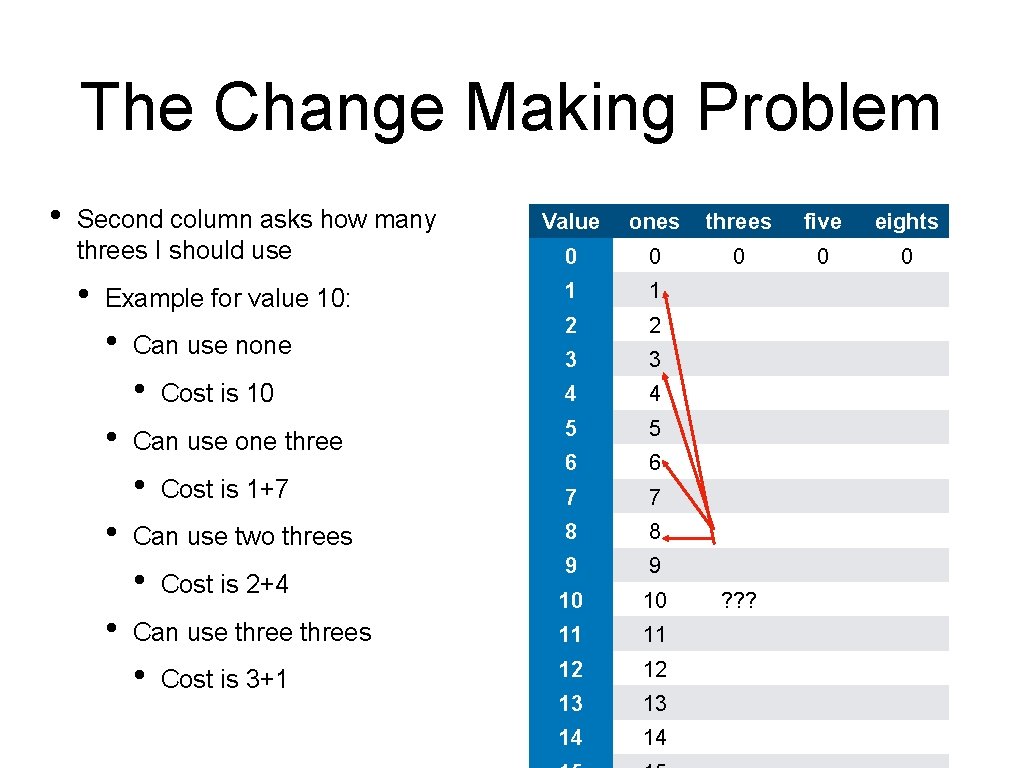
The Change Making Problem • Second column asks how many threes I should use • Value ones threes five eights 0 0 0 Example for value 10: 1 1 • 2 2 3 3 4 4 5 5 6 6 7 7 Can use two threes 8 8 • 9 9 10 10 Can use threes 11 11 • 12 12 13 13 14 14 Can use none • • Can use one three • • • Cost is 10 Cost is 1+7 Cost is 2+4 Cost is 3+1 ? ? ?
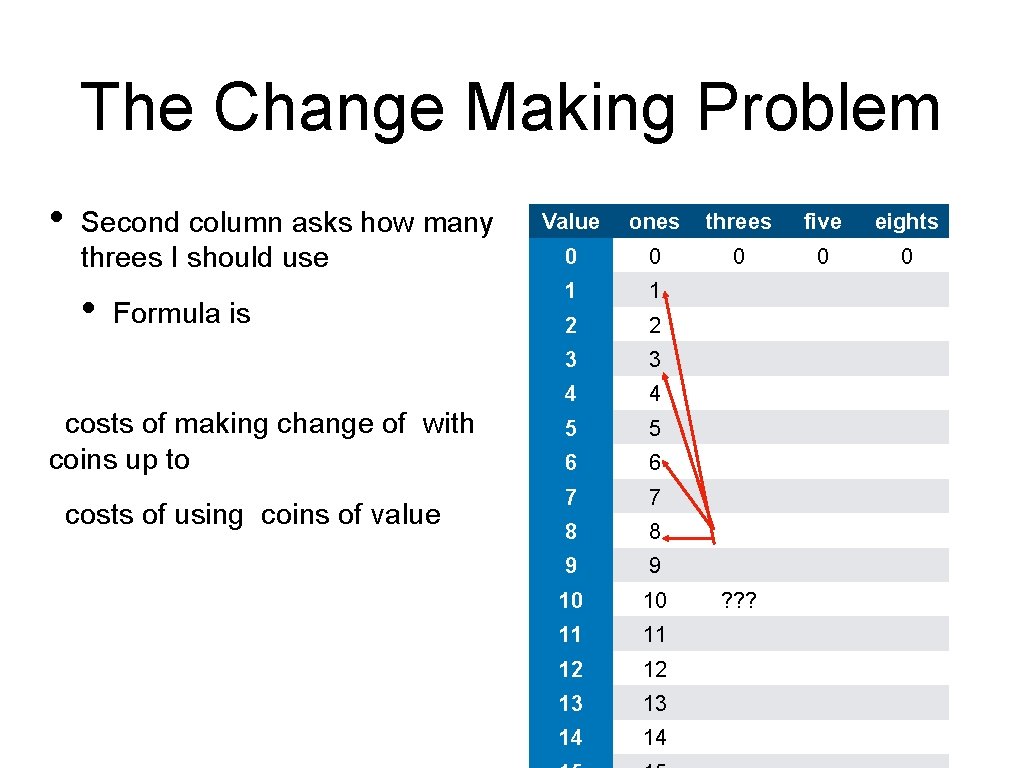
The Change Making Problem • Second column asks how many threes I should use • Formula is costs of making change of with coins up to costs of using coins of value Value ones threes five eights 0 0 0 1 1 2 2 3 3 4 4 5 5 6 6 7 7 8 8 9 9 10 10 11 11 12 12 13 13 14 14 ? ? ?
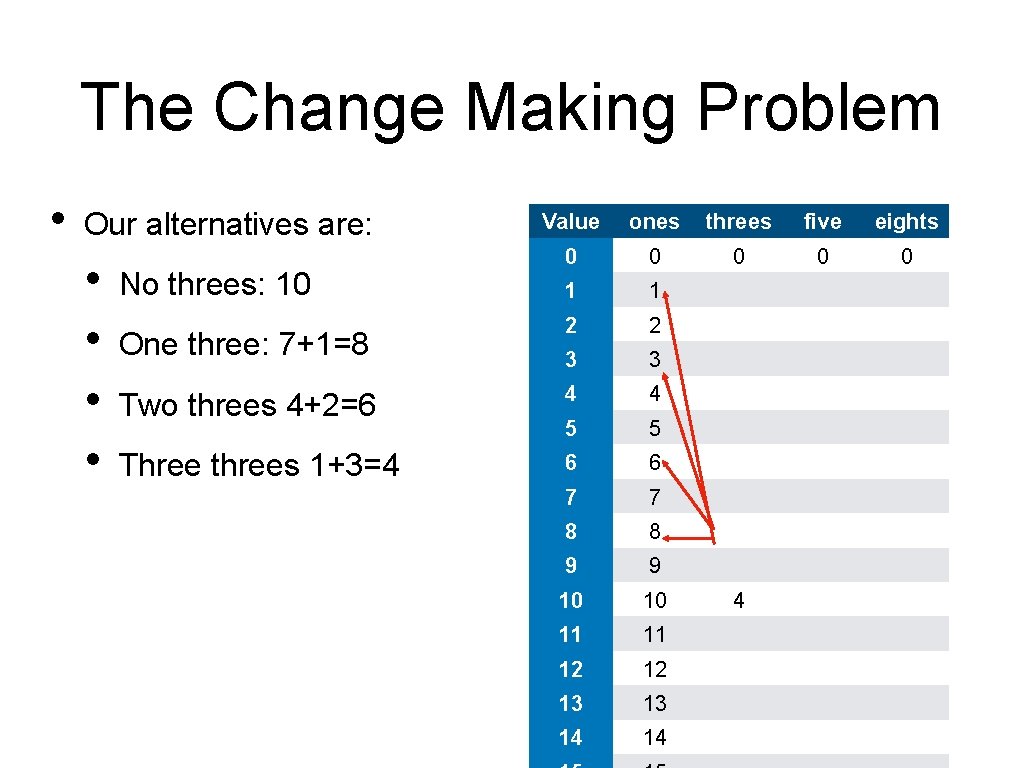
The Change Making Problem • Our alternatives are: • • Value ones threes five eights 0 0 0 1 1 2 2 3 3 Two threes 4+2=6 4 4 5 5 Three threes 1+3=4 6 6 7 7 8 8 9 9 10 10 11 11 12 12 13 13 14 14 No threes: 10 One three: 7+1=8 4
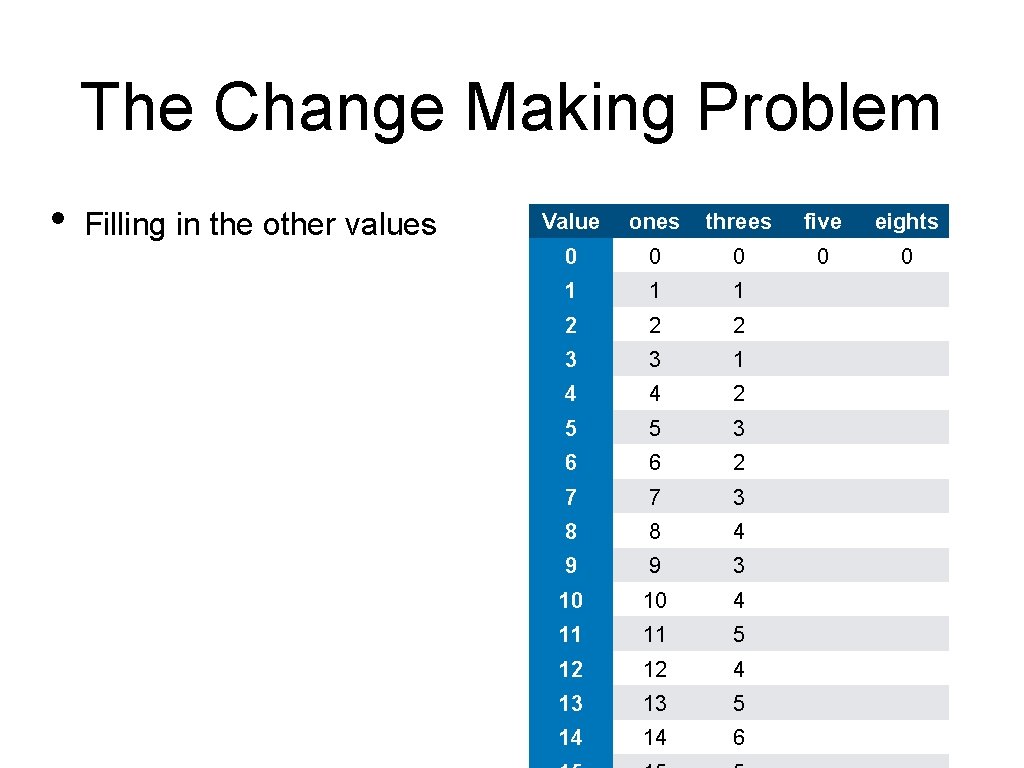
The Change Making Problem • Filling in the other values Value ones threes five eights 0 0 0 1 1 1 2 2 2 3 3 1 4 4 2 5 5 3 6 6 2 7 7 3 8 8 4 9 9 3 10 10 4 11 11 5 12 12 4 13 13 5 14 14 6
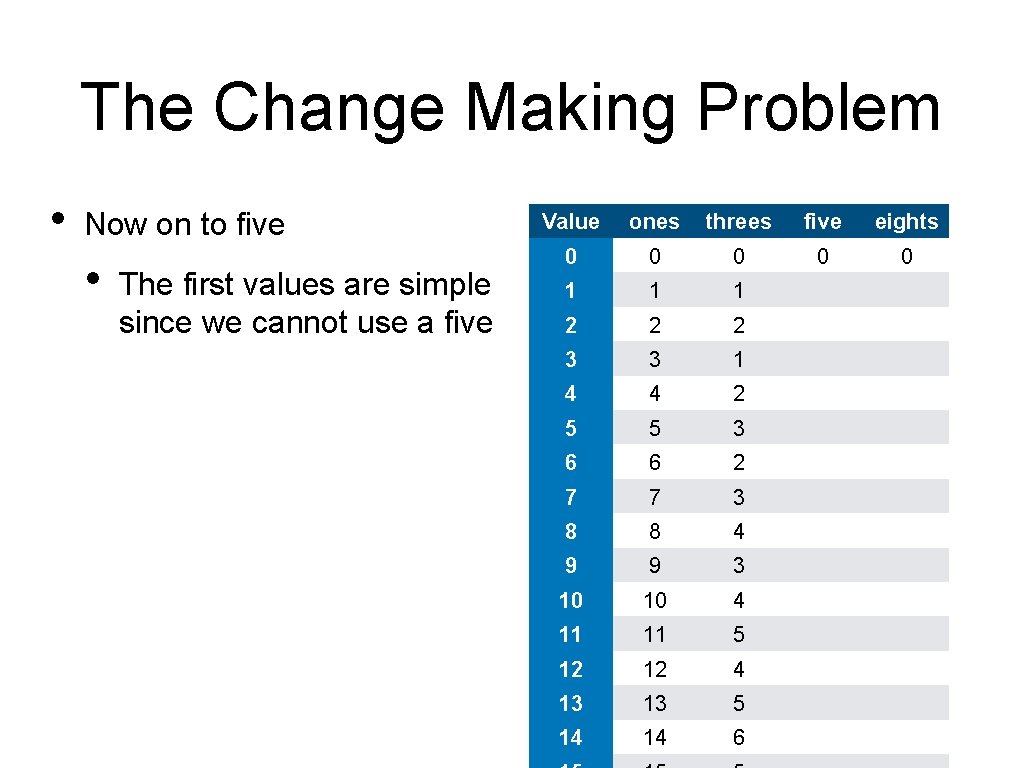
The Change Making Problem • Now on to five • The first values are simple since we cannot use a five Value ones threes five eights 0 0 0 1 1 1 2 2 2 3 3 1 4 4 2 5 5 3 6 6 2 7 7 3 8 8 4 9 9 3 10 10 4 11 11 5 12 12 4 13 13 5 14 14 6
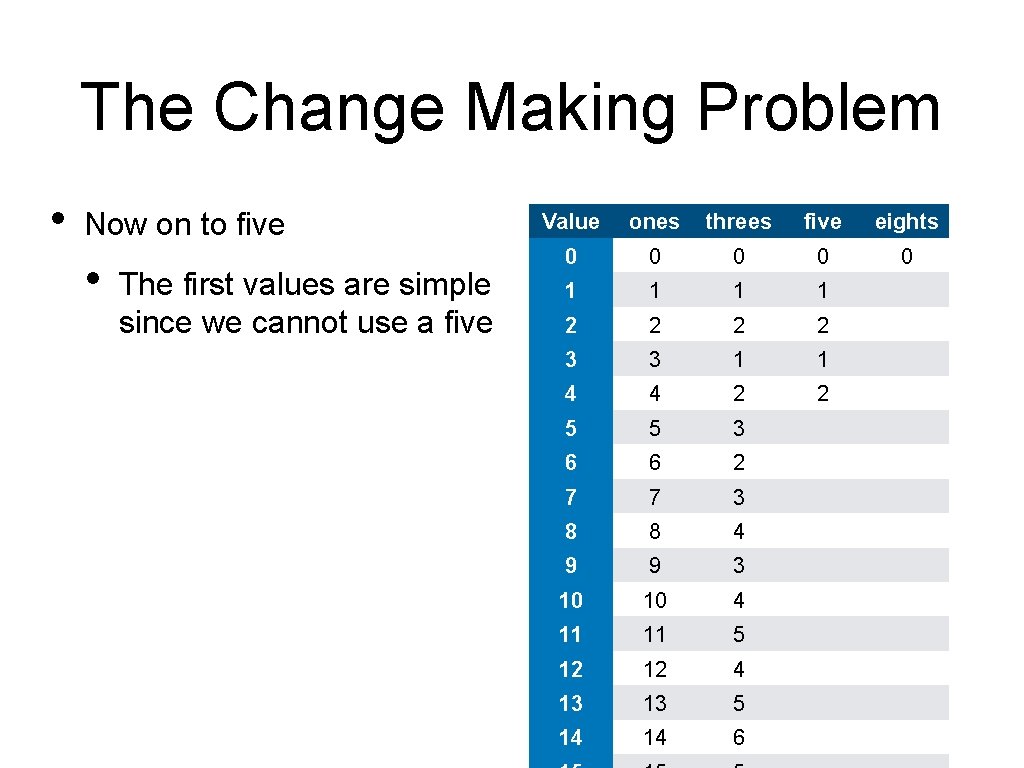
The Change Making Problem • Now on to five • The first values are simple since we cannot use a five Value ones threes five eights 0 0 0 1 1 2 2 3 3 1 1 4 4 2 2 5 5 3 6 6 2 7 7 3 8 8 4 9 9 3 10 10 4 11 11 5 12 12 4 13 13 5 14 14 6
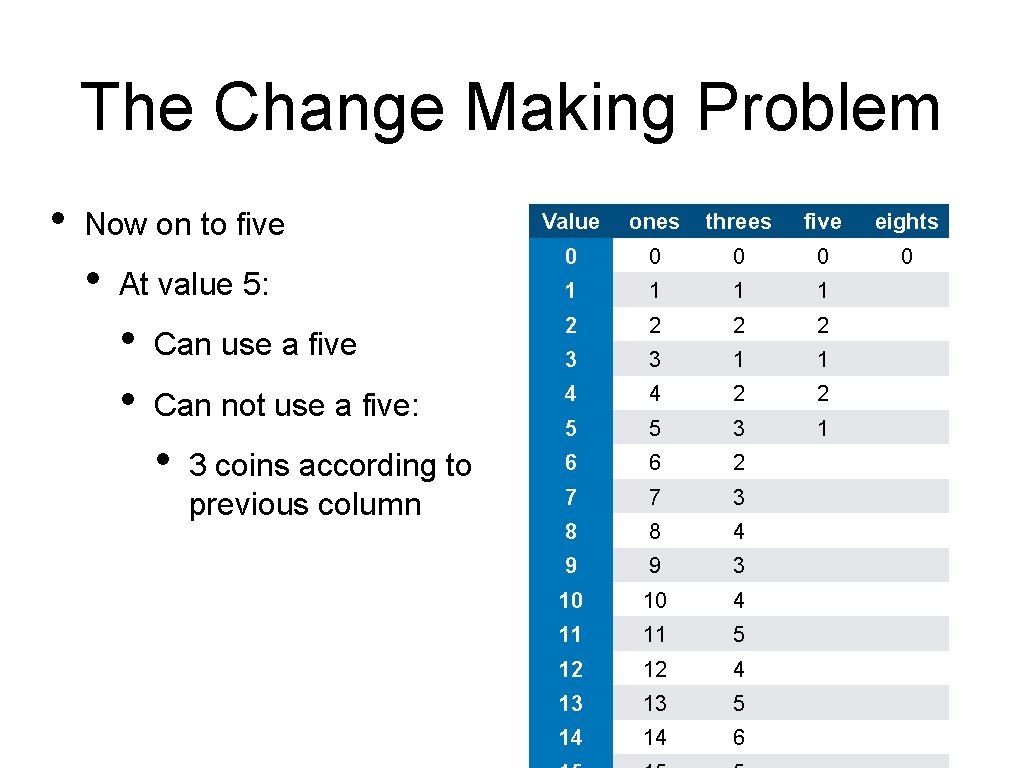
The Change Making Problem • Now on to five • Value ones threes five eights 0 0 0 1 1 2 2 3 3 1 1 Can not use a five: 4 4 2 2 • 5 5 3 1 6 6 2 7 7 3 8 8 4 9 9 3 10 10 4 11 11 5 12 12 4 13 13 5 14 14 6 At value 5: • • Can use a five 3 coins according to previous column
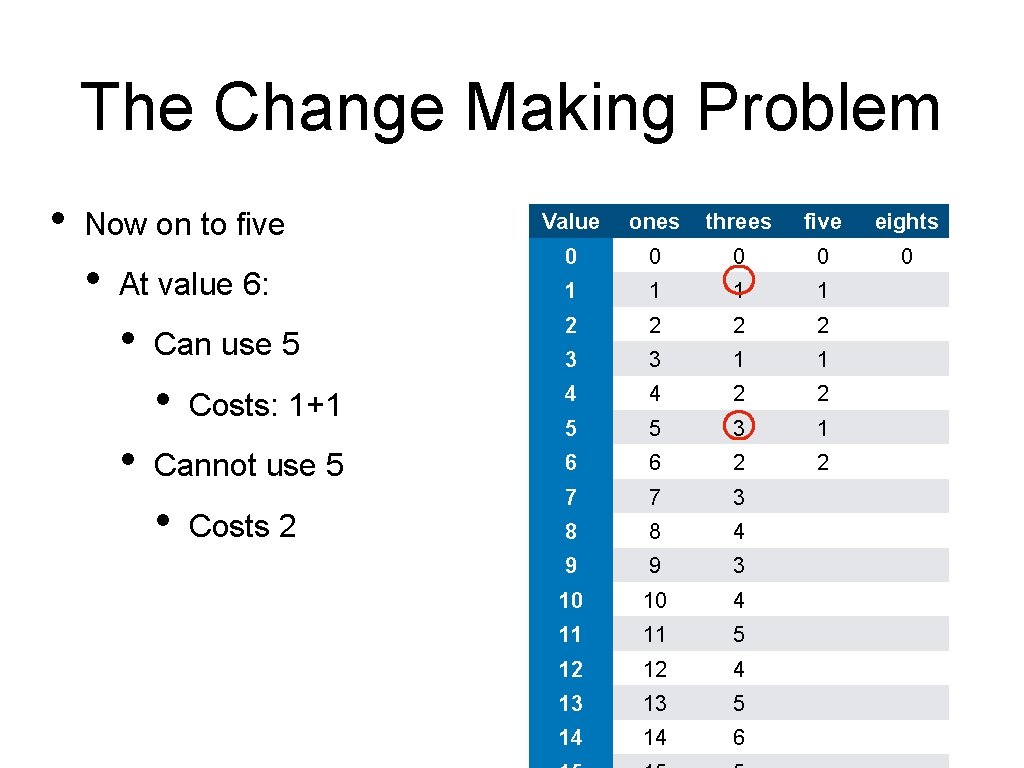
The Change Making Problem • Now on to five • Value ones threes five eights 0 0 0 1 1 2 2 3 3 1 1 Costs: 1+1 4 4 2 2 5 5 3 1 Cannot use 5 6 6 2 2 • 7 7 3 8 8 4 9 9 3 10 10 4 11 11 5 12 12 4 13 13 5 14 14 6 At value 6: • Can use 5 • • Costs 2
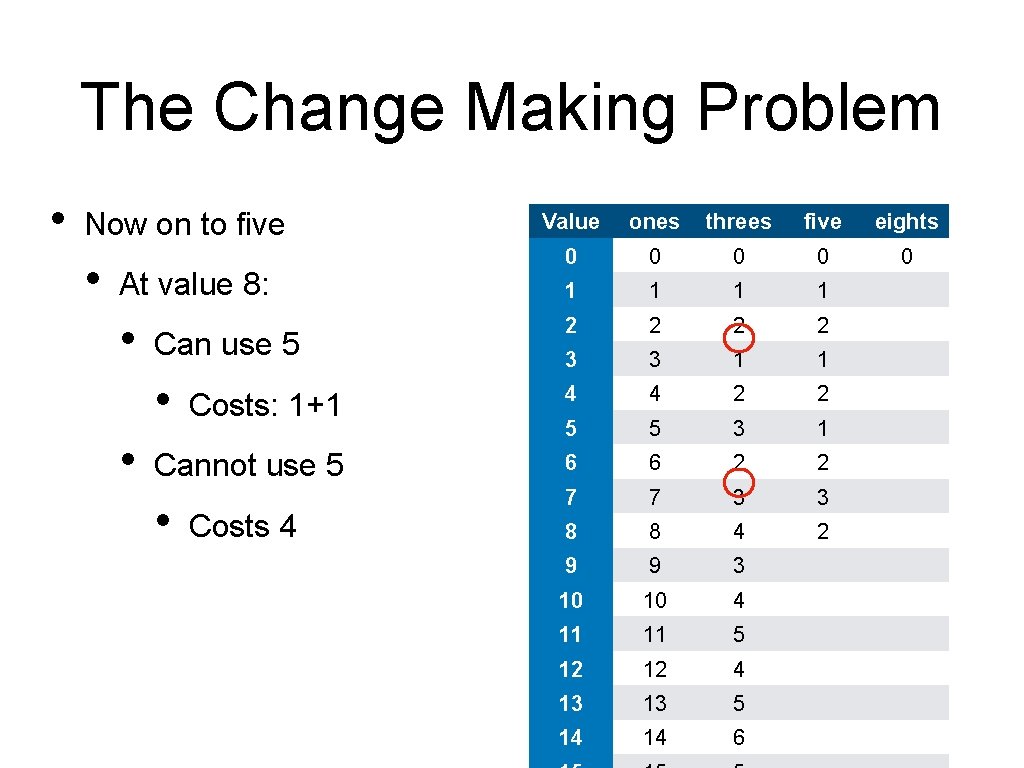
The Change Making Problem • Now on to five • Value ones threes five eights 0 0 0 1 1 2 2 3 3 1 1 Costs: 1+1 4 4 2 2 5 5 3 1 Cannot use 5 6 6 2 2 • 7 7 3 3 8 8 4 2 9 9 3 10 10 4 11 11 5 12 12 4 13 13 5 14 14 6 At value 8: • Can use 5 • • Costs 4
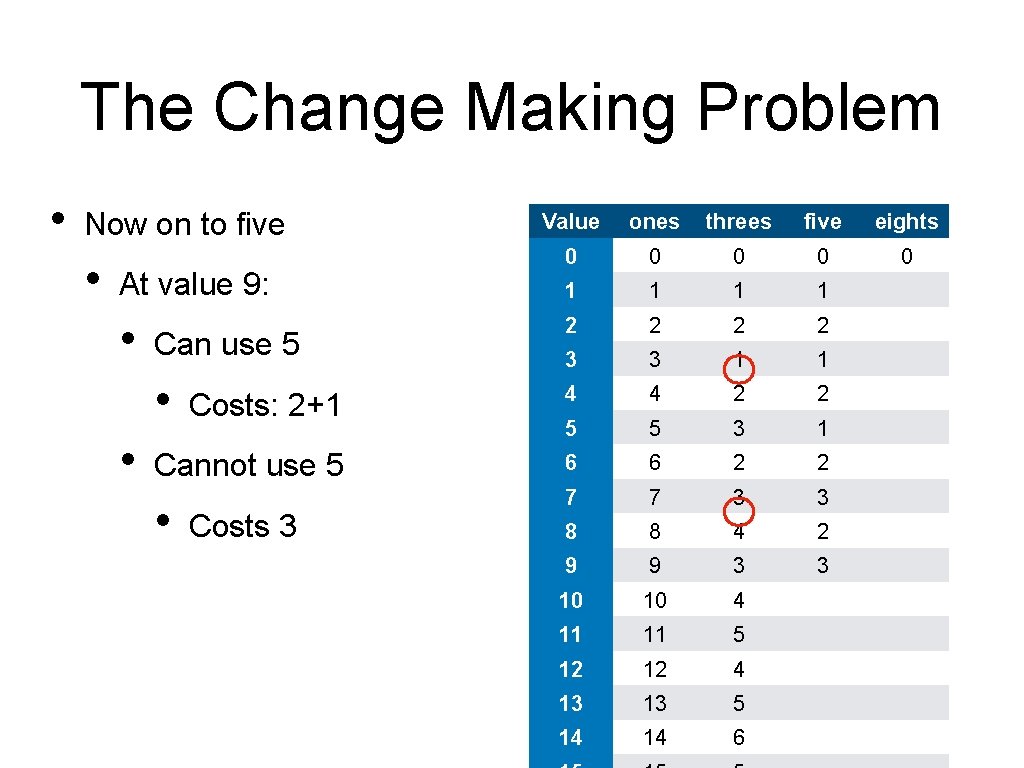
The Change Making Problem • Now on to five • Value ones threes five eights 0 0 0 1 1 2 2 3 3 1 1 Costs: 2+1 4 4 2 2 5 5 3 1 Cannot use 5 6 6 2 2 • 7 7 3 3 8 8 4 2 9 9 3 3 10 10 4 11 11 5 12 12 4 13 13 5 14 14 6 At value 9: • Can use 5 • • Costs 3
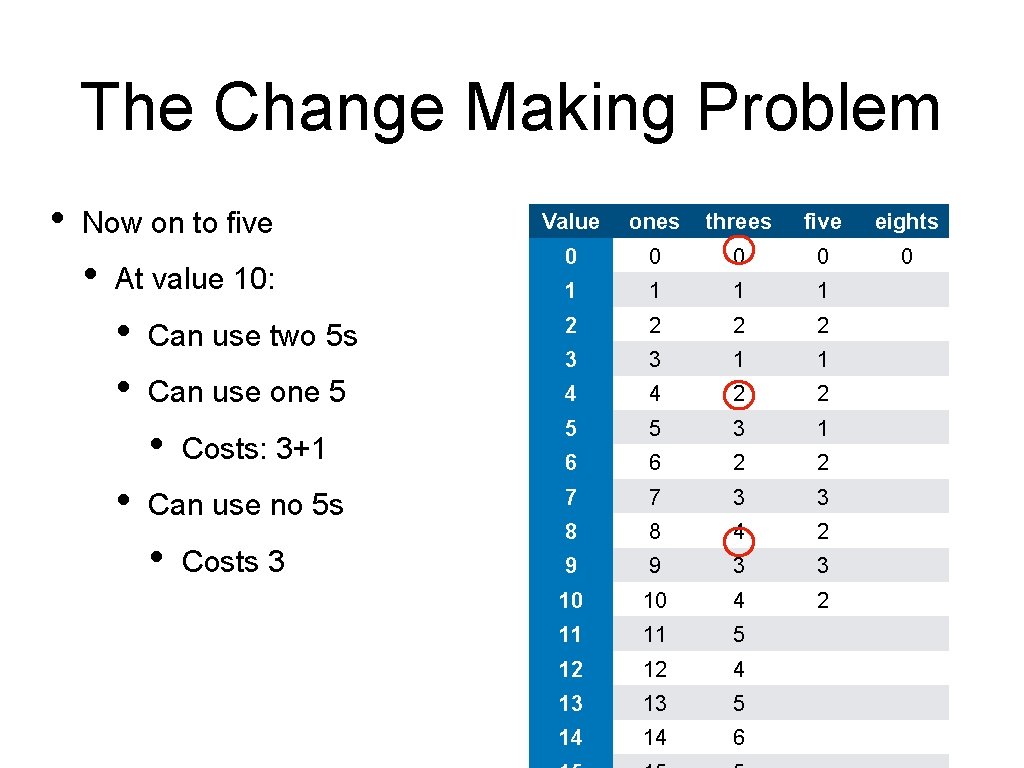
The Change Making Problem • Now on to five • Value ones threes five eights 0 0 0 1 1 Can use two 5 s 2 2 3 3 1 1 Can use one 5 4 4 2 2 • 5 5 3 1 6 6 2 2 Can use no 5 s 7 7 3 3 • 8 8 4 2 9 9 3 3 10 10 4 2 11 11 5 12 12 4 13 13 5 14 14 6 At value 10: • • • Costs: 3+1 Costs 3
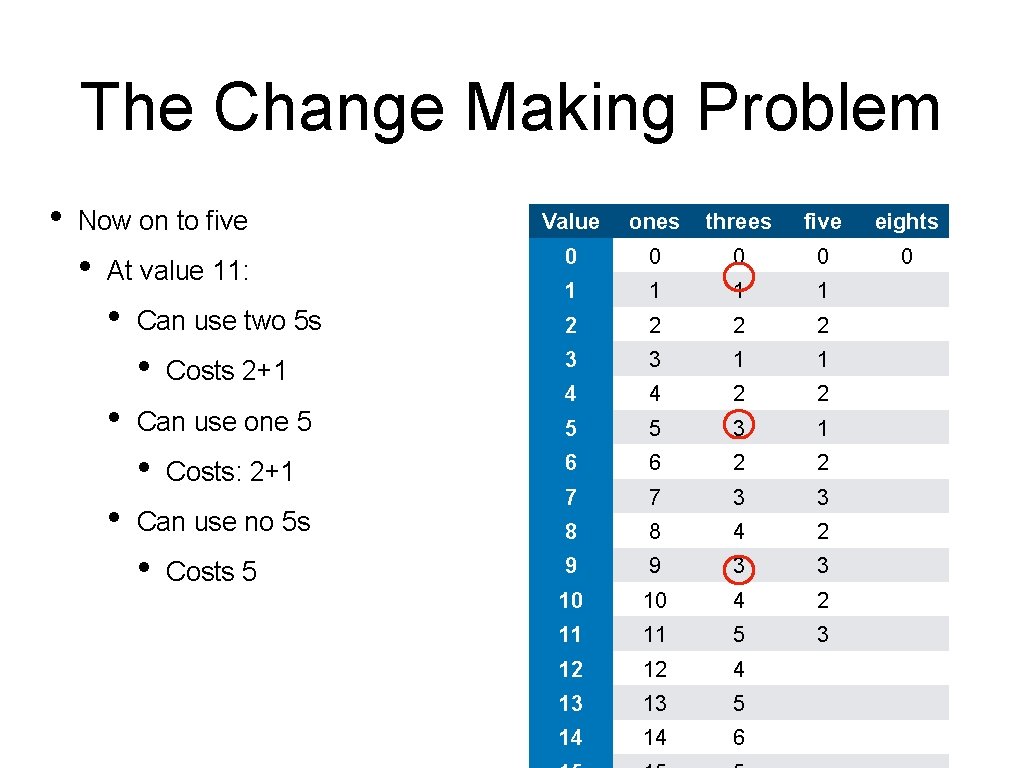
The Change Making Problem • Now on to five • Value ones threes five eights 0 0 0 1 1 Can use two 5 s 2 2 • Costs 2+1 3 3 1 1 4 4 2 2 Can use one 5 5 5 3 1 • 6 6 2 2 7 7 3 3 8 8 4 2 9 9 3 3 10 10 4 2 11 11 5 3 12 12 4 13 13 5 14 14 6 At value 11: • • • Costs: 2+1 Can use no 5 s • Costs 5
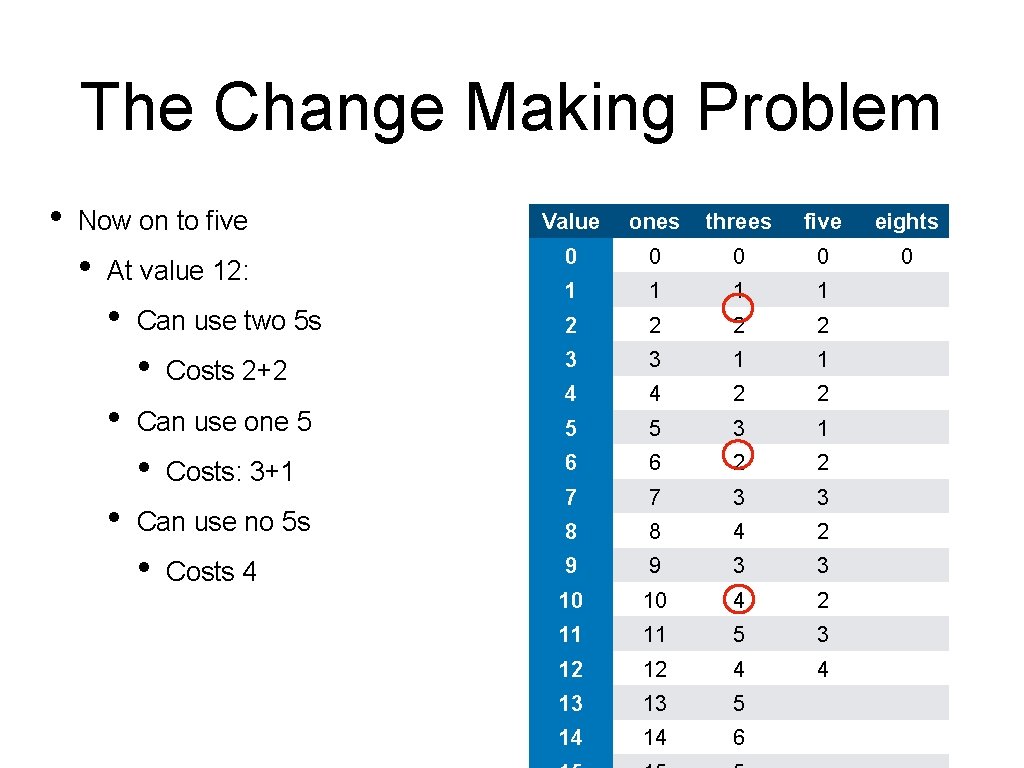
The Change Making Problem • Now on to five • Value ones threes five eights 0 0 0 1 1 Can use two 5 s 2 2 • Costs 2+2 3 3 1 1 4 4 2 2 Can use one 5 5 5 3 1 • 6 6 2 2 7 7 3 3 8 8 4 2 9 9 3 3 10 10 4 2 11 11 5 3 12 12 4 4 13 13 5 14 14 6 At value 12: • • • Costs: 3+1 Can use no 5 s • Costs 4

The Change Making Problem • Now on to five • Value ones threes five eights 0 0 0 1 1 Can use two 5 s 2 2 • Costs 2+1 3 3 1 1 4 4 2 2 Can use one 5 5 5 3 1 • 6 6 2 2 7 7 3 3 8 8 4 2 9 9 3 3 10 10 4 2 11 11 5 3 12 12 4 4 13 13 5 3 14 14 6 At value 13: • • • Costs: 4+1 Can use no 5 s • Costs 5
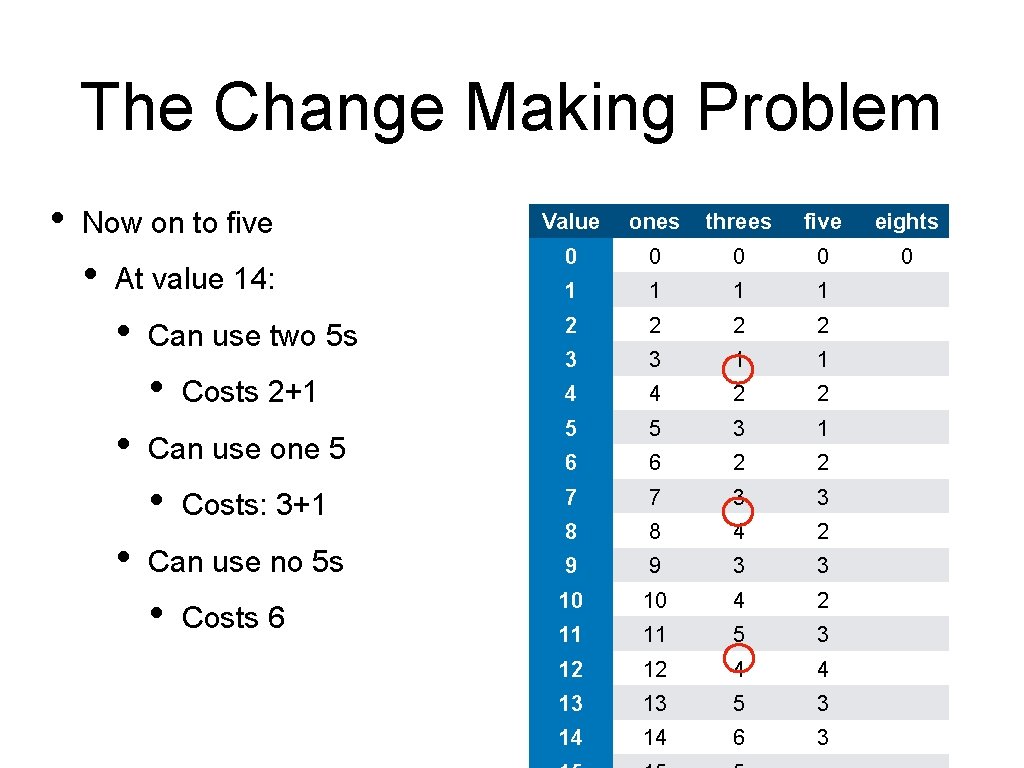
The Change Making Problem • Now on to five • Value ones threes five eights 0 0 0 1 1 Can use two 5 s 2 2 • 3 3 1 1 4 4 2 2 5 5 3 1 6 6 2 2 7 7 3 3 8 8 4 2 Can use no 5 s 9 9 3 3 • 10 10 4 2 11 11 5 3 12 12 4 4 13 13 5 3 14 14 6 3 At value 14: • • Can use one 5 • • Costs 2+1 Costs: 3+1 Costs 6
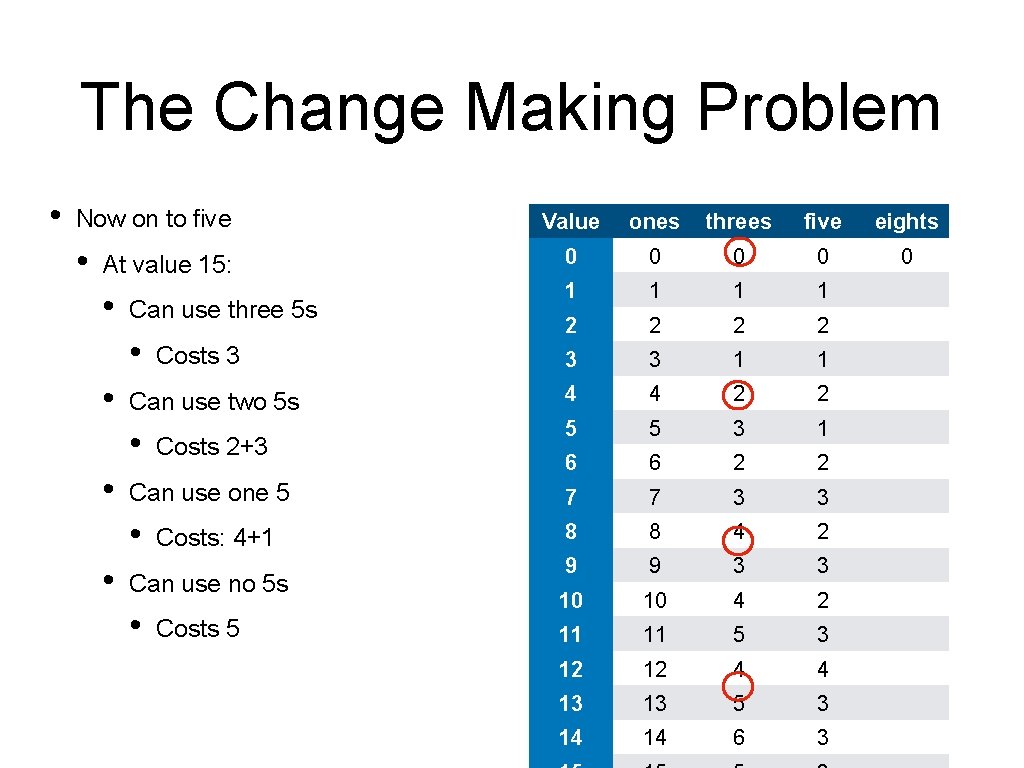
The Change Making Problem • Now on to five • Value ones threes five eights At value 15: 0 0 0 • 1 1 2 2 3 3 1 1 Can use two 5 s 4 4 2 2 • 5 5 3 1 6 6 2 2 Can use one 5 7 7 3 3 • 8 8 4 2 9 9 3 3 10 10 4 2 11 11 5 3 12 12 4 4 13 13 5 3 14 14 6 3 Can use three 5 s • • Costs 3 Costs 2+3 Costs: 4+1 Can use no 5 s • Costs 5
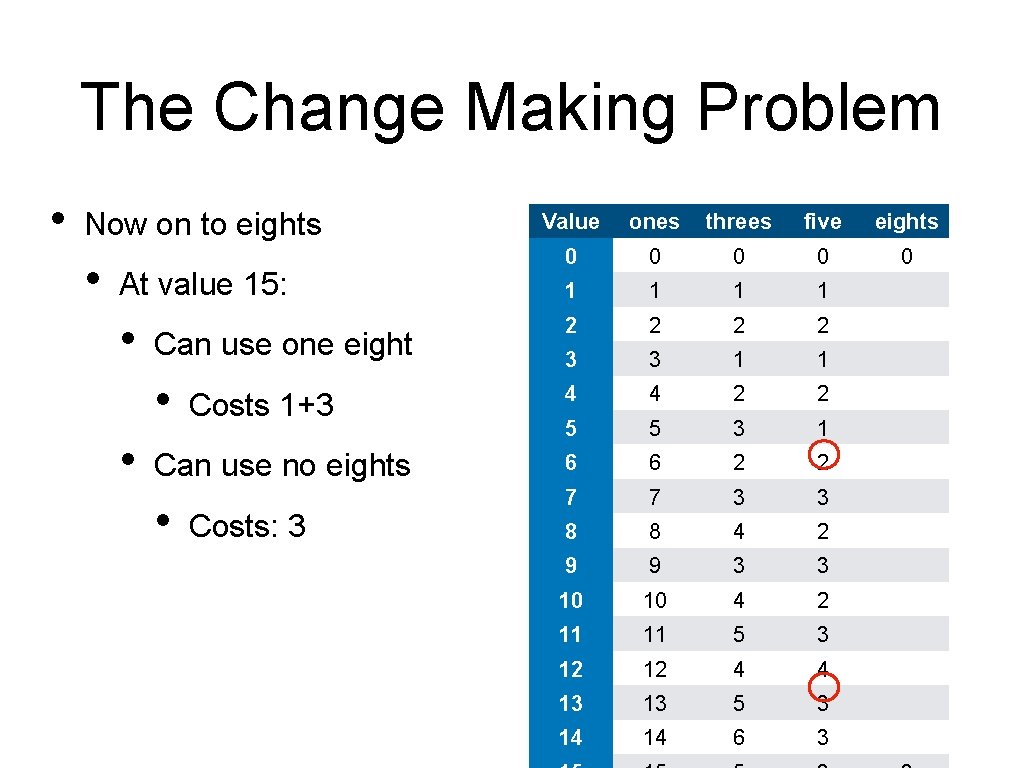
The Change Making Problem • Now on to eights • Value ones threes five eights 0 0 0 1 1 2 2 3 3 1 1 4 4 2 2 5 5 3 1 Can use no eights 6 6 2 2 • 7 7 3 3 8 8 4 2 9 9 3 3 10 10 4 2 11 11 5 3 12 12 4 4 13 13 5 3 14 14 6 3 At value 15: • Can use one eight • • Costs 1+3 Costs: 3
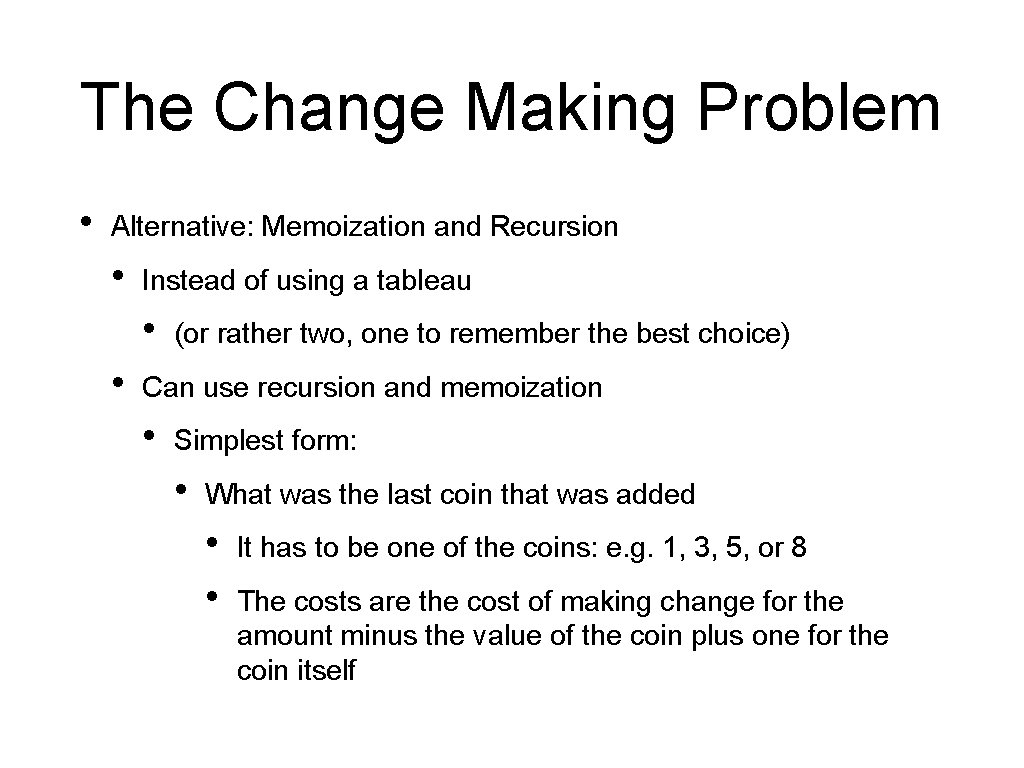
The Change Making Problem • Alternative: Memoization and Recursion • Instead of using a tableau • • (or rather two, one to remember the best choice) Can use recursion and memoization • Simplest form: • What was the last coin that was added • • It has to be one of the coins: e. g. 1, 3, 5, or 8 The costs are the cost of making change for the amount minus the value of the coin plus one for the coin itself
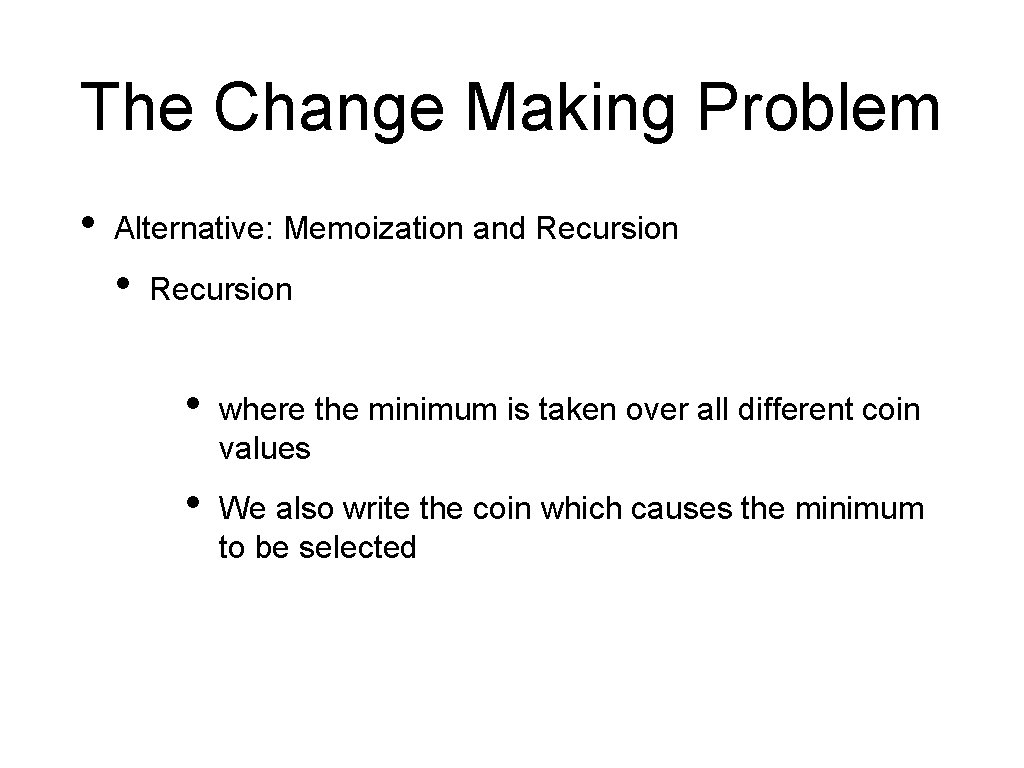
The Change Making Problem • Alternative: Memoization and Recursion • where the minimum is taken over all different coin values • We also write the coin which causes the minimum to be selected
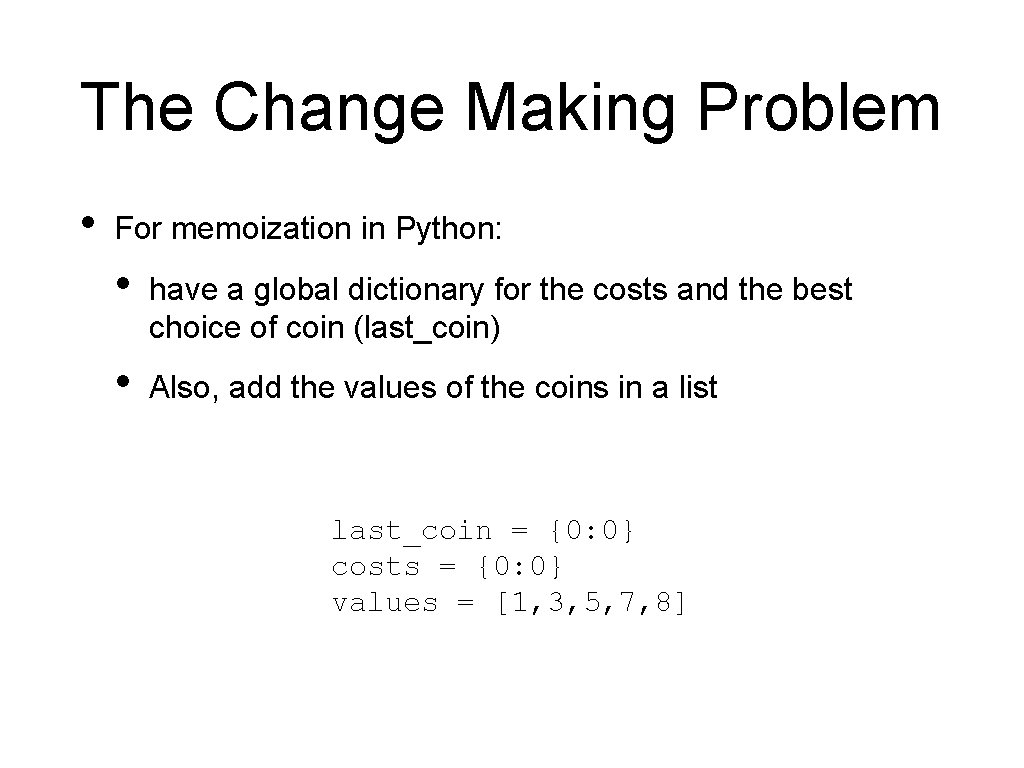
The Change Making Problem • For memoization in Python: • have a global dictionary for the costs and the best choice of coin (last_coin) • Also, add the values of the coins in a list last_coin = {0: 0} costs = {0: 0} values = [1, 3, 5, 7, 8]
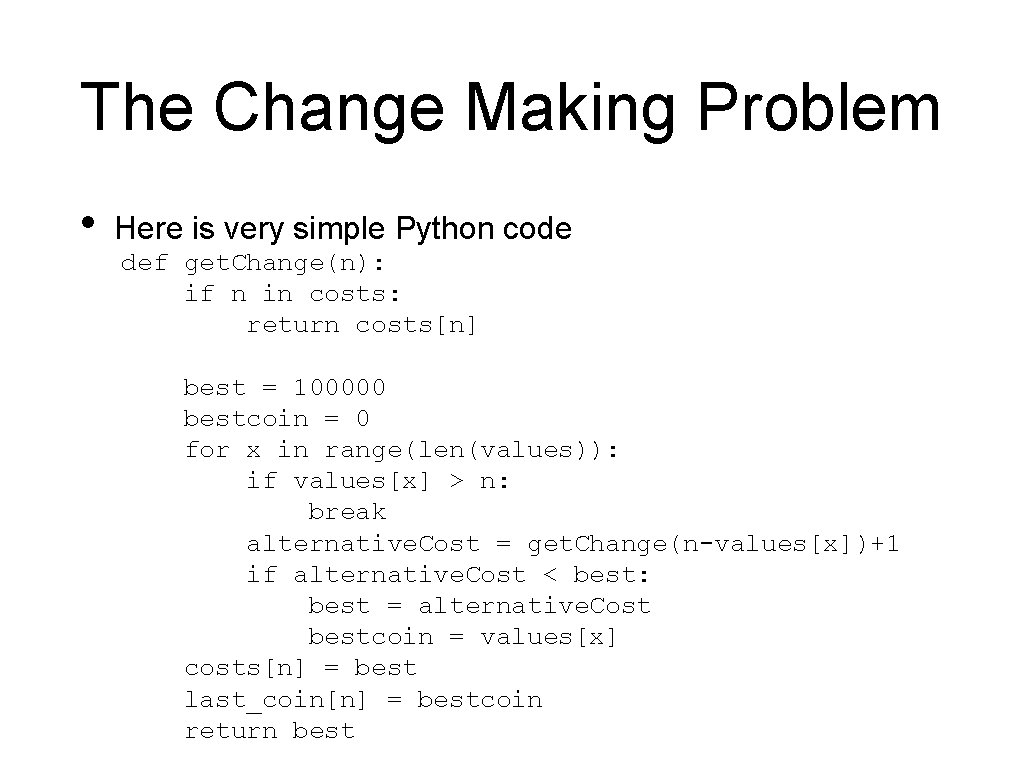
The Change Making Problem • Here is very simple Python code def get. Change(n): if n in costs: return costs[n] best = 100000 bestcoin = 0 for x in range(len(values)): if values[x] > n: break alternative. Cost = get. Change(n-values[x])+1 if alternative. Cost < best: best = alternative. Cost bestcoin = values[x] costs[n] = best last_coin[n] = bestcoin return best
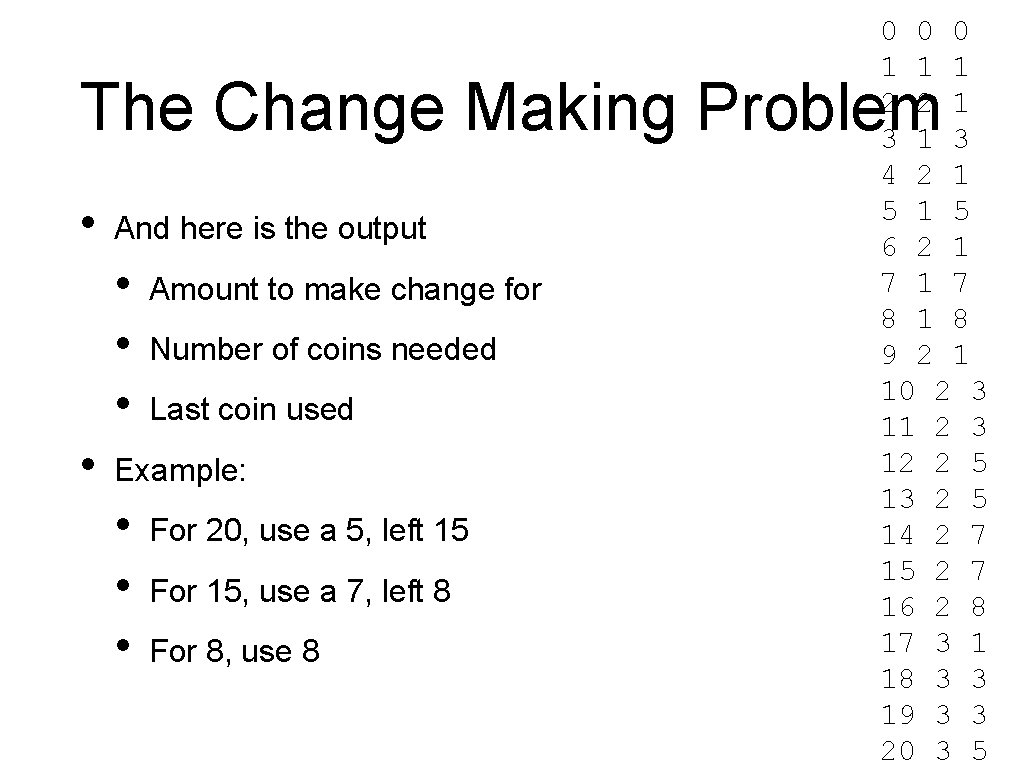
0 0 0 1 1 1 2 2 1 3 4 2 1 5 6 2 1 7 8 1 8 9 2 1 10 2 3 11 2 3 12 2 5 13 2 5 14 2 7 15 2 7 16 2 8 17 3 1 18 3 3 19 3 3 20 3 5 The Change Making Problem • And here is the output • • Amount to make change for Number of coins needed Last coin used Example: • • • For 20, use a 5, left 15 For 15, use a 7, left 8 For 8, use 8
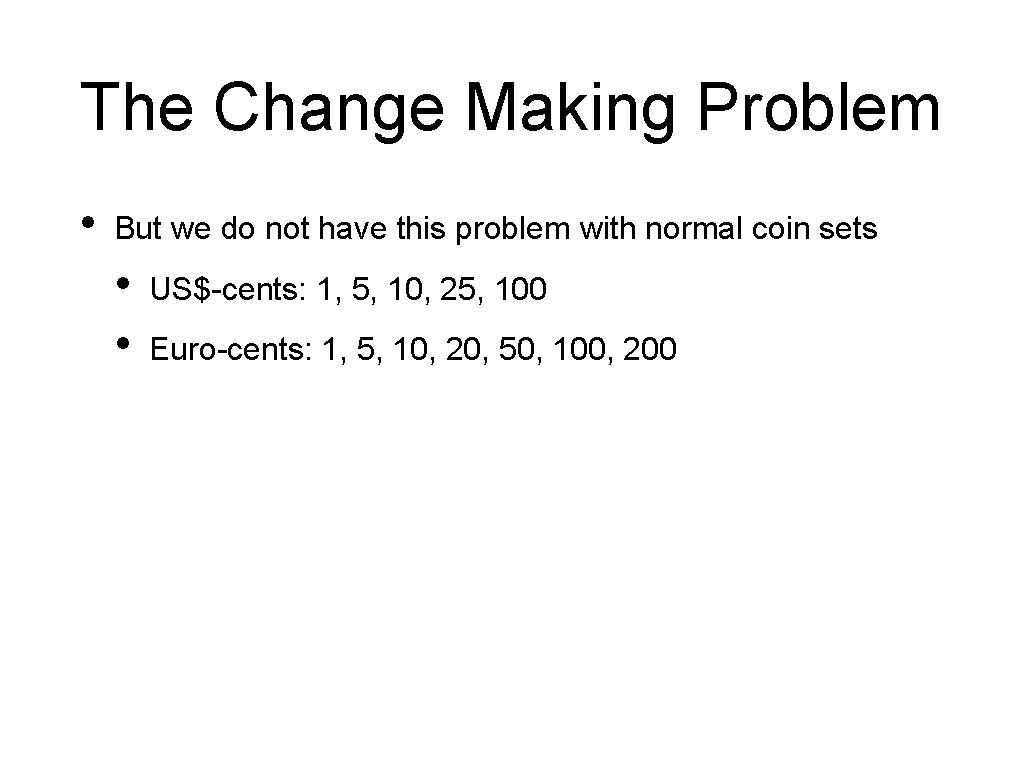
The Change Making Problem • But we do not have this problem with normal coin sets • • US$-cents: 1, 5, 10, 25, 100 Euro-cents: 1, 5, 10, 20, 50, 100, 200
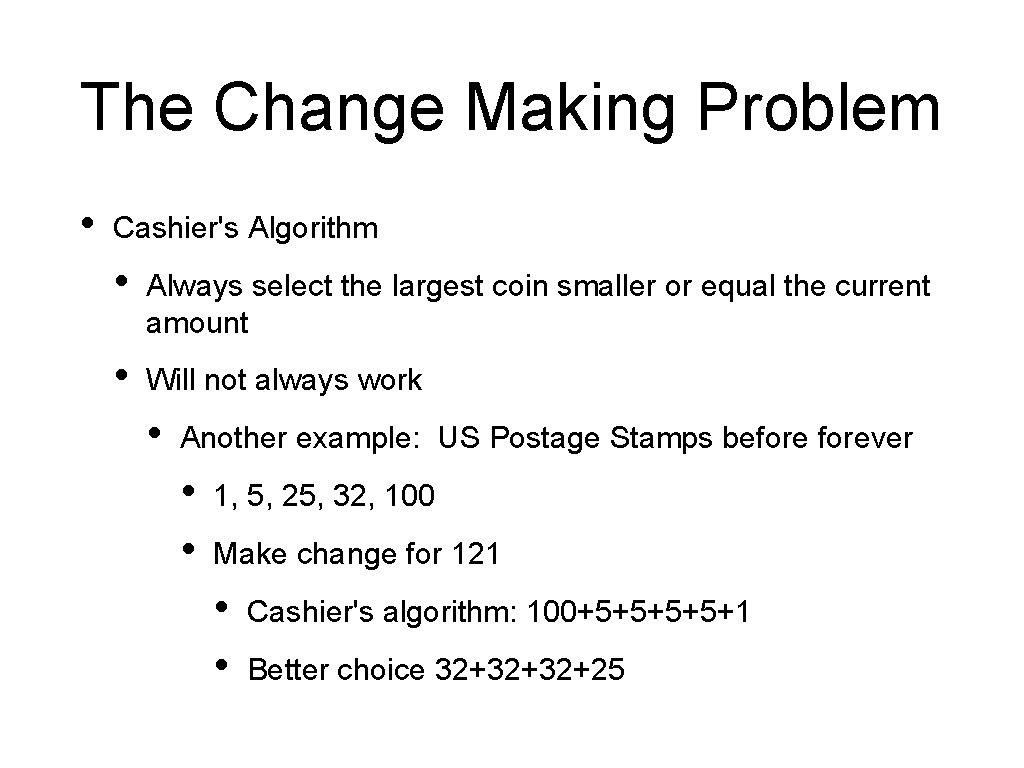
The Change Making Problem • Cashier's Algorithm • Always select the largest coin smaller or equal the current amount • Will not always work • Another example: US Postage Stamps beforever • • 1, 5, 25, 32, 100 Make change for 121 • • Cashier's algorithm: 100+5+5+1 Better choice 32+32+32+25
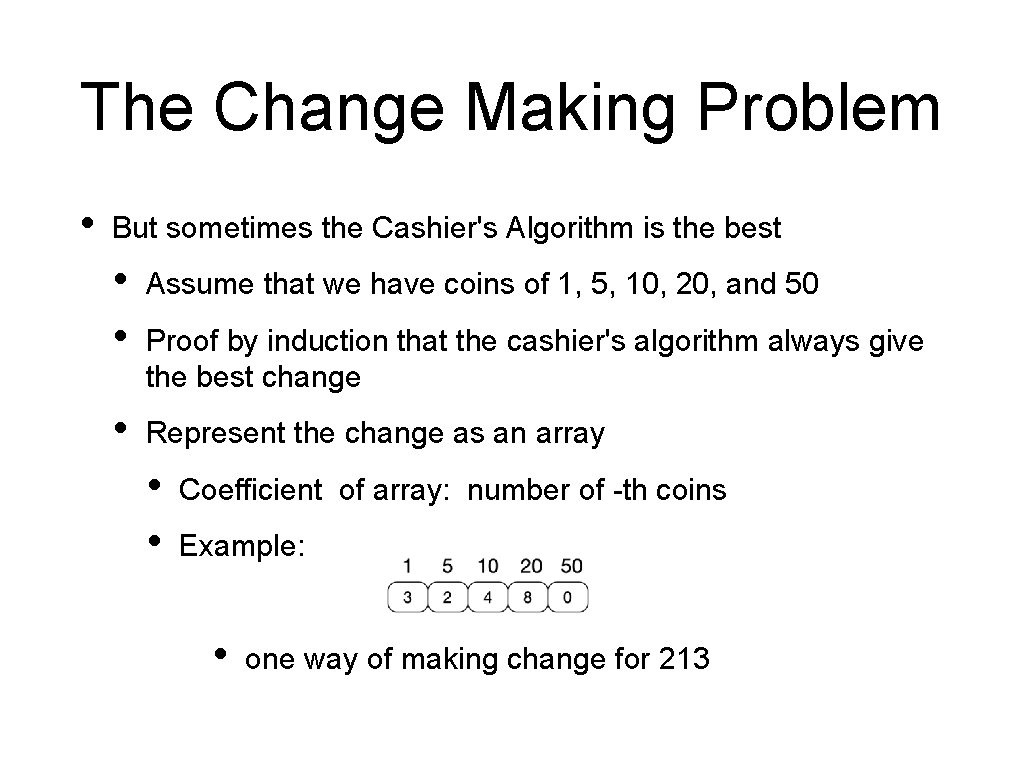
The Change Making Problem • But sometimes the Cashier's Algorithm is the best • • Assume that we have coins of 1, 5, 10, 20, and 50 • Represent the change as an array Proof by induction that the cashier's algorithm always give the best change • • Coefficient of array: number of -th coins Example: • one way of making change for 213
The Change Making Problem • • Proof: Assume is the result of the cashier's algorithm for an amount of • Assume is an alternative with less coins for the same amount but
The Change Making Problem • • Proof: Want to show that.
The Change Making Problem • Proof: • Lemma 1: An optimal solutions has not more than four pennies • • Lemma 2: An optimal solution has not more than one 10 cent piece • • Otherwise replace with a 5 cent piece Otherwise replace with a 20 cent piece Lemma 3: An optimal solution cannot have two twenty cent pieces and one 10 cent piece • Otherwise replace with a 50 cent piece
The Change Making Problem • Proof: • Lemma 5: Maximum number of pennies in an optimal solution is four • • Follows from Lemma 1 Lemma 6: If the optimal solution has only pennies and five cents, then the amount is at most nine • Follows from Lemma 2 and Lemma 5
The Change Making Problem • Lemma 7: The maximum amount for an optimal solution with only pennies, 5 cent and 10 cent pieces is 19 • Lemma 8: The maximum amount for an optimal solution with only 1 cent, 5 cent, 10 cent, and 20 cent pieces is 49
The Change Making Problem • Proof: • Assume that the number of 50 cent coins in A and C differ. • Because of how C is defined, the number of 50 cent coins in A has to be lower. • However, the difference needs to be made up with coins of smaller value • But an optimal solution cannot have more than 49 cents in smaller coins • Contradiction
The Change Making Problem • Proof: • • • So, the number of 50 cent coins does not differ • If there are 50 cent coins, then look at the best solution for amount- coins. • and with the 50 cent coins removed are still two different solutions for the same amount Now apply the same argument to the 20 cent coins. Et cetera
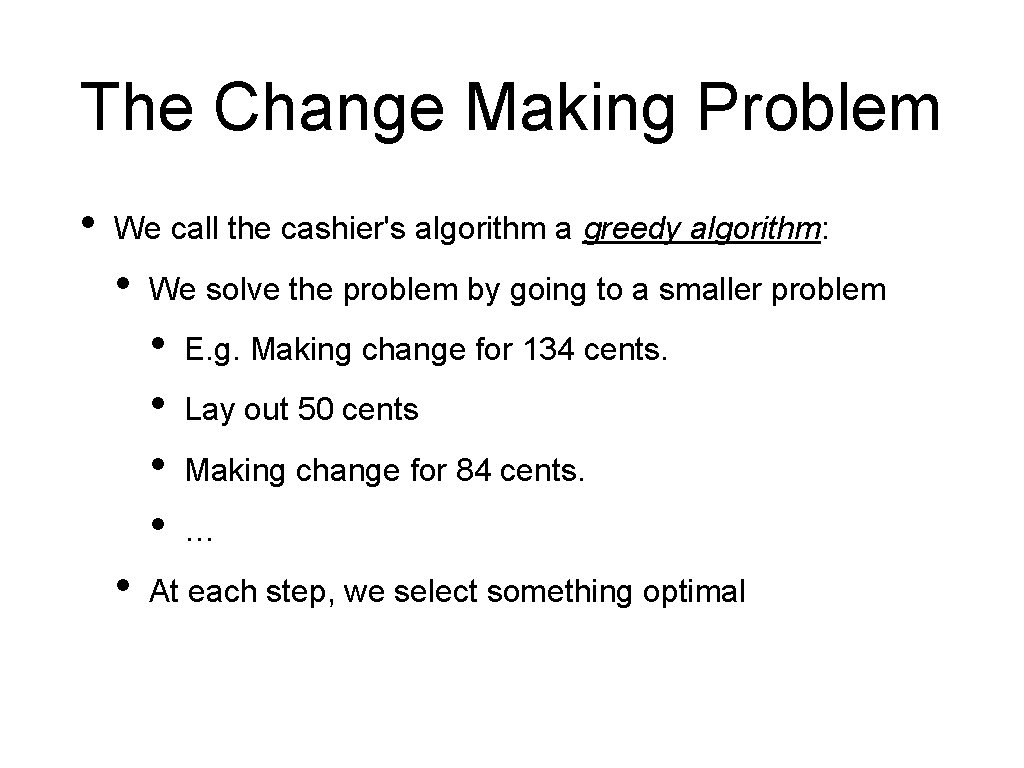
The Change Making Problem • We call the cashier's algorithm a greedy algorithm: • We solve the problem by going to a smaller problem • • • E. g. Making change for 134 cents. Lay out 50 cents Making change for 84 cents. … At each step, we select something optimal
Greedy Algorithms • Many algorithms run from stage to stage • • A Greedy algorithm makes decisions • • • At each stage, they make a decision based on the information available At each stage, using locally available information, the greedy algorithm makes an optimal choice Sometimes, greedy algorithms give an overall optimal solution Sometimes, greedy algorithms will not result in an optimal solution but often in one good enough
Divisible Items Knapsack Problem • Given a set of items • • • Each item has a weight Each item has a value Select a subset • Constraint: • Objective Function:
Divisible Items Knapsack Problem • Order all items by impact • • In order of impact (highest first), ask whether you want to include the item • And you include it if the sum of the weights of the items already selected is smaller than
Optimal Rental • Set of activities • Each activity has a start time and a finish time • • Each activity needs to use your facility Only one activity at a time Make the rental agreements that maximize the number of rentals
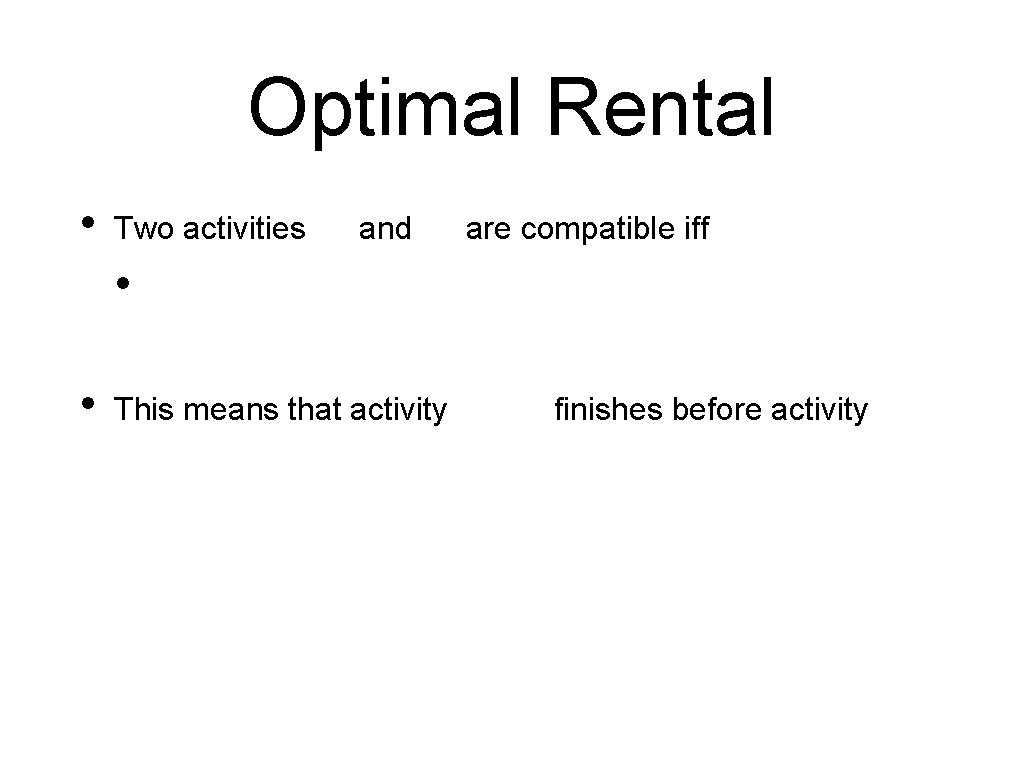
Optimal Rental • Two activities and are compatible iff • • This means that activity finishes before activity
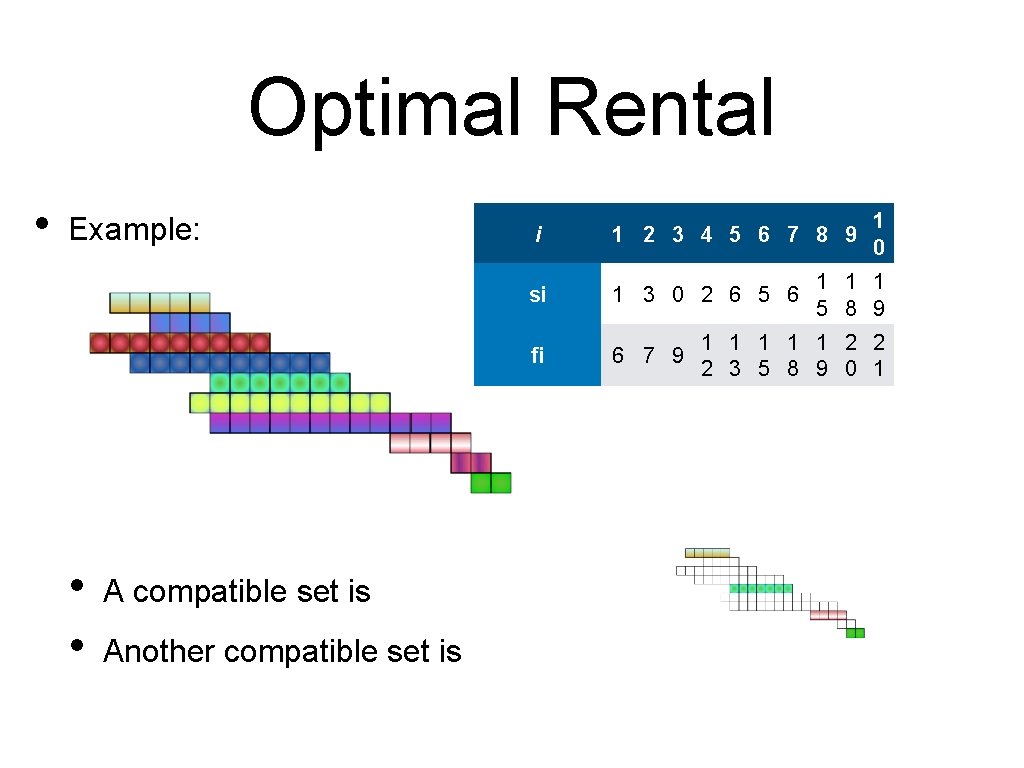
Optimal Rental • Example: • • A compatible set is Another compatible set is i 1 2 3 4 5 6 7 8 9 si 1 3 0 2 6 5 6 fi 6 7 9 1 0 1 1 1 5 8 9 1 1 1 2 2 2 3 5 8 9 0 1
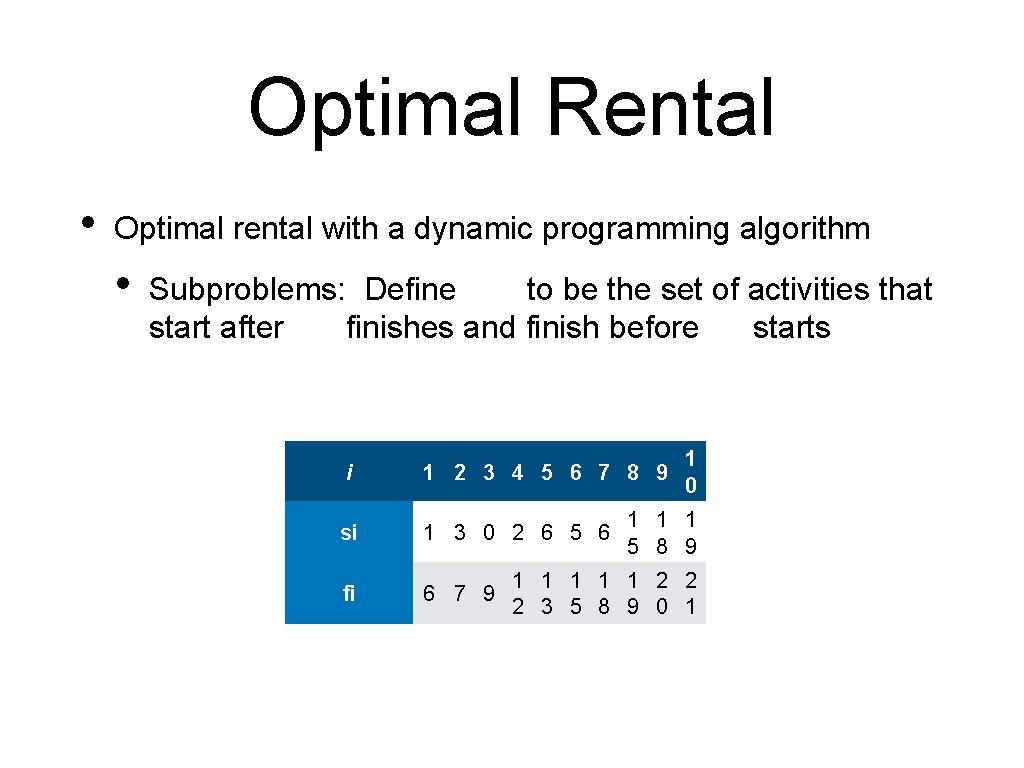
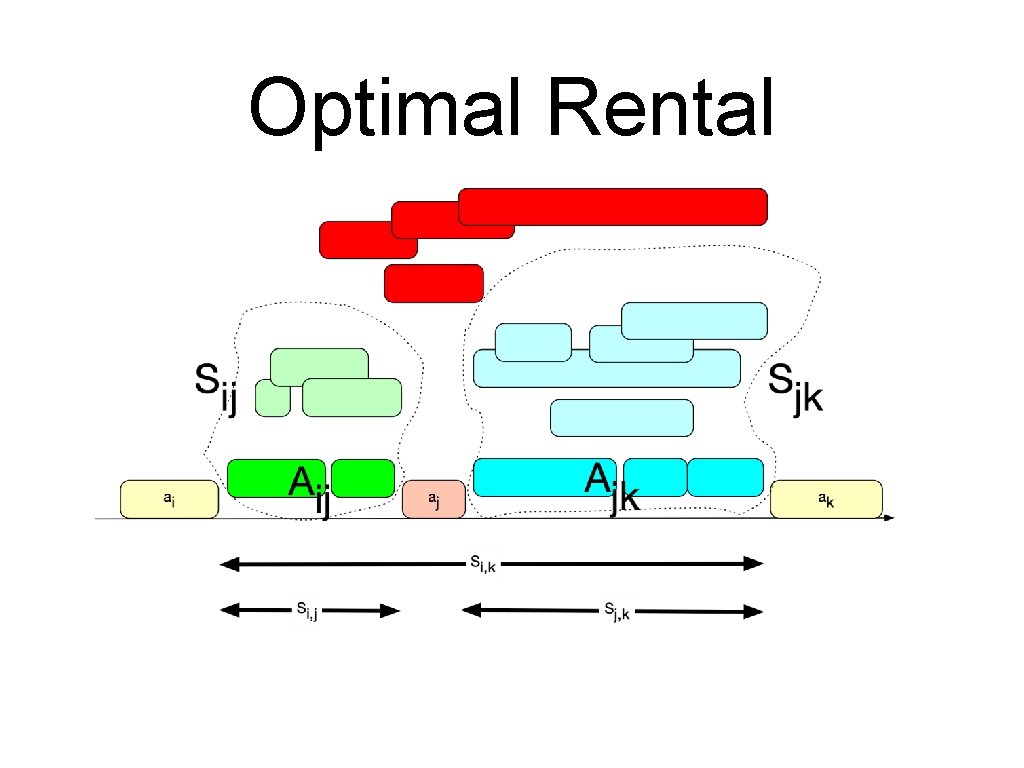
Optimal Rental • Optimal rental with a dynamic programming algorithm • Subproblems: Define to be the set of activities that start after finishes and finish before starts 1 0 i 1 2 3 4 5 6 7 8 9 si 1 1 3 0 2 6 5 8 9 fi 1 1 1 2 2 6 7 9 2 3 5 8 9 0 1
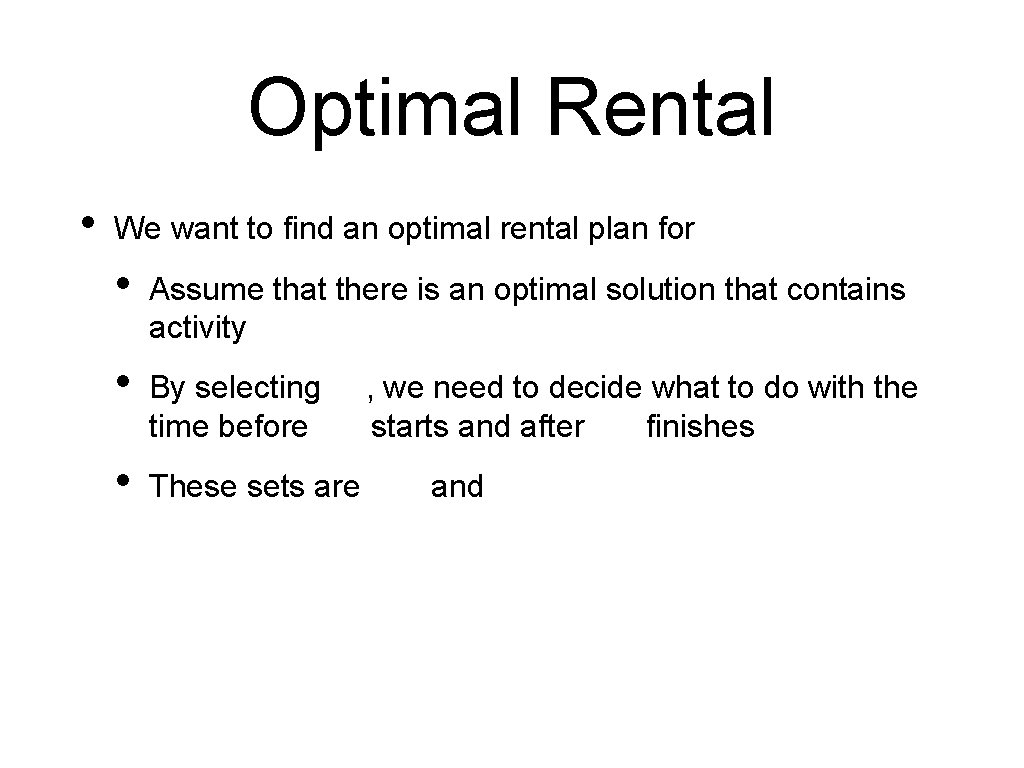
Optimal Rental • We want to find an optimal rental plan for • Assume that there is an optimal solution that contains activity • By selecting time before • These sets are , we need to decide what to do with the starts and after finishes and
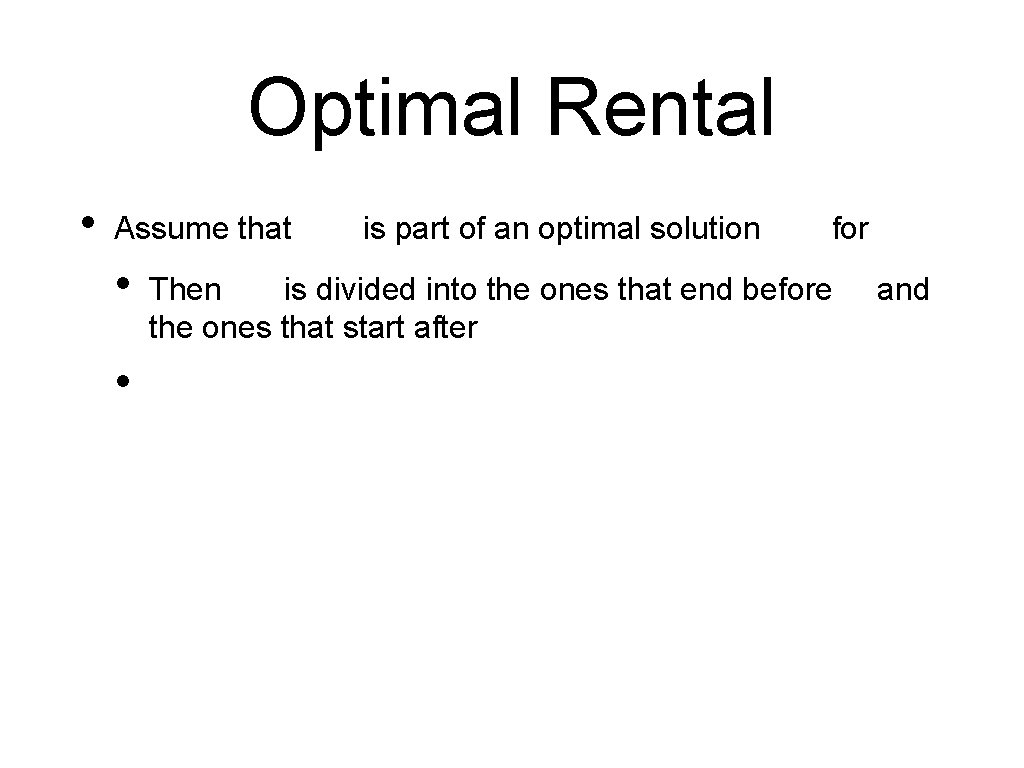
Optimal Rental • Assume that • • is part of an optimal solution for Then is divided into the ones that end before the ones that start after and
Optimal Rental
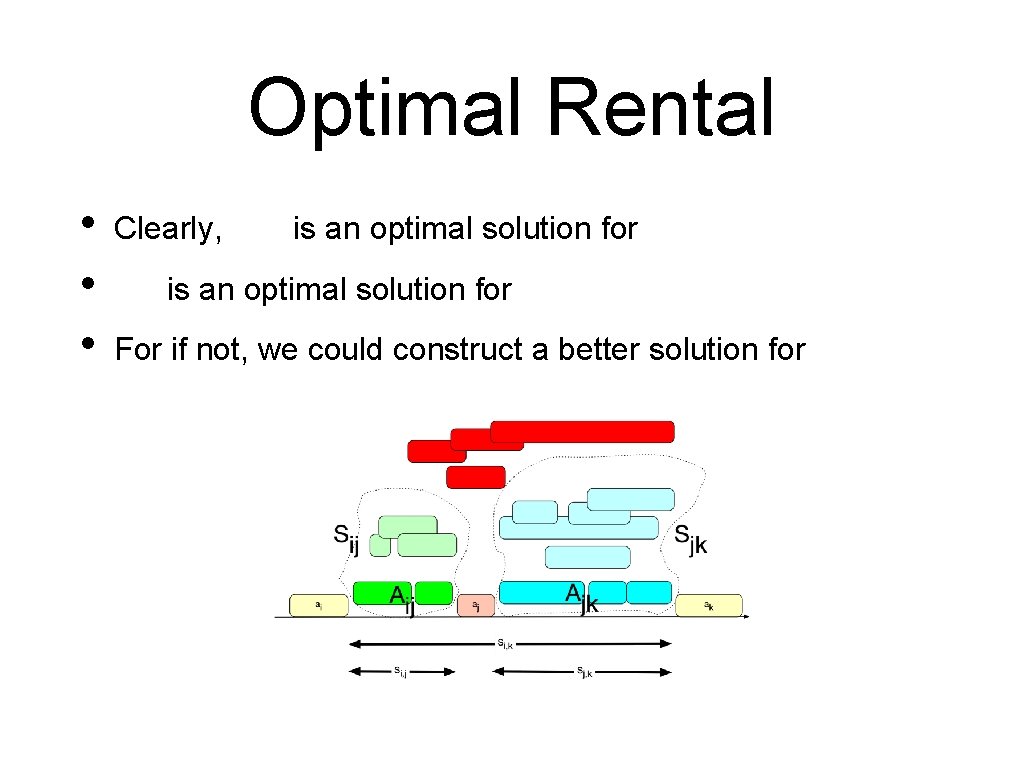
Optimal Rental • • • Clearly, is an optimal solution for For if not, we could construct a better solution for
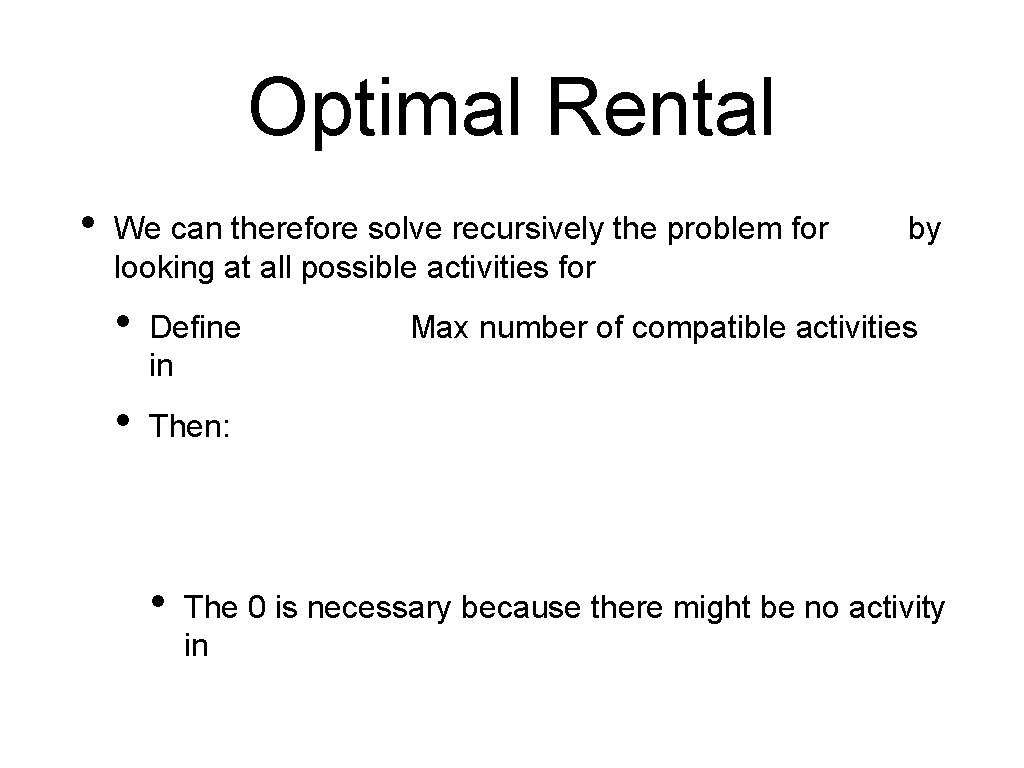
Optimal Rental • We can therefore solve recursively the problem for looking at all possible activities for • Define in • Then: • by Max number of compatible activities The 0 is necessary because there might be no activity in
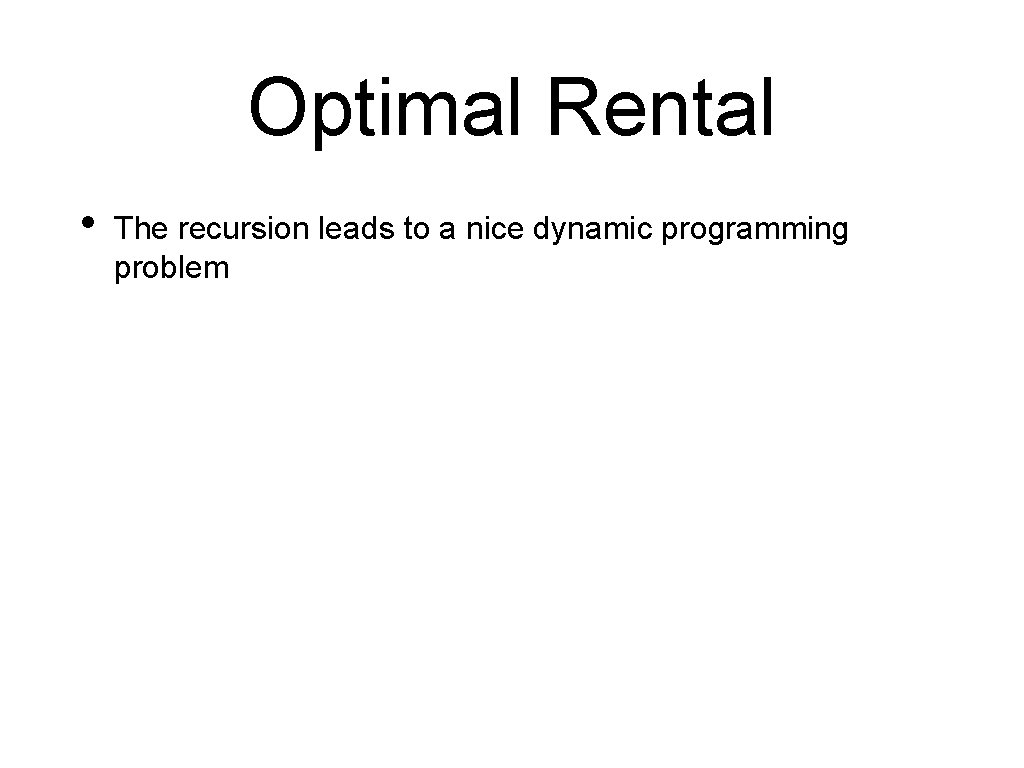
Optimal Rental • The recursion leads to a nice dynamic programming problem
Optimal Rental • But can we do better?
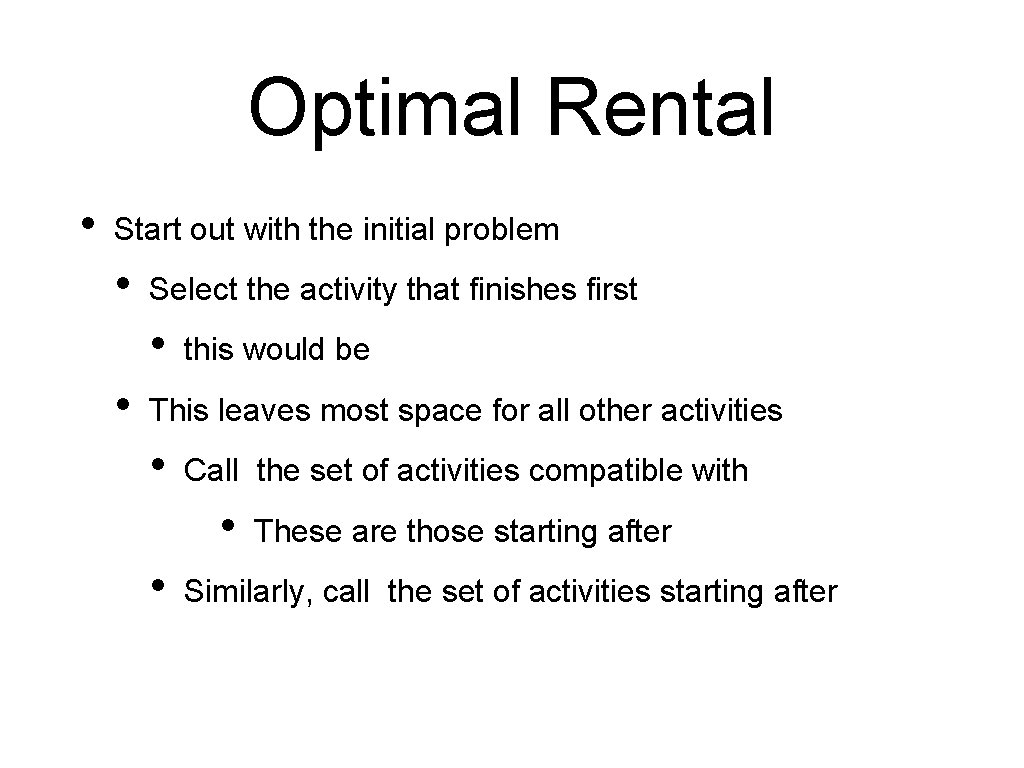
Optimal Rental • Start out with the initial problem • Select the activity that finishes first • • this would be This leaves most space for all other activities • Call the set of activities compatible with • • These are those starting after Similarly, call the set of activities starting after
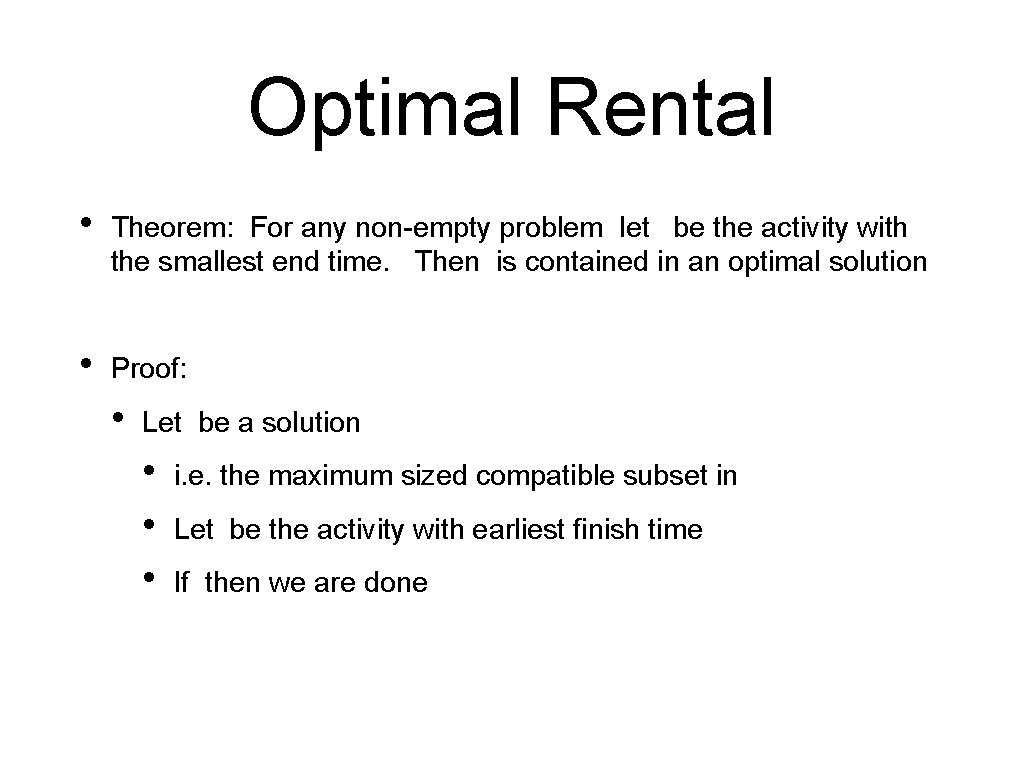
Optimal Rental • Theorem: For any non-empty problem let be the activity with the smallest end time. Then is contained in an optimal solution • Proof: • Let be a solution • • • i. e. the maximum sized compatible subset in Let be the activity with earliest finish time If then we are done
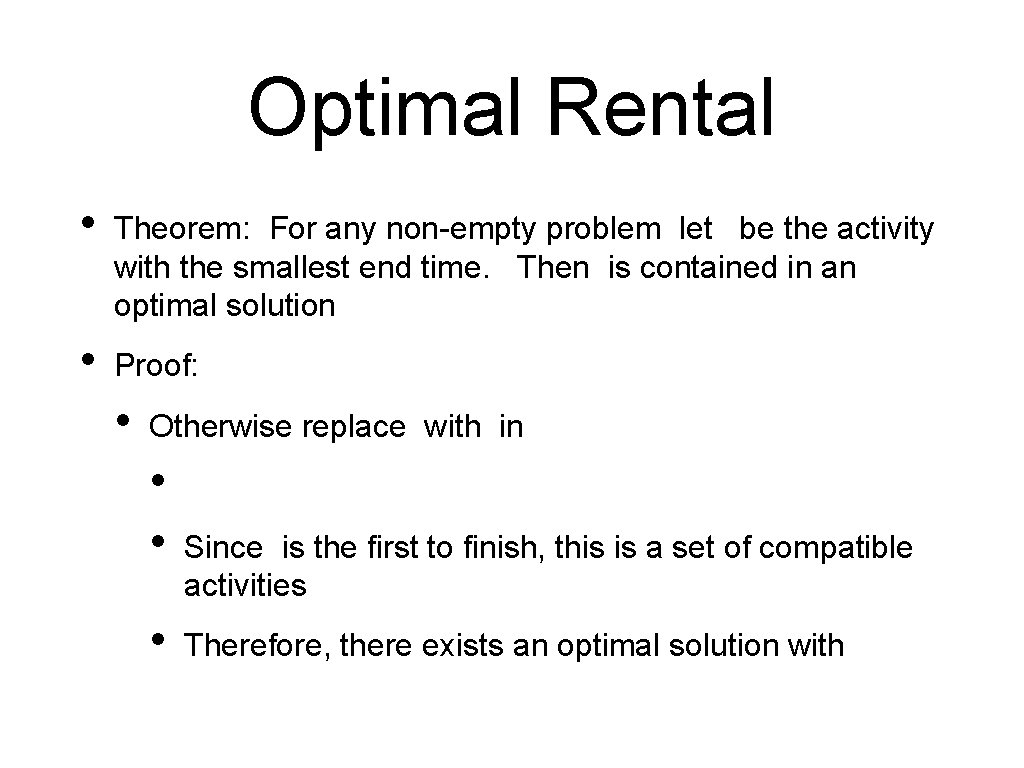
Optimal Rental • Theorem: For any non-empty problem let be the activity with the smallest end time. Then is contained in an optimal solution • Proof: • Otherwise replace with in • • • Since is the first to finish, this is a set of compatible activities Therefore, there exists an optimal solution with
Optimal Rental • Result of the Theorem: • We can find an optimal solution (but not necessarily all optimal solutions) by always picking the first one to finish.
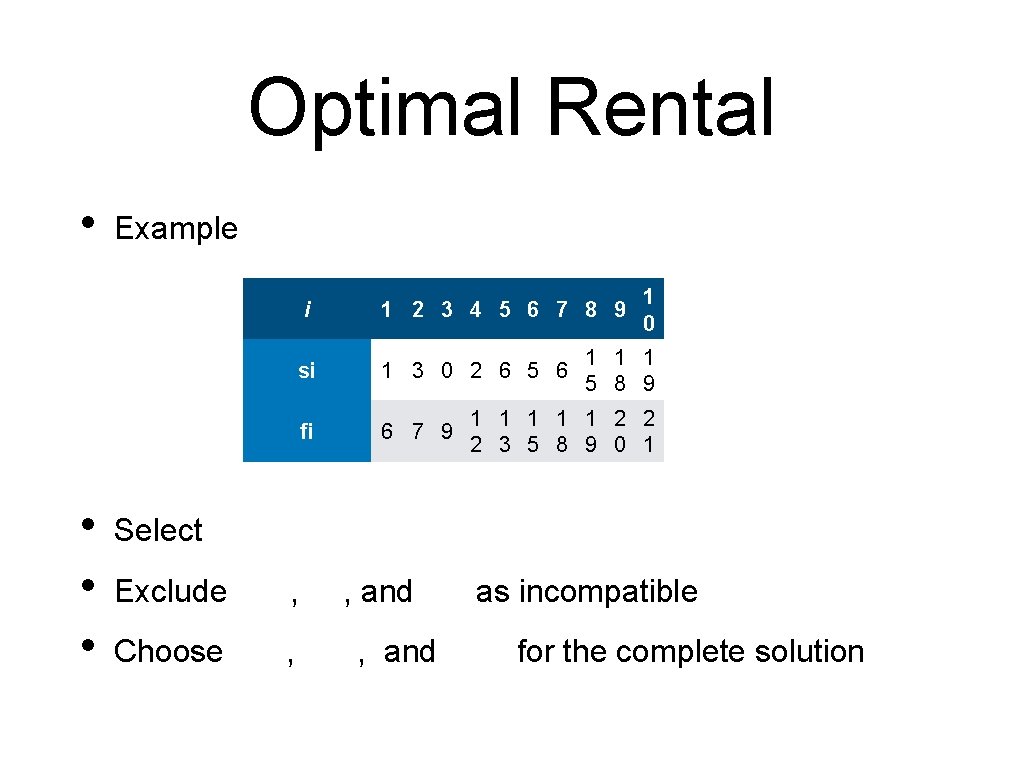
Optimal Rental • • Example i 1 2 3 4 5 6 7 8 9 si 1 3 0 2 6 5 6 fi 6 7 9 1 0 1 1 1 5 8 9 1 1 1 2 2 2 3 5 8 9 0 1 Select Exclude , Choose , , and as incompatible for the complete solution

Greedy Algorithms • Greedy algorithms • • Determine the optimal substructure • • Obtain a recursive algorithm Develop a recursive solution Show that making the greedy choice is best Show that making the greedy choice leads to a similar subproblem Convert the recursive algorithm to an iterative algorithm
- Slides: 59