
Greatest Common Divisor Definitions Let a and b

Greatest Common Divisor

Definitions • Let a and b be two non-zero integers. The • greatest common divisor of a and b, denoted gcd(a, b) is the largest of all common divisors of a and b. When gcd(a, b) = 1, we say that a and b are relatively prime.

Examples • gcd(10, 25) = 5 • gcd(10, 26) = 2 • gcd(10, 27) = 1 • • • so 10 and 27 are relatively prime! gcd(10, 30) = 10 gcd(-10, -30) = 10 gcd(13978, 15457) = 29

Thm 0. 2 GCD is a Linear Combination • For any nonzero integers a and b, there • • exist integers s and t such that gcd(a, b) = as + bt Moreover, gcd(a, b) is the smallest postive integer of the form as + bt. Note: This is the most important thing to know about greatest common divisors!
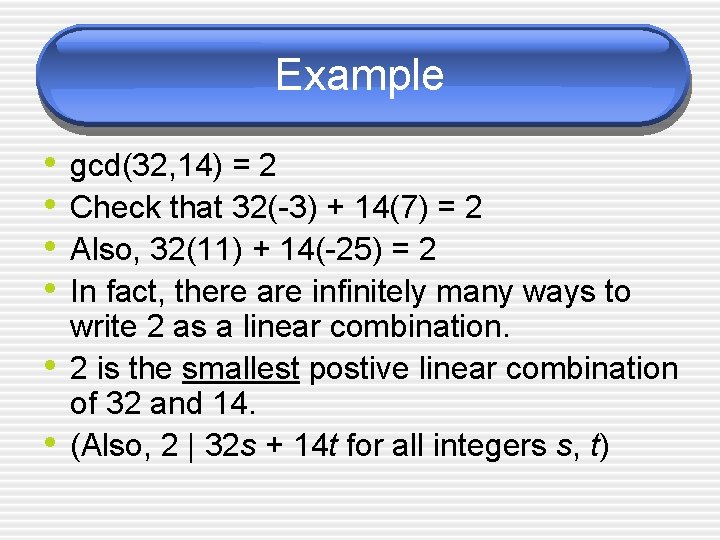
Example • • • gcd(32, 14) = 2 Check that 32(-3) + 14(7) = 2 Also, 32(11) + 14(-25) = 2 In fact, there are infinitely many ways to write 2 as a linear combination. 2 is the smallest postive linear combination of 32 and 14. (Also, 2 | 32 s + 14 t for all integers s, t)
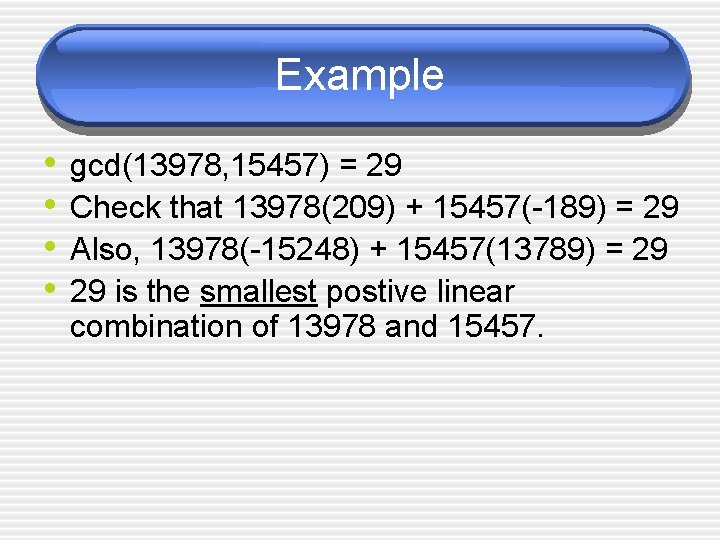
Example • • gcd(13978, 15457) = 29 Check that 13978(209) + 15457(-189) = 29 Also, 13978(-15248) + 15457(13789) = 29 29 is the smallest postive linear combination of 13978 and 15457.
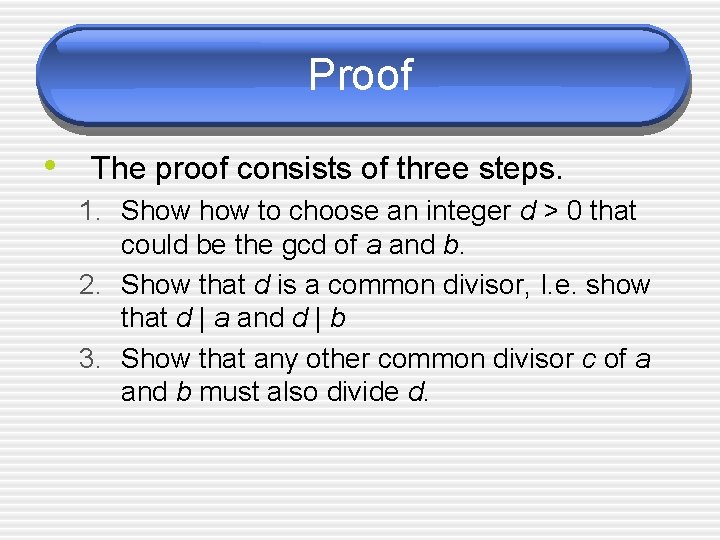
Proof • The proof consists of three steps. 1. Show to choose an integer d > 0 that could be the gcd of a and b. 2. Show that d is a common divisor, I. e. show that d | a and d | b 3. Show that any other common divisor c of a and b must also divide d.

1. Choose d • Given non-zero integers a, b, let S be the • set of positive linear combinations of a, b. S = {as+bt | s, t are integers and as+bt > 0} Clearly S is a set of non-empty positive integers. By the WOP, S has a least element, d.
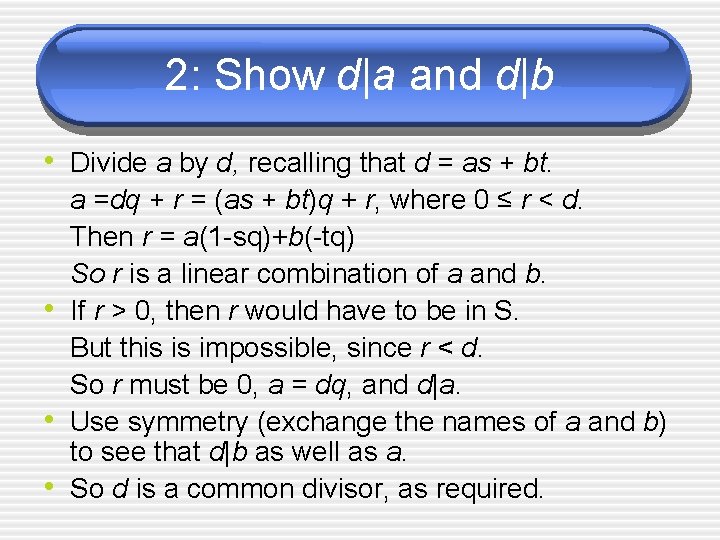
2: Show d|a and d|b • Divide a by d, recalling that d = as + bt. • • • a =dq + r = (as + bt)q + r, where 0 ≤ r < d. Then r = a(1 -sq)+b(-tq) So r is a linear combination of a and b. If r > 0, then r would have to be in S. But this is impossible, since r < d. So r must be 0, a = dq, and d|a. Use symmetry (exchange the names of a and b) to see that d|b as well as a. So d is a common divisor, as required.

3. Show any other common divisor must divide d • Let c be any common divisor of a and b. • • Say a = ch and b = ck. Then d = as + bt = chs + ckt = c(hs+kt) So c|d.
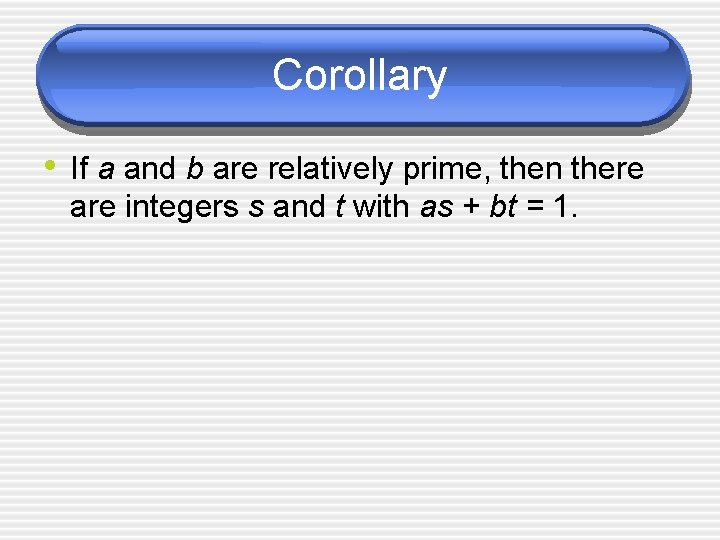
Corollary • If a and b are relatively prime, then there are integers s and t with as + bt = 1.
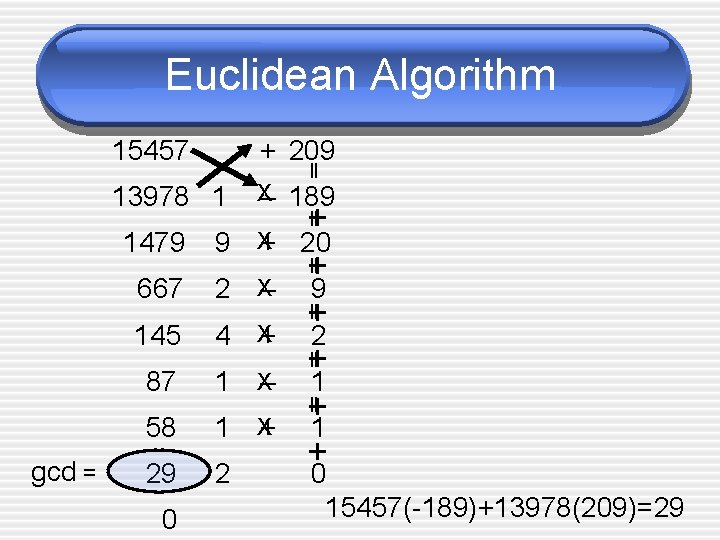
Euclidean Algorithm gcd = 15457 + 209 13978 1 X – 189 || 1479 9 X+ 667 2 X– 145 4 X+ 87 1 X– 58 1 X+ 29 2 0 +|| 20 +|| 9 +|| 2 +|| 1 +||1 + 0 15457(-189)+13978(209)=29
- Slides: 12