
Great Theoretical Ideas In Computer Science V Adamchik


- Slides: 55
Great Theoretical Ideas In Computer Science V. Adamchik D. Sleator Lecture 10 CS 15 -251 Feb. 11, 2010 Spring 2010 Carnegie Mellon University Mathematical Games
Plan Introduction to Impartial Combinatorial Games
References Game Theory, by T. Ferguson Download from: http: //www. math. ucla. edu/~tom/Game_Theo ry/Contents. html
Related courses 15 -859, (21 -801) - Mathematical Games Look for it in Spring ‘ 11
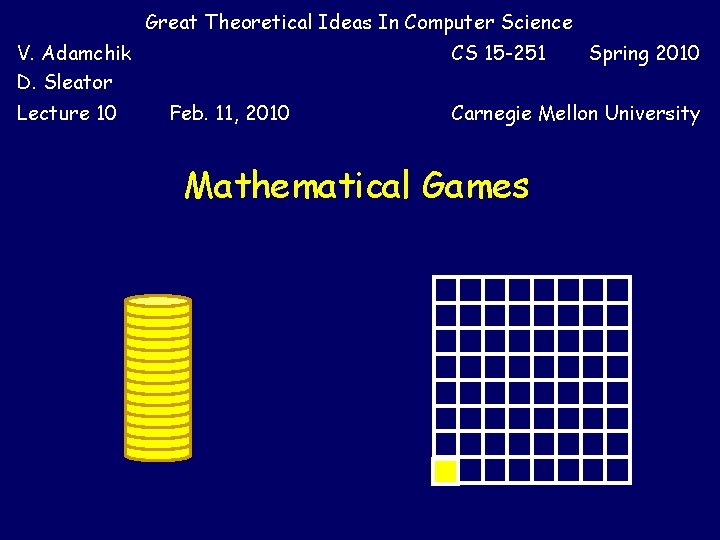
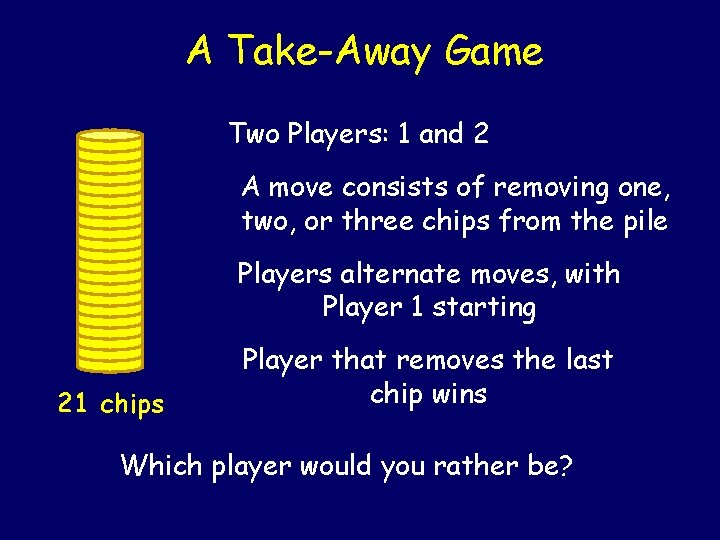
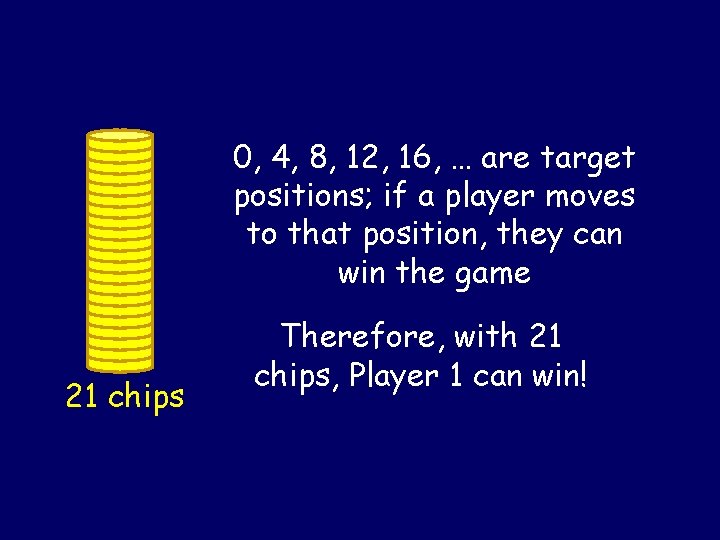
A Take-Away Game Two Players: 1 and 2 A move consists of removing one, two, or three chips from the pile Players alternate moves, with Player 1 starting 21 chips Player that removes the last chip wins Which player would you rather be?
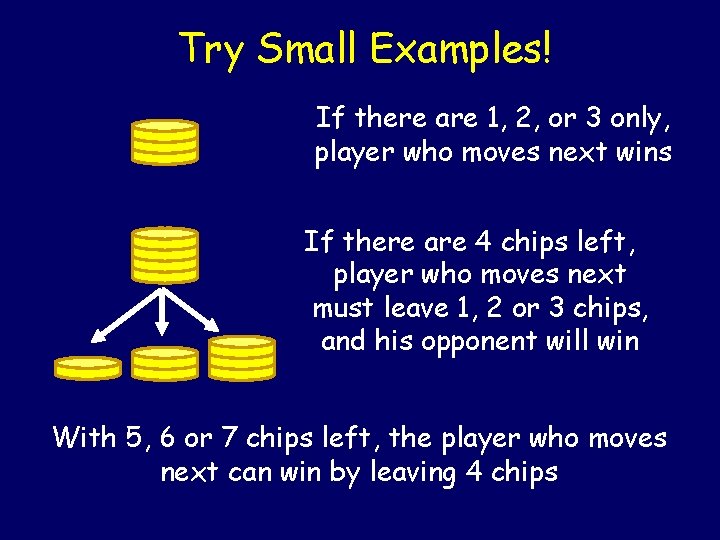
Try Small Examples! If there are 1, 2, or 3 only, player who moves next wins If there are 4 chips left, player who moves next must leave 1, 2 or 3 chips, and his opponent will win With 5, 6 or 7 chips left, the player who moves next can win by leaving 4 chips
0, 4, 8, 12, 16, … are target positions; if a player moves to that position, they can win the game 21 chips Therefore, with 21 chips, Player 1 can win!
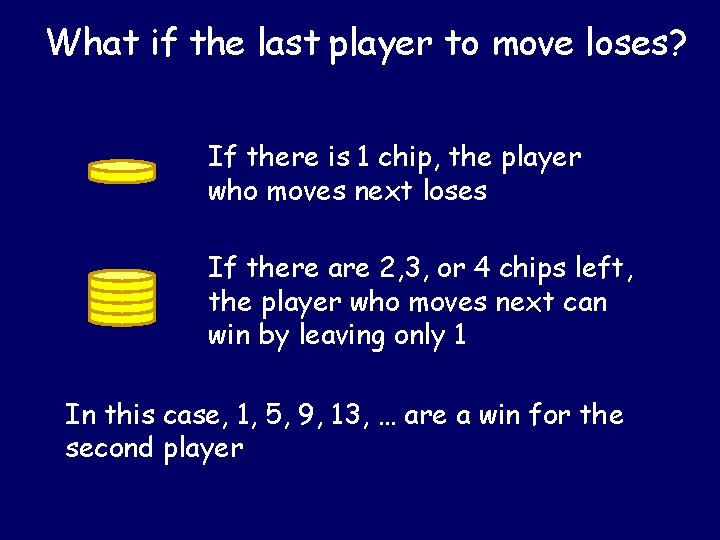
What if the last player to move loses? If there is 1 chip, the player who moves next loses If there are 2, 3, or 4 chips left, the player who moves next can win by leaving only 1 In this case, 1, 5, 9, 13, … are a win for the second player
Combinatorial Games • A set of positions • Two players • Rules specify for each player and for each position which moves to other positions are legal moves • The players alternate moving • A terminal position in one in which there are no moves • The game ends when a player has no moves • The game must end in a finite number of moves • (No draws!)
Normal Versus Misère Normal Play Rule: The last player to move wins Misère Play Rule: The last player to move loses A Terminal Position is one where neither player can move anymore
What is Omitted No random moves (This rules out games like poker) No hidden state (This rules out games like battleship) No draws in a finite number of moves (This rules out tic-tac-toe)
Impartial Versus Partizan A combinatorial game is impartial if the same set of moves is available to both players in any position. A combinatorial game is partizan if the move sets may differ for the two players In this lecture we'll study impartial games. Partizan games will not be discussed
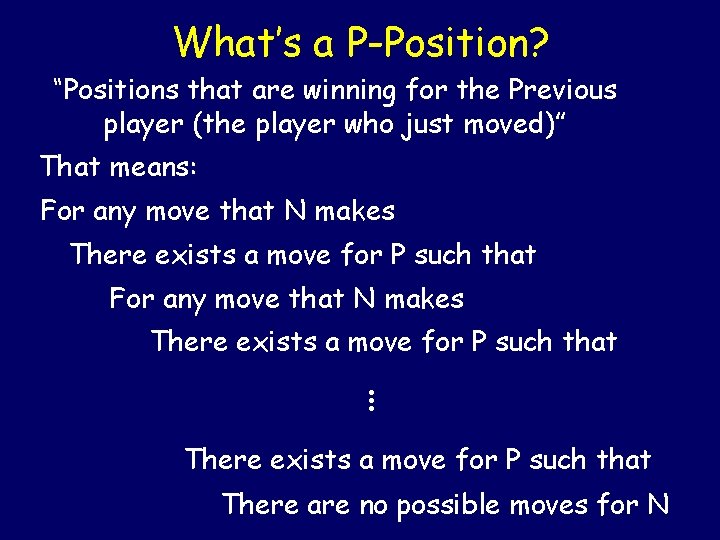
P-Positions and N-Positions P-Position: Positions that are winning for the Previous player (the player who just moved) (Sometimes called LOSING positions) N-Position: Positions that are winning for the Next player (the player who is about to move) (Sometimes called WINNING positions)
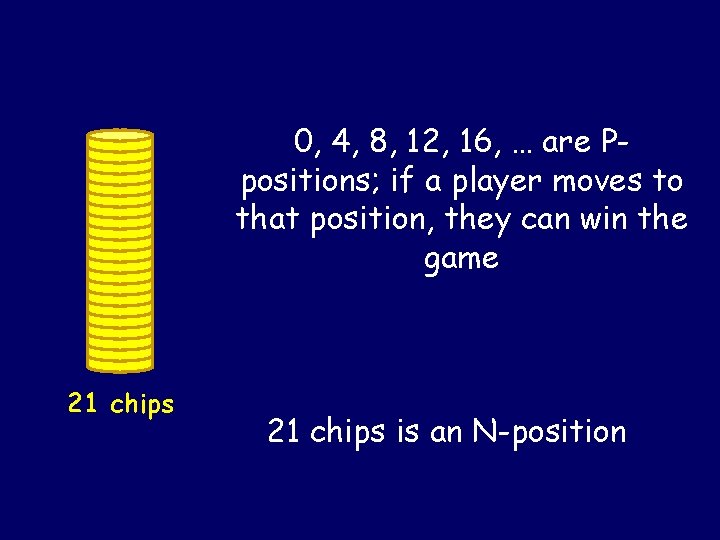
0, 4, 8, 12, 16, … are Ppositions; if a player moves to that position, they can win the game 21 chips is an N-position
What’s a P-Position? “Positions that are winning for the Previous player (the player who just moved)” That means: For any move that N makes There exists a move for P such that … There exists a move for P such that There are no possible moves for N
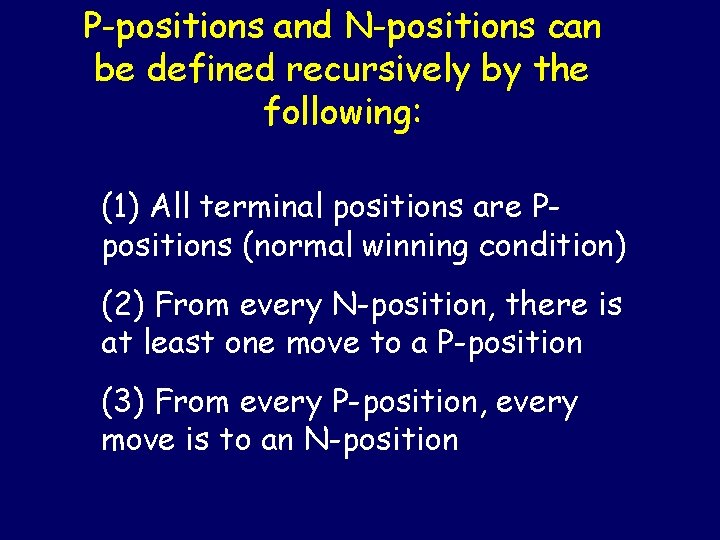
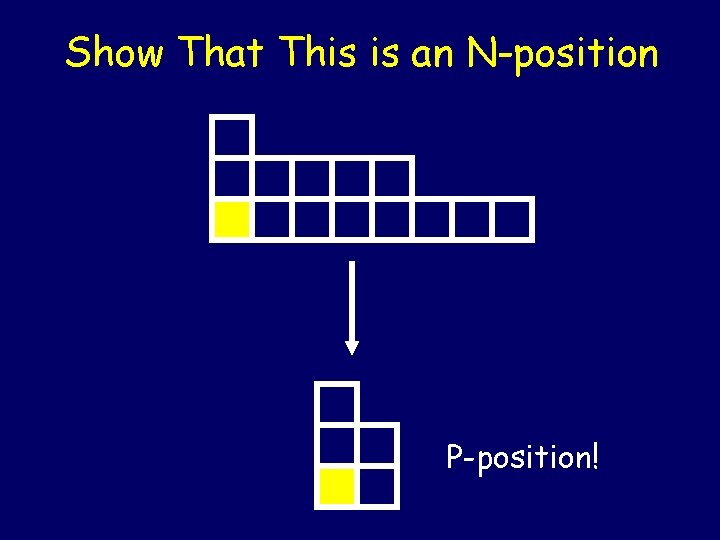
P-positions and N-positions can be defined recursively by the following: (1) All terminal positions are Ppositions (normal winning condition) (2) From every N-position, there is at least one move to a P-position (3) From every P-position, every move is to an N-position
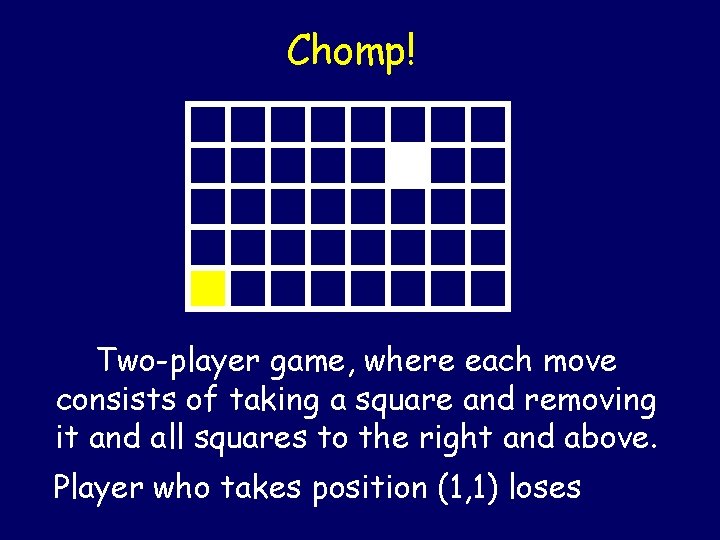
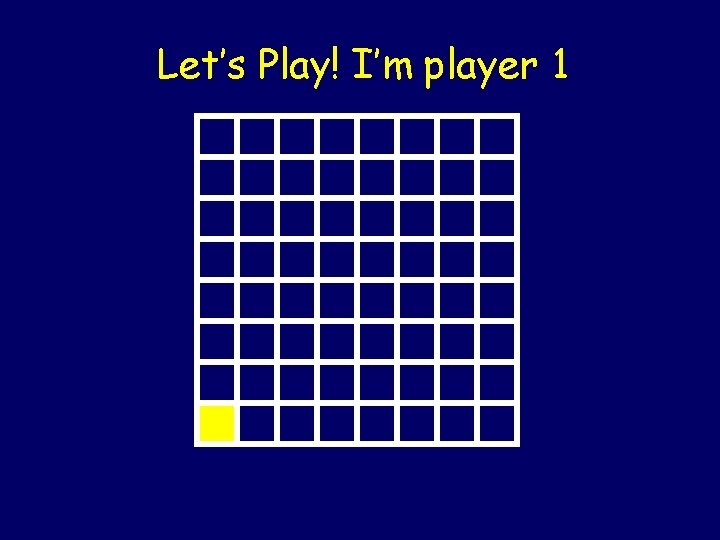
Chomp! Two-player game, where each move consists of taking a square and removing it and all squares to the right and above. Player who takes position (1, 1) loses
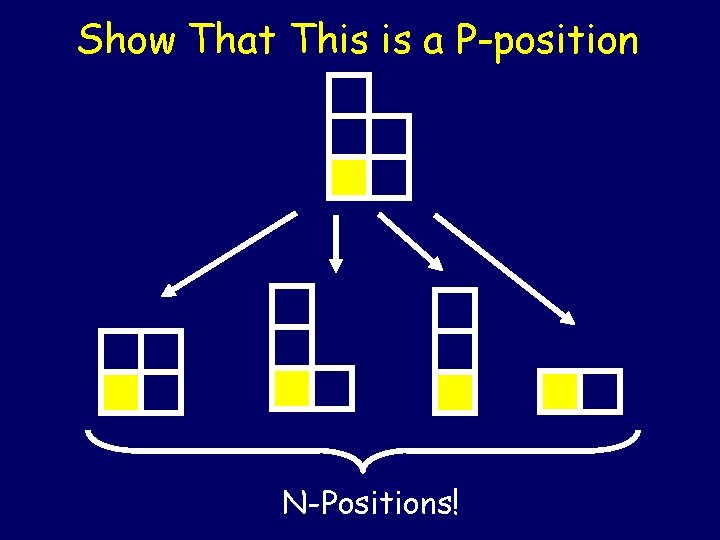
Show That This is a P-position N-Positions!
Show That This is an N-position P-position!
Let’s Play! I’m player 1
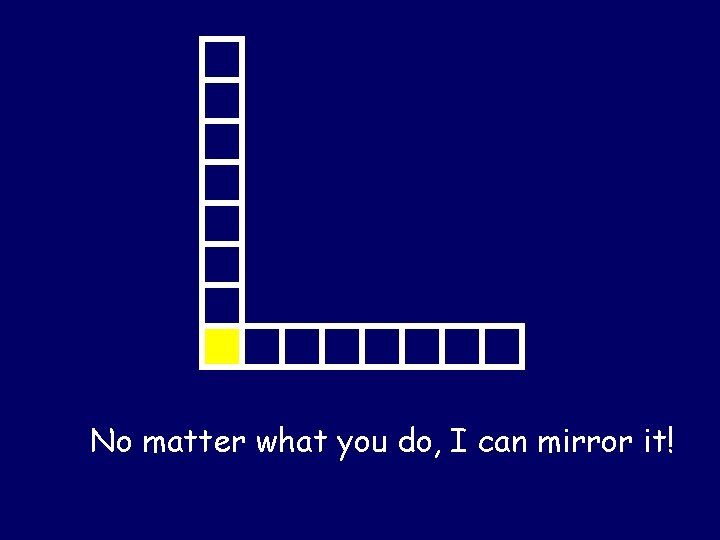
No matter what you do, I can mirror it!
Mirroring is an extremely important strategy in combinatorial games!
Theorem: Player 1 can win in any square starting position of Chomp Proof: The winning strategy for player 1 is to chomp on (2, 2), leaving only an “L” shaped position Then, for any move that Player 2 takes, Player 1 can simply mirror it on the flip side of the “L”
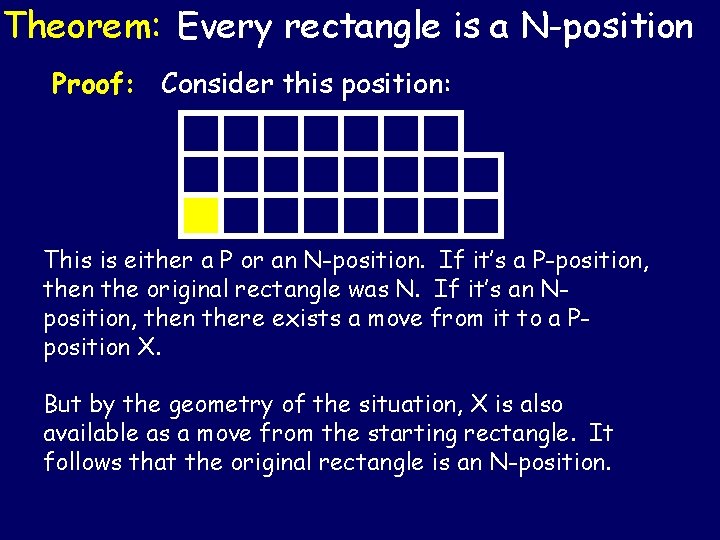
Theorem: Every rectangle is a N-position Proof: Consider this position: This is either a P or an N-position. If it’s a P-position, then the original rectangle was N. If it’s an Nposition, then there exists a move from it to a Pposition X. But by the geometry of the situation, X is also available as a move from the starting rectangle. It follows that the original rectangle is an N-position.
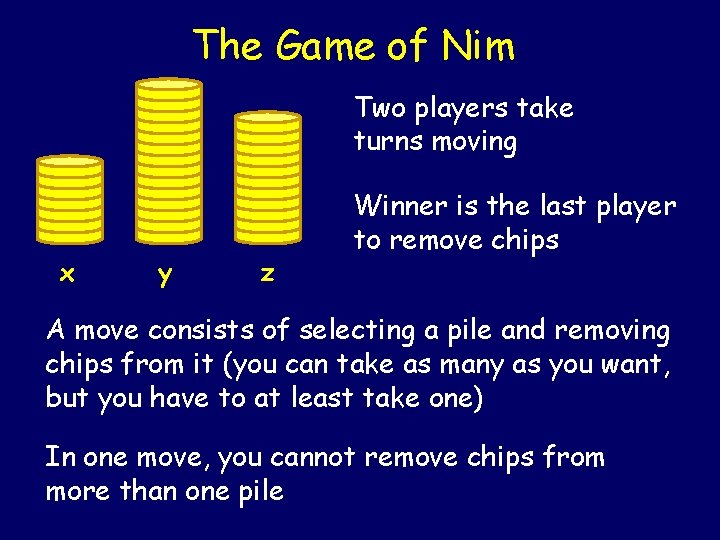
The Game of Nim Two players take turns moving x y z Winner is the last player to remove chips A move consists of selecting a pile and removing chips from it (you can take as many as you want, but you have to at least take one) In one move, you cannot remove chips from more than one pile
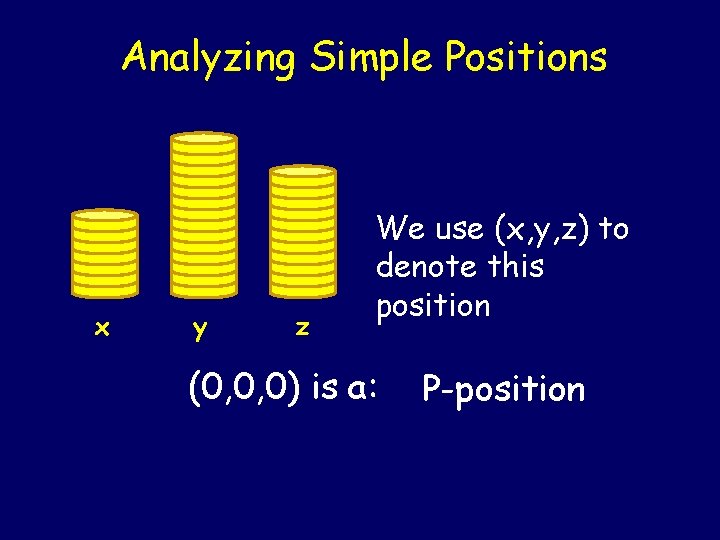
Analyzing Simple Positions x y z We use (x, y, z) to denote this position (0, 0, 0) is a: P-position
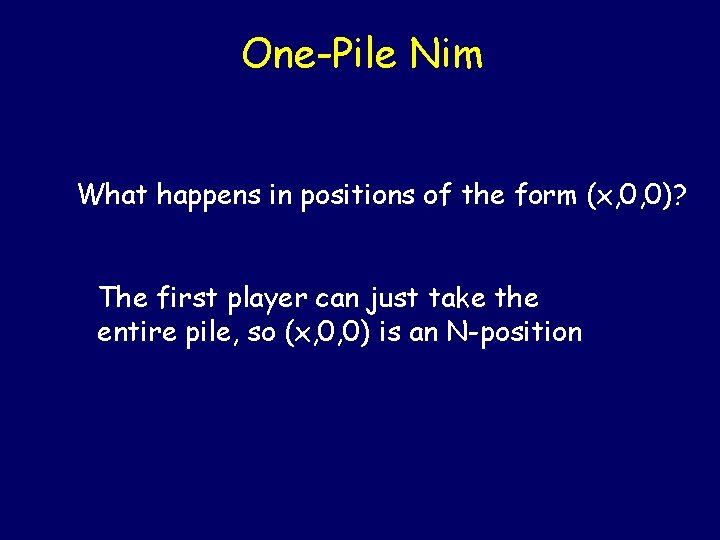
One-Pile Nim What happens in positions of the form (x, 0, 0)? The first player can just take the entire pile, so (x, 0, 0) is an N-position
Two-Pile Nim P-positions are those for which the two piles have an equal number of chips If it is the opponent’s turn to move from such a position, he must change to a position in which the two piles have different number of chips From a position with an unequal number of chips, you can easily go to one with an equal number of chips (perhaps the terminal position)
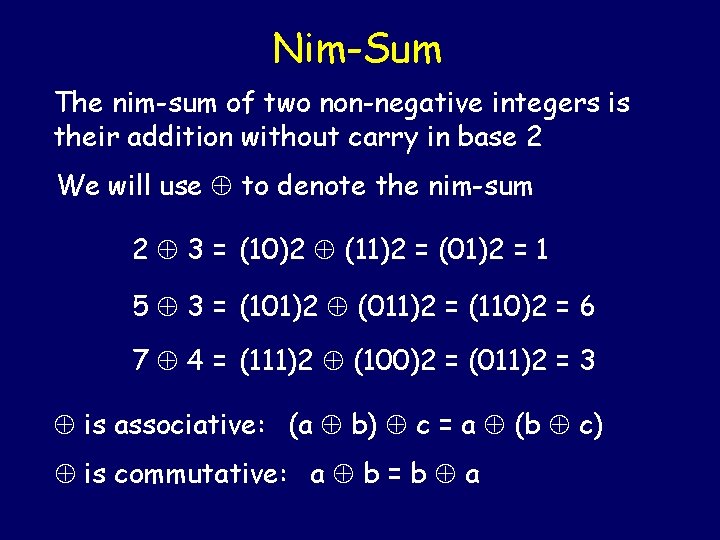
Nim-Sum The nim-sum of two non-negative integers is their addition without carry in base 2 We will use to denote the nim-sum 2 3 = (10)2 (11)2 = (01)2 = 1 5 3 = (101)2 (011)2 = (110)2 = 6 7 4 = (111)2 (100)2 = (011)2 = 3 is associative: (a b) c = a (b c) is commutative: a b = b a
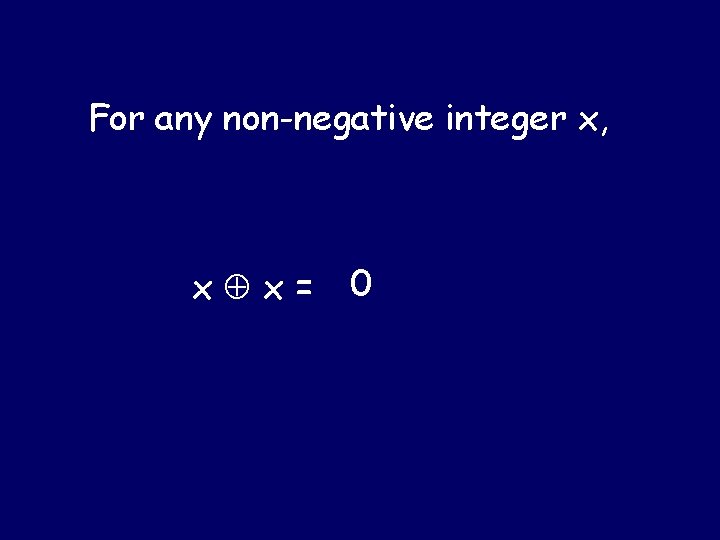
For any non-negative integer x, x x= 0
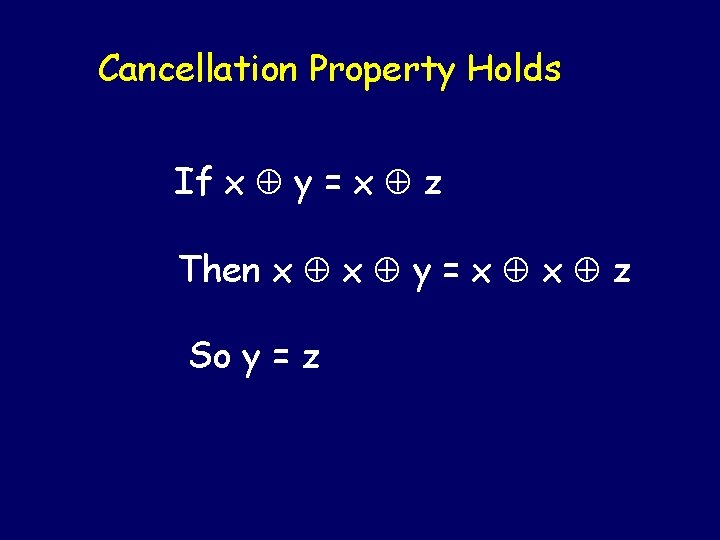
Cancellation Property Holds If x y = x z Then x x y = x x z So y = z
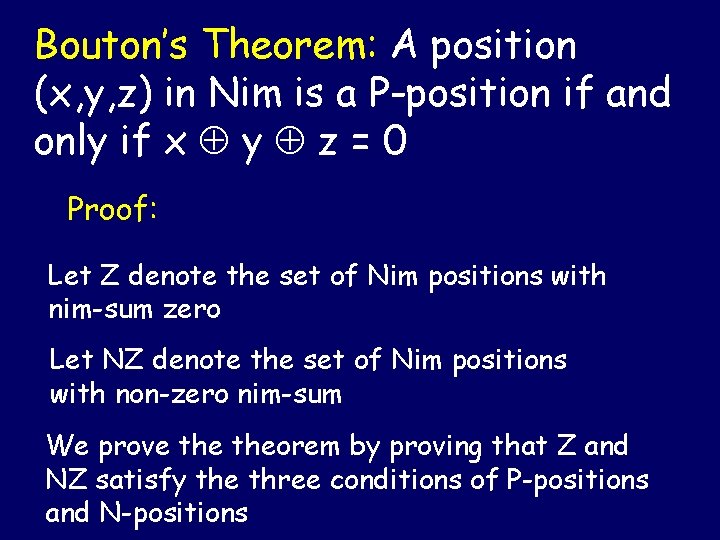
Bouton’s Theorem: A position (x, y, z) in Nim is a P-position if and only if x y z = 0 Proof: Let Z denote the set of Nim positions with nim-sum zero Let NZ denote the set of Nim positions with non-zero nim-sum We prove theorem by proving that Z and NZ satisfy the three conditions of P-positions and N-positions
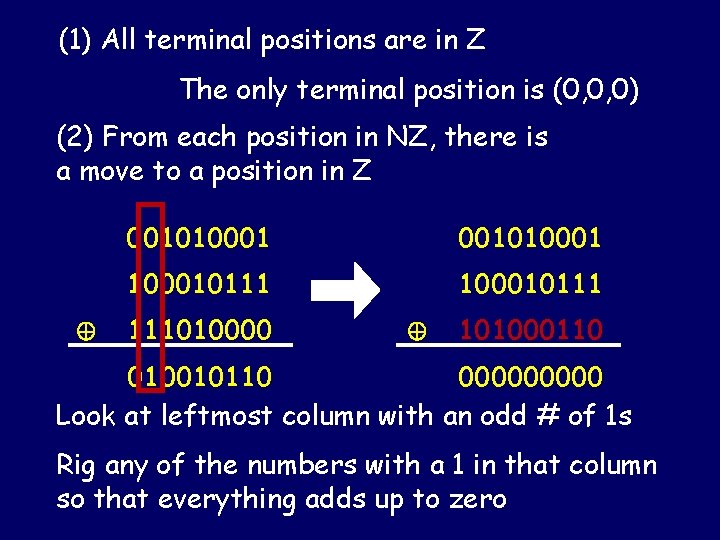
(1) All terminal positions are in Z The only terminal position is (0, 0, 0) (2) From each position in NZ, there is a move to a position in Z 0010100010111 111010000 010010110 101000110 00000 Look at leftmost column with an odd # of 1 s Rig any of the numbers with a 1 in that column so that everything adds up to zero
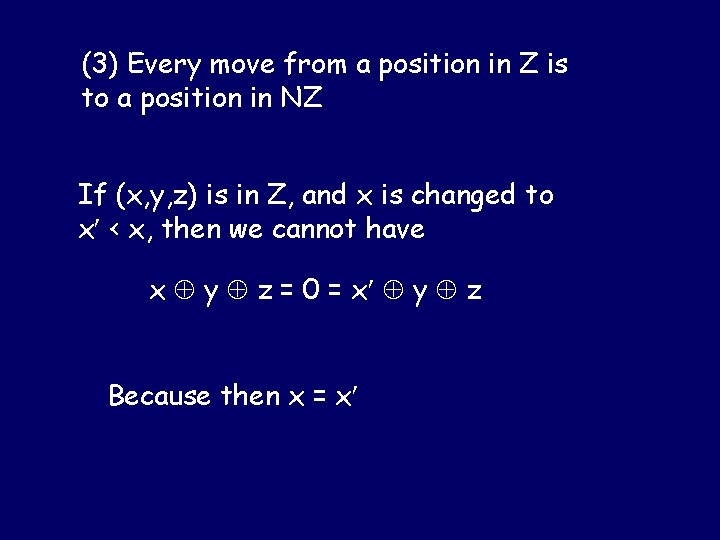
(3) Every move from a position in Z is to a position in NZ If (x, y, z) is in Z, and x is changed to x < x, then we cannot have x y z = 0 = x y z Because then x = x
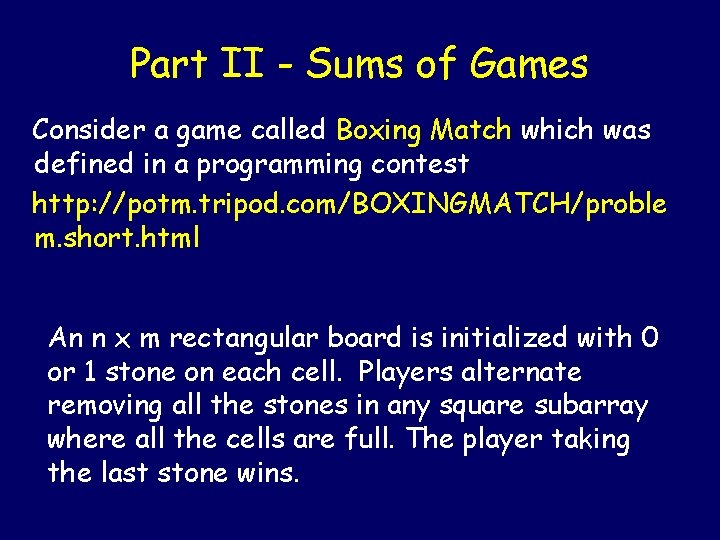
Part II - Sums of Games Consider a game called Boxing Match which was defined in a programming contest http: //potm. tripod. com/BOXINGMATCH/proble m. short. html An n x m rectangular board is initialized with 0 or 1 stone on each cell. Players alternate removing all the stones in any square subarray where all the cells are full. The player taking the last stone wins.
Boxing Match Example Suppose we start with a 10 x 20 array that is completely full. Is this a P or an N-position?
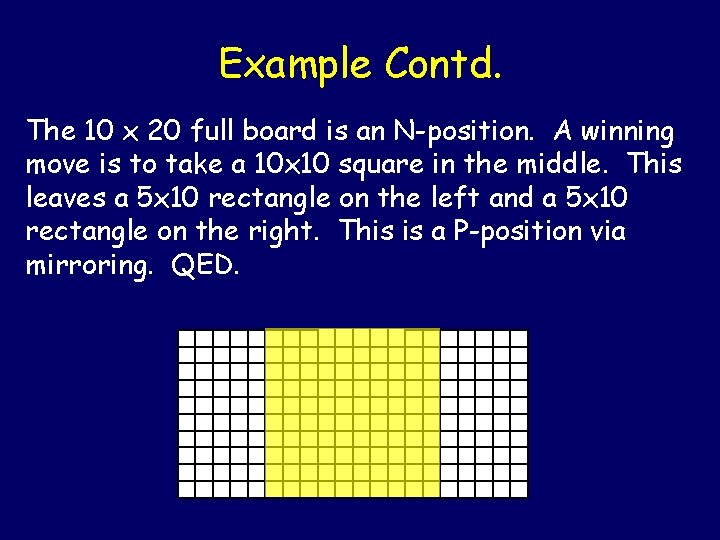
Example Contd. The 10 x 20 full board is an N-position. A winning move is to take a 10 x 10 square in the middle. This leaves a 5 x 10 rectangle on the left and a 5 x 10 rectangle on the right. This is a P-position via mirroring. QED.
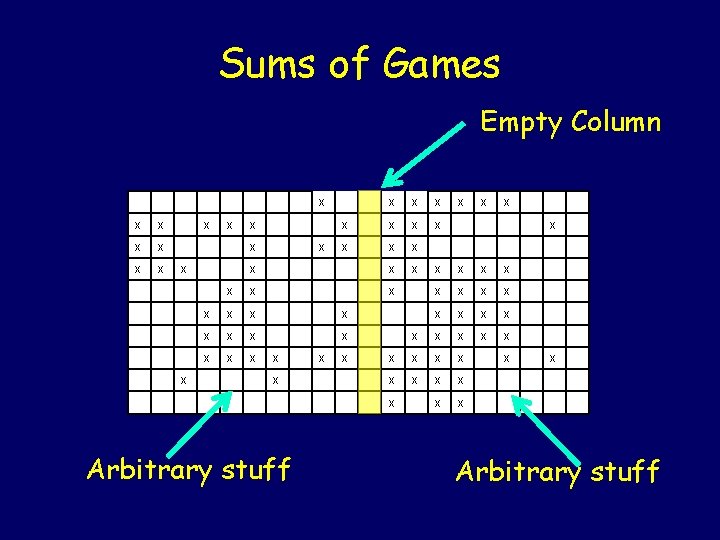
Sums of Games Empty Column x x x x x x x x x x x x x x x x x x x Arbitrary stuff x x x Arbitrary stuff
In this kind of situation, the left and right games are completely independent games that don’t interact at all. This naturally leads to the notion of the sum of two games. A + B
A+B A and B are games. The game A+B is a new game where the allowed moves are to pick one of the two games A or B (that is non-terminal) and make a move in that game. The position is terminal iff both A and B are terminal. The sum operator is clearly commutative and associative.
Sums of Games* We assign a number to any position in any game. This number is called the Nimber of the game. (It’s also called the “Nim Sum” or the “Sprague-Grundy” number of a game. But we’ll call it the Nimber. ) *Only applies to normal, impartial games.
The MEX The “MEX” of a finite set of natural numbers is the Minimum EXcluded element. MEX {0, 1, 2, 4, 5, 6} = 3 MEX {1, 3, 5, 7, 9} = 0
Definition of Nimber The Nimber of a game G (denoted N(G)) is defined inductively as follows: N(G) = 0 if G is terminal N(G) = MEX{N(G 1), N(G 2), … N(Gn)} Where G 1, G 2, … Gn are the successor positions of game G. (I. e. the positions resulting from all the allowed moves. )
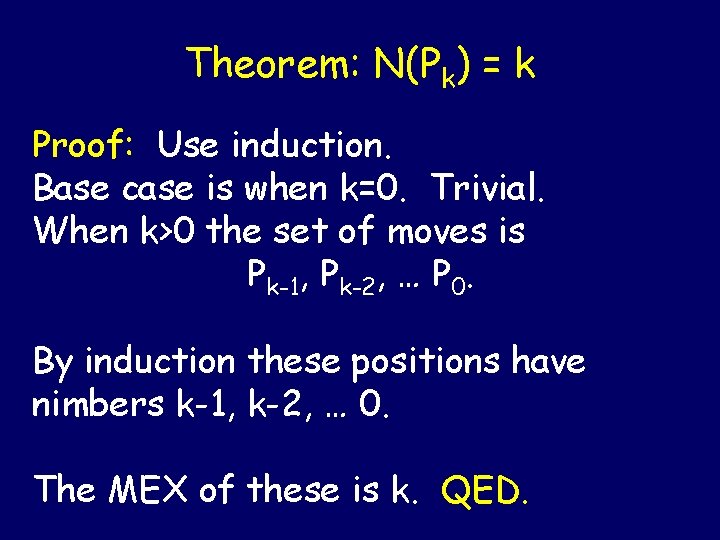
Another look at Nim Let Pk denote the game that is a pile of k stones in the game of Nim. Theorem: N(Pk) = k
Theorem: N(Pk) = k Proof: Use induction. Base case is when k=0. Trivial. When k>0 the set of moves is Pk-1, Pk-2, … P 0. By induction these positions have nimbers k-1, k-2, … 0. The MEX of these is k. QED.
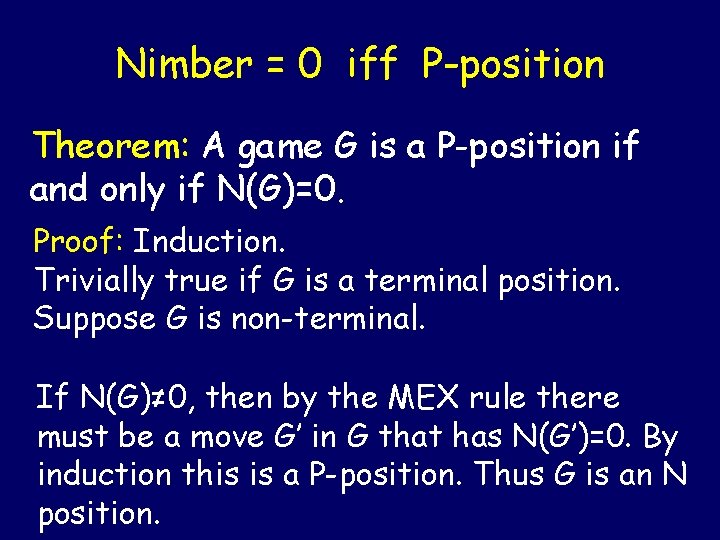
Nimber = 0 iff P-position Theorem: A game G is a P-position if and only if N(G)=0. Proof: Induction. Trivially true if G is a terminal position. Suppose G is non-terminal. If N(G)≠ 0, then by the MEX rule there must be a move G’ in G that has N(G’)=0. By induction this is a P-position. Thus G is an N position.
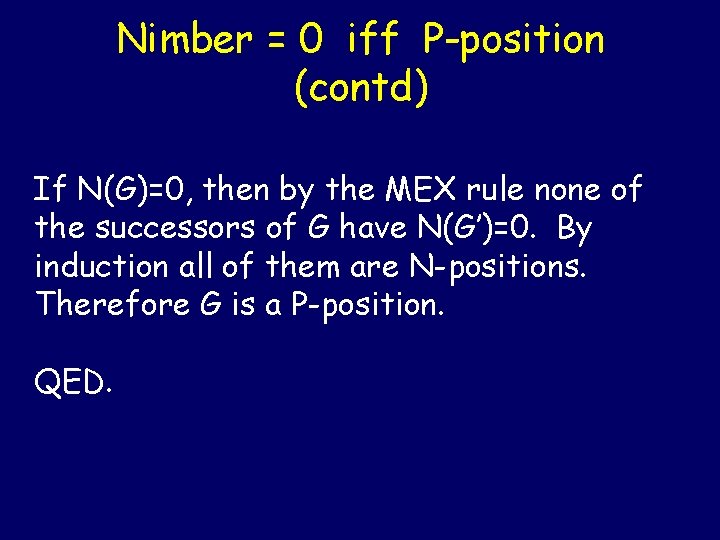
Nimber = 0 iff P-position (contd) If N(G)=0, then by the MEX rule none of the successors of G have N(G’)=0. By induction all of them are N-positions. Therefore G is a P-position. QED.
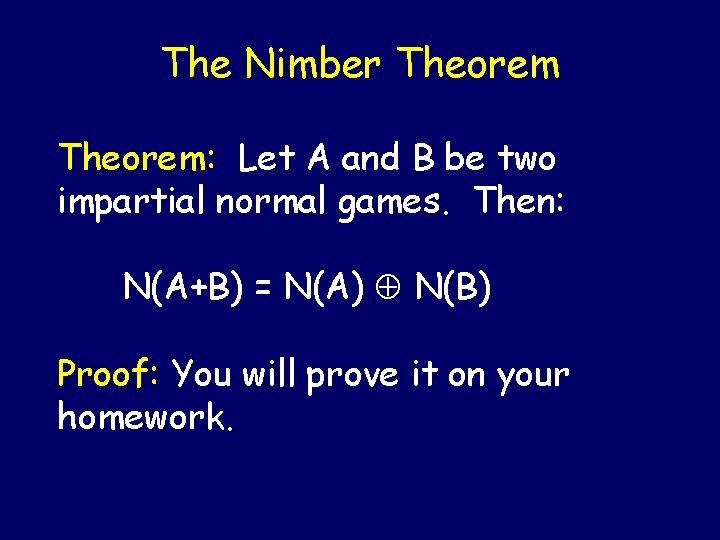
The Nimber Theorem: Let A and B be two impartial normal games. Then: N(A+B) = N(A) N(B) Proof: You will prove it on your homework.
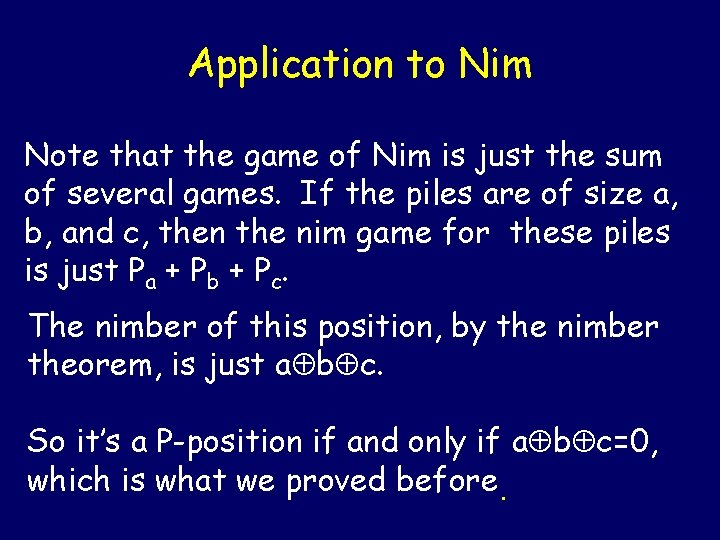
Application to Nim Note that the game of Nim is just the sum of several games. If the piles are of size a, b, and c, then the nim game for these piles is just Pa + Pb + Pc. The nimber of this position, by the nimber theorem, is just a b c. So it’s a P-position if and only if a b c=0, which is what we proved before.
Application to Boxing Match The beauty of Nimbers is that they completely capture what you need to know about a game in order to add it to another game. This can speed up game search exponentially. My friends Guy Jacobson and David Applegate used this to cream all the other players in the Boxing Match contest.
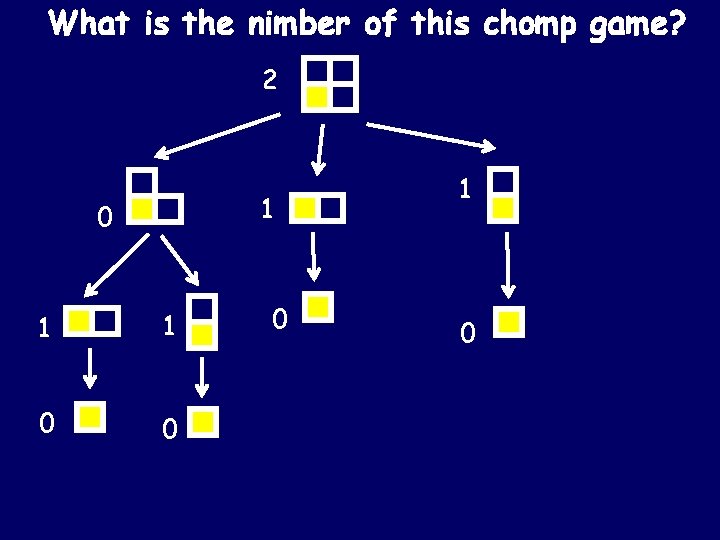
What is the nimber of this chomp game? 2 1 0 1 1 0 0 0 1 0
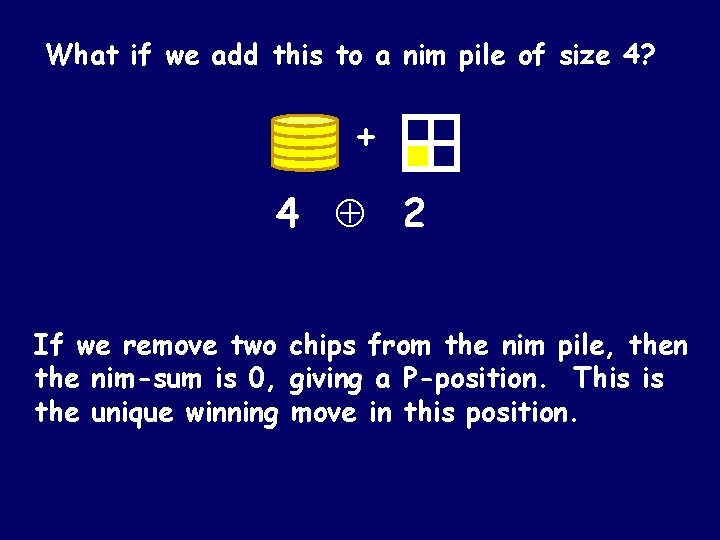
What if we add this to a nim pile of size 4? + 4 2 If we remove two chips from the nim pile, then the nim-sum is 0, giving a P-position. This is the unique winning move in this position.
• P-positions versus N-positions • Nim-sum • Bouton’s Theorem • Definition of Nimbers • The MEX operator • Sum of Games • The Nimber Theorem Study Bee