
Great Theoretical Ideas In Computer Science S Rudich








- Slides: 59
Great Theoretical Ideas In Computer Science S. Rudich V. Adamchik Lecture 8 CS 15 -251 Feb. 09, 2006 Spring 2006 Carnegie Mellon University RSA Cryptosystem p-1 =p 1
Cryptography is the mathematics of devising secure communication systems Cryptanalysis is the mathematics of breaking such systems.
RSA Cryptography Basically unbreakable method for encoding messages
RSA Cryptography Rivest Shamir Adelman (1978)
This is Alice
This is Alice and this is Bob
This is Alice and this is Bob and this is Trudy
Plaintext Encryption Ciphertext Transmission Decryption Message
Plaintext Encryption Ciphertext Transmission Decryption Message Eavesdropping Impersonation Alteration
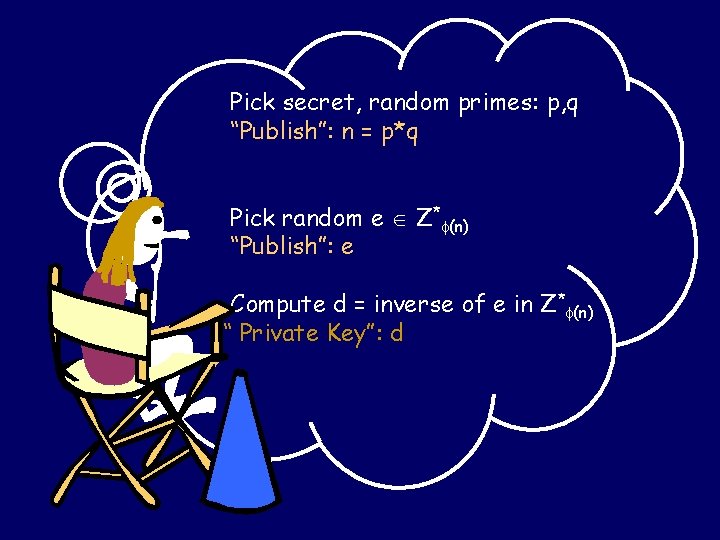
Pick secret, random primes: p, q “Publish”: n = p*q Pick random e Z* (n) “Publish”: e Compute d = inverse of e in Z* (n) “ Private Key”: d
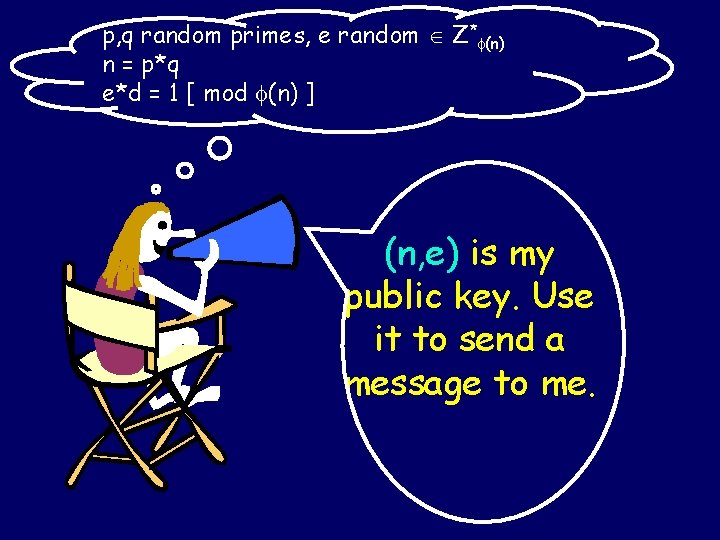
p, q random primes, e random Z* (n) n = p*q e*d = 1 [ mod (n) ] (n, e) is my public key. Use it to send a message to me.
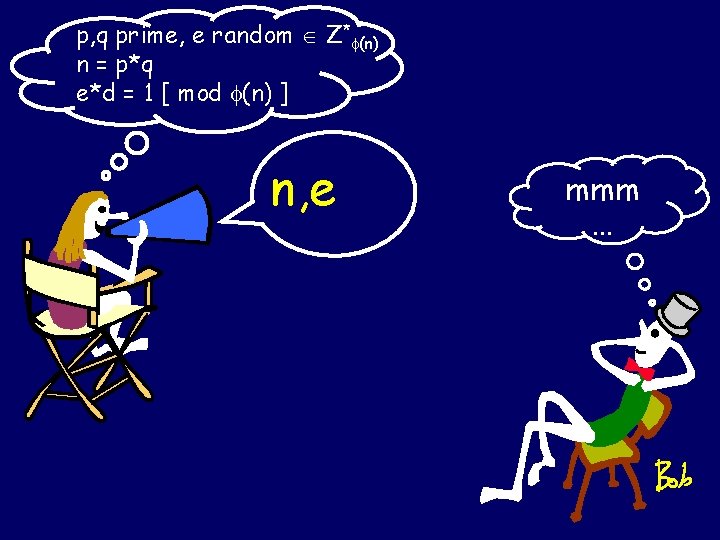
p, q prime, e random Z* (n) n = p*q e*d = 1 [ mod (n) ] n, e mmm …
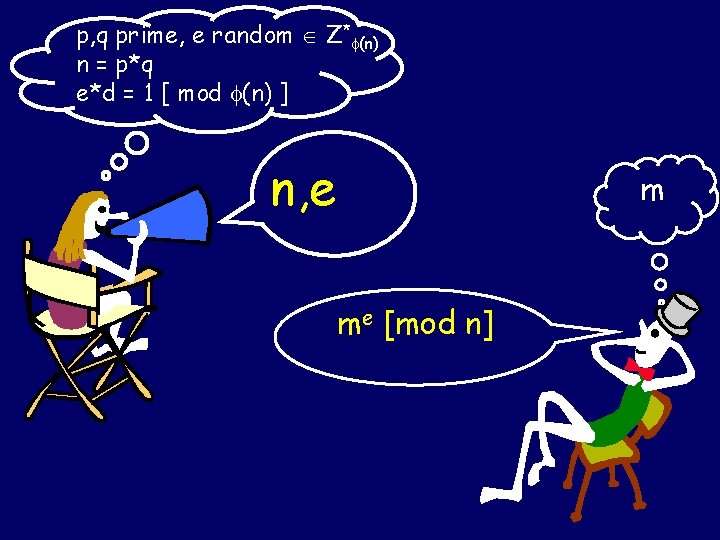
p, q prime, e random Z* (n) n = p*q e*d = 1 [ mod (n) ] n, e m me [mod n]
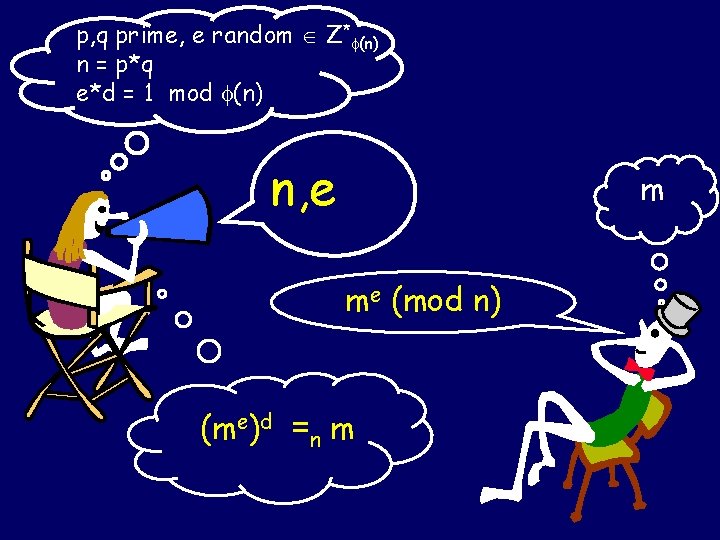
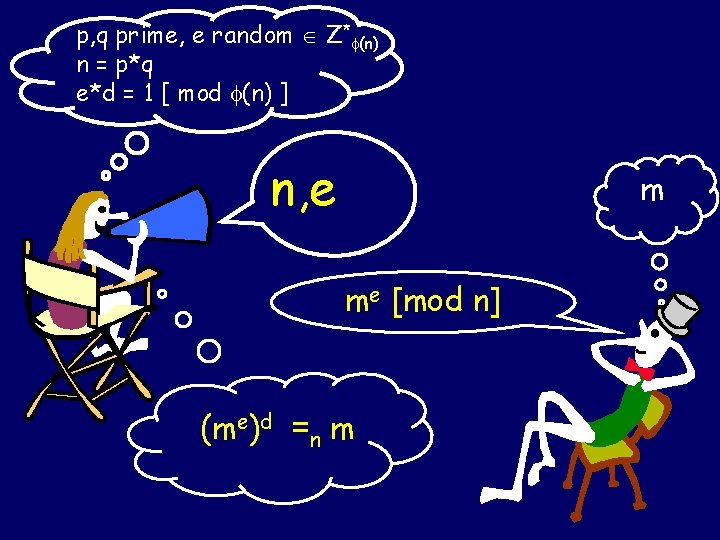
p, q prime, e random Z* (n) n = p*q e*d = 1 mod (n) n, e m me (mod n) (me)d =n m
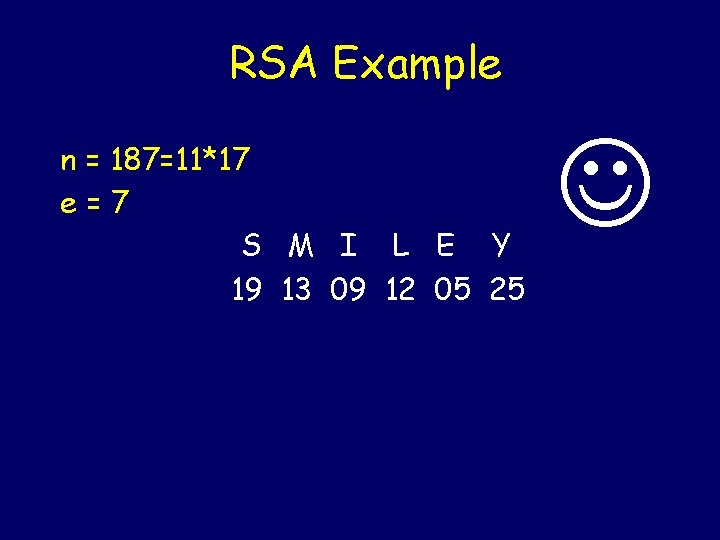
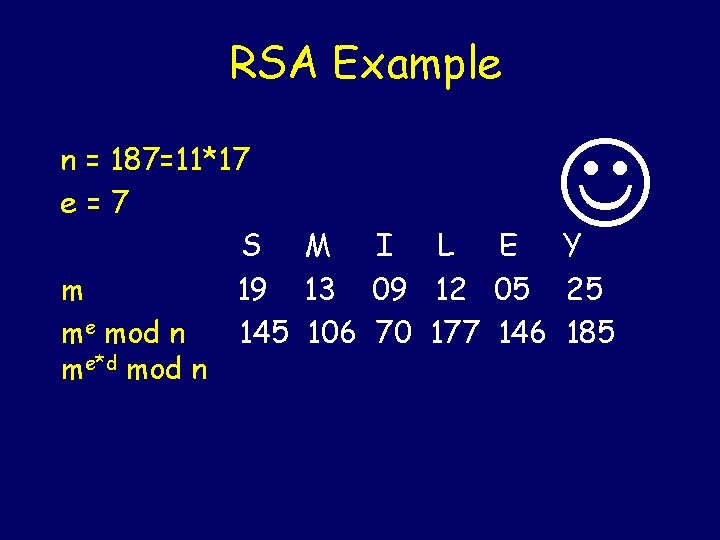
RSA Example n = 187=11*17 e=7 S M I L E Y 19 13 09 12 05 25
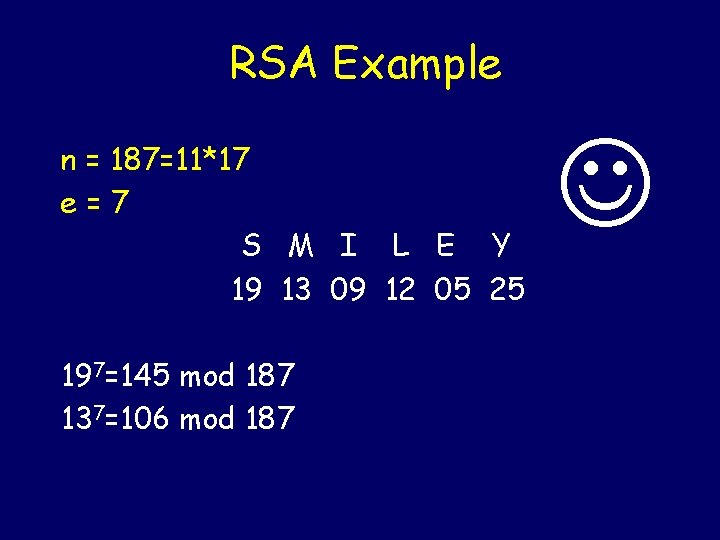
RSA Example n = 187=11*17 e=7 S M I L E Y 19 13 09 12 05 25 197=145 mod 187 137=106 mod 187
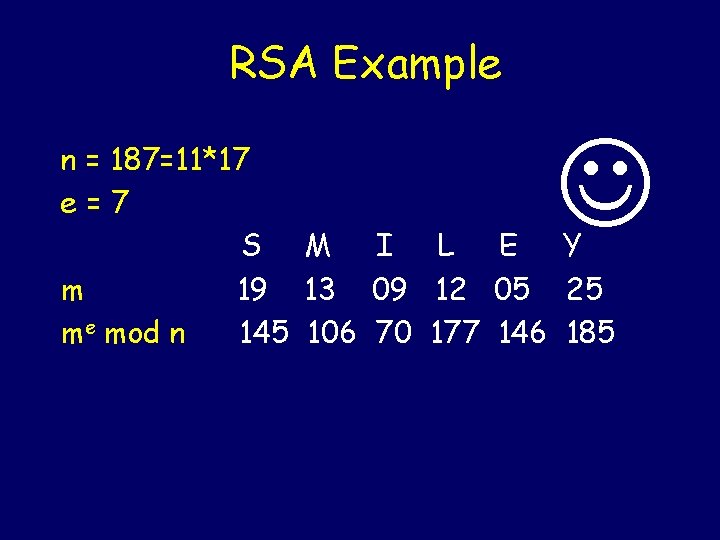
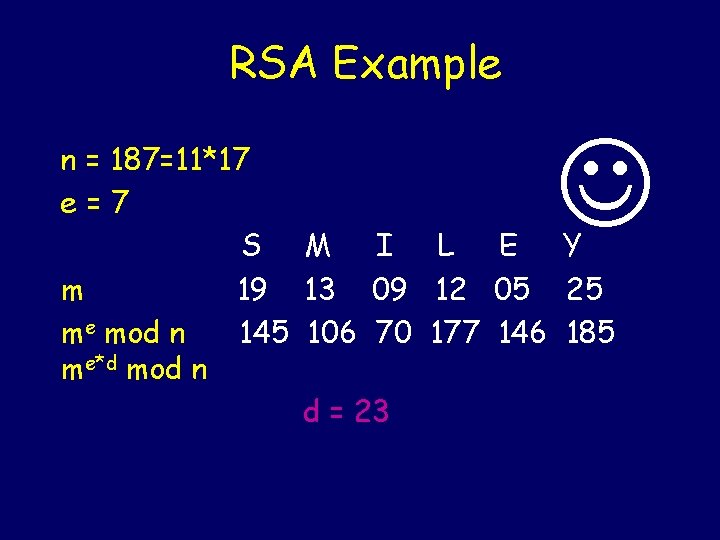
RSA Example n = 187=11*17 e=7 S M I L E Y m 19 13 09 12 05 25 me mod n 145 106 70 177 146 185
RSA Example n = 187=11*17 e=7 S M I L E Y m 19 13 09 12 05 25 me mod n 145 106 70 177 146 185 me*d mod n
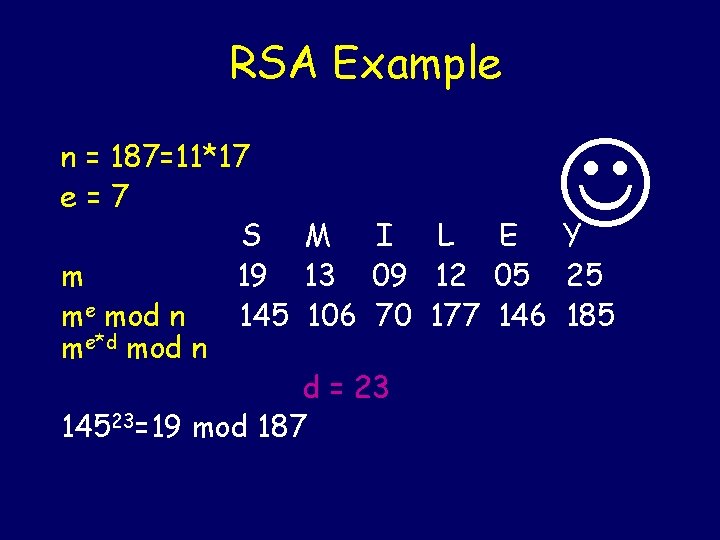
RSA Example n = 187=11*17 e=7 S M I L E Y m 19 13 09 12 05 25 me mod n 145 106 70 177 146 185 me*d mod n d = 23
RSA Example n = 187=11*17 e=7 S M I L E Y m 19 13 09 12 05 25 me mod n 145 106 70 177 146 185 me*d mod n d = 23 14523=19 mod 187
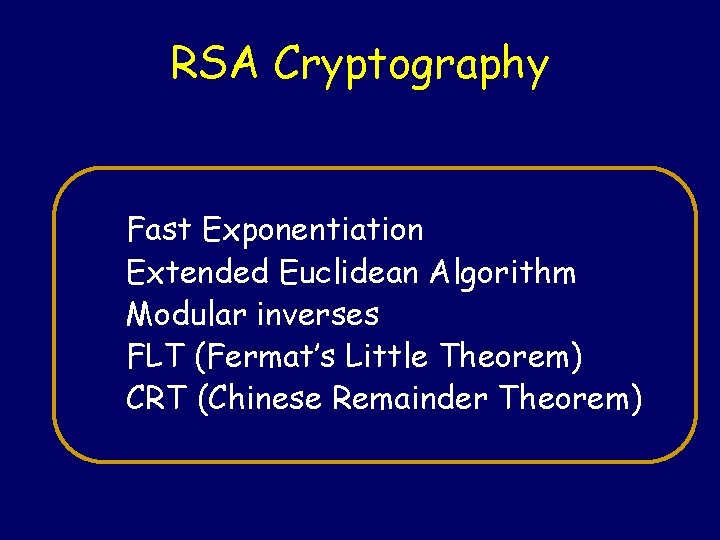
RSA Cryptography Fast Exponentiation Extended Euclidean Algorithm Modular inverses FLT (Fermat’s Little Theorem) CRT (Chinese Remainder Theorem)
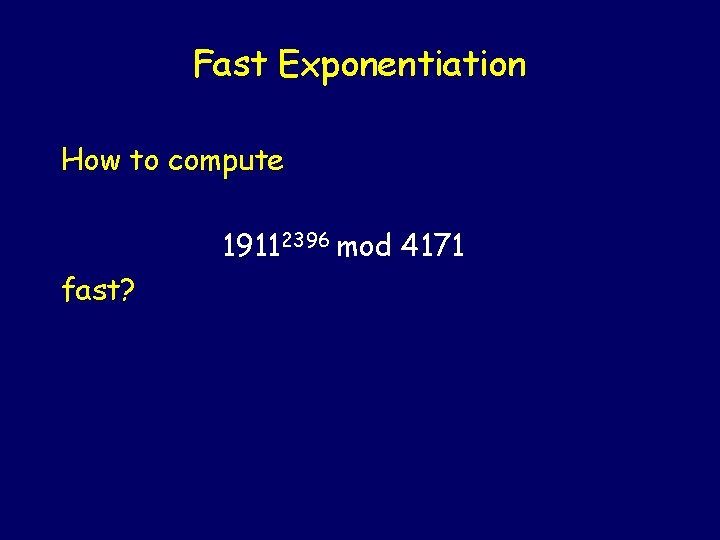
Fast Exponentiation How to compute 19112396 mod 4171 fast?
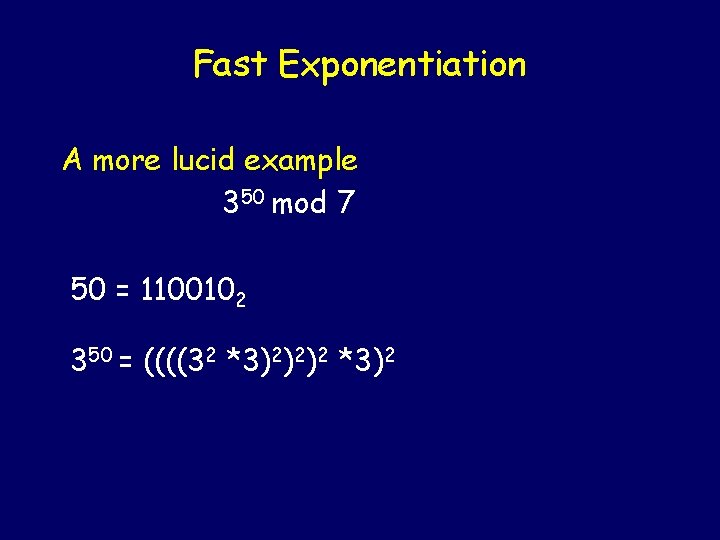
Fast Exponentiation A more lucid example 350 mod 7 50 = 1100102 350 = ((((32 *3)2)2)2 *3)2
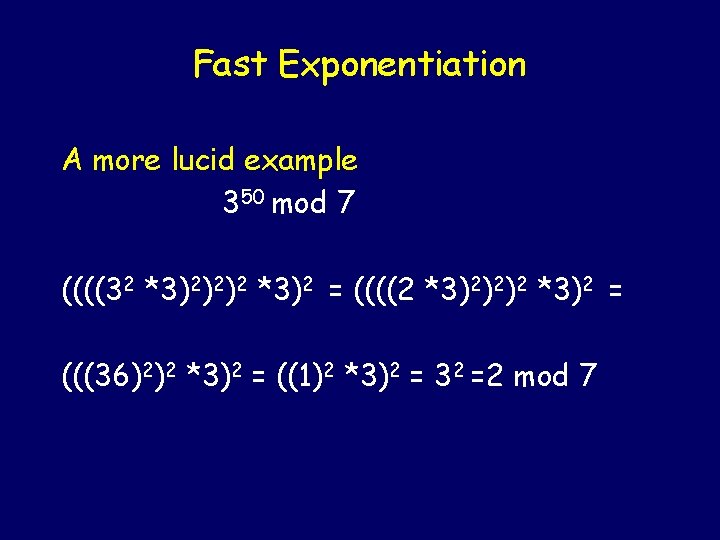
Fast Exponentiation A more lucid example 350 mod 7 ((((32 *3)2)2)2 *3)2 = ((((2 *3)2)2)2 *3)2 = (((36)2)2 *3)2 = ((1)2 *3)2 = 32 =2 mod 7
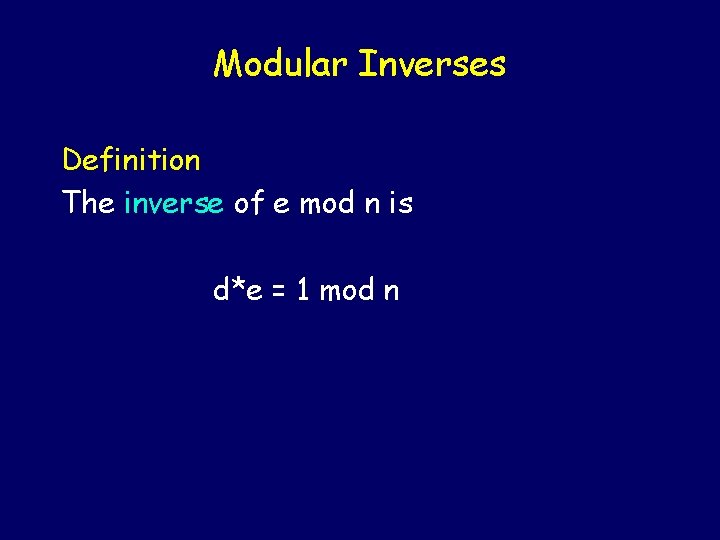
Modular Inverses Definition The inverse of e mod n is d*e = 1 mod n
Modular Inverses Definition The inverse of e mod n is d*e = 1 mod n Question. What is the inverse of 3 mod 29?
Modular Inverses Definition The inverse of e mod n is d*e = 1 mod n Question. What is the inverse of 4 mod 8?
Modular Inverses Definition The inverse of e mod n is d*e = 1 mod n Theorem. e has an inverse mod n iff GCD(e, n)=1
Modular Inverses Theorem. e has an inverse mod n iff GCD(e, n)=1 Proof. By the EEA 1 = a*e + b*n
Extended Euclidean Algorithm The algorithm works the same as the regular Euclidean algorithm, except it keeps track of more details. It computes x and y such that GCD(a, b) = a*x + b*y
Extended Euclidean Algorithm Application. Recall the Die Hard movie. Willis and Jackson are supposed to disarm a bomb by measuring exactly 4 gallons of water using only 3 and 5 -gallons containers. GCD(3, 5) = 2*3 + (-1)*5
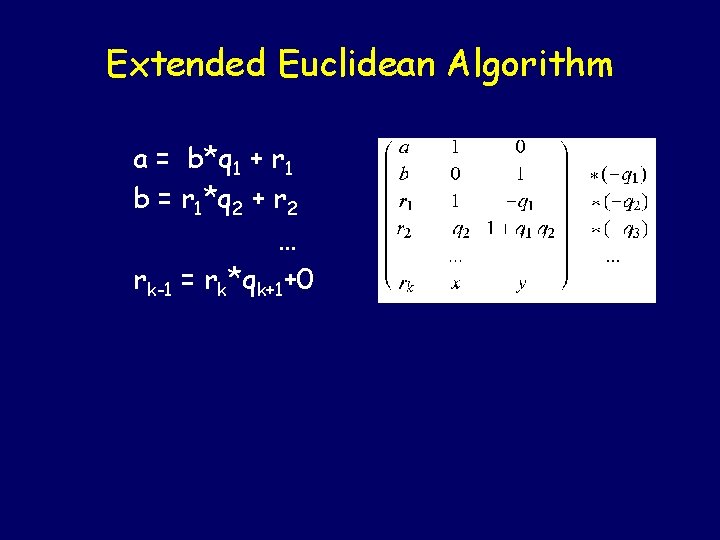
Extended Euclidean Algorithm a = b*q 1 + r 1 b = r 1*q 2 + r 2 … rk-1 = rk*qk+1+0
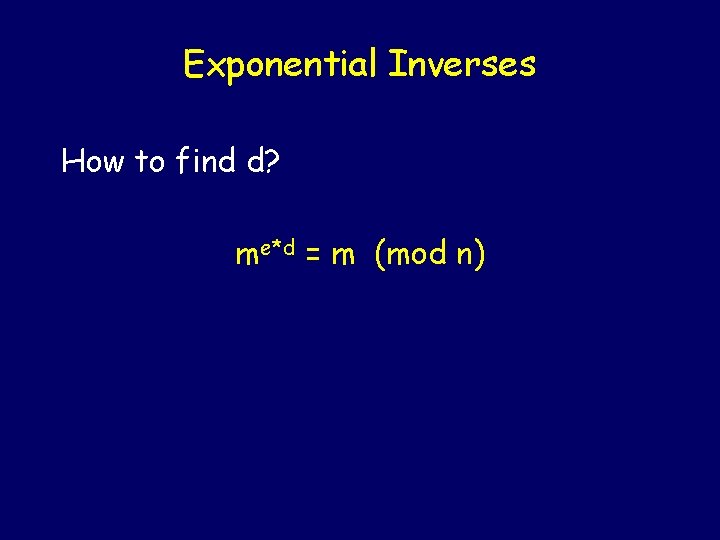
Exponential Inverses How to find d? me*d = m (mod n)
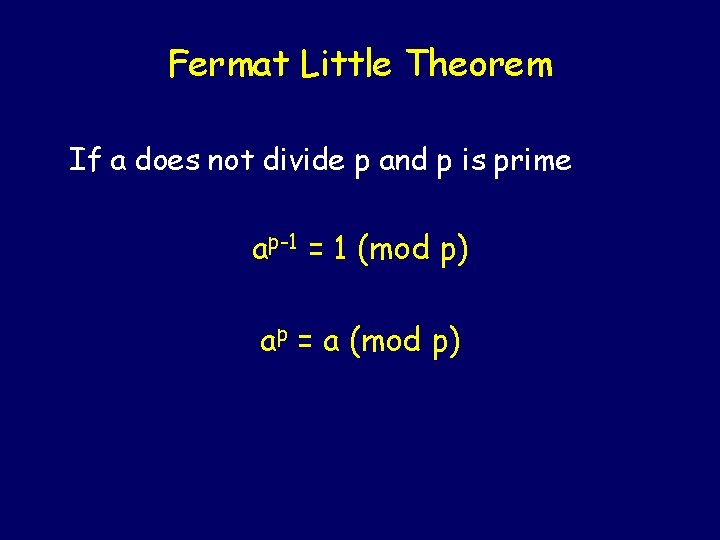
Fermat Little Theorem If a does not divide p and p is prime ap-1 = 1 (mod p) ap = a (mod p)
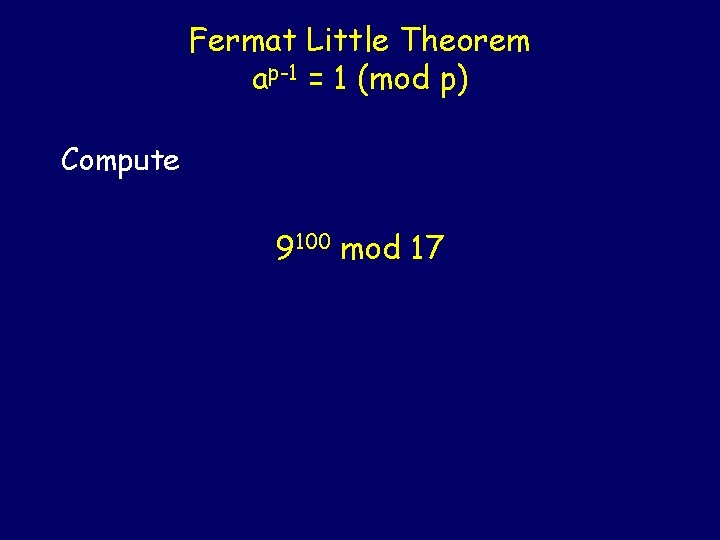
Fermat Little Theorem ap-1 = 1 (mod p) Compute 9100 mod 17
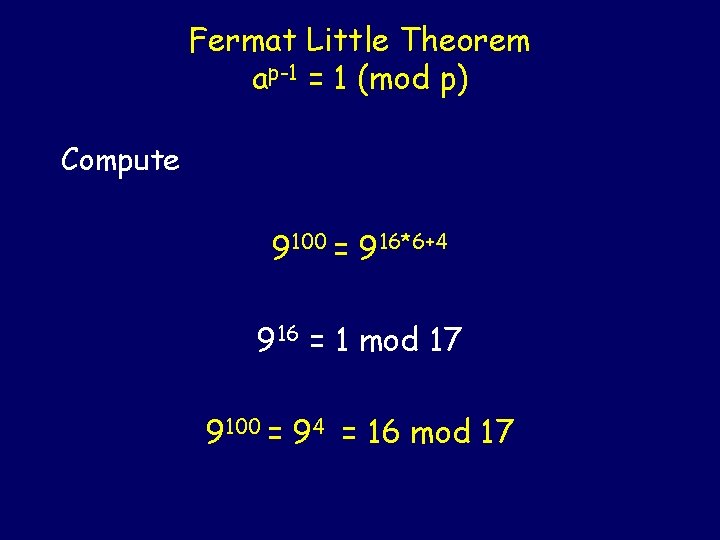
Fermat Little Theorem ap-1 = 1 (mod p) Compute 9100 = 916*6+4 916 = 1 mod 17 9100 = 94 = 16 mod 17
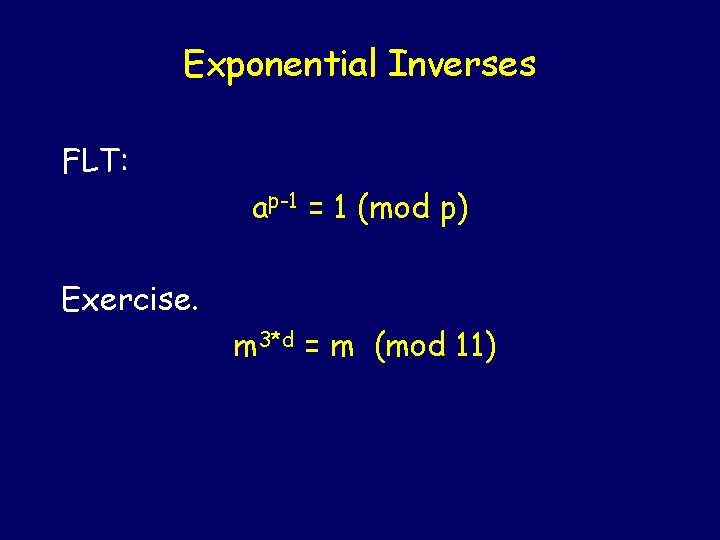
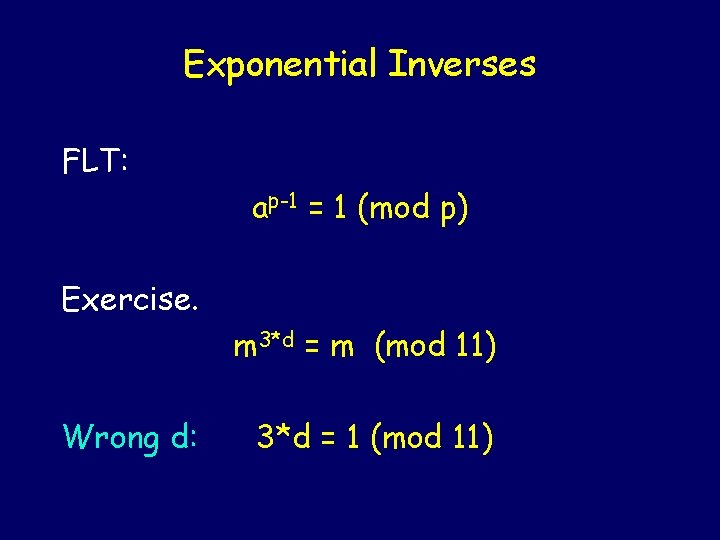
Exponential Inverses FLT: ap-1 = 1 (mod p) Exercise. m 3*d = m (mod 11)
Exponential Inverses FLT: ap-1 = 1 (mod p) Exercise. m 3*d = m (mod 11) Wrong d: 3*d = 1 (mod 11)
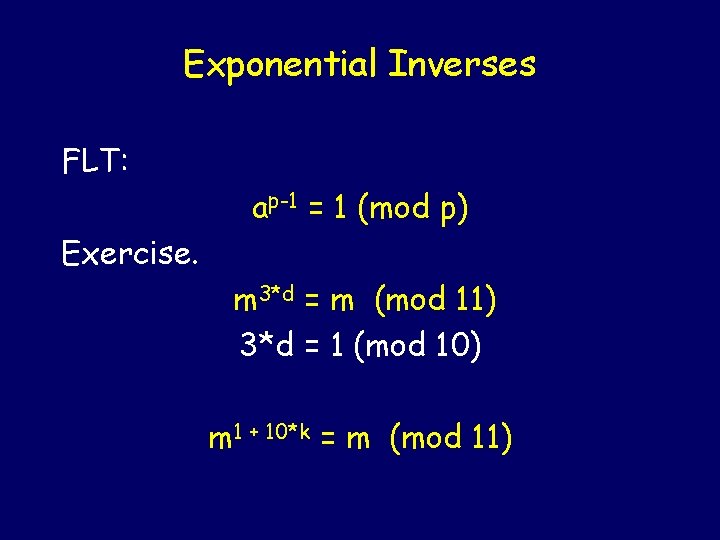
Exponential Inverses FLT: ap-1 = 1 (mod p) Exercise. m 3*d = m (mod 11) 3*d = 1 (mod 10) m 1 + 10*k = m (mod 11)
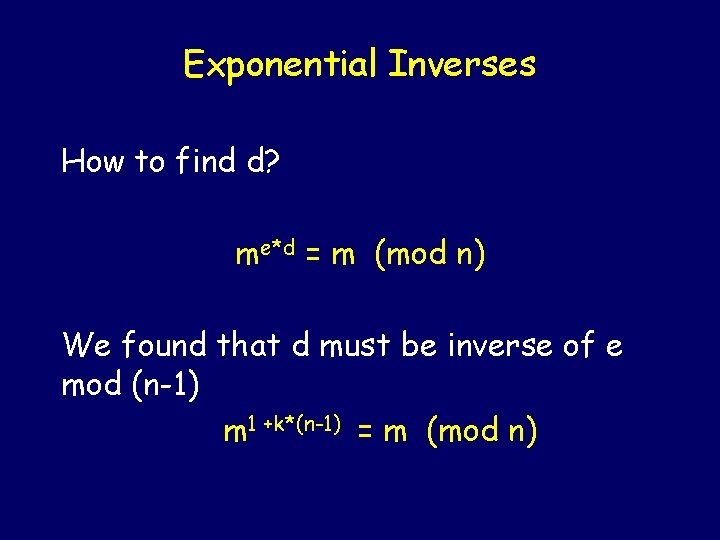
Exponential Inverses How to find d? me*d = m (mod n) We found that d must be inverse of e mod (n-1) m 1 +k*(n-1) = m (mod n)
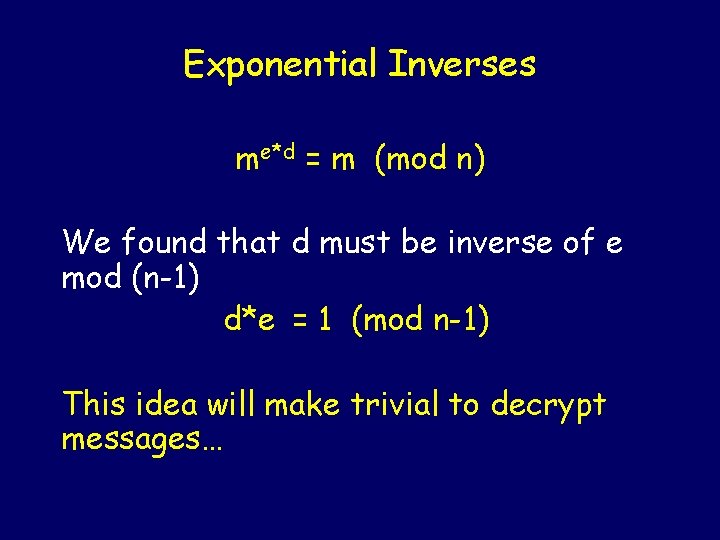
Exponential Inverses me*d = m (mod n) We found that d must be inverse of e mod (n-1) d*e = 1 (mod n-1) This idea will make trivial to decrypt messages…
RSA uses n = p*q a product of two primes
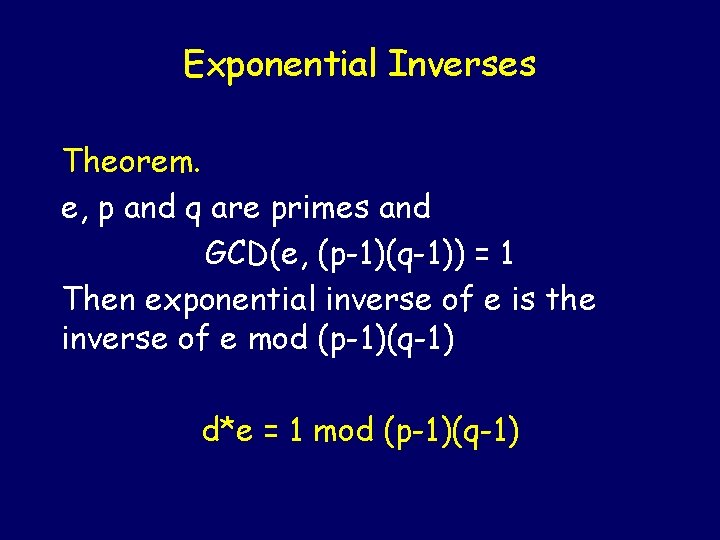
Exponential Inverses Theorem. e, p and q are primes and GCD(e, (p-1)(q-1)) = 1 Then exponential inverse of e is the inverse of e mod (p-1)(q-1) d*e = 1 mod (p-1)(q-1)
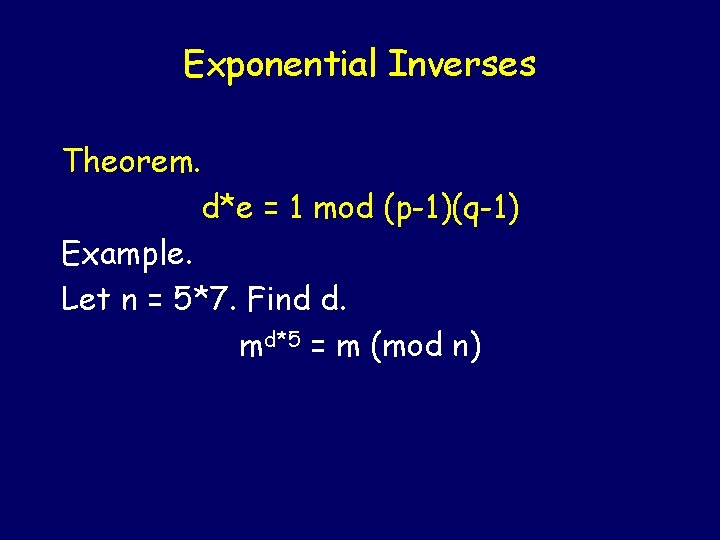
Exponential Inverses Theorem. d*e = 1 mod (p-1)(q-1) Example. Let n = 5*7. Find d. md*5 = m (mod n)
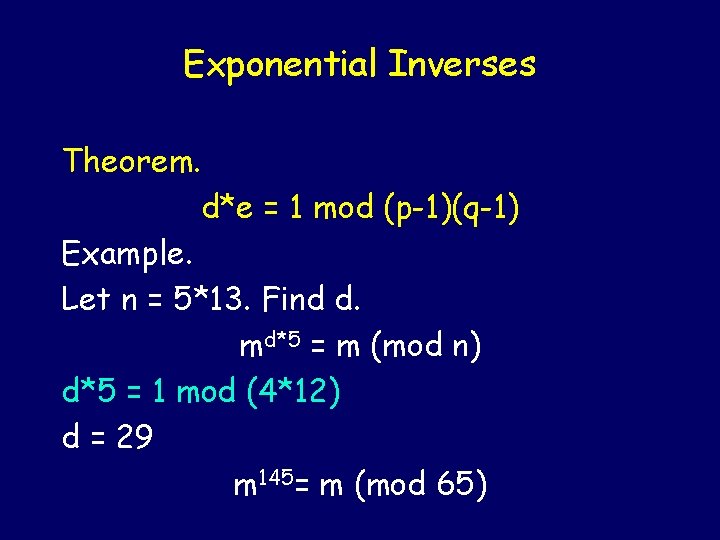
Exponential Inverses Theorem. d*e = 1 mod (p-1)(q-1) Example. Let n = 5*13. Find d. md*5 = m (mod n) d*5 = 1 mod (4*12) d = 29 m 145= m (mod 65)
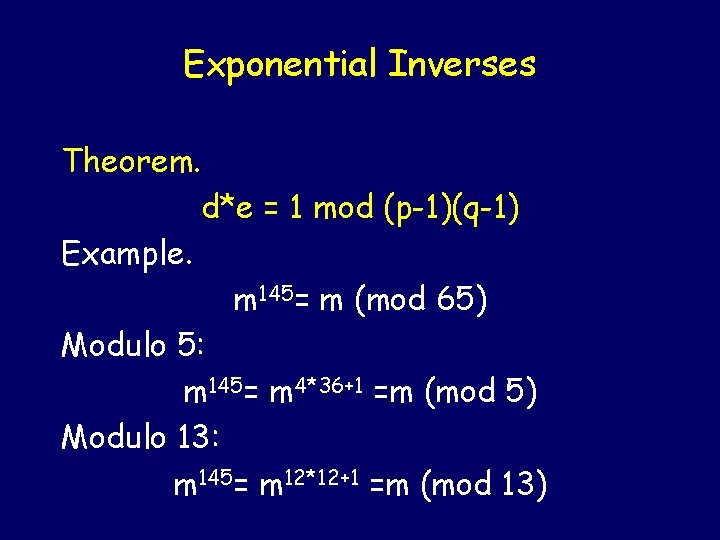
Exponential Inverses Theorem. d*e = 1 mod (p-1)(q-1) Example. m 145= m (mod 65) Modulo 5: m 145= m 4*36+1 =m (mod 5) Modulo 13: m 145= m 12*12+1 =m (mod 13)
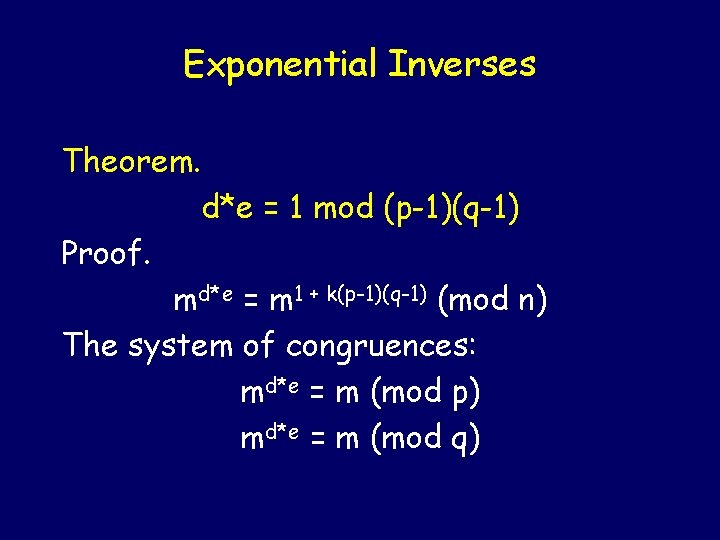
Exponential Inverses Theorem. d*e = 1 mod (p-1)(q-1) Proof. md*e = m 1 + k(p-1)(q-1) (mod n) The system of congruences: md*e = m (mod p) md*e = m (mod q)
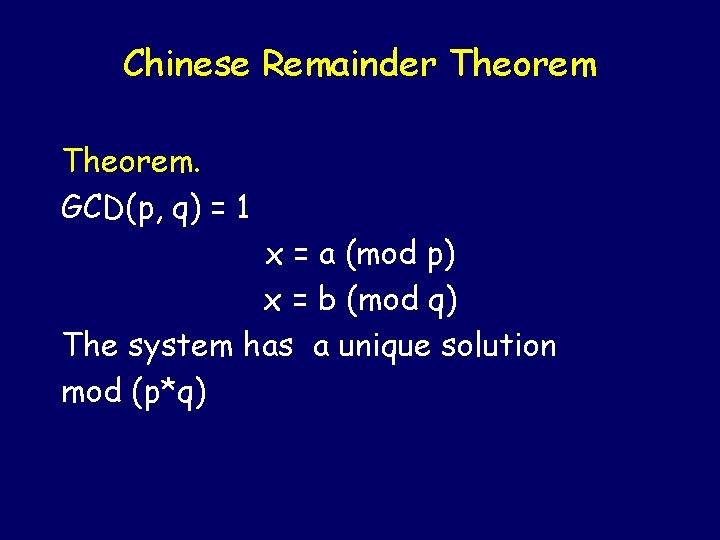
Chinese Remainder Theorem. GCD(p, q) = 1 x = a (mod p) x = b (mod q) The system has a unique solution mod (p*q)
p, q prime, e random Z* (n) n = p*q e*d = 1 [ mod (n) ] n, e m me [mod n] (me)d =n m
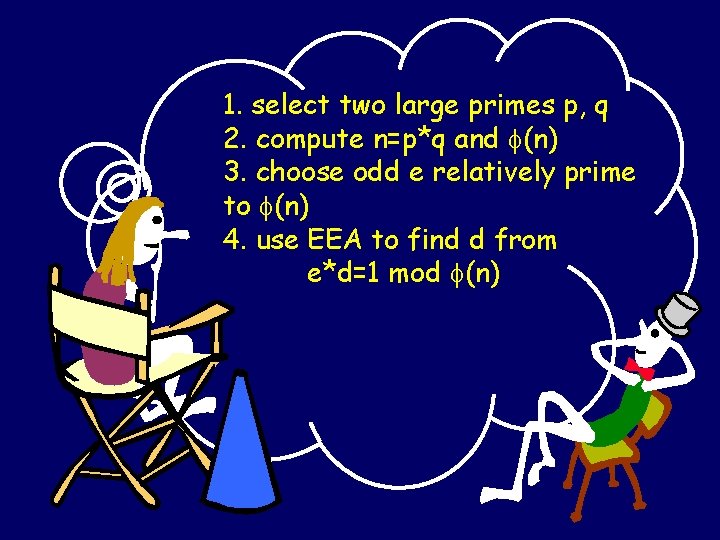
1. select two large primes p, q 2. compute n=p*q and (n) 3. choose odd e relatively prime to (n) 4. use EEA to find d from e*d=1 mod (n)
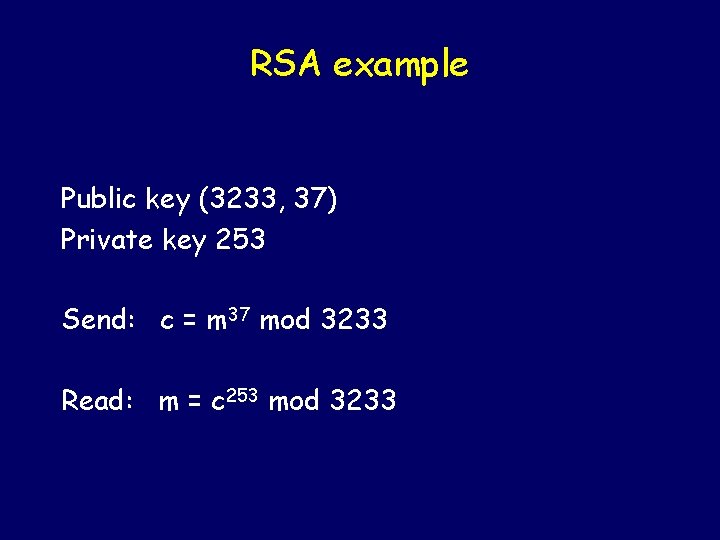
1. Sending message me = c (mod n) 2. Reading message cd = m (mod n)
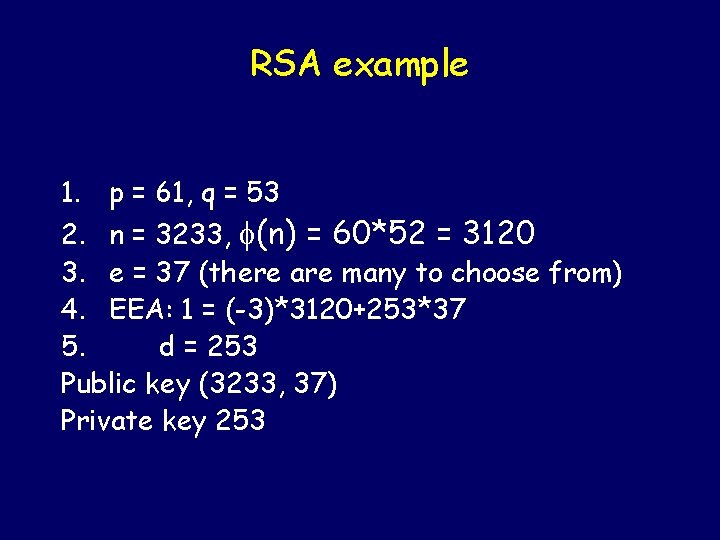
RSA example 1. p = 61, q = 53 2. n = 3233, (n) = 60*52 = 3120 3. e = 37 (there are many to choose from) 4. EEA: 1 = (-3)*3120+253*37 5. d = 253 Public key (3233, 37) Private key 253
RSA example Public key (3233, 37) Private key 253 Send: c = m 37 mod 3233 Read: m = c 253 mod 3233
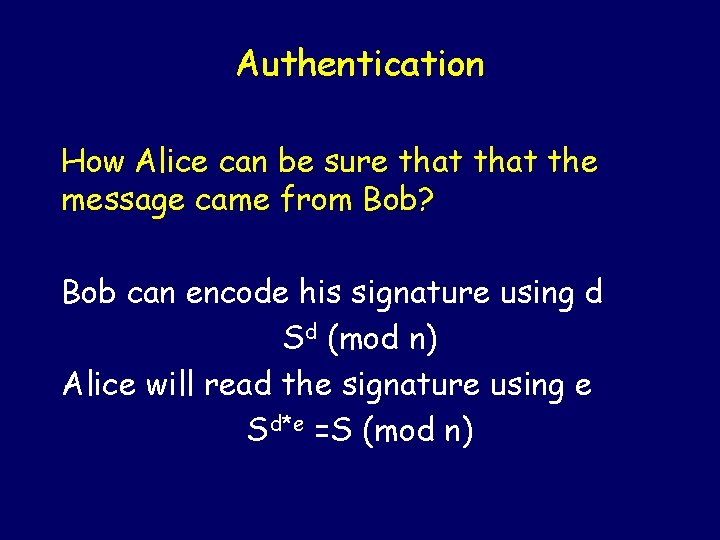
Authentication How Alice can be sure that the message came from Bob?
Authentication How Alice can be sure that the message came from Bob? Bob can encode his signature using d Sd (mod n) Alice will read the signature using e Sd*e =S (mod n)
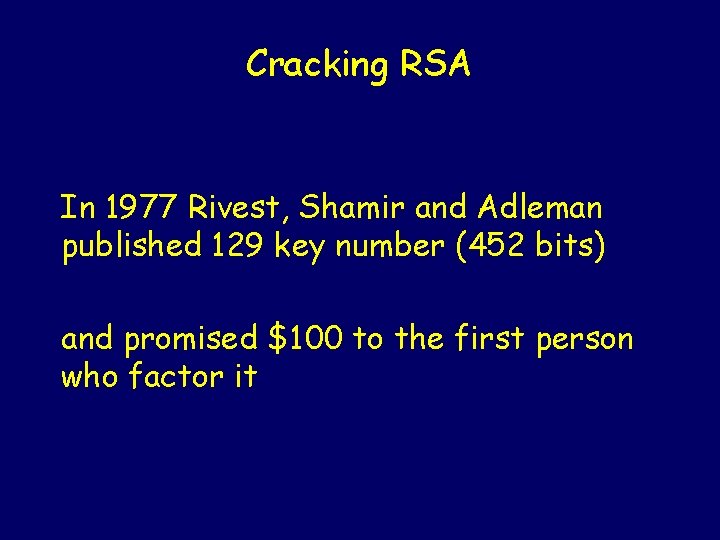
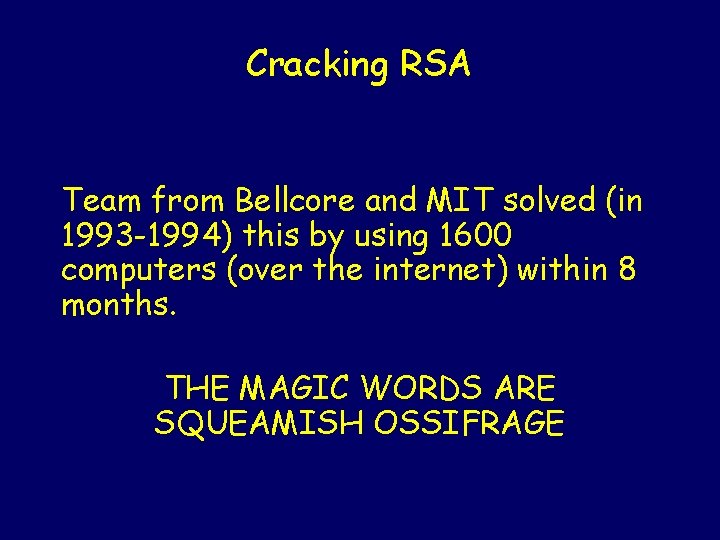
Cracking RSA In 1977 Rivest, Shamir and Adleman published 129 key number (452 bits) and promised $100 to the first person who factor it
Cracking RSA Team from Bellcore and MIT solved (in 1993 -1994) this by using 1600 computers (over the internet) within 8 months. THE MAGIC WORDS ARE SQUEAMISH OSSIFRAGE
Cracking RSA The current record: RSA-674: Nov. , 2005
• Fast Exponentiation • EEA • Modular inverses • FLT • CRT Study Bee