
Great Theoretical Ideas In Computer Science John Lafferty

- Slides: 50
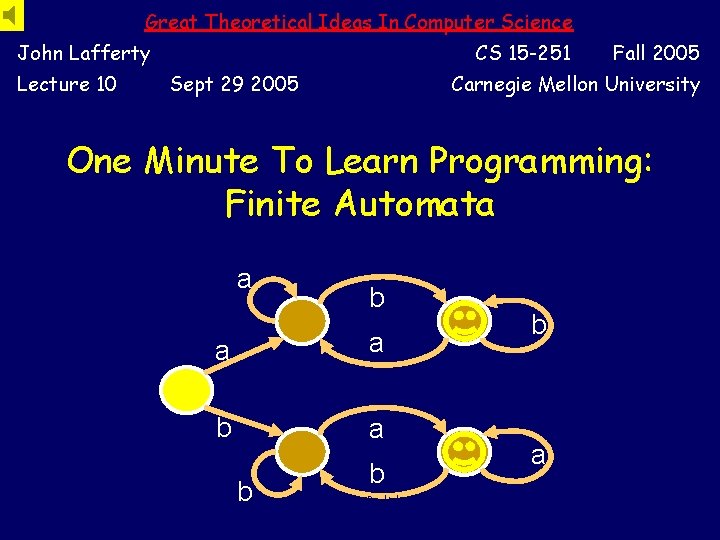
Great Theoretical Ideas In Computer Science John Lafferty Lecture 10 CS 15 -251 Sept 29 2005 Fall 2005 Carnegie Mellon University One Minute To Learn Programming: Finite Automata a b a b b Steven Rudich: www. cs. cmu. edu/~rudich 0123456789 b a
Let me teach you a programming language so simple that you can learn it in less than a minute. Steven Rudich: www. cs. cmu. edu/~rudich 0123456789
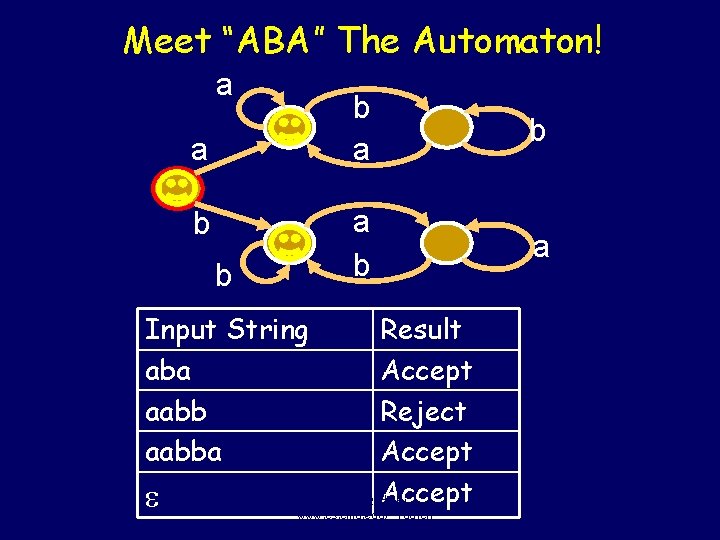
Meet “ABA” The Automaton! a a b b Input String aba aabba b a b a Result Accept Reject Accept Steven Rudich: www. cs. cmu. edu/~rudich 0123456789
The Simplest Interesting Machine: Finite State Machine OR Finite Automaton Steven Rudich: www. cs. cmu. edu/~rudich 0123456789
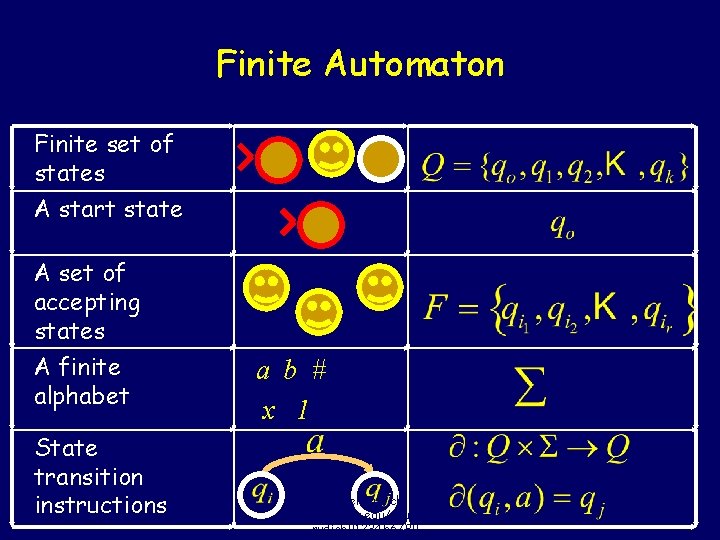
Finite Automaton Finite set of states A start state A set of accepting states A finite alphabet State transition instructions a b # x 1 Steven Rudich: www. cs. cmu. edu/~rudich 0123456789
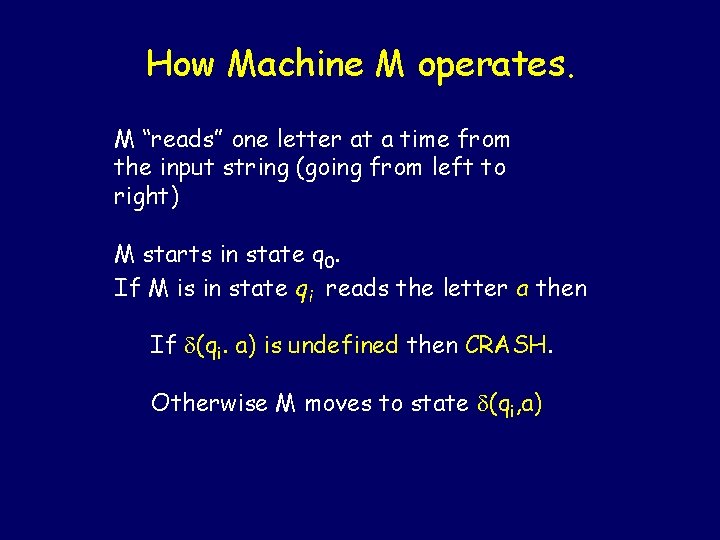
How Machine M operates. M “reads” one letter at a time from the input string (going from left to right) M starts in state q 0. If M is in state qi reads the letter a then If (qi. a) is undefined then CRASH. Otherwise M moves to state (qi, a) Steven Rudich: www. cs. cmu. edu/~rudich 0123456789
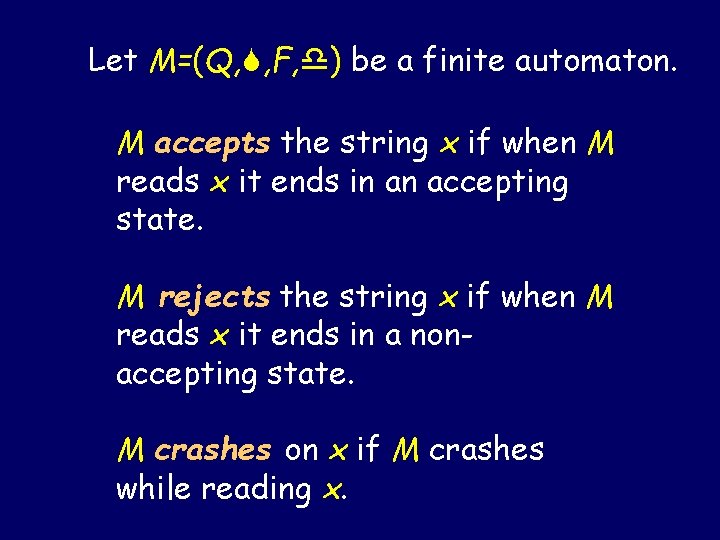
Let M=(Q, , F, ) be a finite automaton. M accepts the string x if when M reads x it ends in an accepting state. M rejects the string x if when M reads x it ends in a nonaccepting state. M crashes on x if M crashes while reading x. Steven Rudich: www. cs. cmu. edu/~rudich 0123456789
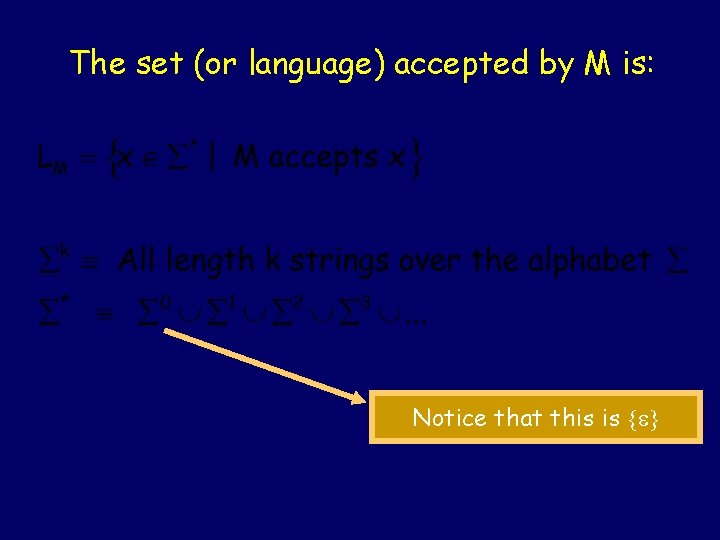
The set (or language) accepted by M is: Notice that this is Steven Rudich: www. cs. cmu. edu/~rudich 0123456789
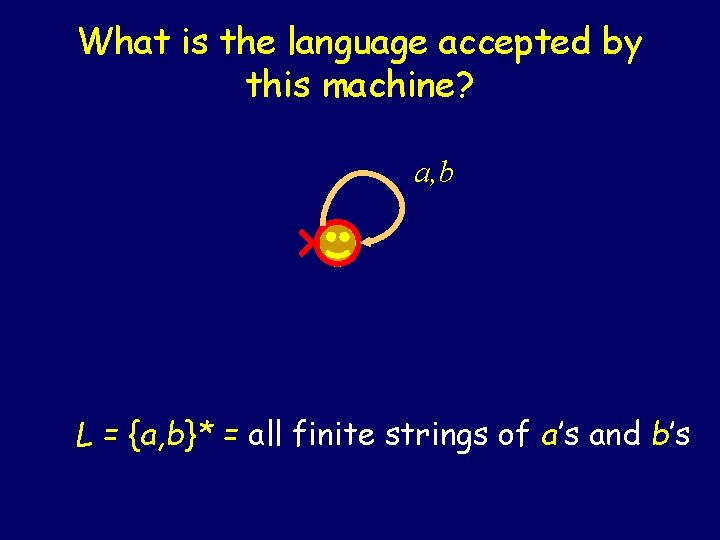
What is the language accepted by this machine? a, b L = {a, b}* = all finite strings of a’s and b’s Steven Rudich: www. cs. cmu. edu/~rudich 0123456789
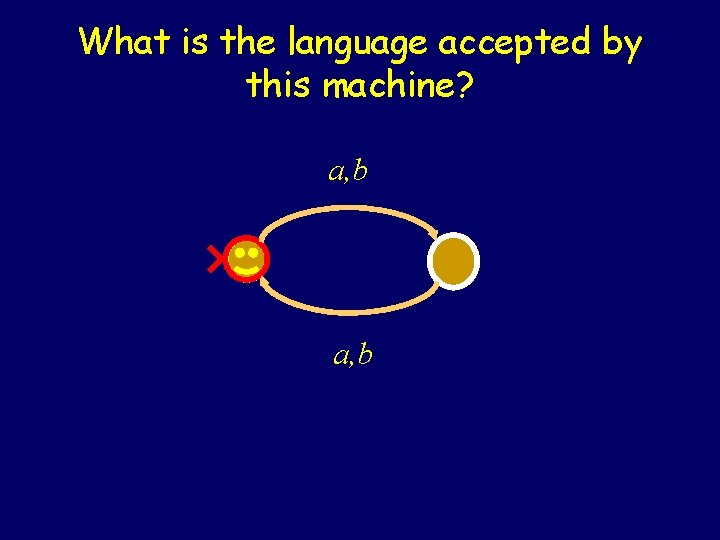
What is the language accepted by this machine? a, b Steven Rudich: www. cs. cmu. edu/~rudich 0123456789
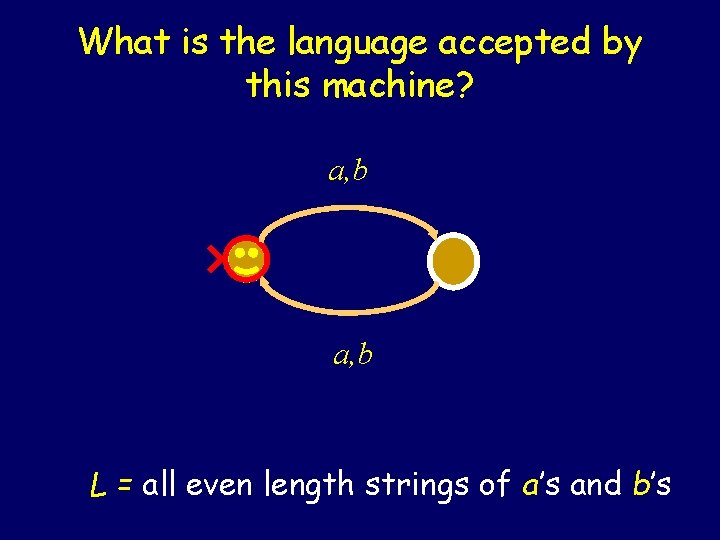
What is the language accepted by this machine? a, b L = all even length strings of a’s and b’s Steven Rudich: www. cs. cmu. edu/~rudich 0123456789
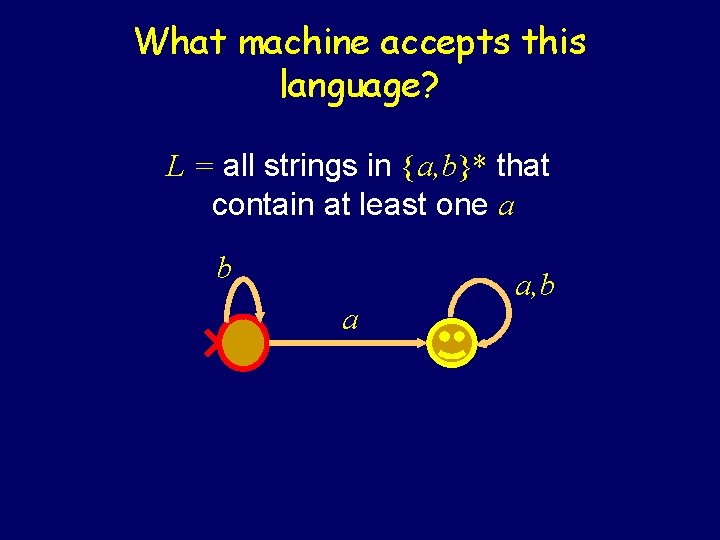
What machine accepts this language? L = all strings in {a, b}* that contain at least one a b a Steven Rudich: www. cs. cmu. edu/~rudich 0123456789 a, b
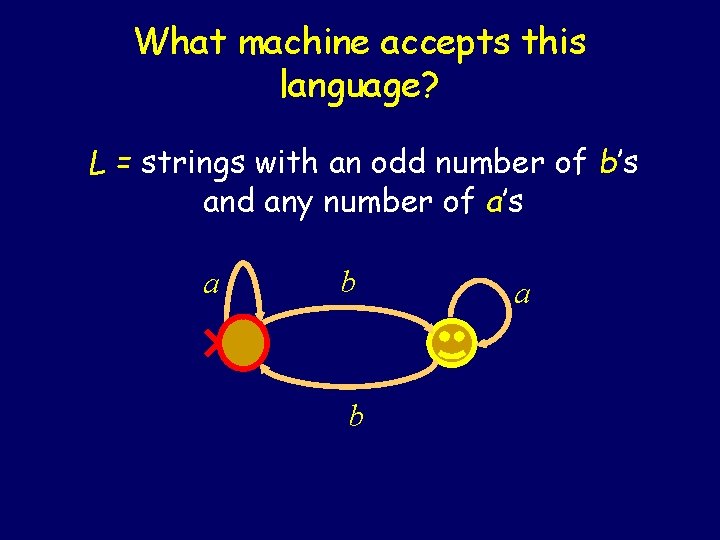
What machine accepts this language? L = strings with an odd number of b’s and any number of a’s a b b Steven Rudich: www. cs. cmu. edu/~rudich 0123456789 a
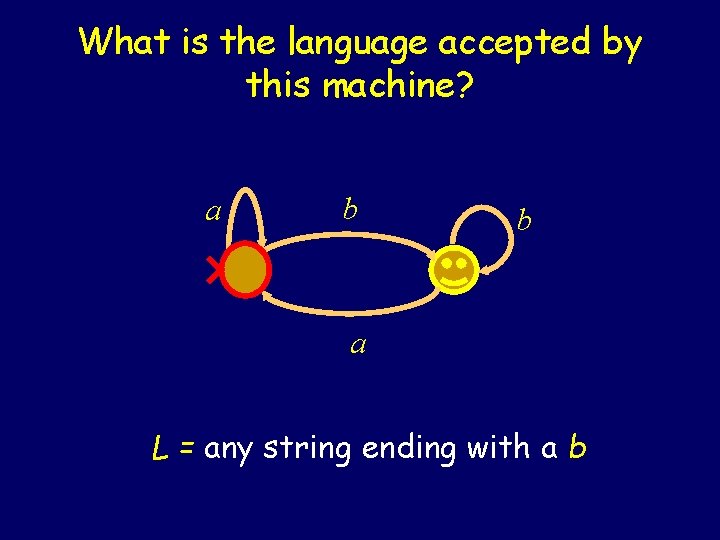
What is the language accepted by this machine? a b b a L = any string ending with a b Steven Rudich: www. cs. cmu. edu/~rudich 0123456789
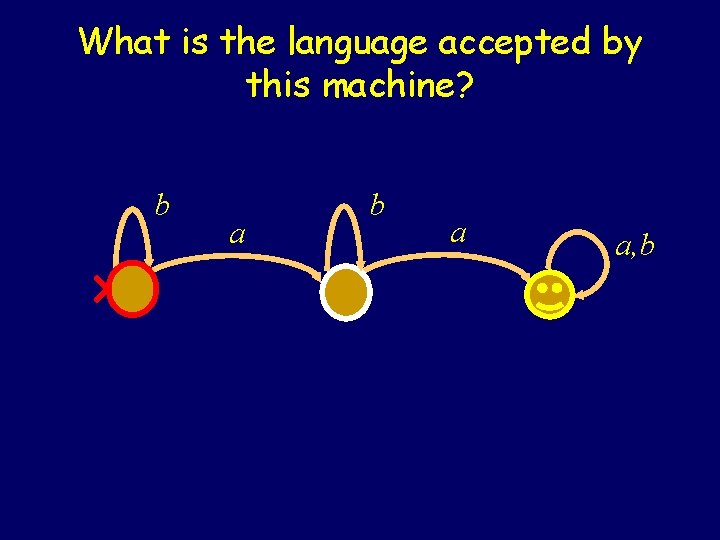
What is the language accepted by this machine? b a b Steven Rudich: www. cs. cmu. edu/~rudich 0123456789 a a, b
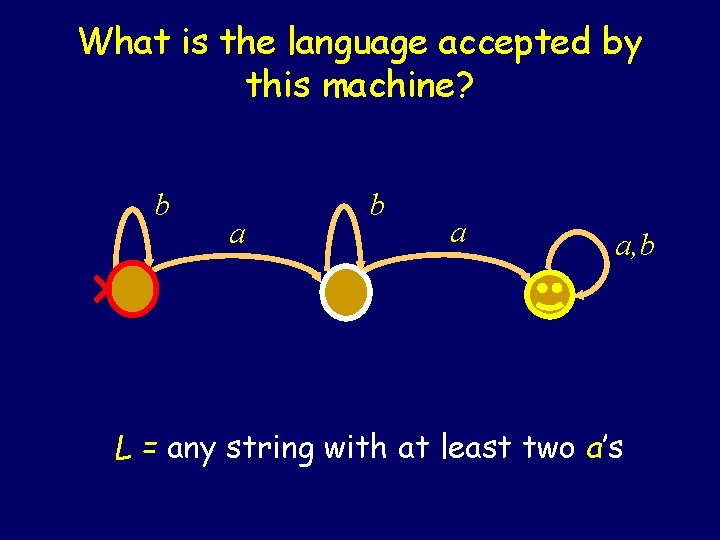
What is the language accepted by this machine? b a a, b L = any string with at least two a’s Steven Rudich: www. cs. cmu. edu/~rudich 0123456789
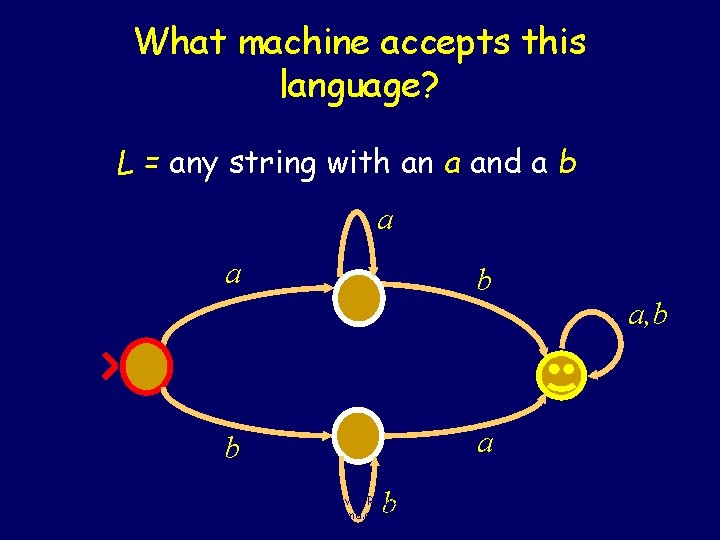
What machine accepts this language? L = any string with an a and a b Steven Rudich: www. cs. cmu. edu/~rudich 0123456789
What machine accepts this language? L = any string with an a and a b a b b Steven Rudich: www. cs. cmu. edu/~rudich 0123456789 a, b
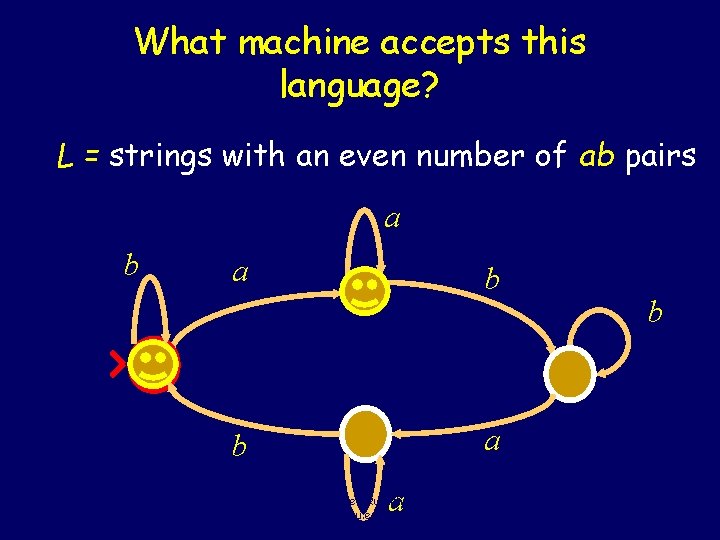
What machine accepts this language? L = strings with an even number of ab pairs a b a b a Steven Rudich: www. cs. cmu. edu/~rudich 0123456789 b
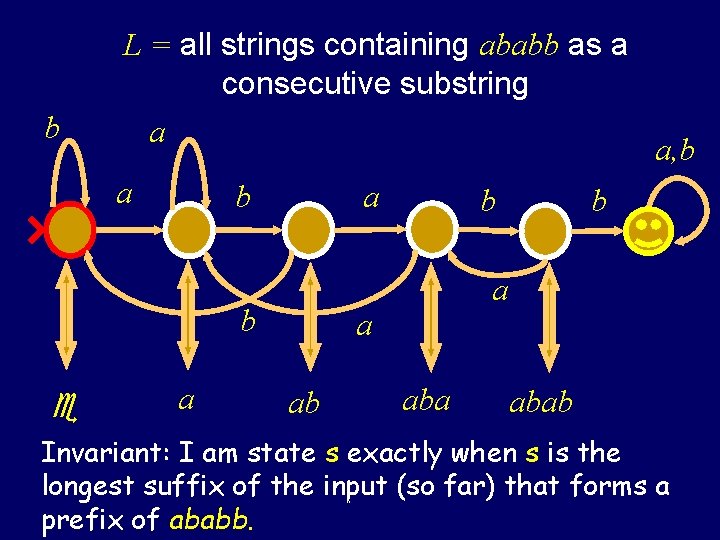
L = all strings containing ababb as a consecutive substring Steven Rudich: www. cs. cmu. edu/~rudich 0123456789
L = all strings containing ababb as a consecutive substring b a a, b a a b b a ab b b abab Invariant: I am state s exactly when s is the longest suffix of the input (so far) that forms a Steven Rudich: www. cs. cmu. edu/~rudich prefix of ababb. rudich 0123456789
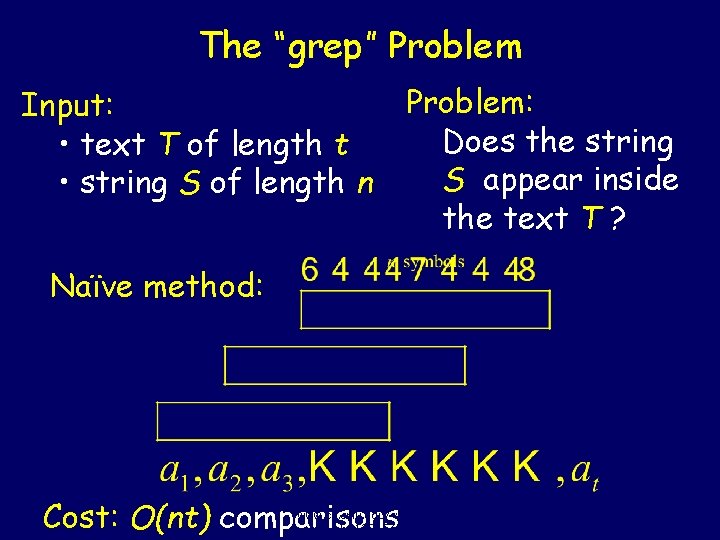
The “grep” Problem Input: • text T of length t • string S of length n Problem: Does the string S appear inside the text T ? Naïve method: Steven Rudich: www. cs. cmu. edu/~rudich 0123456789 Cost: O(nt) comparisons
Automata Solution • Build a machine M that accepts any string with S as a consecutive substring. • Feed the text to M. • Cost: t comparisons + time to build M. • As luck would have it, the Knuth, Morris, Pratt algorithm builds M quickly. Steven Rudich: www. cs. cmu. edu/~rudich 0123456789
Real-life uses of finite state machines • grep • coke machines • thermostats (fridge) • elevators • train track switches • lexical analyzers for parsers Steven Rudich: www. cs. cmu. edu/~rudich 0123456789
Any L is defined to be a language. L is just a set of strings. It is called a language for historical reasons. Steven Rudich: www. cs. cmu. edu/~rudich 0123456789
Let L be a language. L is called a regular language if there is some finite automaton that accepts L. In this lecture we have seen many regular languages. • • even length strings • strings containing ababb Steven Rudich: www. cs. cmu. edu/~rudich 0123456789
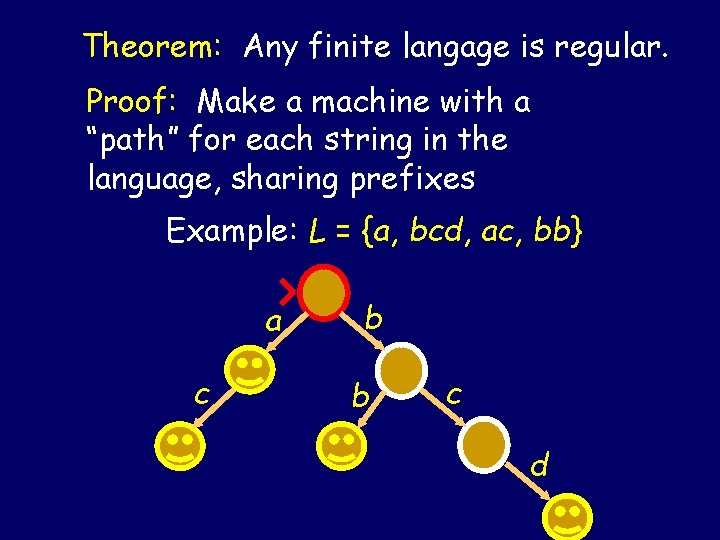
Theorem: Any finite langage is regular. Proof: Make a machine with a “path” for each string in the language, sharing prefixes Example: L = {a, bcd, ac, bb} a c b b c d Steven Rudich: www. cs. cmu. edu/~rudich 0123456789
Are all languages regular? Steven Rudich: www. cs. cmu. edu/~rudich 0123456789
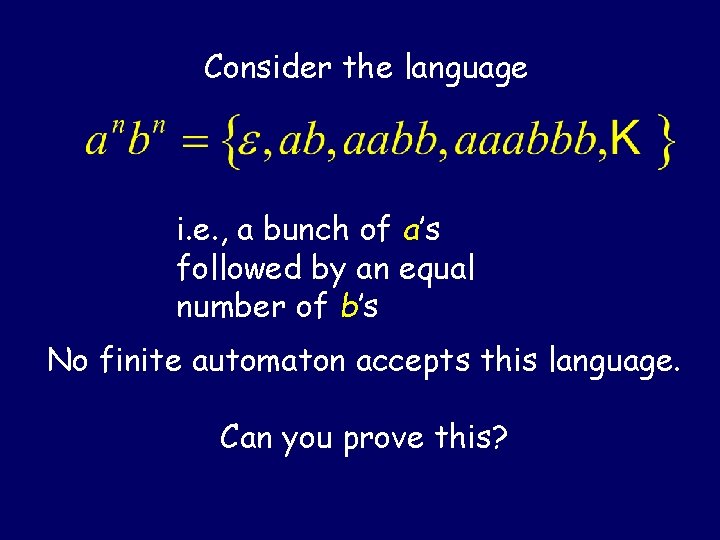
Consider the language i. e. , a bunch of a’s followed by an equal number of b’s No finite automaton accepts this language. Can you prove this? Steven Rudich: www. cs. cmu. edu/~rudich 0123456789
anbn is not regular. No machine has enough states to keep track of the number of a’s it might encounter. Steven Rudich: www. cs. cmu. edu/~rudich 0123456789
That is a fairly weak argument. Consider the following example… Steven Rudich: www. cs. cmu. edu/~rudich 0123456789
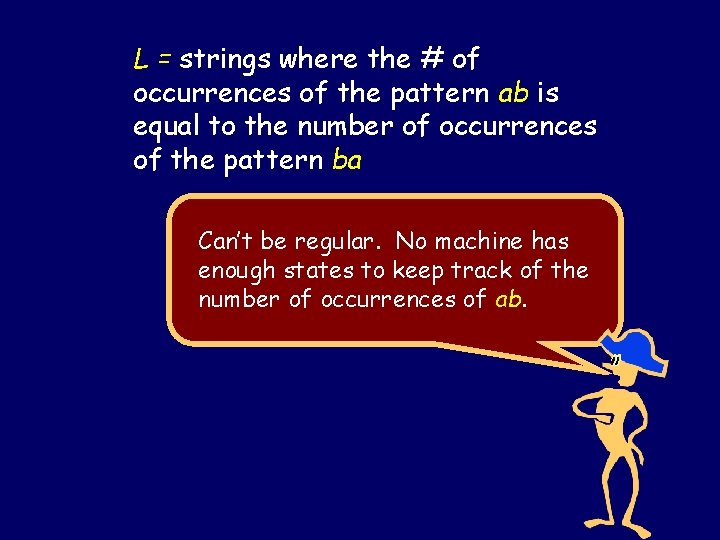
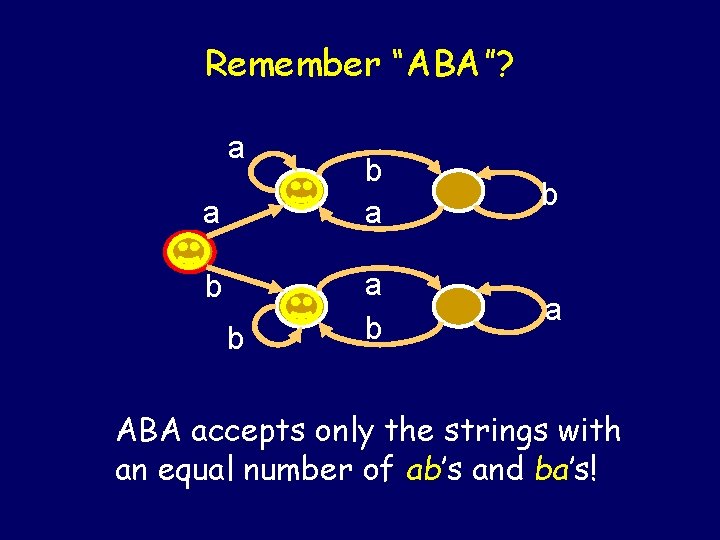
L = strings where the # of occurrences of the pattern ab is equal to the number of occurrences of the pattern ba Can’t be regular. No machine has enough states to keep track of the number of occurrences of ab. Steven Rudich: www. cs. cmu. edu/~rudich 0123456789
Remember “ABA”? a a b b b a b a ABA accepts only the strings with an equal number of ab’s and ba’s! Steven Rudich: www. cs. cmu. edu/~rudich 0123456789
Let me show you a professional strength proof that anbn is not regular…. Steven Rudich: www. cs. cmu. edu/~rudich 0123456789
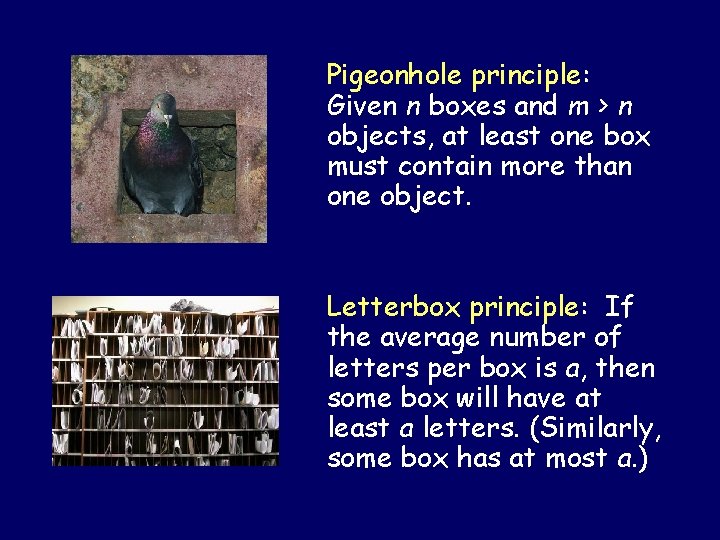
Pigeonhole principle: Given n boxes and m > n objects, at least one box must contain more than one object. Letterbox principle: If the average number of letters per box is a, then some box will have at least a letters. (Similarly, some box has at most a. ) Steven Rudich: www. cs. cmu. edu/~rudich 0123456789
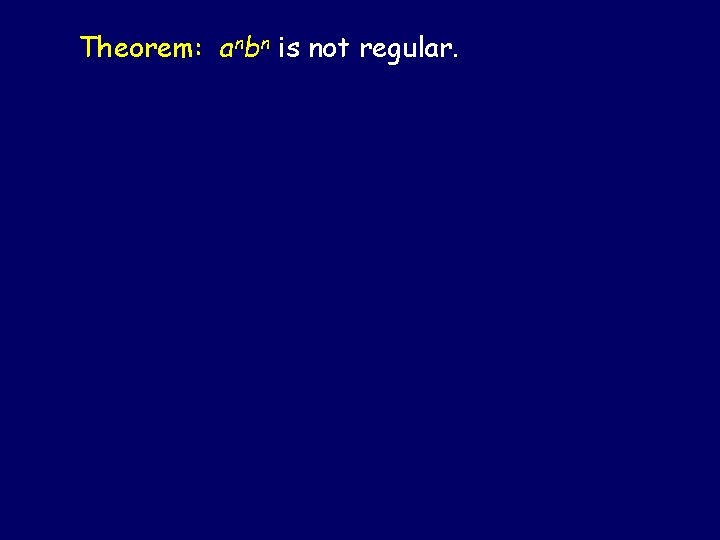
Theorem: anbn is not regular. Steven Rudich: www. cs. cmu. edu/~rudich 0123456789
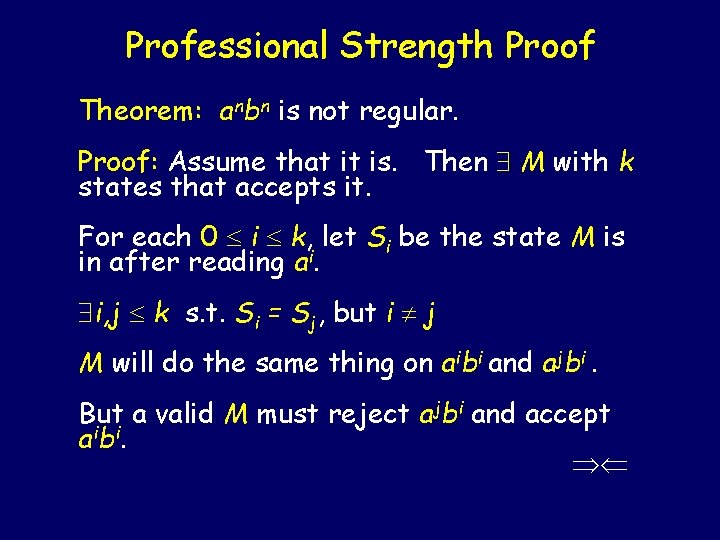
Professional Strength Proof Theorem: anbn is not regular. Proof: Assume that it is. Then M with k states that accepts it. For each 0 i k, let Si be the state M is in after reading ai. i, j k s. t. Si = Sj, but i j M will do the same thing on aibi and ajbi. But a valid M must reject ajbi and accept a ib i. Steven Rudich: www. cs. cmu. edu/~rudich 0123456789
MORAL: Finite automata can’t count. Steven Rudich: www. cs. cmu. edu/~rudich 0123456789
Advertisement You can learn much more about these creatures in the FLAC course. Formal Languages, Automata, and Computation • There is a unique smallest automaton for any regular language • It can be found by a fast algorithm. Steven Rudich: www. cs. cmu. edu/~rudich 0123456789
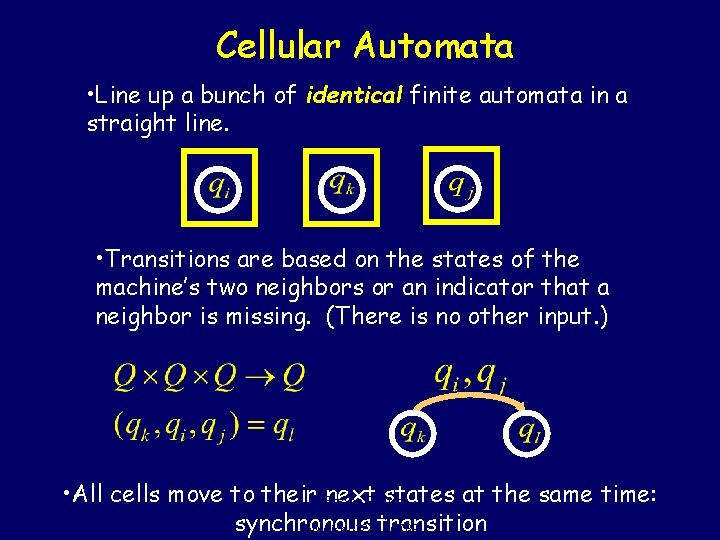
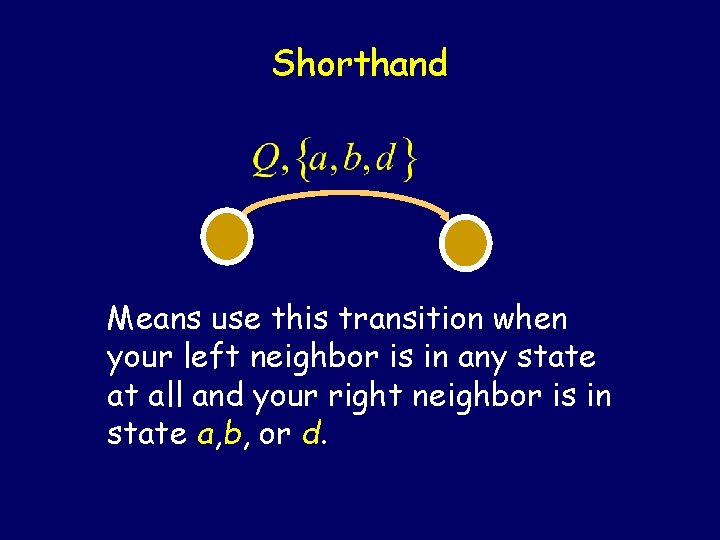
Cellular Automata • Line up a bunch of identical finite automata in a straight line. • Transitions are based on the states of the machine’s two neighbors or an indicator that a neighbor is missing. (There is no other input. ) • All cells move to their Steven next. Rudich: states at the same time: www. cs. cmu. edu/~rudich synchronous transition rudich 0123456789
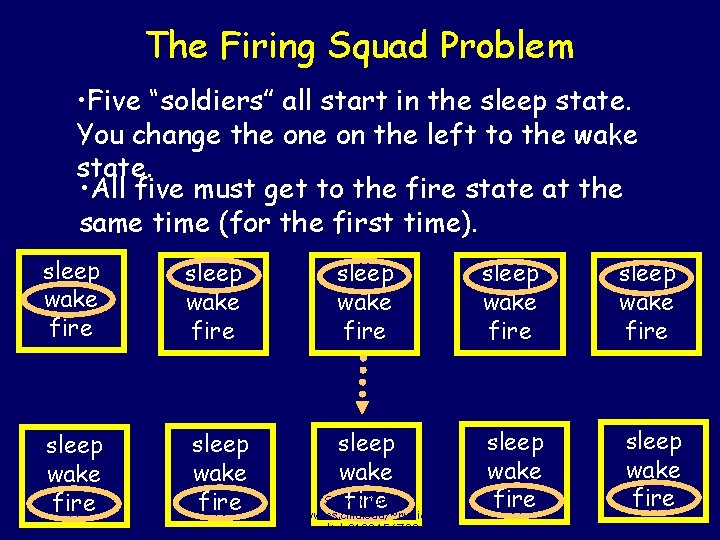
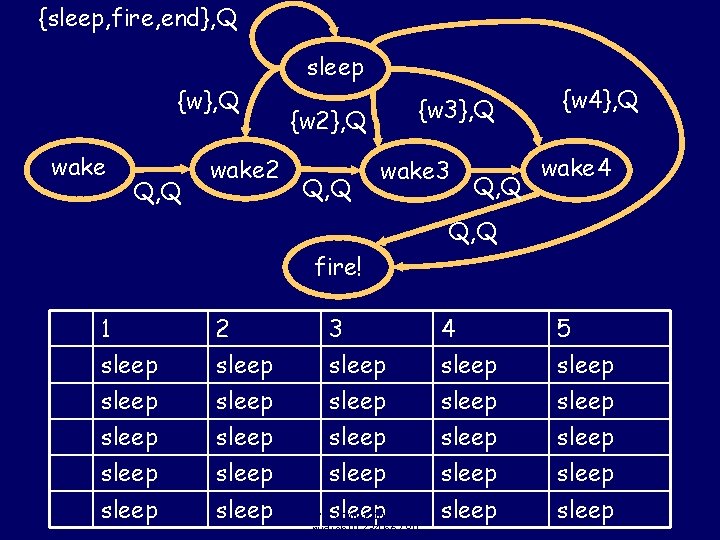
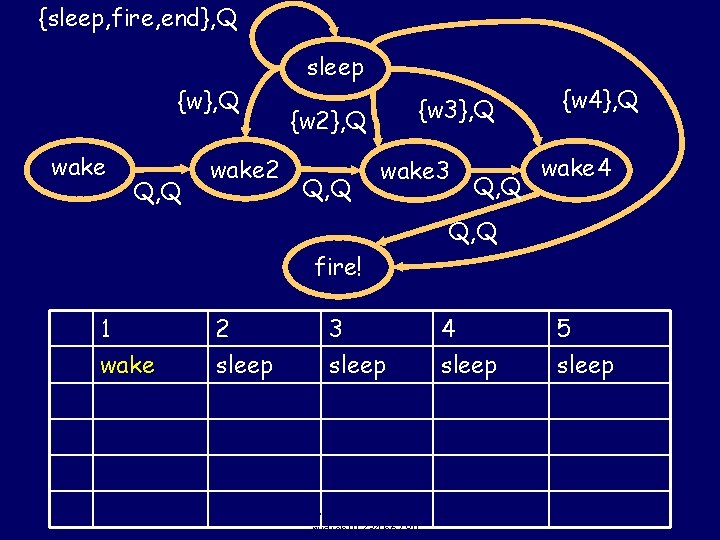
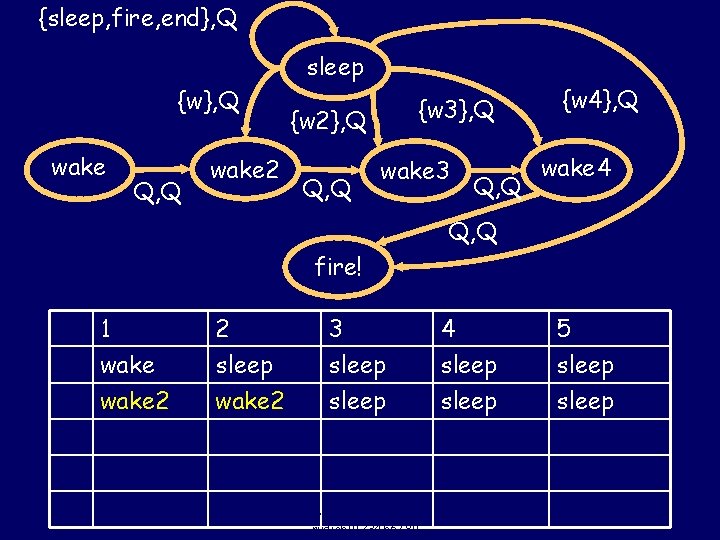
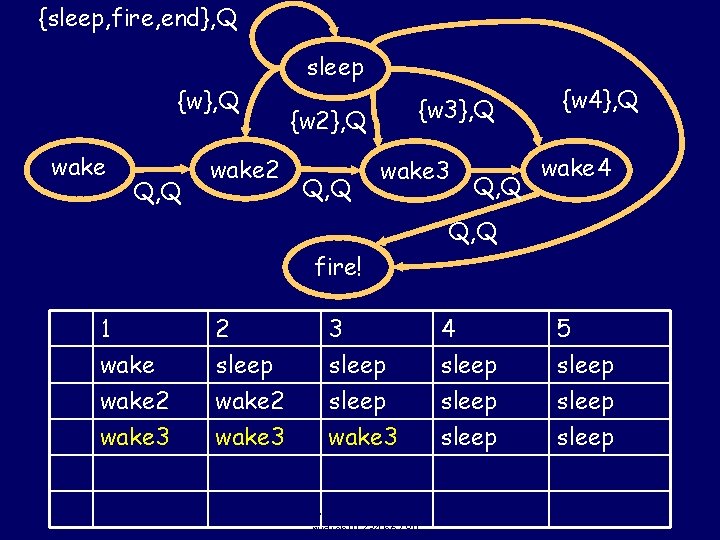
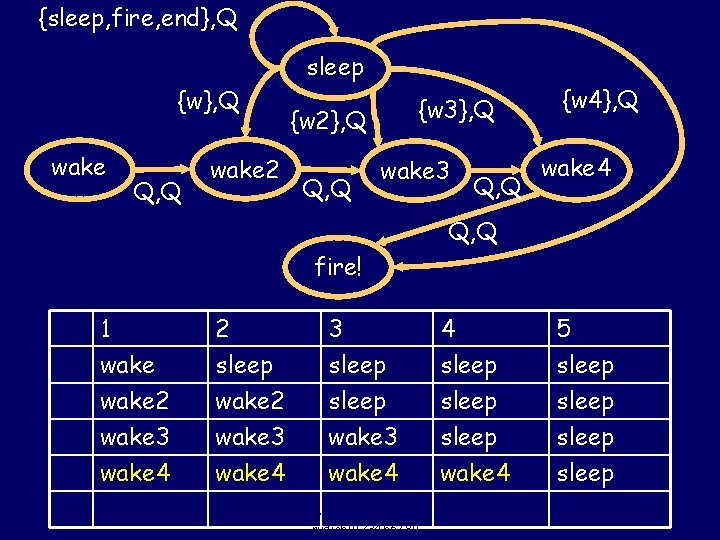
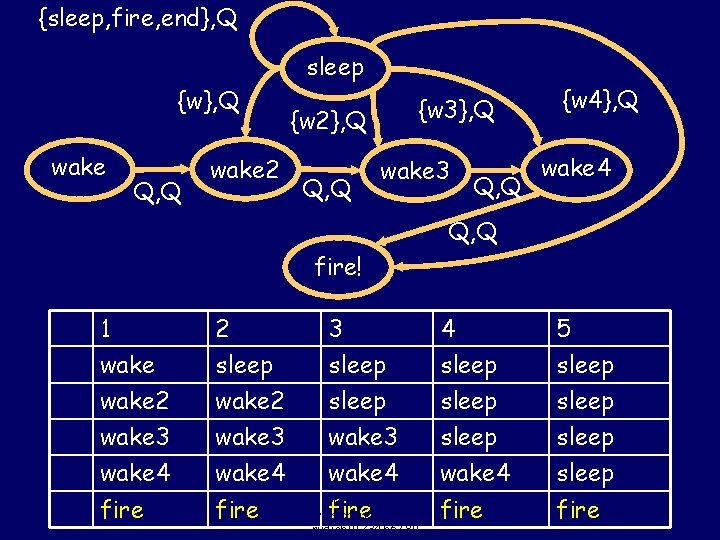
The Firing Squad Problem • Five “soldiers” all start in the sleep state. You change the on the left to the wake state. • All five must get to the fire state at the same time (for the first time). sleep wake fire sleep wake fire sleep wake Steven Rudich: fire www. cs. cmu. edu/~rudich sleep wake fire rudich 0123456789
Shorthand Means use this transition when your left neighbor is in any state at all and your right neighbor is in state a, b, or d. Steven Rudich: www. cs. cmu. edu/~rudich 0123456789
{sleep, fire, end}, Q {w}, Q wake Q, Q wake 2 sleep {w 3}, Q {w 2}, Q Q, Q wake 3 Q, Q {w 4}, Q wake 4 Q, Q fire! 1 2 3 4 5 sleep sleep sleep sleep sleep sleep sleep Steven Rudich: www. cs. cmu. edu/~rudich 0123456789
{sleep, fire, end}, Q {w}, Q wake Q, Q wake 2 sleep {w 3}, Q {w 2}, Q Q, Q wake 3 Q, Q {w 4}, Q wake 4 Q, Q fire! 1 2 3 4 5 wake sleep Steven Rudich: www. cs. cmu. edu/~rudich 0123456789
{sleep, fire, end}, Q {w}, Q wake Q, Q wake 2 sleep {w 3}, Q {w 2}, Q Q, Q wake 3 Q, Q {w 4}, Q wake 4 Q, Q fire! 1 2 3 4 5 wake sleep wake 2 sleep Steven Rudich: www. cs. cmu. edu/~rudich 0123456789
{sleep, fire, end}, Q {w}, Q wake Q, Q wake 2 sleep {w 3}, Q {w 2}, Q Q, Q wake 3 Q, Q {w 4}, Q wake 4 Q, Q fire! 1 2 3 4 5 wake sleep wake 2 sleep wake 3 sleep Steven Rudich: www. cs. cmu. edu/~rudich 0123456789
{sleep, fire, end}, Q {w}, Q wake Q, Q wake 2 sleep {w 3}, Q {w 2}, Q Q, Q wake 3 Q, Q {w 4}, Q wake 4 Q, Q fire! 1 2 3 4 5 wake sleep wake 2 sleep wake 3 sleep wake 4 sleep Steven Rudich: www. cs. cmu. edu/~rudich 0123456789
{sleep, fire, end}, Q {w}, Q wake Q, Q wake 2 sleep {w 3}, Q {w 2}, Q Q, Q wake 3 Q, Q {w 4}, Q wake 4 Q, Q fire! 1 2 3 4 5 wake sleep wake 2 sleep wake 3 sleep wake 4 sleep fire fire Steven Rudich: www. cs. cmu. edu/~rudich 0123456789
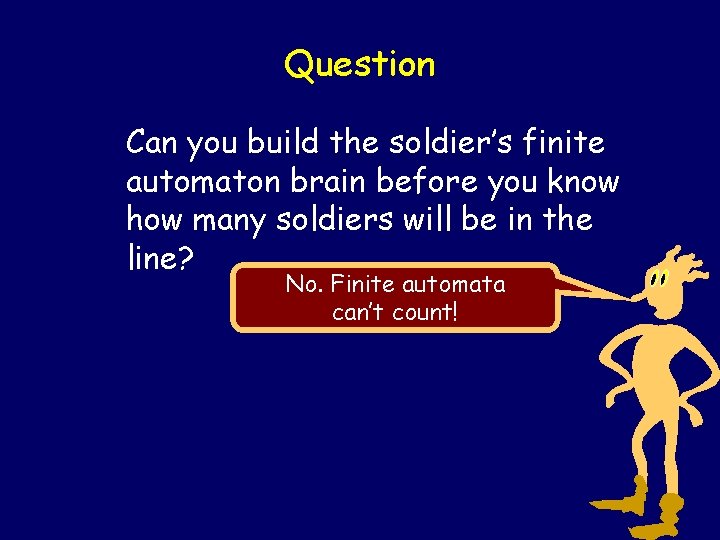
Question Can you build the soldier’s finite automaton brain before you know how many soldiers will be in the line? No. Finite automata can’t count! Steven Rudich: www. cs. cmu. edu/~rudich 0123456789
Don’t jump to conclusions! It is possible to design a single cellular automaton that works for any number of soldiers! Steven Rudich: www. cs. cmu. edu/~rudich 0123456789