
Great Theoretical Ideas In Computer Science Anupam Gupta

![Rene Descartes [1596 -1650] “Method Of Infinite Decent” Show that for any counter-example you](https://slidetodoc.com/presentation_image_h2/b78d217c6bb50eb10b09c0bd16ecb8a8/image-46.jpg "Rene Descartes [1596 -1650] “Method Of Infinite Decent” Show that for any counter-example you")

- Slides: 91
Great Theoretical Ideas In Computer Science Anupam Gupta Lecture 2 CS 15 -251 Sept 01, 2005 Fall 2005 Carnegie Mellon University Induction: One Step At A Time
Today we will talk about INDUCTION
Induction is the primary way we: 1. Prove theorems 2. Construct and define objects
Let’s start with dominoes
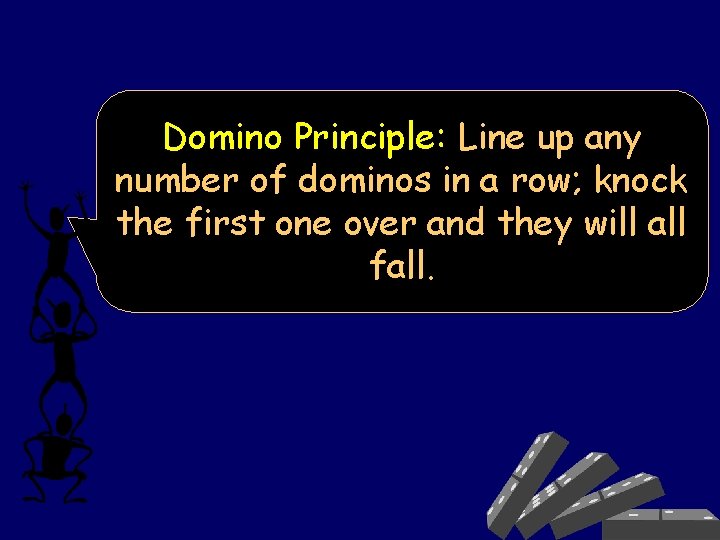
Domino Principle: Line up any number of dominos in a row; knock the first one over and they will all fall.
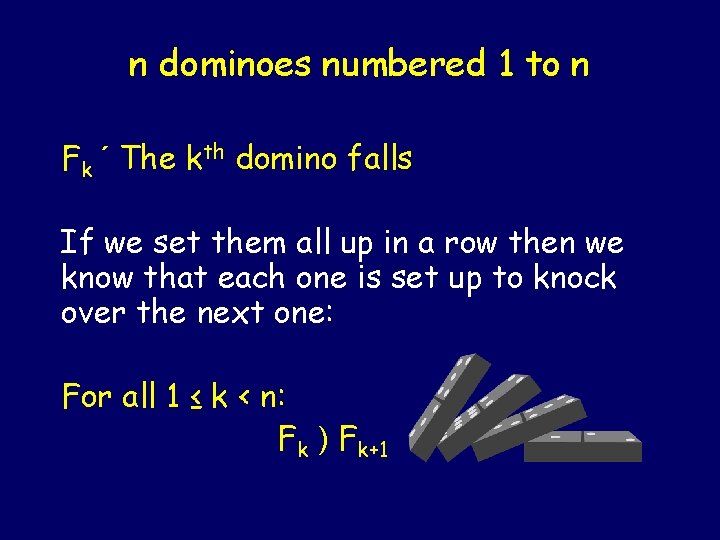
n dominoes numbered 1 to n Fk ´ The kth domino falls If we set them all up in a row then we know that each one is set up to knock over the next one: For all 1 ≤ k < n: Fk ) Fk+1
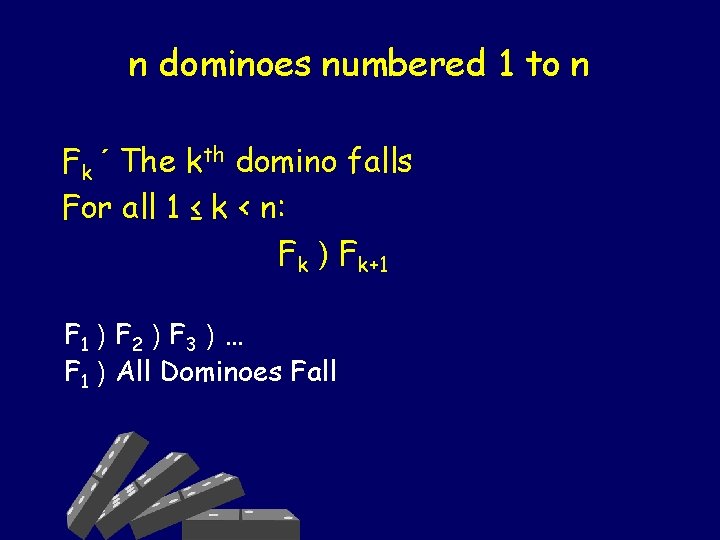
n dominoes numbered 1 to n Fk ´ The kth domino falls For all 1 ≤ k < n: Fk ) Fk+1 F 1 ) F 2 ) F 3 ) … F 1 ) All Dominoes Fall
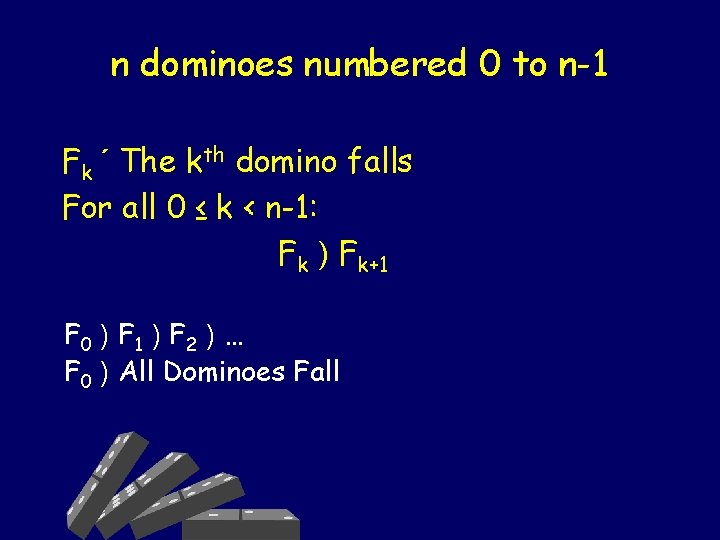
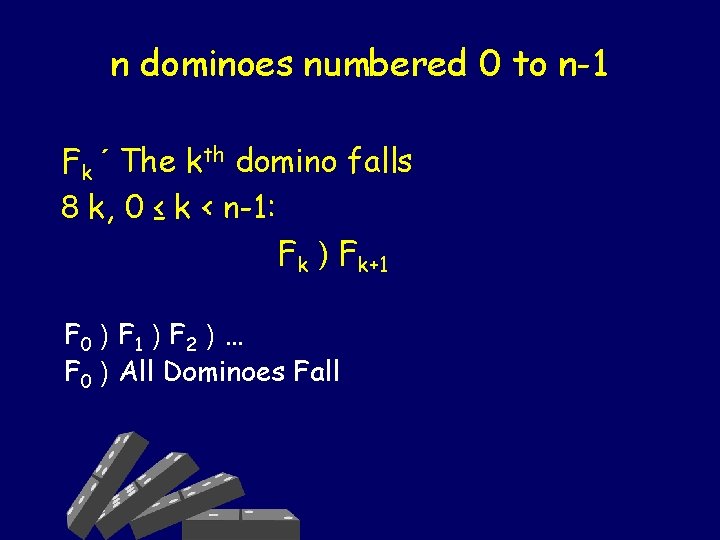
n dominoes numbered 0 to n-1 Fk ´ The kth domino falls For all 0 ≤ k < n-1: Fk ) Fk+1 F 0 ) F 1 ) F 2 ) … F 0 ) All Dominoes Fall
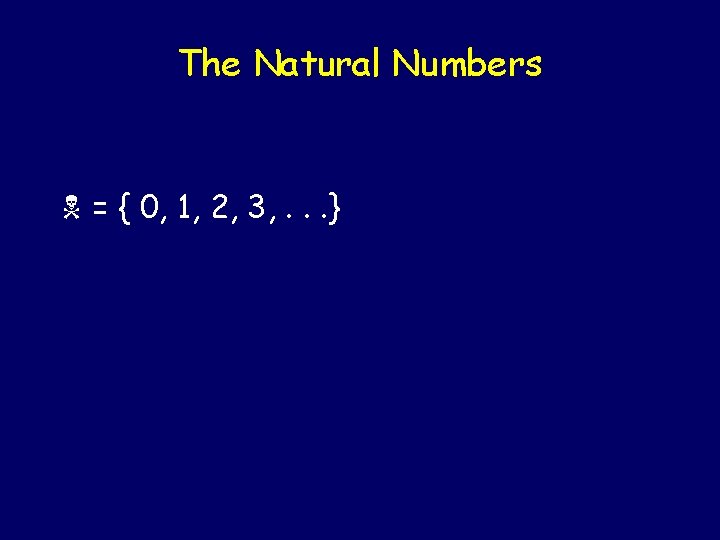
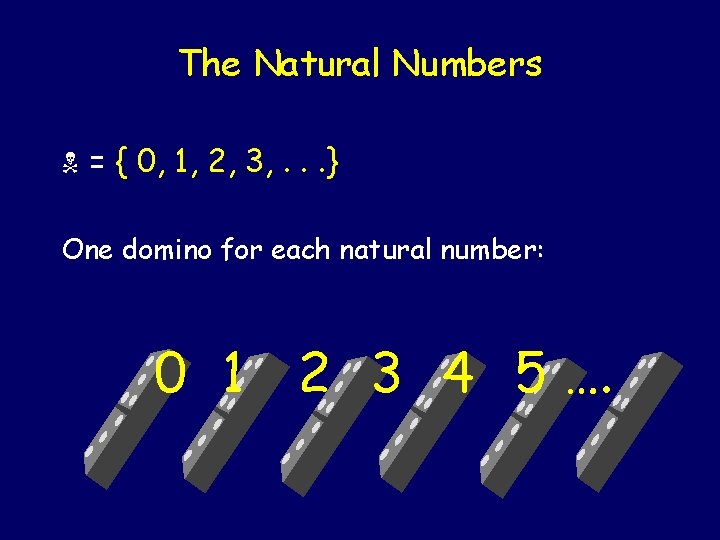
The Natural Numbers = { 0, 1, 2, 3, . . . }
The Natural Numbers = { 0, 1, 2, 3, . . . } One domino for each natural number: 0 1 2 3 4 5 ….
Standard Notation/Abbreviation “for all” is written “ 8” Example: For all k>0, P(k) is equivalent to 8 k>0, P(k)
n dominoes numbered 0 to n-1 Fk ´ The kth domino falls 8 k, 0 ≤ k < n-1: Fk ) Fk+1 F 0 ) F 1 ) F 2 ) … F 0 ) All Dominoes Fall
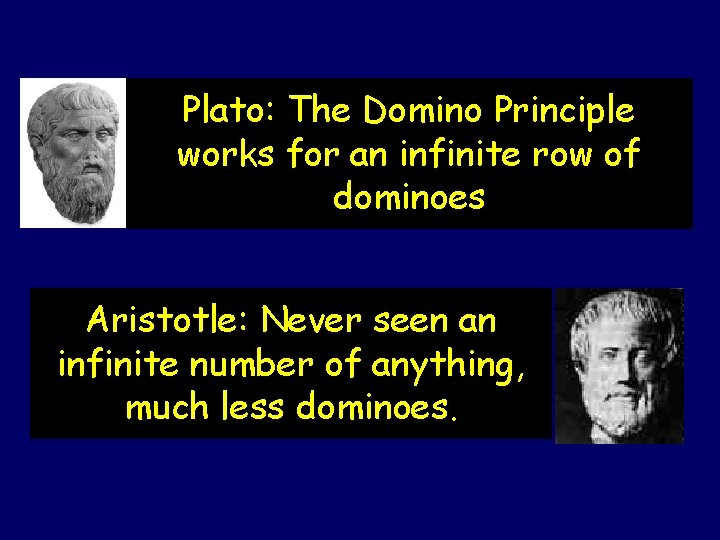
Plato: The Domino Principle works for an infinite row of dominoes Aristotle: Never seen an infinite number of anything, much less dominoes.
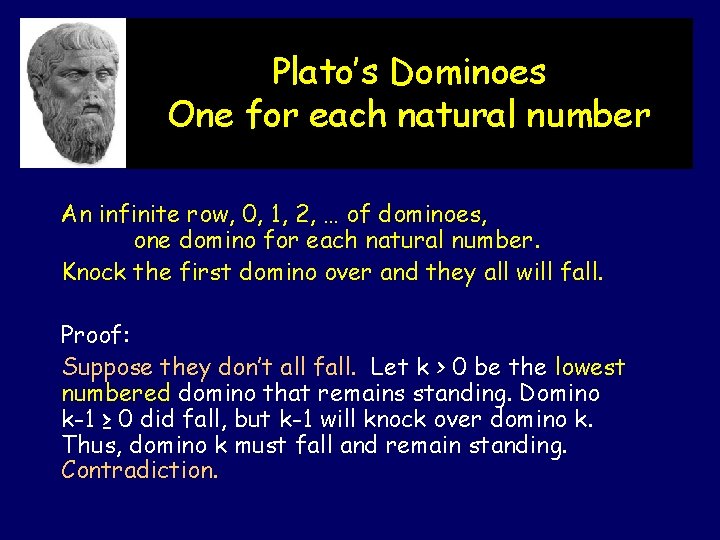
Plato’s Dominoes One for each natural number An infinite row, 0, 1, 2, … of dominoes, one domino for each natural number. Knock the first domino over and they all will fall. Proof: Suppose they don’t all fall. Let k > 0 be the lowest numbered domino that remains standing. Domino k-1 ≥ 0 did fall, but k-1 will knock over domino k. Thus, domino k must fall and remain standing. Contradiction.
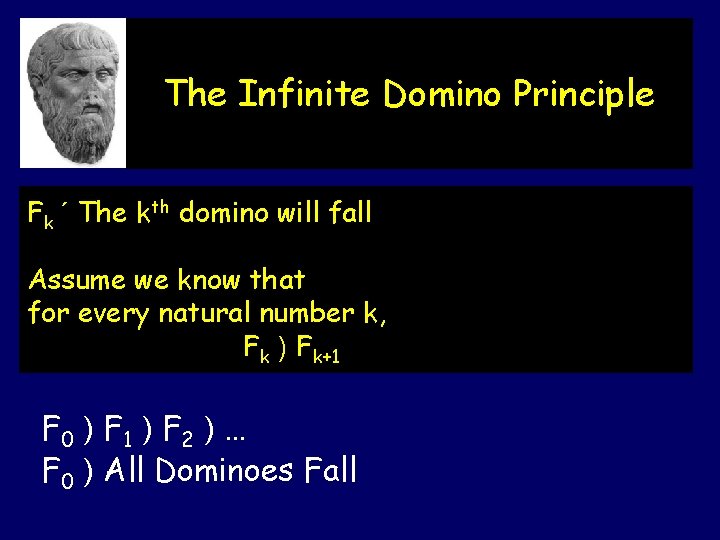
The Infinite Domino Principle Fk ´ The kth domino will fall Assume we know that for every natural number k, Fk ) Fk+1 F 0 ) F 1 ) F 2 ) … F 0 ) All Dominoes Fall
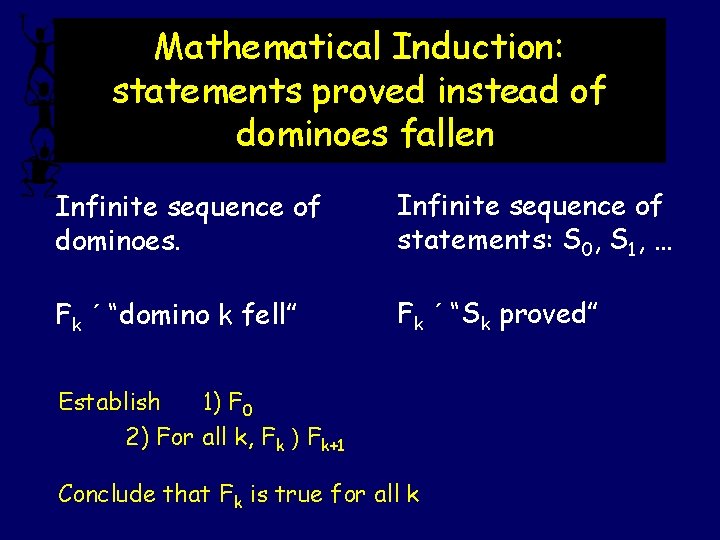
Mathematical Induction: statements proved instead of dominoes fallen Infinite sequence of dominoes. Infinite sequence of statements: S 0, S 1, … Fk ´ “domino k fell” Fk ´ “Sk proved” Establish 1) F 0 2) For all k, Fk ) Fk+1 Conclude that Fk is true for all k
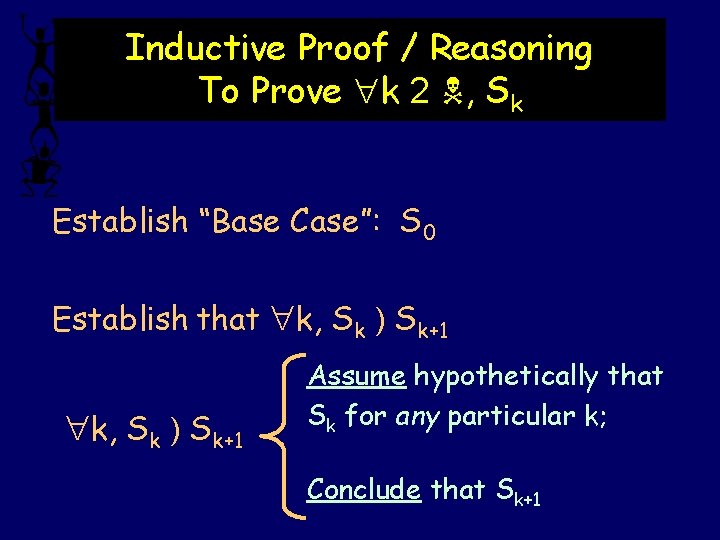
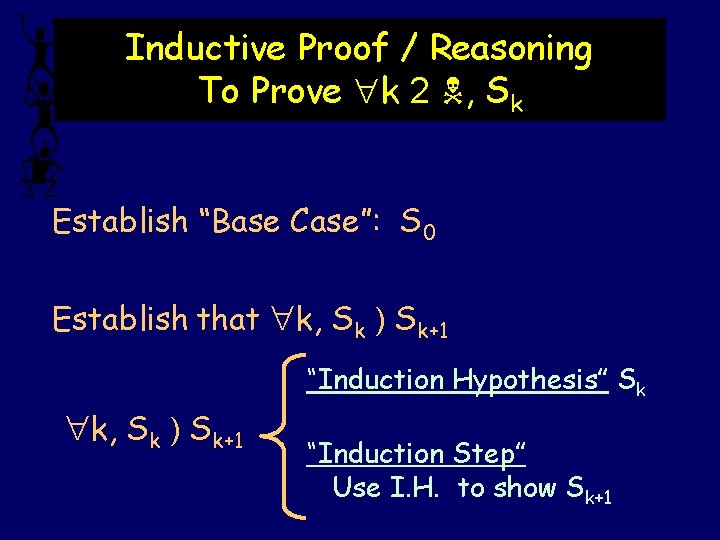
Inductive Proof / Reasoning To Prove k 2 , Sk Establish “Base Case”: S 0 Establish that k, Sk ) Sk+1 Assume hypothetically that Sk for any particular k; Conclude that Sk+1
Inductive Proof / Reasoning To Prove k 2 , Sk Establish “Base Case”: S 0 Establish that k, Sk ) Sk+1 “Induction Hypothesis” Sk k, Sk ) Sk+1 “Induction Step” Use I. H. to show Sk+1
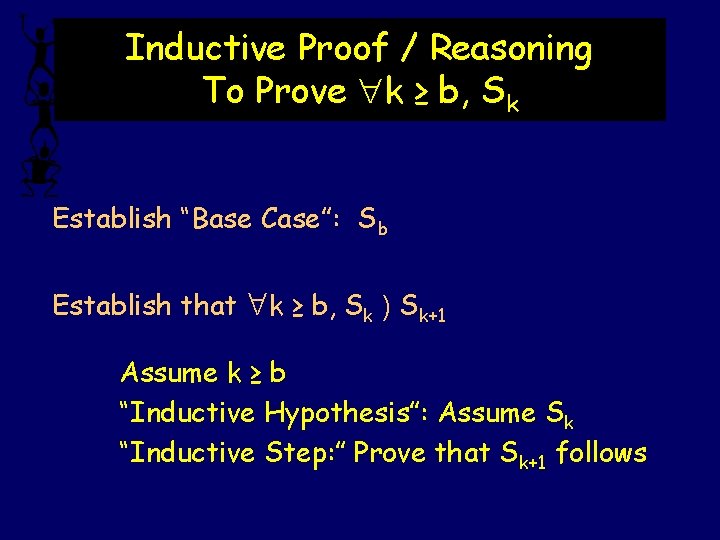
Inductive Proof / Reasoning To Prove k ≥ b, Sk Establish “Base Case”: Sb Establish that k ≥ b, Sk ) Sk+1 Assume k ≥ b “Inductive Hypothesis”: Assume Sk “Inductive Step: ” Prove that Sk+1 follows
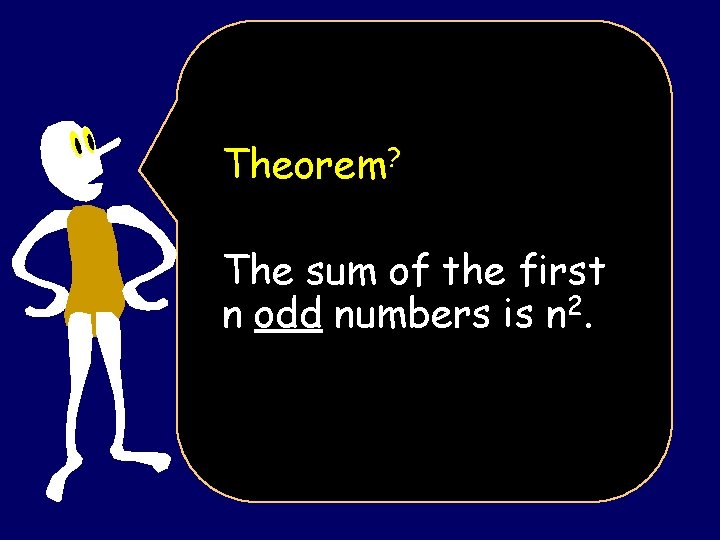
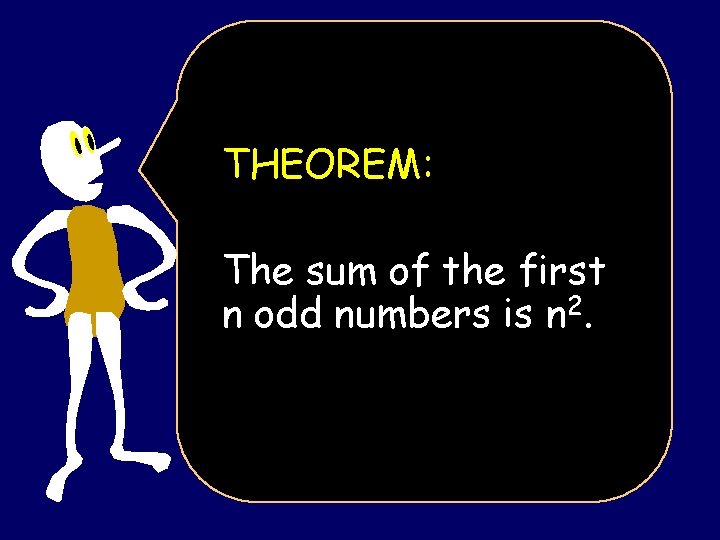
Theorem? The sum of the first n odd numbers is n 2.
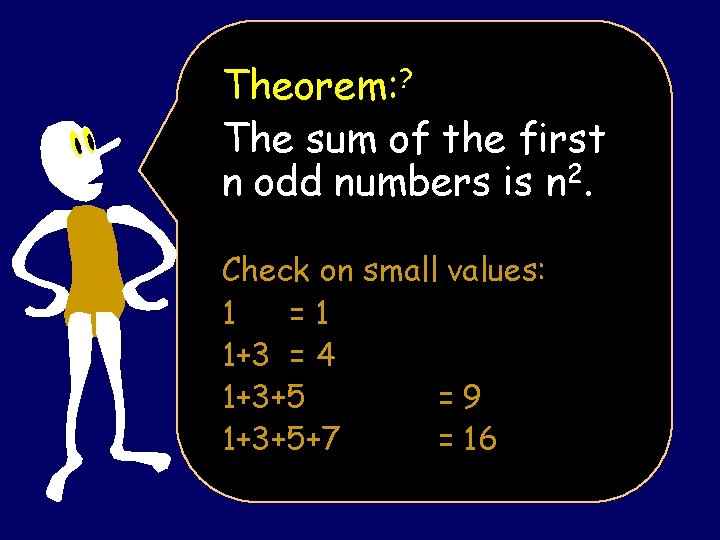
Theorem: ? The sum of the first n odd numbers is n 2. Check on small values: 1 =1 1+3 = 4 1+3+5 =9 1+3+5+7 = 16
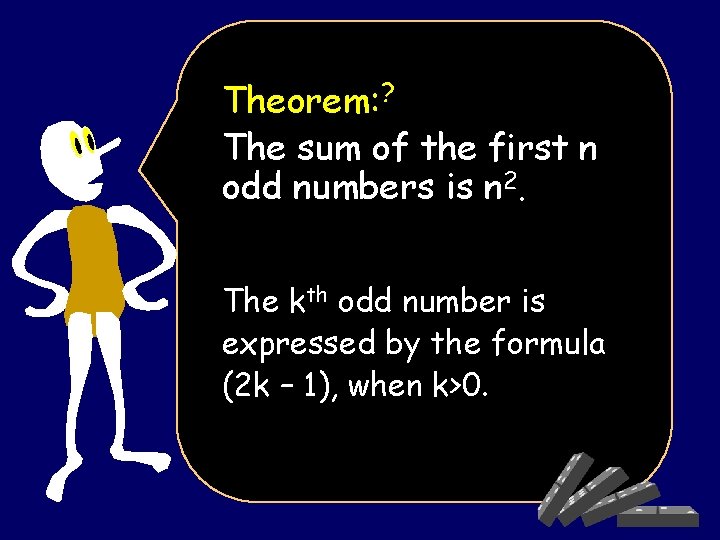
Theorem: ? The sum of the first n odd numbers is n 2. The kth odd number is expressed by the formula (2 k – 1), when k>0.
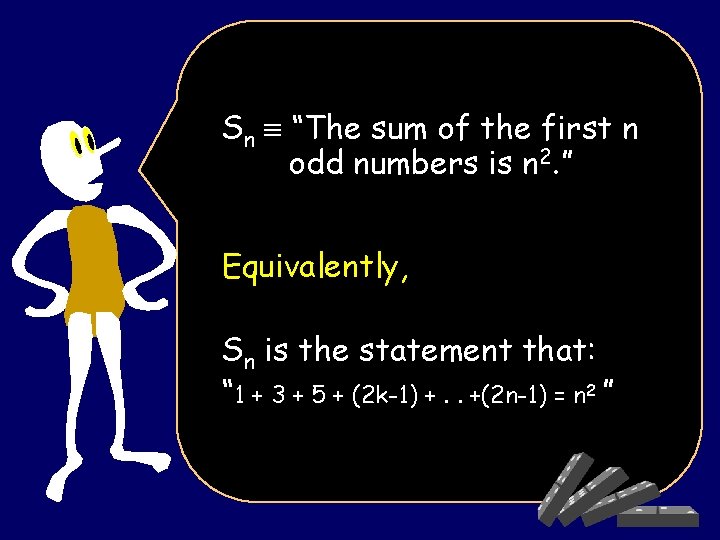
Sn “The sum of the first n odd numbers is n 2. ” Equivalently, Sn is the statement that: “ 1 + 3 + 5 + (2 k-1) +. . +(2 n-1) = n 2 ”
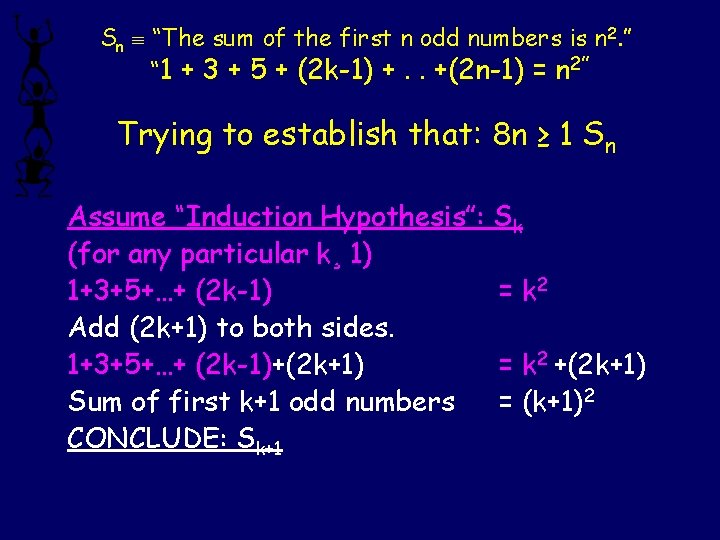
Sn “The sum of the first n odd numbers is n 2. ” “ 1 + 3 + 5 + (2 k-1) +. . +(2 n-1) = n 2” Trying to establish that: 8 n ≥ 1 Sn Assume “Induction Hypothesis”: (for any particular k¸ 1) 1+3+5+…+ (2 k-1) Add (2 k+1) to both sides. 1+3+5+…+ (2 k-1)+(2 k+1) Sum of first k+1 odd numbers CONCLUDE: Sk+1 Sk = k 2 +(2 k+1) = (k+1)2
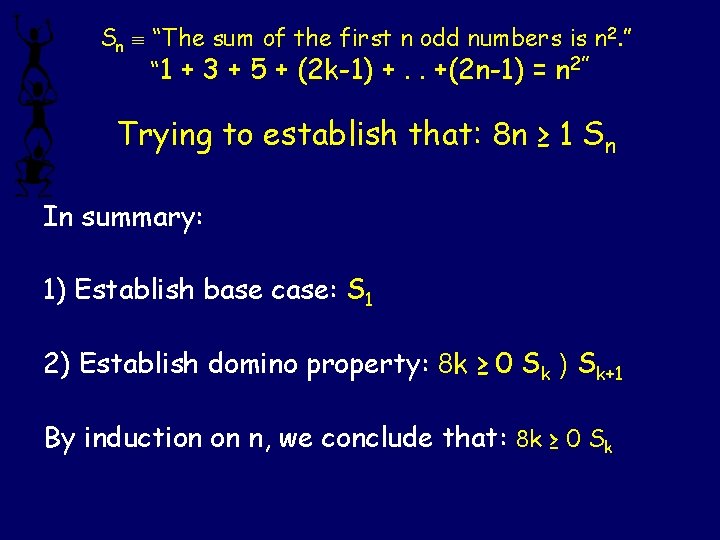
Sn “The sum of the first n odd numbers is n 2. ” “ 1 + 3 + 5 + (2 k-1) +. . +(2 n-1) = n 2” Trying to establish that: 8 n ≥ 1 Sn In summary: 1) Establish base case: S 1 2) Establish domino property: 8 k ≥ 0 Sk ) Sk+1 By induction on n, we conclude that: 8 k ≥ 0 Sk
THEOREM: The sum of the first n odd numbers is n 2.
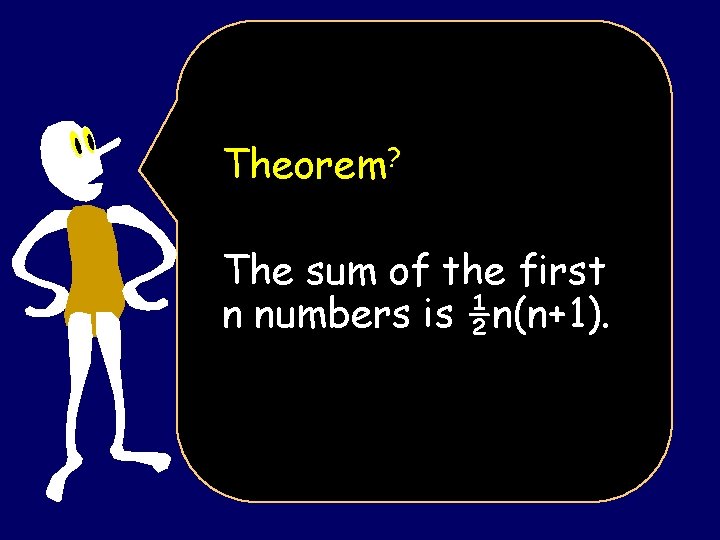
Theorem? The sum of the first n numbers is ½n(n+1).
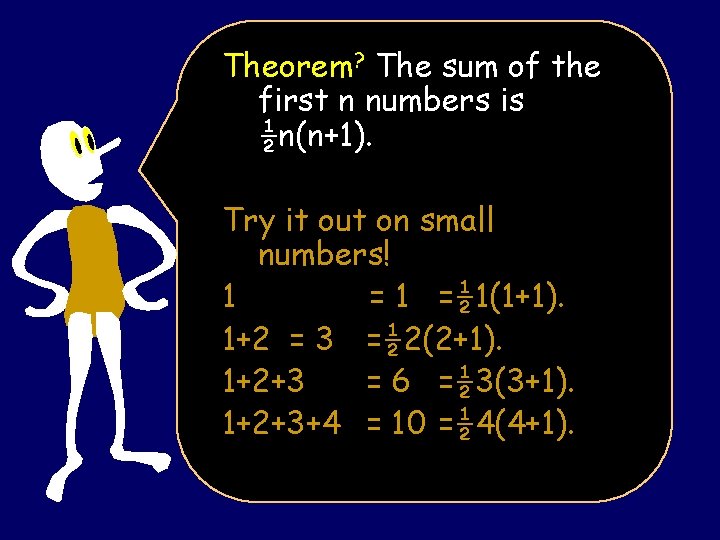
Theorem? The sum of the first n numbers is ½n(n+1). Try it out on small numbers! 1 =½ 1(1+1). 1+2 = 3 =½ 2(2+1). 1+2+3 = 6 =½ 3(3+1). 1+2+3+4 = 10 =½ 4(4+1).
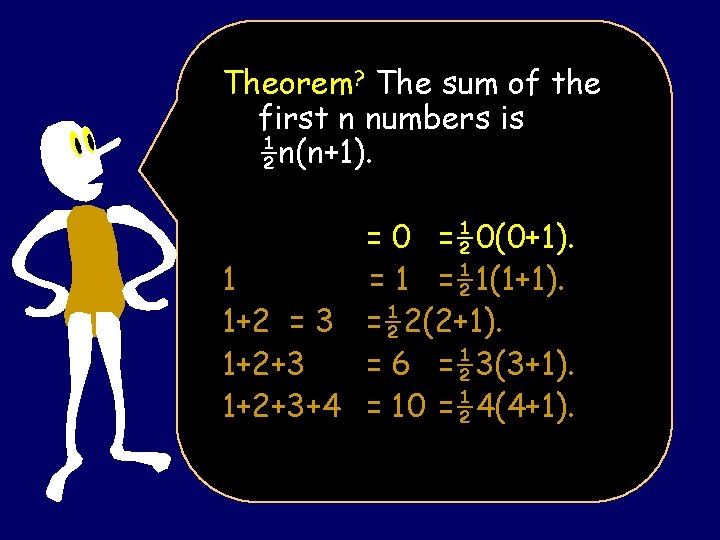
Theorem? The sum of the first n numbers is ½n(n+1). = 0 =½ 0(0+1). 1 =½ 1(1+1). 1+2 = 3 =½ 2(2+1). 1+2+3 = 6 =½ 3(3+1). 1+2+3+4 = 10 =½ 4(4+1).
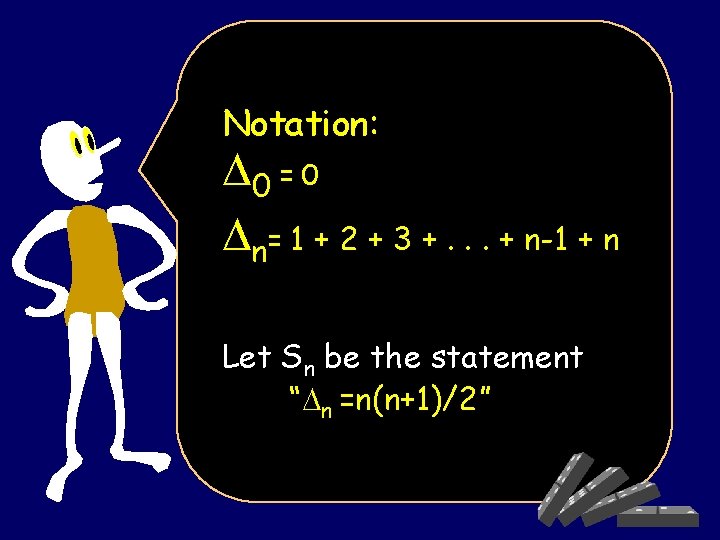
Notation: 0 = 0 n= 1 + 2 + 3 +. . . + n-1 + n Let Sn be the statement “ n =n(n+1)/2”
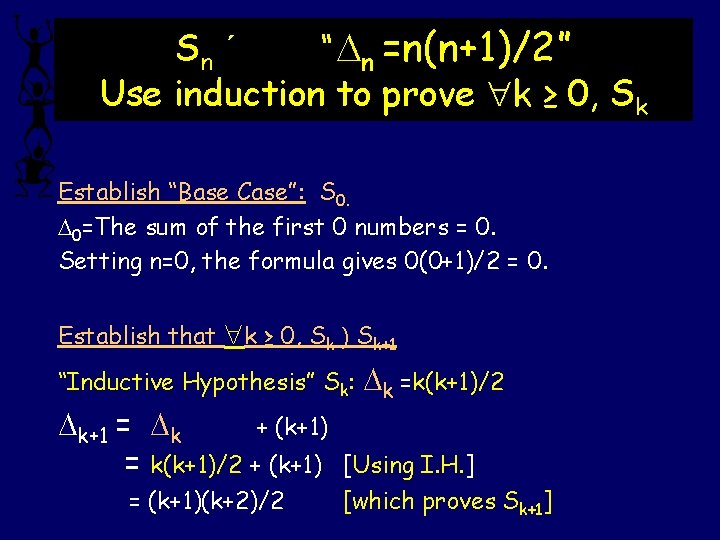
Sn ´ “ n =n(n+1)/2” Use induction to prove k ≥ 0, Sk Establish “Base Case”: S 0. 0=The sum of the first 0 numbers = 0. Setting n=0, the formula gives 0(0+1)/2 = 0. Establish that k ≥ 0, Sk ) Sk+1 “Inductive Hypothesis” Sk: k =k(k+1)/2 k+1 = k + (k+1) = k(k+1)/2 + (k+1) = (k+1)(k+2)/2 [Using I. H. ] [which proves Sk+1]
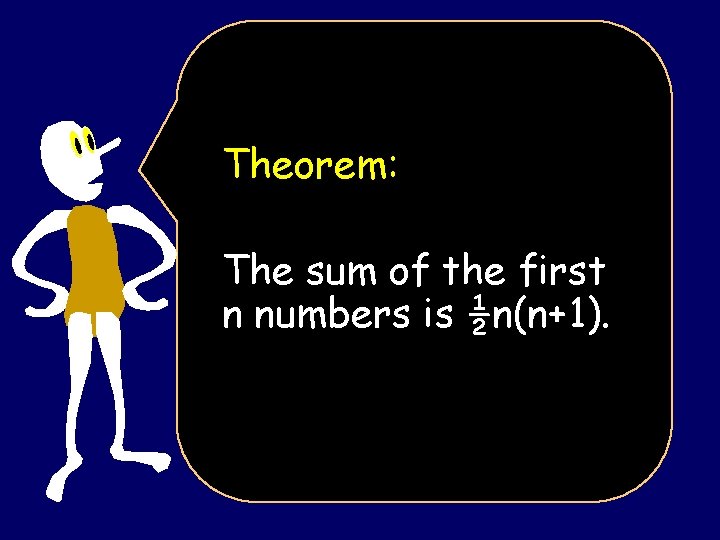
Theorem: The sum of the first n numbers is ½n(n+1).
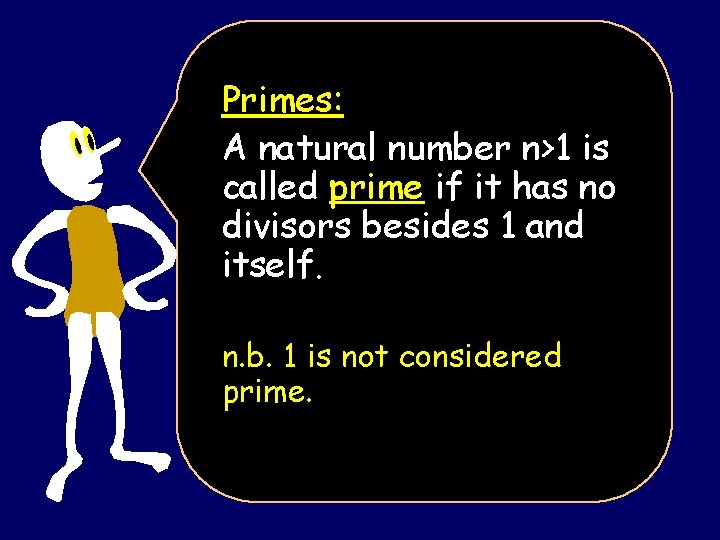
Primes: A natural number n>1 is called prime if it has no divisors besides 1 and itself. n. b. 1 is not considered prime.
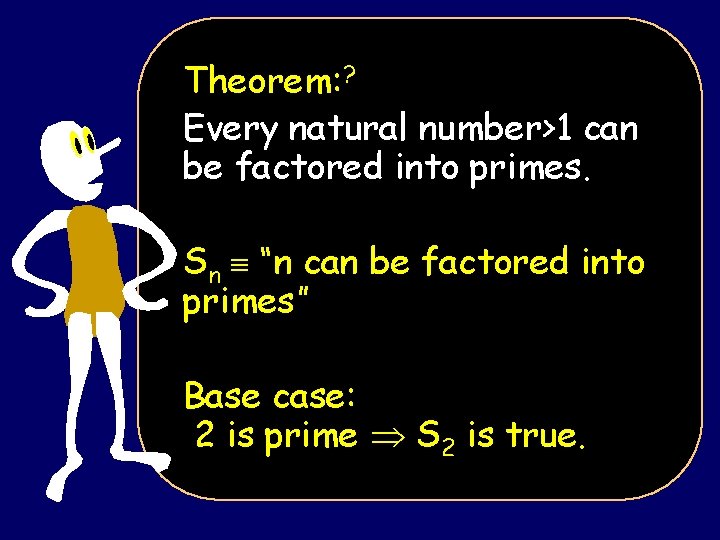
Theorem: ? Every natural number>1 can be factored into primes. Sn “n can be factored into primes” Base case: 2 is prime S 2 is true.
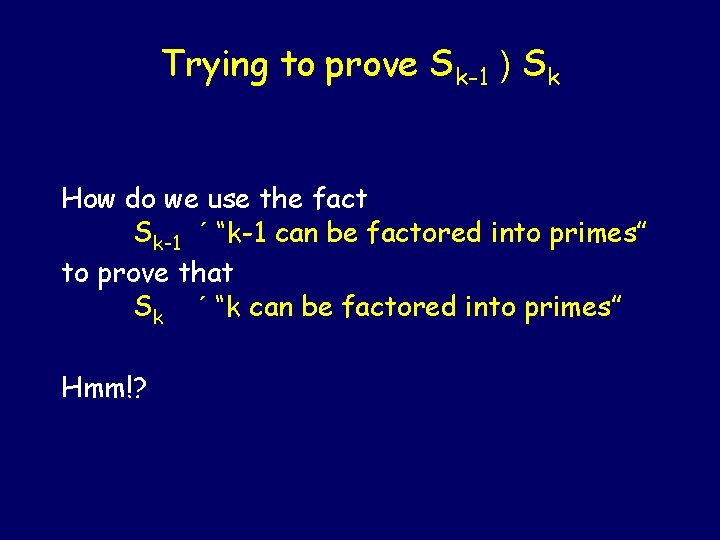
Trying to prove Sk-1 ) Sk How do we use the fact Sk-1 ´ “k-1 can be factored into primes” to prove that Sk ´ “k can be factored into primes” Hmm!?
This illustrates a technical point about using and defining mathematical induction.
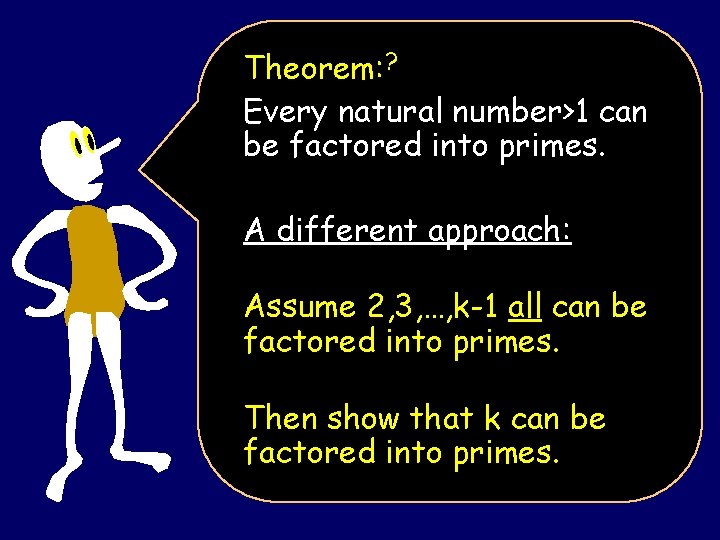
Theorem: ? Every natural number>1 can be factored into primes. A different approach: Assume 2, 3, …, k-1 all can be factored into primes. Then show that k can be factored into primes.
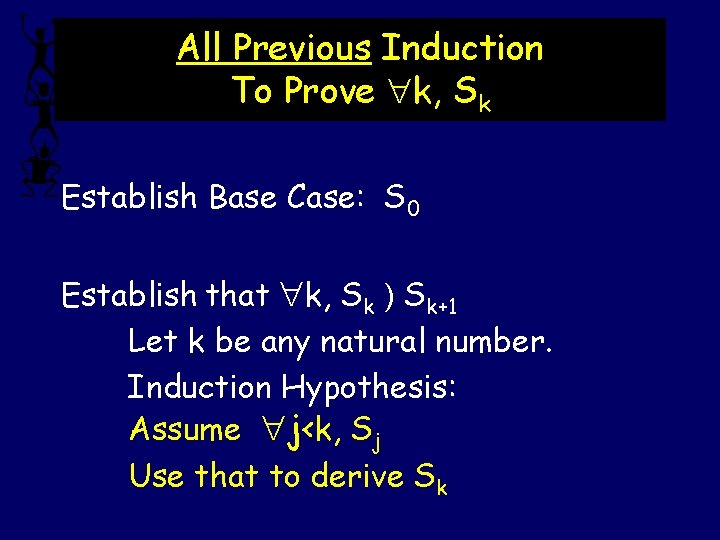
All Previous Induction To Prove k, Sk Establish Base Case: S 0 Establish that k, Sk ) Sk+1 Let k be any natural number. Induction Hypothesis: Assume j<k, Sj Use that to derive Sk
Also called “Strong Induction”
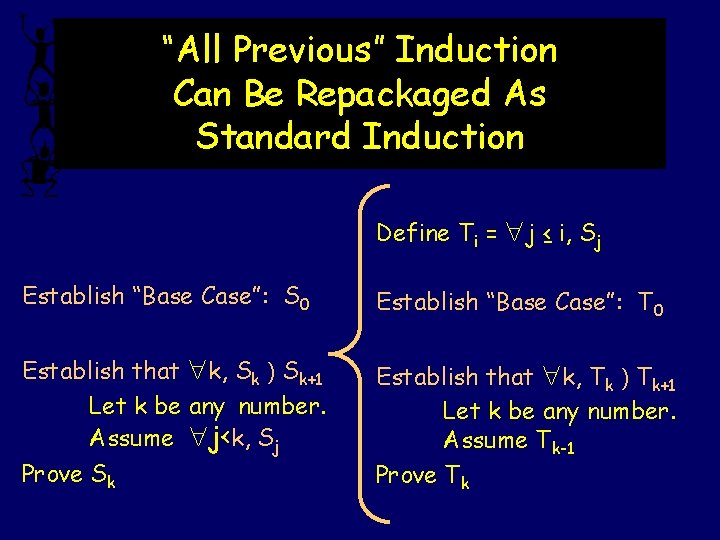
“All Previous” Induction Can Be Repackaged As Standard Induction Define Ti = j ≤ i, Sj Establish “Base Case”: S 0 Establish “Base Case”: T 0 Establish that k, Sk ) Sk+1 Let k be any number. Assume j<k, Sj Prove Sk Establish that k, Tk ) Tk+1 Let k be any number. Assume Tk-1 Prove Tk
And there are more ways to do inductive proofs
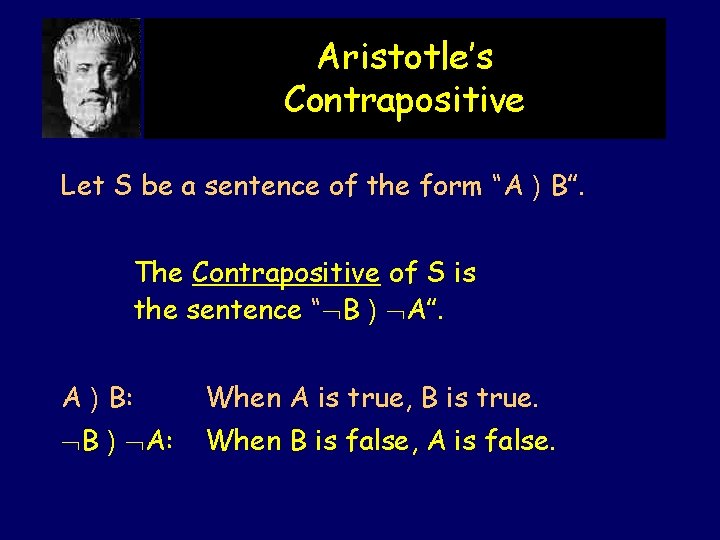
Aristotle’s Contrapositive Let S be a sentence of the form “A ) B”. The Contrapositive of S is the sentence “ B ) A”. A ) B: When A is true, B is true. B ) A: When B is false, A is false.
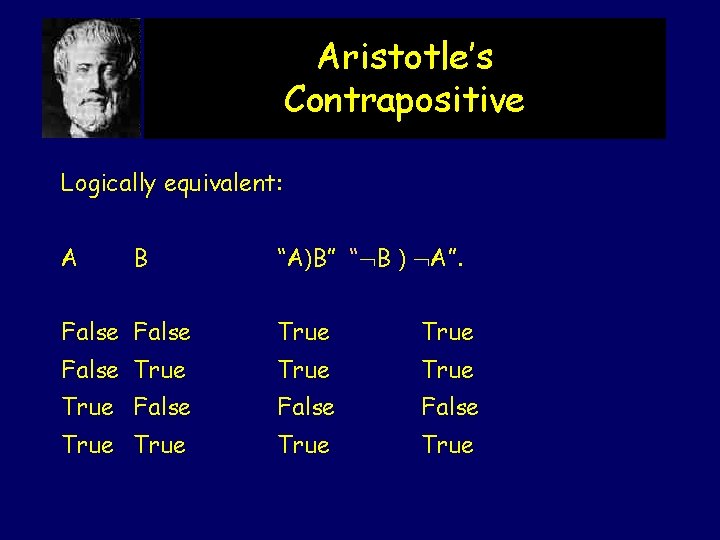
Aristotle’s Contrapositive Logically equivalent: A B “A)B” “ B ) A”. False True True False True
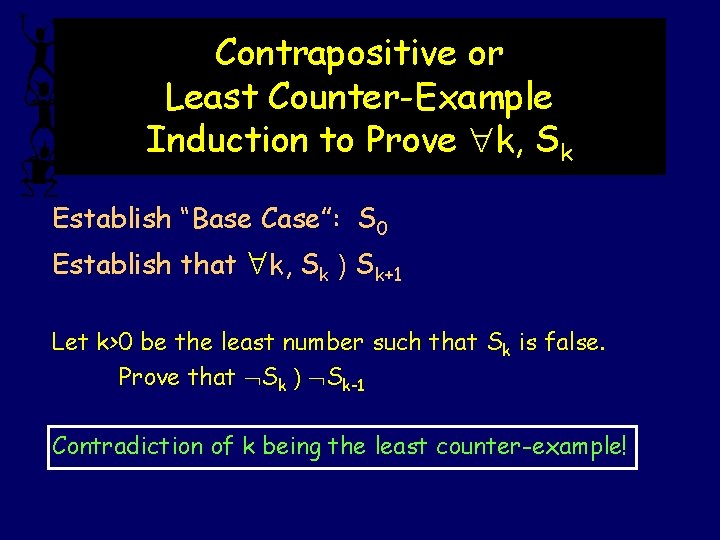
Contrapositive or Least Counter-Example Induction to Prove k, Sk Establish “Base Case”: S 0 Establish that k, Sk ) Sk+1 Let k>0 be the least number such that Sk is false. Prove that Sk ) Sk-1 Contradiction of k being the least counter-example!
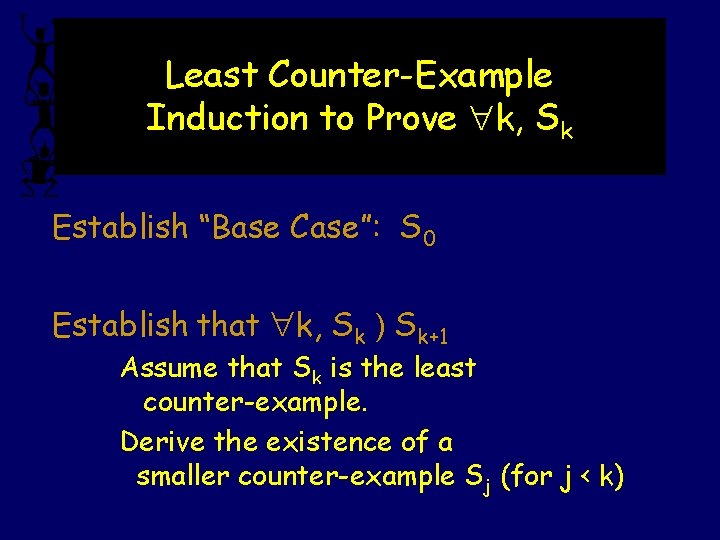
Least Counter-Example Induction to Prove k, Sk Establish “Base Case”: S 0 Establish that k, Sk ) Sk+1 Assume that Sk is the least counter-example. Derive the existence of a smaller counter-example Sj (for j < k)
Rene Descartes [1596 -1650] “Method Of Infinite Decent” Show that for any counter-example you find a smaller one. If a counter-example exists there would be an infinite sequence of smaller and smaller counter examples.
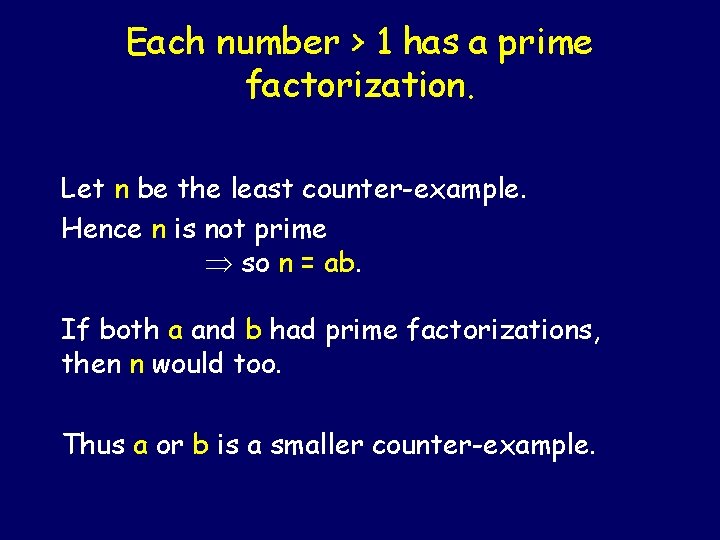
Each number > 1 has a prime factorization. Let n be the least counter-example. Hence n is not prime so n = ab. If both a and b had prime factorizations, then n would too. Thus a or b is a smaller counter-example.
Inductive reasoning is the high level idea: “Standard” Induction “All Previous” Induction “Least Counter-example” all just different packaging.
Euclid’s theorem on the unique factorization of a number into primes. Assume there is a least counter-example. Derive the existence of a smaller counter-example.
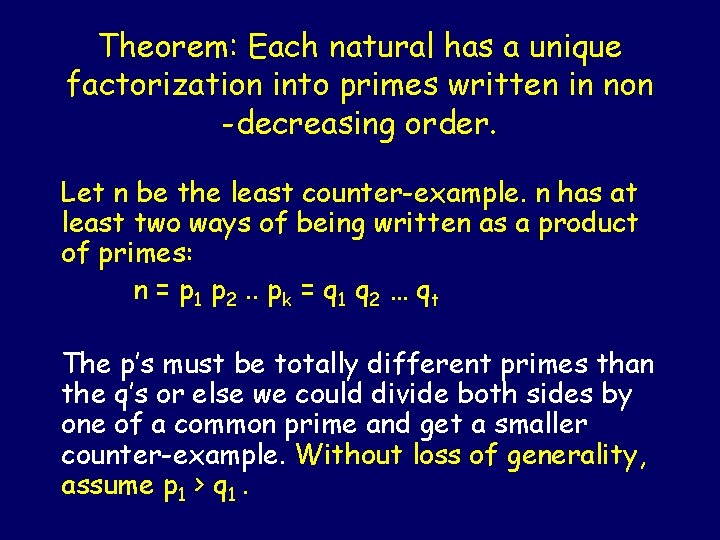
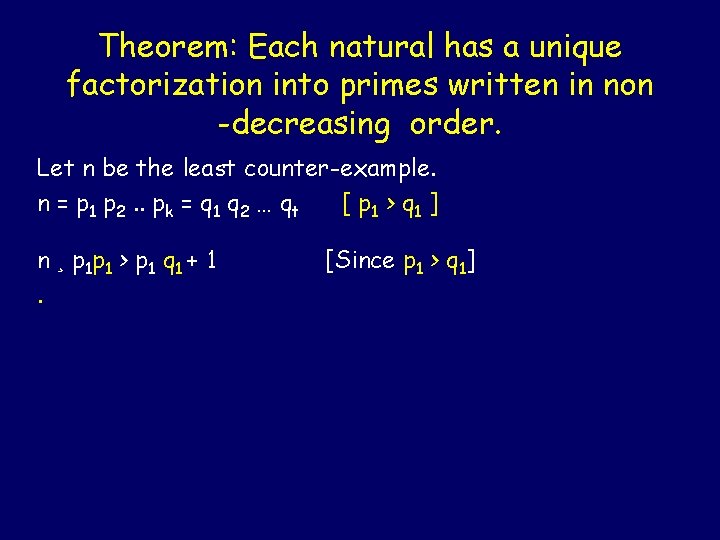
Theorem: Each natural has a unique factorization into primes written in non -decreasing order. Let n be the least counter-example. n has at least two ways of being written as a product of primes: n = p 1 p 2. . pk = q 1 q 2 … qt The p’s must be totally different primes than the q’s or else we could divide both sides by one of a common prime and get a smaller counter-example. Without loss of generality, assume p 1 > q 1.
Theorem: Each natural has a unique factorization into primes written in non -decreasing order. Let n be the least counter-example. n = p 1 p 2. . pk = q 1 q 2 … qt [ p 1 > q 1 ] n ¸ p 1 > p 1 q 1 + 1. [Since p 1 > q 1]
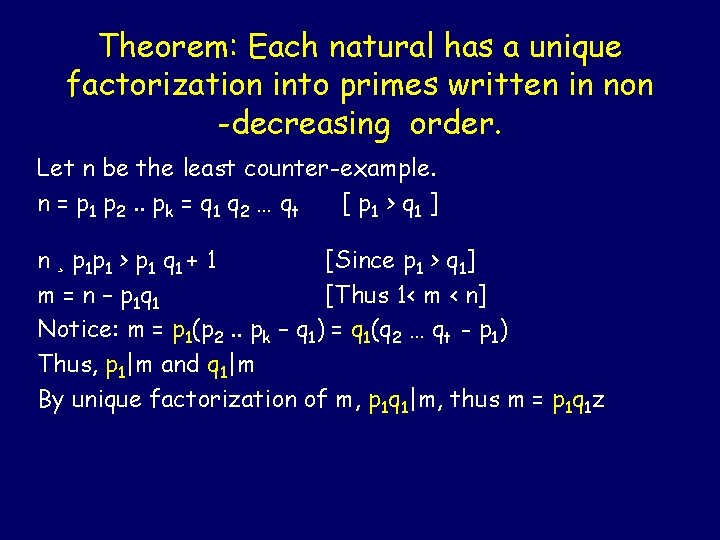
Theorem: Each natural has a unique factorization into primes written in non -decreasing order. Let n be the least counter-example. n = p 1 p 2. . pk = q 1 q 2 … qt [ p 1 > q 1 ] n ¸ p 1 p 1 > p 1 q 1 + 1 [Since p 1 > q 1] m = n – p 1 q 1 [Thus 1< m < n] Notice: m = p 1(p 2. . pk – q 1) = q 1(q 2 … qt - p 1) Thus, p 1|m and q 1|m By unique factorization of m, p 1 q 1|m, thus m = p 1 q 1 z
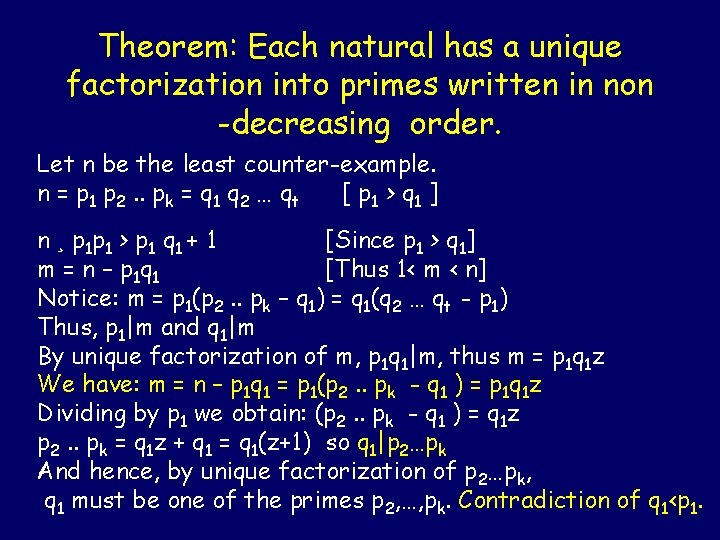
Theorem: Each natural has a unique factorization into primes written in non -decreasing order. Let n be the least counter-example. n = p 1 p 2. . pk = q 1 q 2 … qt [ p 1 > q 1 ] n ¸ p 1 p 1 > p 1 q 1 + 1 [Since p 1 > q 1] m = n – p 1 q 1 [Thus 1< m < n] Notice: m = p 1(p 2. . pk – q 1) = q 1(q 2 … qt - p 1) Thus, p 1|m and q 1|m By unique factorization of m, p 1 q 1|m, thus m = p 1 q 1 z We have: m = n – p 1 q 1 = p 1(p 2. . pk - q 1 ) = p 1 q 1 z Dividing by p 1 we obtain: (p 2. . pk - q 1 ) = q 1 z p 2. . pk = q 1 z + q 1 = q 1(z+1) so q 1|p 2…pk And hence, by unique factorization of p 2…pk, q 1 must be one of the primes p 2, …, pk. Contradiction of q 1<p 1.
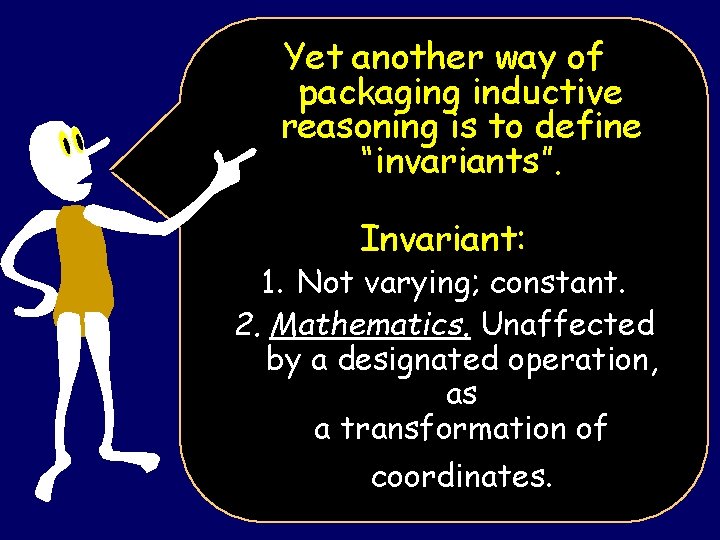
Yet another way of packaging inductive reasoning is to define “invariants”. Invariant: 1. Not varying; constant. 2. Mathematics. Unaffected by a designated operation, as a transformation of coordinates.
Yet another way of packaging inductive reasoning is to define “invariants”. Invariant: 3. programming A rule, such as the ordering an ordered list or heap, that applies throughout the life of a data structure or procedure. Each change to the data structure must maintain the correctness of the invariant.
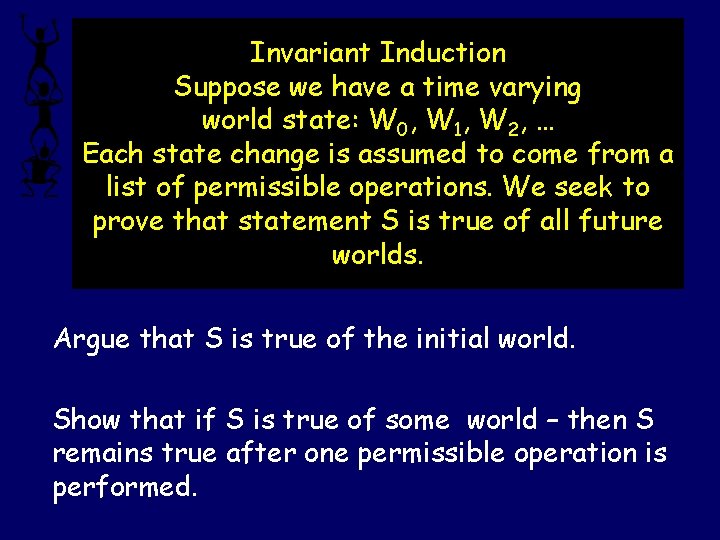
Invariant Induction Suppose we have a time varying world state: W 0, W 1, W 2, … Each state change is assumed to come from a list of permissible operations. We seek to prove that statement S is true of all future worlds. Argue that S is true of the initial world. Show that if S is true of some world – then S remains true after one permissible operation is performed.
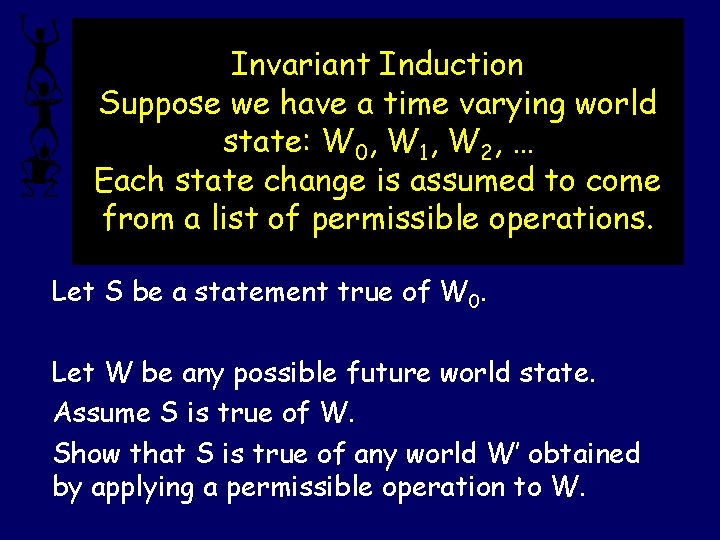
Invariant Induction Suppose we have a time varying world state: W 0, W 1, W 2, … Each state change is assumed to come from a list of permissible operations. Let S be a statement true of W 0. Let W be any possible future world state. Assume S is true of W. Show that S is true of any world W’ obtained by applying a permissible operation to W.
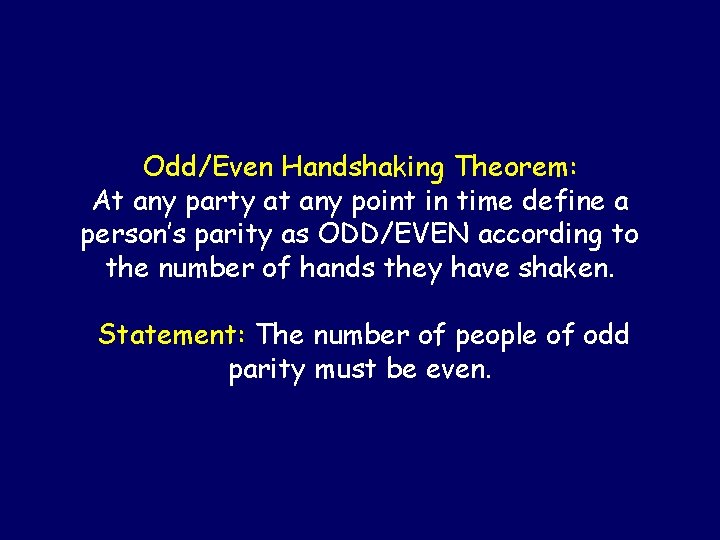
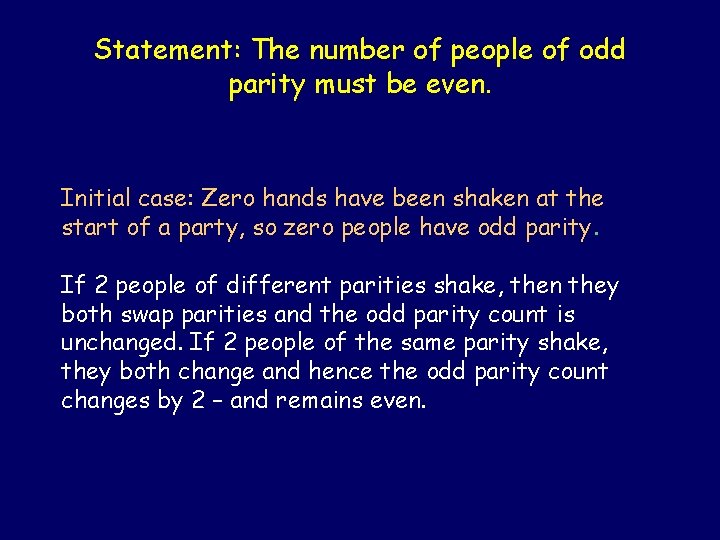
Odd/Even Handshaking Theorem: At any party at any point in time define a person’s parity as ODD/EVEN according to the number of hands they have shaken. Statement: The number of people of odd parity must be even.
Statement: The number of people of odd parity must be even. Initial case: Zero hands have been shaken at the start of a party, so zero people have odd parity. If 2 people of different parities shake, then they both swap parities and the odd parity count is unchanged. If 2 people of the same parity shake, they both change and hence the odd parity count changes by 2 – and remains even.
Inductive reasoning is the high level idea: “Standard” Induction “Least Counter-example” “All-Previous” Induction and ”Invariants” all just different packaging.
Induction is also how we can define and construct our world.
So many things, from buildings to computers, are built up stage by stage, module by module, each depending on the previous stages.
Well, almost always
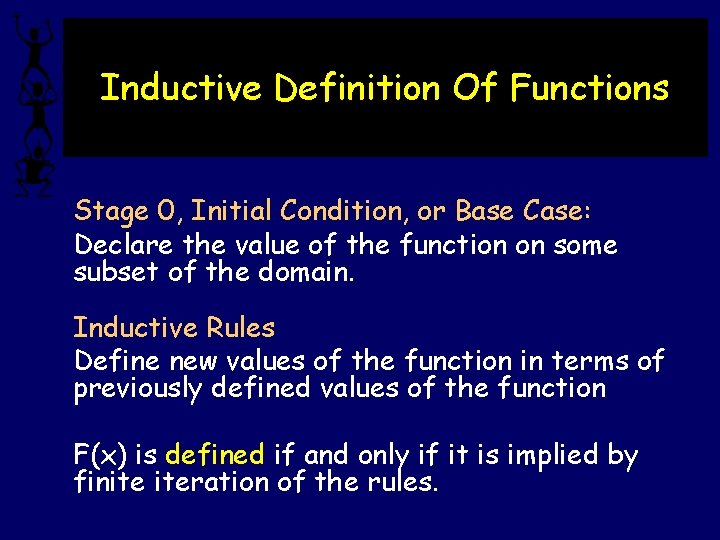
Inductive Definition Of Functions Stage 0, Initial Condition, or Base Case: Declare the value of the function on some subset of the domain. Inductive Rules Define new values of the function in terms of previously defined values of the function F(x) is defined if and only if it is implied by finite iteration of the rules.
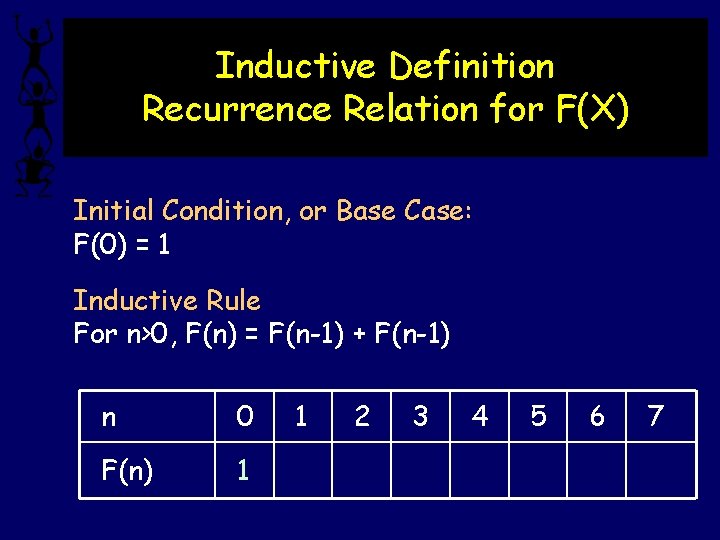
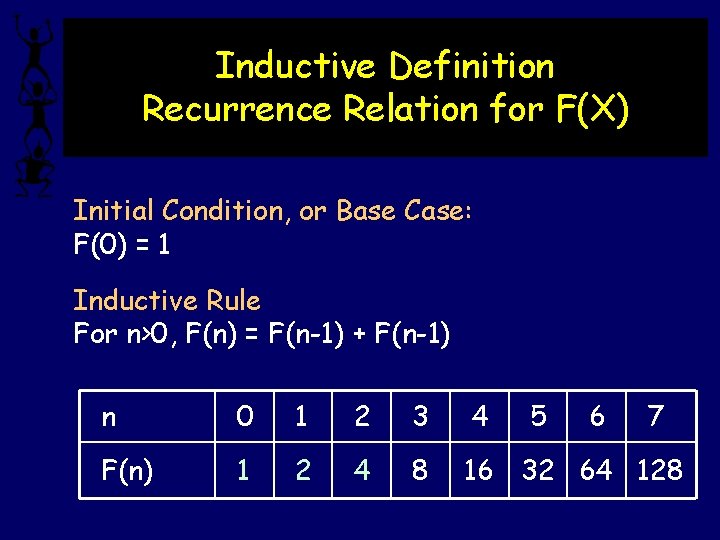
Inductive Definition Recurrence Relation for F(X) Initial Condition, or Base Case: F(0) = 1 Inductive Rule For n>0, F(n) = F(n-1) + F(n-1) n 0 F(n) 1 1 2 3 4 5 6 7
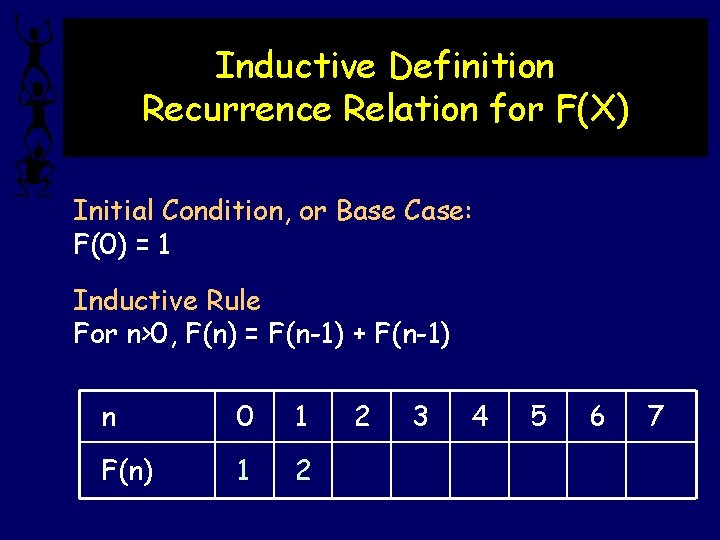
Inductive Definition Recurrence Relation for F(X) Initial Condition, or Base Case: F(0) = 1 Inductive Rule For n>0, F(n) = F(n-1) + F(n-1) n 0 1 F(n) 1 2 2 3 4 5 6 7
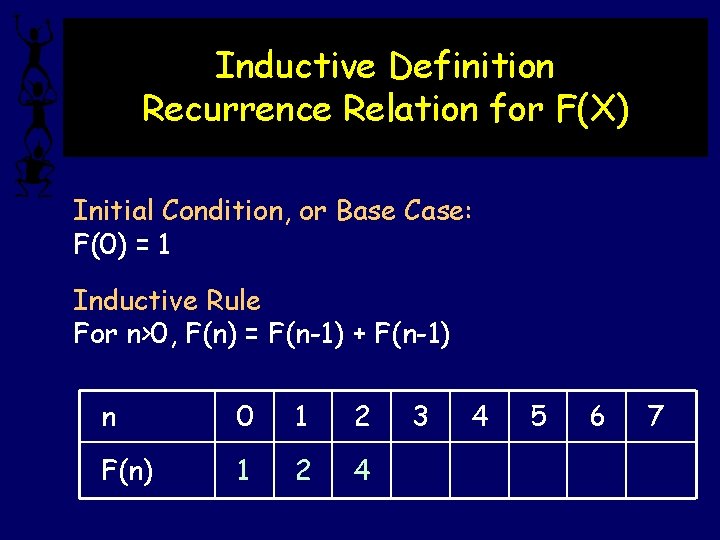
Inductive Definition Recurrence Relation for F(X) Initial Condition, or Base Case: F(0) = 1 Inductive Rule For n>0, F(n) = F(n-1) + F(n-1) n 0 1 2 F(n) 1 2 4 3 4 5 6 7
Inductive Definition Recurrence Relation for F(X) Initial Condition, or Base Case: F(0) = 1 Inductive Rule For n>0, F(n) = F(n-1) + F(n-1) n 0 1 2 3 4 5 6 7 F(n) 1 2 4 8 16 32 64 128
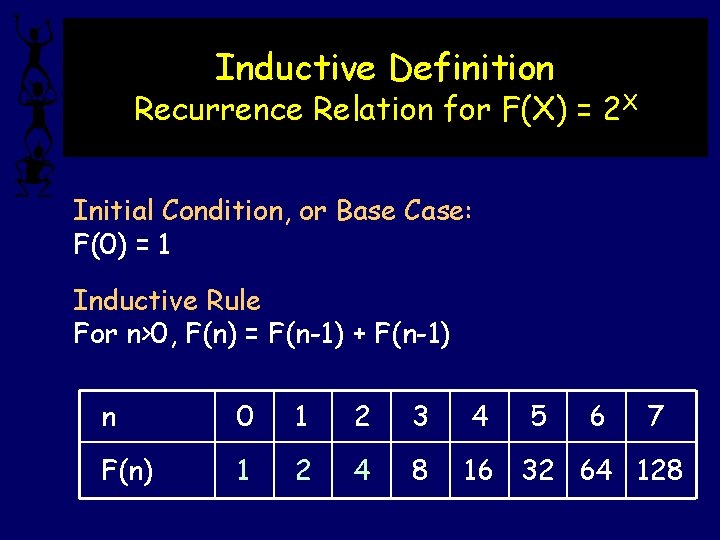
Inductive Definition Recurrence Relation for F(X) = 2 X Initial Condition, or Base Case: F(0) = 1 Inductive Rule For n>0, F(n) = F(n-1) + F(n-1) n 0 1 2 3 4 5 6 7 F(n) 1 2 4 8 16 32 64 128
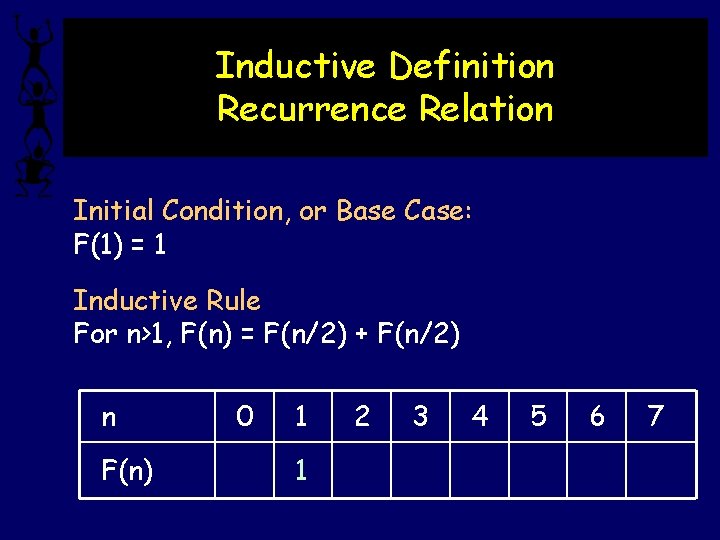
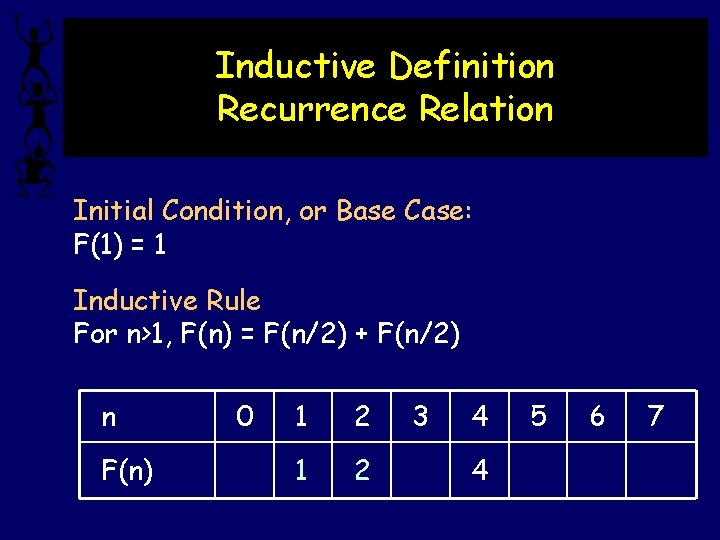
Inductive Definition Recurrence Relation Initial Condition, or Base Case: F(1) = 1 Inductive Rule For n>1, F(n) = F(n/2) + F(n/2) n F(n) 0 1 1 2 3 4 5 6 7
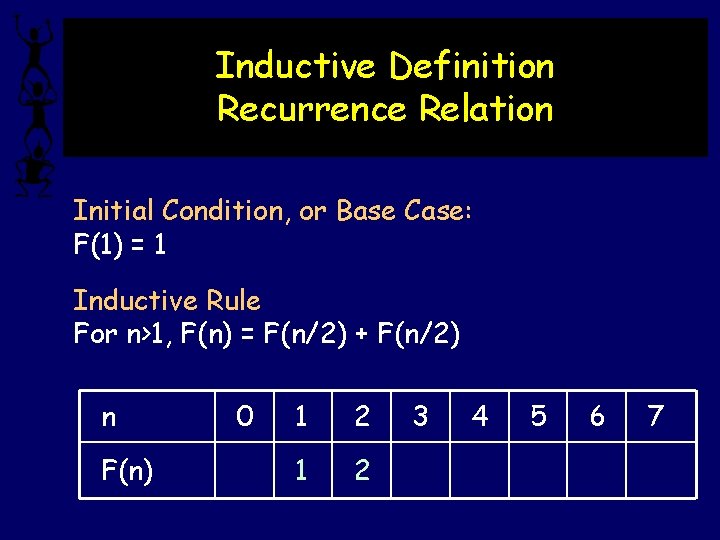
Inductive Definition Recurrence Relation Initial Condition, or Base Case: F(1) = 1 Inductive Rule For n>1, F(n) = F(n/2) + F(n/2) n F(n) 0 1 2 3 4 5 6 7
Inductive Definition Recurrence Relation Initial Condition, or Base Case: F(1) = 1 Inductive Rule For n>1, F(n) = F(n/2) + F(n/2) n F(n) 0 1 2 3 4 4 5 6 7
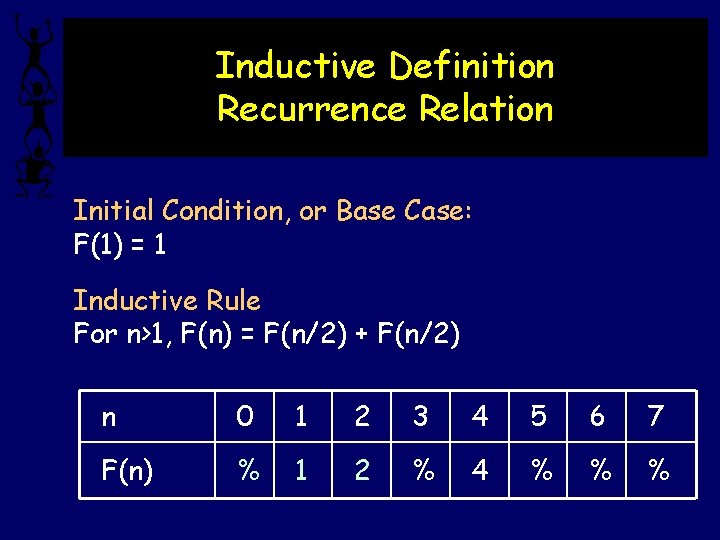
Inductive Definition Recurrence Relation Initial Condition, or Base Case: F(1) = 1 Inductive Rule For n>1, F(n) = F(n/2) + F(n/2) n 0 1 2 3 4 5 6 7 F(n) % 1 2 % 4 % % %
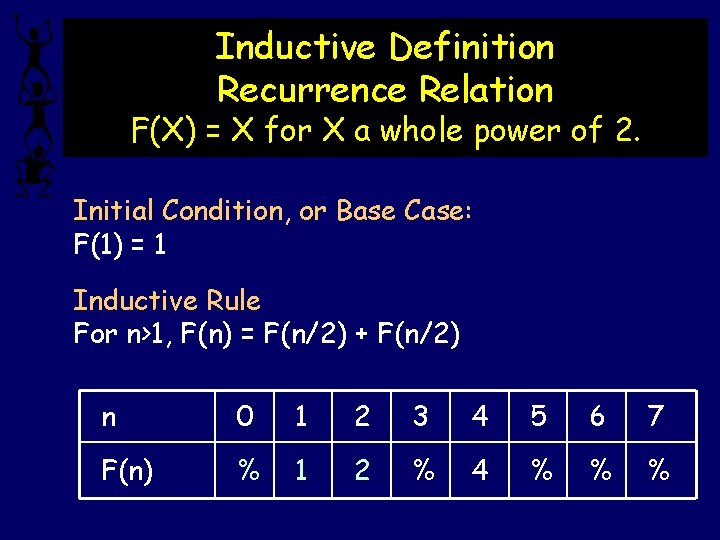
Inductive Definition Recurrence Relation F(X) = X for X a whole power of 2. Initial Condition, or Base Case: F(1) = 1 Inductive Rule For n>1, F(n) = F(n/2) + F(n/2) n 0 1 2 3 4 5 6 7 F(n) % 1 2 % 4 % % %
Leonardo Fibonacci In 1202, Fibonacci proposed a problem about the growth of rabbit populations.
Leonardo Fibonacci In 1202, Fibonacci proposed a problem about the growth of rabbit populations.
Leonardo Fibonacci In 1202, Fibonacci proposed a problem about the growth of rabbit populations.
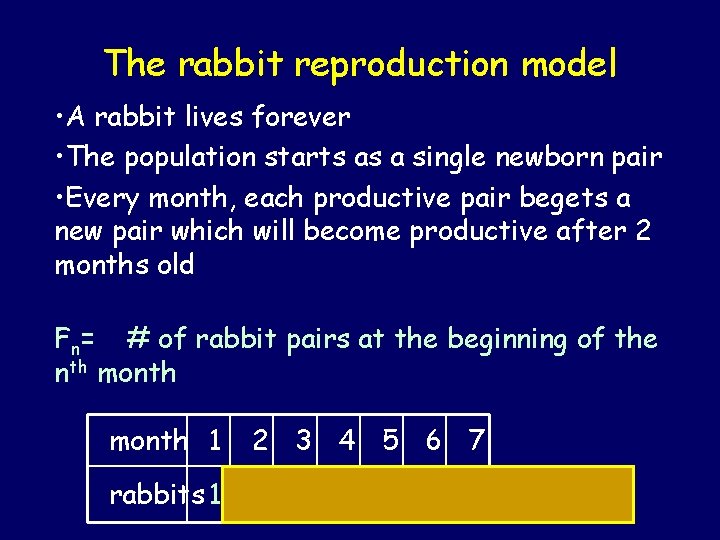
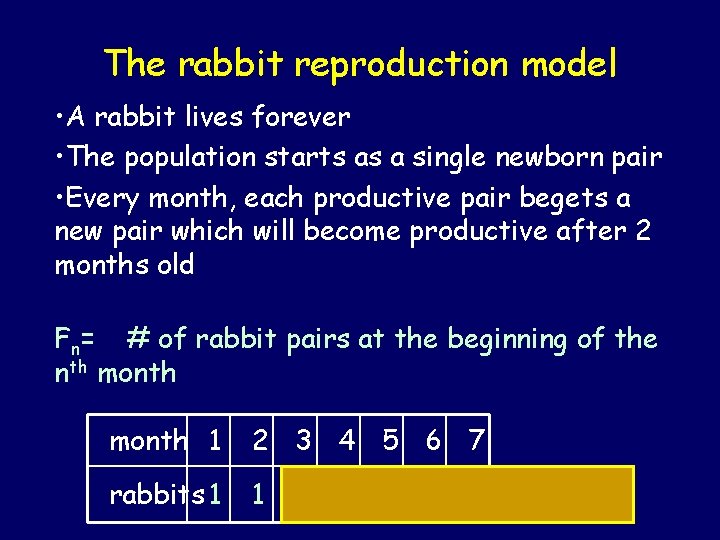
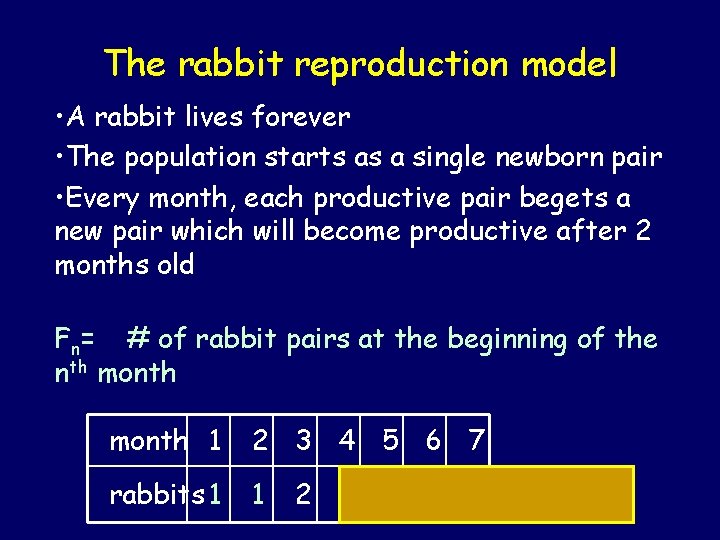
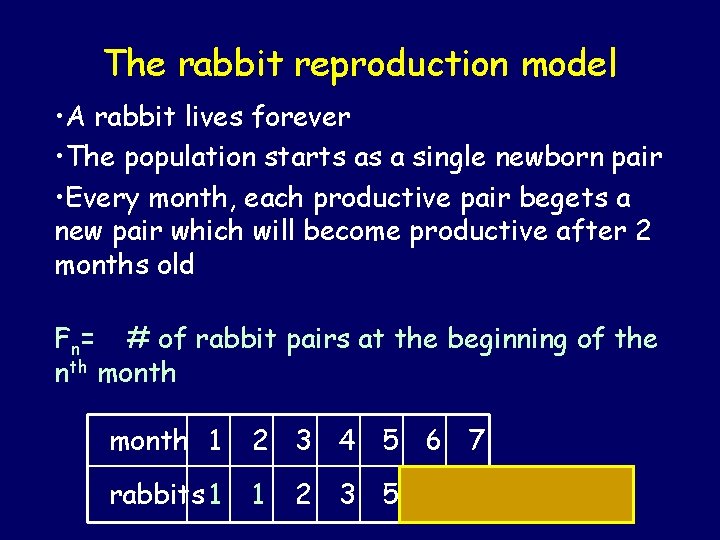
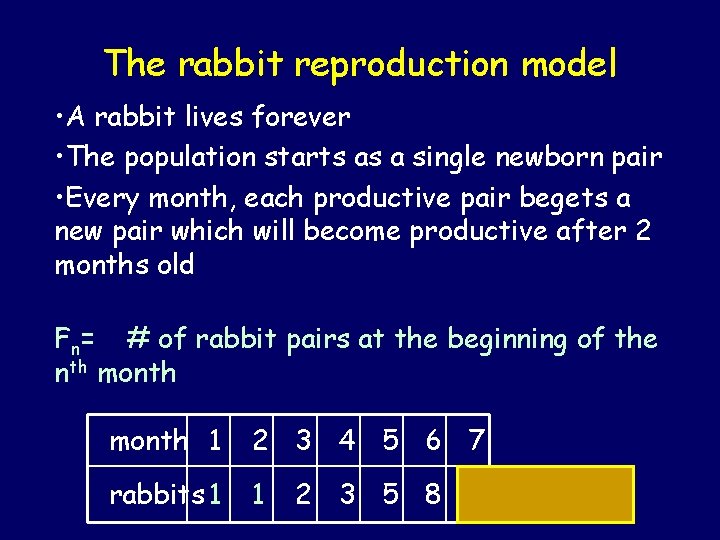
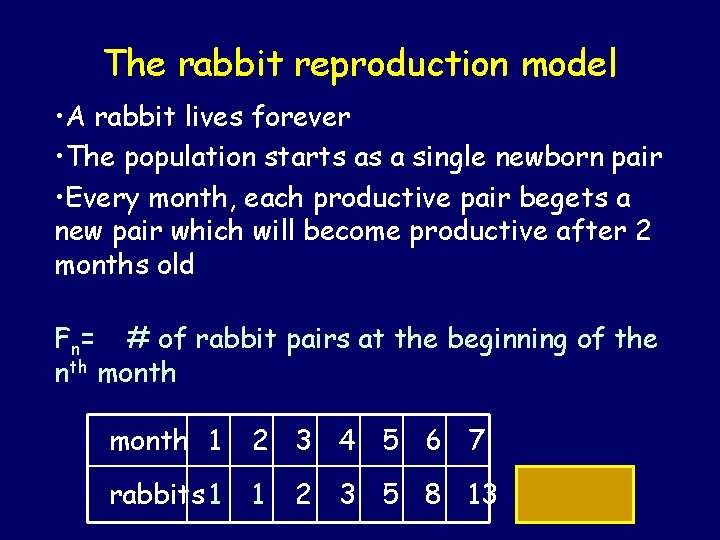
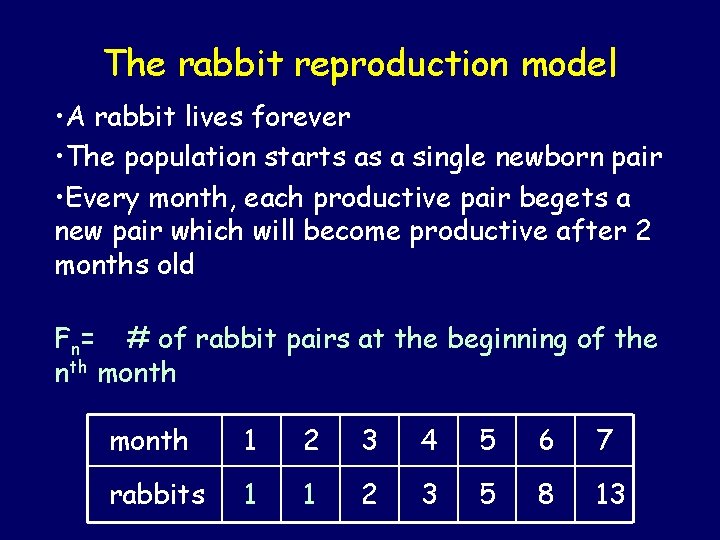
The rabbit reproduction model • A rabbit lives forever • The population starts as a single newborn pair • Every month, each productive pair begets a new pair which will become productive after 2 months old Fn= # of rabbit pairs at the beginning of the nth month 1 2 3 4 5 6 7 rabbits 1 1 2 3 5 8 13
The rabbit reproduction model • A rabbit lives forever • The population starts as a single newborn pair • Every month, each productive pair begets a new pair which will become productive after 2 months old Fn= # of rabbit pairs at the beginning of the nth month 1 2 3 4 5 6 7 rabbits 1 1 2 3 5 8 13
The rabbit reproduction model • A rabbit lives forever • The population starts as a single newborn pair • Every month, each productive pair begets a new pair which will become productive after 2 months old Fn= # of rabbit pairs at the beginning of the nth month 1 2 3 4 5 6 7 rabbits 1 1 2 3 5 8 13
The rabbit reproduction model • A rabbit lives forever • The population starts as a single newborn pair • Every month, each productive pair begets a new pair which will become productive after 2 months old Fn= # of rabbit pairs at the beginning of the nth month 1 2 3 4 5 6 7 rabbits 1 1 2 3 5 8 13
The rabbit reproduction model • A rabbit lives forever • The population starts as a single newborn pair • Every month, each productive pair begets a new pair which will become productive after 2 months old Fn= # of rabbit pairs at the beginning of the nth month 1 2 3 4 5 6 7 rabbits 1 1 2 3 5 8 13
The rabbit reproduction model • A rabbit lives forever • The population starts as a single newborn pair • Every month, each productive pair begets a new pair which will become productive after 2 months old Fn= # of rabbit pairs at the beginning of the nth month 1 2 3 4 5 6 7 rabbits 1 1 2 3 5 8 13
The rabbit reproduction model • A rabbit lives forever • The population starts as a single newborn pair • Every month, each productive pair begets a new pair which will become productive after 2 months old Fn= # of rabbit pairs at the beginning of the nth month 1 2 3 4 5 6 7 rabbits 1 1 2 3 5 8 13
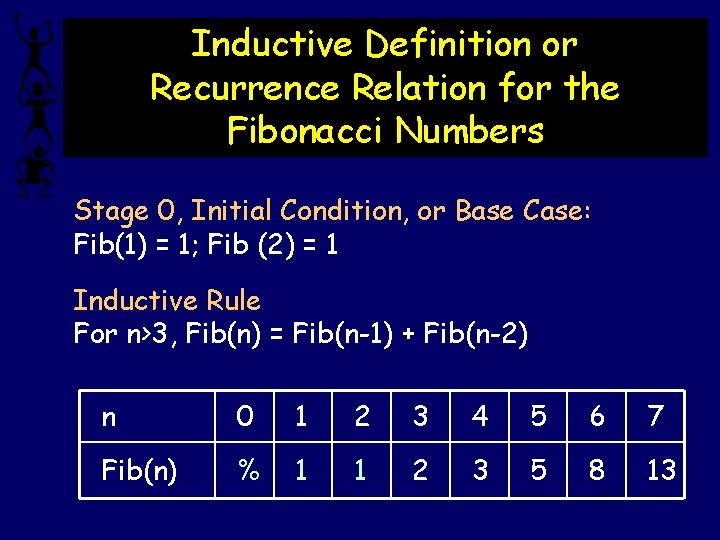
Inductive Definition or Recurrence Relation for the Fibonacci Numbers Stage 0, Initial Condition, or Base Case: Fib(1) = 1; Fib (2) = 1 Inductive Rule For n>3, Fib(n) = Fib(n-1) + Fib(n-2) n 0 1 2 3 4 5 6 7 Fib(n) % 1 1 2 3 5 8 13
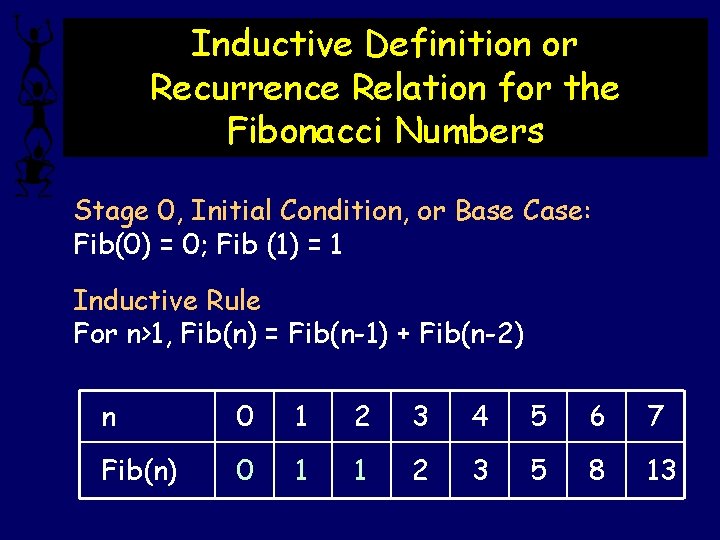
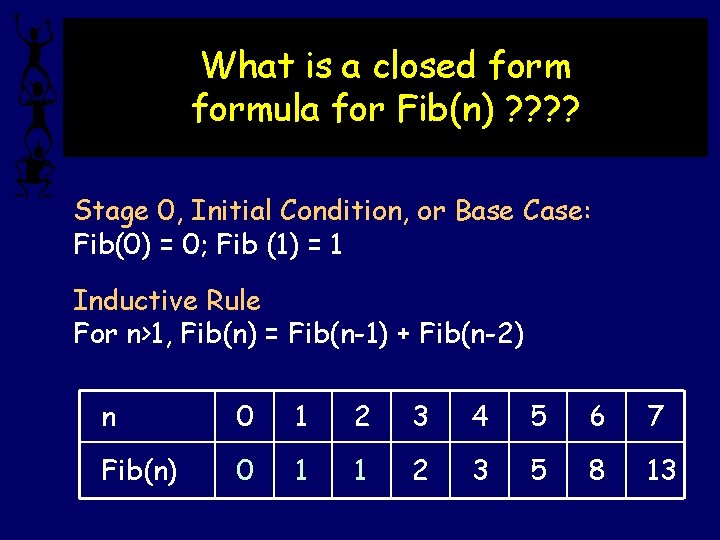
Inductive Definition or Recurrence Relation for the Fibonacci Numbers Stage 0, Initial Condition, or Base Case: Fib(0) = 0; Fib (1) = 1 Inductive Rule For n>1, Fib(n) = Fib(n-1) + Fib(n-2) n 0 1 2 3 4 5 6 7 Fib(n) 0 1 1 2 3 5 8 13
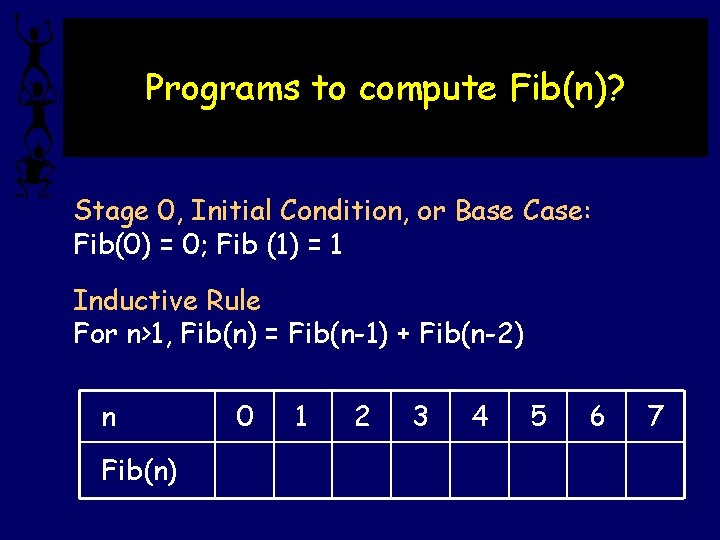
Programs to compute Fib(n)? Stage 0, Initial Condition, or Base Case: Fib(0) = 0; Fib (1) = 1 Inductive Rule For n>1, Fib(n) = Fib(n-1) + Fib(n-2) n Fib(n) 0 1 2 3 4 5 6 7
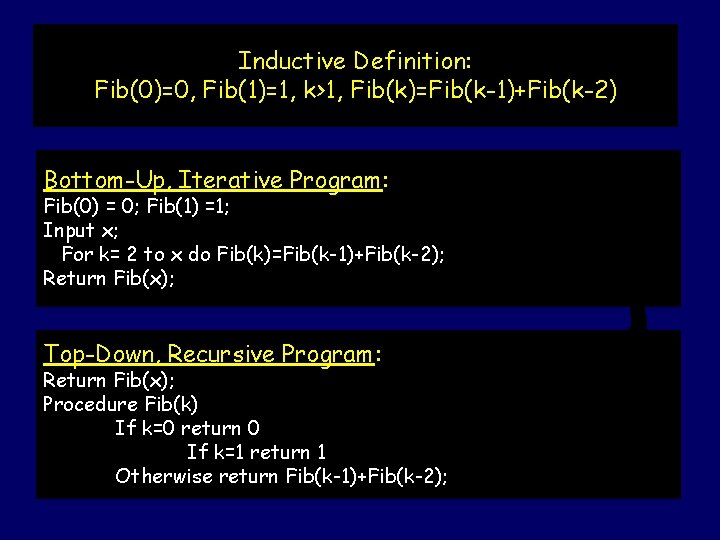
Inductive Definition: Fib(0)=0, Fib(1)=1, k>1, Fib(k)=Fib(k-1)+Fib(k-2) Bottom-Up, Iterative Program: Fib(0) = 0; Fib(1) =1; Input x; For k= 2 to x do Fib(k)=Fib(k-1)+Fib(k-2); Return Fib(x); Top-Down, Recursive Program: Return Fib(x); Procedure Fib(k) If k=0 return 0 If k=1 return 1 Otherwise return Fib(k-1)+Fib(k-2);
What is a closed formula for Fib(n) ? ? Stage 0, Initial Condition, or Base Case: Fib(0) = 0; Fib (1) = 1 Inductive Rule For n>1, Fib(n) = Fib(n-1) + Fib(n-2) n 0 1 2 3 4 5 6 7 Fib(n) 0 1 1 2 3 5 8 13
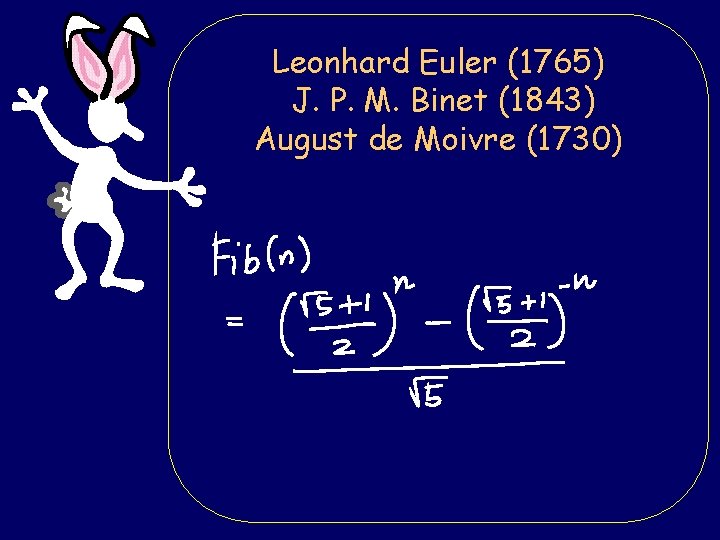
Leonhard Euler (1765) J. P. M. Binet (1843) August de Moivre (1730)
Inductive Proof Standard Form All Previous Form Least-Counter Example Form Invariant Form Inductive Definition Bottom-Up Programming Top-Down Programming Recurrence Relations Fibonacci Numbers Study Bee Logic Contrapositive Form of S