
Great Theoretical Ideas In Computer Science Anupam Gupta
![Theorem [Cook/Levin]: CIRCUITSAT is one language in NP, such that if we can show](https://slidetodoc.com/presentation_image_h2/75ce04c1e648612dcb18dbfcd92b01b6/image-51.jpg "Theorem [Cook/Levin]: CIRCUITSAT is one language in NP, such that if we can show")
- Slides: 70
Great Theoretical Ideas In Computer Science Anupam Gupta Lecture 29 CS 15 -251 Dec 8, 2005 Fall 2005 Carnegie Mellon University P vs NP: what is efficient computation?
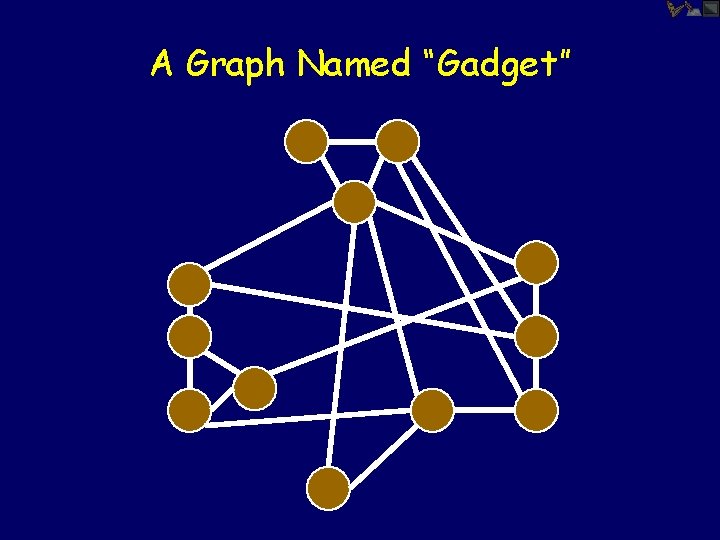
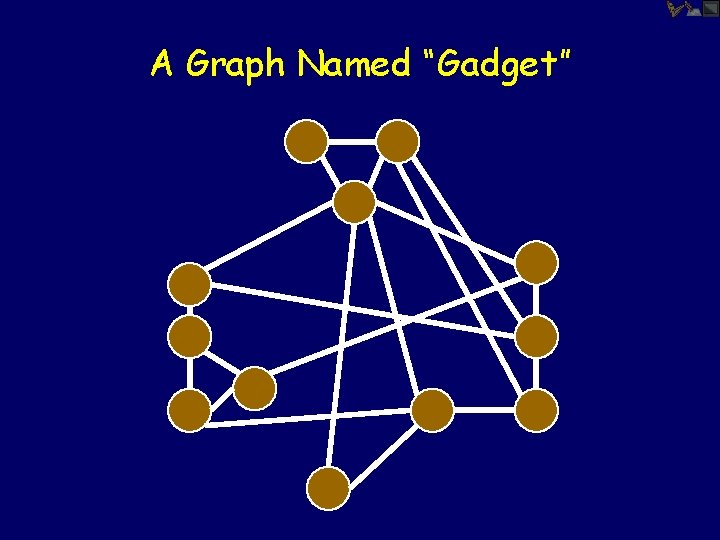
A Graph Named “Gadget”
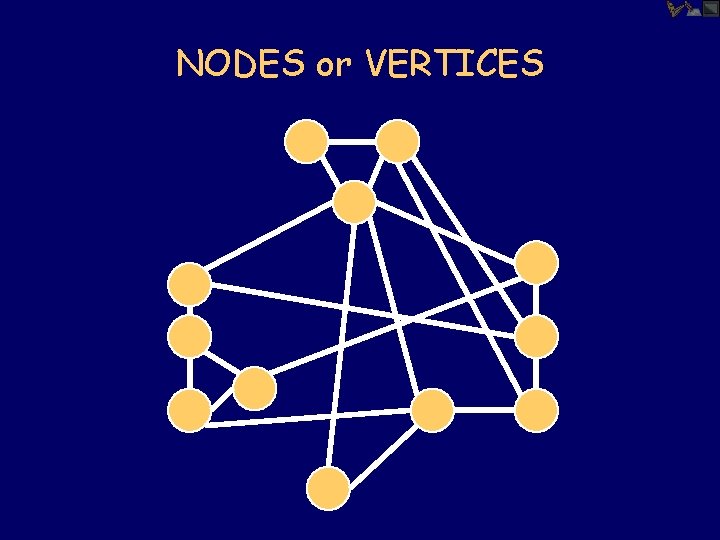
NODES or VERTICES
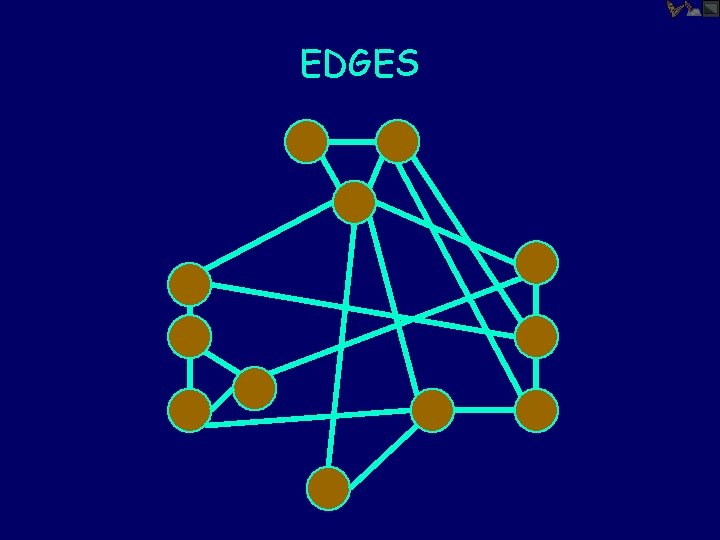
EDGES
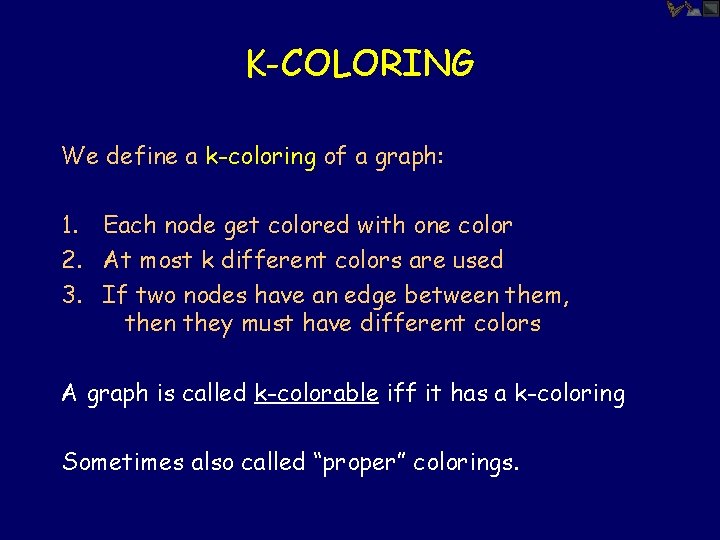
K-COLORING We define a k-coloring of a graph: 1. Each node get colored with one color 2. At most k different colors are used 3. If two nodes have an edge between them, then they must have different colors A graph is called k-colorable iff it has a k-coloring Sometimes also called “proper” colorings.
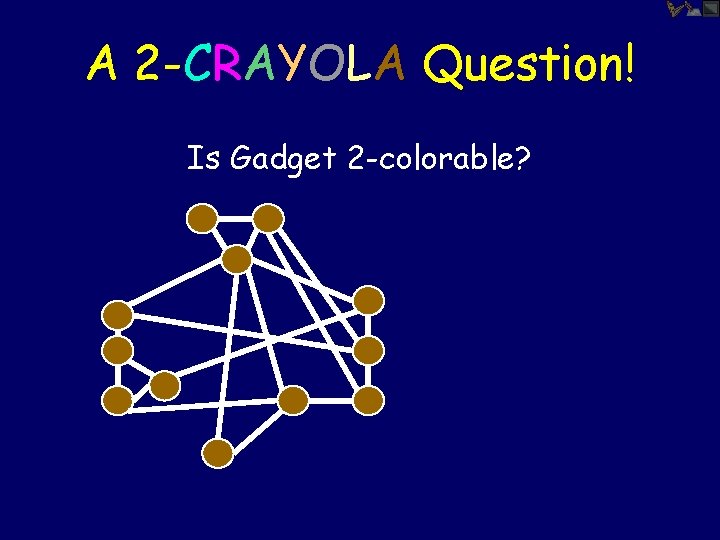
A 2 -CRAYOLA Question! Is Gadget 2 -colorable?
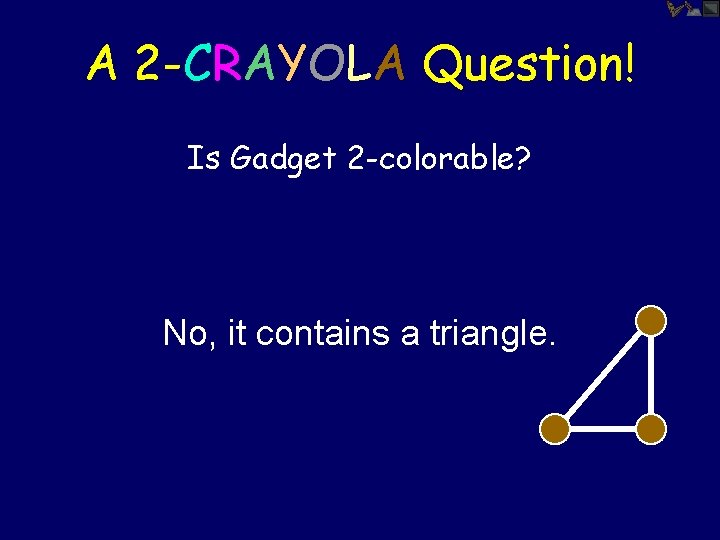
A 2 -CRAYOLA Question! Is Gadget 2 -colorable? No, it contains a triangle.
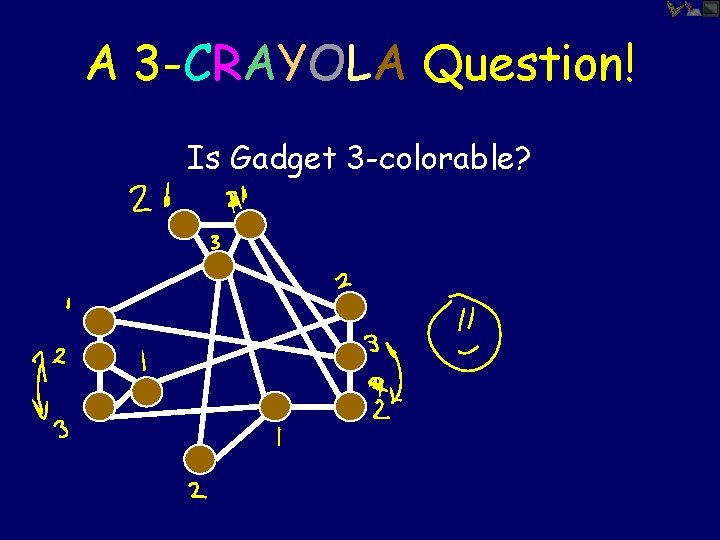
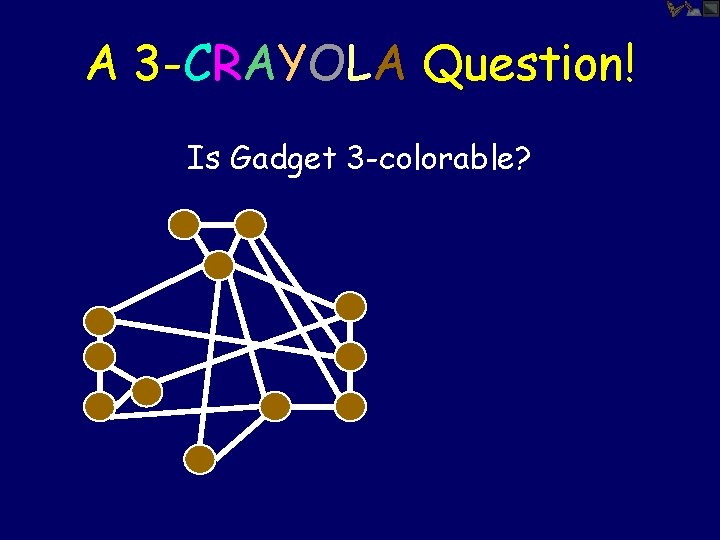
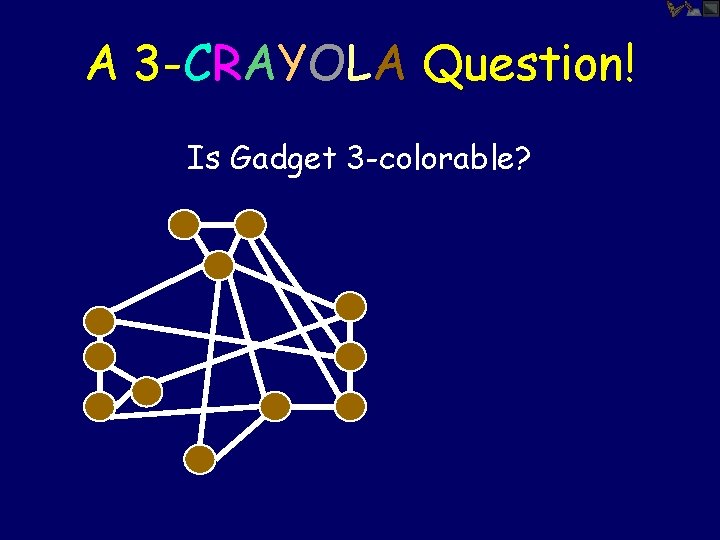
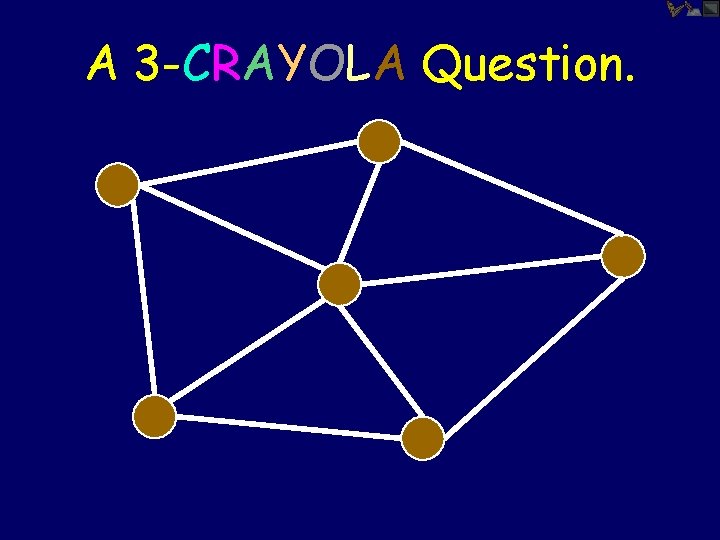
A 3 -CRAYOLA Question! Is Gadget 3 -colorable?
A 3 -CRAYOLA Question! Is Gadget 3 -colorable?
A 3 -CRAYOLA Question! Is Gadget 3 -colorable?
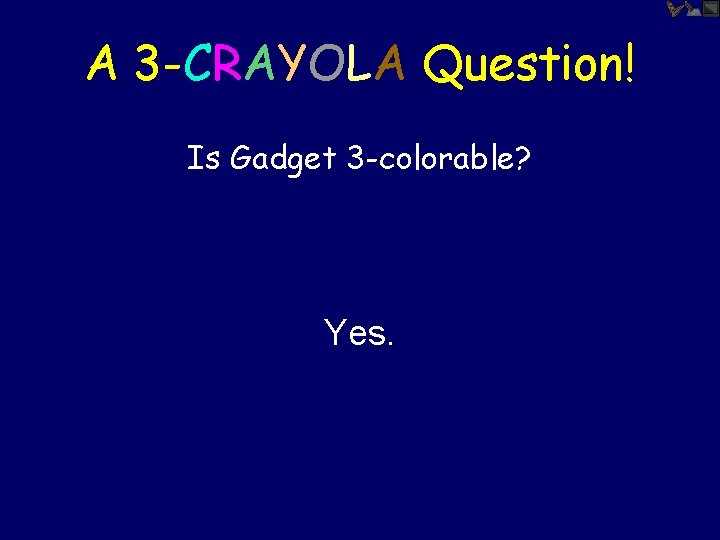
A 3 -CRAYOLA Question! Is Gadget 3 -colorable? Yes.
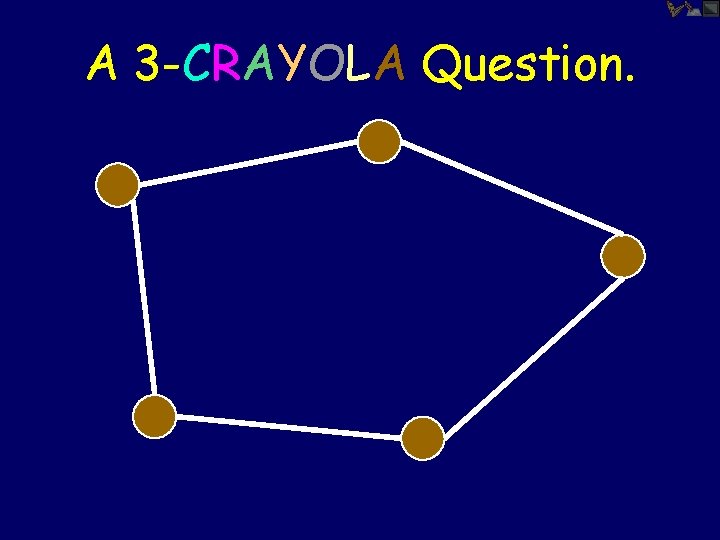
A 3 -CRAYOLA Question.
A 3 -CRAYOLA Question.
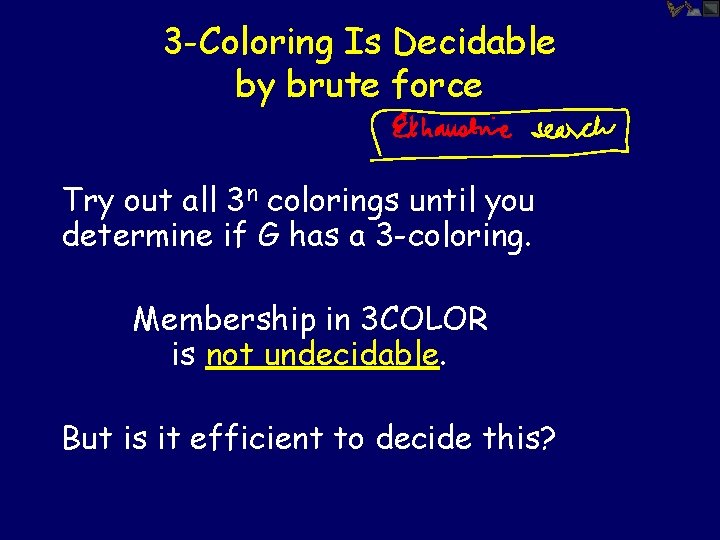
3 -Coloring Is Decidable by brute force Try out all 3 n colorings until you determine if G has a 3 -coloring. Membership in 3 COLOR is not undecidable. But is it efficient to decide this?
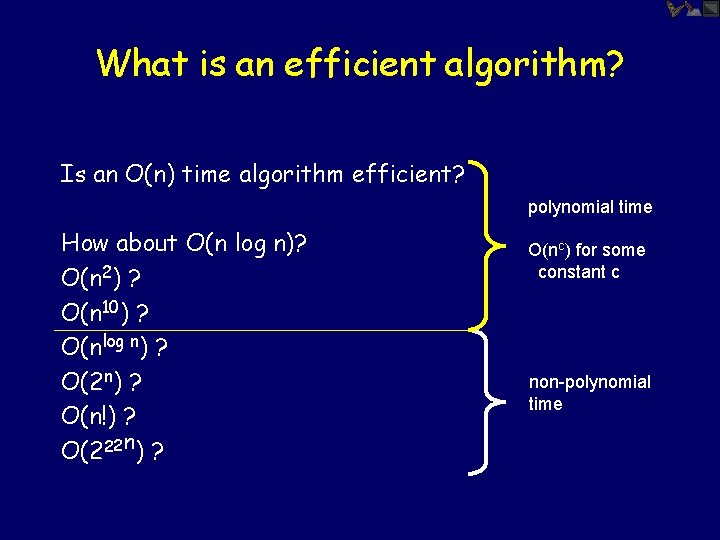
What is an efficient algorithm? Is an O(n) time algorithm efficient? polynomial time How about O(n log n)? O(n 2) ? O(n 10) ? O(nlog n) ? O(2 n) ? O(n!) ? O(222 n) ? O(nc) for some constant c non-polynomial time
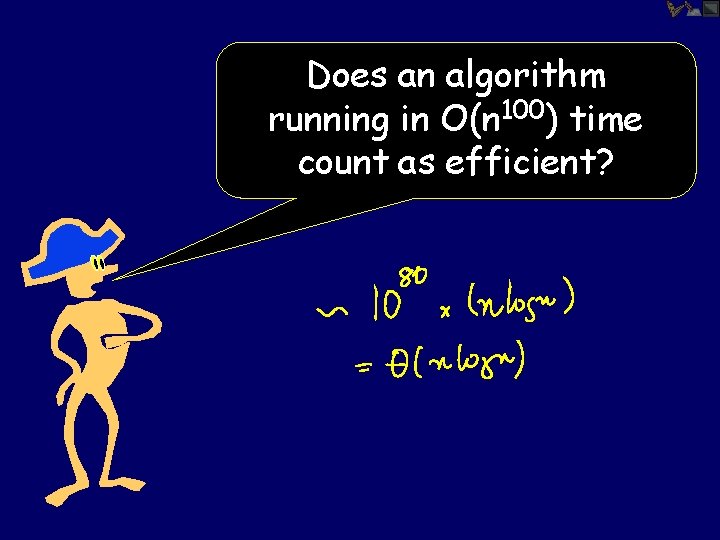
Does an algorithm running in O(n 100) time count as efficient?
We consider non-polynomial time algorithms to be inefficient. And hence a necessary condition for an algorithm to be efficient is that it should run in poly-time.
Asking for a poly-time algorithm for a problem sets a (very) low bar when asking for efficient algorithms. The question is: can we achieve even this?
I see! Once we know that our favorite problems have polynomial time algorithms, we can then worry about making them run in O(n log n) or O(n 2) time! But we don’t know that yet for many common problems…
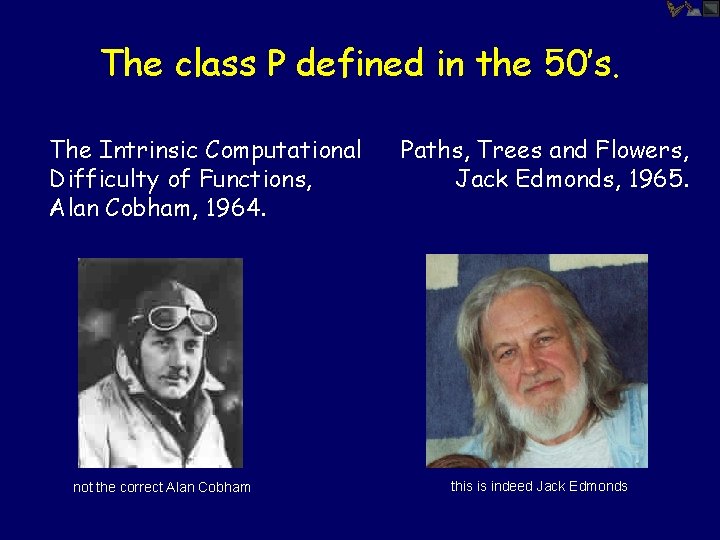
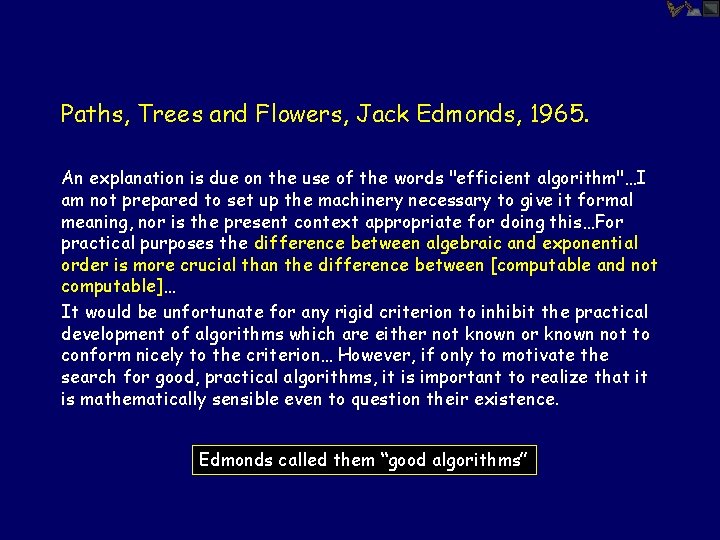
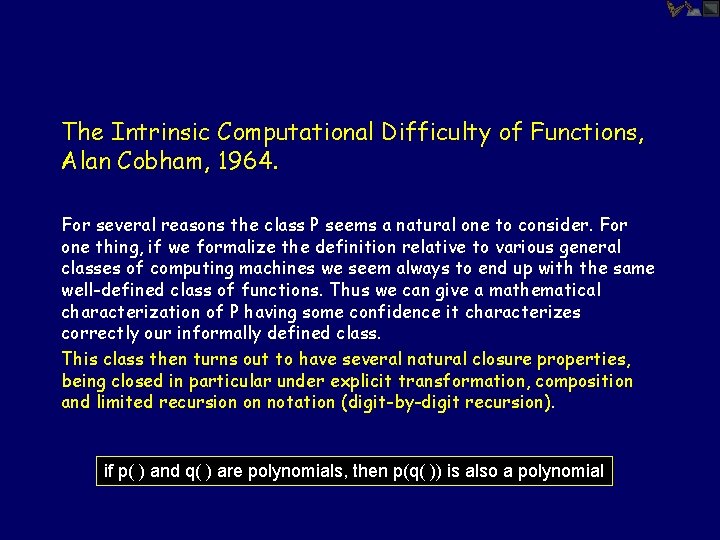
The class P defined in the 50’s. The Intrinsic Computational Difficulty of Functions, Alan Cobham, 1964. not the correct Alan Cobham Paths, Trees and Flowers, Jack Edmonds, 1965. this is indeed Jack Edmonds
Paths, Trees and Flowers, Jack Edmonds, 1965. An explanation is due on the use of the words "efficient algorithm"…I am not prepared to set up the machinery necessary to give it formal meaning, nor is the present context appropriate for doing this…For practical purposes the difference between algebraic and exponential order is more crucial than the difference between [computable and not computable]… It would be unfortunate for any rigid criterion to inhibit the practical development of algorithms which are either not known or known not to conform nicely to the criterion… However, if only to motivate the search for good, practical algorithms, it is important to realize that it is mathematically sensible even to question their existence. Edmonds called them “good algorithms”
The Intrinsic Computational Difficulty of Functions, Alan Cobham, 1964. For several reasons the class P seems a natural one to consider. For one thing, if we formalize the definition relative to various general classes of computing machines we seem always to end up with the same well-defined class of functions. Thus we can give a mathematical characterization of P having some confidence it characterizes correctly our informally defined class. This class then turns out to have several natural closure properties, being closed in particular under explicit transformation, composition and limited recursion on notation (digit-by-digit recursion). if p( ) and q( ) are polynomials, then p(q( )) is also a polynomial
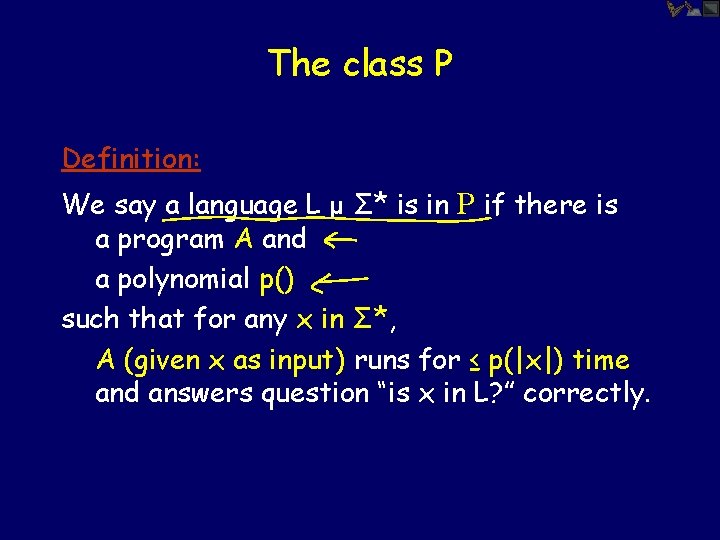
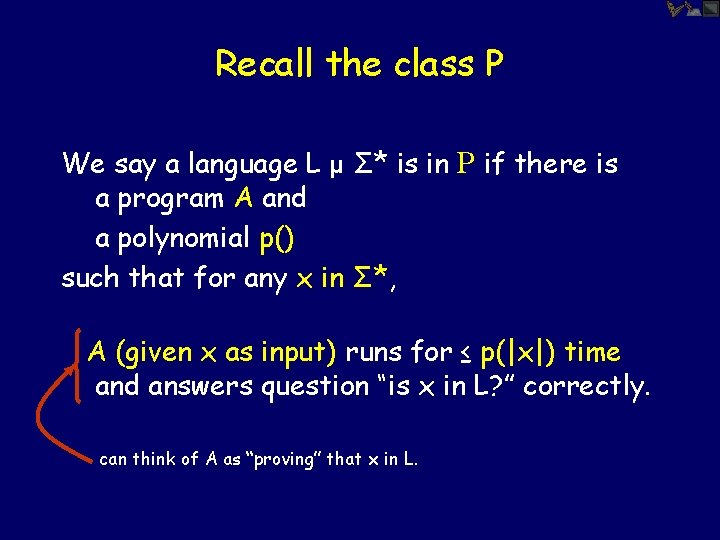
The class P Definition: We say a language L µ Σ* is in P if there is a program A and a polynomial p() such that for any x in Σ*, A (given x as input) runs for ≤ p(|x|) time and answers question “is x in L? ” correctly.
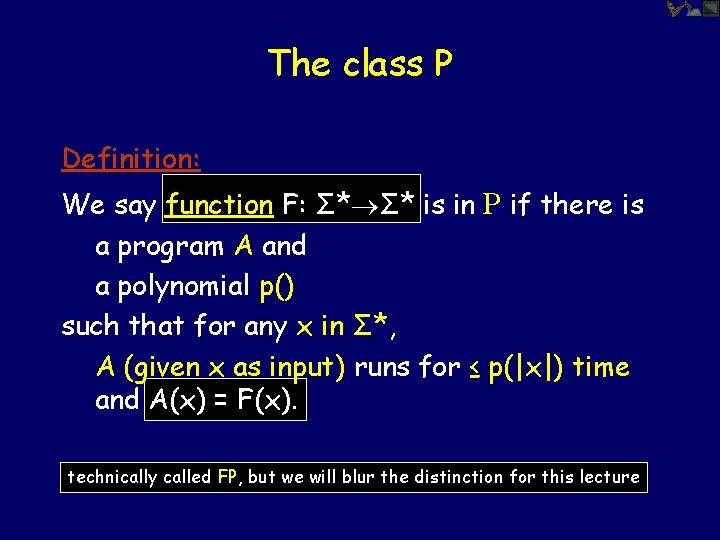
The class P Definition: We say function F: Σ* Σ* is in P if there is a program A and a polynomial p() such that for any x in Σ*, A (given x as input) runs for ≤ p(|x|) time and A(x) = F(x). technically called FP, but we will blur the distinction for this lecture
The class P The set of all languages L that can be recognized in polynomial time. The set of functions that can be computed in polynomial time.
Why are we looking only at languages Σ*? What if we want to work with graphs or boolean formulas?
Requiring that L Σ* is not really restrictive, since we can encode graphs and Boolean formulas as strings of 0’s and 1’s. In fact, we do this all the time: inputs for all our programs are just sequences of 0’s and 1’s encoded in some suitable format.
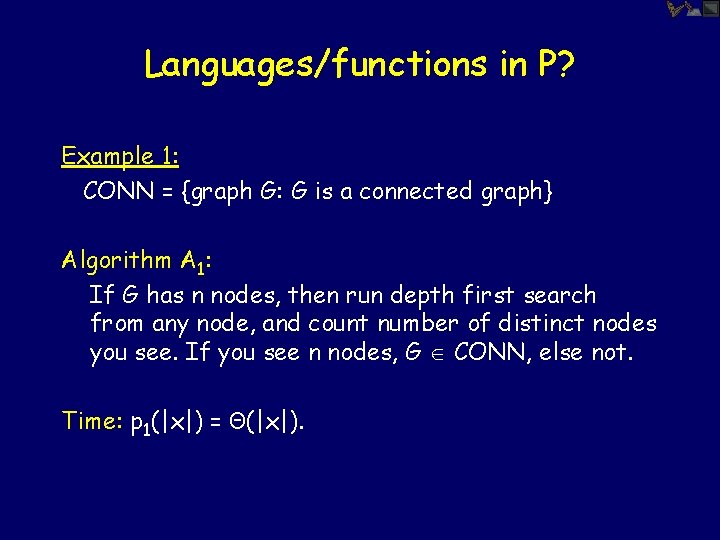
Languages/functions in P? Example 1: CONN = {graph G: G is a connected graph} Algorithm A 1: If G has n nodes, then run depth first search from any node, and count number of distinct nodes you see. If you see n nodes, G CONN, else not. Time: p 1(|x|) = Θ(|x|).
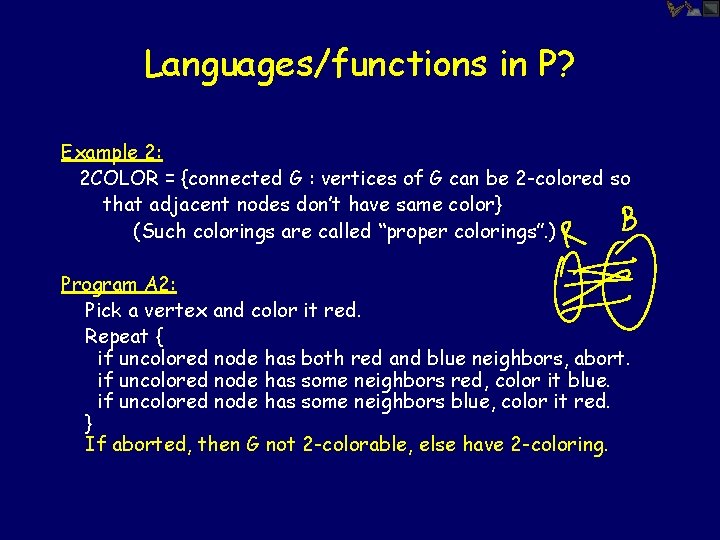
Languages/functions in P? Example 2: 2 COLOR = {connected G : vertices of G can be 2 -colored so that adjacent nodes don’t have same color} (Such colorings are called “proper colorings”. ) Program A 2: Pick a vertex and color it red. Repeat { if uncolored node has both red and blue neighbors, abort. if uncolored node has some neighbors red, color it blue. if uncolored node has some neighbors blue, color it red. } If aborted, then G not 2 -colorable, else have 2 -coloring.
Languages/functions in P? Example 3: 3 COLOR = {G : vertices of G can be 3 -colored} N T O N K W O ! N
Languages/functions in P? And now a problem for Boolean circuits C:
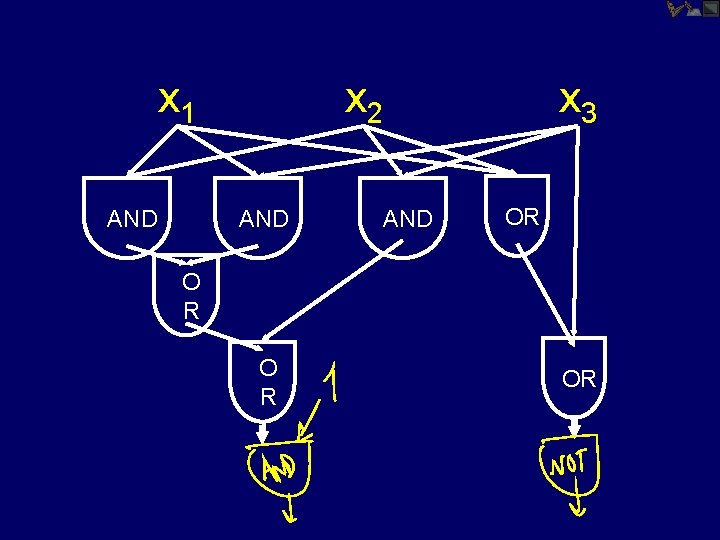
Languages/functions in P? And, now a problem dealing with Combinational Circuits: AND, OR, NOT, 0, 1 gates wired together with no feedback allowed.
x 1 AND x 2 AND x 3 AND OR O R OR
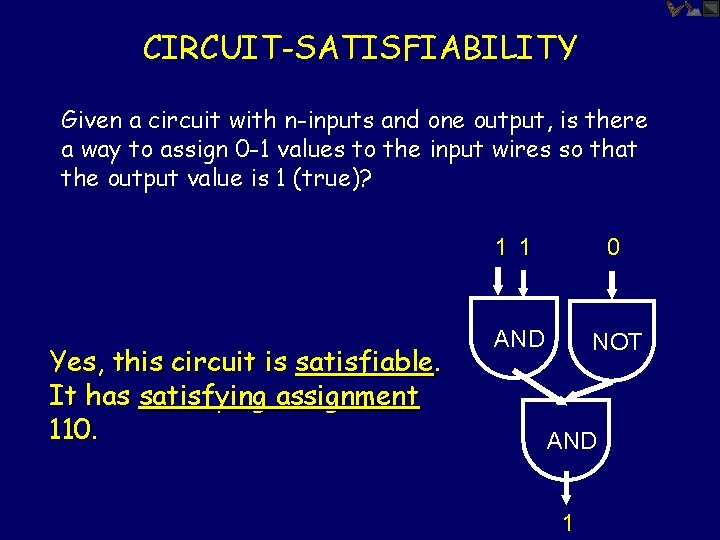
CIRCUIT-SATISFIABILITY Given a circuit with n-inputs and one output, is there a way to assign 0 -1 values to the input wires so that the output value is 1 (true)? 1 1 Yes, this circuit is satisfiable. It has satisfying assignment 110. 0 AND NOT AND 1
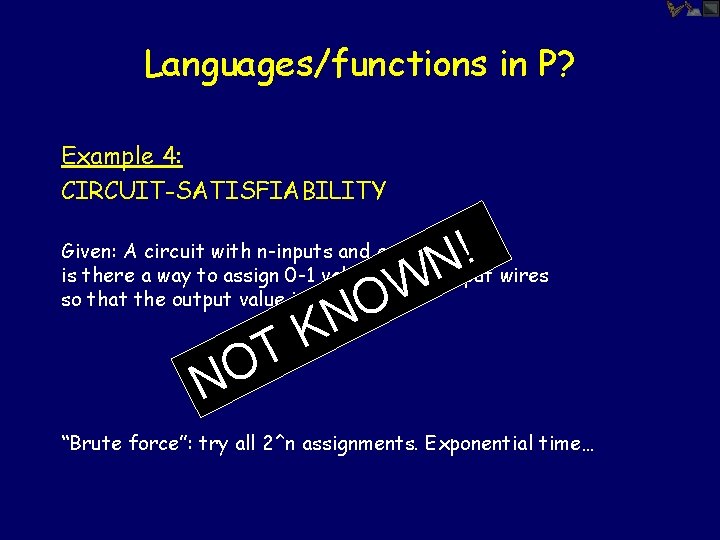
Languages/functions in P? Example 4: CIRCUIT-SATISFIABILITY ! N Given: A circuit with n-inputs and one output, is there a way to assign 0 -1 values to the input wires so that the output value is 1 (true)? T O N N K W O “Brute force”: try all 2^n assignments. Exponential time…
Onto the new class, NP
Recall the class P We say a language L µ Σ* is in P if there is a program A and a polynomial p() such that for any x in Σ*, A (given x as input) runs for ≤ p(|x|) time and answers question “is x in L? ” correctly. can think of A as “proving” that x in L.
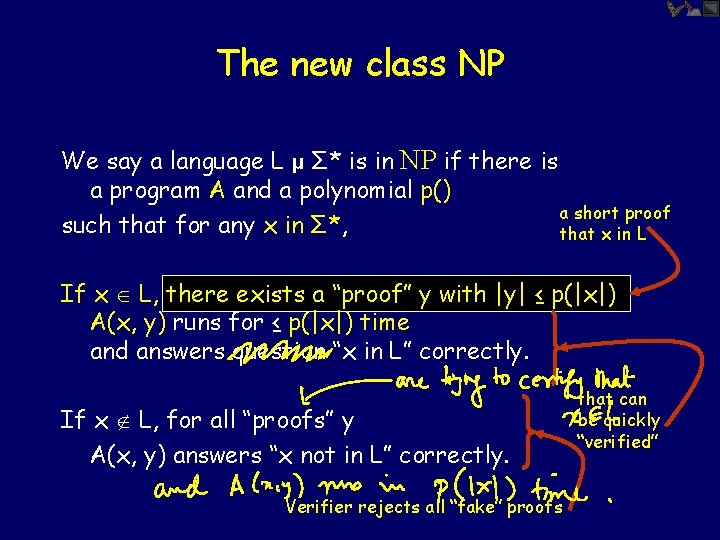
The new class NP We say a language L µ Σ* is in NP if there is a program A and a polynomial p() a short proof such that for any x in Σ*, that x in L If x L, there exists a “proof” y with |y| ≤ p(|x|) A(x, y) runs for ≤ p(|x|) time and answers question “x in L” correctly. If x L, for all “proofs” y A(x, y) answers “x not in L” correctly. Verifier rejects all “fake” proofs that can be quickly “verified”
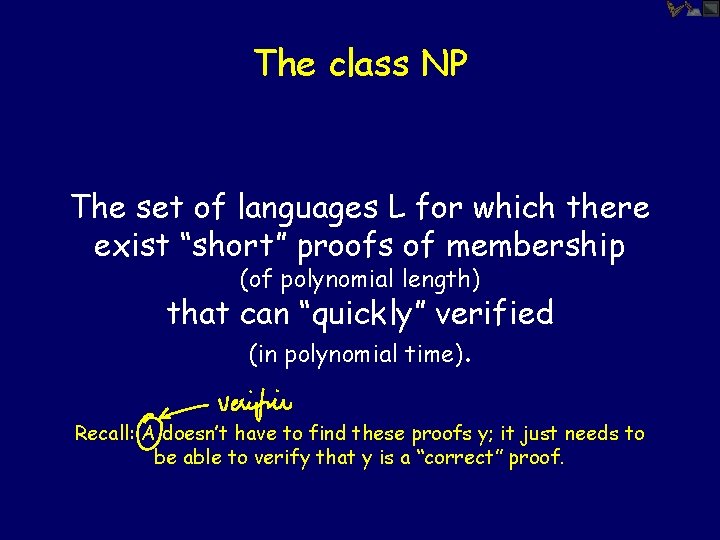
The class NP The set of languages L for which there exist “short” proofs of membership (of polynomial length) that can “quickly” verified (in polynomial time). Recall: A doesn’t have to find these proofs y; it just needs to be able to verify that y is a “correct” proof.
Which languages are in NP?
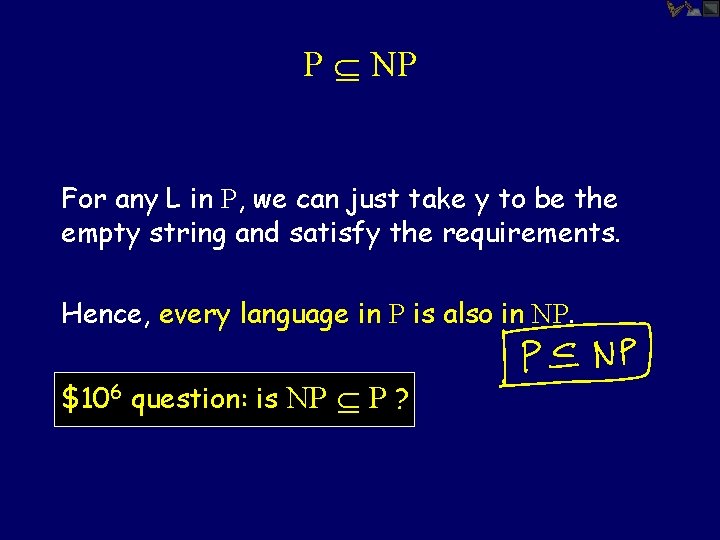
P NP For any L in P, we can just take y to be the empty string and satisfy the requirements. Hence, every language in P is also in NP. $106 question: is NP P ?
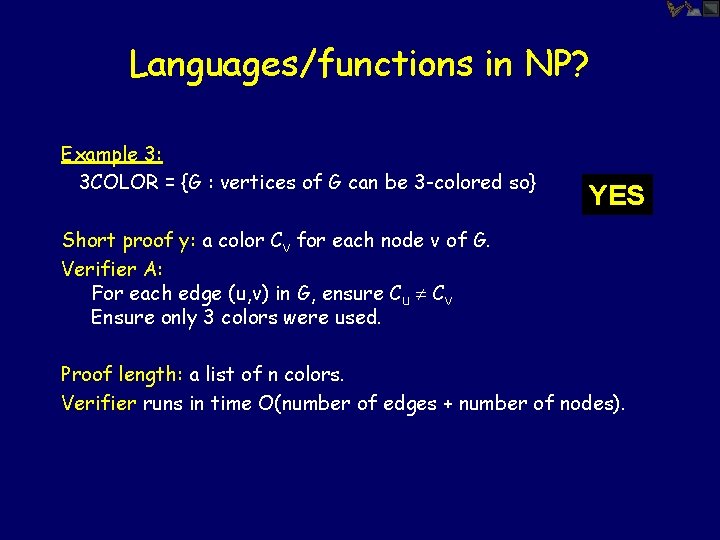
Languages/functions in NP? Example 3: 3 COLOR = {G : vertices of G can be 3 -colored so} YES Short proof y: a color Cv for each node v of G. Verifier A: For each edge (u, v) in G, ensure Cu Cv Ensure only 3 colors were used. Proof length: a list of n colors. Verifier runs in time O(number of edges + number of nodes).
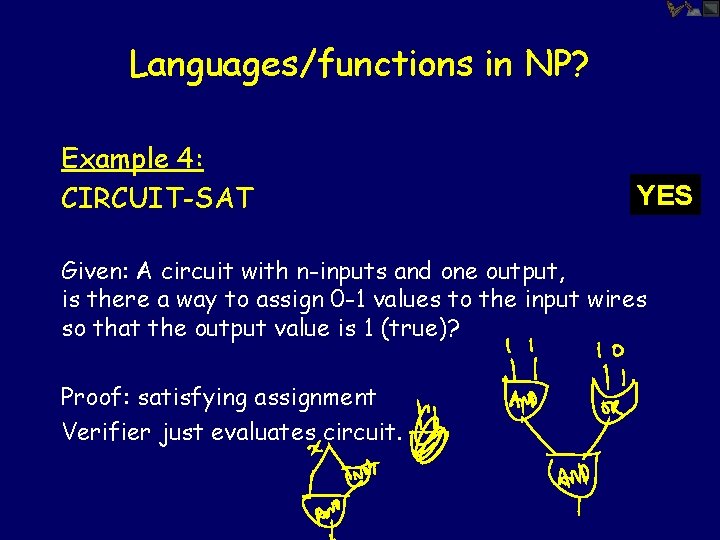
Languages/functions in NP? Example 4: CIRCUIT-SAT YES Given: A circuit with n-inputs and one output, is there a way to assign 0 -1 values to the input wires so that the output value is 1 (true)? Proof: satisfying assignment Verifier just evaluates circuit.
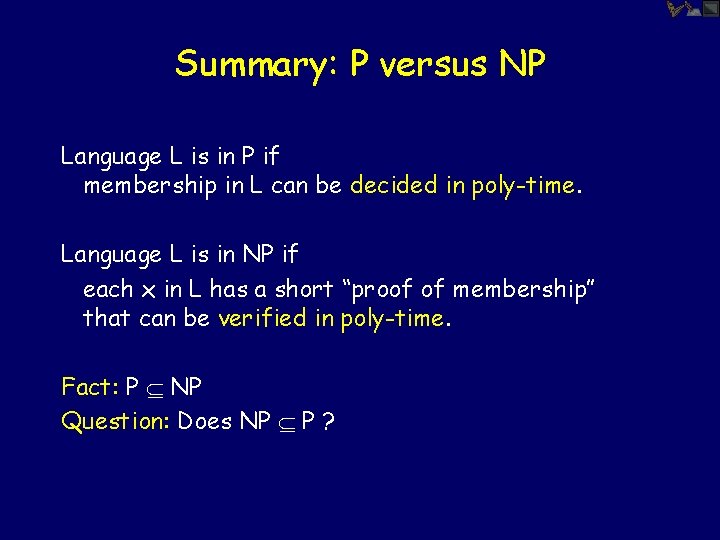
Summary: P versus NP Language L is in P if membership in L can be decided in poly-time. Language L is in NP if each x in L has a short “proof of membership” that can be verified in poly-time. Fact: P NP Question: Does NP P ?
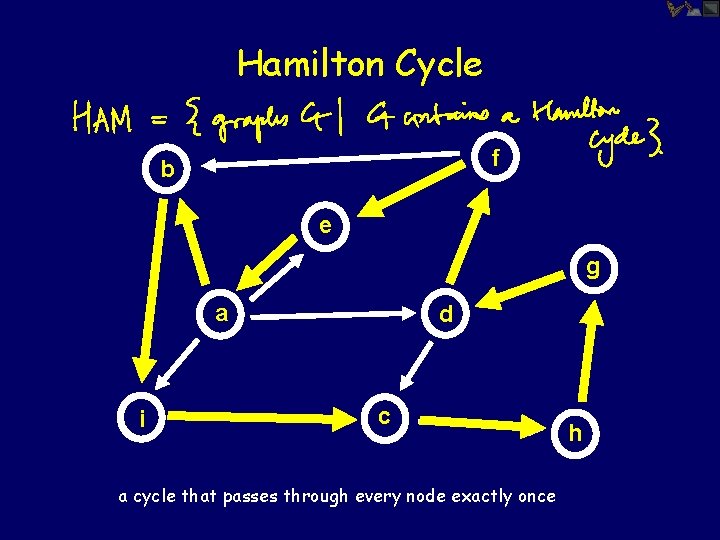
Hamilton Cycle f b e g a i d c a cycle that passes through every node exactly once h
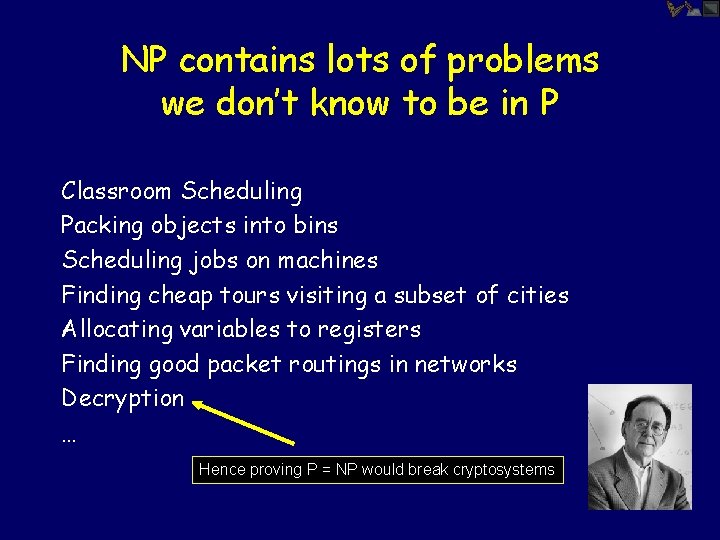
NP contains lots of problems we don’t know to be in P Classroom Scheduling Packing objects into bins Scheduling jobs on machines Finding cheap tours visiting a subset of cities Allocating variables to registers Finding good packet routings in networks Decryption … Hence proving P = NP would break cryptosystems
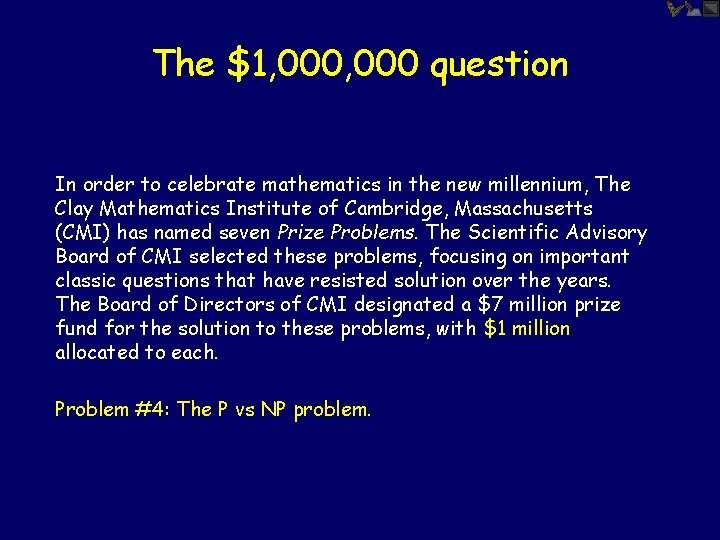
The $1, 000 question In order to celebrate mathematics in the new millennium, The Clay Mathematics Institute of Cambridge, Massachusetts (CMI) has named seven Prize Problems. The Scientific Advisory Board of CMI selected these problems, focusing on important classic questions that have resisted solution over the years. The Board of Directors of CMI designated a $7 million prize fund for the solution to these problems, with $1 million allocated to each. Problem #4: The P vs NP problem.
How can we prove that NP P? I would have to show that every language in NP has a polynomial time algorithm… How do I do that? It may take forever! Also, what if I forgot one of the languages in NP?
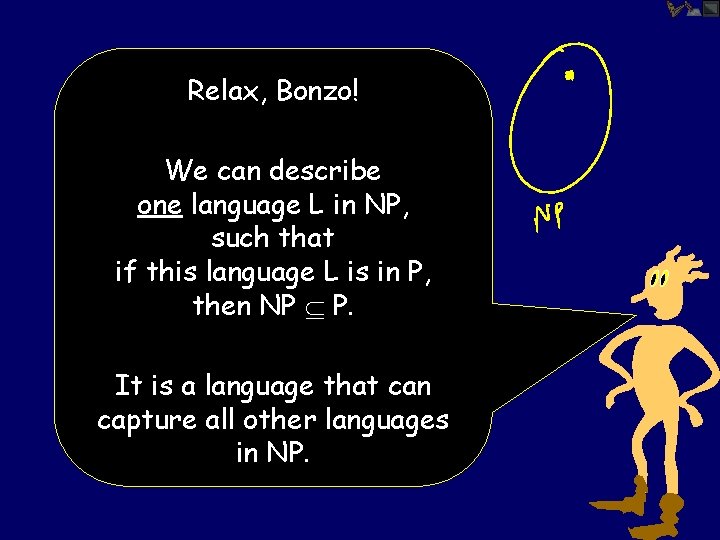
Relax, Bonzo! We can describe one language L in NP, such that if this language L is in P, then NP P. It is a language that can capture all other languages in NP.
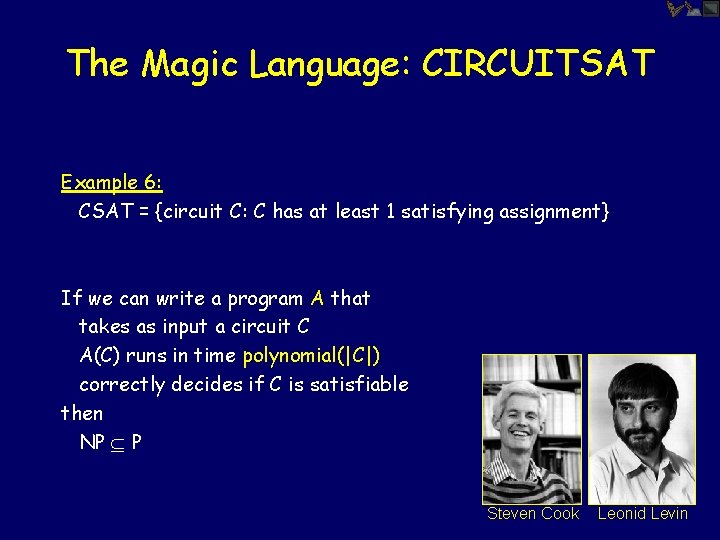
The Magic Language: CIRCUITSAT Example 6: CSAT = {circuit C: C has at least 1 satisfying assignment} If we can write a program A that takes as input a circuit C A(C) runs in time polynomial(|C|) correctly decides if C is satisfiable then NP P Steven Cook Leonid Levin
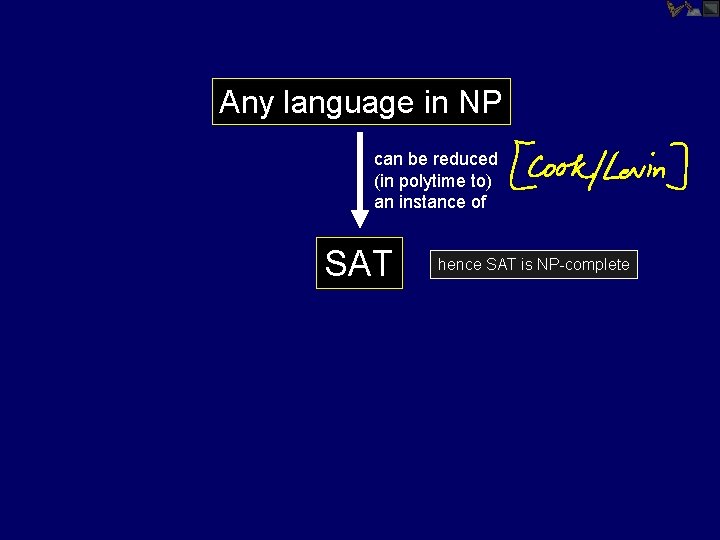
Theorem [Cook/Levin]: CIRCUITSAT is one language in NP, such that if we can show CIRCUITSAT is in P, then we have shown NP P. CIRCUITSAT is a language in NP that can capture all other languages in NP. We say CIRCUITSAT is NP-complete. Proof not difficult, but we defer the proof to 15 -451 (Algos) or 15 -453 (FLAC)
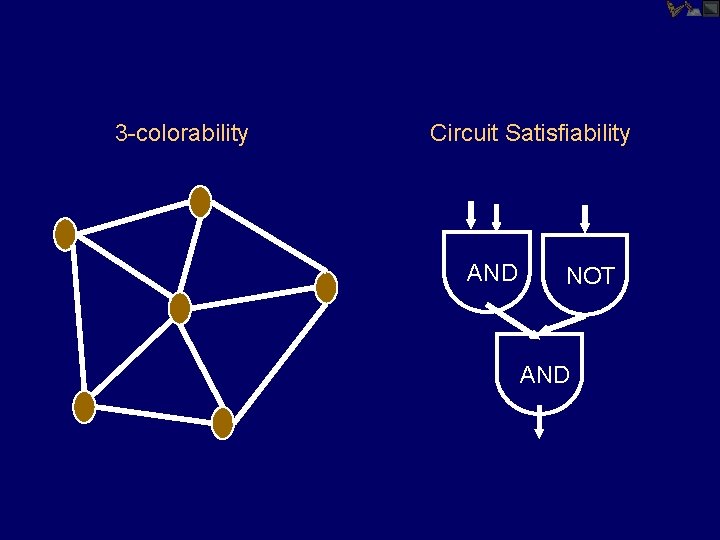
3 -colorability Circuit Satisfiability AND NOT AND
CIRCUIT-SAT and 3 COLOR Two problems that seem quite different, but are substantially the same
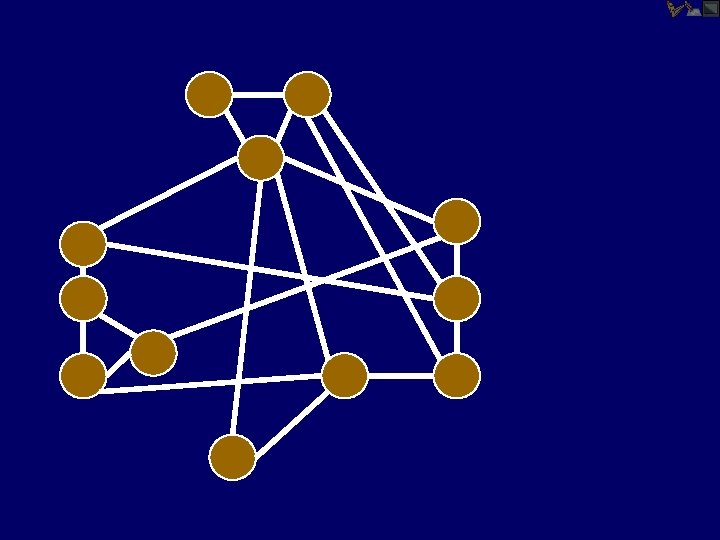
A Graph Named “Gadget”
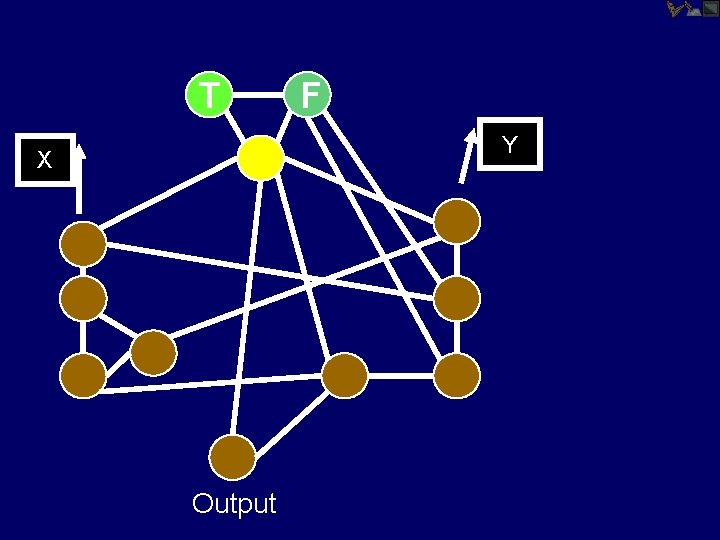
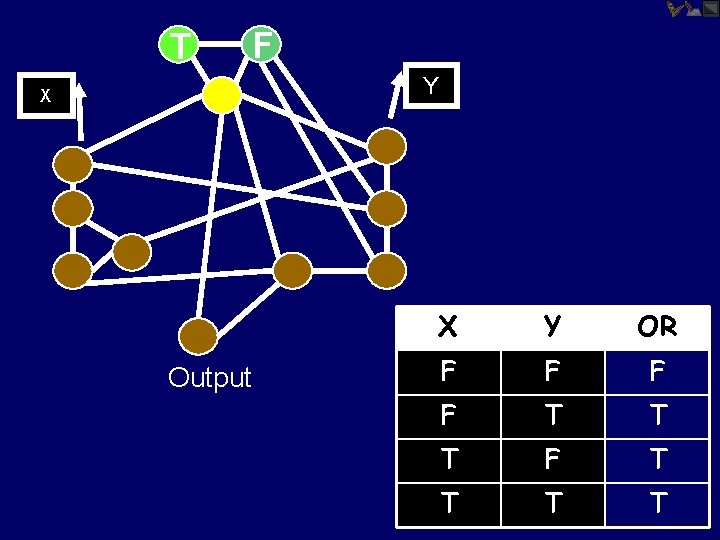
T F Y X Output
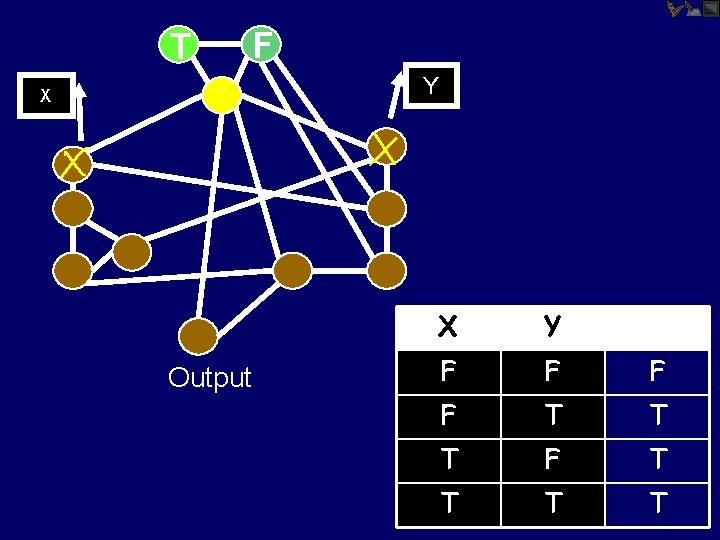
T F Y X Output X Y F F T T T F T T
T F Y X Output X Y OR F F T T T F T T
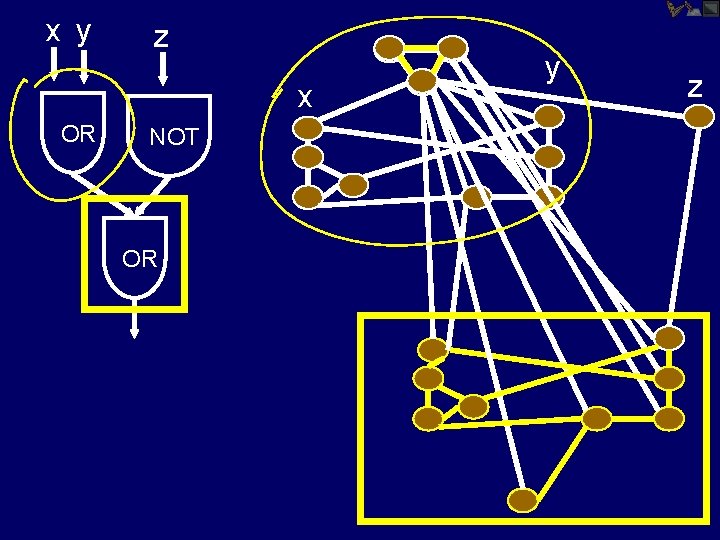
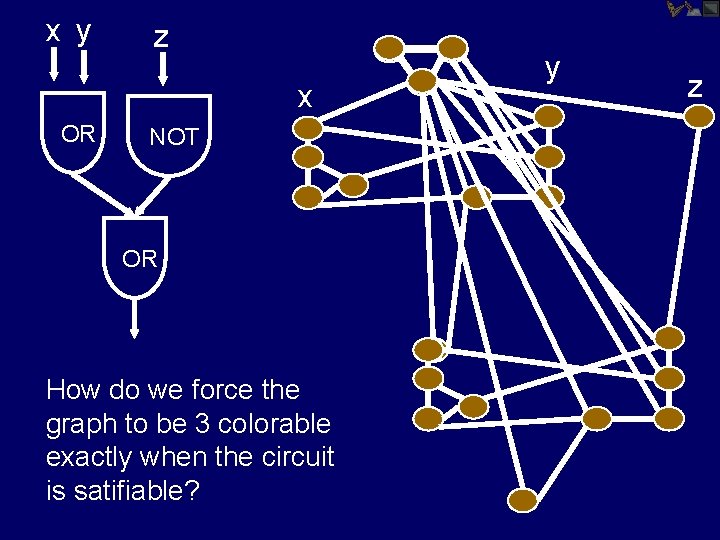
x y z x OR NOT OR y z
x y z x OR NOT OR How do we force the graph to be 3 colorable exactly when the circuit is satifiable? y z
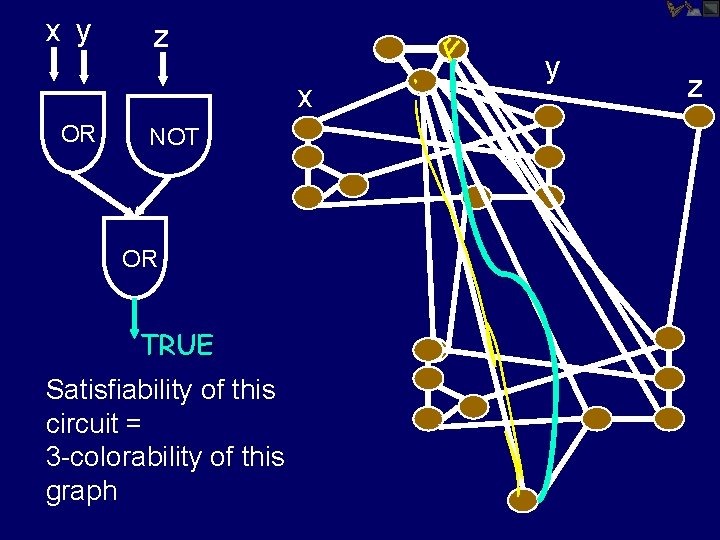
x y z x OR NOT OR TRUE Satisfiability of this circuit = 3 -colorability of this graph y z
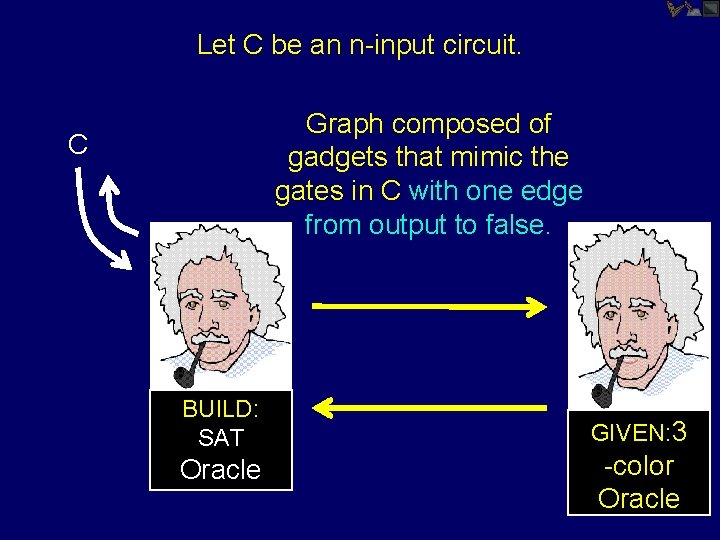
Let C be an n-input circuit. Graph composed of gadgets that mimic the gates in C with one edge from output to false. C BUILD: SAT Oracle GIVEN: 3 -color Oracle
You can quickly transform a method to decide 3 -coloring into a method to decide circuit satifiability!
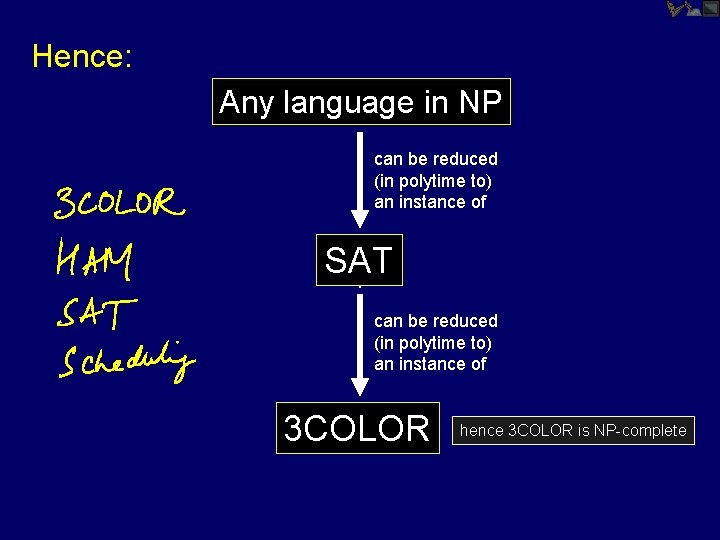
Any language in NP can be reduced (in polytime to) an instance of SAT hence SAT is NP-complete
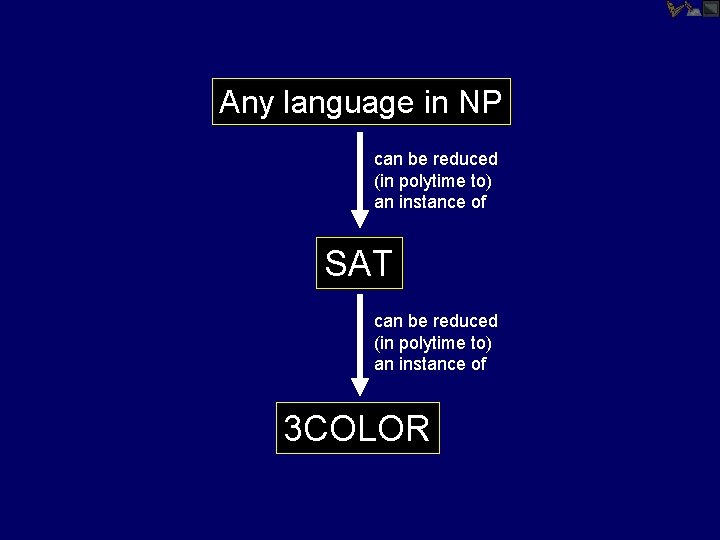
Any language in NP can be reduced (in polytime to) an instance of SAT can be reduced (in polytime to) an instance of 3 COLOR
Hence: Any language in NP can be reduced (in polytime to) an instance of SAT can be reduced (in polytime to) an instance of 3 COLOR hence 3 COLOR is NP-complete
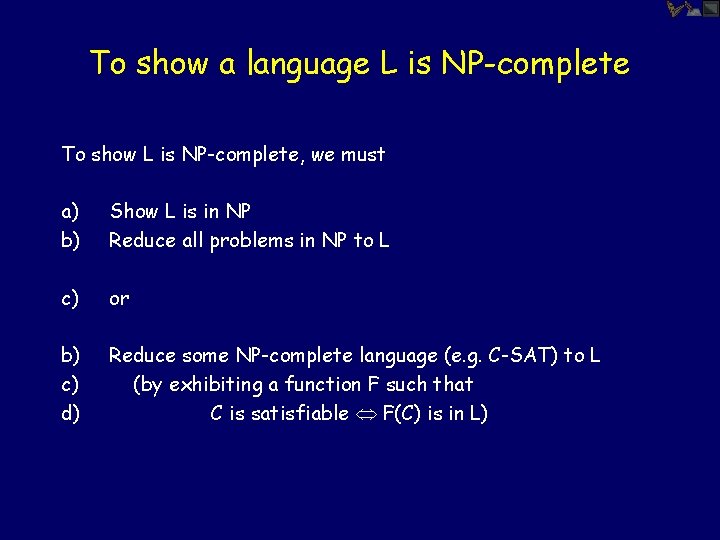
To show a language L is NP-complete To show L is NP-complete, we must a) b) Show L is in NP Reduce all problems in NP to L c) or b) c) d) Reduce some NP-complete language (e. g. C-SAT) to L (by exhibiting a function F such that C is satisfiable F(C) is in L)
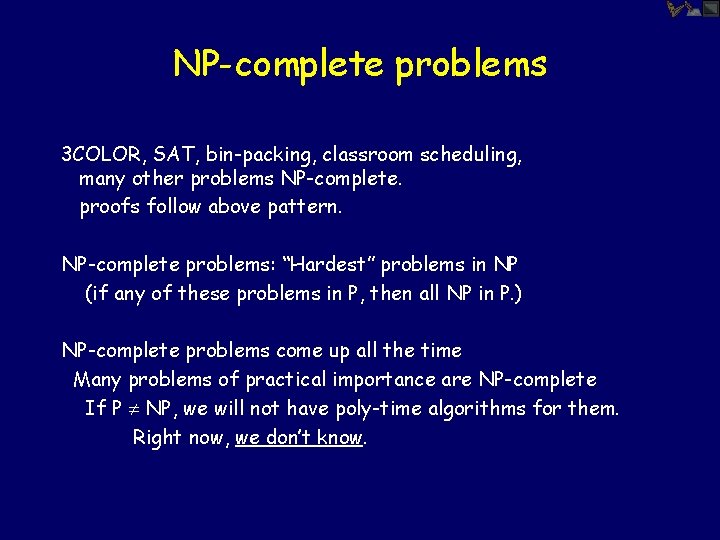
NP-complete problems 3 COLOR, SAT, bin-packing, classroom scheduling, many other problems NP-complete. proofs follow above pattern. NP-complete problems: “Hardest” problems in NP (if any of these problems in P, then all NP in P. ) NP-complete problems come up all the time Many problems of practical importance are NP-complete If P NP, we will not have poly-time algorithms for them. Right now, we don’t know.
Reference Computers and Intractablity: A guide to the Theory of NP-completeness by Mike Garey and David Johnson
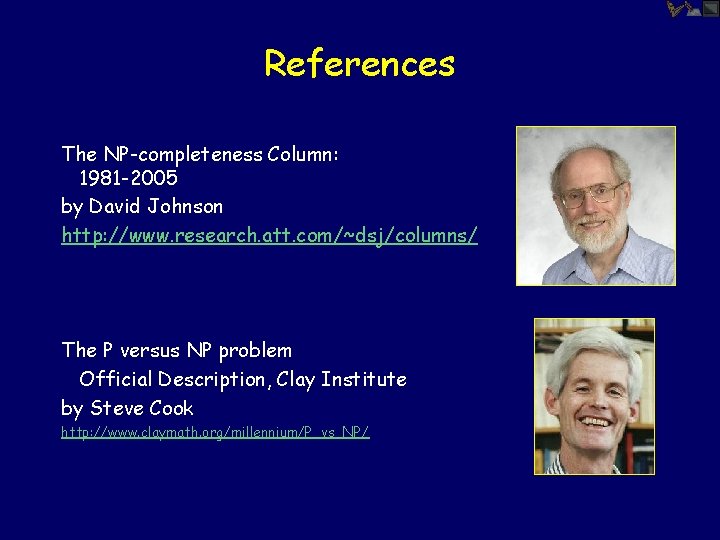
References The NP-completeness Column: 1981 -2005 by David Johnson http: //www. research. att. com/~dsj/columns/ The P versus NP problem Official Description, Clay Institute by Steve Cook http: //www. claymath. org/millennium/P_vs_NP/