
GREAT Registry of Abdominal and Thoracic Aortic Devices
GREAT Registry of Abdominal and Thoracic Aortic Devices Robert M. Bersin, MD, MPH
Robert Bersin, MD I have no relevant financial relationships
GREAT Global Registry for Endovascular Aortic Treatment § International, multicenter (114 sites), prospective registry designed to capture data on all commercially available Gore aortic endografts § Includes both on-label and off-label use of any of these devices § Designed to capture serious adverse events as defined by ISO 14155: 2009 Clinical investigation of medical devices for human subjects – Good Clinical Practice § Collects patient data on all pathologies treated with any Gore Aortic endovascular device § Minimal inclusion and exclusion criteria for enrollment in order to capture real world clinical practice § No protocol mandated follow up schedule
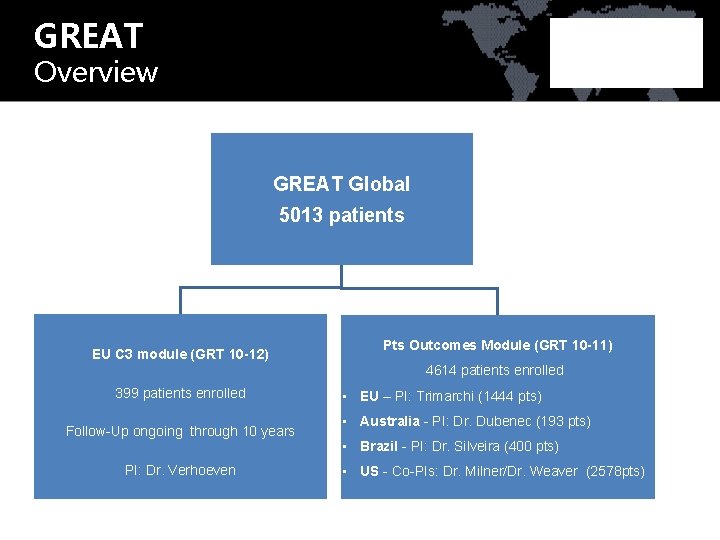
GREAT Overview GREAT Global 5013 patients EU C 3 module (GRT 10 -12) Pts Outcomes Module (GRT 10 -11) 4614 patients enrolled 399 patients enrolled Follow-Up ongoing through 10 years PI: Dr. Verhoeven • EU – PI: Trimarchi (1444 pts) • Australia - PI: Dr. Dubenec (193 pts) • Brazil - PI: Dr. Silveira (400 pts) • US - Co-PIs: Dr. Milner/Dr. Weaver (2578 pts)
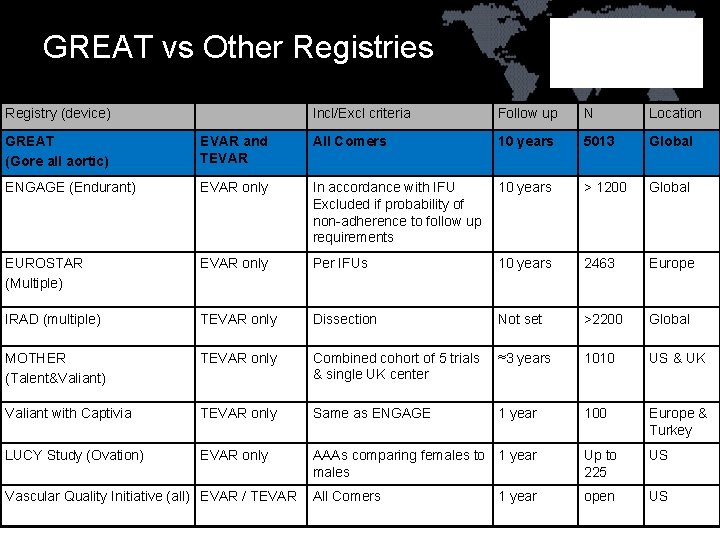
GREAT vs Other Registries Registry (device) Incl/Excl criteria Follow up N Location 10 years 5013 Global GREAT (Gore all aortic) EVAR and TEVAR All Comers ENGAGE (Endurant) EVAR only In accordance with IFU 10 years Excluded if probability of non-adherence to follow up requirements > 1200 Global EUROSTAR (Multiple) EVAR only Per IFUs 10 years 2463 Europe IRAD (multiple) TEVAR only Dissection Not set >2200 Global MOTHER (Talent&Valiant) TEVAR only Combined cohort of 5 trials & single UK center ≈3 years 1010 US & UK Valiant with Captivia TEVAR only Same as ENGAGE 1 year 100 Europe & Turkey LUCY Study (Ovation) EVAR only AAAs comparing females to 1 year males Up to 225 US All Comers open US Vascular Quality Initiative (all) EVAR / TEVAR 1 year
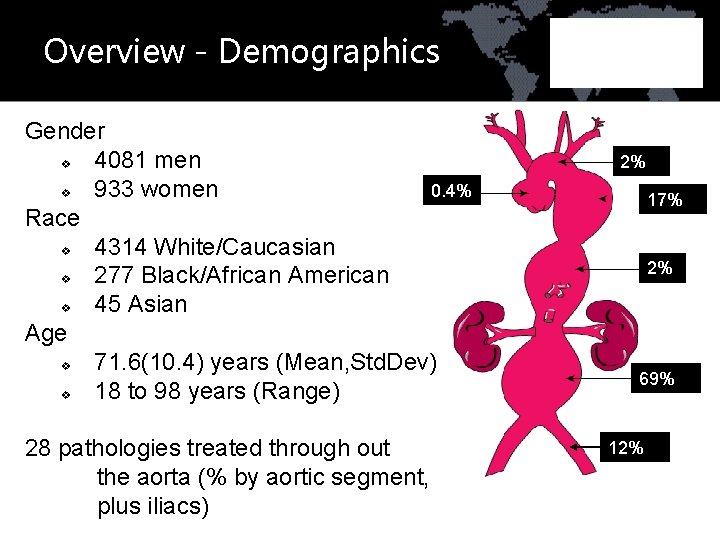
Overview - Demographics Gender v 4081 men 0. 4% v 933 women Race v 4314 White/Caucasian v 277 Black/African American v 45 Asian Age v 71. 6(10. 4) years (Mean, Std. Dev) v 18 to 98 years (Range) 28 pathologies treated through out the aorta (% by aortic segment, plus iliacs) 2% 17% 2% 69% 12%
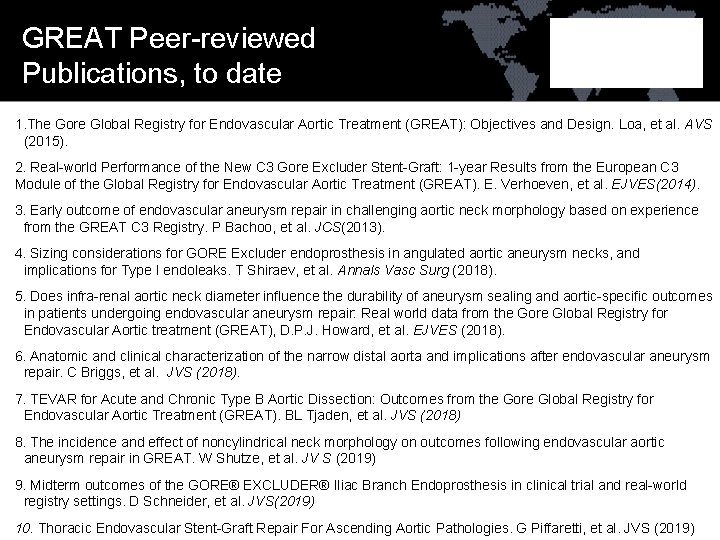
GREAT Peer-reviewed Publications, to date 1. The Gore Global Registry for Endovascular Aortic Treatment (GREAT): Objectives and Design. Loa, et al. AVS (2015). 2. Real-world Performance of the New C 3 Gore Excluder Stent-Graft: 1 -year Results from the European C 3 Module of the Global Registry for Endovascular Aortic Treatment (GREAT). E. Verhoeven, et al. EJVES(2014). 3. Early outcome of endovascular aneurysm repair in challenging aortic neck morphology based on experience from the GREAT C 3 Registry. P Bachoo, et al. JCS(2013). 4. Sizing considerations for GORE Excluder endoprosthesis in angulated aortic aneurysm necks, and implications for Type I endoleaks. T Shiraev, et al. Annals Vasc Surg (2018). 5. Does infra-renal aortic neck diameter influence the durability of aneurysm sealing and aortic-specific outcomes in patients undergoing endovascular aneurysm repair: Real world data from the Gore Global Registry for Endovascular Aortic treatment (GREAT), D. P. J. Howard, et al. EJVES (2018). 6. Anatomic and clinical characterization of the narrow distal aorta and implications after endovascular aneurysm repair. C Briggs, et al. JVS (2018). 7. TEVAR for Acute and Chronic Type B Aortic Dissection: Outcomes from the Gore Global Registry for Endovascular Aortic Treatment (GREAT). BL Tjaden, et al. JVS (2018) 8. The incidence and effect of noncylindrical neck morphology on outcomes following endovascular aortic aneurysm repair in GREAT. W Shutze, et al. JV S (2019) 9. Midterm outcomes of the GORE® EXCLUDER® Iliac Branch Endoprosthesis in clinical trial and real-world registry settings. D Schneider, et al. JVS(2019) 10. Thoracic Endovascular Stent-Graft Repair For Ascending Aortic Pathologies. G Piffaretti, et al. JVS (2019)
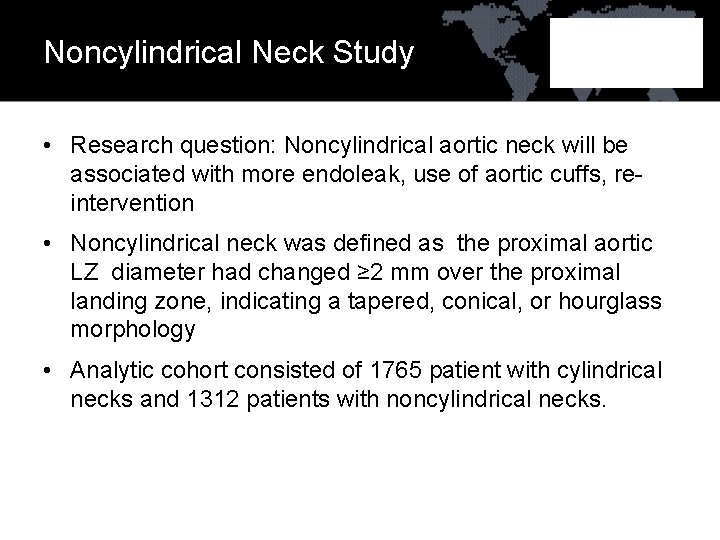
Noncylindrical Neck Study • Research question: Noncylindrical aortic neck will be associated with more endoleak, use of aortic cuffs, reintervention • Noncylindrical neck was defined as the proximal aortic LZ diameter had changed ≥ 2 mm over the proximal landing zone, indicating a tapered, conical, or hourglass morphology • Analytic cohort consisted of 1765 patient with cylindrical necks and 1312 patients with noncylindrical necks.
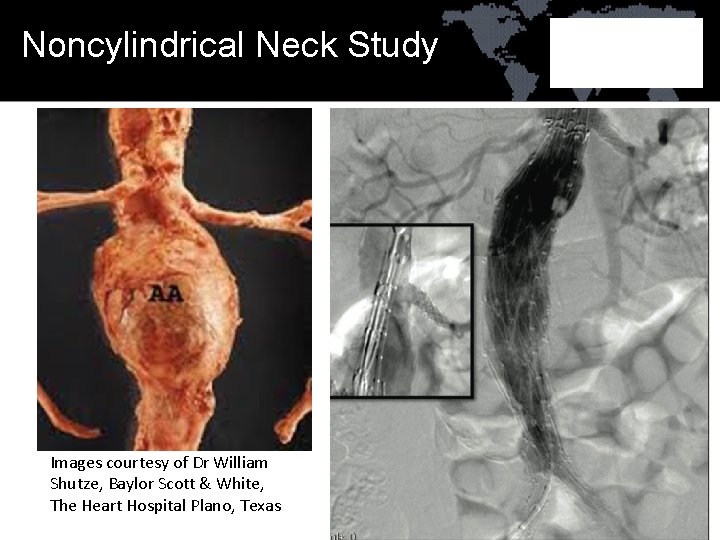
Noncylindrical Neck Study Images courtesy of Dr William Shutze, Baylor Scott & White, The Heart Hospital Plano, Texas
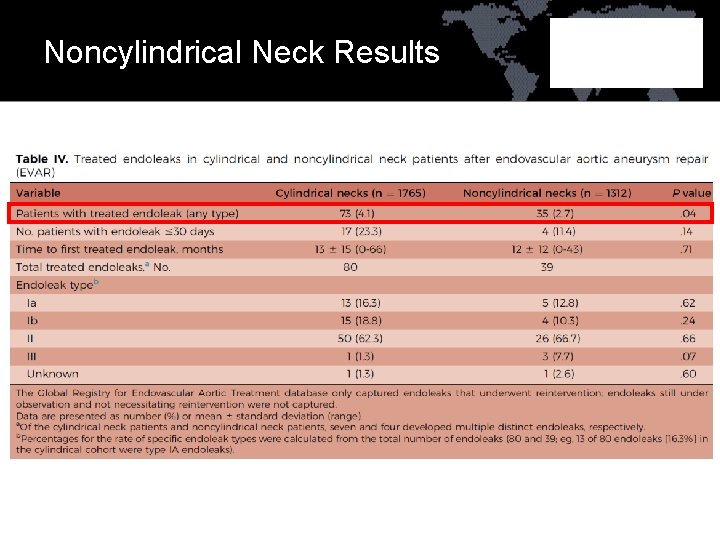
Noncylindrical Neck Results
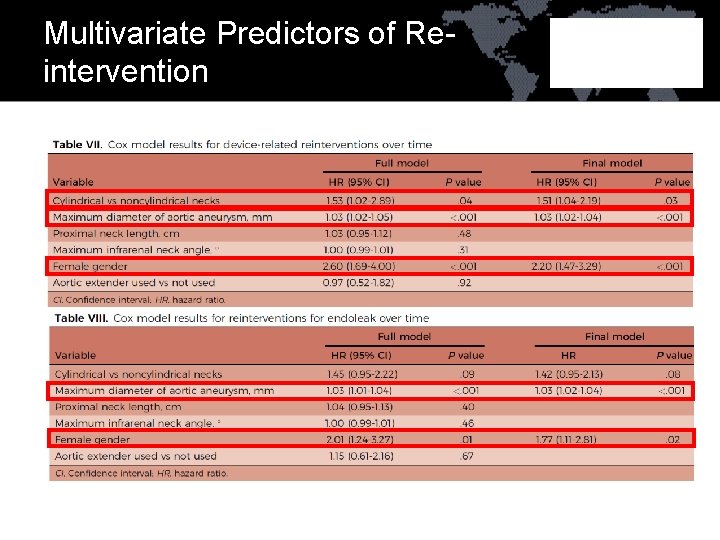
Multivariate Predictors of Reintervention
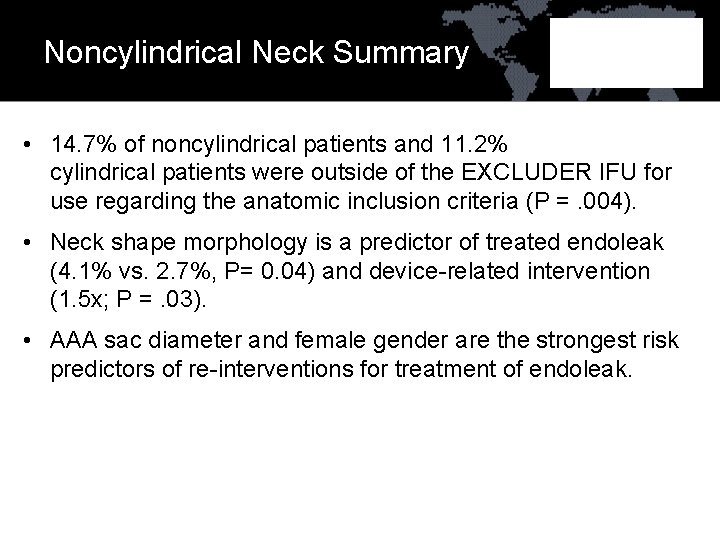
Noncylindrical Neck Summary • 14. 7% of noncylindrical patients and 11. 2% cylindrical patients were outside of the EXCLUDER IFU for use regarding the anatomic inclusion criteria (P =. 004). • Neck shape morphology is a predictor of treated endoleak (4. 1% vs. 2. 7%, P= 0. 04) and device-related intervention (1. 5 x; P =. 03). • AAA sac diameter and female gender are the strongest risk predictors of re-interventions for treatment of endoleak.
Narrow Aortic Body Study • 1 -year outcomes determining the effect of a narrow AOB (defined as <16 mm) , specifically whether narrow AOBs are associated with an increased rate of type II endoleaks and limb occlusions. • Narrow AOB (NB) patients mean aortic neck diameter = 12. 4 mm and Standard AOB (SB) patients mean aortic neck diameter = 25. 3 mm • NB patients had significantly smaller proximal neck diameters and were more often female with a more comorbidities
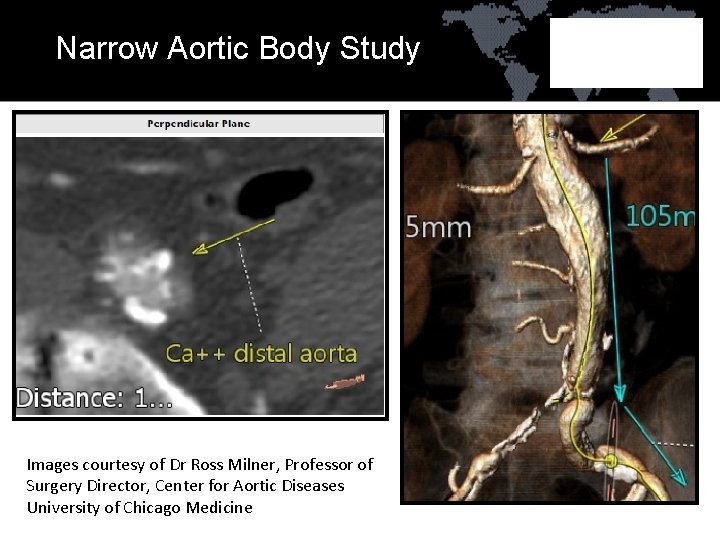
Narrow Aortic Body Study Images courtesy of Dr Ross Milner, Professor of Surgery Director, Center for Aortic Diseases University of Chicago Medicine
Narrow Aortic Body Results
Narrow Aortic Body Results
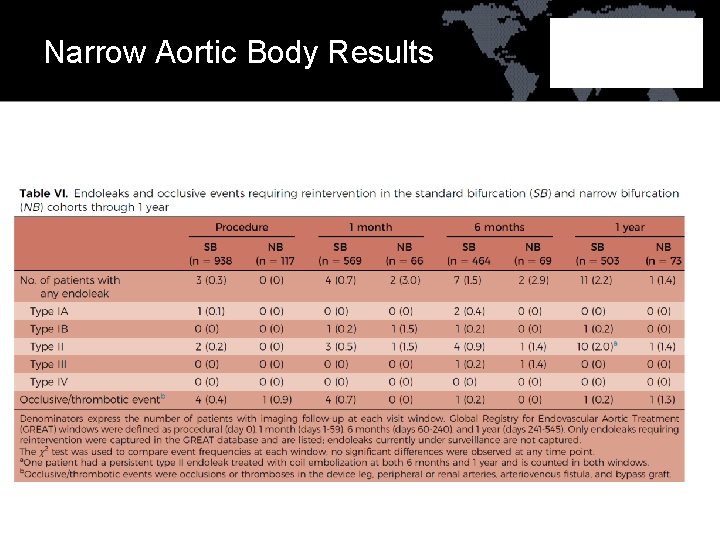
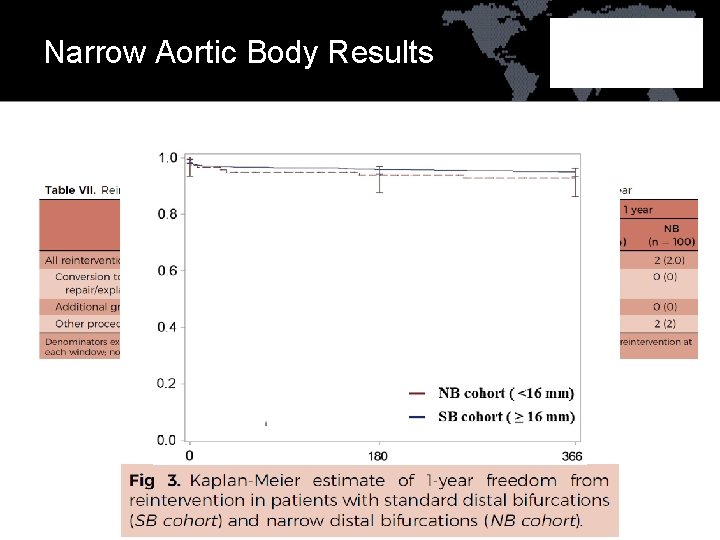
Narrow Aortic Body Summary • Narrow aortic bifurcation leads to increased lumbar collaterals • Anecdotally, increased rate of type 2 EL, suggests higher type 2 EL in NB patients • NB group were more often female and had a more severe comorbidity burden • 30 -day mortality and safety SAEs were similar • No statistical difference in endoleaks requiring reintervention and occlusive/thrombotic SAEs • Treatment with the EXCLUDER device in patients with narrow AOB with 1 -year outcomes comparable to those of patients with standard AOBs
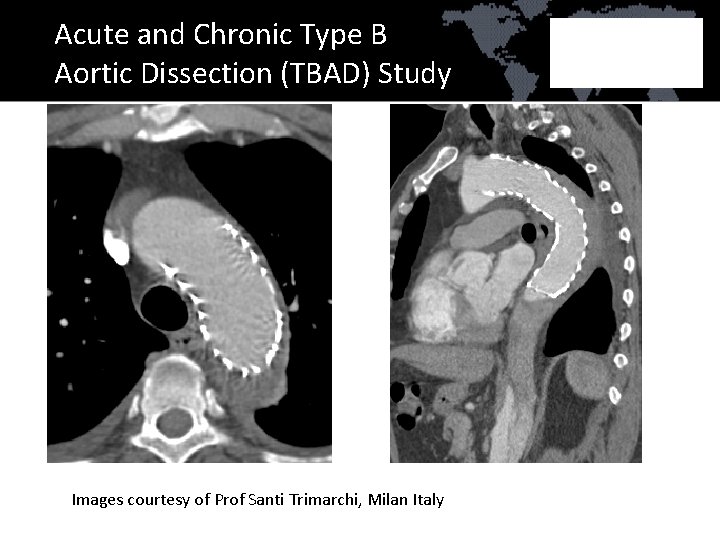
Acute and Chronic Type B Aortic Dissection (TBAD) Study Images courtesy of Prof Santi Trimarchi, Milan Italy
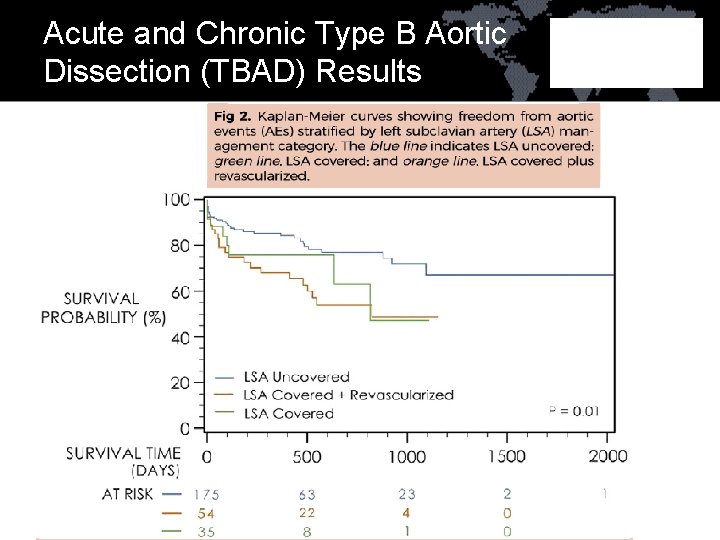
Acute and Chronic Type B Aortic Dissection (TBAD) Study Purpose was to examine real world results of TBAD patients treated with TEVAR and to determine factors predictive of adverse outcomes • N=264, chronic = 94 and acute = 170 • 100% procedural success • Median Length of Stay – 8 days • 9% of patients experienced at least one early postoperative complication at initial hospitalization for index TEVAR
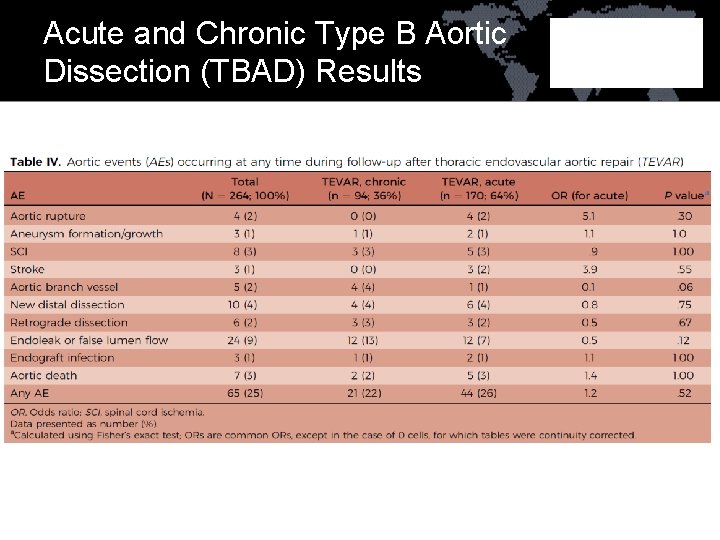
Acute and Chronic Type B Aortic Dissection (TBAD) Results
Acute and Chronic Type B Aortic Dissection (TBAD) Results
Acute and Chronic Type B Aortic Dissection (TBAD) Summary • TEVAR can be performed with low and equivalent perioperative complication rates for acute and chronic Type B dissection. • Postoperative aortic events are not uncommon, but seem to occur less frequently than reported in other series. • Retrograde dissection is rare, but associated with death in both the short and long term. • A proximal landing zone >40 mm has a higher risk for RTAD (18% vs 2%). • Coverage of the left subclavian artery is associated with increased rates of aortic events, but revascularization is associated with even higher rates. • Overall, patients with acute uncomplicated dissections appear to behave as a distinct entity after TEVAR, with significantly improved overall survival when compared to other categories of Type B dissections that are treated with TEVAR.
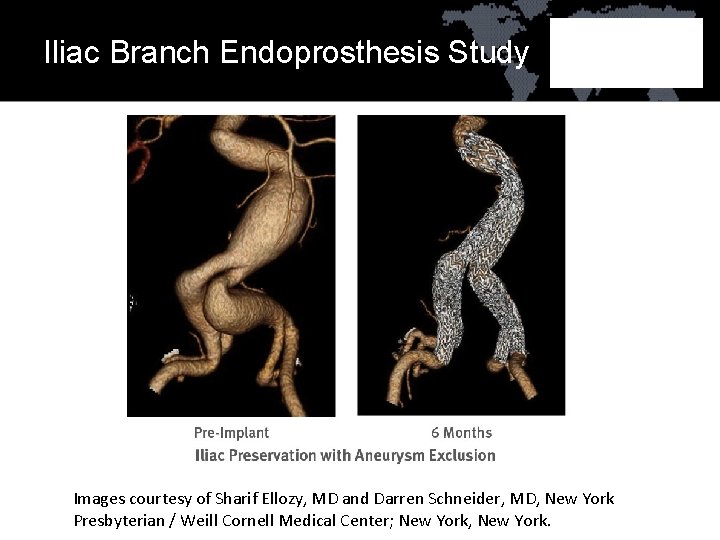
Iliac Branch Endoprosthesis Study Images courtesy of Sharif Ellozy, MD and Darren Schneider, MD, New York Presbyterian / Weill Cornell Medical Center; New York, New York.
Iliac Branch Endoprosthesis Study Purpose: Report midterm results of the IDE trial with both pivotal phase and continued access cohorts and to comparatively assess the clinical trial outcomes with real world outcomes from GREAT. US IDE pivotal (n=64), US IDE continued access (35), and GREAT (n=99) of which 28 were treated in US and 64 OUS. GREAT cohort was significantly smaller stature, lower weight, older, and had more females. GREAT cohort had 13 patients and US IDE had 4 patients with bilateral IBE treatment
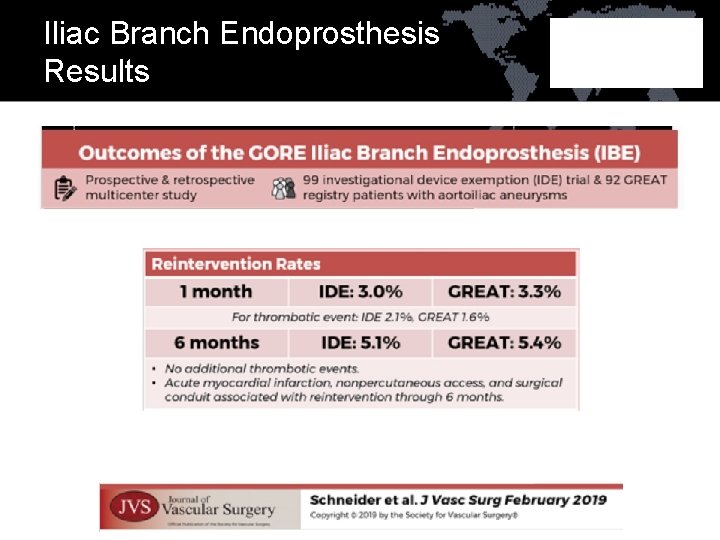
Iliac Branch Endoprosthesis Results
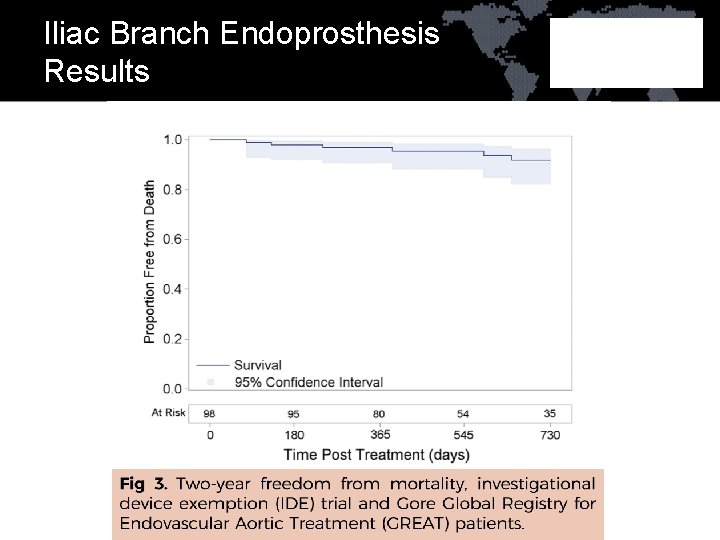
Iliac Branch Endoprosthesis Results
- Slides: 26