
Great Expectations Setting 19 th century England Background

Great Expectations Setting: 19 th century England
Background: England in the 1800 s • The 1800 s were a turbulent time in England. • Poverty and disease were rampant. • The legal system was unjust. • Many abuses • No rights for children • Money could solve any problem • Women had few legal rights. • If a divorce should occur, the husband received the children and any and all property or belongings of the wife, even if they were in her possession before the marriage.
Dickens’ Biography In Video
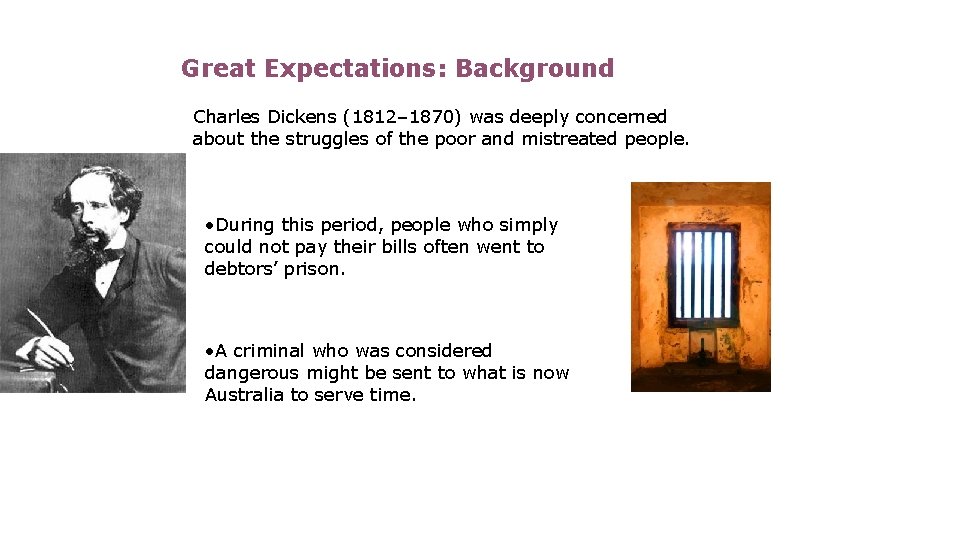
Great Expectations: Background Charles Dickens (1812– 1870) was deeply concerned about the struggles of the poor and mistreated people. • During this period, people who simply could not pay their bills often went to debtors’ prison. • A criminal who was considered dangerous might be sent to what is now Australia to serve time.
Great Expectations: Background In Dickens’s time, London was a rich city, but poor people lived in terrible squalor. • Children of those in debtors’ prison often had to support themselves. • A child might work up to sixteen hours a day. • Labor in a factory or work pulling a cart earned only pennies a day.
Great Expectations: Background Shortly before his own father was sent to debtors’ prison, twelve-year-old Charles was sent to work at a shoe polish factory. • Dickens’s unfinished autobiography describes the suffering he endured as a child laborer. • He worked long hours in a cramped room infested with rats.
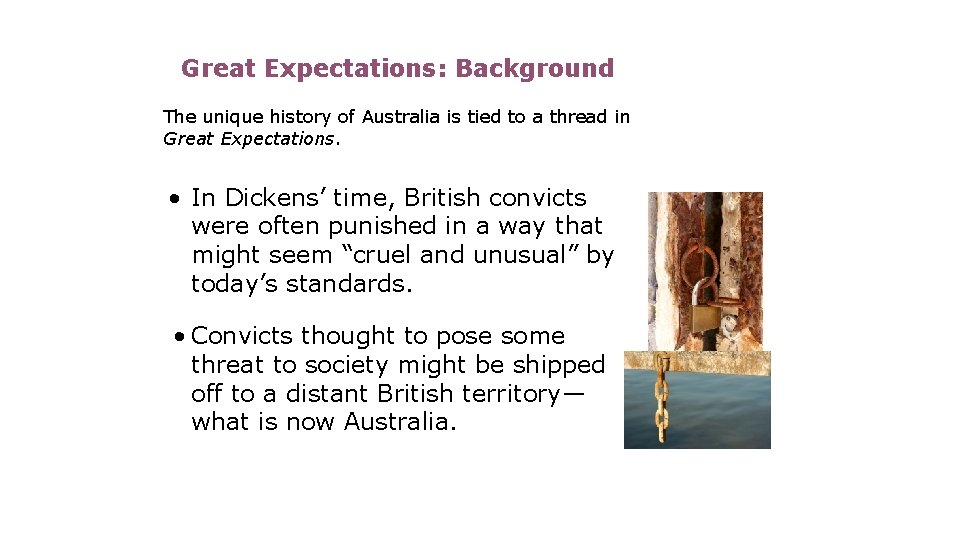
Great Expectations: Background The unique history of Australia is tied to a thread in Great Expectations. • In Dickens’ time, British convicts were often punished in a way that might seem “cruel and unusual” by today’s standards. • Convicts thought to pose some threat to society might be shipped off to a distant British territory— what is now Australia.
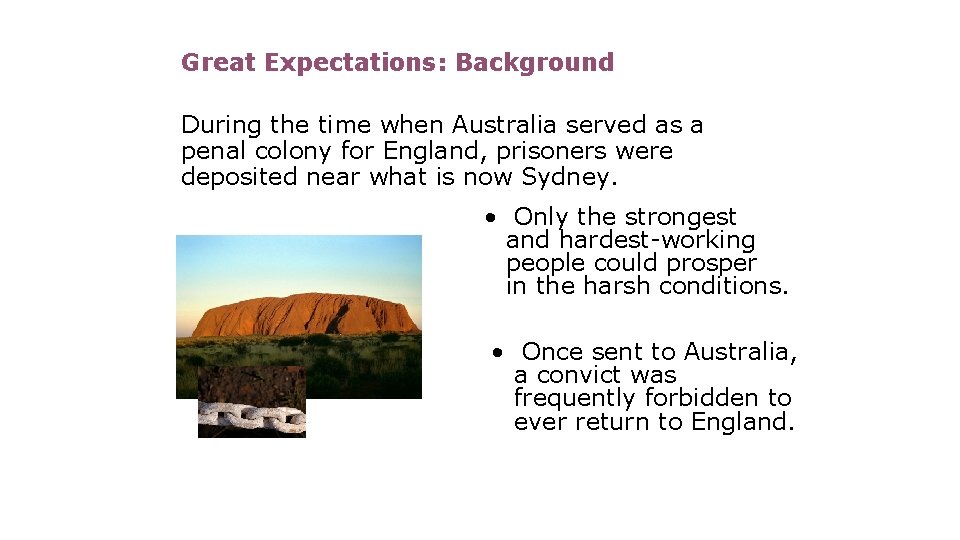
Great Expectations: Background During the time when Australia served as a penal colony for England, prisoners were deposited near what is now Sydney. • Only the strongest and hardest-working people could prosper in the harsh conditions. • Once sent to Australia, a convict was frequently forbidden to ever return to England.
Quick Notes on Great Expectations • Dickens wrote Great Expectations in two chapter, weekly installments in the publication All the Year Round from December 1860 to August 1861. • KEEP IN MIND: Dickens had to keep his audience wanting more…hence the mini cliff hangers at the end of the chapters! Reading this novel for people back then is the SAME THING as you watching your favorite TV show from week to week.
• Dickens spent hours and hours a day walking around the streets of London, fathering information for the ways of life. When we see London described in the novel, Dickens paints a true picture. • Dickens was also paid by the word as he wrote the novel. This explains his long and lengthy chapters!

GREAT EXPECTATIONS, THE NOVEL
Bildungsroman • Story is an example of a bildungsroman • A German word meaning “a novel of self-cultivation” • a novelistic form that concentrates on the development and growth of the protagonist usually from childhood to maturity • “Coming of age story” • The protagonist goes on a journey of some kind. • The novel ends with an understanding by the protagonist of himself/herself and his/her new place in the world.
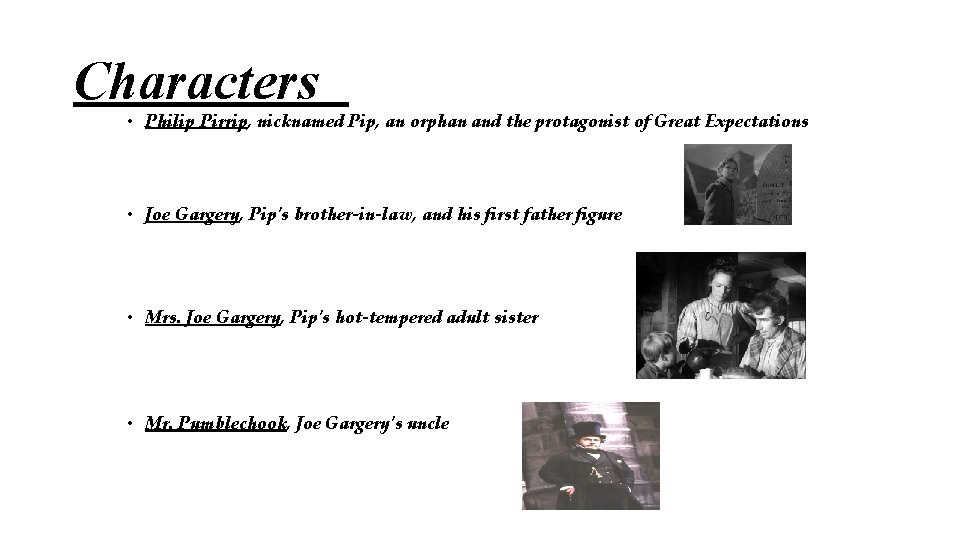
Characters • Philip Pirrip, nicknamed Pip, an orphan and the protagonist of Great Expectations • Joe Gargery, Pip's brother-in-law, and his first father figure • Mrs. Joe Gargery, Pip's hot-tempered adult sister • Mr. Pumblechook, Joe Gargery's uncle
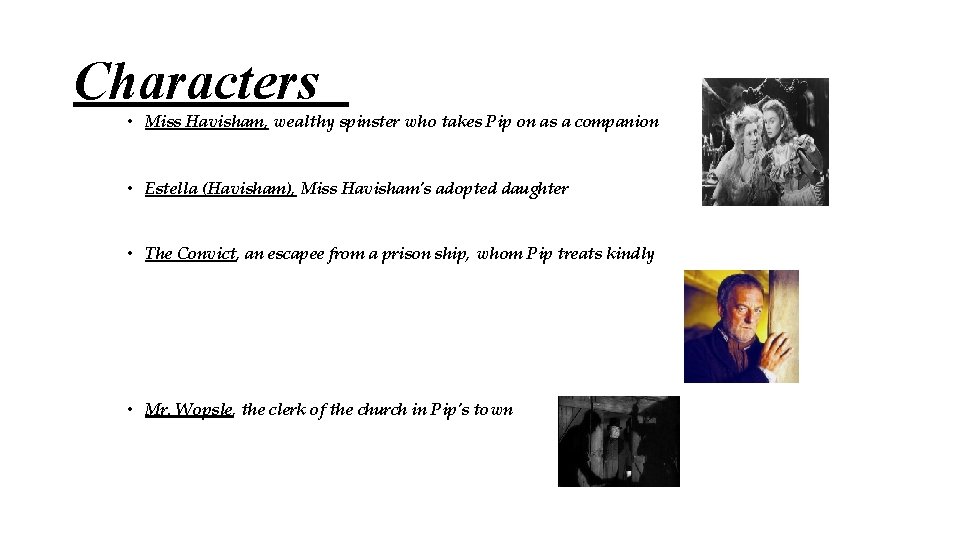
Characters • Miss Havisham, wealthy spinster who takes Pip on as a companion • Estella (Havisham), Miss Havisham's adopted daughter • The Convict, an escapee from a prison ship, whom Pip treats kindly • Mr. Wopsle, the clerk of the church in Pip's town
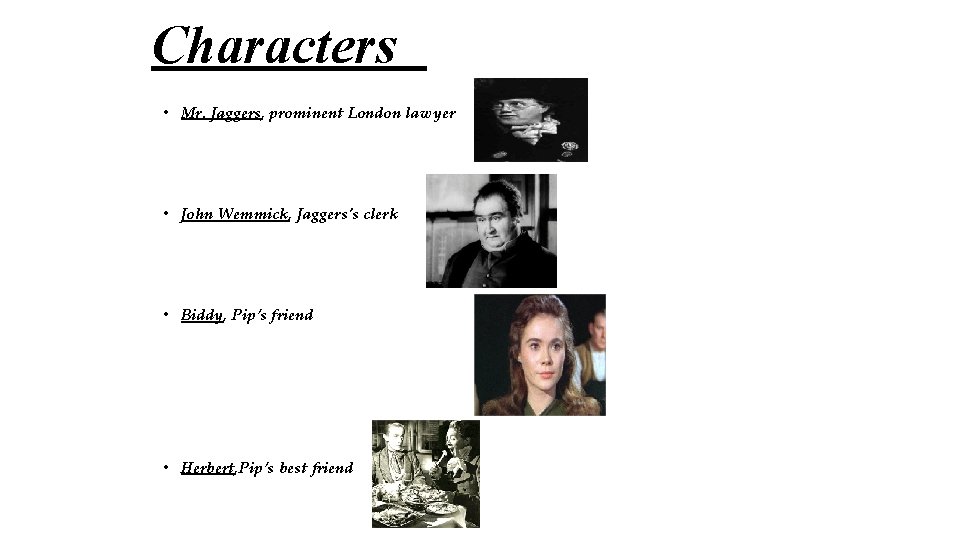
Characters • Mr. Jaggers, prominent London lawyer • John Wemmick, Jaggers's clerk • Biddy, Pip’s friend • Herbert, Pip’s best friend
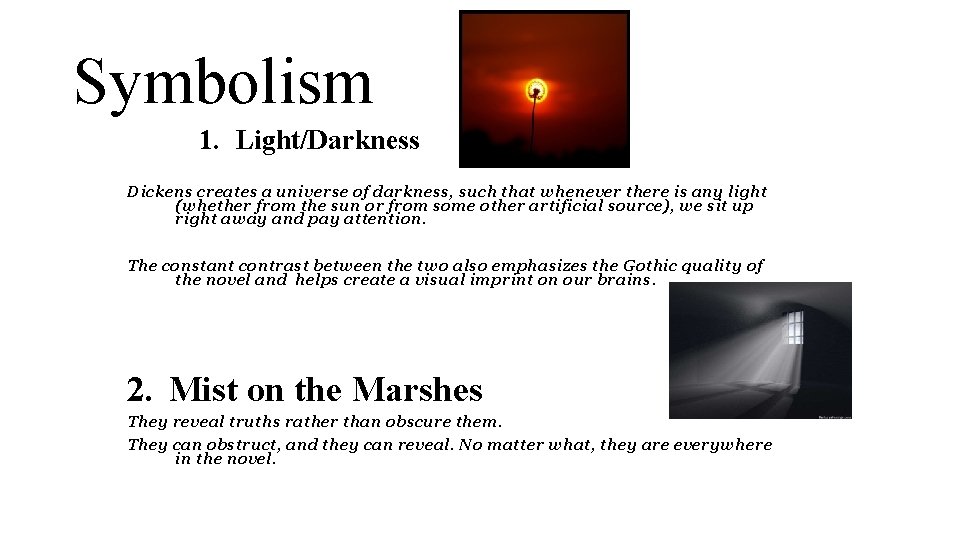
Symbolism 1. Light/Darkness Dickens creates a universe of darkness, such that whenever there is any light (whether from the sun or from some other artificial source), we sit up right away and pay attention. The constant contrast between the two also emphasizes the Gothic quality of the novel and helps create a visual imprint on our brains. 2. Mist on the Marshes They reveal truths rather than obscure them. They can obstruct, and they can reveal. No matter what, they are everywhere in the novel.
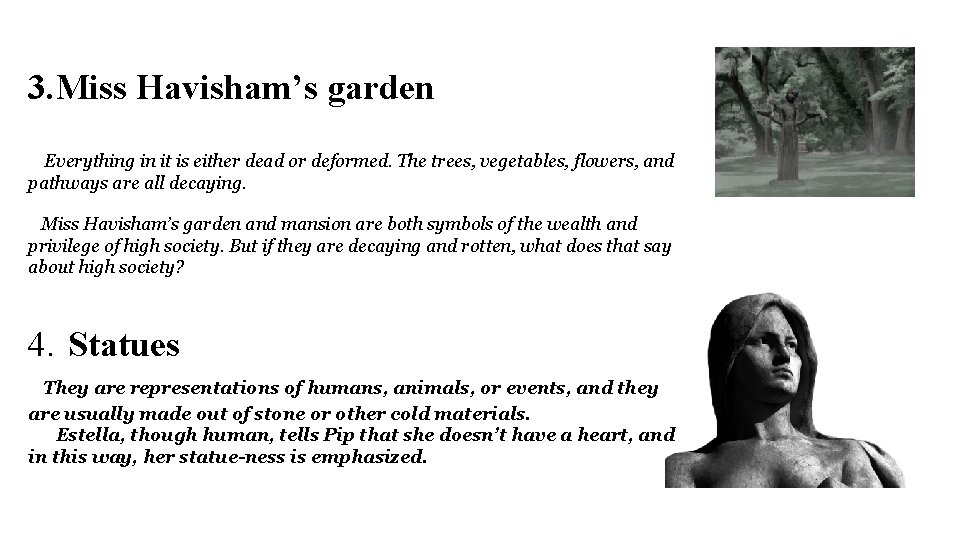
3. Miss Havisham’s garden Everything in it is either dead or deformed. The trees, vegetables, flowers, and pathways are all decaying. Miss Havisham’s garden and mansion are both symbols of the wealth and privilege of high society. But if they are decaying and rotten, what does that say about high society? 4. Statues They are representations of humans, animals, or events, and they are usually made out of stone or other cold materials. Estella, though human, tells Pip that she doesn’t have a heart, and in this way, her statue-ness is emphasized.
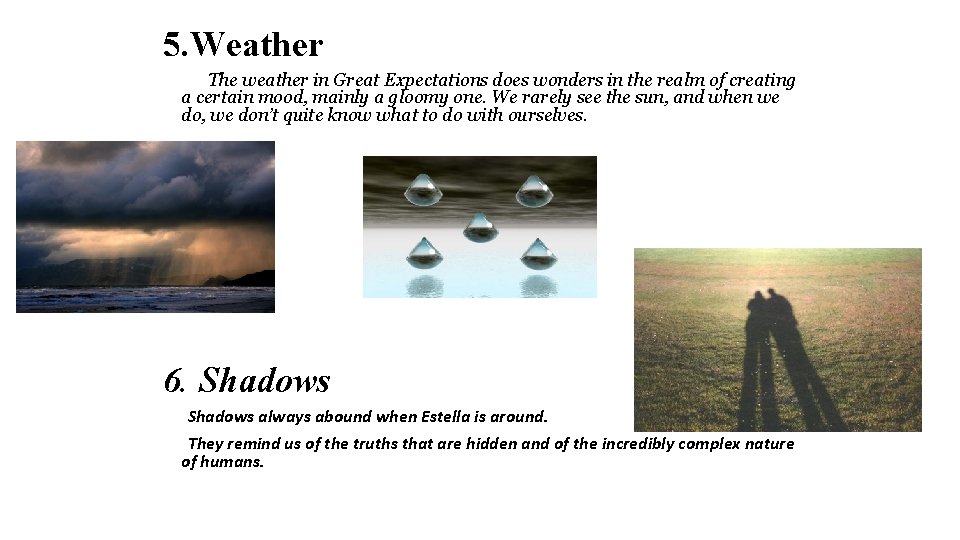
5. Weather The weather in Great Expectations does wonders in the realm of creating a certain mood, mainly a gloomy one. We rarely see the sun, and when we do, we don’t quite know what to do with ourselves. 6. Shadows always abound when Estella is around. They remind us of the truths that are hidden and of the incredibly complex nature of humans.
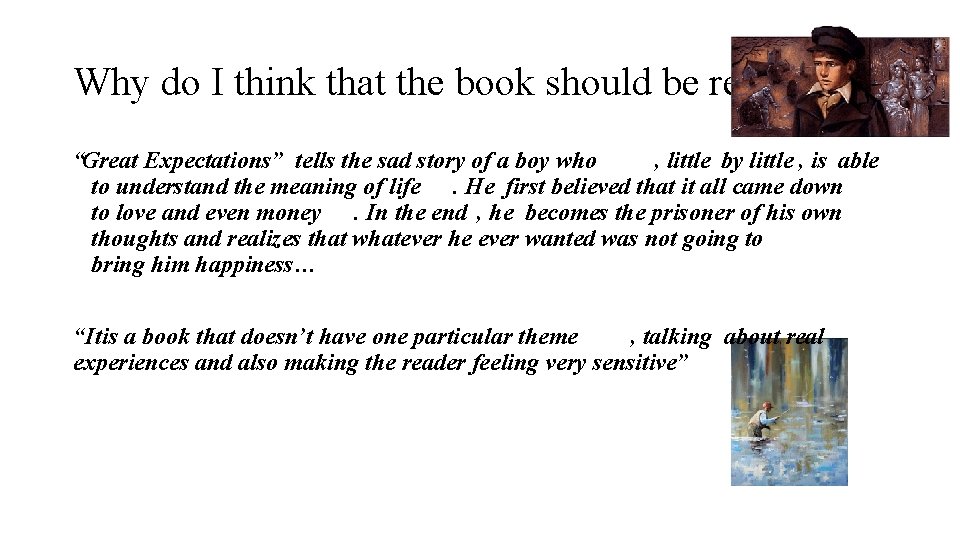
Why do I think that the book should be read? “Great Expectations” tells the sad story of a boy who , little by little , is able to understand the meaning of life. He first believed that it all came down to love and even money. In the end , he becomes the prisoner of his own thoughts and realizes that whatever he ever wanted was not going to bring him happiness… “It is a book that doesn’t have one particular theme , talking about real experiences and also making the reader feeling very sensitive”
This language is criminal!: Dialect in Chapter 1 • “Show us where you live, ” said the man. “Pint out the place. ” • “Darn me if I couldn’t eat ‘em, ” said the man, with a threatening shake of his head, and if I han’t half a mind to’it!” • “An you know what wittles is? ” • “You fail, or go from my words in any partickler, no matter how small it is” • “That young man has a secret way pecooliar to himself of getting at a boy and at his heart and at his liver” • “It is in wain for a boy to attempt to hide himself from that young man”
What Does the Word Successful Mean? Great Expectations is primarily focused on the concept of success and bettering oneself. Before we can appreciate the novel’s discussion of success, let’s have our own here and determine what success means to each of us.

Steve Jobs Successful?

Successful? Oprah Winfrey
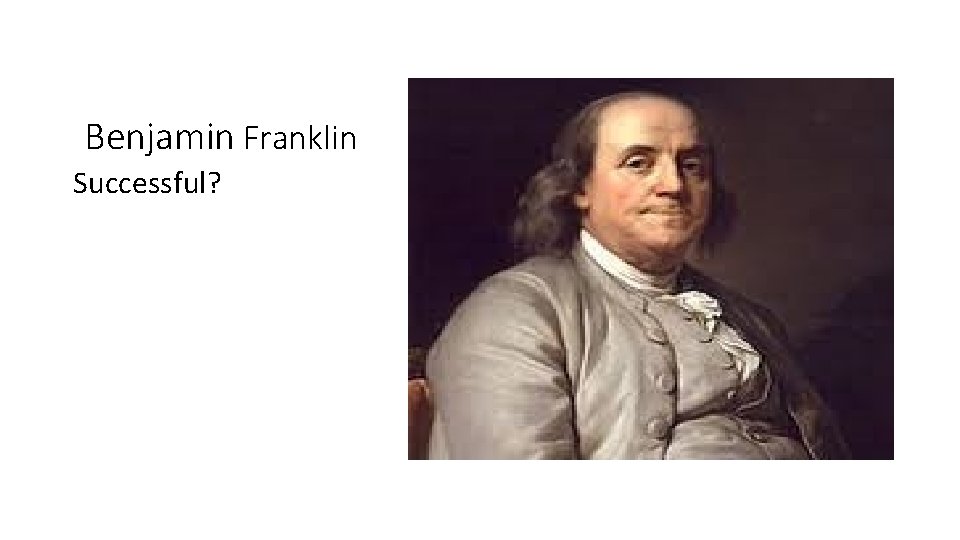
Benjamin Franklin Successful?

Mother Teresa Successful?
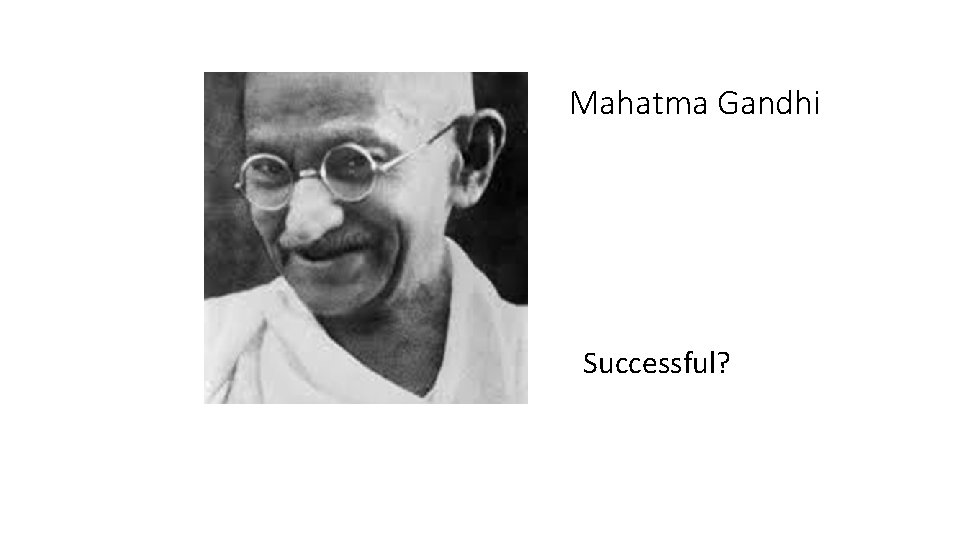
Mahatma Gandhi Successful?

Mark Cuban Successful?
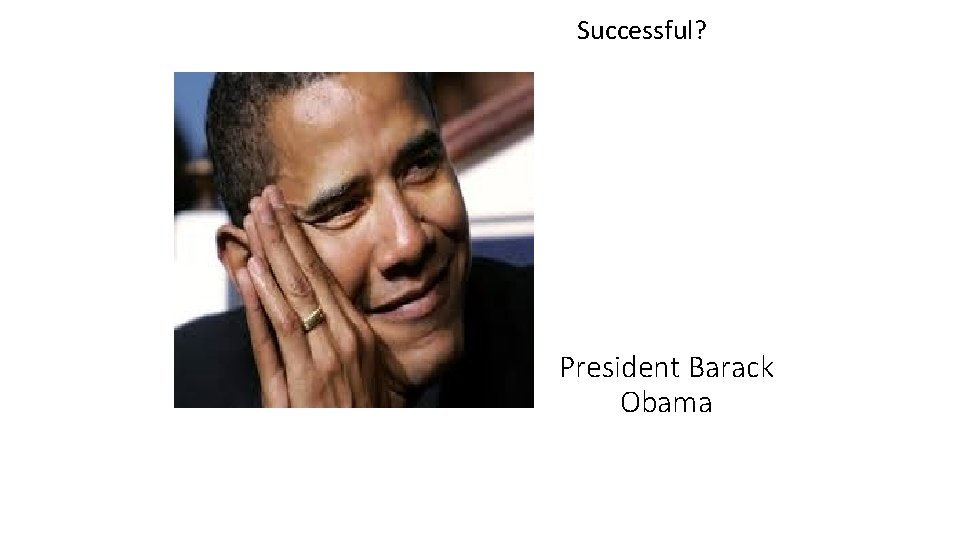
Successful? President Barack Obama

Successful? Stay at Home Mom

Graduating Seniors Successful?

First Job Successful?
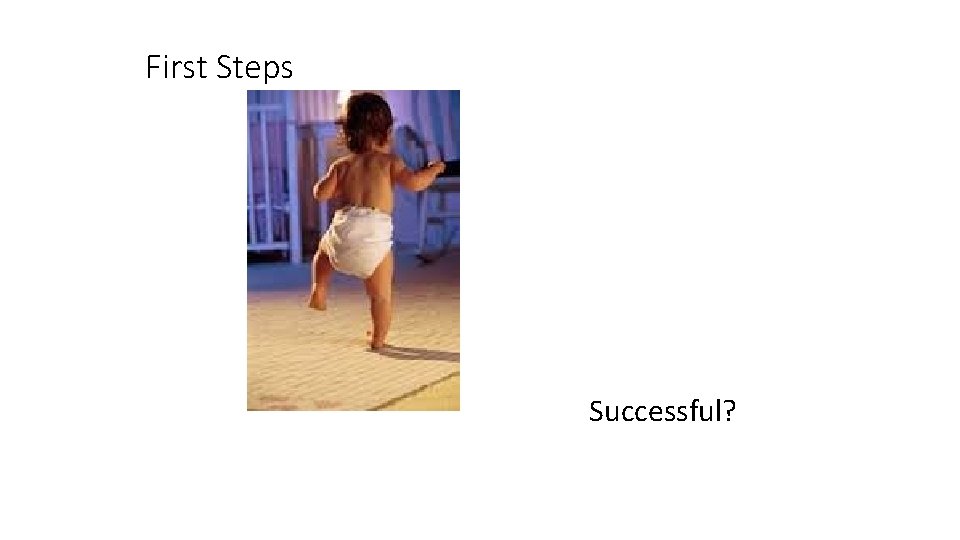
First Steps Successful?
- Slides: 32