
GREAT ENACTUS PROJECTS UNDER THE NEW CRITERION ENACTUS







- Slides: 149
GREAT ENACTUS PROJECTS UNDER THE NEW CRITERION
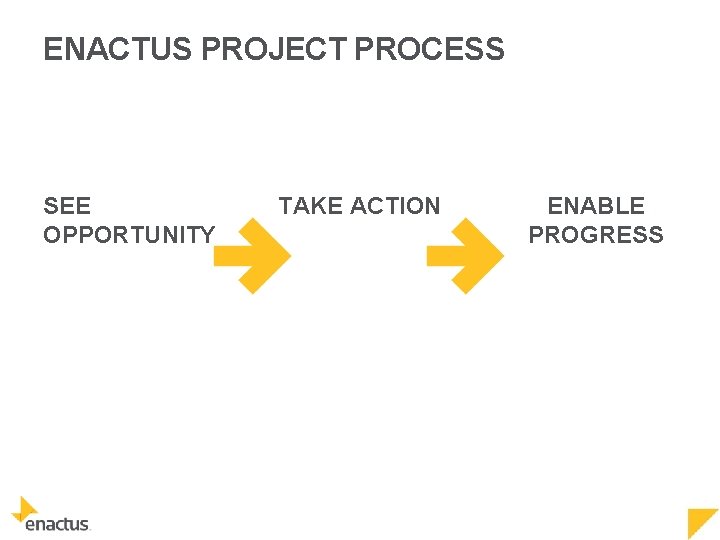
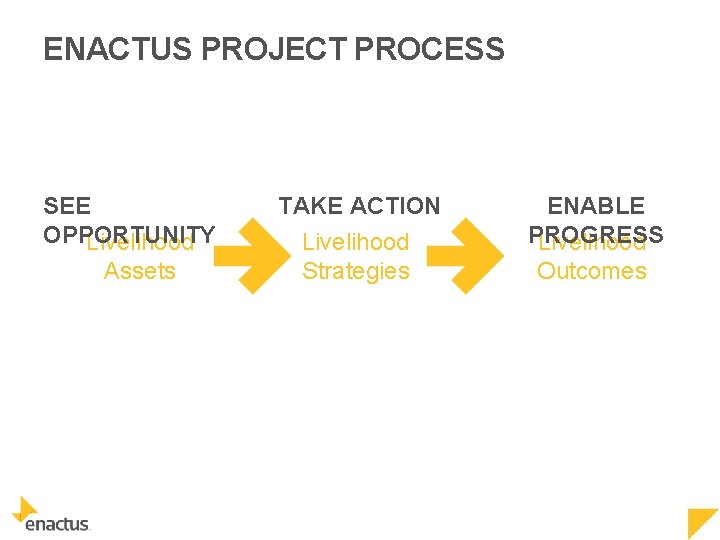
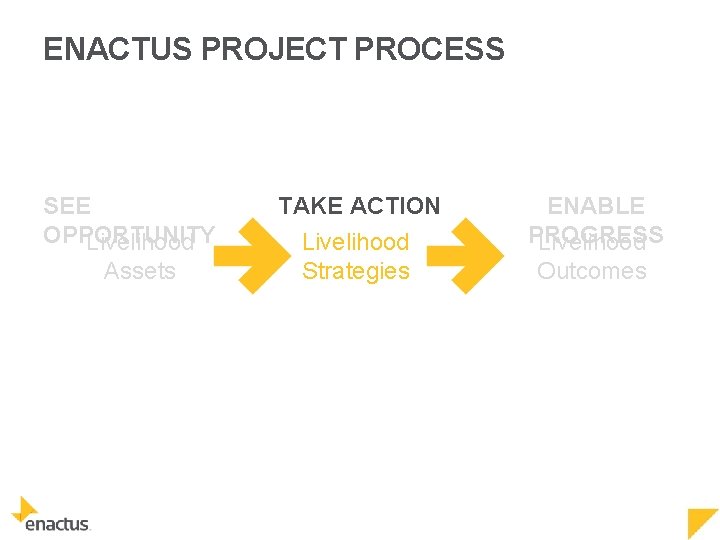
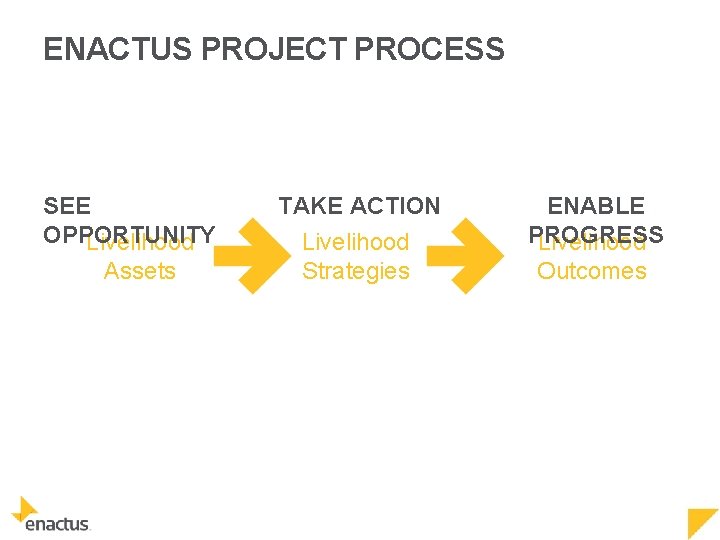
ENACTUS PROJECT PROCESS SEE OPPORTUNITY TAKE ACTION ENABLE PROGRESS
PREVIOUS JUDGING CRITERION Considering the relevant economic, social and environmental factors, which Enactus team most effectively empowered people in need by applying business and economic concepts and an entrepreneurial approach to improve their quality of life and standard of living?
REVISED JUDGING CRITERION Which Enactus team most effectively used entrepreneurial action to empower people to improve their livelihoods in an economically, socially and environmentally sustainable way?
REVISED JUDGING CRITERION 1. Fewer words! Was 37! Now 23! (We counted) 2. Different words! Same spirit. 3. Not exactly the same. 4. Result of an effort to create a better impact framework 5. Better fits the Enactus Project Process
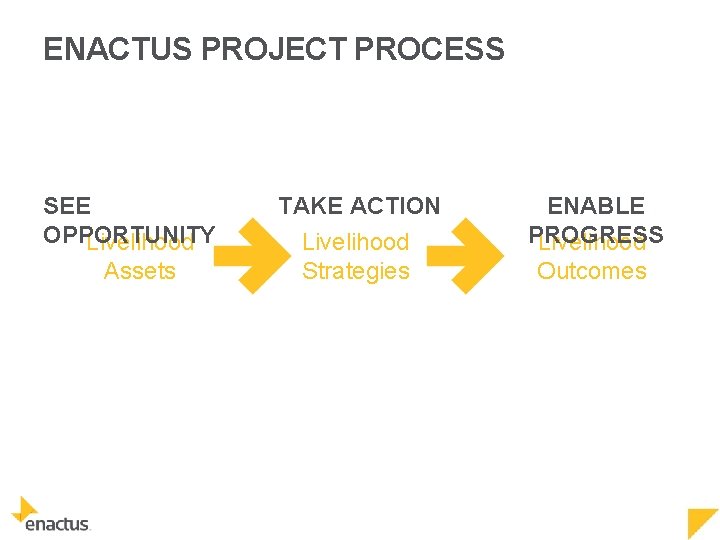
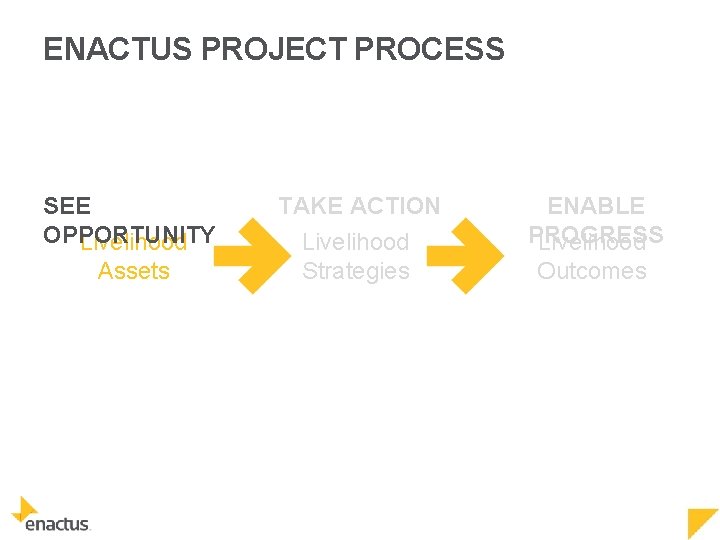
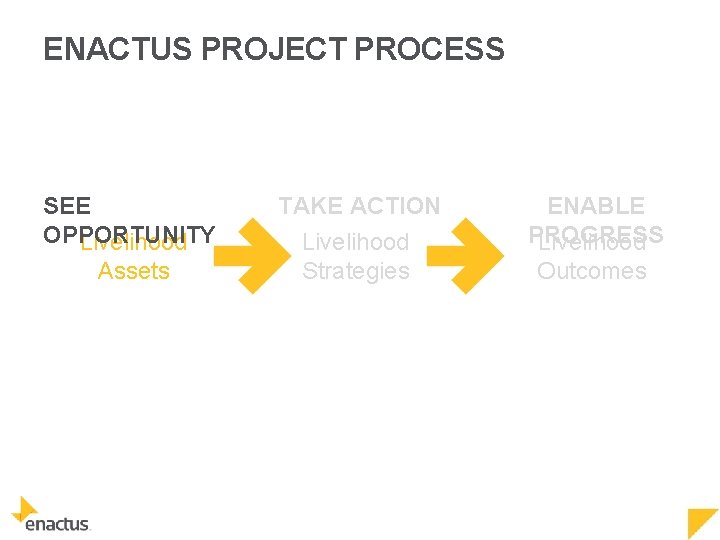
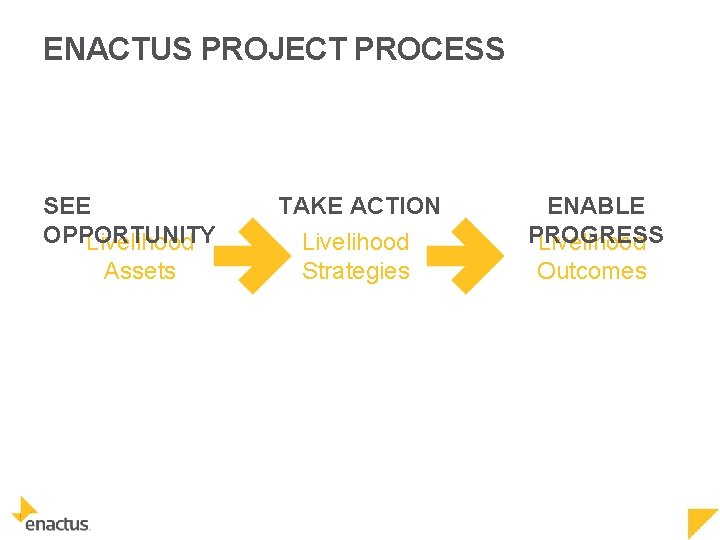
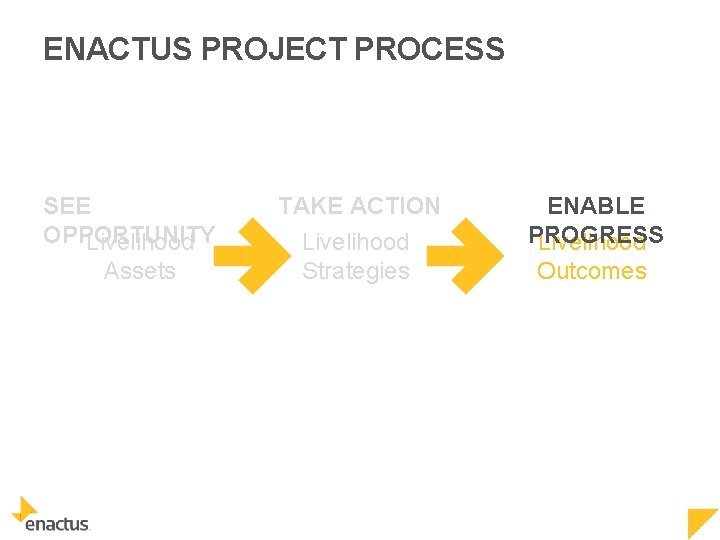
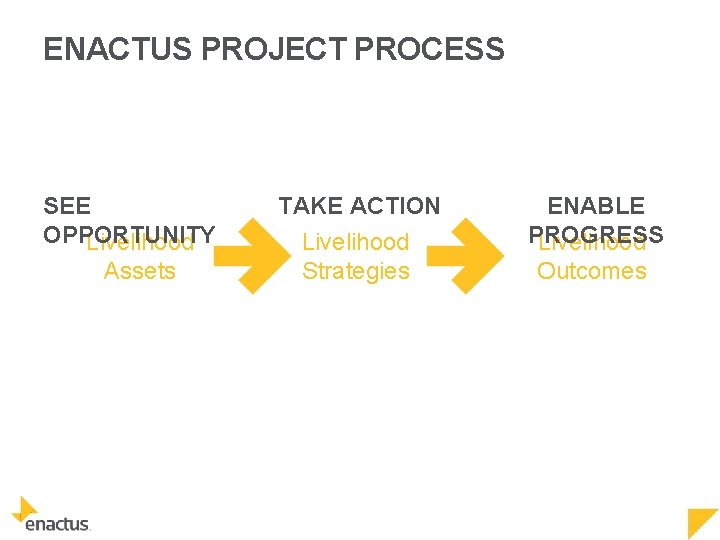
ENACTUS PROJECT PROCESS SEE OPPORTUNITY Livelihood Assets TAKE ACTION Livelihood Strategies ENABLE PROGRESS Livelihood Outcomes
REVISED JUDGING CRITERION Let’s break it down…
REVISED JUDGING CRITERION Which Enactus team most effectively used entrepreneurial action to empower people to improve their livelihoods in an economically, socially and environmentally sustainable way?
REVISED JUDGING CRITERION Which Enactus team most effectively used entrepreneurial action to empower people to improve their livelihoods in an economically, socially and environmentally sustainable way?
WHAT IS ENTREPRENEURIAL ACTION? ?
WHAT IS ENTREPRENEURIAL ACTION? Taking the opportunity to use sustainable business and sound economic practices to develop innovative business models based on risk, commitment and a willingness to follow through
WHAT IS ENTREPRENEURIAL ACTION? Not necessarily to do with creating entrepreneurial ventures Instead refers to the manner in which projects are developed and delivered
WHAT IS ENTREPRENEURIAL ACTION? Entrepreneurial action should result in the demonstration of creativity, innovation and an entrepreneurial culture through the team’s efforts Should demonstrate ‘the positive power of business’
WHAT IS ENTREPRENEURIAL ACTION? Example: Germany
REVISED JUDGING CRITERION Which Enactus team most effectively used entrepreneurial action to empower people to improve their livelihoods in an economically, socially and environmentally sustainable way?
REVISED JUDGING CRITERION Which Enactus team most effectively used entrepreneurial action to empower people to improve their livelihoods in an economically, socially and environmentally sustainable way?
REVISED JUDGING CRITERION Which Enactus team most effectively used entrepreneurial action to empower people to improve their livelihoods in an economically, socially and environmentally sustainable way?
HOW ARE PEOPLE EMPOWERED? ?
HOW ARE PEOPLE EMPOWERED? Empowerment happens when project beneficiaries take skills/knowledge they learned during the initial stages of a project and implement those skills/knowledge in their lives Project has not created dependence
HOW ARE PEOPLE EMPOWERED? Direct empowerment requires communication, understanding and challenging long-standing assumptions about what outcomes people need
HOW ARE PEOPLE EMPOWERED? Collaborative approach is key. Project beneficiaries should be an active part of all stages of project design and execution (This cannot happen in team meetings alone) Incorporate solutions for long-term empowerment into project design
A NOTE ABOUT EMPOWERMENT AND SUSTAINABILITY: People utilize the knowledge and skills they learned Not simply giving someone an asset or desired outcome, but empowering and teaching them strategies to obtain it themselves
HOW ARE PEOPLE EMPOWERED? Example: China
REVISED JUDGING CRITERION Which Enactus team most effectively used entrepreneurial action to empower people to improve their livelihoods in an economically, socially and environmentally sustainable way?
REVISED JUDGING CRITERION Which Enactus team most effectively used entrepreneurial action to empower people to improve their livelihoods in an economically, socially and environmentally sustainable way?
REVISED JUDGING CRITERION Which Enactus team most effectively used entrepreneurial action to empower people to improve their livelihoods in an economically, socially and environmentally sustainable way?
WHAT ARE LIVELIHOODS? ?
WHAT ARE LIVELIHOODS? The means and activities involved in sustaining an individual’s life. Livelihoods are fueled by what are known as livelihood assets. Five categories: Financial, Social, Natural, Physical, and Human Biggest change in criterion.
WHAT ARE LIVELIHOODS? A livelihood is the means and activities involved in sustaining an individual’s life Livelihoods are fueled by livelihood assets
UNDERSTANDING LIVELIHOOD ASSETS Every individual and community has access to at least one form of livelihood asset Livelihood assets are the capital involved in obtaining desired outcomes
UNDERSTANDING LIVELIHOOD ASSETS What do these asset categories look like?
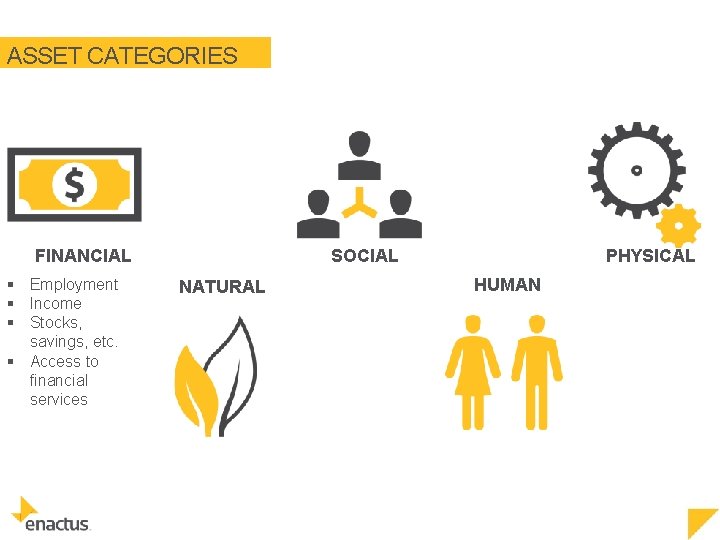
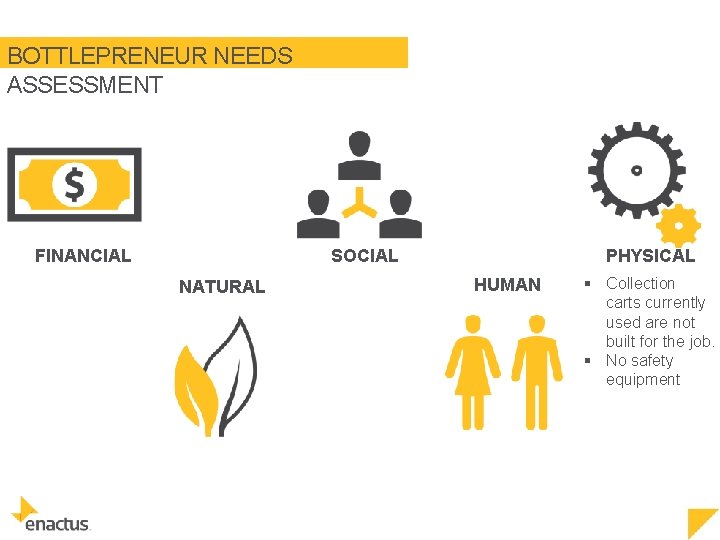
ASSET CATEGORIES SOCIAL FINANCIAL § Employment § Income § Stocks, savings, etc. § Access to financial services NATURAL PHYSICAL HUMAN
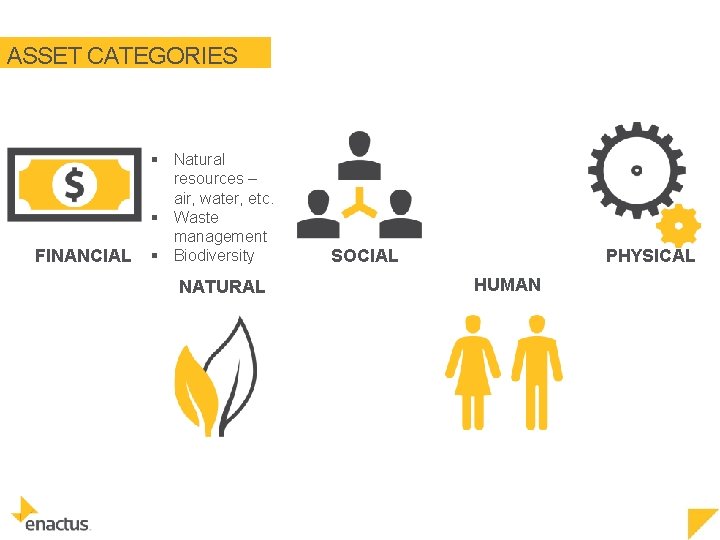
ASSET CATEGORIES FINANCIAL § Natural resources – air, water, etc. § Waste management § Biodiversity NATURAL SOCIAL PHYSICAL HUMAN
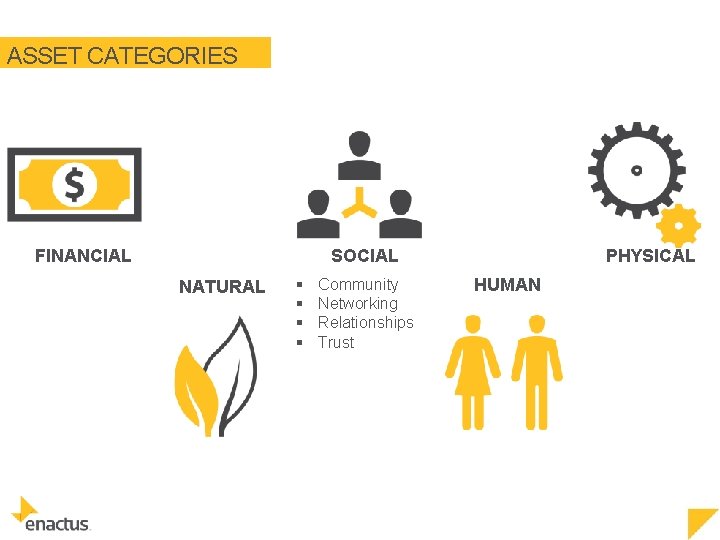
ASSET CATEGORIES SOCIAL FINANCIAL NATURAL § § Community Networking Relationships Trust PHYSICAL HUMAN
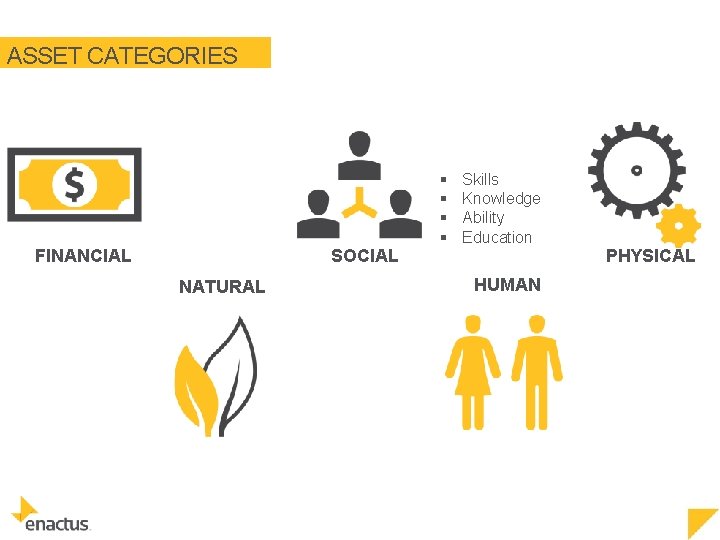
ASSET CATEGORIES SOCIAL FINANCIAL NATURAL § § Skills Knowledge Ability Education HUMAN PHYSICAL
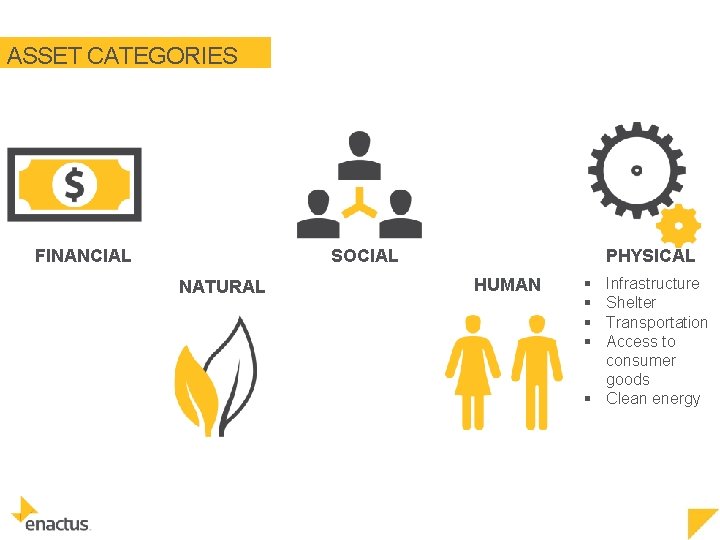
ASSET CATEGORIES SOCIAL FINANCIAL NATURAL PHYSICAL HUMAN § § Infrastructure Shelter Transportation Access to consumer goods § Clean energy
REVISED JUDGING CRITERION Which Enactus team most effectively used entrepreneurial action to empower people to improve their livelihoods in an economically, socially and environmentally sustainable way?
REVISED JUDGING CRITERION Which Enactus team most effectively used entrepreneurial action to empower people to improve their livelihoods in an economically, socially and environmentally sustainable way?
REVISED JUDGING CRITERION Which Enactus team most effectively used entrepreneurial action to empower people to improve their livelihoods in an economically, socially and environmentally sustainable way?
WHAT MAKES AN ENACTUS PROJECT ECONOMICALLY, SOCIALLY AND ENVIRONMENTALLY SUSTAINABLE? ?
WHAT MAKES AN ENACTUS PROJECT ECONOMICALLY, SOCIALLY AND ENVIRONMENTALLY SUSTAINABLE? The inclusion of the triple bottom line is meant to ensure each project is truly sustainable. All areas must be duly considered, although one or two may have greater relevance
WHAT MAKES AN ENACTUS PROJECT ECONOMICALLY, SOCIALLY AND ENVIRONMENTALLY SUSTAINABLE? When relevant, each area should be addressed in an integrated manner, rather than as separate activities. Example: Ensuring a project goes paperless as opposed to having a tree planting day to offset a project’s impact.
WHAT MAKES AN ENACTUS PROJECT ECONOMICALLY, SOCIALLY AND ENVIRONMENTALLY SUSTAINABLE? Example: United States
REVISED JUDGING CRITERION Which Enactus team most effectively used entrepreneurial action to empower people to improve their livelihoods in an economically, socially and environmentally sustainable way?
REVISED JUDGING CRITERION Which Enactus team most effectively used entrepreneurial action to empower people to improve their livelihoods in an economically, socially and environmentally sustainable way?
GREAT ENACTUS PROJECTS UNDER THE NEW CRITERION
ENACTUS PROJECT PROCESS SEE OPPORTUNITY Livelihood Assets TAKE ACTION Livelihood Strategies ENABLE PROGRESS Livelihood Outcomes
ENACTUS PROJECT PROCESS SEE OPPORTUNITY Livelihood Assets TAKE ACTION Livelihood Strategies ENABLE PROGRESS Livelihood Outcomes
SEEING OPPORTUNITY This can be broken down into two areas that we are already familiar with 1. ) Project Ideation 2. )Needs Assessment
SEEING OPPORTUNITY This can be broken down into two areas that we are already familiar with 1. ) Project Ideation 2. )Needs Assessment
SEEING OPPORTUNITY – PROJECT IDEATION Historically, Enactus teams in Canada have struggled in this area. All too often, project ideation and needs assessments happen within the confines of a classroom during team meetings
SEEING OPPORTUNITY – PROJECT IDEATION Approaching any problem in this manner limits the solution to the capabilities and imaginations of the people engaged Additionally, there is no way to ensure the proposed solution is appropriate until after it is implemented.
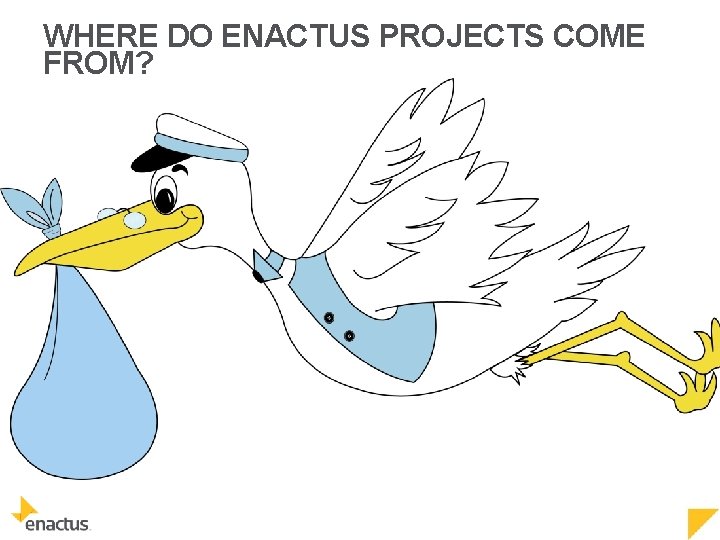
WHERE DO ENACTUS PROJECTS COME FROM?
SEEING OPPORTUNITY – PROJECT IDEATION More often than not, great project opportunities are brought to Enactus teams by others: - School Administration - BAB Members - Like-minded community organizations
SEEING OPPORTUNITY – PROJECT IDEATION Project Dago – University President City Thrive – Dean In. Still Life – Community Connection Project Stitch – Community Connection
SEEING OPPORTUNITY – PROJECT IDEATION Improving relationships with administration: • Find excuses for facetime –Program Manger Visits –Showcases –BAB / Project Advice • Align team mission with your school’s
SEEING OPPORTUNITY – PROJECT IDEATION Improving relationships with you community: • Ensure a marketing presence beyond your campus • Search community postings for opportunities for your team to volunteer –(Wear your Enactus shirts!)
SEEING OPPORTUNITY – PROJECT IDEATION Improving relationships with you community: • Meet with like-minded community organizations to gain their perspective on issues important to your team • Run a campaign which gages community perspectives on local challenges
SEEING OPPORTUNITY – PROJECT IDEATION Additionally, it is important to stay informed on what’s happening in your community • Read the news and listen to call-in shows on community issues • Attend networking events • Have team members sit on relevant boards
SEEING OPPORTUNITY – PROJECT IDEATION But… should we wait for projects to come to us? No.
#SEEOPPORTUNITY
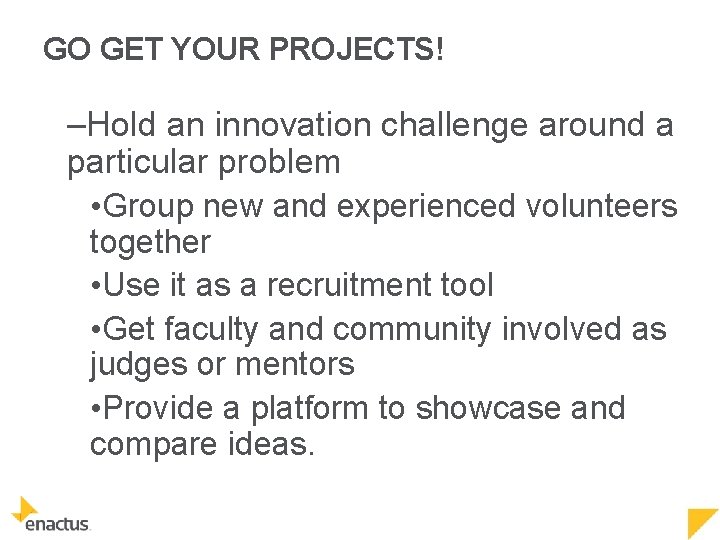
GO GET YOUR PROJECTS! –Hold an innovation challenge around a particular problem • Group new and experienced volunteers together • Use it as a recruitment tool • Get faculty and community involved as judges or mentors • Provide a platform to showcase and compare ideas.
ENACTUS PROJECT PROCESS SEE OPPORTUNITY Livelihood Assets TAKE ACTION Livelihood Strategies ENABLE PROGRESS Livelihood Outcomes
SEEING OPPORTUNITY This can be broken down into two areas that we are already familiar with 1. ) Project Ideation 2. )Needs Assessment
SEEING OPPORTUNITY This can be broken down into two areas that we are already familiar with 1. ) Project Ideation 2. )Needs Assessment
SEE OPPORTUNITY – NEEDS ASSESSMENT • Building your project team –Once you have an idea of the problem you want to address, it’s time to surround yourself with the proper people –Diversity is important –Don’t forget about faculty!
SEE OPPORTUNITY – NEEDS ASSESSMENT • Building your project team –As an example, suppose your team is in talks with the chief of a particular aboriginal reserve, who is looking to address the following issues: • Financial Literacy • Unemployment • Women’s Empowerment • Poor Living Conditions
SEE OPPORTUNITY – NEEDS ASSESSMENT • Who should be on our project team? ?
WHAT IS A NEEDS ASSESSMENT? Once the team is formed, it’s time for the team to begin a needs assessment This should lead to a unbiased and comprehensive understanding of the issues and the demographics affected
WHAT IS A NEEDS ASSESSMENT? A needs assessment is a process for identifying the gaps between an individual or community’s current conditions and their desired outcomes
WHY DO I NEED TO PERFORM ONE? Understanding the larger context of your target audience leads to a more sustainable project Needs assessments empower target audience members by giving them a voice and a stake in their own outcome
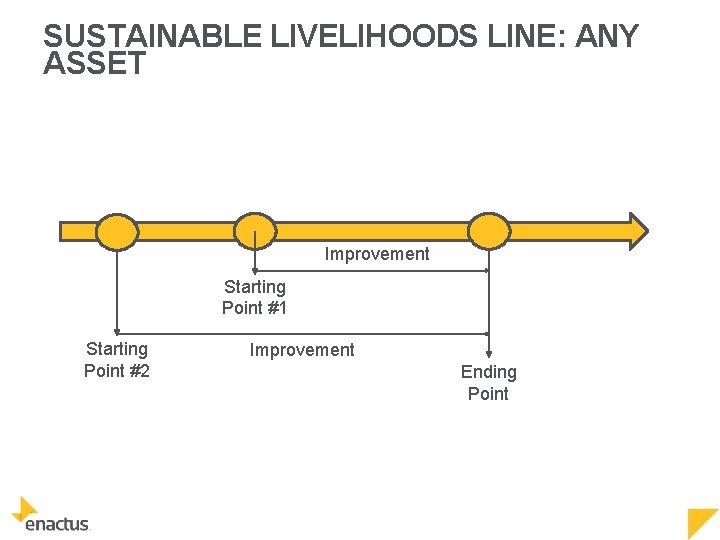
WHY DO I NEED TO PERFORM ONE? You need to benchmark where you start in order to measure how far you’ve come.
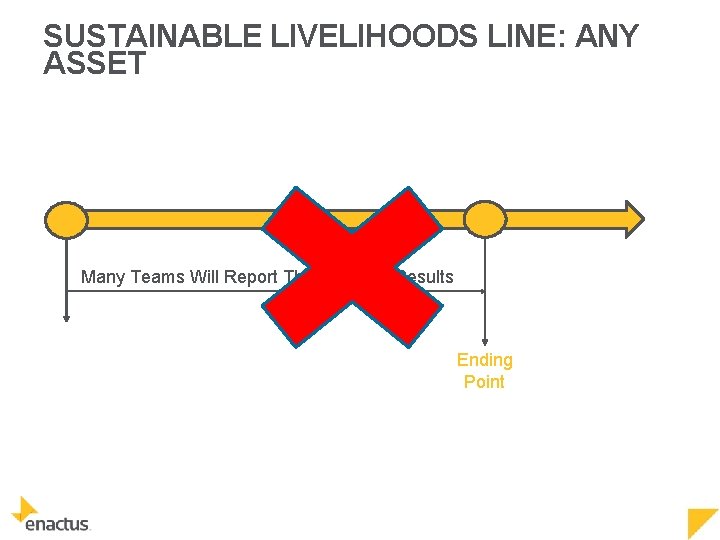
SUSTAINABLE LIVELIHOODS LINE: ANY ASSET Many Teams Will Report This As Their Results Ending Point
SUSTAINABLE LIVELIHOODS LINE: ANY ASSET Improvement Starting Point #1 Starting Point #2 Improvement Ending Point
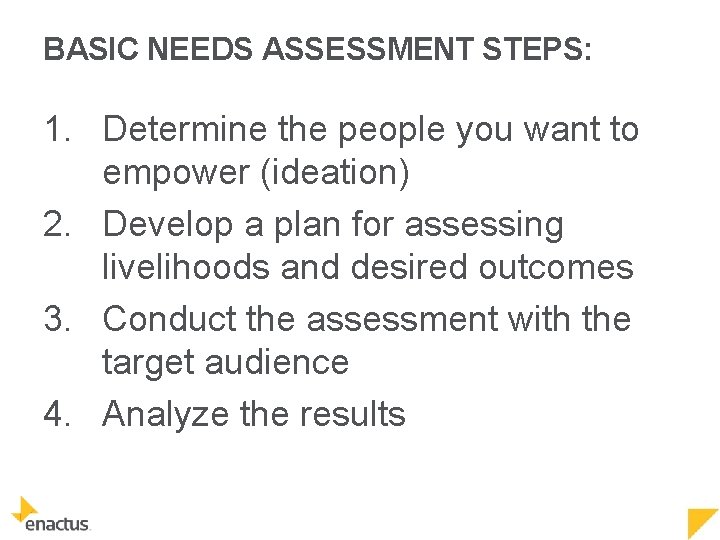
BASIC NEEDS ASSESSMENT STEPS: 1. Determine the people you want to empower (ideation) 2. Develop a plan for assessing livelihoods and desired outcomes 3. Conduct the assessment with the target audience 4. Analyze the results
Bottlepreneur Video
WHO SHOULD I INCLUDE IN THE ASSESSMENT PROCESS? • Target audience members • Key Enactus team members • Community leaders • Businesses involved in the project • Others who are knowledgeable about the community
WHO SHOULD I INCLUDE IN THE ASSESSMENT PROCESS? • In Project Bottlepreneur –Recycling Depots –Bottle Collectors –Local Businesses –Local Residents
HOW DO I START A NEEDS ASSESSMENT? Begin by doing a high-level examination of the sustainability context: Economic, social and environmental concerns or trends relevant to the target audience of the project Utilize existing census data, surveys and other local reports
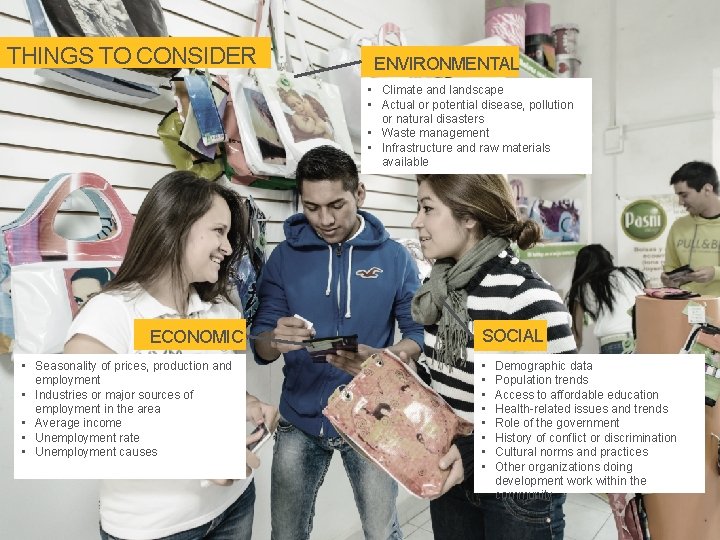
THINGS TO CONSIDER ENVIRONMENTAL • Climate and landscape • Actual or potential disease, pollution or natural disasters • Waste management • Infrastructure and raw materials available ECONOMIC • Seasonality of prices, production and employment • Industries or major sources of employment in the area • Average income • Unemployment rate • Unemployment causes SOCIAL • • Demographic data Population trends Access to affordable education Health-related issues and trends Role of the government History of conflict or discrimination Cultural norms and practices Other organizations doing development work within the community
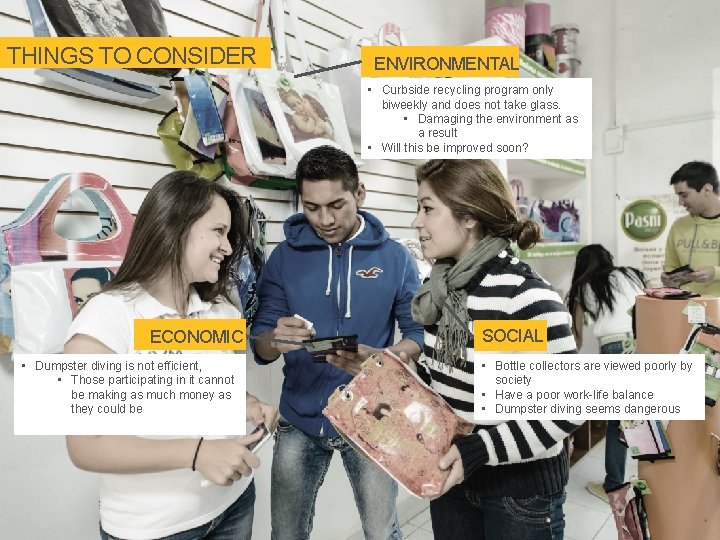
THINGS TO CONSIDER ENVIRONMENTAL • Curbside recycling program only biweekly and does not take glass. • Damaging the environment as a result • Will this be improved soon? ECONOMIC • Dumpster diving is not efficient, • Those participating in it cannot be making as much money as they could be SOCIAL • Bottle collectors are viewed poorly by society • Have a poor work-life balance • Dumpster diving seems dangerous
UNDERSTANDING LIVELIHOOD ASSETS & LIVELIHOOD STRATEGIES Now that you understand the types of questions you want to ask, meet with the relevant audiences to learn more about current livelihood assets and livelihood strategies
UNDERSTANDING LIVELIHOOD ASSETS & LIVELIHOOD STRATEGIES Hold on. What’s a livelihood strategy? Basically, it’s any activity undertaken by an individual to increase one or more of their livelihood assets.
UNDERSTANDING LIVELIHOOD ASSETS & LIVELIHOOD STRATEGIES Livelihood Strategy: Working at Enactus Assets Affected: -Financial: Making money -Social: Expanding my network -Human: Increased knowledge and experience
UNDERSTANDING LIVELIHOOD ASSETS & LIVELIHOOD STRATEGIES The project itself is not the livelihood strategy. During the needs assessment, we gain an understanding of current strategies being used, and then develop project to positively affect them.
UNDERSTANDING LIVELIHOOD ASSETS & LIVELIHOOD STRATEGIES How do we find out the information we need: • Interviews • Focus groups • Public forums • Direct observation
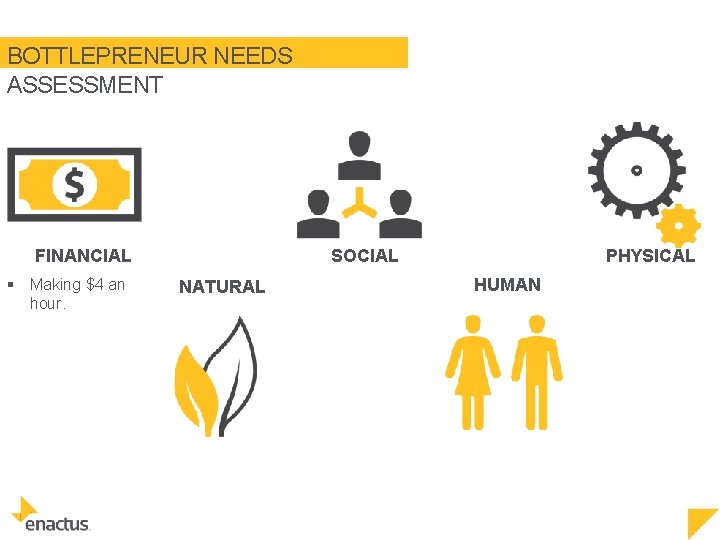
BOTTLEPRENEUR NEEDS ASSESSMENT SOCIAL FINANCIAL § Making $4 an hour. NATURAL PHYSICAL HUMAN
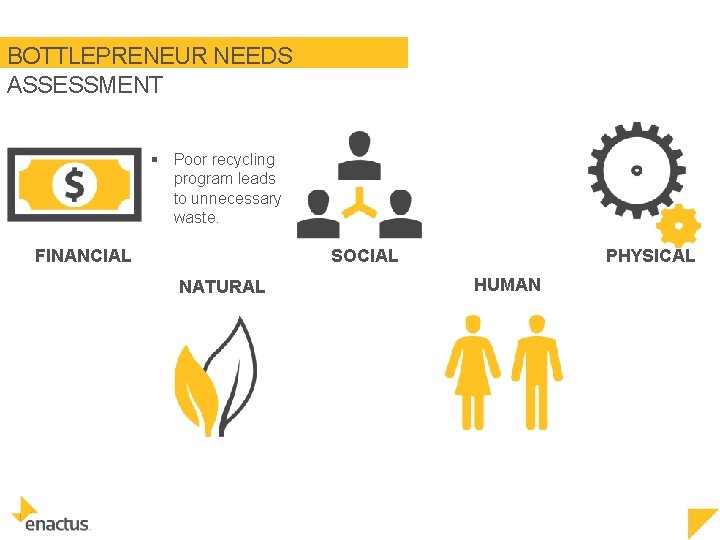
BOTTLEPRENEUR ASSET CATEGORIES NEEDS ASSESSMENT § Poor recycling program leads to unnecessary waste. SOCIAL FINANCIAL NATURAL PHYSICAL HUMAN
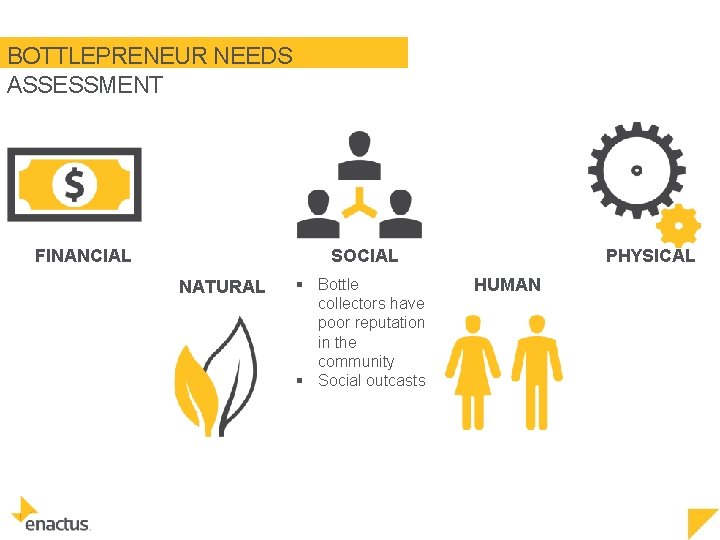
BOTTLEPRENEUR ASSET CATEGORIES NEEDS ASSESSMENT SOCIAL FINANCIAL NATURAL § Bottle collectors have poor reputation in the community § Social outcasts PHYSICAL HUMAN
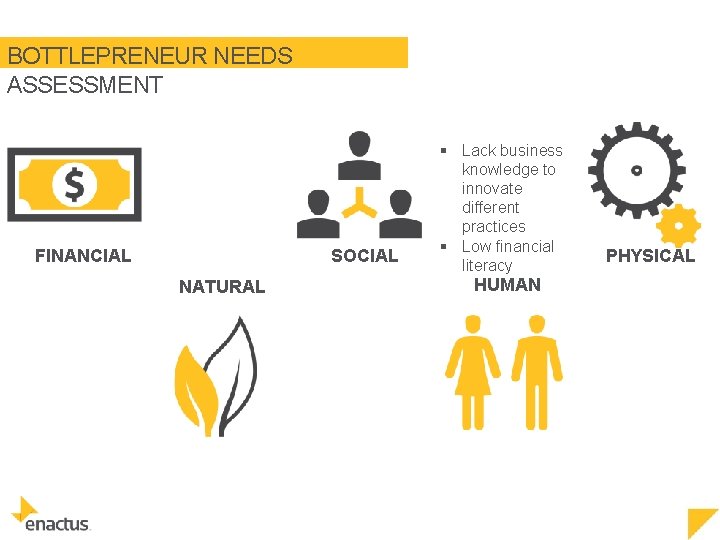
BOTTLEPRENEUR ASSET CATEGORIES NEEDS ASSESSMENT SOCIAL FINANCIAL NATURAL § Lack business knowledge to innovate different practices § Low financial literacy HUMAN PHYSICAL
BOTTLEPRENEUR ASSET CATEGORIES NEEDS ASSESSMENT SOCIAL FINANCIAL NATURAL PHYSICAL HUMAN § Collection carts currently used are not built for the job. § No safety equipment
SEEING OPPORTUNITY – NEEDS ASSESSMENT But… Is there a tool that I can use to assist me in my needs assessment? Yes.
#SEEOPPORTUNITY
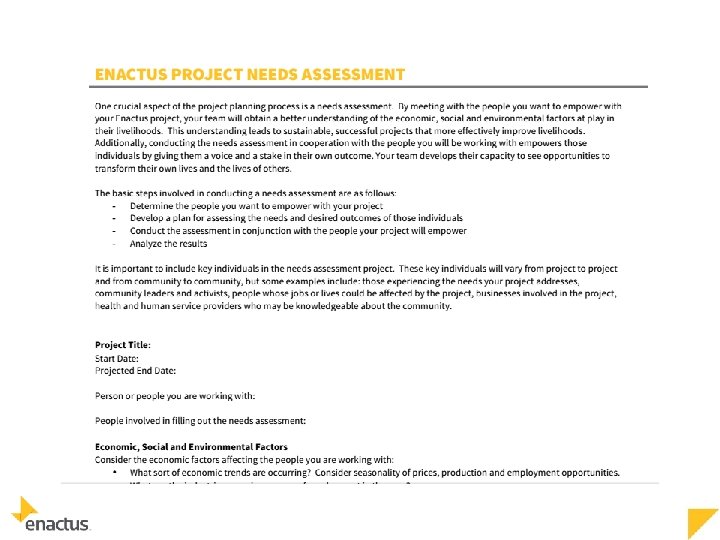
USE THE NEEDS ASSESSMENT FORM • This is four page document will help guide your team through its needs assessment • It is located in the appendix of the 20142015 Enactus Team Handbook • It looks like this:
SEEING OPPORTUNITY This can be broken down into two areas that we are already familiar with 1. ) Project Ideation 2. )Needs Assessment
SEEING OPPORTUNITY This can be broken down into two areas that we are already familiar with 1. ) Project Ideation 2. )Needs Assessment
ENACTUS PROJECT PROCESS SEE OPPORTUNITY Livelihood Assets TAKE ACTION Livelihood Strategies ENABLE PROGRESS Livelihood Outcomes
ENACTUS PROJECT PROCESS SEE OPPORTUNITY Livelihood Assets TAKE ACTION Livelihood Strategies ENABLE PROGRESS Livelihood Outcomes
TAKING ACTION Now that you understand where the project beneficiary’s livelihood assets currently stand, it’s time to take action. This is the ‘how’ of bridging the gap between their current situation and their desired situation.
TAKING ACTION This can be broken down into two areas that we are already familiar with 1. ) Project Creation 2. )Project Implementation
TAKING ACTION This can be broken down into two areas that we are already familiar with 1. ) Project Creation 2. )Project Implementation
TAKING ACTION – PROJECT CREATION In Canada, teams have clearly demonstrated they are more comfortable with certain project types than others. While many of these are great initiatives, we should not be limiting ourselves to what we’re comfortable with.
TAKING ACTION – PROJECT CREATION But… is there a project type that, while not common in Canada, has seen great success on the world stage? Yes.
#SEEOPPORTUNITY
SOCIAL ENTERPRISES A social enterprise is an organization that applies commercial strategies to maximize improvements in human and environmental well being, rather than maximizing profits for external shareholders.
SOCIAL ENTERPRISES A social enterprise is an organization that applies commercial strategies to maximize improvements in human and environmental well being, rather than maximizing profits for external shareholders.
SOCIAL ENTERPRISES What do these look like? Germany – 2013 World Cup Champion Accelerated the growth of an existing social enterprise which allowed individuals in developing villages to make a living sell One Dollar glasses
SOCIAL ENTERPRISES What do these look like? USA – 2012 World Cup Champion Created a mattress recycling business which acted as a transition program for previously incarcerated individuals.
SOCIAL ENTERPRISES What do these look like? Canada– 2008 World Cup Champion Brought sustainability to a pottery business which provided employment to individuals suffering from muscular dystrophy
TAKING ACTION This can be broken down into two areas that we are already familiar with 1. ) Project Creation 2. )Project Implementation
TAKING ACTION This can be broken down into two areas that we are already familiar with 1. ) Project Creation 2. )Project Implementation
TAKING ACTION – PROJECT IMPLEMENTATION Starting a new initiative can be daunting, especially if your team is trying something new. The fear of failure often ends up holding teams back.
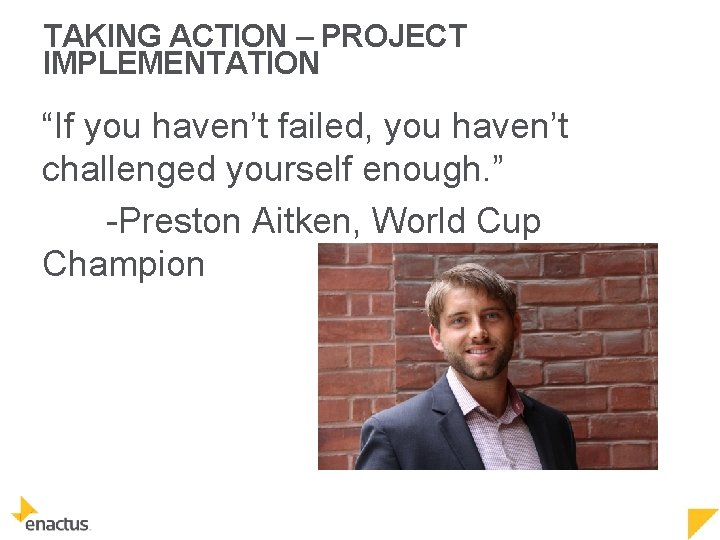
TAKING ACTION – PROJECT IMPLEMENTATION “If you haven’t failed, you haven’t challenged yourself enough. ” -Preston Aitken, World Cup Champion
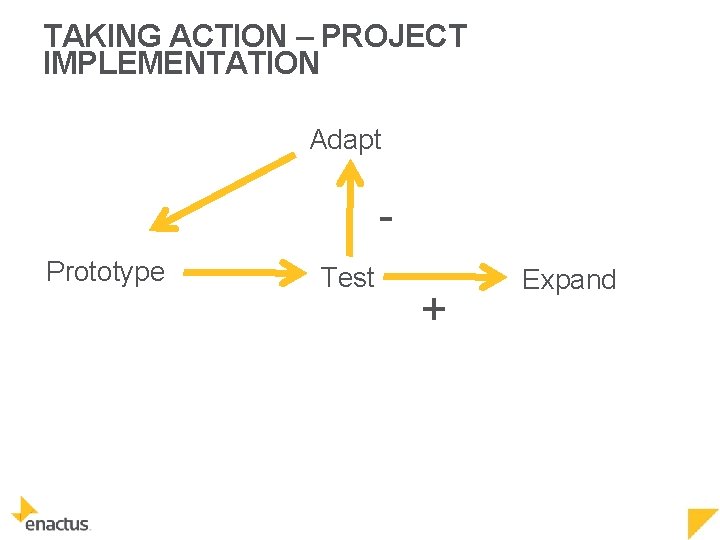
TAKING ACTION – PROJECT IMPLEMENTATION Many of the most successful Enactus projects have started working with just one person. This allows for prototyping and testing on a small scale to figure out what works and what doesn’t.
TAKING ACTION – PROJECT IMPLEMENTATION Prototyping is not about getting it right the first time. In fact, it’s the opposite! The best prototypes will change over time. Your team could even prototype two or three ideas at once to test multiple aspects of possible solutions.
TAKING ACTION – PROJECT IMPLEMENTATION Examples: Project Bottlepreneur began with just one bottlepreneur.
TAKING ACTION – PROJECT IMPLEMENTATION Examples: The Enactus team in China who created mushroom fertilizer out of coffee grounds tested many variations of their product before expansion.
TAKING ACTION – PROJECT IMPLEMENTATION Examples: Springback Recycling started with taking apart just one mattress. And the students brought the business to a sustainable level before employing any project beneficiaries.
TAKING ACTION – PROJECT IMPLEMENTATION Adapt Prototype Test + Expand
TAKING ACTION – PROJECT IMPLEMENTATION But… do we stop measuring, innovating and adapting our projects once we expand? Of course not. No opportunity alert. Sry.
TAKING ACTION – PROJECT IMPLEMENTATION How did Project Bottlepreneur take action? • Started with one Bottlepreneur • Started with ~10 streets Identified problems, ensured it was a better solution, then looked to expand
ENACTUS PROJECT PROCESS SEE OPPORTUNITY Livelihood Assets TAKE ACTION Livelihood Strategies ENABLE PROGRESS Livelihood Outcomes
ENACTUS PROJECT PROCESS SEE OPPORTUNITY Livelihood Assets TAKE ACTION Livelihood Strategies ENABLE PROGRESS Livelihood Outcomes
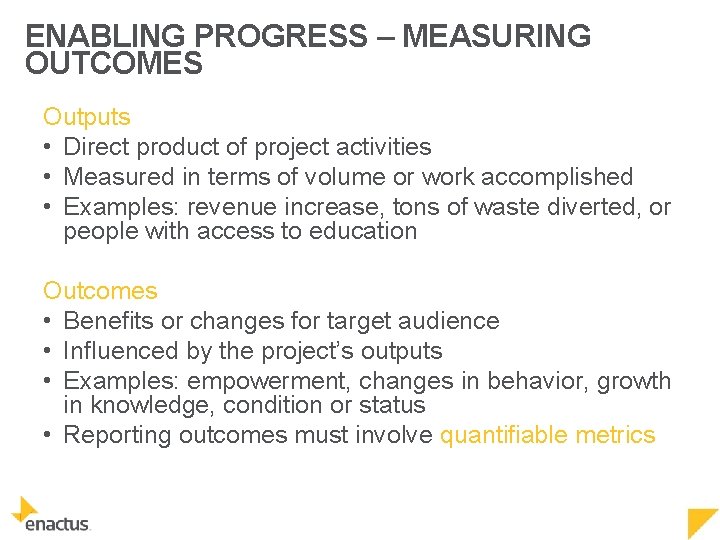
ENABLING PROGRESS – MEASURING OUTCOMES Measuring the outcomes of any initiative is critical to determining its success. Given that your project approach was created to enhance certain livelihood assets, this step should be fairly straight forward.
ENABLING PROGRESS – MEASURING OUTCOMES Understanding what an outcome is and what it is not is obviously crucial to understanding your projects success accurately.
ENABLING PROGRESS – MEASURING OUTCOMES Outputs • Direct product of project activities • Measured in terms of volume or work accomplished • Examples: revenue increase, tons of waste diverted, or people with access to education Outcomes • Benefits or changes for target audience • Influenced by the project’s outputs • Examples: empowerment, changes in behavior, growth in knowledge, condition or status • Reporting outcomes must involve quantifiable metrics
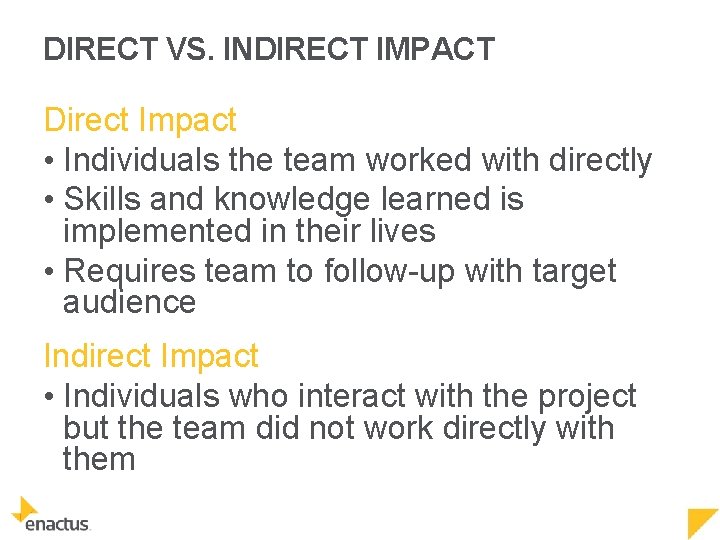
DIRECT VS. INDIRECT IMPACT Direct Impact • Individuals the team worked with directly • Skills and knowledge learned is implemented in their lives • Requires team to follow-up with target audience Indirect Impact • Individuals who interact with the project but the team did not work directly with them
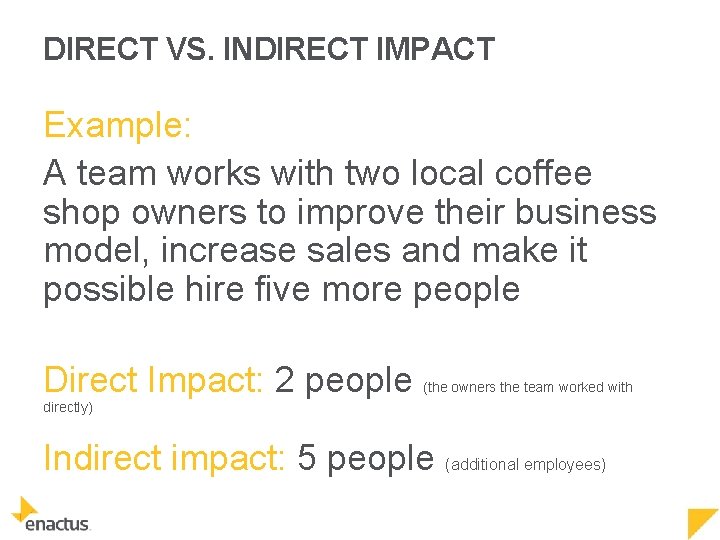
DIRECT VS. INDIRECT IMPACT Example: A team works with two local coffee shop owners to improve their business model, increase sales and make it possible hire five more people Direct Impact: 2 people (the owners the team worked with directly) Indirect impact: 5 people (additional employees)
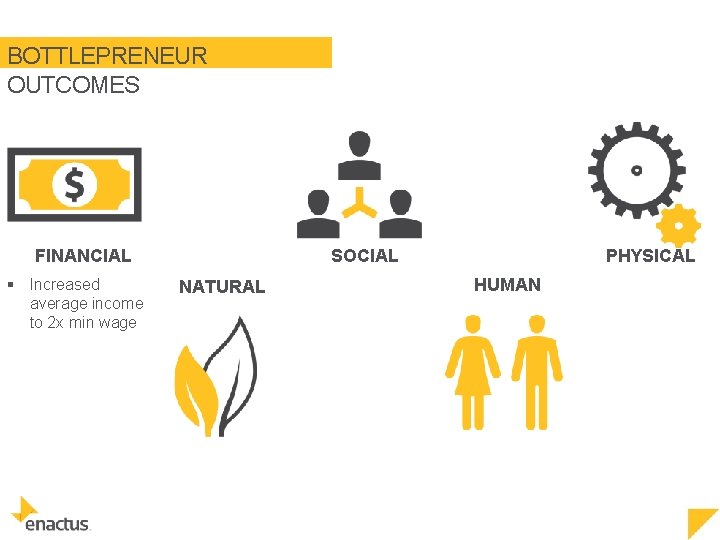
BOTTLEPRENEUR OUTCOMES SOCIAL FINANCIAL § Increased average income to 2 x min wage NATURAL PHYSICAL HUMAN
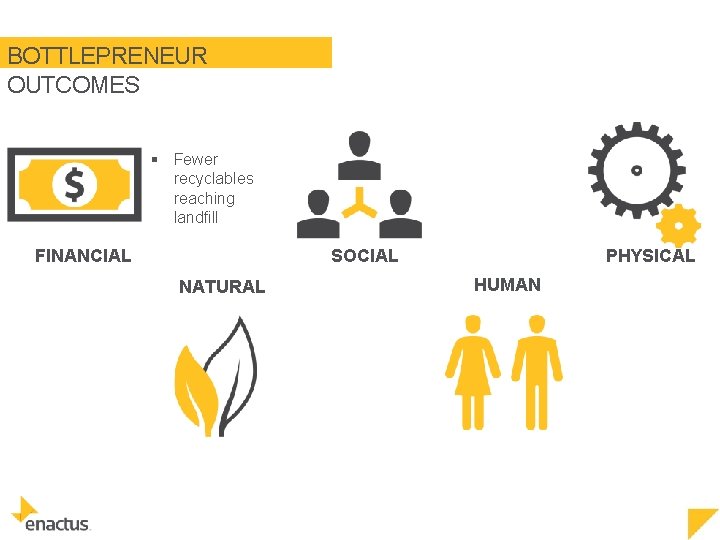
BOTTLEPRENEUR ASSET CATEGORIES OUTCOMES § Fewer recyclables reaching landfill SOCIAL FINANCIAL NATURAL PHYSICAL HUMAN
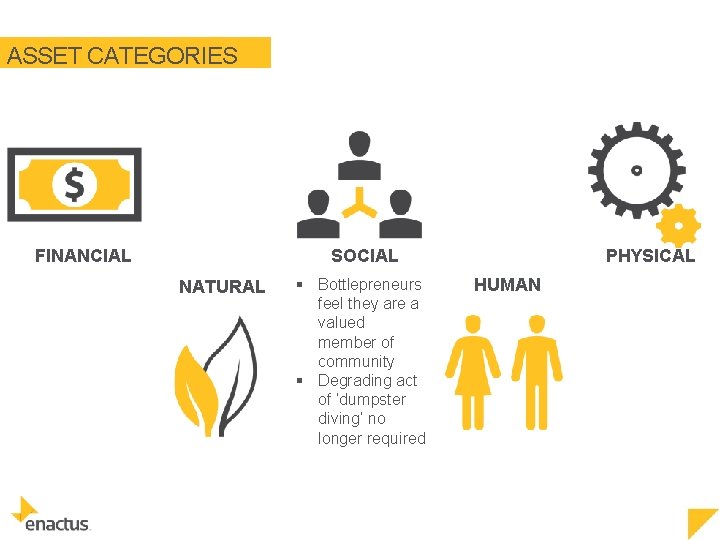
ASSET CATEGORIES SOCIAL FINANCIAL NATURAL § Bottlepreneurs feel they are a valued member of community § Degrading act of ‘dumpster diving’ no longer required PHYSICAL HUMAN
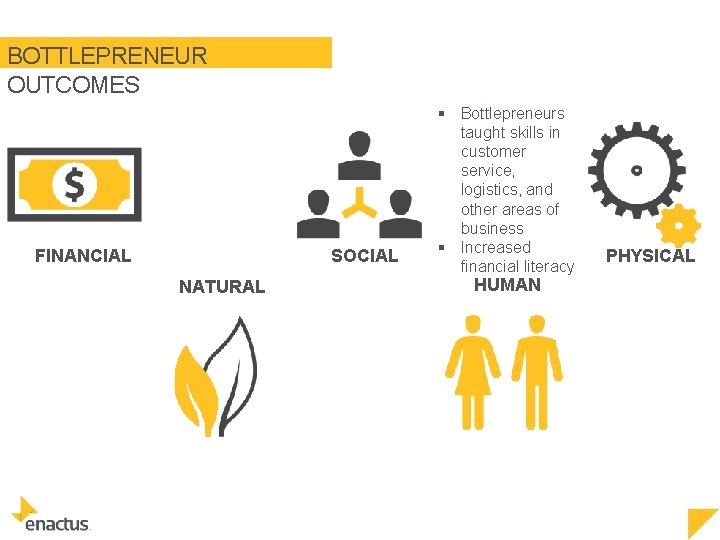
BOTTLEPRENEUR ASSET CATEGORIES OUTCOMES SOCIAL FINANCIAL NATURAL § Bottlepreneurs taught skills in customer service, logistics, and other areas of business § Increased financial literacy HUMAN PHYSICAL
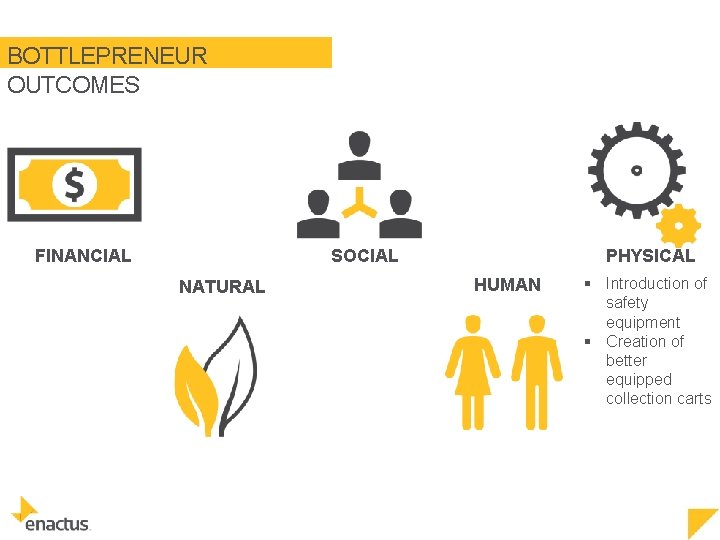
BOTTLEPRENEUR ASSET CATEGORIES OUTCOMES SOCIAL FINANCIAL NATURAL PHYSICAL HUMAN § Introduction of safety equipment § Creation of better equipped collection carts
ENABLING PROGRESS– MEASURING OUTCOMES But… are there any metrics in particular that would be beneficial for us to measure, if at all possible? Yes.
#SEEOPPORTUNITY
UNDERSTAND PROJECT REPORTING Last year we introduced a new reporting system which was designed to better aggregate our data. This has been hugely helpful in understanding our true impact and to identify partnership opportunities with potential donors.
UNDERSTAND PROJECT REPORTING This year’s reporting templates will be release within the next month. All project managers should understand what metrics they will be asked to report on at the end of the year.
UNDERSTAND PROJECT REPORTING This has two clear benefits: 1. Not playing catch-up when the time for reporting does come along 2. Identifying areas to measure which your team may not have thought of.
ENACTUS PROJECT PROCESS SEE OPPORTUNITY Livelihood Assets TAKE ACTION Livelihood Strategies ENABLE PROGRESS Livelihood Outcomes
ENACTUS PROJECT PROCESS SEE OPPORTUNITY Livelihood Assets TAKE ACTION Livelihood Strategies ENABLE PROGRESS Livelihood Outcomes
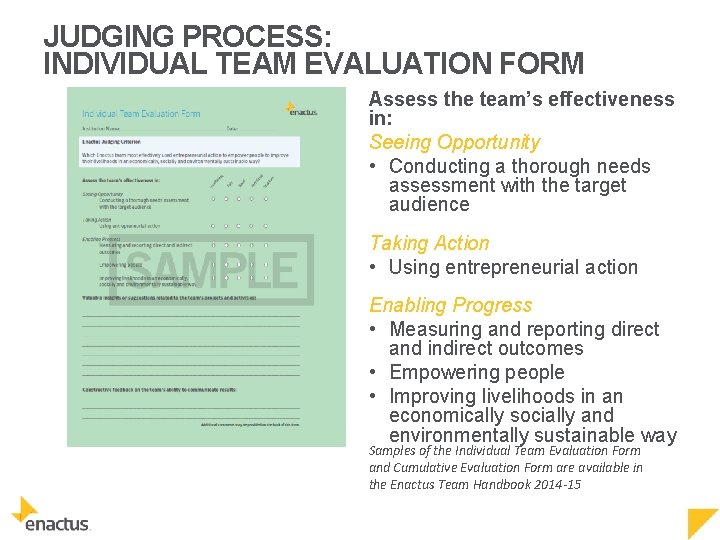
JUDGING PROCESS: INDIVIDUAL TEAM EVALUATION FORM Assess the team’s effectiveness in: Seeing Opportunity • Conducting a thorough needs assessment with the target audience Taking Action • Using entrepreneurial action Enabling Progress • Measuring and reporting direct and indirect outcomes • Empowering people • Improving livelihoods in an economically socially and environmentally sustainable way Samples of the Individual Team Evaluation Form and Cumulative Evaluation Form are available in the Enactus Team Handbook 2014 -15
ACTIVITY – YOU BE THE JUDGE! 2014 Enactus United States National Runner-Up Enactus Heritage University
REVISED JUDGING CRITERION: CONDUCTING A NEEDS ASSESSMENT