
GRE 4220 BEGINNING GREEK I Class VI Demonstrative
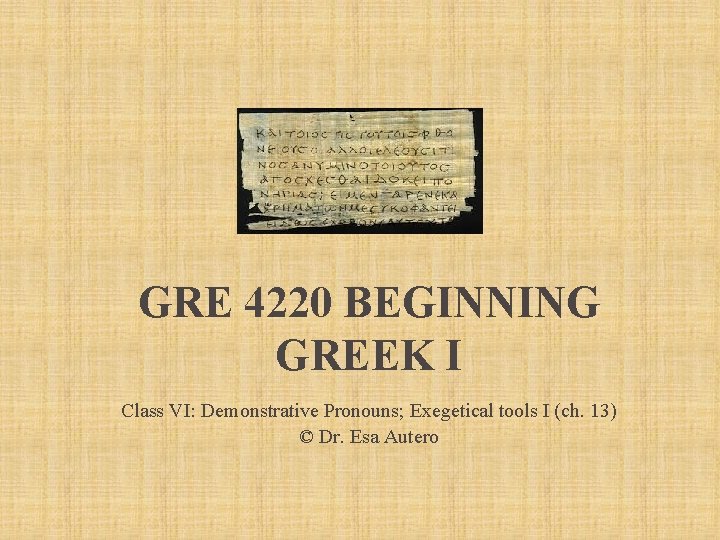
GRE 4220 BEGINNING GREEK I Class VI: Demonstrative Pronouns; Exegetical tools I (ch. 13) © Dr. Esa Autero
Demonstrative Pronouns 1. 1 Introduction q A demonstrative pronoun represents a thing or things: Ø Ø q q Near in distance or time (this, these) Far in distance or time (that, those) This tastes good These are bad times. Look at that! Those were the days!
Demonstrative Pronouns q Demonstrative pronouns can function as: Ø Pronoun or Adjectives Ø Pronoun o Ø That is mine Adjective o That car is mine
Demonstrative Pronouns 1. 2 Demonstrative Pronouns in Greek q Two important demonstrative pronouns: Ø οὗτος (this) relates something near at hand Ø ἐκεῖνος (that) relates something farther removed
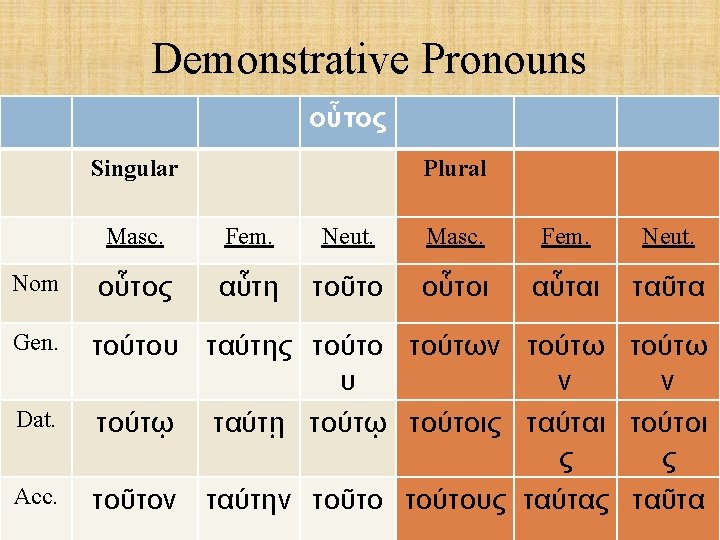
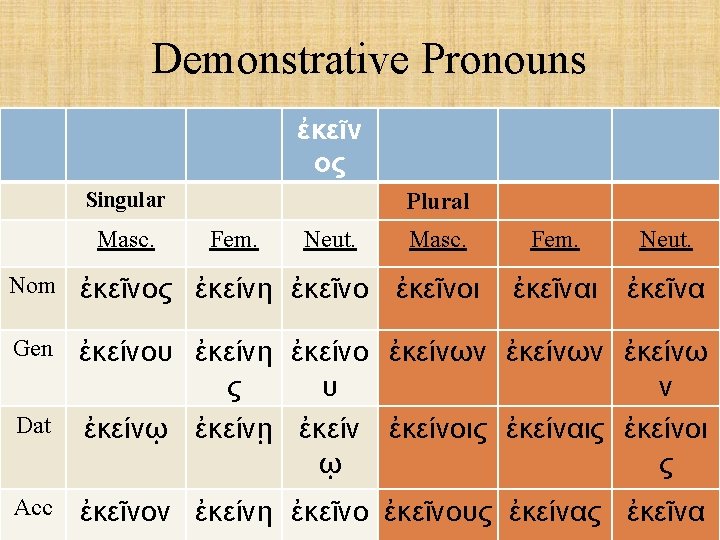
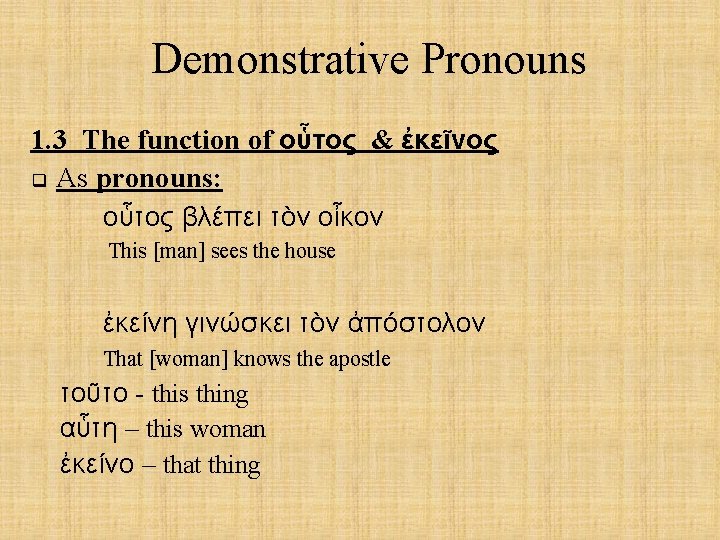
Demonstrative Pronouns 1. 3 The function of οὗτος & ἐκεῖνος q As pronouns: οὗτος βλέπει τὸν οἶκον This [man] sees the house ἐκείνη γινώσκει τὸν ἀπόστολον That [woman] knows the apostle τοῦτο - this thing αὗτη – this woman ἐκείνο – that thing
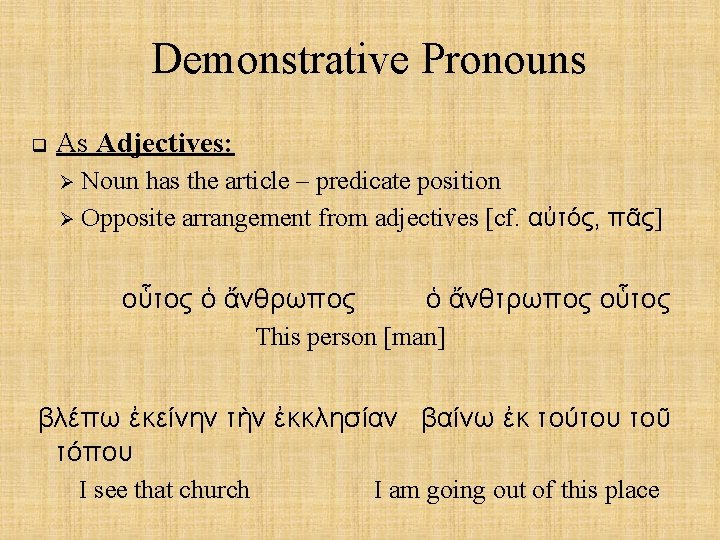
Demonstrative Pronouns q As Adjectives: Noun has the article – predicate position Ø Opposite arrangement from adjectives [cf. αὐτός, πᾶς] Ø οὗτος ὁ ἄνθρωπος ὁ ἄνθτρωπος οὗτος This person [man] βλέπω ἐκείνην τὴν ἐκκλησίαν βαίνω ἐκ τούτου τοῦ τόπου I see that church I am going out of this place
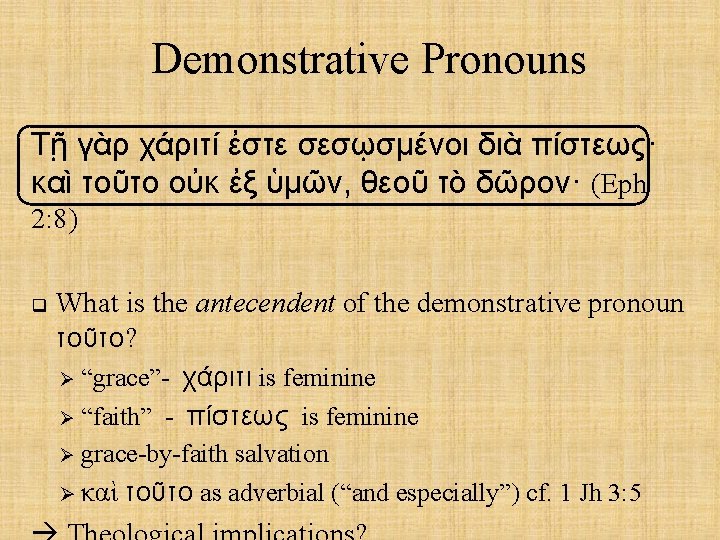
Demonstrative Pronouns Τῇ γὰρ χάριτί ἐστε σεσῳσμένοι διὰ πίστεως· καὶ τοῦτο οὐκ ἐξ ὑμῶν, θεοῦ τὸ δῶρον· (Eph 2: 8) q What is the antecendent of the demonstrative pronoun τοῦτο? Ø “grace”- χάριτι is feminine Ø “faith” - πίστεως is feminine grace-by-faith salvation Ø καὶ τοῦτο as adverbial (“and especially”) cf. 1 Jh 3: 5 Ø
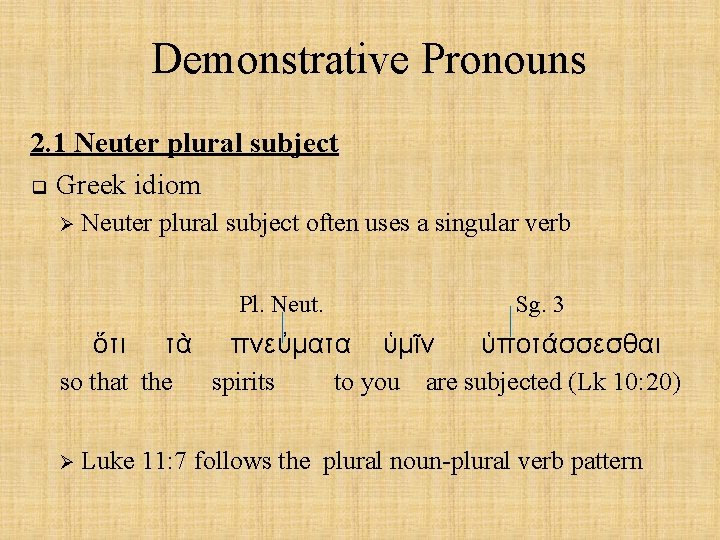
Demonstrative Pronouns 2. 1 Neuter plural subject q Greek idiom Ø Neuter plural subject often uses a singular verb Pl. Neut. ὅτι τὰ so that the Ø Sg. 3 πνεὐματα spirits ὑμῖν to you ὑποτάσσεσθαι are subjected (Lk 10: 20) Luke 11: 7 follows the plural noun-plural verb pattern

Demonstrative Pronouns/Adjectives 3. 1 Vocative – the 5 th Case q Greek cases learned so far: Ø Nominative – basic (naming case) Genitive - possession (of); separation (from) Dative - “to”, “in”, “with” [indirect obj. ; instrumental, locative] Accusative - direct object Ø Vocative – case of direct address Ø Ø Ø When a noun is being directly addressed – e. g. “Teacher”

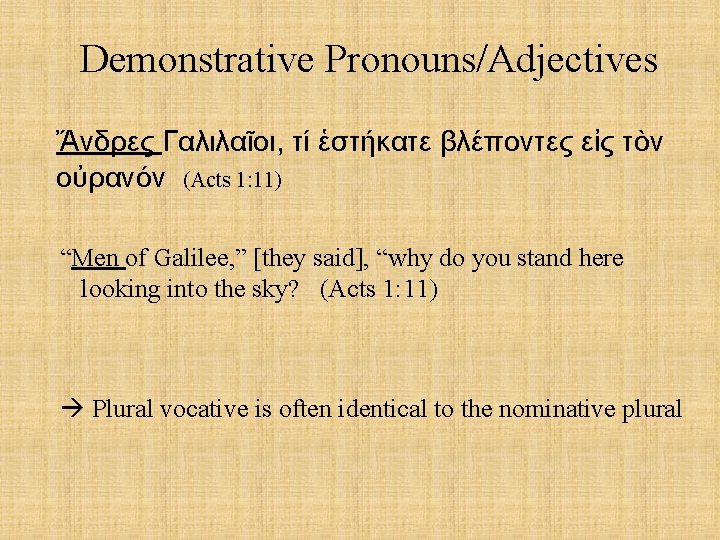
Demonstrative Pronouns/Adjectives Ἄνδρες Γαλιλαῖοι, τί ἑστήκατε βλέποντες εἰς τὸν οὐρανόν (Acts 1: 11) “Men of Galilee, ” [they said], “why do you stand here looking into the sky? (Acts 1: 11) Plural vocative is often identical to the nominative plural
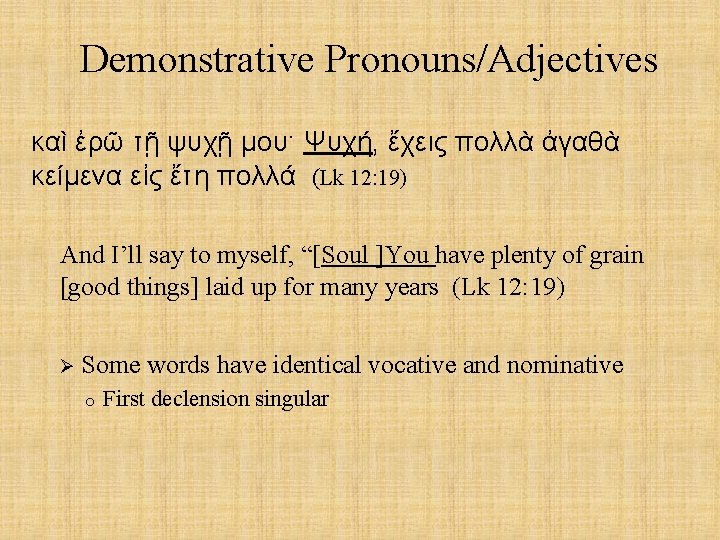
Demonstrative Pronouns/Adjectives καὶ ἐρῶ τῇ ψυχῇ μου· Ψυχή, ἔχεις πολλὰ ἀγαθὰ κείμενα εἰς ἔτη πολλά (Lk 12: 19) And I’ll say to myself, “[Soul ]You have plenty of grain [good things] laid up for many years (Lk 12: 19) Ø Some words have identical vocative and nominative o First declension singular
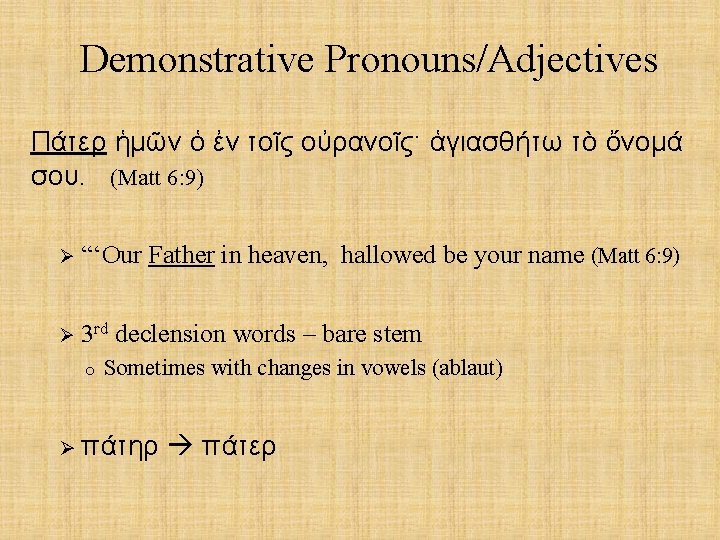
Demonstrative Pronouns/Adjectives Πάτερ ἡμῶν ὁ ἐν τοῖς οὐρανοῖς· ἁγιασθήτω τὸ ὄνομά σου. (Matt 6: 9) Ø “‘Our Father in heaven, hallowed be your name (Matt 6: 9) Ø 3 rd declension words – bare stem o Sometimes with changes in vowels (ablaut) Ø πάτηρ πάτερ
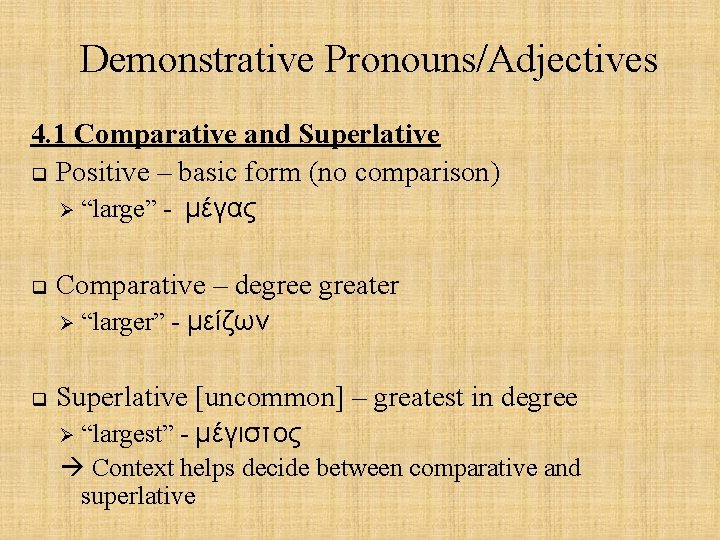
Demonstrative Pronouns/Adjectives 4. 1 Comparative and Superlative q Positive – basic form (no comparison) Ø “large” - μέγας q q Comparative – degree greater Ø “larger” - μείζων Superlative [uncommon] – greatest in degree Ø “largest” - μέγιστος Context helps decide between comparative and superlative
Practice & Exercises q Workbook: Ø q p. 45 – warm-up and parsing Homework: q P. 43, no: 8 -10 q P. 47, no: 8 -10 q Quiz: chs. 12 -13
Greek Language Tools 5. 1 Introduction q How to study God’s Word? q Use tools effectively and accurately q Avoid pitfalls q Utilize and develop knowledge of Greek q Evaluate translations
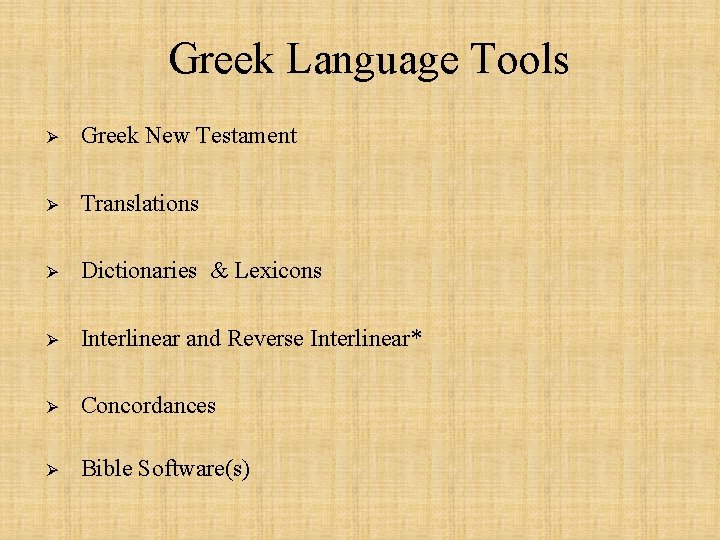
Greek Language Tools Ø Greek New Testament Ø Translations Ø Dictionaries & Lexicons Ø Interlinear and Reverse Interlinear* Ø Concordances Ø Bible Software(s)
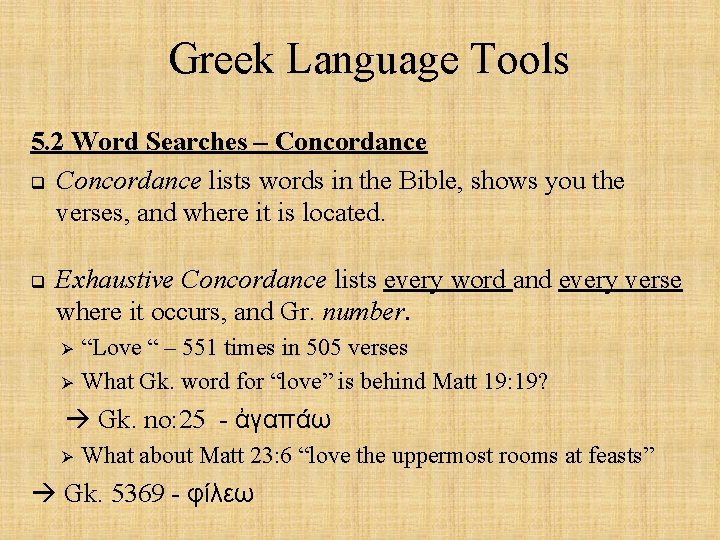
Greek Language Tools 5. 2 Word Searches – Concordance q Concordance lists words in the Bible, shows you the verses, and where it is located. q Exhaustive Concordance lists every word and every verse where it occurs, and Gr. number. Ø Ø “Love “ – 551 times in 505 verses What Gk. word for “love” is behind Matt 19: 19? Gk. no: 25 - ἀγαπάω Ø What about Matt 23: 6 “love the uppermost rooms at feasts” Gk. 5369 - φίλεω
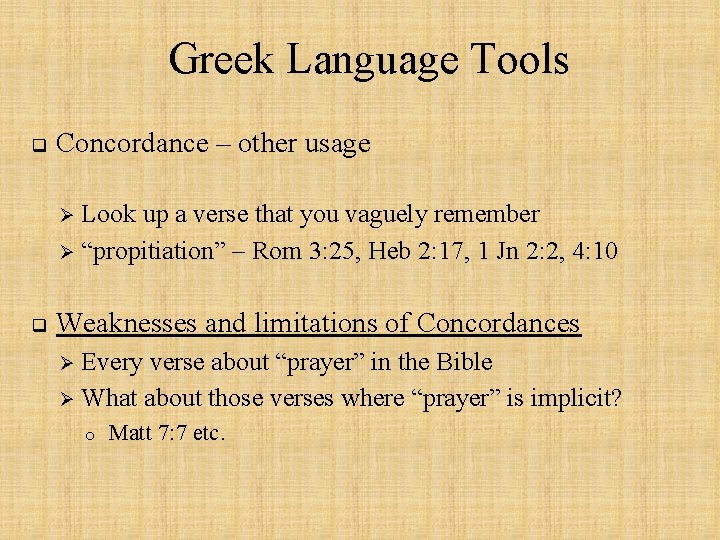
Greek Language Tools q Concordance – other usage Look up a verse that you vaguely remember Ø “propitiation” – Rom 3: 25, Heb 2: 17, 1 Jn 2: 2, 4: 10 Ø q Weaknesses and limitations of Concordances Every verse about “prayer” in the Bible Ø What about those verses where “prayer” is implicit? Ø o Matt 7: 7 etc.
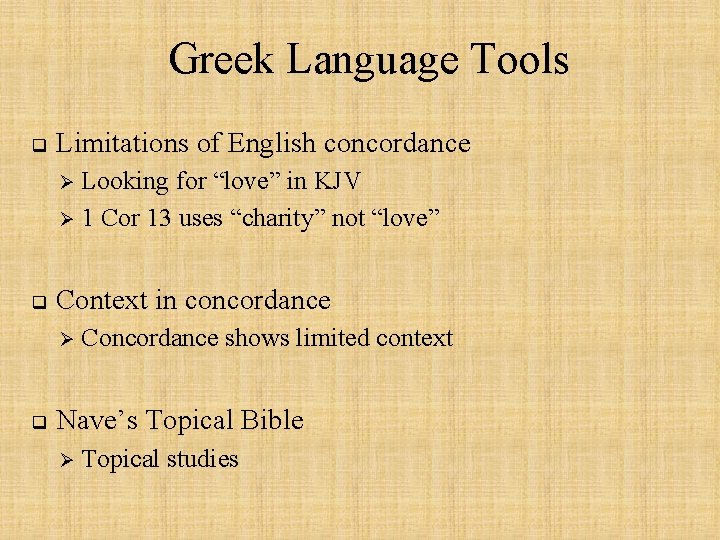
Greek Language Tools q Limitations of English concordance Looking for “love” in KJV Ø 1 Cor 13 uses “charity” not “love” Ø q Context in concordance Ø q Concordance shows limited context Nave’s Topical Bible Ø Topical studies
Greek Language Tools 5. 3 Concordance Exercises 1. ) Look up the word “world” and find how it is used in Luke 2: 1? 2. ) What is the underlying Greek word? 3. ) What other Greek words for “world” are used by Luke? How can this add to the understanding of the Bible?
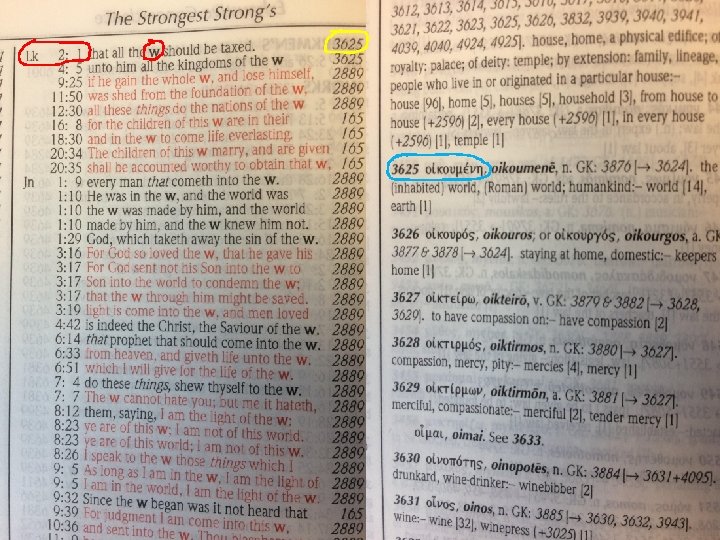
Greek Language Tools 5. 3 Concordance Exercises 1. ) Look up the word “world” and find how it is used in Luke 2: 1? 2. ) What is the underlying Greek word? 3. ) What other Greek words for “world” are used by Luke? How can this add to the understanding of the Bible?
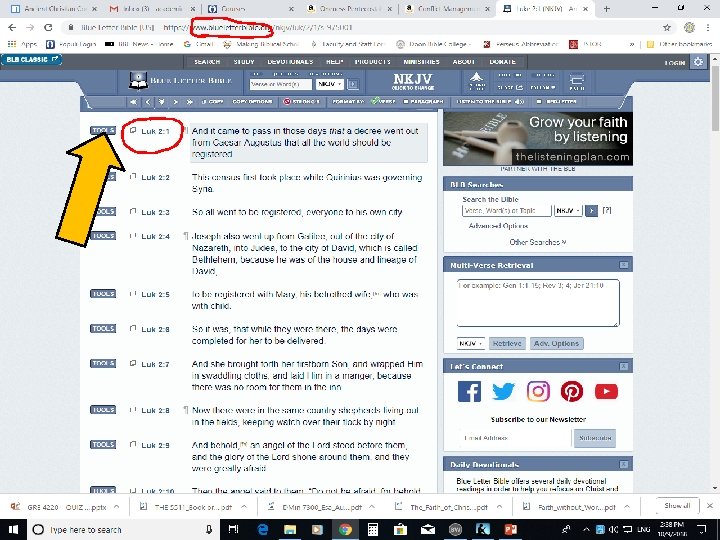
Greek Language Tools 5. 3 Concordance Exercises 1. ) Look up the word “world” and find how it is used in Luke 2: 1? 2. ) What is the underlying Greek word? 3. ) What other Greek words for “world” are used by Luke? How can this add to the understanding of the Bible?
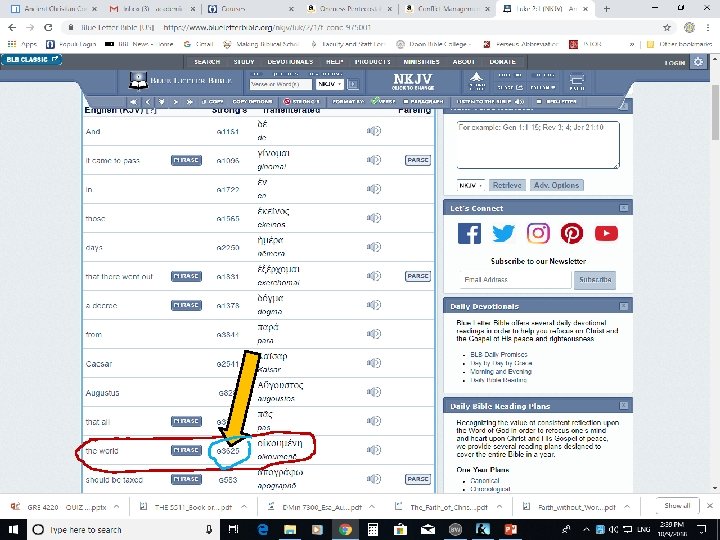
Greek Language Tools 5. 3 Concordance Exercises 1. ) Look up the word “world” and find how it is used in Luke 2: 1? 2. ) What is the underlying Greek word? 3. ) What other Greek words for “world” are used by Luke? How can this add to the understanding of the Bible?
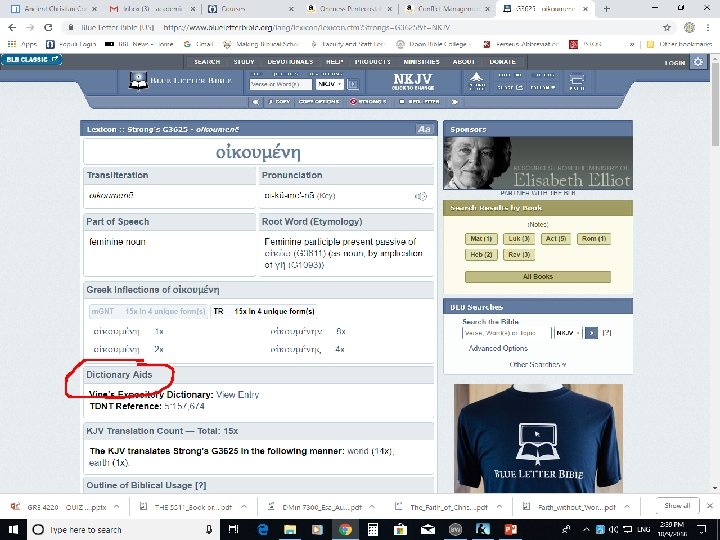
Greek Language Tools 5. 3 Concordance Exercises 1. ) Look up the word “world” and find how it is used in Luke 2: 1? 2. ) What is the underlying Greek word? 3. ) What other Greek words for “world” are used by Luke? How can this add to the understanding of the Bible?
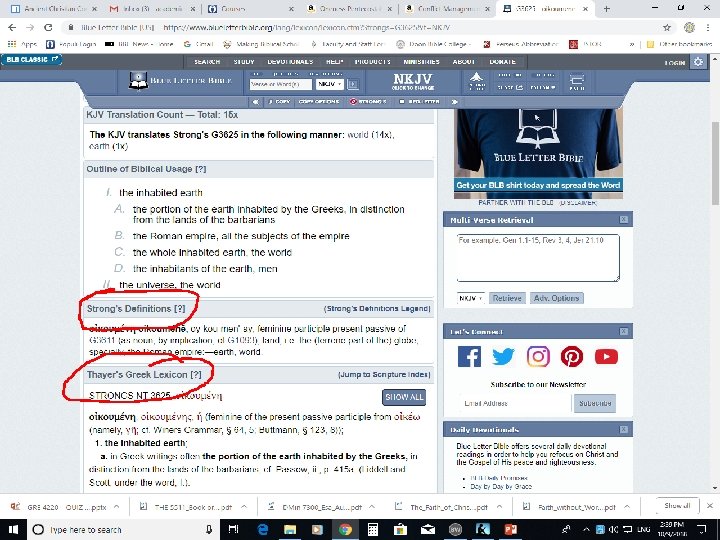
Greek Language Tools 5. 3 Concordance Exercises 1. ) Look up the word “world” and find how it is used in Luke 2: 1? 2. ) What is the underlying Greek word? 3. ) What other Greek words for “world” are used by Luke? How can this add to the understanding of the Bible?
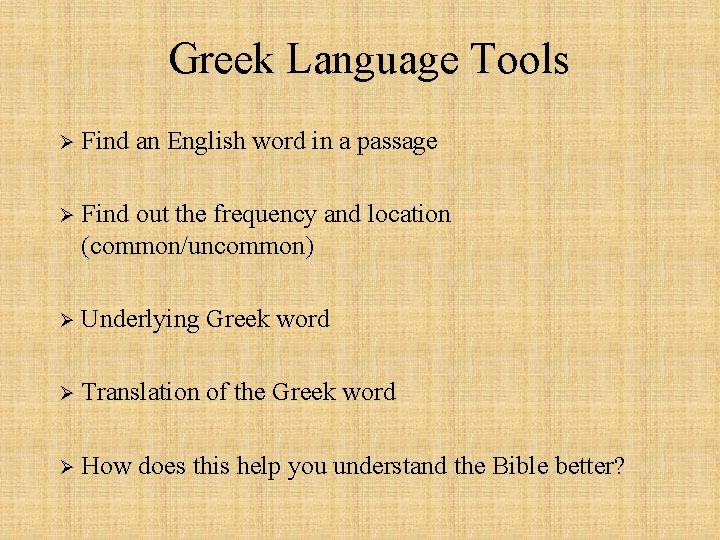
Greek Language Tools Ø Find an English word in a passage Ø Find out the frequency and location (common/uncommon) Ø Underlying Greek word Ø Translation of the Greek word Ø How does this help you understand the Bible better?
Greek Language Tools 6. 1 Introduction to Word Studies “What was originally expressed in Hebrew does not have exactly the same sense when translated into another language. ” Prologue to the Book of Sirach c. 180 BC
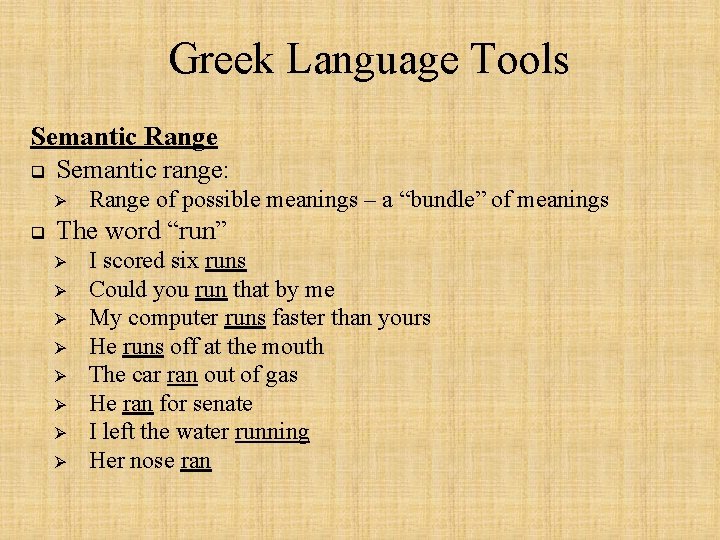
Greek Language Tools Semantic Range q Semantic range: Ø q Range of possible meanings – a “bundle” of meanings The word “run” Ø Ø Ø Ø I scored six runs Could you run that by me My computer runs faster than yours He runs off at the mouth The car ran out of gas He ran for senate I left the water running Her nose ran
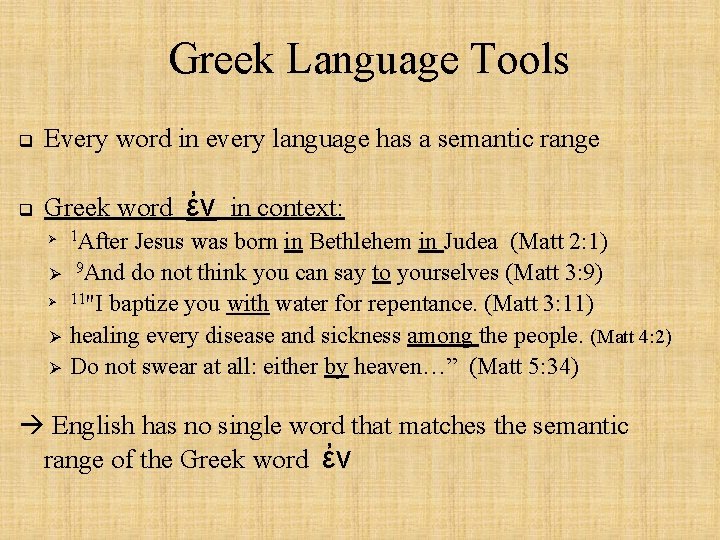
Greek Language Tools q Every word in every language has a semantic range q Greek word ἐν in context: Ø Ø Ø 1 After Jesus was born in Bethlehem in Judea (Matt 2: 1) 9 And do not think you can say to yourselves (Matt 3: 9) 11"I baptize you with water for repentance. (Matt 3: 11) healing every disease and sickness among the people. (Matt 4: 2) Do not swear at all: either by heaven…” (Matt 5: 34) English has no single word that matches the semantic range of the Greek word ἐν
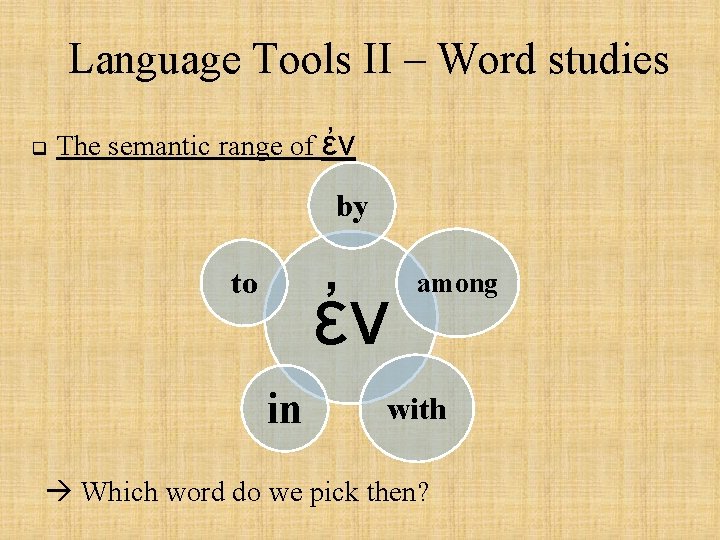
Language Tools II – Word studies q The semantic range of ἐν by to ἐν in among with Which word do we pick then?
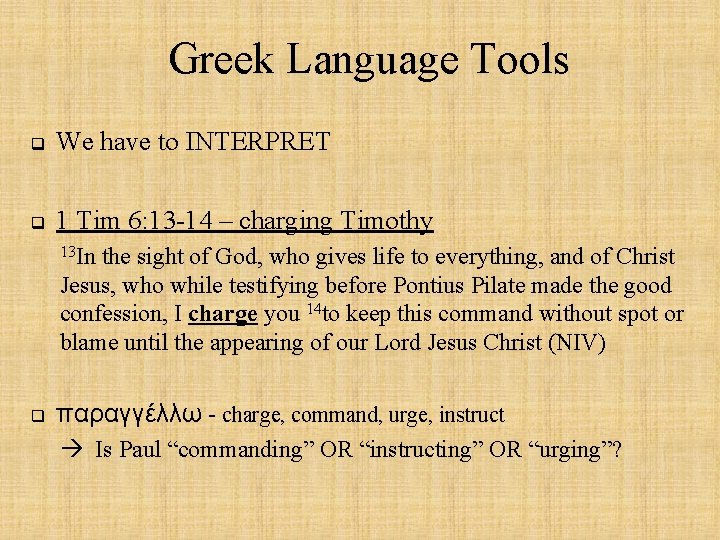
Greek Language Tools q We have to INTERPRET q 1 Tim 6: 13 -14 – charging Timothy 13 In the sight of God, who gives life to everything, and of Christ Jesus, who while testifying before Pontius Pilate made the good confession, I charge you 14 to keep this command without spot or blame until the appearing of our Lord Jesus Christ (NIV) q παραγγέλλω - charge, command, urge, instruct Is Paul “commanding” OR “instructing” OR “urging”?
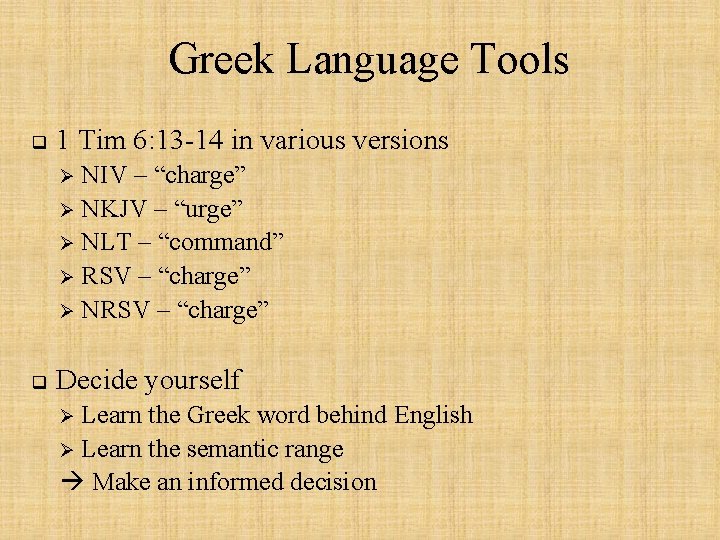
Greek Language Tools q 1 Tim 6: 13 -14 in various versions NIV – “charge” Ø NKJV – “urge” Ø NLT – “command” Ø RSV – “charge” Ø NRSV – “charge” Ø q Decide yourself Learn the Greek word behind English Ø Learn the semantic range Make an informed decision Ø
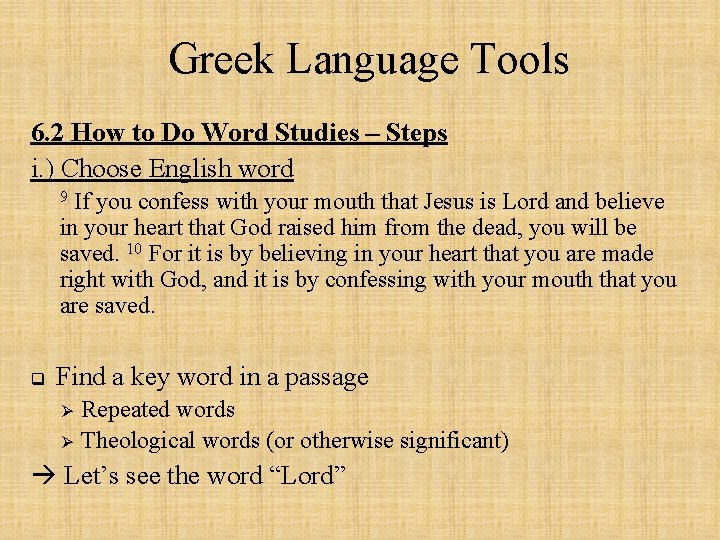
Greek Language Tools 6. 2 How to Do Word Studies – Steps i. ) Choose English word If you confess with your mouth that Jesus is Lord and believe in your heart that God raised him from the dead, you will be saved. 10 For it is by believing in your heart that you are made right with God, and it is by confessing with your mouth that you are saved. 9 q Find a key word in a passage Ø Ø Repeated words Theological words (or otherwise significant) Let’s see the word “Lord”
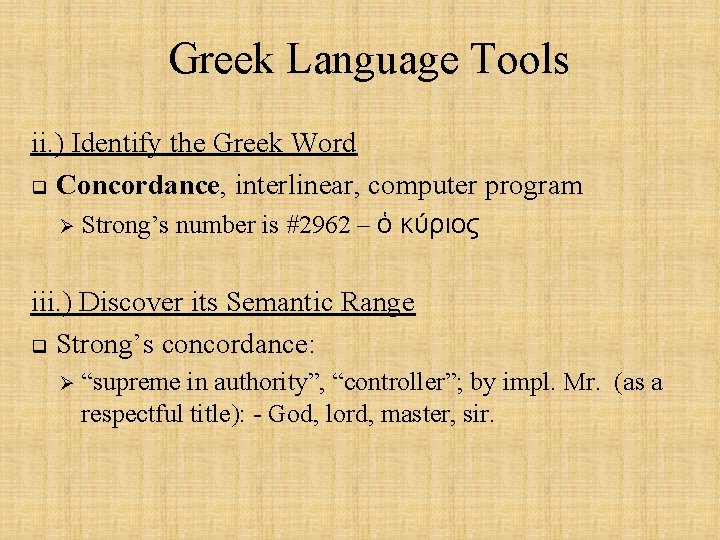
Greek Language Tools ii. ) Identify the Greek Word q Concordance, interlinear, computer program Ø Strong’s number is #2962 – ὁ κύριος iii. ) Discover its Semantic Range q Strong’s concordance: Ø “supreme in authority”, “controller”; by impl. Mr. (as a respectful title): - God, lord, master, sir.
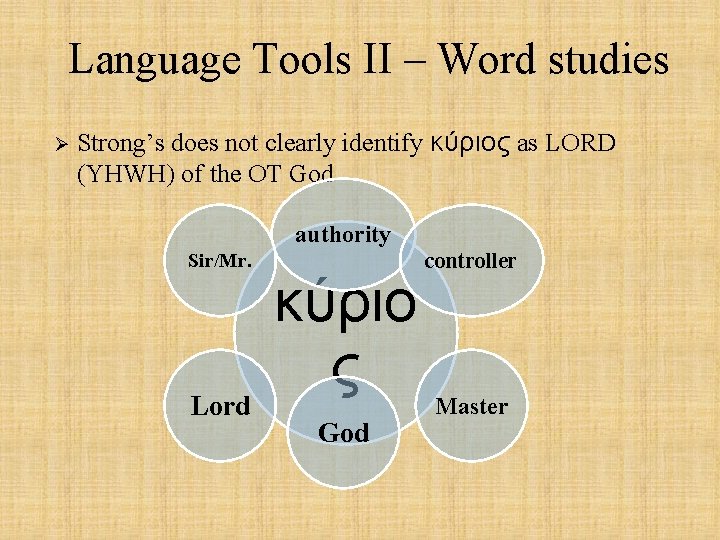
Language Tools II – Word studies Ø Strong’s does not clearly identify κύριος as LORD (YHWH) of the OT God authority Sir/Mr. Lord κύριο ς God controller Master
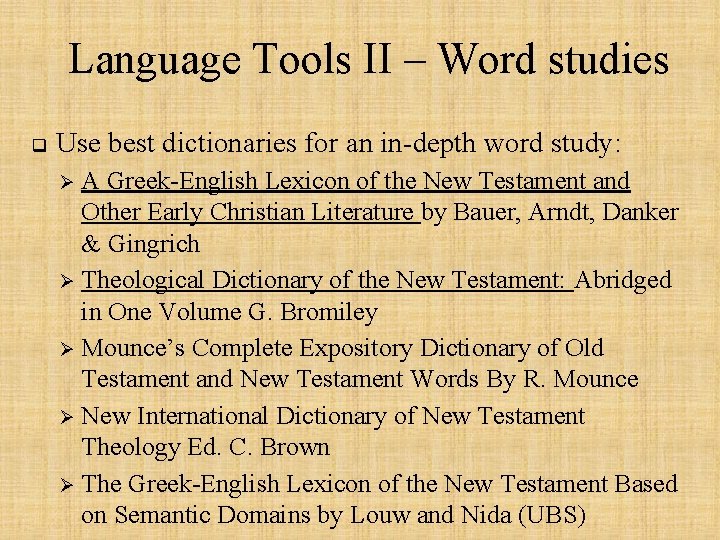
Language Tools II – Word studies q Use best dictionaries for an in-depth word study: A Greek-English Lexicon of the New Testament and Other Early Christian Literature by Bauer, Arndt, Danker & Gingrich Ø Theological Dictionary of the New Testament: Abridged in One Volume G. Bromiley Ø Mounce’s Complete Expository Dictionary of Old Testament and New Testament Words By R. Mounce Ø New International Dictionary of New Testament Theology Ed. C. Brown Ø The Greek-English Lexicon of the New Testament Based on Semantic Domains by Louw and Nida (UBS) Ø
Language Tools II – Word studies iv. ) The word in Context q Decision time q The answer to picking the right meaning is CONTEXT q Move from immediate context to more distant context! Look for clues in the context that would define the meaning of the word. Ø Stop when you have found the clue Ø
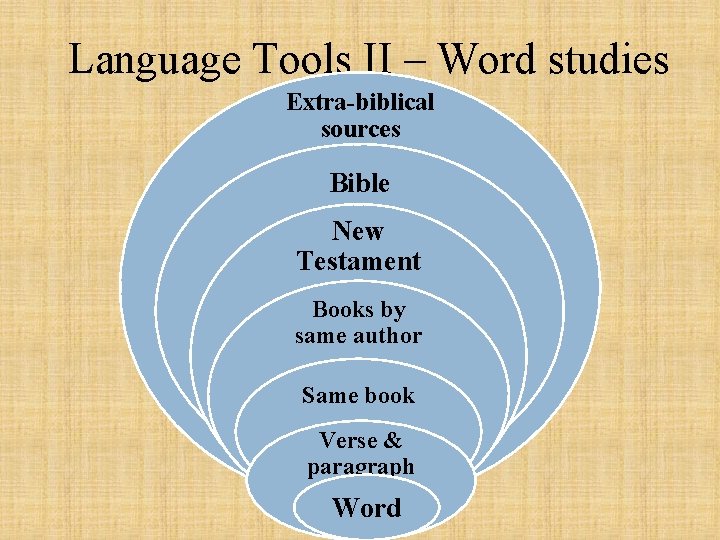
Language Tools II – Word studies Extra-biblical sources Bible New Testament Books by same author Same book Verse & paragraph Word
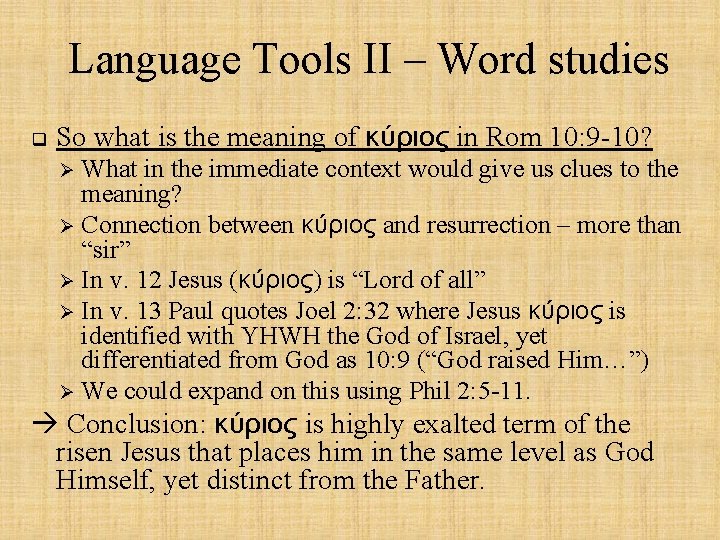
Language Tools II – Word studies q So what is the meaning of κύριος in Rom 10: 9 -10? What in the immediate context would give us clues to the meaning? Ø Connection between κύριος and resurrection – more than “sir” Ø In v. 12 Jesus (κύριος) is “Lord of all” Ø In v. 13 Paul quotes Joel 2: 32 where Jesus κύριος is identified with YHWH the God of Israel, yet differentiated from God as 10: 9 (“God raised Him…”) Ø We could expand on this using Phil 2: 5 -11. Ø Conclusion: κύριος is highly exalted term of the risen Jesus that places him in the same level as God Himself, yet distinct from the Father.
Language Tools II – Word studies v. ) A Step Further – using LXX q Word’s usage in Septuagint Hebrew word behind Greek via LXX Ø Heb. YHWH was translated κύριος in LXX Ø q Cognates A word that is related to another word because of the same root prince – princess Ø Cognates have similar, not identical meaning Ø Look for cognates if you cannot find meaning otherwise Ø
Language Tools II – Word studies vi. ) Common mistakes q Anachronism God’s power as “dynamite” from Gr. δύναμις Definitions do not work backwards: Dynamite blows rocks in English usage but not in Greek. Ø q Etymological fallacy Ø μετανοέω (repent) as “to change your mind” Ø q Gay 100 yrs. ago and today or “nice” originally “foolish” Context and meaning Ø Do not put too much emphasize on individual words
Language Tools II – Word studies 7. 1 Word Study Assignment 1. ) Find a word in a verse from NT - List the verse and highlight the word 2. ) Identify the Greek word - Identify Gr. Number and word 3. ) Discover the word’s semantic range - Use at least three good quality Greek dictionaries 4. ) Determine the usage in context - Use in immediate context and two other instances by the same author Length 2 -3 pages [excluding cover and bibliography]

Exercises & Homework q Homework: q p. q 47 – no: 8 -10 Word study assignment: q Due q 11/6 Exam II: q 10/23
- Slides: 46