
Gravity orbits Isaac Newton 1642 1727 developed a
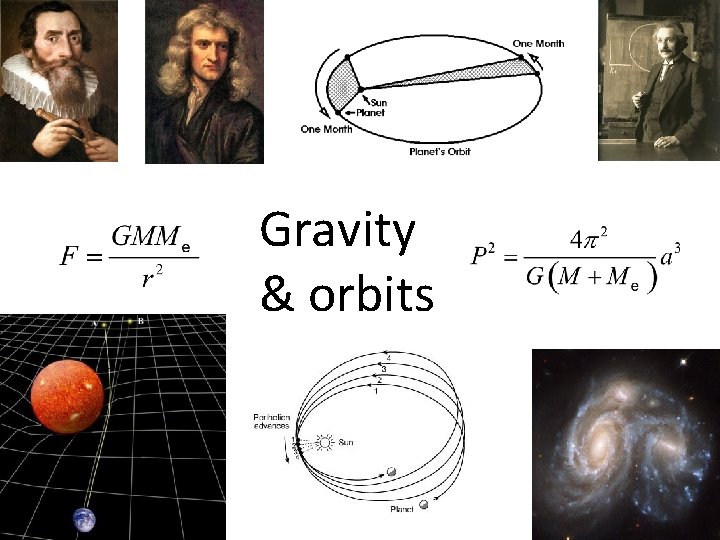
Gravity & orbits
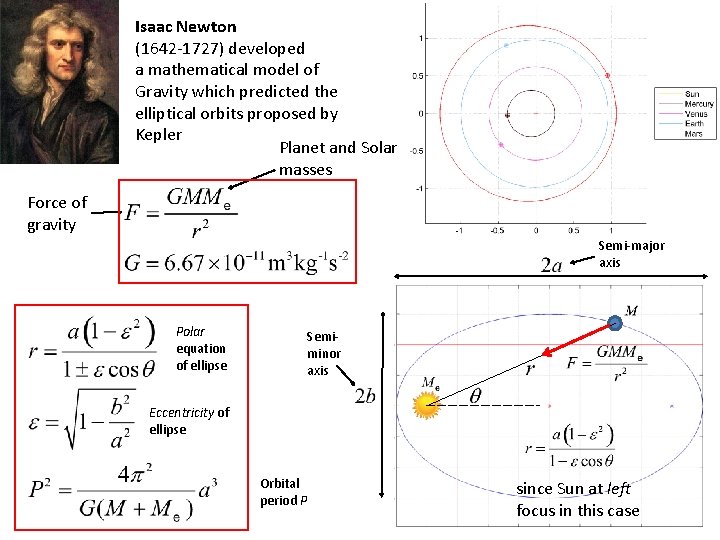
Isaac Newton (1642 -1727) developed a mathematical model of Gravity which predicted the elliptical orbits proposed by Kepler Planet and Solar masses Force of gravity Semi-major axis Polar equation of ellipse Semiminor axis Eccentricity of ellipse Orbital period P since Sun at left focus in this case
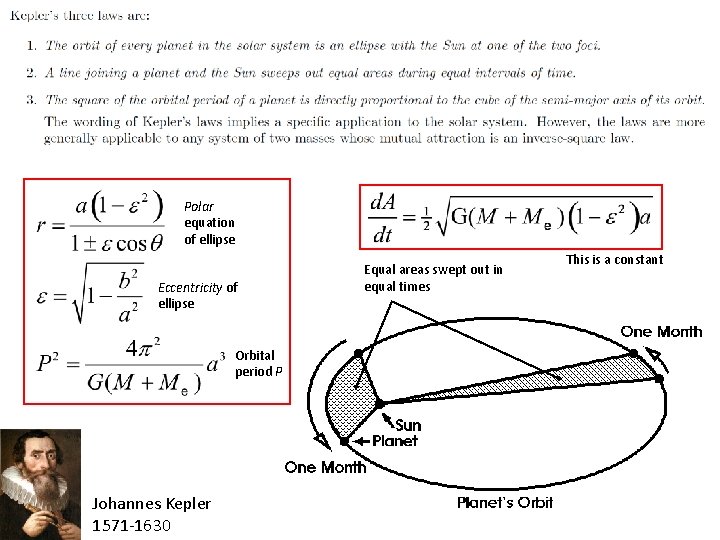
Polar equation of ellipse Eccentricity of ellipse Orbital period P Johannes Kepler 1571 -1630 Equal areas swept out in equal times This is a constant
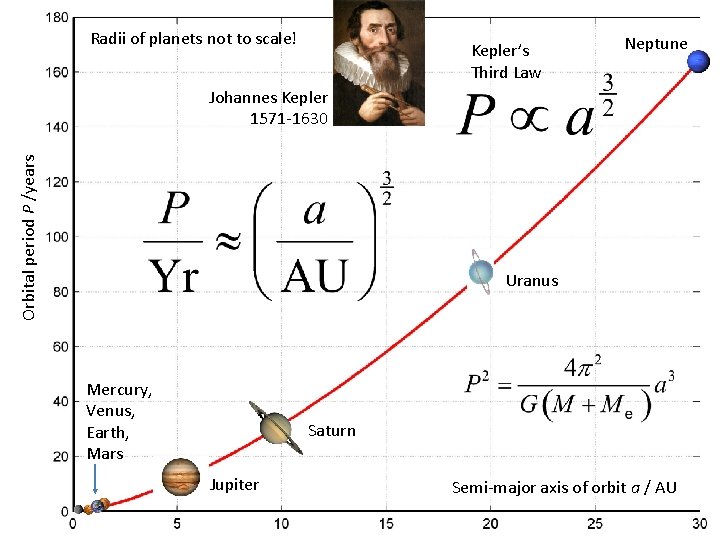
Radii of planets not to scale! Kepler’s Third Law Neptune Orbital period P /years Johannes Kepler 1571 -1630 Uranus Mercury, Venus, Earth, Mars Saturn Jupiter Semi-major axis of orbit a / AU
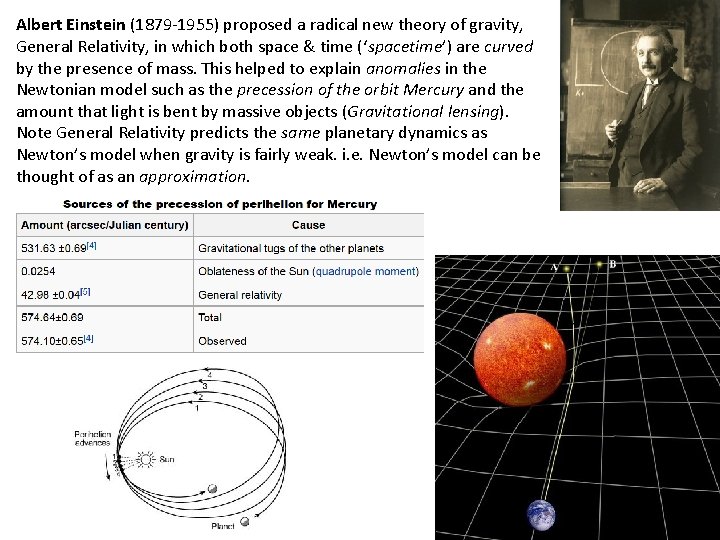
Albert Einstein (1879 -1955) proposed a radical new theory of gravity, General Relativity, in which both space & time (‘spacetime’) are curved by the presence of mass. This helped to explain anomalies in the Newtonian model such as the precession of the orbit Mercury and the amount that light is bent by massive objects (Gravitational lensing). Note General Relativity predicts the same planetary dynamics as Newton’s model when gravity is fairly weak. i. e. Newton’s model can be thought of as an approximation.
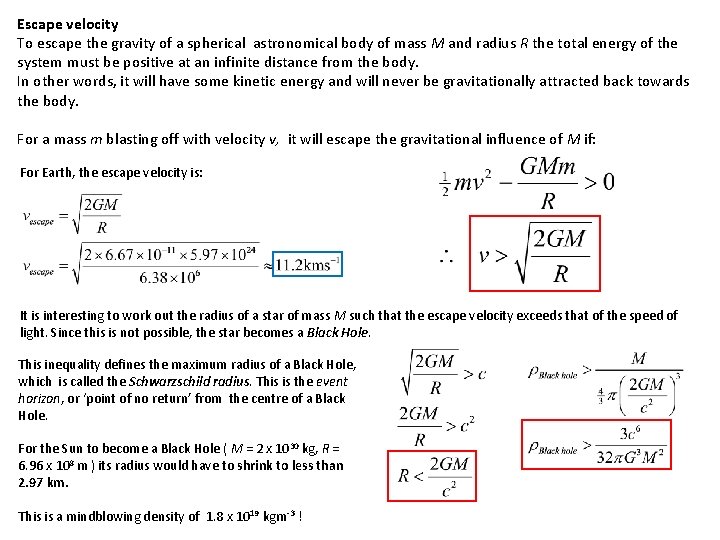
Escape velocity To escape the gravity of a spherical astronomical body of mass M and radius R the total energy of the system must be positive at an infinite distance from the body. In other words, it will have some kinetic energy and will never be gravitationally attracted back towards the body. For a mass m blasting off with velocity v, it will escape the gravitational influence of M if: For Earth, the escape velocity is: It is interesting to work out the radius of a star of mass M such that the escape velocity exceeds that of the speed of light. Since this is not possible, the star becomes a Black Hole. This inequality defines the maximum radius of a Black Hole, which is called the Schwarzschild radius. This is the event horizon, or ‘point of no return’ from the centre of a Black Hole. For the Sun to become a Black Hole ( M = 2 x 1030 kg, R = 6. 96 x 108 m ) its radius would have to shrink to less than 2. 97 km. This is a mindblowing density of 1. 8 x 10¹⁹ kgm-3 !
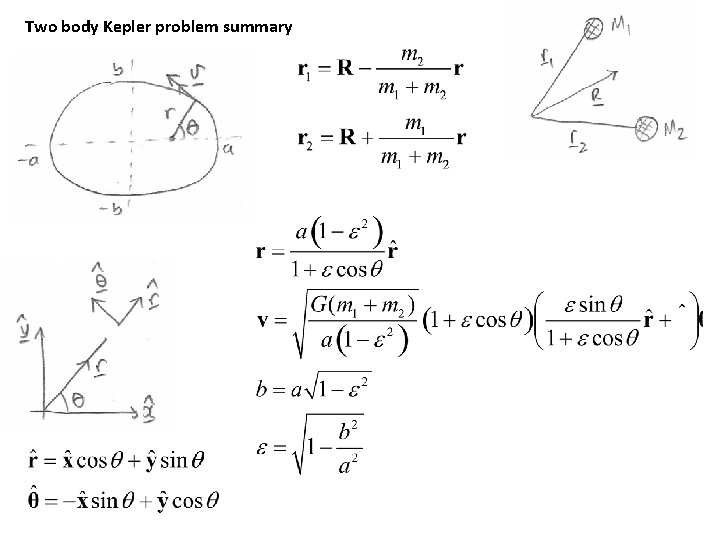
Two body Kepler problem summary
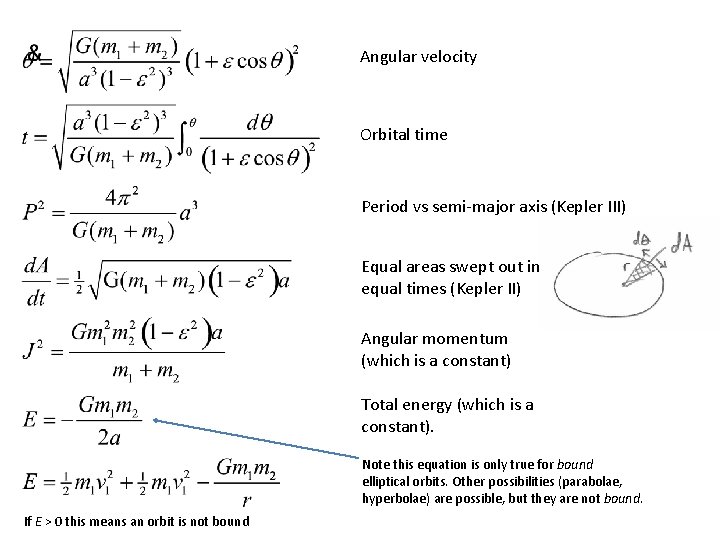
Angular velocity Orbital time Period vs semi-major axis (Kepler III) Equal areas swept out in equal times (Kepler II) Angular momentum (which is a constant) Total energy (which is a constant). Note this equation is only true for bound elliptical orbits. Other possibilities (parabolae, hyperbolae) are possible, but they are not bound. If E > 0 this means an orbit is not bound
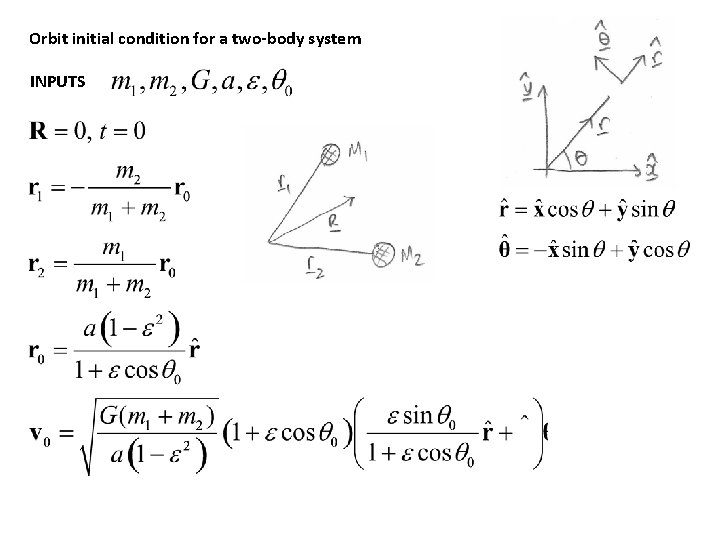
Orbit initial condition for a two-body system INPUTS
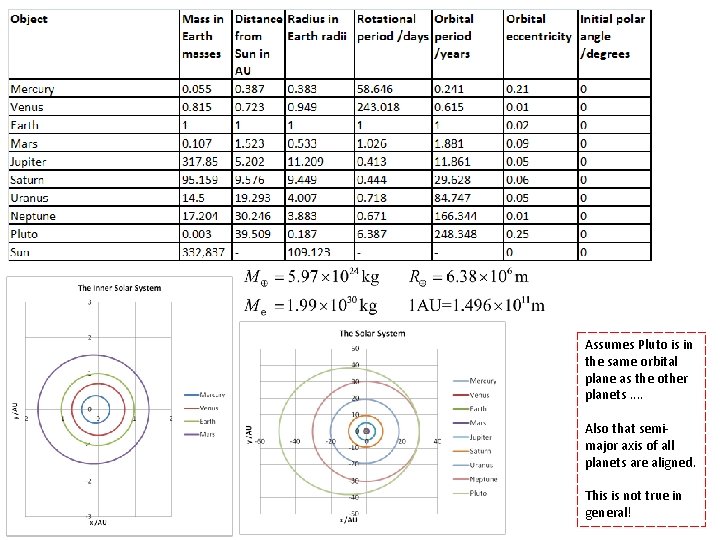
Assumes Pluto is in the same orbital plane as the other planets. . Also that semimajor axis of all planets are aligned. This is not true in general!
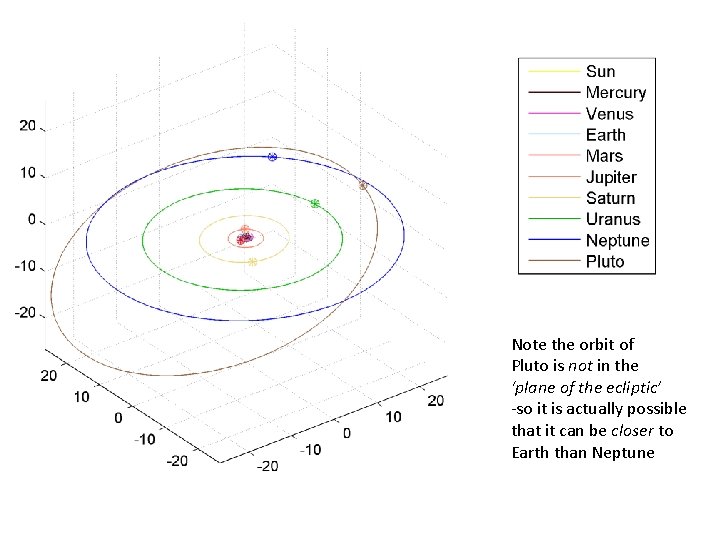
Note the orbit of Pluto is not in the ‘plane of the ecliptic’ -so it is actually possible that it can be closer to Earth than Neptune
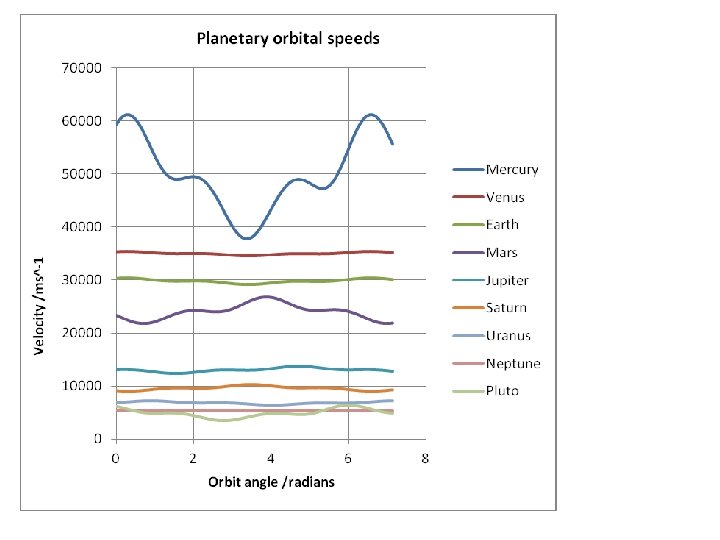
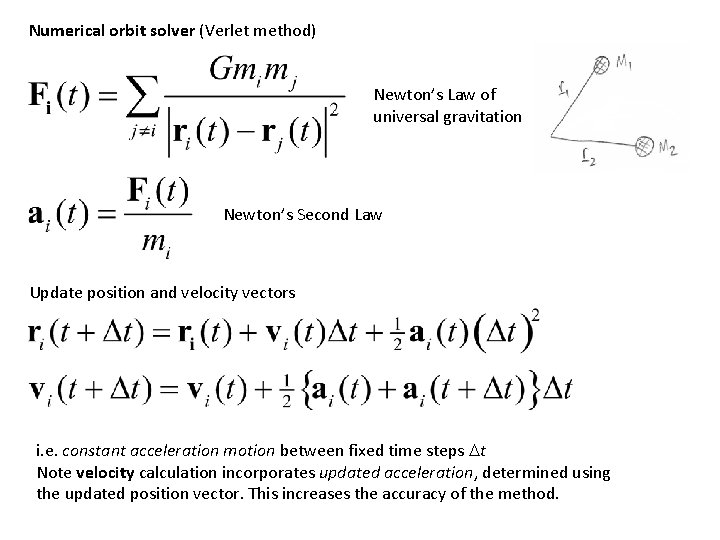
Numerical orbit solver (Verlet method) Newton’s Law of universal gravitation Newton’s Second Law Update position and velocity vectors i. e. constant acceleration motion between fixed time steps Dt Note velocity calculation incorporates updated acceleration, determined using the updated position vector. This increases the accuracy of the method.
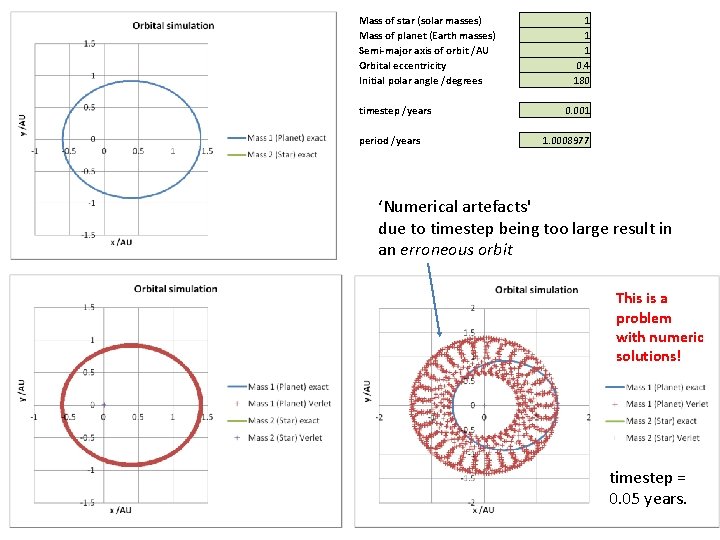
Mass of star (solar masses) Mass of planet (Earth masses) Semi-major axis of orbit /AU Orbital eccentricity Initial polar angle /degrees timestep /years period /years 1 1 1 0. 4 180 0. 001 1. 0008977 ‘Numerical artefacts' due to timestep being too large result in an erroneous orbit This is a problem with numeric solutions! timestep = 0. 05 years.
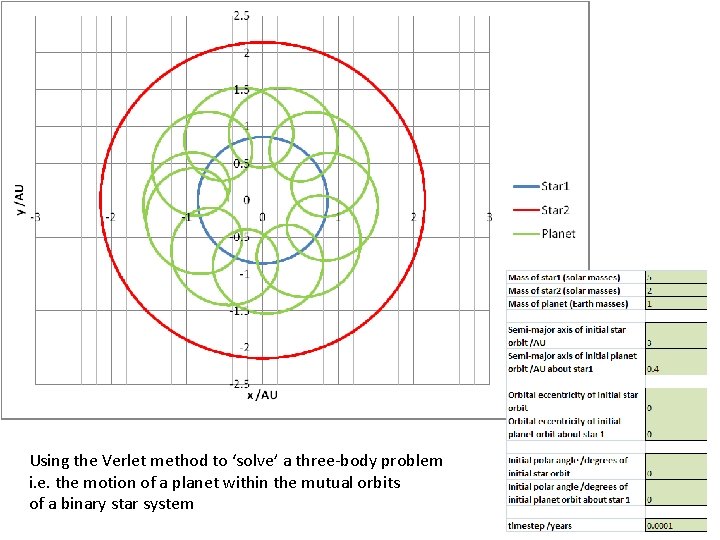
Using the Verlet method to ‘solve’ a three-body problem i. e. the motion of a planet within the mutual orbits of a binary star system
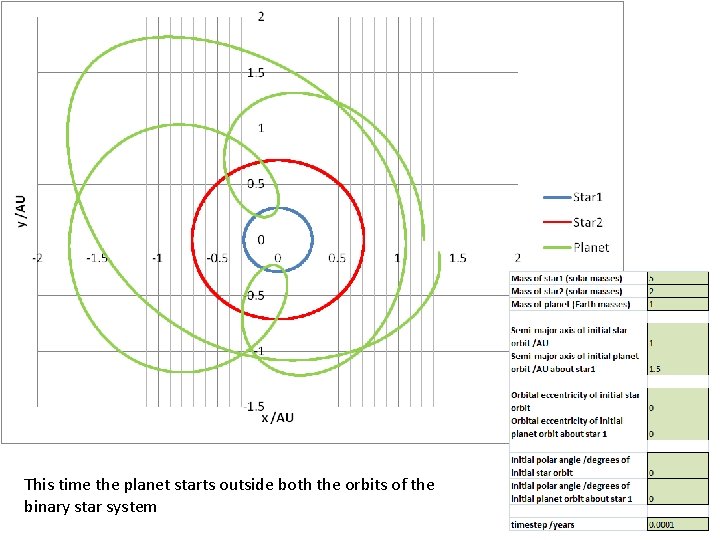
This time the planet starts outside both the orbits of the binary star system
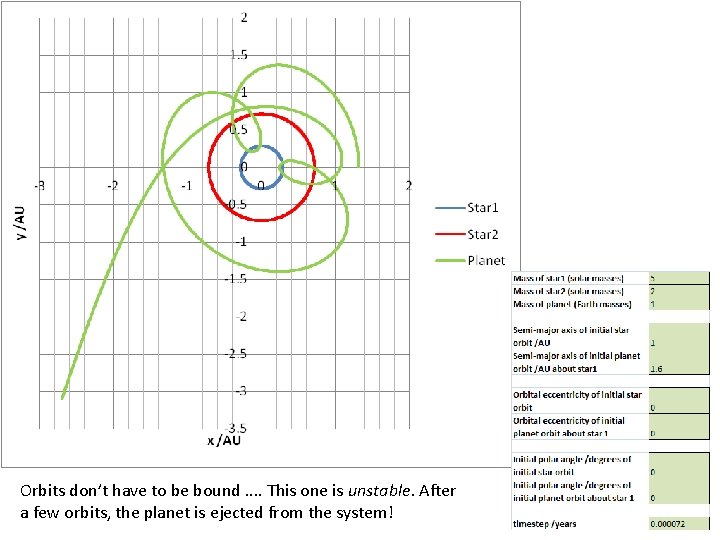
Orbits don’t have to be bound. . This one is unstable. After a few orbits, the planet is ejected from the system!
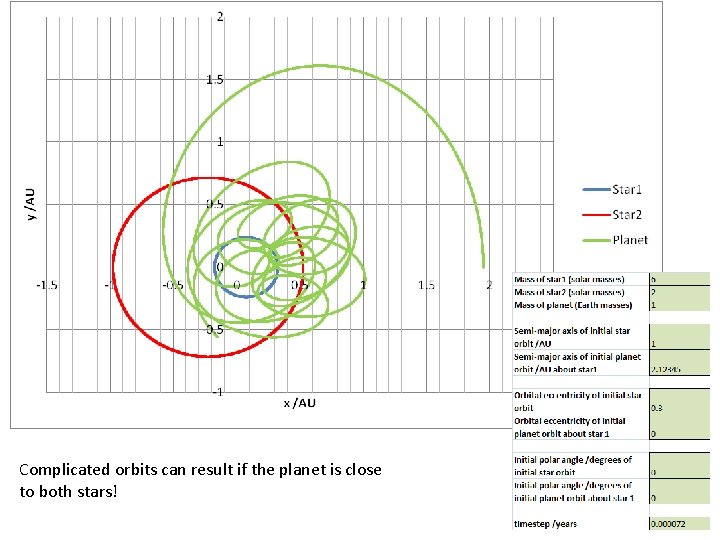
Complicated orbits can result if the planet is close to both stars!
- Slides: 18