
Gravity and Orbits Trish Loeblein Two questions used
Gravity and Orbits Trish Loeblein: Two questions used to help my students review vector addition before we started vector addition in an Electrostatics units. They were very familiar with gravity problems. These were designed to illicit misconceptions. I think it could be used in many topics, but the teacher needs to emphasize that the vectors are not to scale. Learning Goals- Students will be able to • Draw motion of planets, moons and satellites. • Draw diagrams to show gravity is the force that controls the motion of our solar system. • Identify the variables that affect the strength of the gravity • Predict how motion would change if gravity was stronger or weaker.
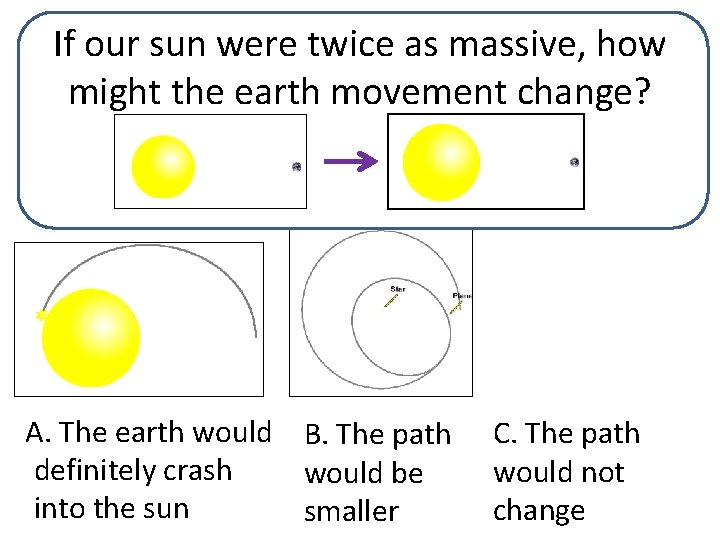
If our sun were twice as massive, how might the earth movement change? A. The earth would B. The path definitely crash would be into the sun smaller C. The path would not change
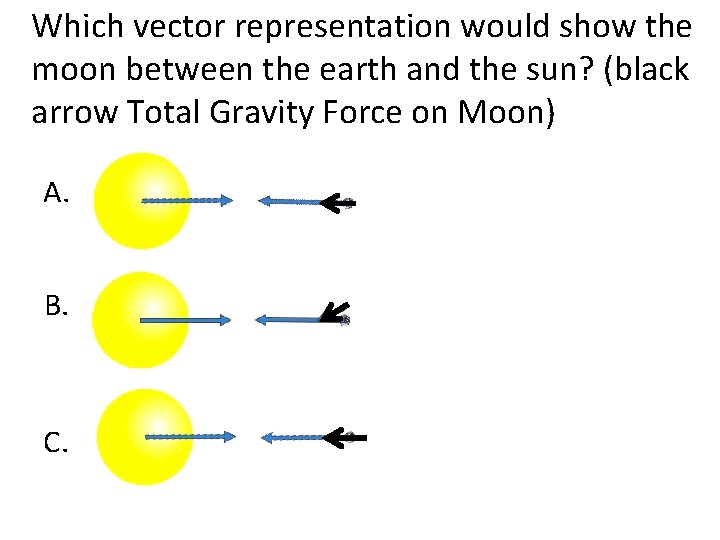
Which vector representation would show the moon between the earth and the sun? (black arrow Total Gravity Force on Moon) A. B. C.
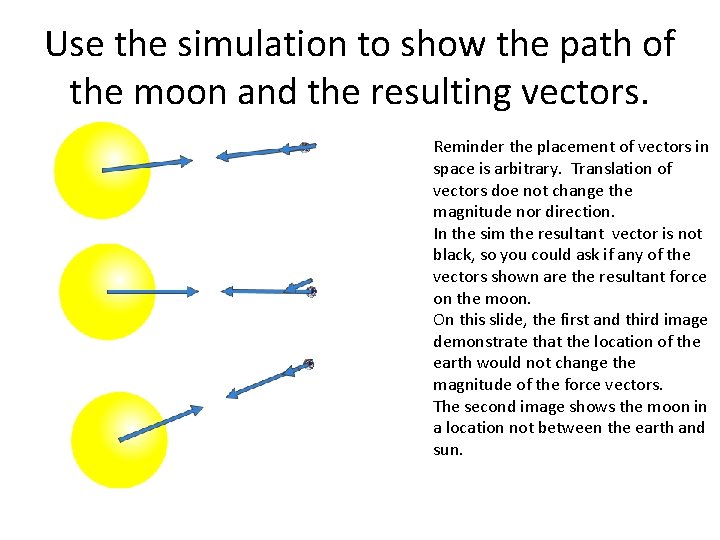
Use the simulation to show the path of the moon and the resulting vectors. Reminder the placement of vectors in space is arbitrary. Translation of vectors doe not change the magnitude nor direction. In the sim the resultant vector is not black, so you could ask if any of the vectors shown are the resultant force on the moon. On this slide, the first and third image demonstrate that the location of the earth would not change the magnitude of the force vectors. The second image shows the moon in a location not between the earth and sun.
- Slides: 4