
Gravity and Newtons Laws of Motion What is
- Slides: 19
Gravity and Newton’s Laws of Motion
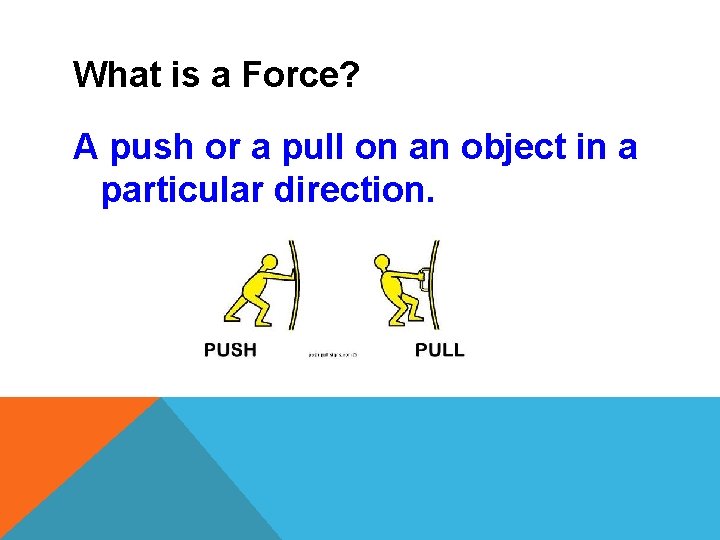
What is a Force? A push or a pull on an object in a particular direction.
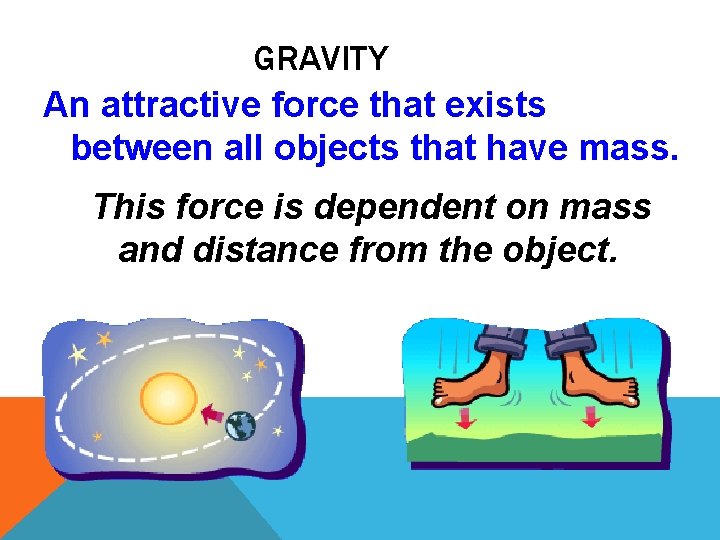
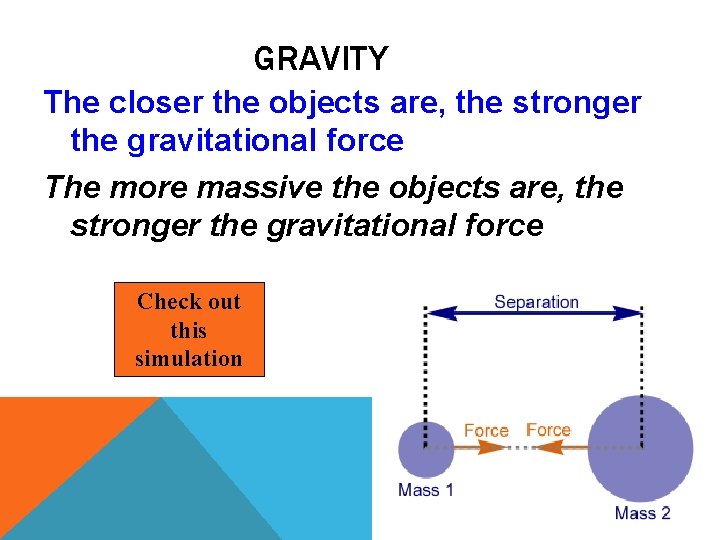
GRAVITY An attractive force that exists between all objects that have mass. This force is dependent on mass and distance from the object.
GRAVITY The closer the objects are, the stronger the gravitational force The more massive the objects are, the stronger the gravitational force Check out this simulation
UNIVERSAL GRAVITATION The law of universal gravitation states that the force of gravity acts between all objects in the universe. video
MASS VS WEIGHT video
MASS VS WEIGHT Mass: Amount of matter in an object. Measured in grams or kilograms What is the difference? Weight: Is the gravitational force exerted on an object. Your weight is actually a force measured in Newton’s. Your weight on other planets
HAMMER FEATHER MOON DROP Video on the Moon Video in a vacuum chamber
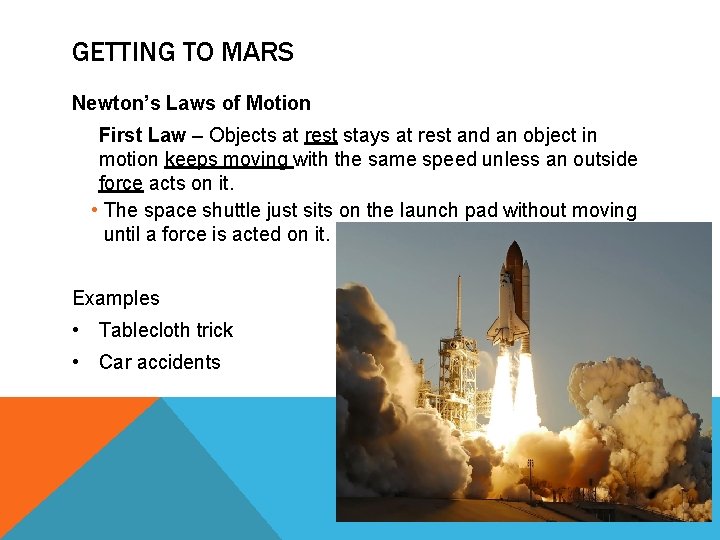
GETTING TO MARS Newton’s Laws of Motion First Law – Objects at rest stays at rest and an object in motion keeps moving with the same speed unless an outside force acts on it. • The space shuttle just sits on the launch pad without moving until a force is acted on it. Examples • Tablecloth trick • Car accidents
Tablecloth Trick Myth video Mythbusters video
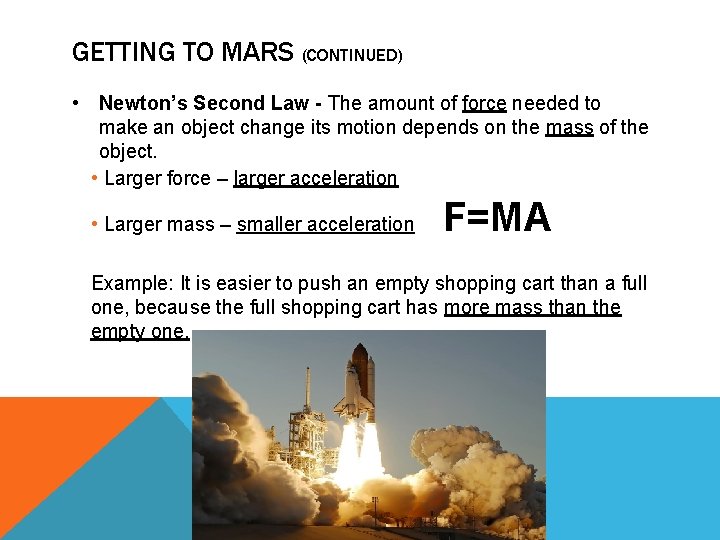
GETTING TO MARS (CONTINUED) • Newton’s Second Law - The amount of force needed to make an object change its motion depends on the mass of the object. • Larger force – larger acceleration • Larger mass – smaller acceleration F=MA Example: It is easier to push an empty shopping cart than a full one, because the full shopping cart has more mass than the empty one.
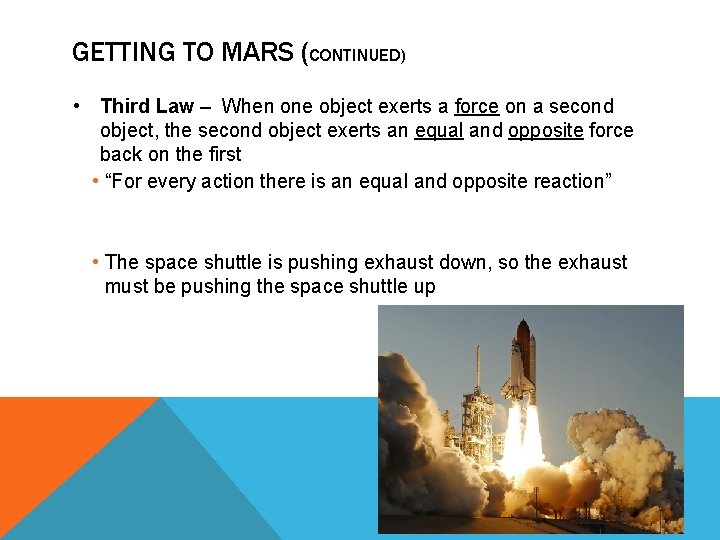
GETTING TO MARS (CONTINUED) • Third Law – When one object exerts a force on a second object, the second object exerts an equal and opposite force back on the first • “For every action there is an equal and opposite reaction” • The space shuttle is pushing exhaust down, so the exhaust must be pushing the space shuttle up
SHUTTLE NEWTON’S THREE LAWS video
HYPOTHESIS You are a NASA engineer trying to get the first person to Mars. You need to get the space shuttle to a speed of 100 m/s within 1 km. You and your team have been having trouble making it travel faster and disagree on how to fix it. Half of the team says to add more force Half of the team says to decrease the mass of the space shuttle. Who do you think is correct? Explain your answer.
INVESTIGATION Half of the team says to add more force Half of the team says to decrease the mass of the space shuttle. Task: Conduct an experiment to either support or oppose each method given the following materials. • String • Matchbox car • Tape • Washers • Paper clips • Stopwatch Take 3 minutes discuss the task, and how you plan to conduct the investigation, collect data, and interpret results.
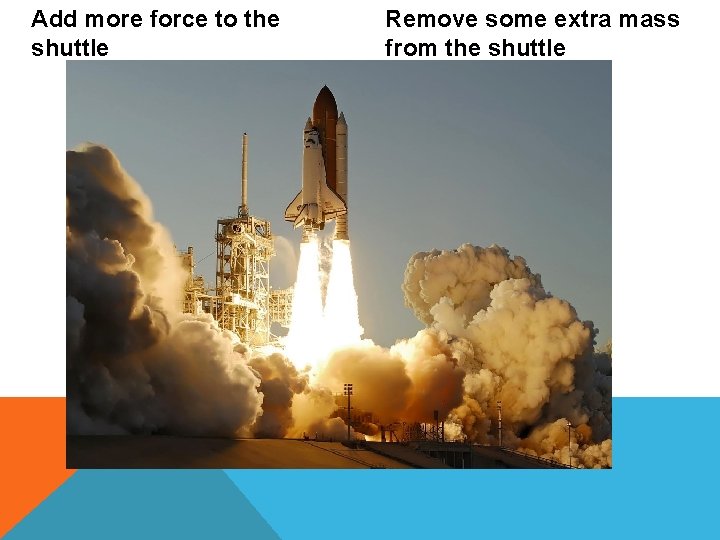
Add more force to the shuttle Remove some extra mass from the shuttle
As the mass of the shuttle decreases, what happens to the acceleration of the shuttle? increases As the amount of force applied to the shuttle increases, what happens to the acceleration of the shuttle? increases
WHO WAS RIGHT? Both were correct. Either removing mass from the shuttle or adding more force would increase the acceleration of the shuttle.