
Gravitationalwave Detection with Interferometers LIGO LISA and the
- Slides: 28
Gravitational-wave Detection with Interferometers LIGO, LISA, and the like Nergis Mavalvala 8. 971 seminar @ MIT September 18, 2002 1
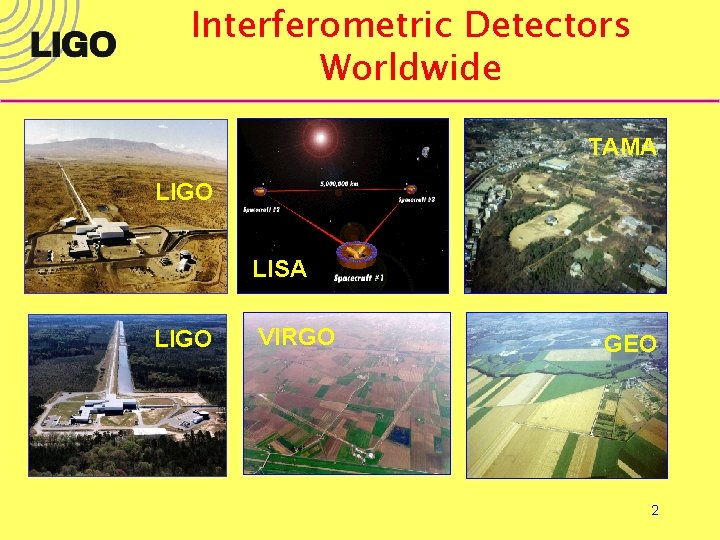
Interferometric Detectors Worldwide TAMA LIGO LISA LIGO VIRGO GEO 2
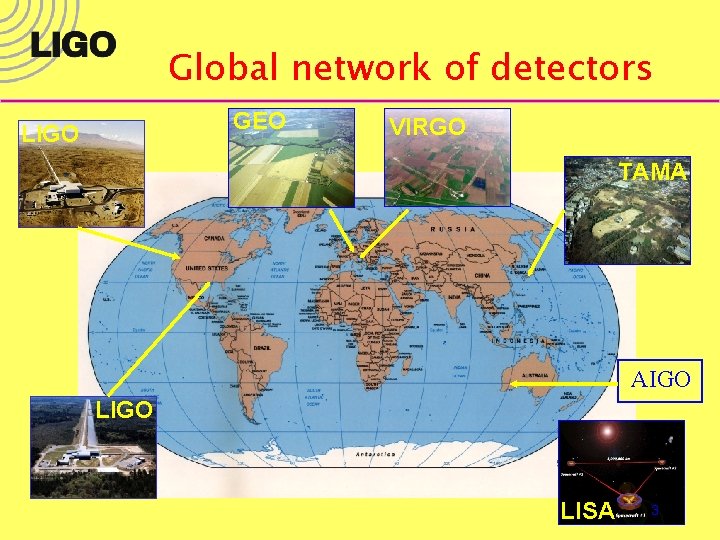
Global network of detectors GEO LIGO VIRGO TAMA AIGO LISA 3
Science goals: detection of gravitational waves q. Tests of general relativity § Waves direct evidence for time-dependent metric § Black hole signatures test of strong field gravity § Polarization of the waves spin of graviton § Propagation velocity mass of graviton q. Astrophysical processes § Inner dynamics of processes hidden from EM astronomy § Cores of supernovae § Dynamics of neutron stars large scale nuclear matter § The earliest moments of the Big Bang Planck epoch q. Astrophysics… 4
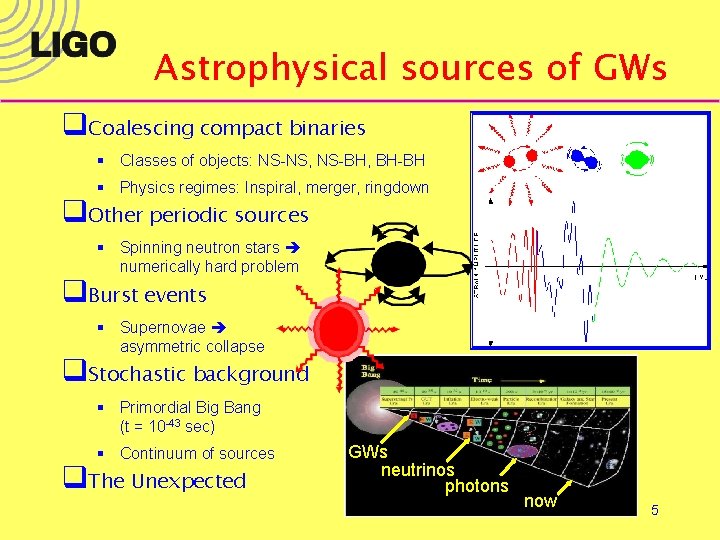
Astrophysical sources of GWs q. Coalescing compact binaries § Classes of objects: NS-NS, NS-BH, BH-BH § Physics regimes: Inspiral, merger, ringdown q. Other periodic sources § Spinning neutron stars numerically hard problem q. Burst events § Supernovae asymmetric collapse q. Stochastic background § Primordial Big Bang (t = 10 -43 sec) § Continuum of sources q. The Unexpected GWs neutrinos photons now 5
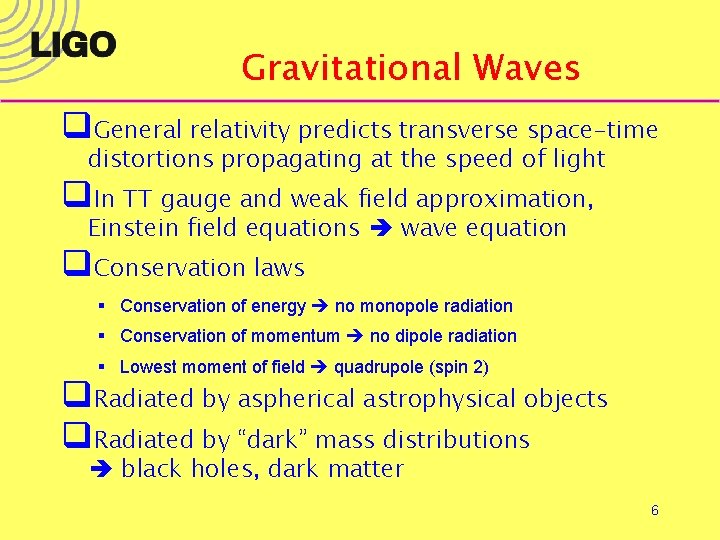
Gravitational Waves q. General relativity predicts transverse space-time distortions propagating at the speed of light q. In TT gauge and weak field approximation, Einstein field equations wave equation q. Conservation laws § Conservation of energy no monopole radiation § Conservation of momentum no dipole radiation § Lowest moment of field quadrupole (spin 2) q. Radiated by aspherical astrophysical objects q. Radiated by “dark” mass distributions black holes, dark matter 6
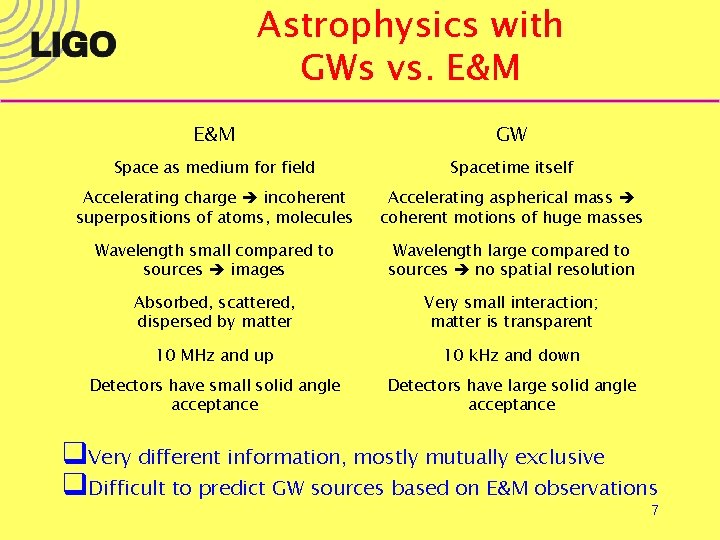
Astrophysics with GWs vs. E&M GW Space as medium for field Spacetime itself Accelerating charge incoherent superpositions of atoms, molecules Accelerating aspherical mass coherent motions of huge masses Wavelength small compared to sources images Wavelength large compared to sources no spatial resolution Absorbed, scattered, dispersed by matter Very small interaction; matter is transparent 10 MHz and up 10 k. Hz and down Detectors have small solid angle acceptance Detectors have large solid angle acceptance q. Very different information, mostly mutually exclusive q. Difficult to predict GW sources based on E&M observations 7
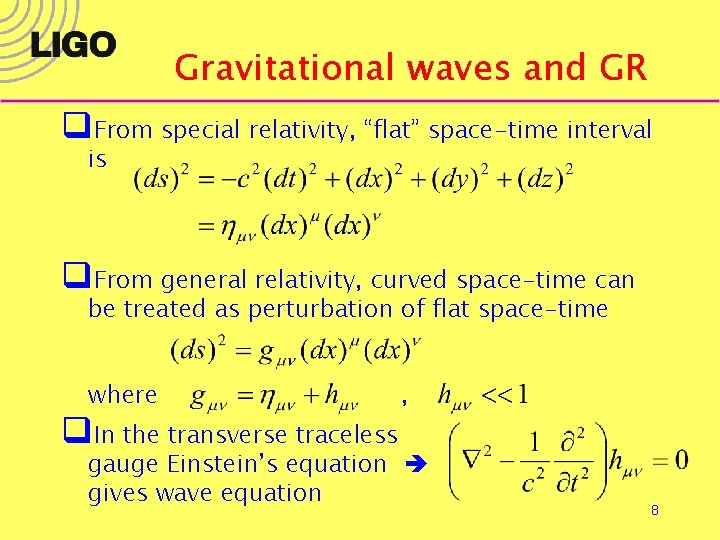
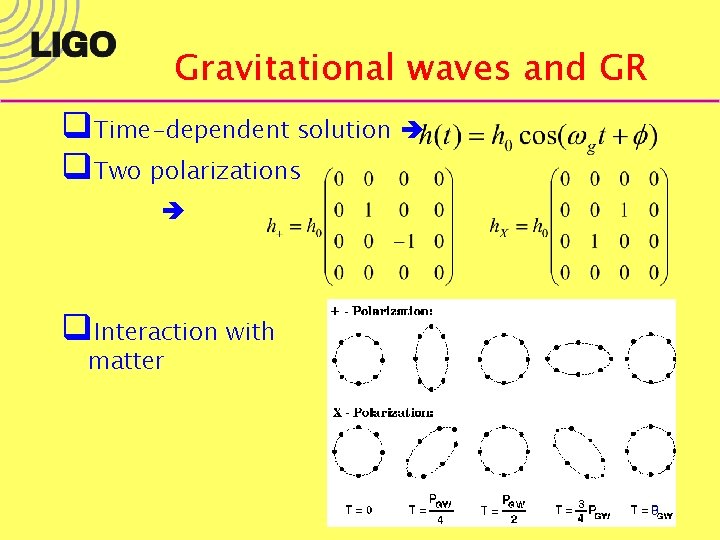
Gravitational waves and GR q. From special relativity, “flat” space-time interval is q. From general relativity, curved space-time can be treated as perturbation of flat space-time where q. In the transverse traceless , gauge Einstein’s equation gives wave equation 8
Gravitational waves and GR q. Time-dependent solution q. Two polarizations q. Interaction with matter 9
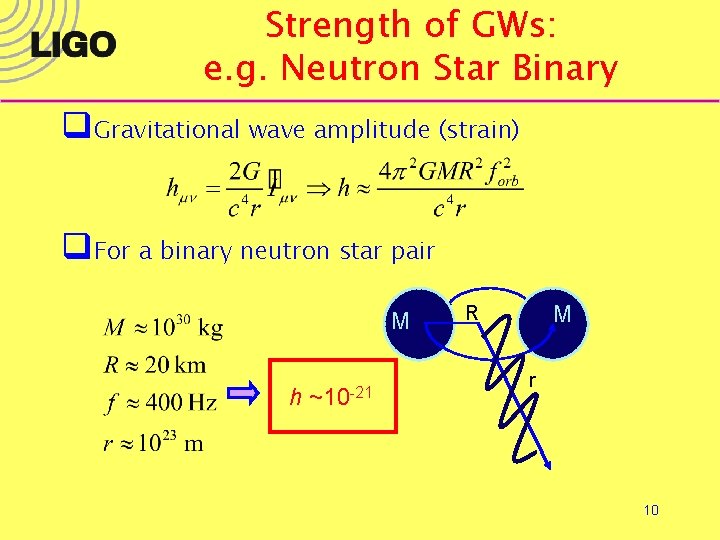
Strength of GWs: e. g. Neutron Star Binary q. Gravitational wave amplitude (strain) q. For a binary neutron star pair M h ~10 -21 M R r 10
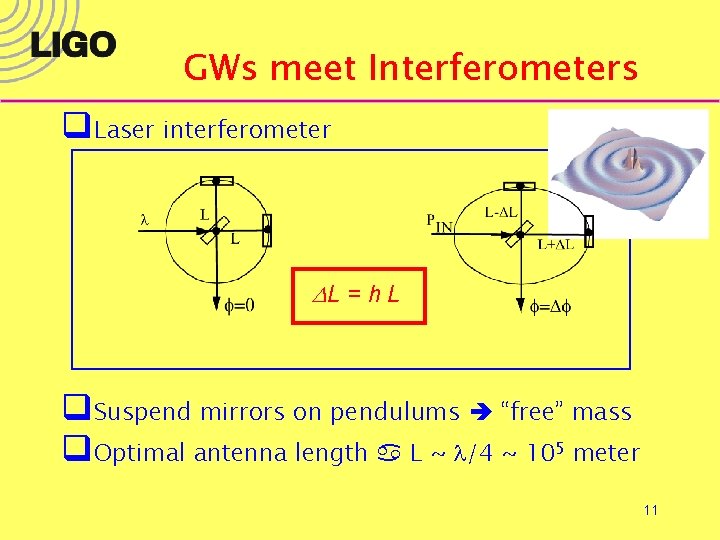
GWs meet Interferometers q. Laser interferometer DL = h L q. Suspend mirrors on pendulums “free” mass q. Optimal antenna length a L ~ l/4 ~ 105 meter 11
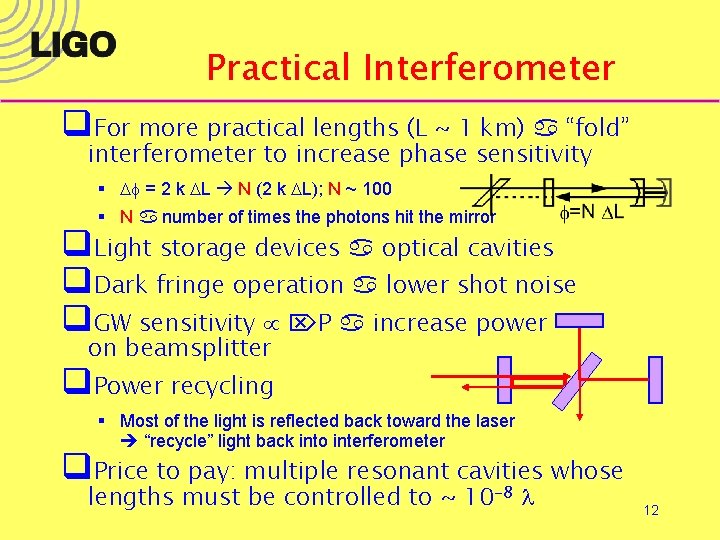
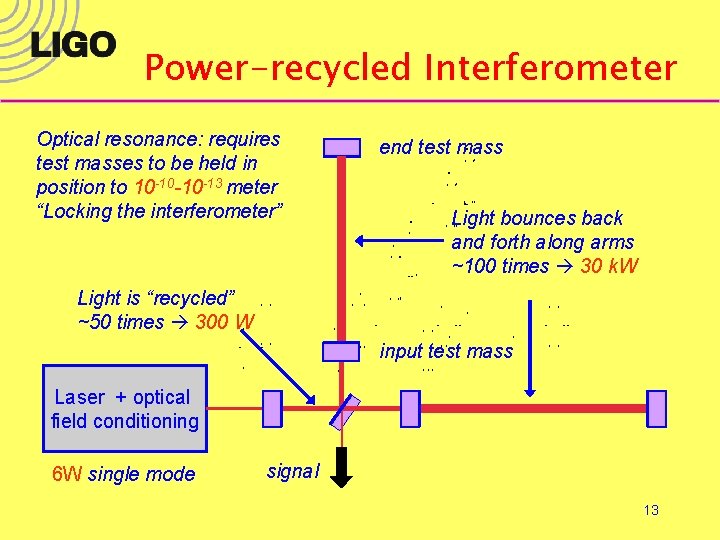
Practical Interferometer q. For more practical lengths (L ~ 1 km) a “fold” interferometer to increase phase sensitivity § Df = 2 k DL N (2 k DL); N ~ 100 § N a number of times the photons hit the mirror q. Light storage devices a optical cavities q. Dark fringe operation a lower shot noise q. GW sensitivity P a increase power on beamsplitter q. Power recycling § Most of the light is reflected back toward the laser “recycle” light back into interferometer q. Price to pay: multiple resonant cavities whose lengths must be controlled to ~ 10 -8 l 12
Power-recycled Interferometer Optical resonance: requires test masses to be held in position to 10 -10 -10 -13 meter “Locking the interferometer” end test mass Light bounces back and forth along arms ~100 times 30 k. W Light is “recycled” ~50 times 300 W input test mass Laser + optical field conditioning 6 W single mode signal 13
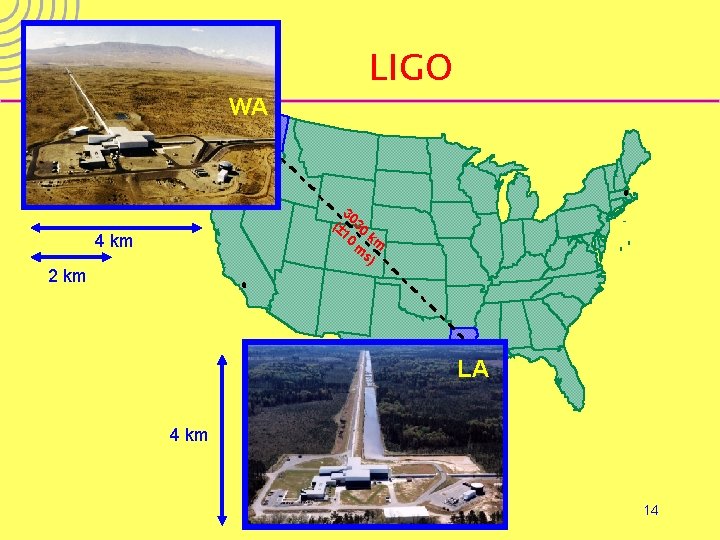
WA LIGO 30 (± 30 10 k m m s) 4 km 2 km LA 4 km 14
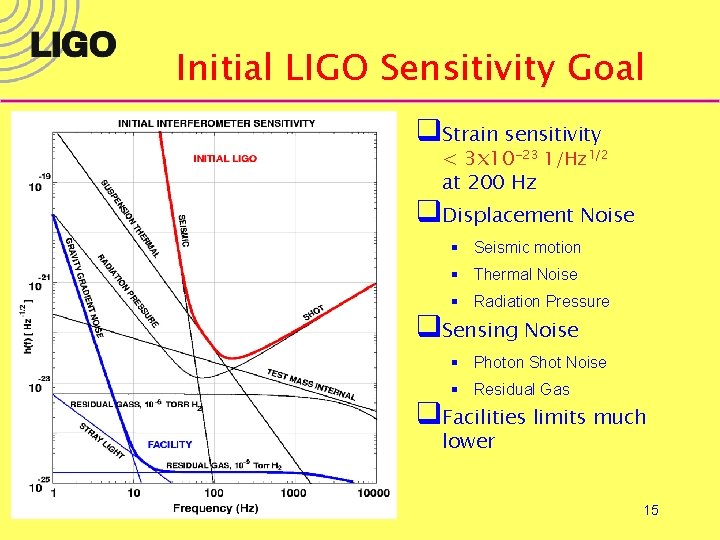
Initial LIGO Sensitivity Goal q. Strain sensitivity < 3 x 10 -23 1/Hz 1/2 at 200 Hz q. Displacement Noise § Seismic motion § Thermal Noise § Radiation Pressure q. Sensing Noise § Photon Shot Noise § Residual Gas q. Facilities limits much lower 15
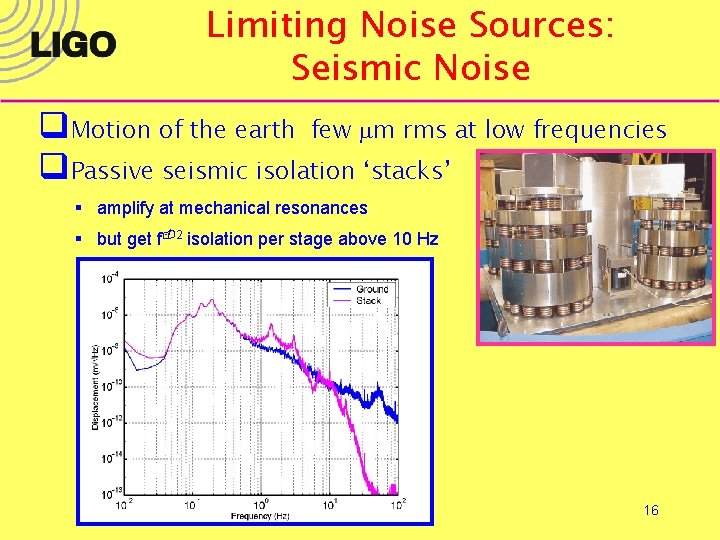
Limiting Noise Sources: Seismic Noise q. Motion of the earth few mm rms at low frequencies q. Passive seismic isolation ‘stacks’ § amplify at mechanical resonances § but get f-2 isolation per stage above 10 Hz 16
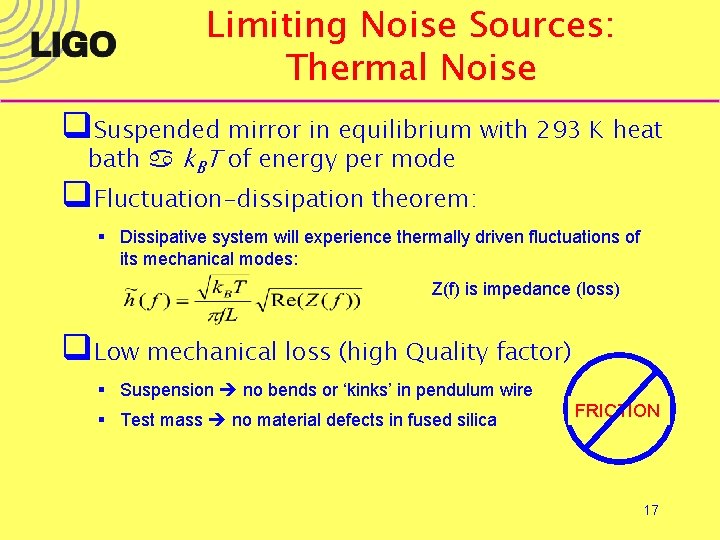
Limiting Noise Sources: Thermal Noise q. Suspended mirror in equilibrium with 293 K heat bath a k. BT of energy per mode q. Fluctuation-dissipation theorem: § Dissipative system will experience thermally driven fluctuations of its mechanical modes: Z(f) is impedance (loss) q. Low mechanical loss (high Quality factor) § Suspension no bends or ‘kinks’ in pendulum wire § Test mass no material defects in fused silica FRICTION 17
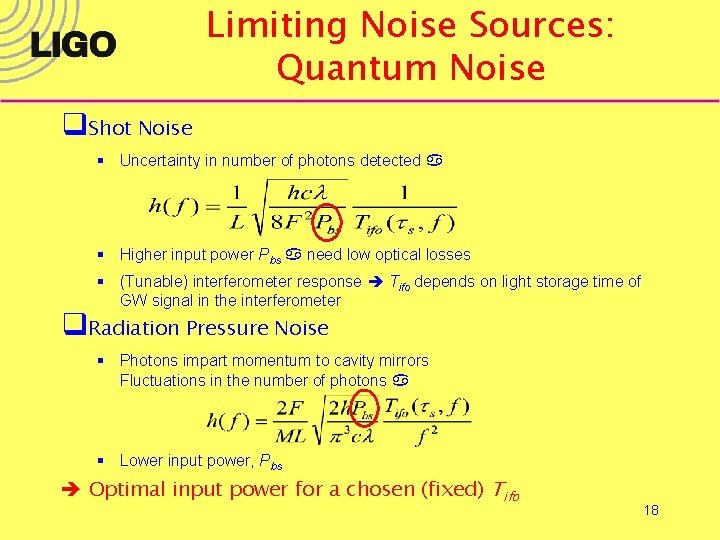
Limiting Noise Sources: Quantum Noise q. Shot Noise § Uncertainty in number of photons detected a § Higher input power Pbs a need low optical losses § (Tunable) interferometer response Tifo depends on light storage time of GW signal in the interferometer q. Radiation Pressure Noise § Photons impart momentum to cavity mirrors Fluctuations in the number of photons a § Lower input power, Pbs Optimal input power for a chosen (fixed) Tifo 18
19
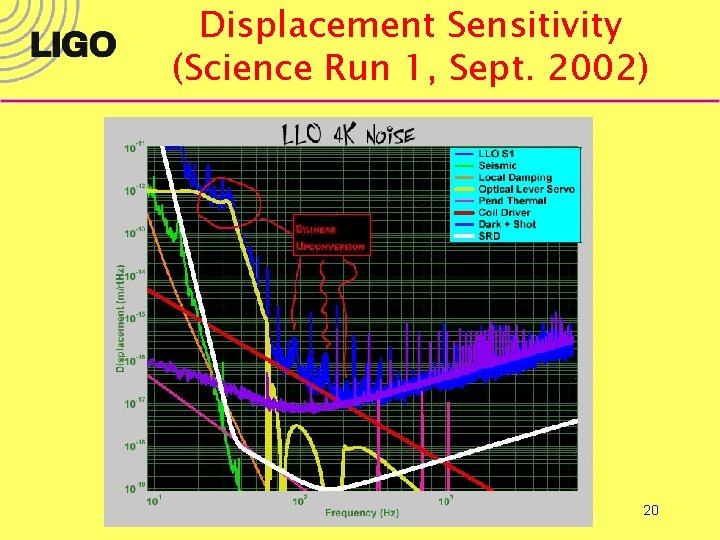
Displacement Sensitivity (Science Run 1, Sept. 2002) 20
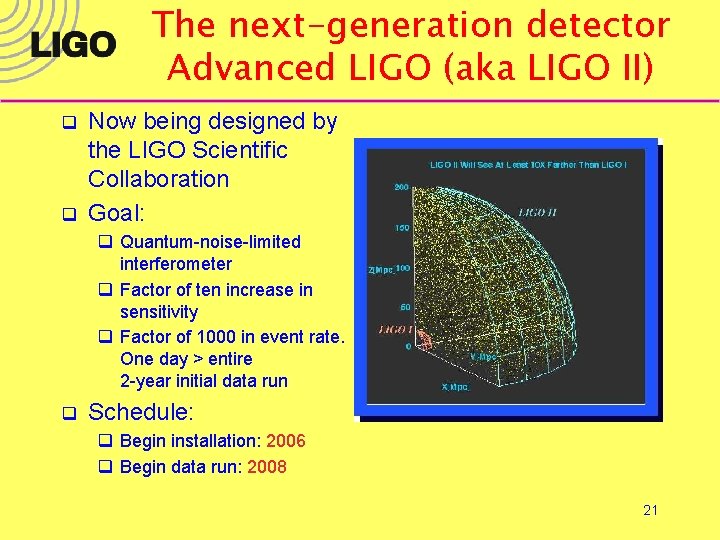
The next-generation detector Advanced LIGO (aka LIGO II) q q Now being designed by the LIGO Scientific Collaboration Goal: q Quantum-noise-limited interferometer q Factor of ten increase in sensitivity q Factor of 1000 in event rate. One day > entire 2 -year initial data run q Schedule: q Begin installation: 2006 q Begin data run: 2008 21
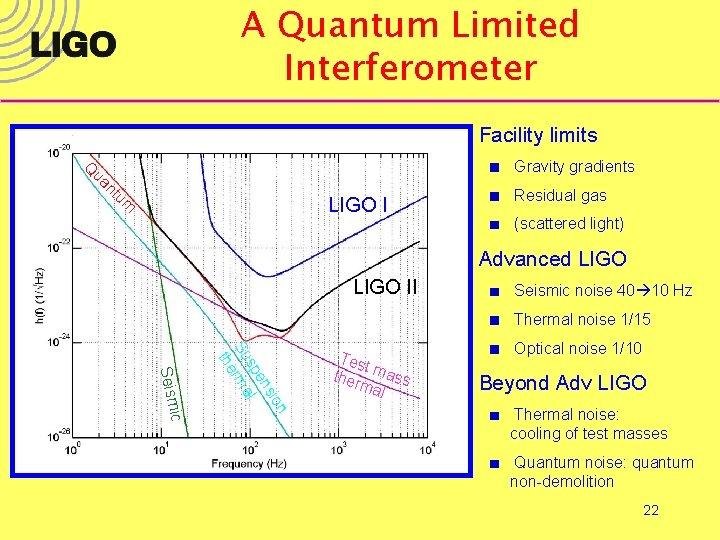
A Quantum Limited Interferometer n Facility limits Q Gravity gradients ua nt um LIGO I Residual gas (scattered light) n Advanced LIGO II Seismic noise 40 10 Hz Thermal noise 1/15 n sio en sp l Su rma the ic Seism Tes t ther mass mal Optical noise 1/10 n Beyond Adv LIGO Thermal noise: cooling of test masses Quantum noise: quantum non-demolition 22
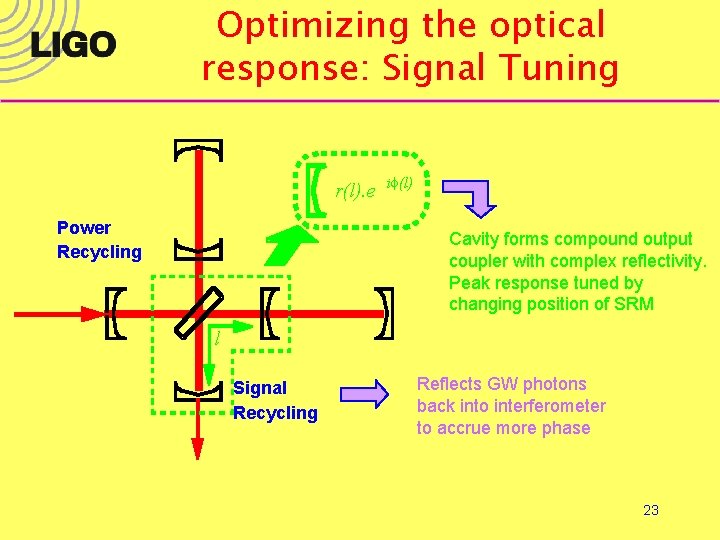
Optimizing the optical response: Signal Tuning r(l). e Power Recycling if (l) Cavity forms compound output coupler with complex reflectivity. Peak response tuned by changing position of SRM l Signal Recycling Reflects GW photons back into interferometer to accrue more phase 23
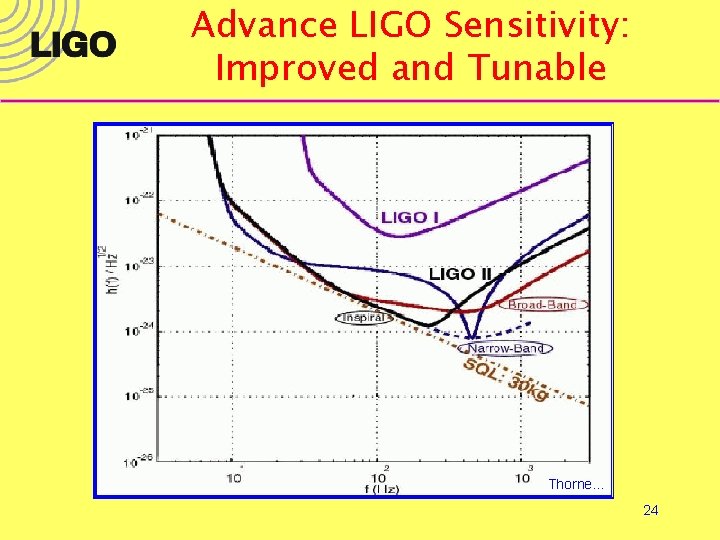
Advance LIGO Sensitivity: Improved and Tunable Thorne… 24
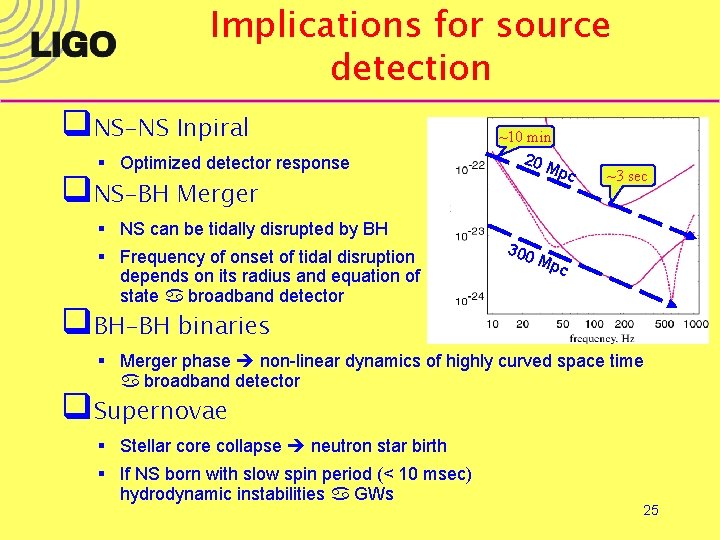
Implications for source detection q. NS-NS Inpiral § Optimized detector response q. NS-BH Merger ~10 min 20 M pc ~3 sec § NS can be tidally disrupted by BH § Frequency of onset of tidal disruption depends on its radius and equation of state a broadband detector 300 Mp c q. BH-BH binaries § Merger phase non-linear dynamics of highly curved space time a broadband detector q. Supernovae § Stellar core collapse neutron star birth § If NS born with slow spin period (< 10 msec) hydrodynamic instabilities a GWs 25
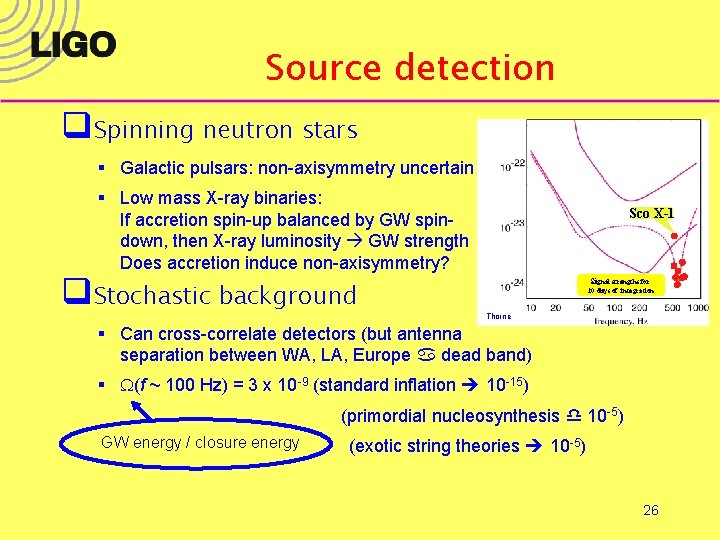
Source detection q. Spinning neutron stars § Galactic pulsars: non-axisymmetry uncertain § Low mass X-ray binaries: If accretion spin-up balanced by GW spindown, then X-ray luminosity GW strength Does accretion induce non-axisymmetry? q. Stochastic background Sco X-1 Signal strengths for 20 days of integration Thorne § Can cross-correlate detectors (but antenna separation between WA, LA, Europe a dead band) § W(f ~ 100 Hz) = 3 x 10 -9 (standard inflation 10 -15) (primordial nucleosynthesis d 10 -5) GW energy / closure energy (exotic string theories 10 -5) 26
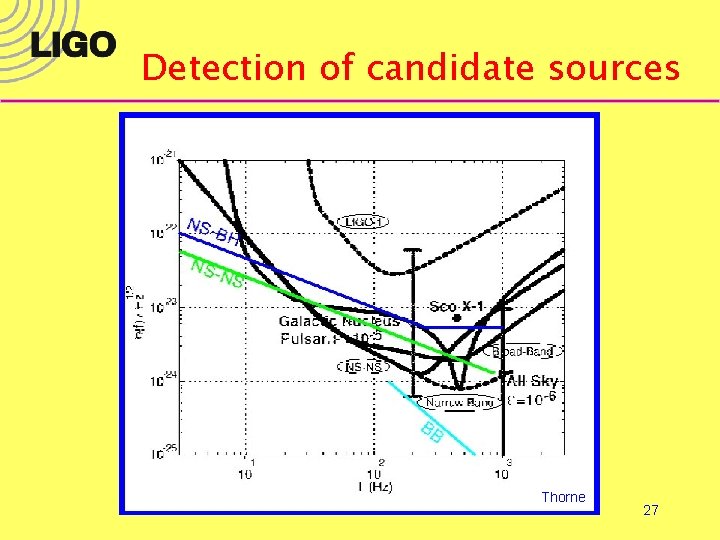
Detection of candidate sources Thorne 27
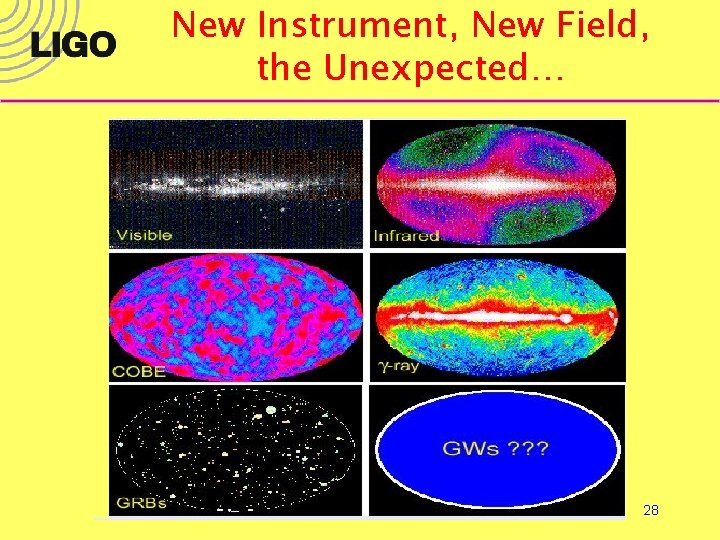
New Instrument, New Field, the Unexpected… 28