
Gravitational Wave Detection Using Pulsar Timing Current Status


- Slides: 31
Gravitational Wave Detection Using Pulsar Timing Current Status and Future Progress Fredrick A. Jenet Center for Gravitational Wave Astronomy University of Texas at Brownsville
Collaborators John Armstrong JPL USA Teviet Creighton Caltech USA George Hobbs ATNF/CSIRO Australia KJ Lee Peking U. China Shane L. Larson Penn State USA Dick Manchester ATNF/CSIRO Australia Andrea Lommen Franklin & Marshall USA Linqing Wen AEI Germany
Main Points • Radio pulsar can directly detect gravitational waves – How can you do that? • What can we learn? – Astrophysics – Gravity • Current State of affairs • What can the SKA do.
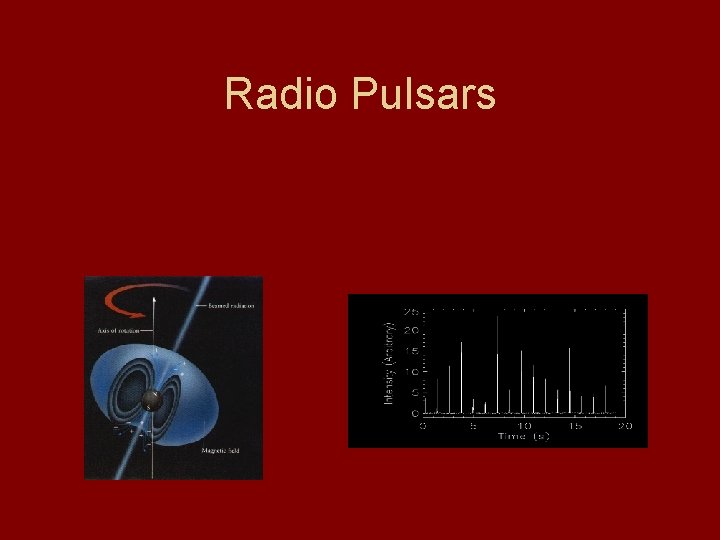
Radio Pulsars
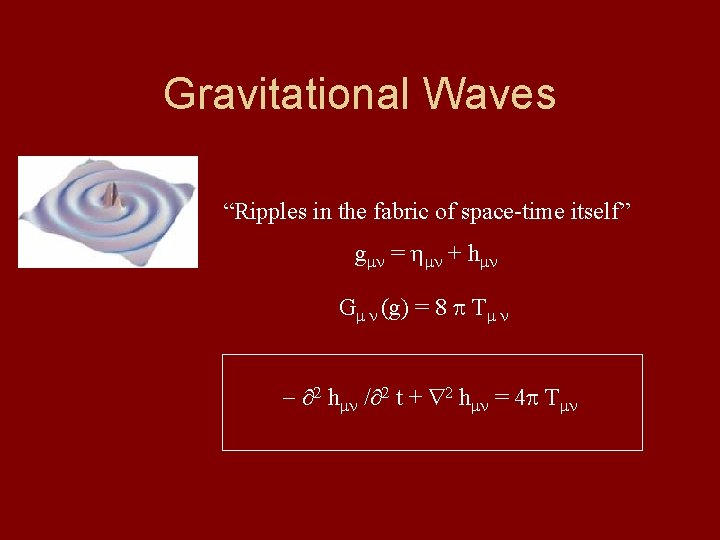
Gravitational Waves “Ripples in the fabric of space-time itself” g = h + h G (g) = 8 T - ¶ 2 h /¶ 2 t + 2 h = 4 T
Pulsar Timing • Pulsar timing is the act of measuring the arrival times of the individual pulses
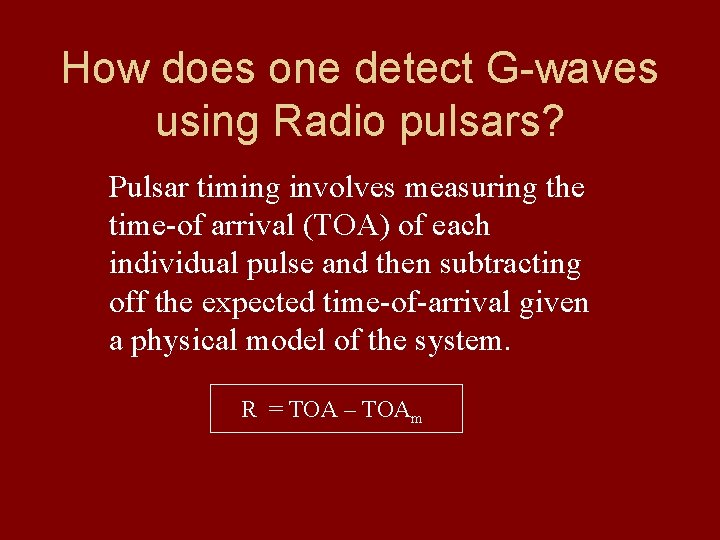
How does one detect G-waves using Radio pulsars? Pulsar timing involves measuring the time-of arrival (TOA) of each individual pulse and then subtracting off the expected time-of-arrival given a physical model of the system. R = TOA – TOAm
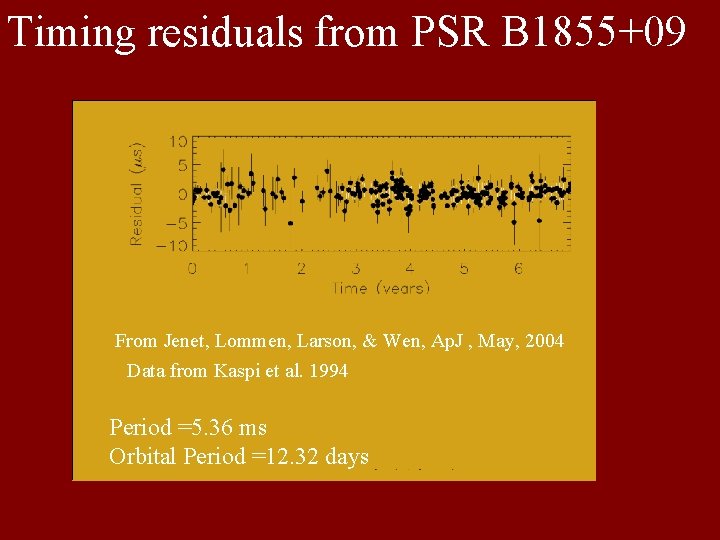
Timing residuals from PSR B 1855+09 From Jenet, Lommen, Larson, & Wen, Ap. J , May, 2004 Data from Kaspi et al. 1994 Period =5. 36 ms Orbital Period =12. 32 days
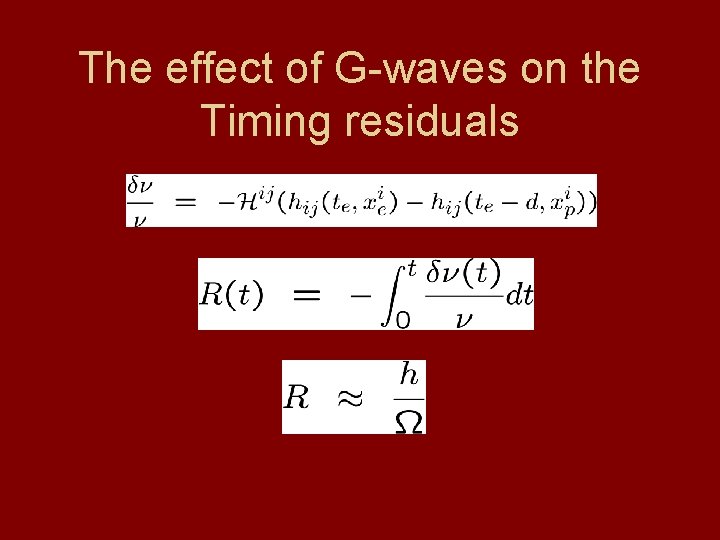
The effect of G-waves on the Timing residuals
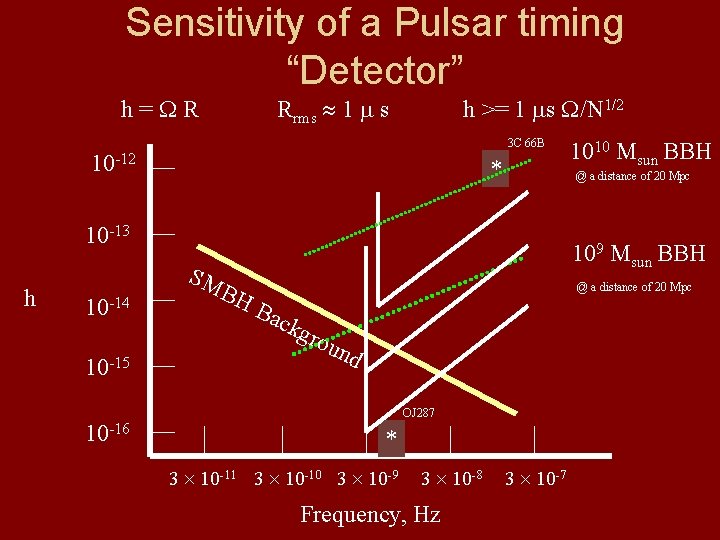
Sensitivity of a Pulsar timing “Detector” h= R Rrms 1 s h >= 1 s /N 1/2 3 C 66 B 10 -12 * @ a distance of 20 Mpc 10 -13 h 10 -14 10 -15 10 -16 1010 Msun BBH 109 Msun BBH SM BH @ a distance of 20 Mpc Ba ckg rou nd OJ 287 * 3 10 -11 3 10 -10 3 10 -9 3 10 -8 Frequency, Hz 3 10 -7
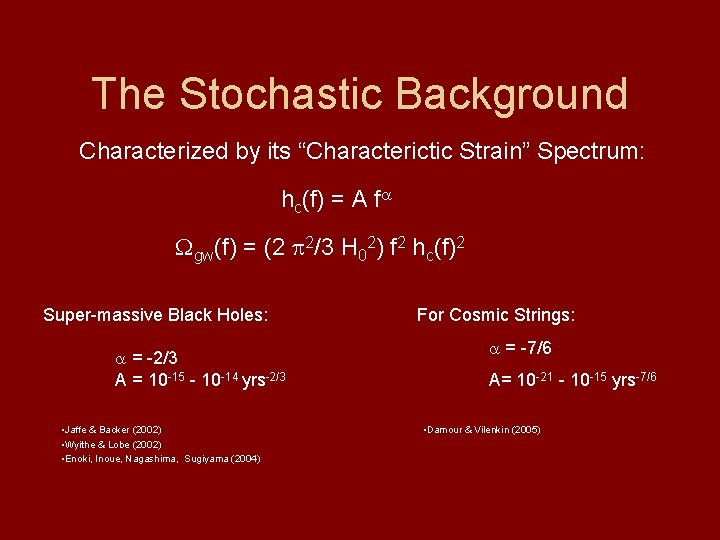
The Stochastic Background Characterized by its “Characterictic Strain” Spectrum: hc(f) = A f gw(f) = (2 2/3 H 02) f 2 hc(f)2 Super-massive Black Holes: = -2/3 A = 10 -15 - 10 -14 yrs-2/3 • Jaffe & Backer (2002) • Wyithe & Lobe (2002) • Enoki, Inoue, Nagashima, Sugiyama (2004) For Cosmic Strings: = -7/6 A= 10 -21 - 10 -15 yrs-7/6 • Damour & Vilenkin (2005)
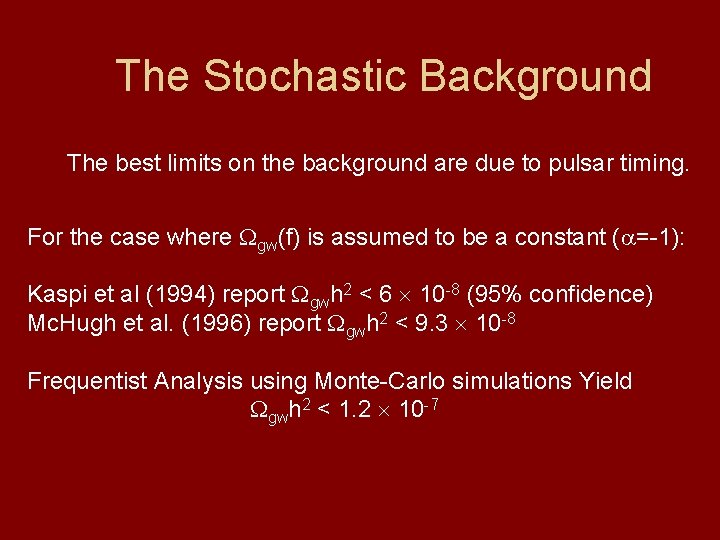
The Stochastic Background The best limits on the background are due to pulsar timing. For the case where gw(f) is assumed to be a constant ( =-1): Kaspi et al (1994) report gwh 2 < 6 10 -8 (95% confidence) Mc. Hugh et al. (1996) report gwh 2 < 9. 3 10 -8 Frequentist Analysis using Monte-Carlo simulations Yield gwh 2 < 1. 2 10 -7
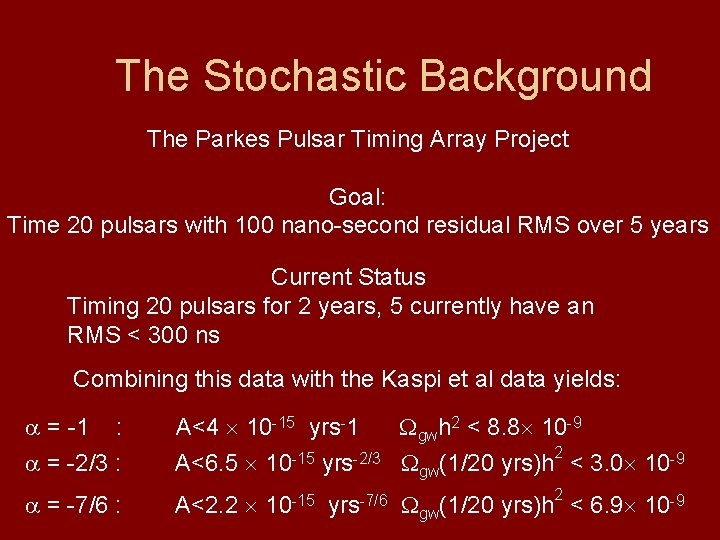
The Stochastic Background The Parkes Pulsar Timing Array Project Goal: Time 20 pulsars with 100 nano-second residual RMS over 5 years Current Status Timing 20 pulsars for 2 years, 5 currently have an RMS < 300 ns Combining this data with the Kaspi et al data yields: = -1 : = -2/3 : A<4 10 -15 yrs-1 gwh 2 < 8. 8 10 -9 2 A<6. 5 10 -15 yrs-2/3 gw(1/20 yrs)h < 3. 0 10 -9 = -7/6 : A<2. 2 10 -15 yrs-7/6 2 gw(1/20 yrs)h < 6. 9 10 -9
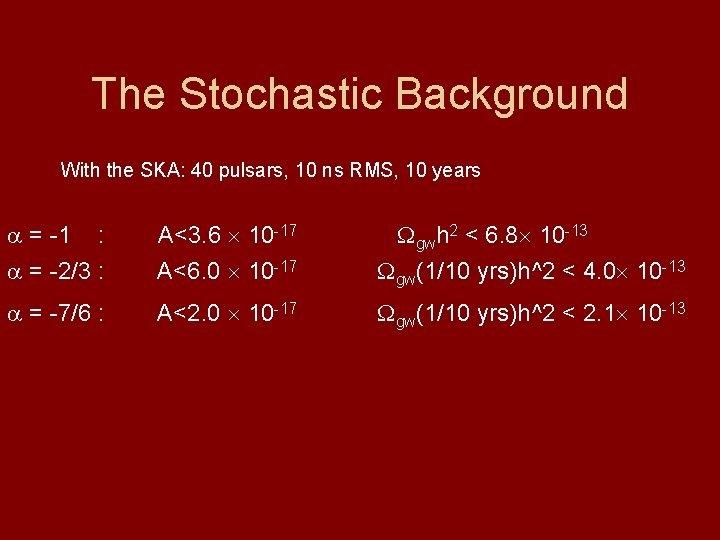
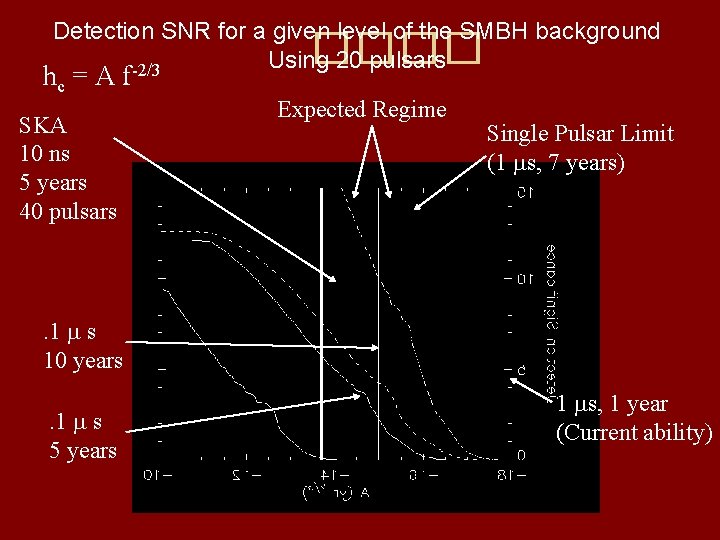
The Stochastic Background With the SKA: 40 pulsars, 10 ns RMS, 10 years = -1 : = -2/3 : A<3. 6 10 -17 A<6. 0 10 -17 gwh 2 < 6. 8 10 -13 gw(1/10 yrs)h^2 < 4. 0 10 -13 = -7/6 : A<2. 0 10 -17 gw(1/10 yrs)h^2 < 2. 1 10 -13
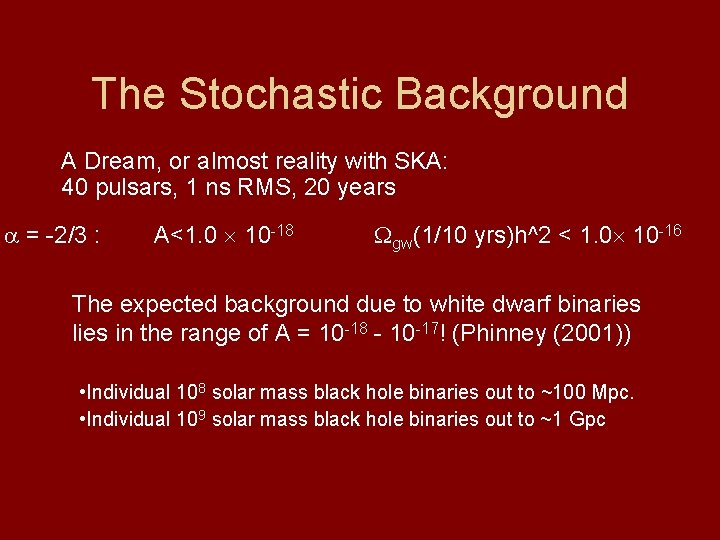
The Stochastic Background A Dream, or almost reality with SKA: 40 pulsars, 1 ns RMS, 20 years = -2/3 : A<1. 0 10 -18 gw(1/10 yrs)h^2 < 1. 0 10 -16 The expected background due to white dwarf binaries lies in the range of A = 10 -18 - 10 -17! (Phinney (2001)) • Individual 108 solar mass black hole binaries out to ~100 Mpc. • Individual 109 solar mass black hole binaries out to ~1 Gpc
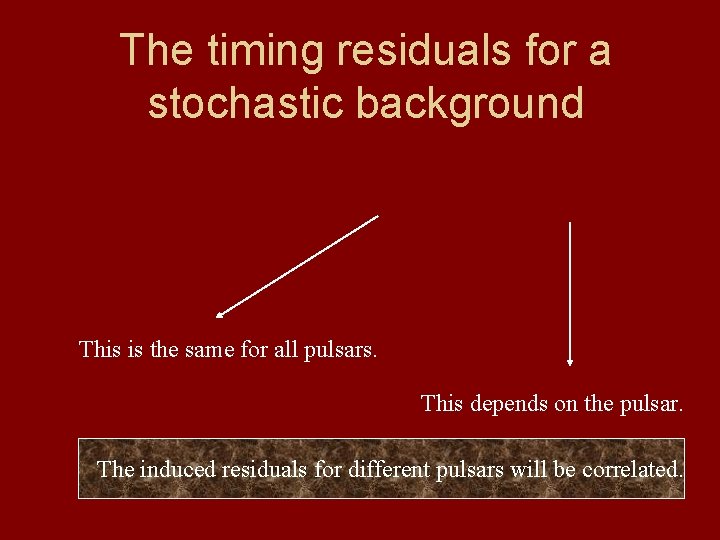
The timing residuals for a stochastic background This is the same for all pulsars. This depends on the pulsar. The induced residuals for different pulsars will be correlated.
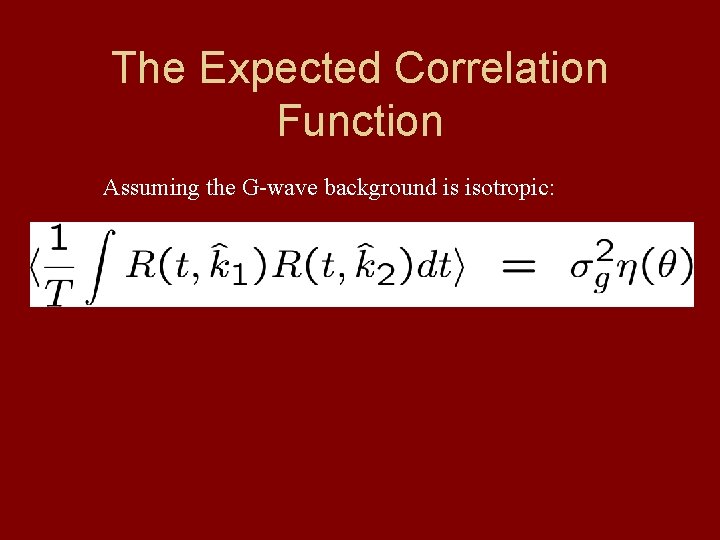
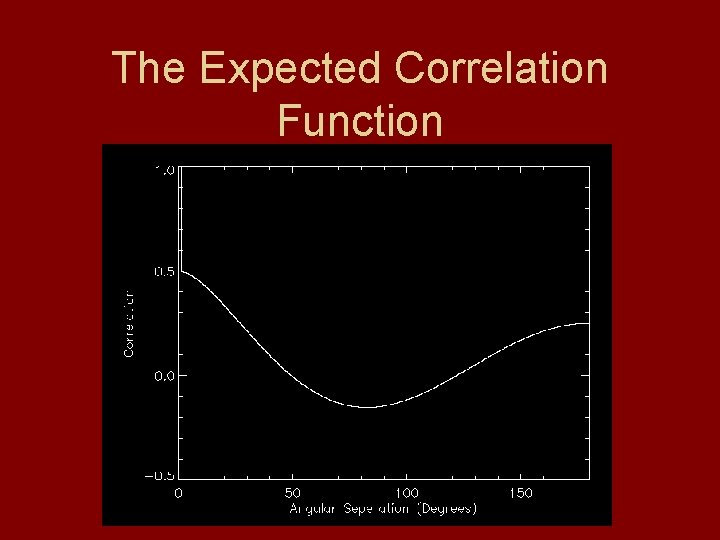
The Expected Correlation Function Assuming the G-wave background is isotropic:
The Expected Correlation Function
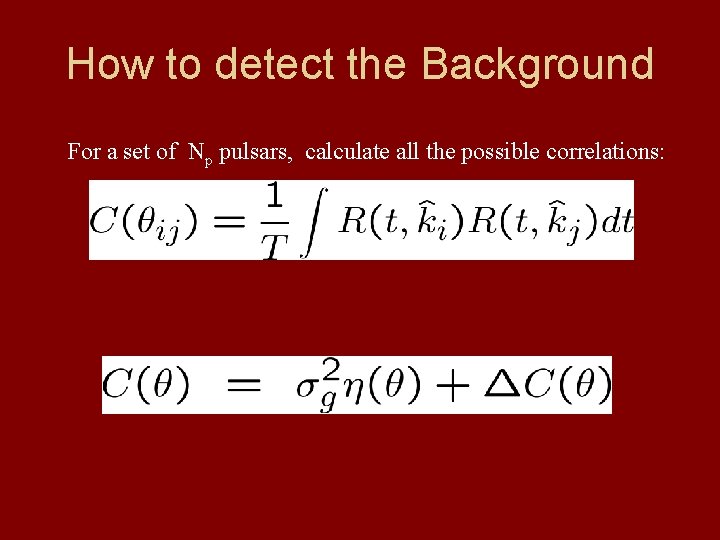
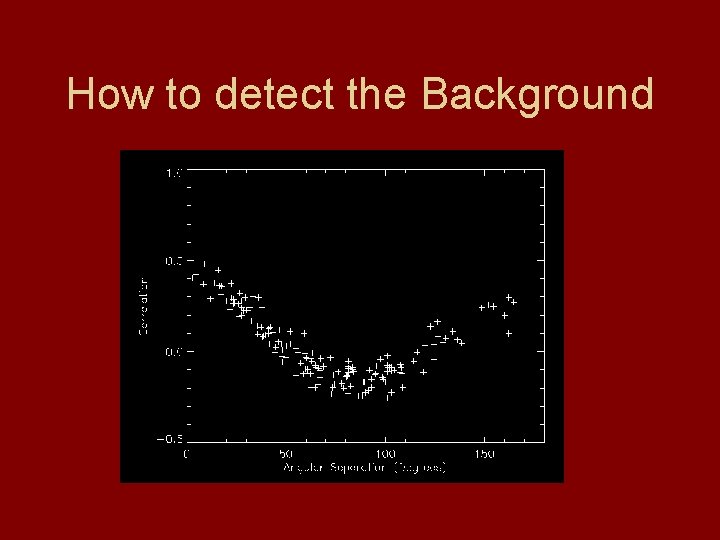
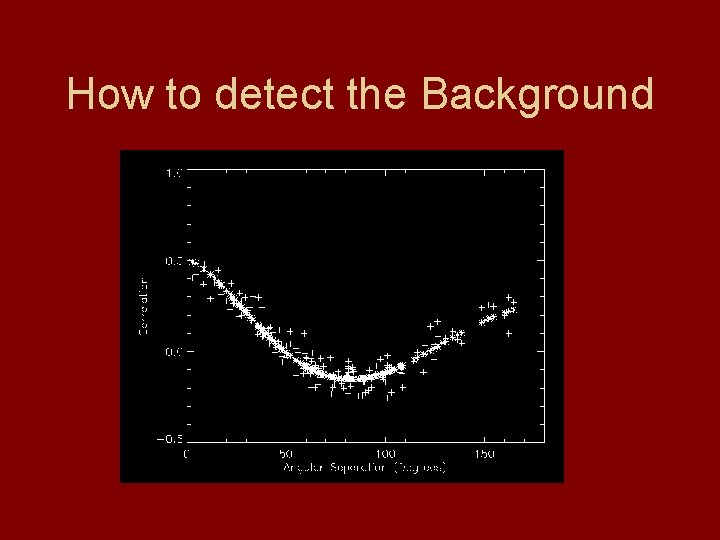
How to detect the Background For a set of Np pulsars, calculate all the possible correlations:
How to detect the Background
How to detect the Background
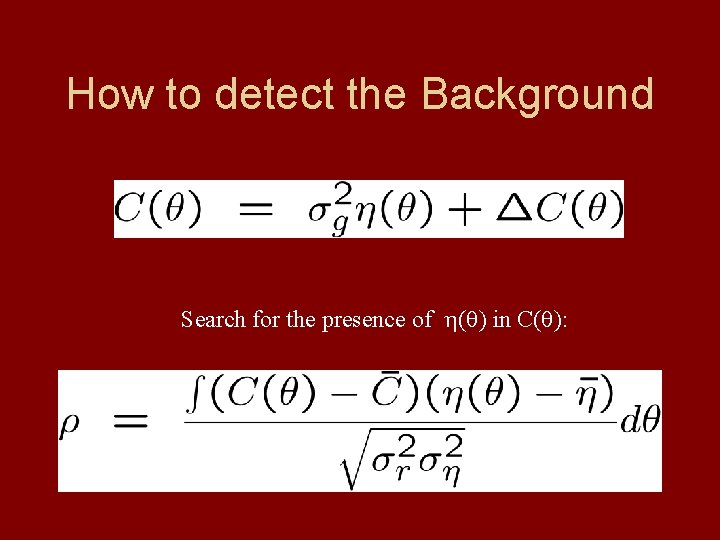
How to detect the Background Search for the presence of h(q) in C(q):
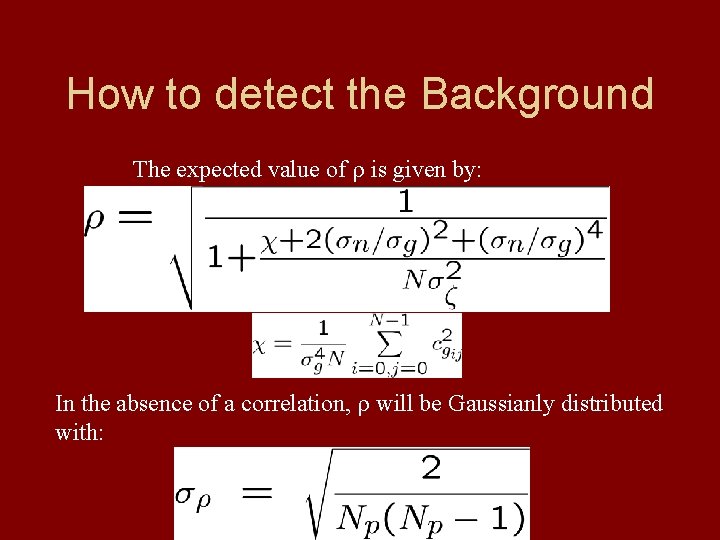
How to detect the Background The expected value of r is given by: In the absence of a correlation, r will be Gaussianly distributed with:
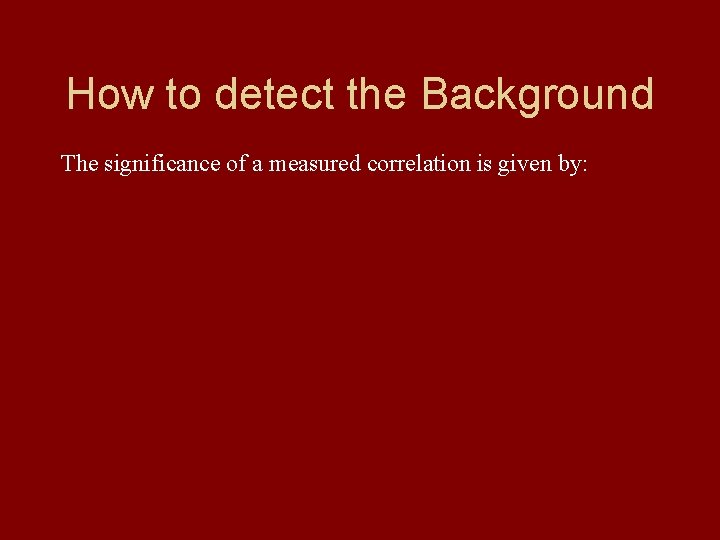
How to detect the Background The significance of a measured correlation is given by:
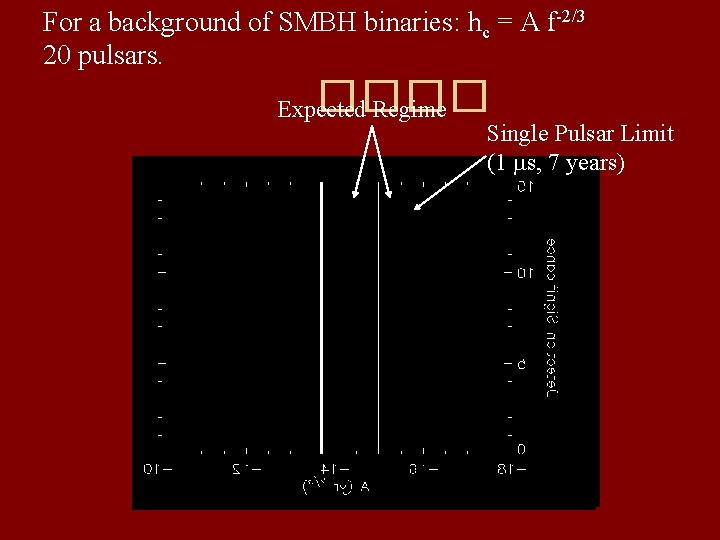
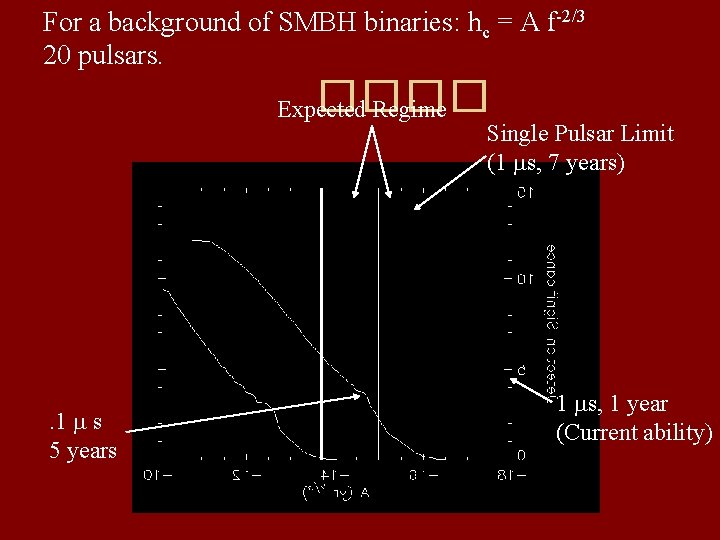
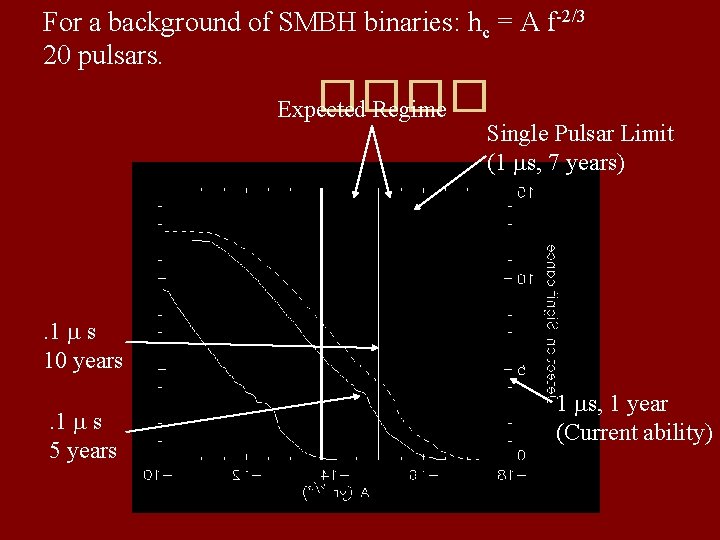
For a background of SMBH binaries: hc = A f-2/3 20 pulsars. ���� Expected Regime Single Pulsar Limit (1 s, 7 years)
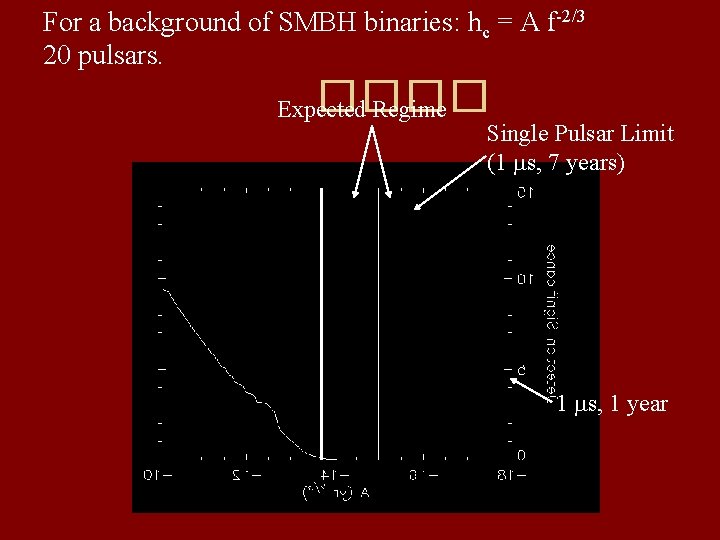
For a background of SMBH binaries: hc = A f-2/3 20 pulsars. ���� Expected Regime Single Pulsar Limit (1 s, 7 years) 1 s, 1 year
For a background of SMBH binaries: hc = A f-2/3 20 pulsars. ���� Expected Regime . 1 s 5 years Single Pulsar Limit (1 s, 7 years) 1 s, 1 year (Current ability)
For a background of SMBH binaries: hc = A f-2/3 20 pulsars. ���� Expected Regime Single Pulsar Limit (1 s, 7 years) . 1 s 10 years. 1 s 5 years 1 s, 1 year (Current ability)
Detection SNR for a given level of the SMBH background Using 20 pulsars -2/3 hc = A f SKA 10 ns 5 years 40 pulsars ���� Expected Regime Single Pulsar Limit (1 s, 7 years) . 1 s 10 years. 1 s 5 years 1 s, 1 year (Current ability)
Graviton Mass • Current solar system limits place mg < 4. 4 10 -22 e. V • 2 = k 2 + (2 mg/h)2 • c = 1/ (4 months) • Detecting 5 year period G-waves reduces the upper bound on the graviton mass by a factor of 15. • By comparing E&M and G-wave measurements, LISA is expected to make a 3 -5 times improvement using LMXRB’s and perhaps up to 10 times better using Helium Cataclismic Variables. (Cutler et al. 2002)
• Radio pulsars can directly detect gravitational waves – R = h/ s , 100 ns (current), 10 ns (SKA) • What can we learn? – Is GR correct? • SKA will allow a high SNR measurement of the residual correlation function -> Test polarization properties of G-waves • Detection implies best limit of Graviton Mass (15 -30 x) – The spectrum of the background set by the astrophysics of the source. • For SMBHs : Rate, Mass, Distribution (Help LISA? ) • Current Limits – For SMBH, A<6. 5 10 -15 or gw(1/20 yrs)h 2 < 3. 0 10 -9 • SKA Limits – For SMBH, A<6. 0 10 -17 or gw(1/10 yrs)h 2 < 4. 0 10 -13 – Dreamland: A<1. 0 10 -18 or gw(1/10 yrs)h 2 < 1. 0 10 -16 • Individual 108 solar mass black hole binaries out to ~100 Mpc. • Individual 109 solar mass black hole binaries out to ~1 Gpc