
Gravitational measurements with cold positronium David B Cassidy
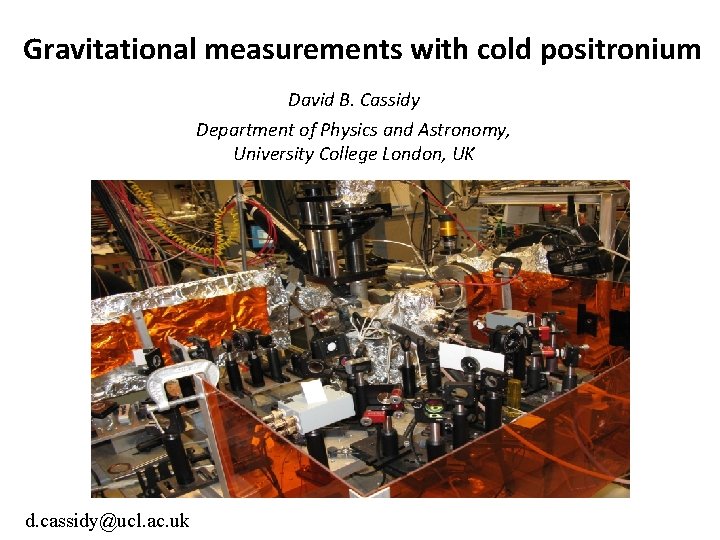
Gravitational measurements with cold positronium David B. Cassidy Department of Physics and Astronomy, University College London, UK d. cassidy@ucl. ac. uk
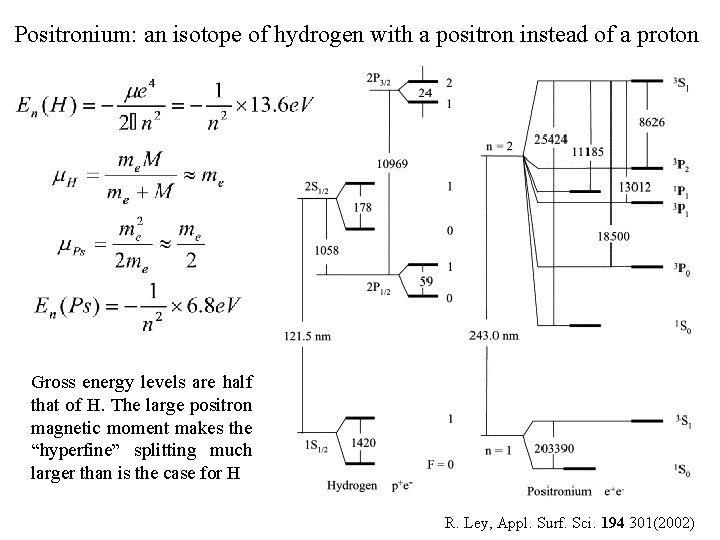
Positronium: an isotope of hydrogen with a positron instead of a proton Gross energy levels are half that of H. The large positron magnetic moment makes the “hyperfine” splitting much larger than is the case for H R. Ley, Appl. Surf. Sci. 194 301(2002)
What is meant by “antigravity”? 1. antimatter-antimatter repulsion not too likely given what we know about matter 2. matter-antimatter repulsion probably the most interesting possibility 3. matter-antimatter/antimatter-antimatter attraction Consistent with general relativity, (and what most people expect) A mutual gravitational repulsion between matter and antimatter could (possibly) help to explain some mysteries of science, such as CP violation, Dark Matter and the lack of observed antimatter in the universe. But should we expect such a thing to occur?
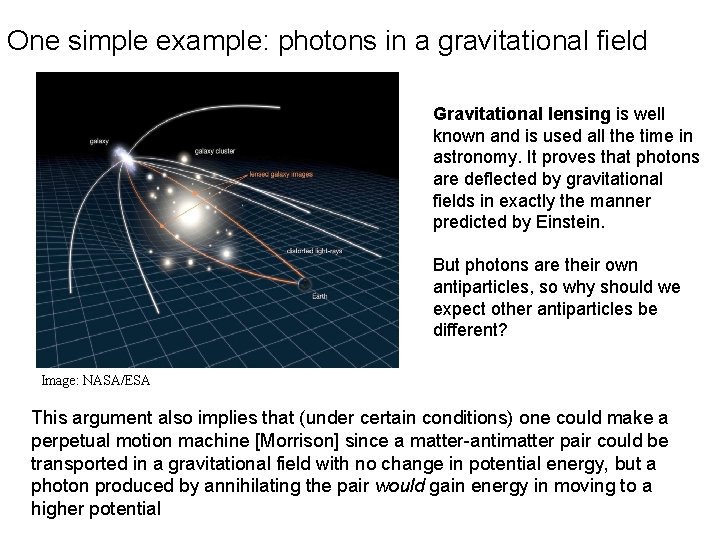
One simple example: photons in a gravitational field Gravitational lensing is well known and is used all the time in astronomy. It proves that photons are deflected by gravitational fields in exactly the manner predicted by Einstein. But photons are their own antiparticles, so why should we expect other antiparticles be different? Image: NASA/ESA This argument also implies that (under certain conditions) one could make a perpetual motion machine [Morrison] since a matter-antimatter pair could be transported in a gravitational field with no change in potential energy, but a photon produced by annihilating the pair would gain energy in moving to a higher potential
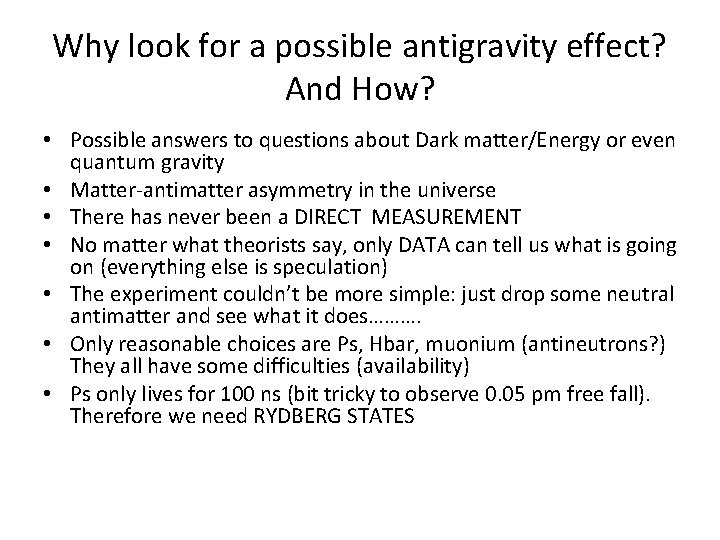
Why look for a possible antigravity effect? And How? • Possible answers to questions about Dark matter/Energy or even quantum gravity • Matter-antimatter asymmetry in the universe • There has never been a DIRECT MEASUREMENT • No matter what theorists say, only DATA can tell us what is going on (everything else is speculation) • The experiment couldn’t be more simple: just drop some neutral antimatter and see what it does………. • Only reasonable choices are Ps, Hbar, muonium (antineutrons? ) They all have some difficulties (availability) • Ps only lives for 100 ns (bit tricky to observe 0. 05 pm free fall). Therefore we need RYDBERG STATES
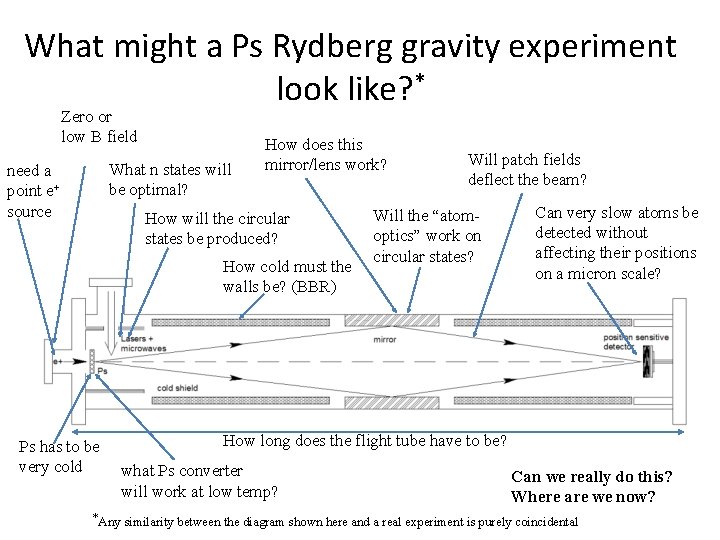
What might a Ps Rydberg gravity experiment look like? * Zero or low B field What n states will be optimal? need a point e+ source How does this mirror/lens work? How will the circular states be produced? How cold must the walls be? (BBR) Ps has to be very cold Will patch fields deflect the beam? Will the “atomoptics” work on circular states? Can very slow atoms be detected without affecting their positions on a micron scale? How long does the flight tube have to be? what Ps converter will work at low temp? Can we really do this? Where are we now? *Any similarity between the diagram shown here and a real experiment is purely coincidental
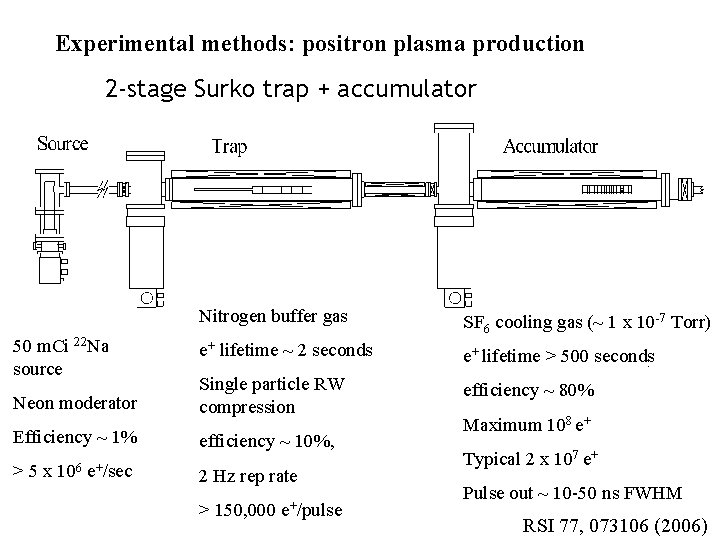
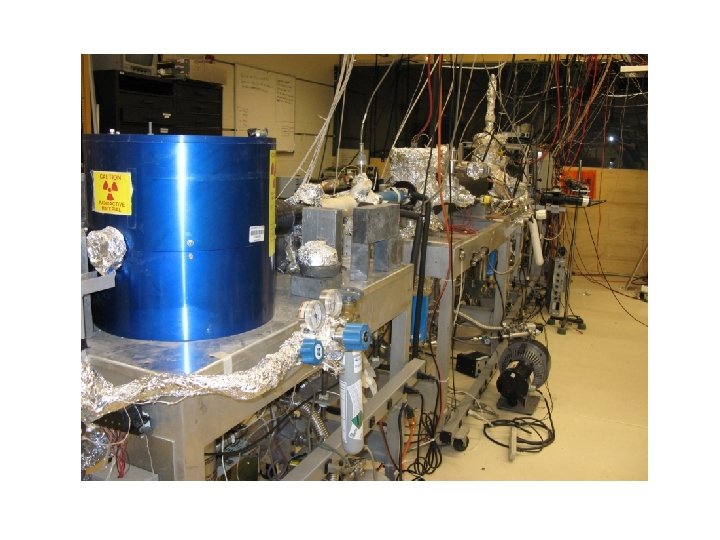
Experimental methods: positron plasma production 2 -stage Surko trap + accumulator 50 m. Ci 22 Na source Neon moderator Efficiency ~ 1% > 5 x 10⁶ e+/sec Nitrogen buffer gas SF 6 cooling gas (~ 1 x 10 -7 Torr) e+ lifetime ~ 2 seconds e+ lifetime > 500 seconds Single particle RW compression efficiency ~ 80% efficiency ~ 10%, 2 Hz rep rate > 150, 000 e+/pulse Maximum 108 e+ Typical 2 x 10⁷ e+ Pulse out ~ 10 -50 ns FWHM RSI 77, 073106 (2006)
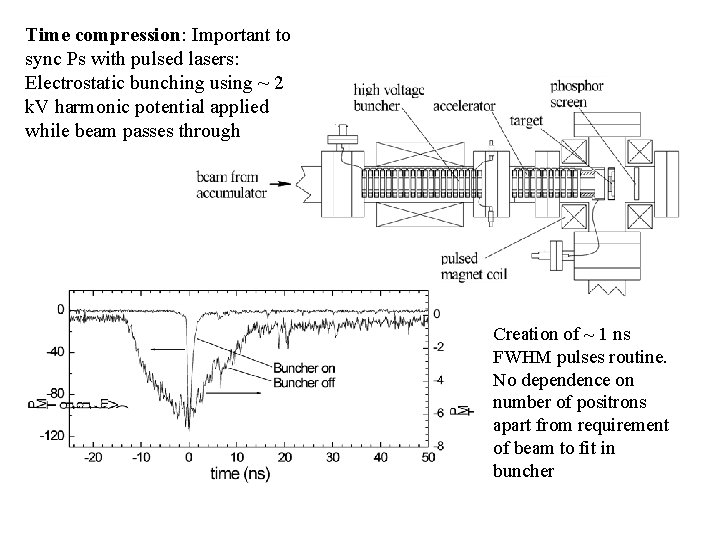
Time compression: Important to sync Ps with pulsed lasers: Electrostatic bunching using ~ 2 k. V harmonic potential applied while beam passes through Creation of ~ 1 ns FWHM pulses routine. No dependence on number of positrons apart from requirement of beam to fit in buncher
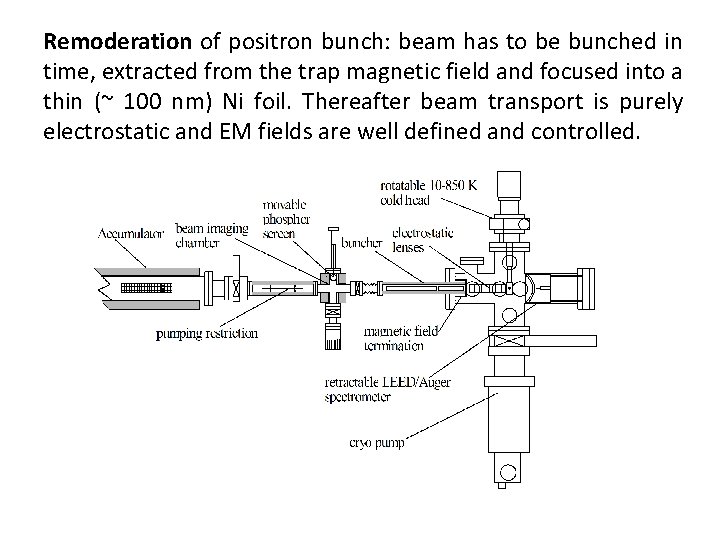
Remoderation of positron bunch: beam has to be bunched in time, extracted from the trap magnetic field and focused into a thin (~ 100 nm) Ni foil. Thereafter beam transport is purely electrostatic and EM fields are well defined and controlled.
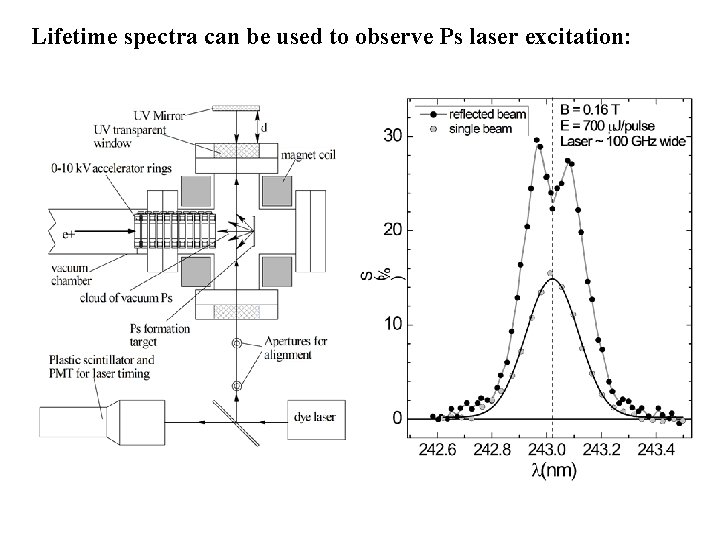
Lifetime spectra can be used to observe Ps laser excitation:
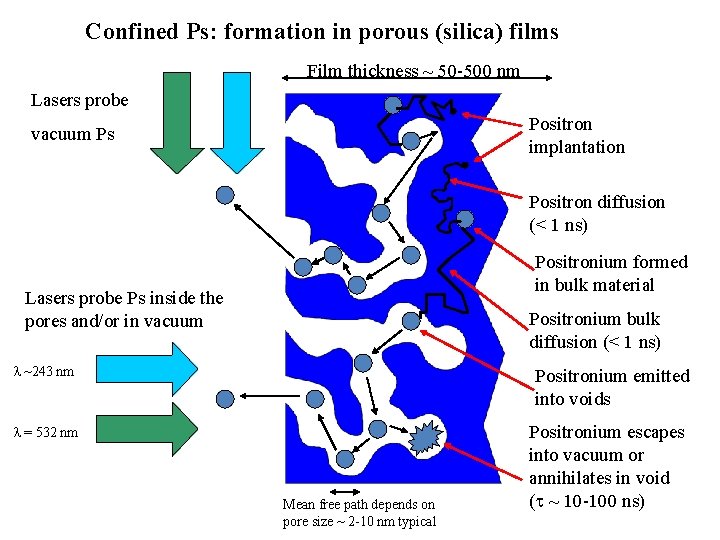
Confined Ps: formation in porous (silica) films Film thickness ~ 50 -500 nm Lasers probe Positron implantation vacuum Ps Positron diffusion (< 1 ns) Positronium formed in bulk material Lasers probe Ps inside the pores and/or in vacuum Positronium bulk diffusion (< 1 ns) l ~243 nm Positronium emitted into voids l = 532 nm Positronium escapes into vacuum or annihilates in void (t ~ 10 -100 ns) Mean free path depends on pore size ~ 2 -10 nm typical
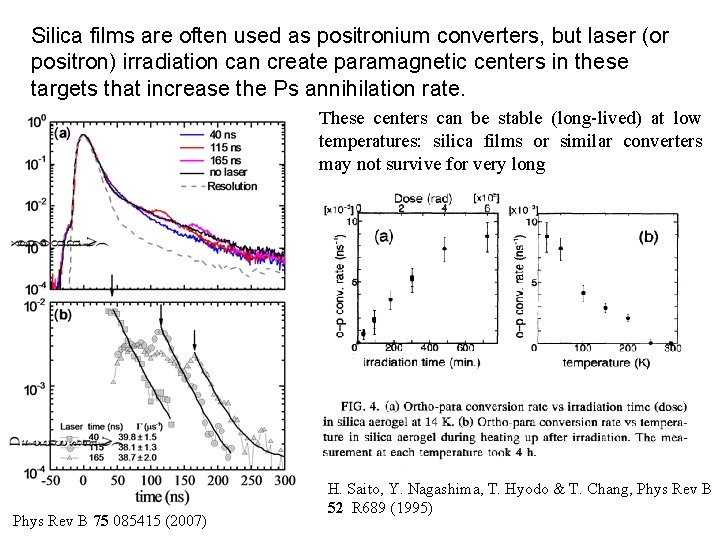
Silica films are often used as positronium converters, but laser (or positron) irradiation can create paramagnetic centers in these targets that increase the Ps annihilation rate. These centers can be stable (long-lived) at low temperatures: silica films or similar converters may not survive for very long Phys Rev B 75 085415 (2007) H. Saito, Y. Nagashima, T. Hyodo & T. Chang, Phys Rev B 52 R 689 (1995)
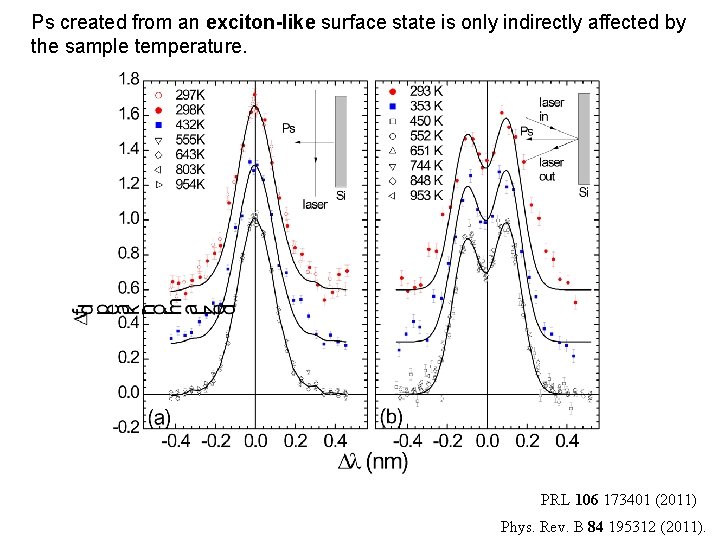
Ps created from an exciton-like surface state is only indirectly affected by the sample temperature. PRL 106 173401 (2011) Phys. Rev. B 84 195312 (2011).
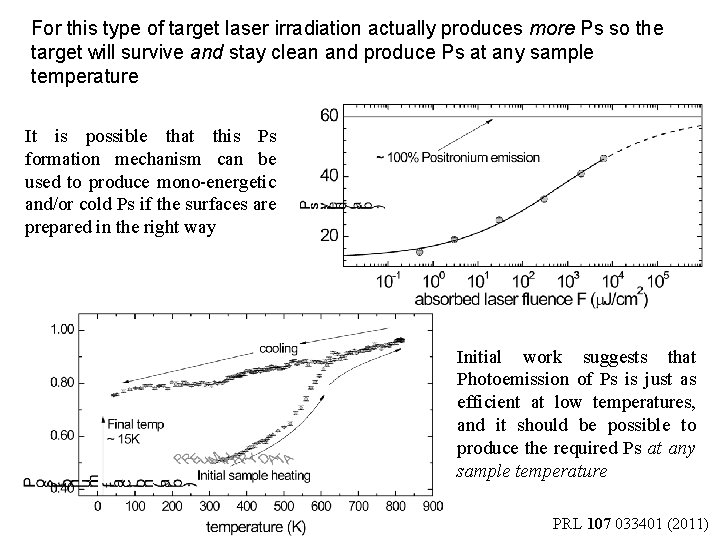
For this type of target laser irradiation actually produces more Ps so the target will survive and stay clean and produce Ps at any sample temperature It is possible that this Ps formation mechanism can be used to produce mono-energetic and/or cold Ps if the surfaces are prepared in the right way Initial work suggests that Photoemission of Ps is just as efficient at low temperatures, and it should be possible to produce the required Ps at any sample temperature PRL 107 033401 (2011)
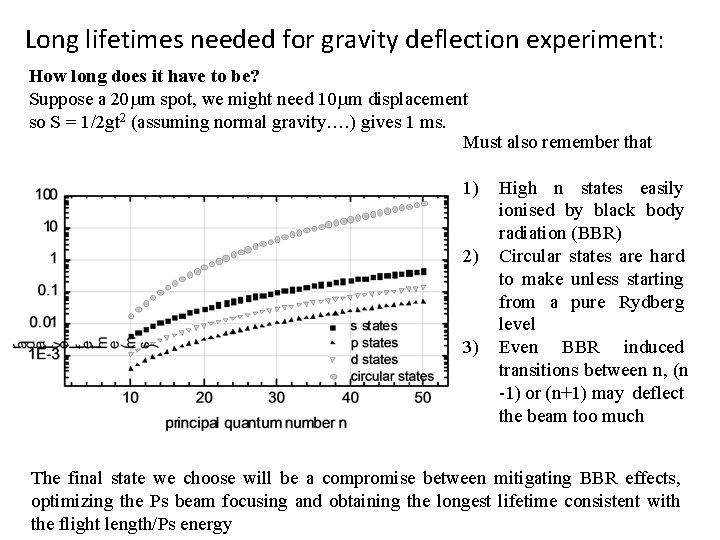
Long lifetimes needed for gravity deflection experiment: How long does it have to be? Suppose a 20 mm spot, we might need 10 mm displacement so S = 1/2 gt 2 (assuming normal gravity…. ) gives 1 ms. Must also remember that 1) 2) 3) High n states easily ionised by black body radiation (BBR) Circular states are hard to make unless starting from a pure Rydberg level Even BBR induced transitions between n, (n -1) or (n+1) may deflect the beam too much The final state we choose will be a compromise between mitigating BBR effects, optimizing the Ps beam focusing and obtaining the longest lifetime consistent with the flight length/Ps energy
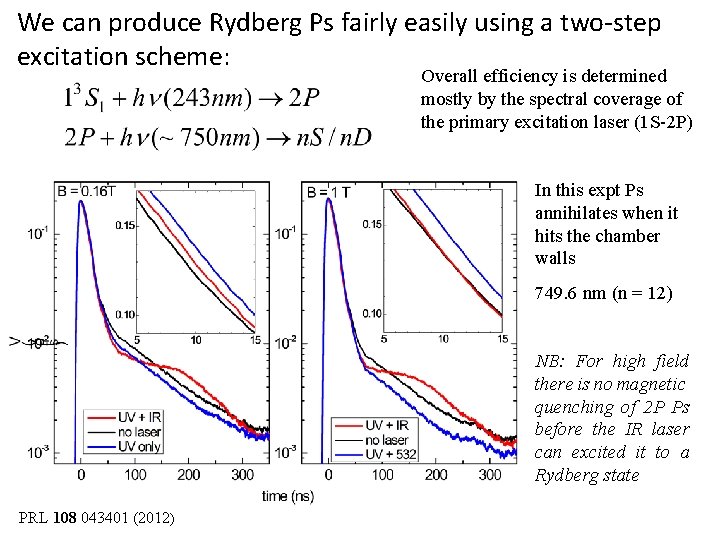
We can produce Rydberg Ps fairly easily using a two-step excitation scheme: Overall efficiency is determined mostly by the spectral coverage of the primary excitation laser (1 S-2 P) In this expt Ps annihilates when it hits the chamber walls 749. 6 nm (n = 12) NB: For high field there is no magnetic quenching of 2 P Ps before the IR laser can excited it to a Rydberg state PRL 108 043401 (2012)
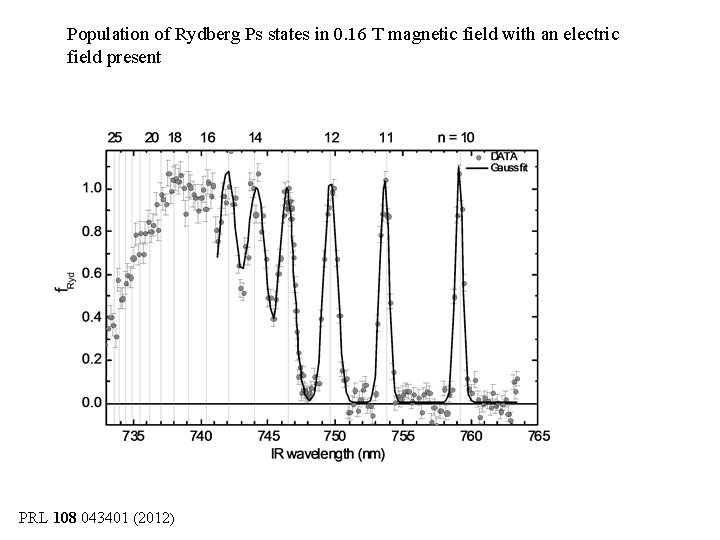
Population of Rydberg Ps states in 0. 16 T magnetic field with an electric field present PRL 108 043401 (2012)
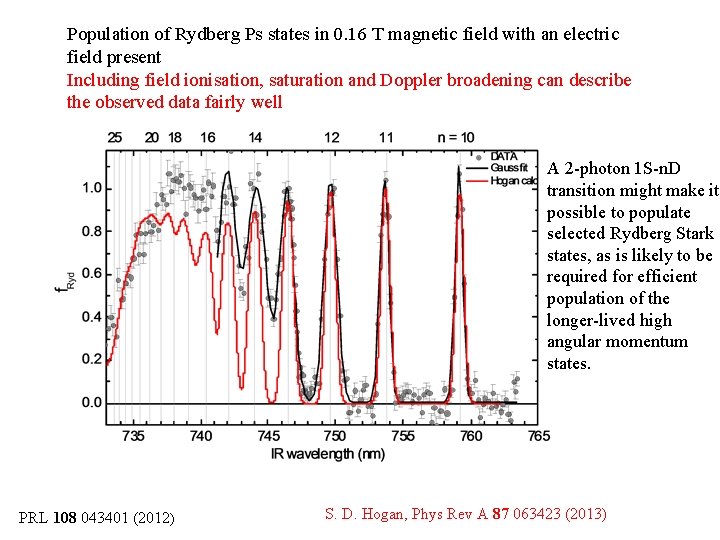
Population of Rydberg Ps states in 0. 16 T magnetic field with an electric field present Including field ionisation, saturation and Doppler broadening can describe the observed data fairly well A 2 -photon 1 S-n. D transition might make it possible to populate selected Rydberg Stark states, as is likely to be required for efficient population of the longer-lived high angular momentum states. PRL 108 043401 (2012) S. D. Hogan, Phys Rev A 87 063423 (2013)
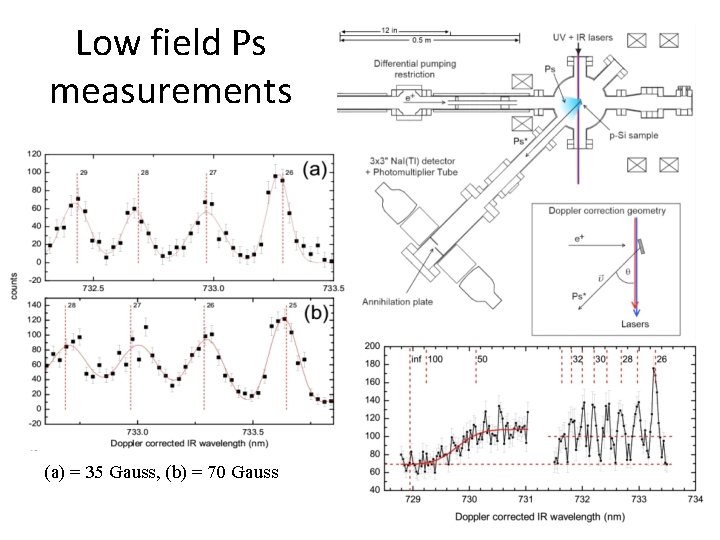
Low field Ps measurements (a) = 35 Gauss, (b) = 70 Gauss
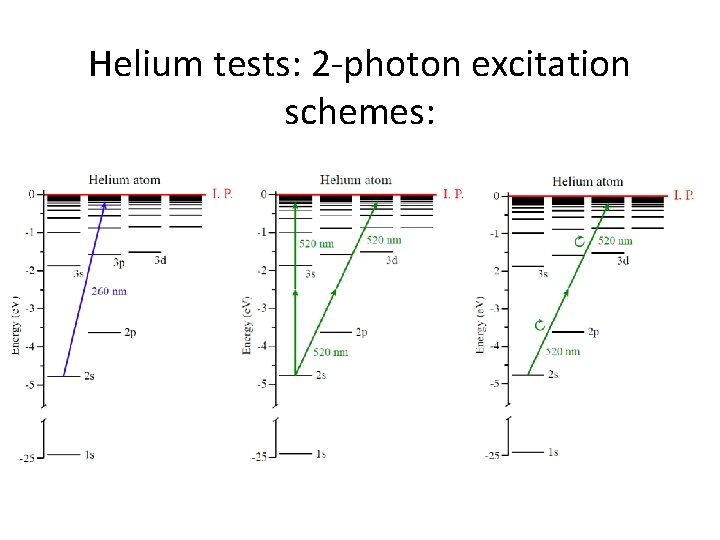
Helium tests: 2 -photon excitation schemes:
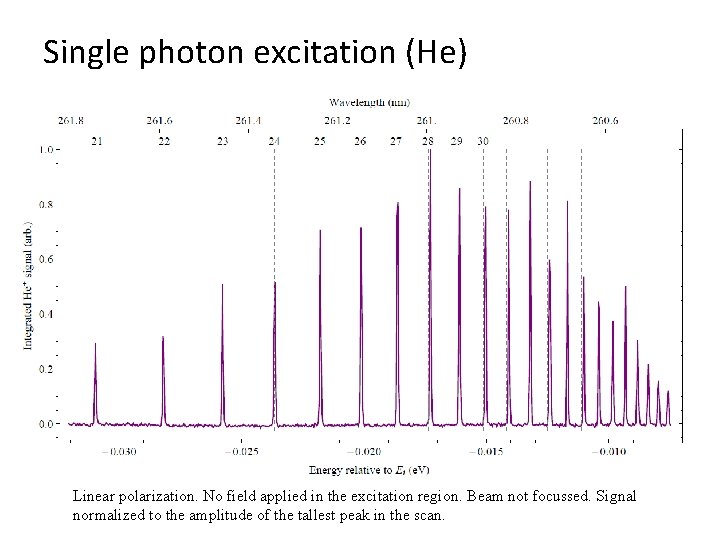
Single photon excitation (He) Linear polarization. No field applied in the excitation region. Beam not focussed. Signal normalized to the amplitude of the tallest peak in the scan.
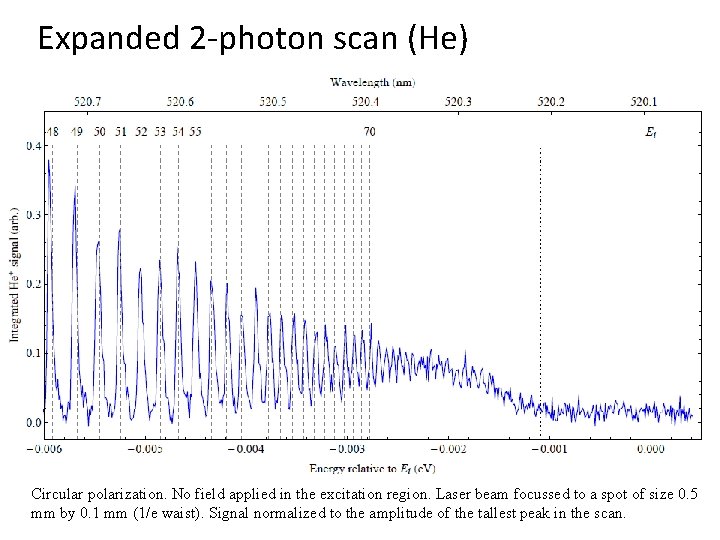
Expanded 2 -photon scan (He) Circular polarization. No field applied in the excitation region. Laser beam focussed to a spot of size 0. 5 mm by 0. 1 mm (1/e waist). Signal normalized to the amplitude of the tallest peak in the scan.
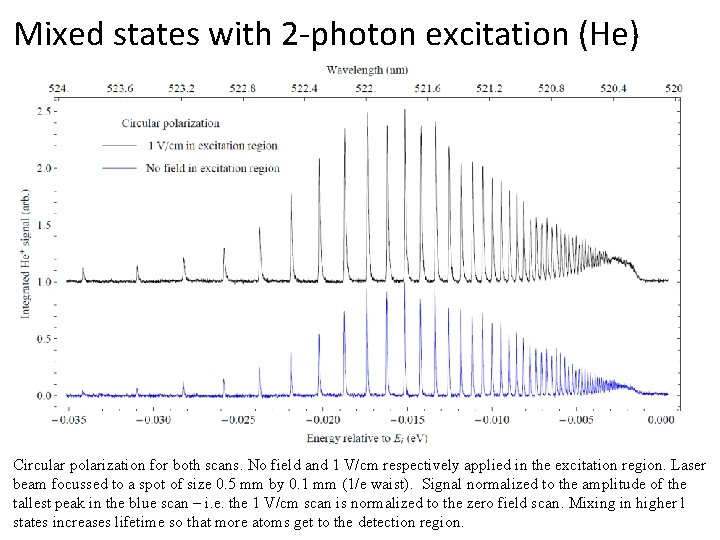
Mixed states with 2 -photon excitation (He) Circular polarization for both scans. No field and 1 V/cm respectively applied in the excitation region. Laser beam focussed to a spot of size 0. 5 mm by 0. 1 mm (1/e waist). Signal normalized to the amplitude of the tallest peak in the blue scan – i. e. the 1 V/cm scan is normalized to the zero field scan. Mixing in higher l states increases lifetime so that more atoms get to the detection region.
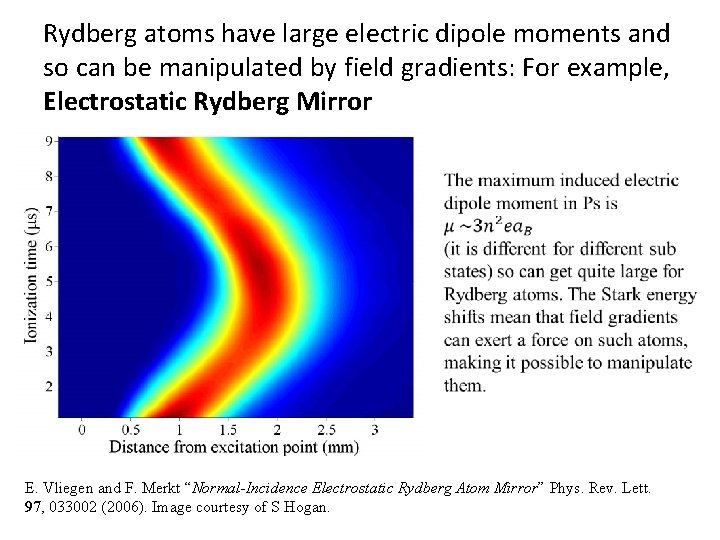
Rydberg atoms have large electric dipole moments and so can be manipulated by field gradients: For example, Electrostatic Rydberg Mirror E. Vliegen and F. Merkt “Normal-Incidence Electrostatic Rydberg Atom Mirror” Phys. Rev. Lett. 97, 033002 (2006). Image courtesy of S Hogan.
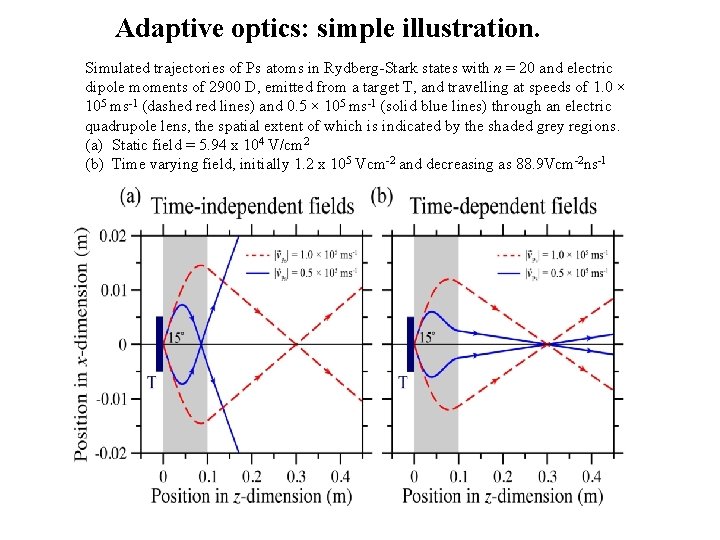
Adaptive optics: simple illustration. Simulated trajectories of Ps atoms in Rydberg-Stark states with n = 20 and electric dipole moments of 2900 D, emitted from a target T, and travelling at speeds of 1. 0 × 105 ms-1 (dashed red lines) and 0. 5 × 10⁵ ms-1 (solid blue lines) through an electric quadrupole lens, the spatial extent of which is indicated by the shaded grey regions. (a) Static field = 5. 94 x 104 V/cm 2 (b) Time varying field, initially 1. 2 x 10⁵ Vcm-2 and decreasing as 88. 9 Vcm-2 ns-1
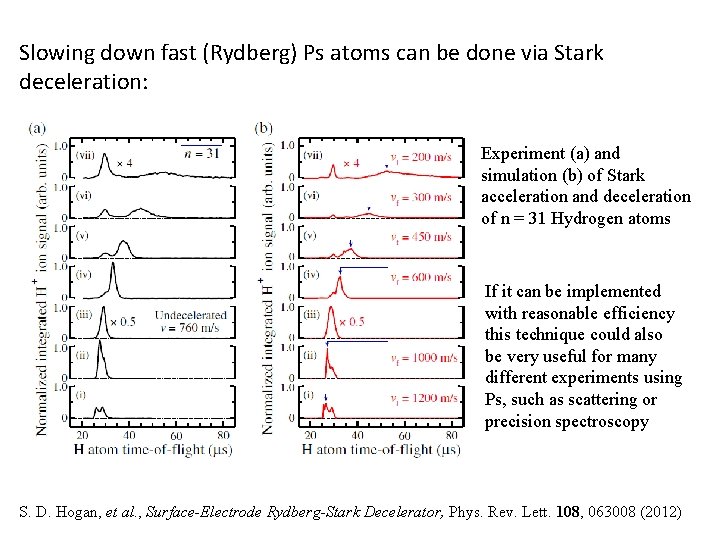
Slowing down fast (Rydberg) Ps atoms can be done via Stark deceleration: Experiment (a) and simulation (b) of Stark acceleration and deceleration of n = 31 Hydrogen atoms If it can be implemented with reasonable efficiency this technique could also be very useful for many different experiments using Ps, such as scattering or precision spectroscopy S. D. Hogan, et al. , Surface-Electrode Rydberg-Stark Decelerator, Phys. Rev. Lett. 108, 063008 (2012)
Concluding remarks: • Ps gravity experiments are not going to be easy, the main problems being related to the production of sufficiently cold Ps and appropriate Rydberg Ps states as well as the implementation of Ps “atom optics” • The first stages of the experiment are now beginning at UCL, including remoderation of the pulsed beam, production of cold Ps, and evaluation of Doppler free two-photon transitions and BBR effects on Rydberg states. Once these are understood it will be easier to plan for focusing and circular state production • There a lot of interesting stand alone experiments to be done as part of the larger project that can be useful for other work (spectroscopy, atom trapping and deceleration, scattering etc) • As we have essentially no data, any measurement resulting from this experiment will be of great importance no matter what the outcome (same for hbar)
Collaborators Allen Mills, Adric Jones, Tomu Hisakado, H. Tom, UCR (USA) Rod Greaves, First Point Scientific Inc. (USA) Laszlo Liszkay, Patrice Perez, CEA, Saclay (France) Stephen Hogan, Thomas Wall, Peter Barker, Adam Deller UCL (UK) Funding from NSF, EPSRC, Leverhulme Trust, ERC Thank you for your attention
- Slides: 29