
Gravitational Instability Can Giant Planet Form by Direct
Gravitational Instability Can Giant Planet Form by Direct Gravitational Instability? Roman Rafikov (CITA)
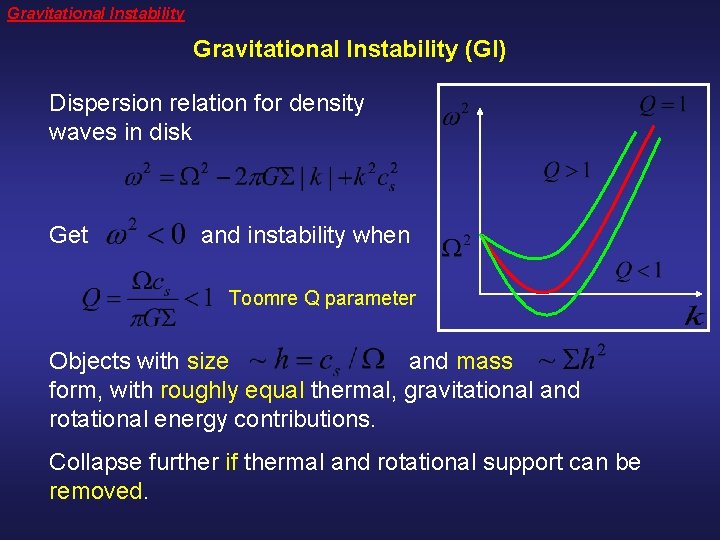
Gravitational Instability (GI) Dispersion relation for density waves in disk Get and instability when Toomre Q parameter Objects with size and mass form, with roughly equal thermal, gravitational and rotational energy contributions. Collapse further if thermal and rotational support can be removed.
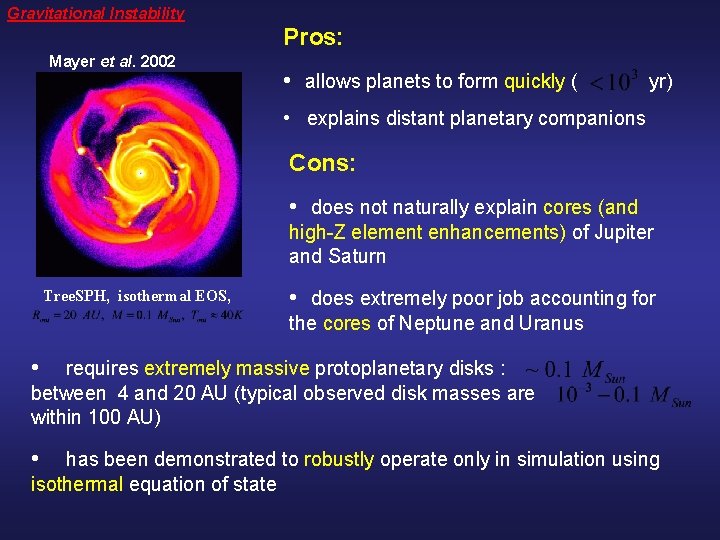
Gravitational Instability Pros: Mayer et al. 2002 • allows planets to form quickly ( yr) • explains distant planetary companions Cons: • does not naturally explain cores (and high-Z element enhancements) of Jupiter and Saturn Tree. SPH, isothermal EOS, • does extremely poor job accounting for the cores of Neptune and Uranus • requires extremely massive protoplanetary disks : between 4 and 20 AU (typical observed disk masses are within 100 AU) • has been demonstrated to robustly operate only in simulation using isothermal equation of state
Gravitational Instability Planet Formation • GI generates overdensities but does not guarantee their strongly nonlinear development. • Even if the disk is gravitationally unstable (Q<1) gas pressure and rotation can stop collapse. Thus, in general, Gravitational Instability Planet Formation • To be able to form bound objects (planets) disk must be able to fragment, i. e. Gravitational Instability + Fragmentation = Planet Formation
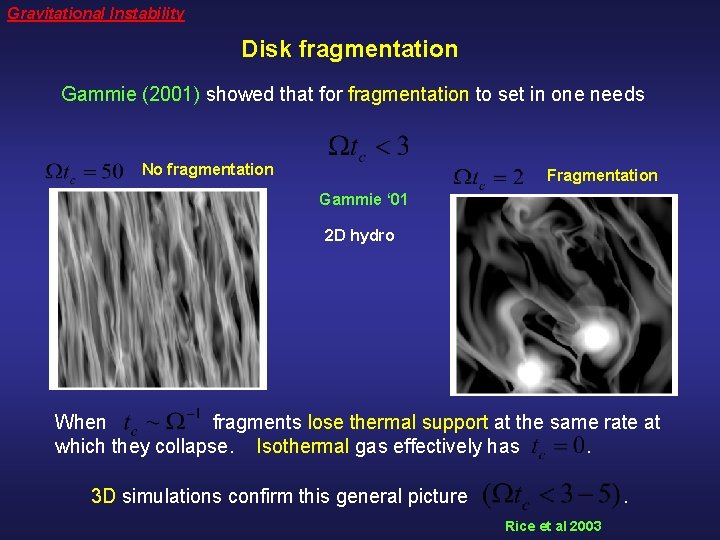
Gravitational Instability Disk fragmentation Gammie (2001) showed that for fragmentation to set in one needs No fragmentation Fragmentation Gammie ‘ 01 2 D hydro When fragments lose thermal support at the same rate at which they collapse. Isothermal gas effectively has. 3 D simulations confirm this general picture . Rice et al 2003
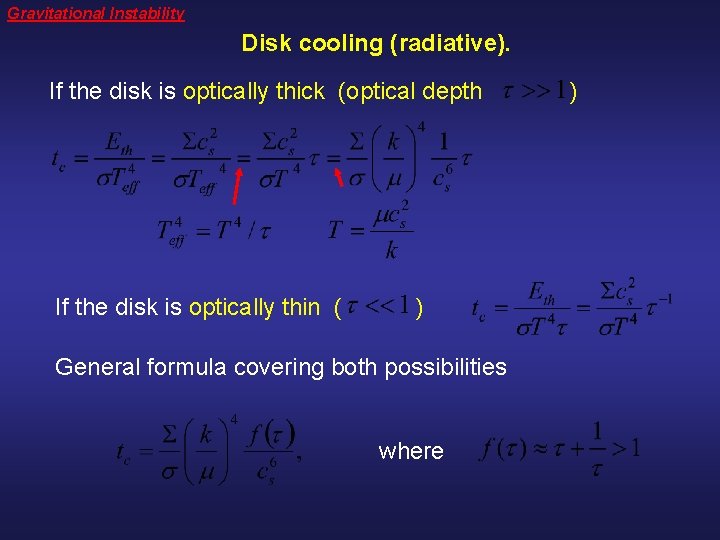
Gravitational Instability Disk cooling (radiative). If the disk is optically thick (optical depth If the disk is optically thin ( ) General formula covering both possibilities where )
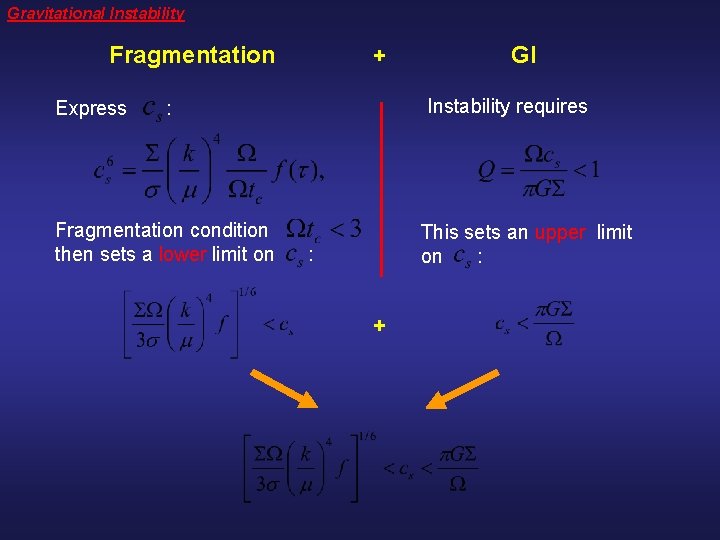
Gravitational Instability Fragmentation Express + Instability requires : Fragmentation condition then sets a lower limit on GI This sets an upper limit on : : +
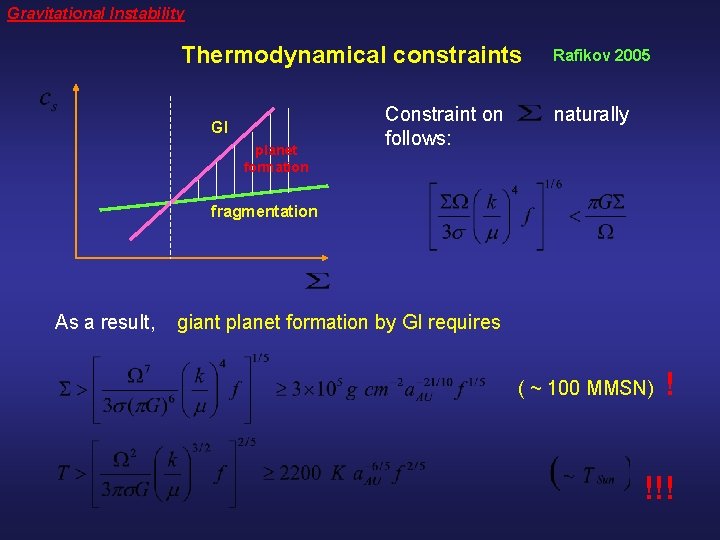
Gravitational Instability Thermodynamical constraints GI planet formation Constraint on follows: Rafikov 2005 naturally fragmentation As a result, giant planet formation by GI requires ( ~ 100 MMSN) ! !!!
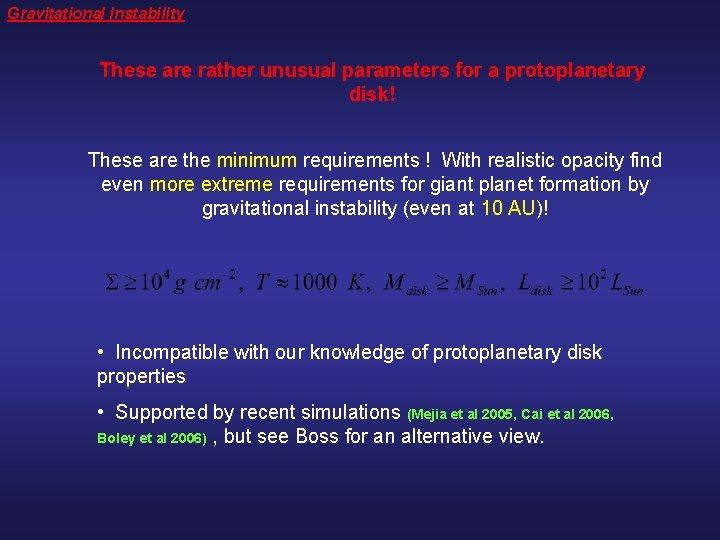
Gravitational Instability These are rather unusual parameters for a protoplanetary disk! These are the minimum requirements ! With realistic opacity find even more extreme requirements for giant planet formation by gravitational instability (even at 10 AU)! • Incompatible with our knowledge of protoplanetary disk properties • Supported by recent simulations (Mejia et al 2005, Cai et al 2006, Boley et al 2006) , but see Boss for an alternative view.
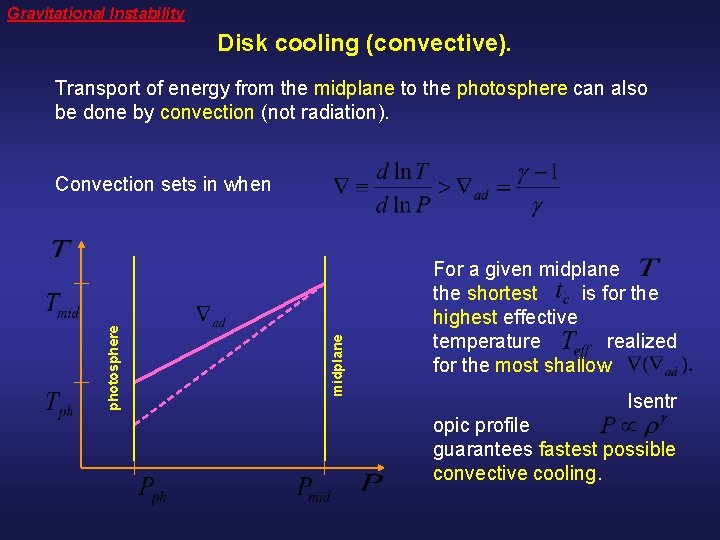
Gravitational Instability Disk cooling (convective). Transport of energy from the midplane to the photosphere can also be done by convection (not radiation). midplane photosphere Convection sets in when For a given midplane the shortest is for the highest effective temperature realized for the most shallow Isentr opic profile guarantees fastest possible convective cooling.
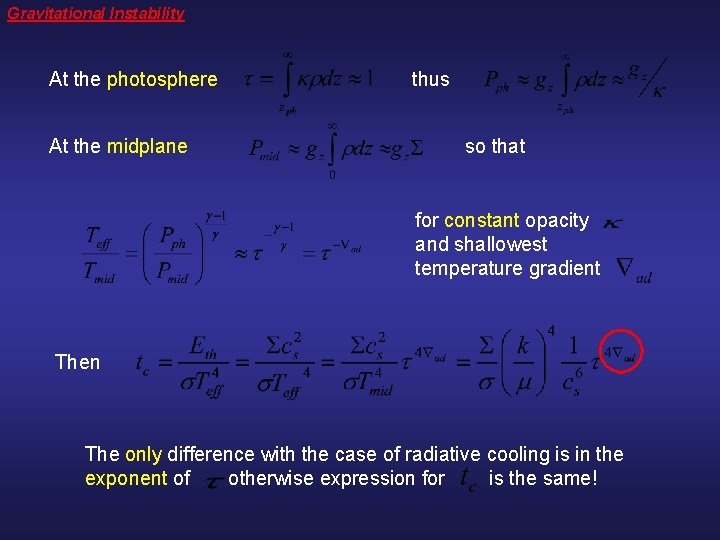
Gravitational Instability At the photosphere At the midplane thus so that for constant opacity and shallowest temperature gradient Then The only difference with the case of radiative cooling is in the exponent of otherwise expression for is the same!
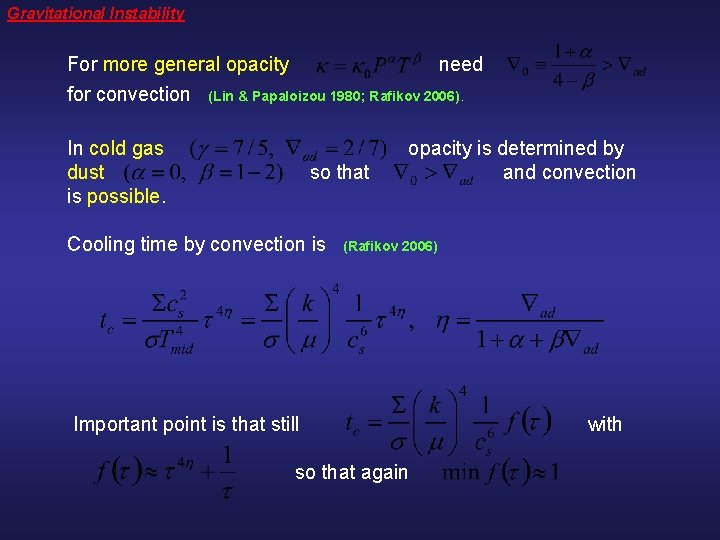
Gravitational Instability For more general opacity need for convection (Lin & Papaloizou 1980; Rafikov 2006). In cold gas dust is possible. so that Cooling time by convection is opacity is determined by and convection (Rafikov 2006) Important point is that still so that again with
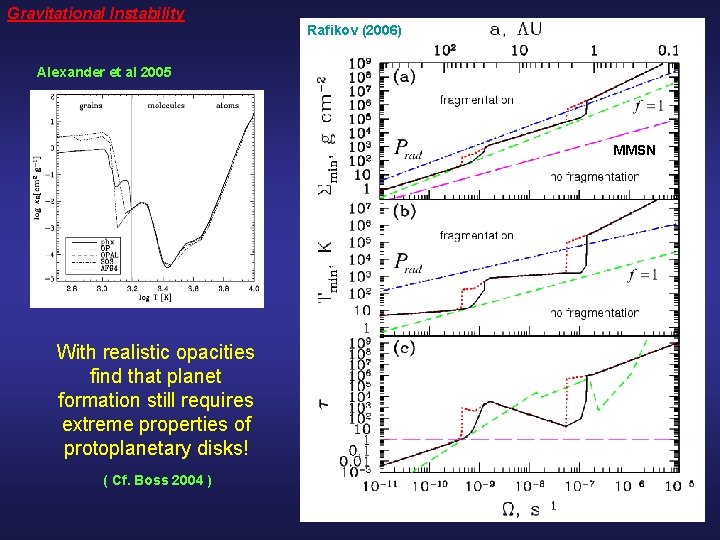
Gravitational Instability Rafikov (2006) Alexander et al 2005 MMSN With realistic opacities find that planet formation still requires extreme properties of protoplanetary disks! ( Cf. Boss 2004 )
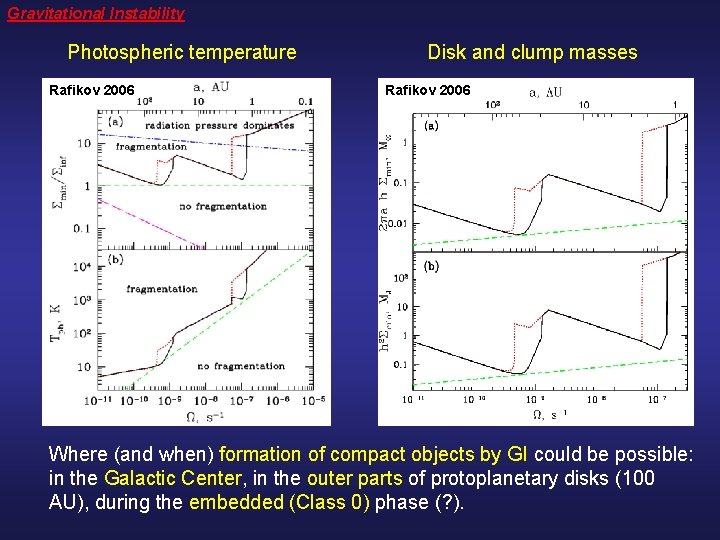
Gravitational Instability Photospheric temperature Rafikov 2006 Disk and clump masses Rafikov 2006 Where (and when) formation of compact objects by GI could be possible: in the Galactic Center, in the outer parts of protoplanetary disks (100 AU), during the embedded (Class 0) phase (? ).
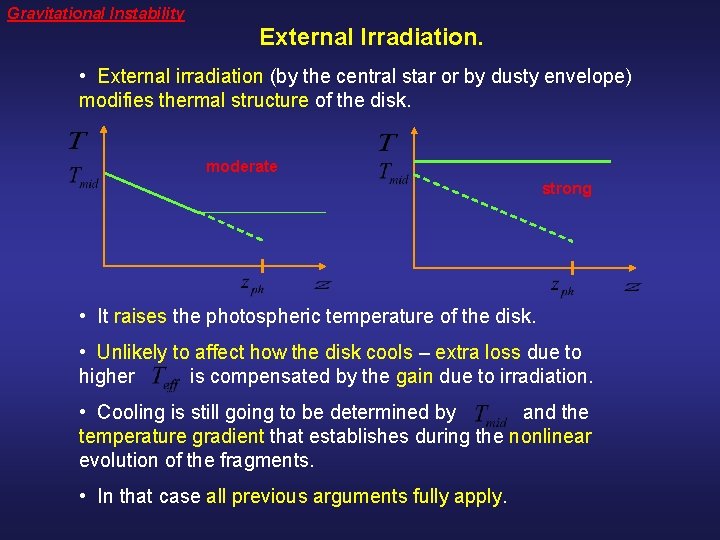
Gravitational Instability External Irradiation. • External irradiation (by the central star or by dusty envelope) modifies thermal structure of the disk. moderate strong • It raises the photospheric temperature of the disk. • Unlikely to affect how the disk cools – extra loss due to higher is compensated by the gain due to irradiation. • Cooling is still going to be determined by and the temperature gradient that establishes during the nonlinear evolution of the fragments. • In that case all previous arguments fully apply.
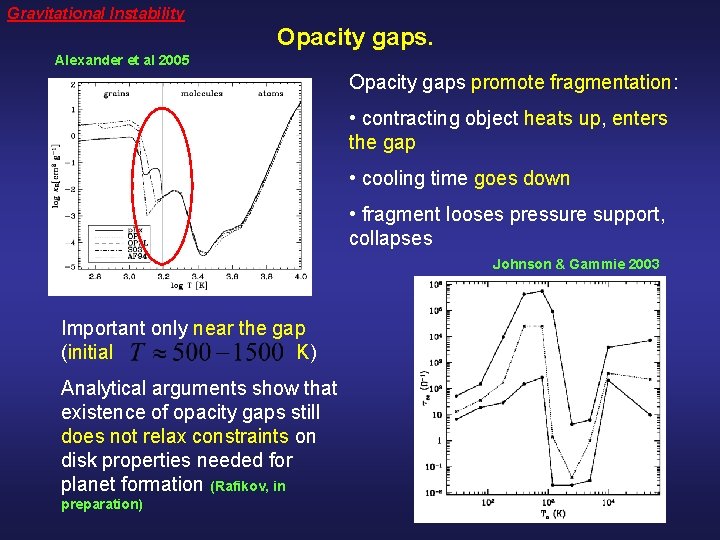
Gravitational Instability Opacity gaps. Alexander et al 2005 Opacity gaps promote fragmentation: • contracting object heats up, enters the gap • cooling time goes down • fragment looses pressure support, collapses Johnson & Gammie 2003 Important only near the gap (initial K) Analytical arguments show that existence of opacity gaps still does not relax constraints on disk properties needed for planet formation (Rafikov, in preparation)
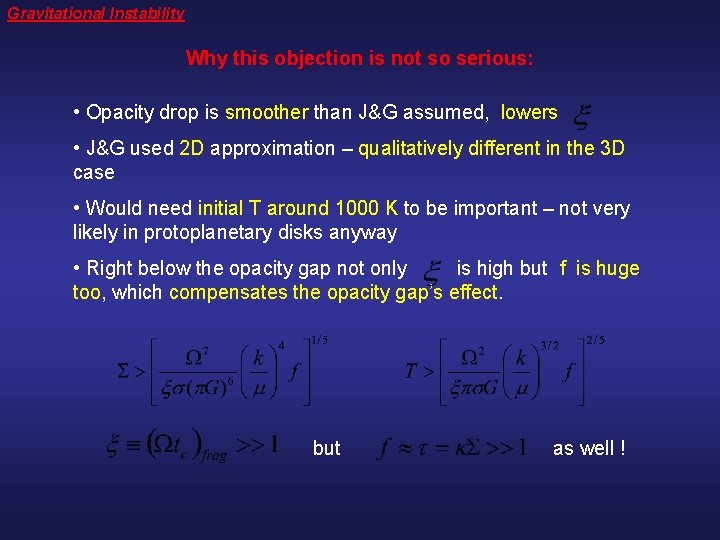
Gravitational Instability Why this objection is not so serious: • Opacity drop is smoother than J&G assumed, lowers • J&G used 2 D approximation – qualitatively different in the 3 D case • Would need initial T around 1000 K to be important – not very likely in protoplanetary disks anyway • Right below the opacity gap not only is high but f is huge too, which compensates the opacity gap’s effect. but as well !
Gravitational Instability Conclusions • Planet formation by gravitational instability is possible only when collapsing objects can cool rapidly • Simple analytical arguments (supported by simulations) demonstrate that this requires extreme properties of protoplanetary disks • None of the following seem to relax these requirements: - Convective cooling - External irradiation - Realistic opacity with gaps • Need more careful simulations with realistic physics to check these predictions – comparison projects!
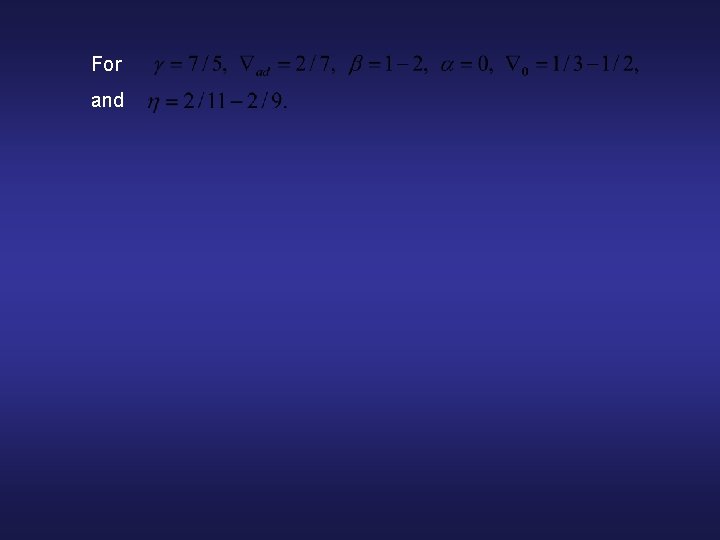
For and
- Slides: 19