
Gravitational Field Historical facts l Geocentric Theory l
- Slides: 53
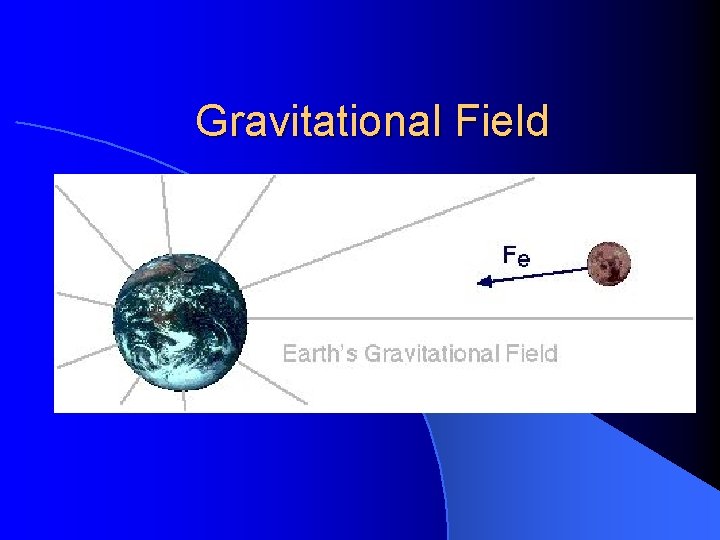
Gravitational Field
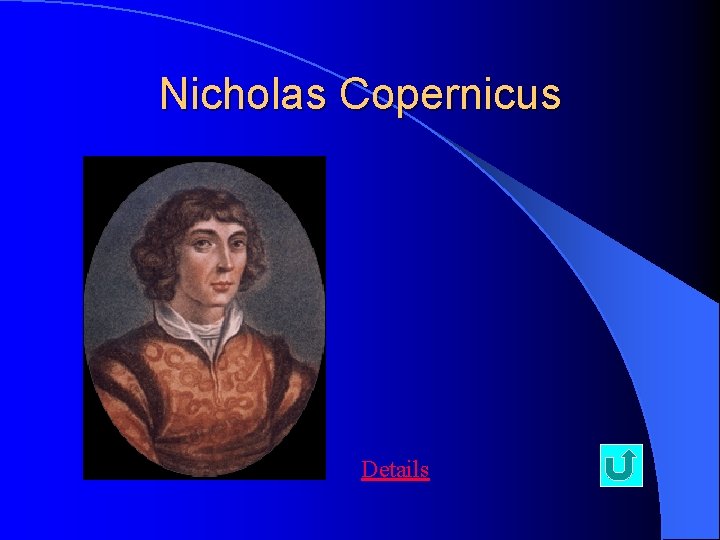
Historical facts l Geocentric Theory l Heliocentric Theory – Nicholas Copernicus (1473 – 1543) – All planets, including Earth, move in orbits around the sun
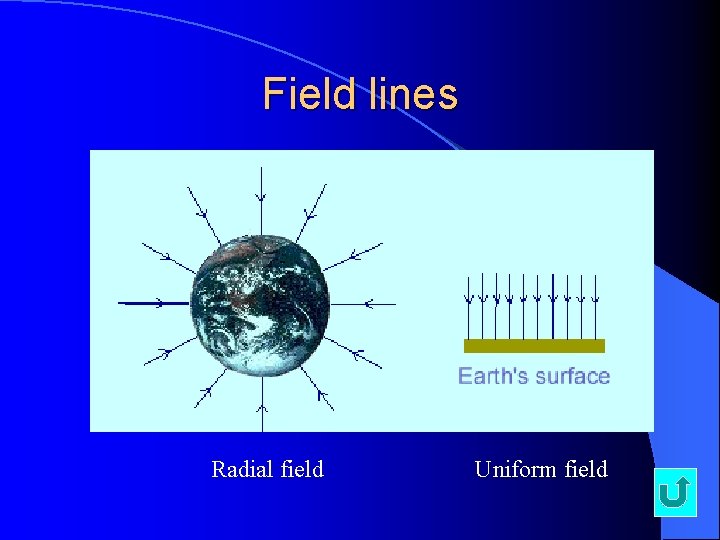
Gravitational field (G-field) (1) l. A region where a force is experienced by a unit mass l A gravitational field is set up in the neighbourhood of a mass and through the interaction of this field with another mass, a force is experienced by the second body l A gravitational field is represented by field lines
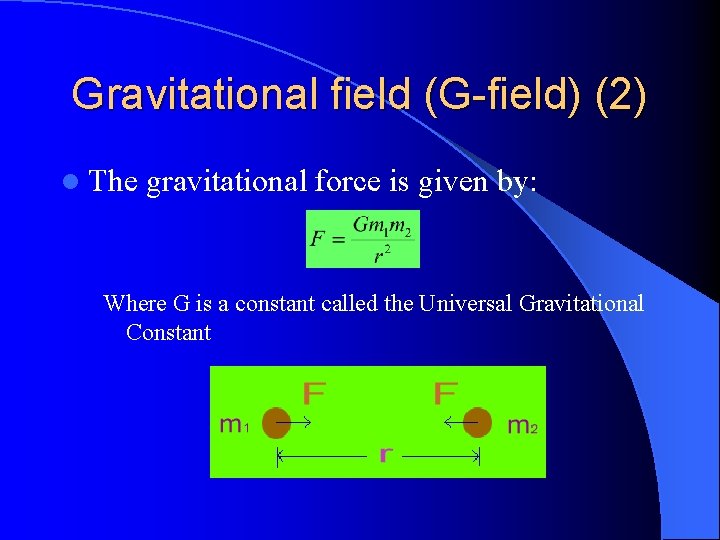
Gravitational field (G-field) (2) l The gravitational force is given by: Where G is a constant called the Universal Gravitational Constant
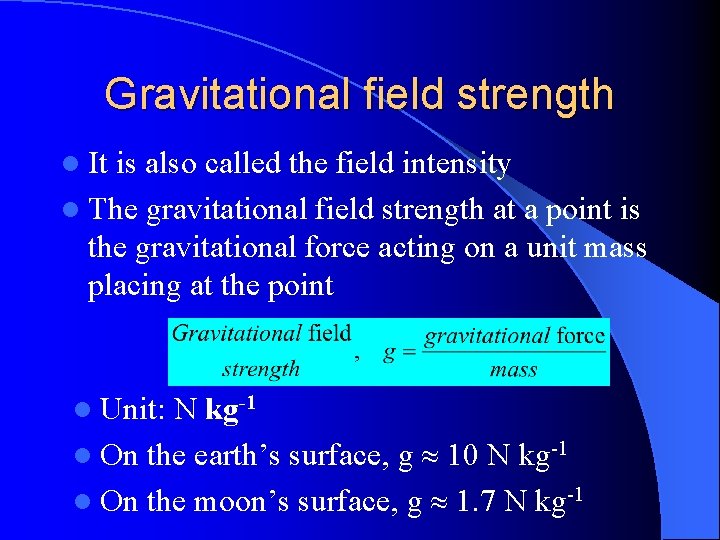
Gravitational field strength l It is also called the field intensity l The gravitational field strength at a point is the gravitational force acting on a unit mass placing at the point l Unit: N kg-1 l On the earth’s surface, g 10 N kg-1 l On the moon’s surface, g 1. 7 N kg-1
Gravitational potential l Due to the existence of the field, a net amount of work has to be done to move a unit mass from one point to another. We say that different points in the field have different gravitational potential l It represents the work done in taking a unit mass from one point in a g-field to another l Unit: J kg-1
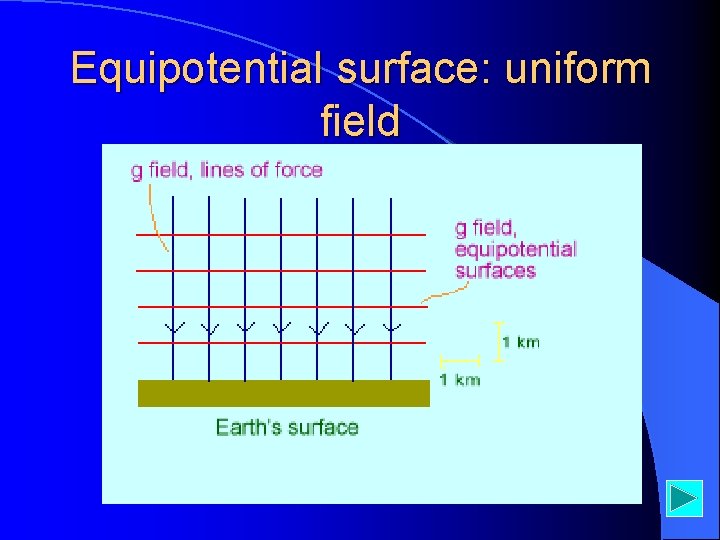
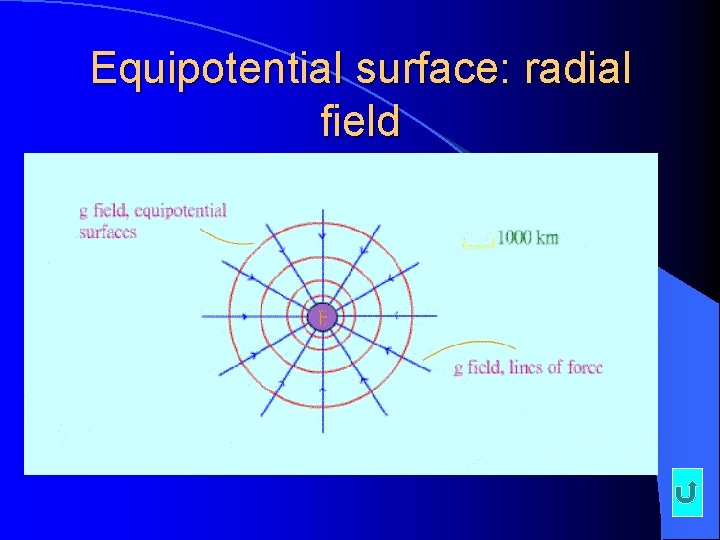
Equipotential surfaces l Surfaces containing points having the same gravitational potential (figure) l The spacing of the equipotential surface is an indication of the field strength l The g-field is pointing in the direction of decreasing gravitational potential
Uniform field l Near the Earth’s surface, the pull of the Earth on a body is constant in size and in direction. The gravitational field g is thus uniform within these limits
Radial field l The field lines are directed radially inwards towards a centre
Important points (1) l The reference zero level for the gravitational potential is defined to be a point at infinity l Work must be done in moving a mass from the earth’s surface to the infinity. At a closer distance from the earth the gravitational potential takes a negative value
Important points (2) l The equipotential surfaces have a nonuniform spacing, being closer to each other nearer the earth’s surface – Explanation: Near the earth’s surface, the g- field is stronger. The same amount of work can only cause a small displacement from the earth’s surface l The density of the field lines is a measure of the field strength
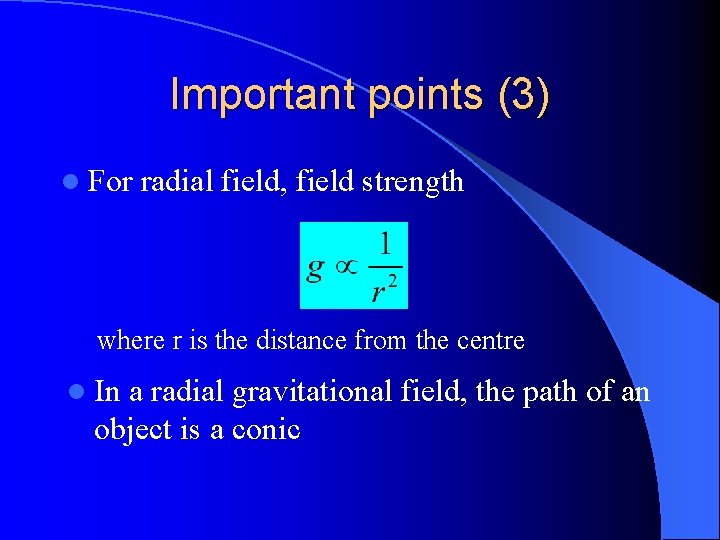
Important points (3) l For radial field, field strength where r is the distance from the centre l In a radial gravitational field, the path of an object is a conic
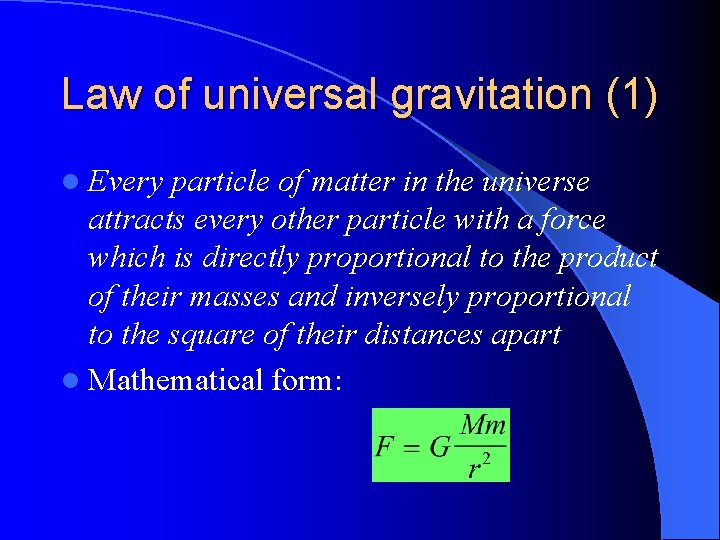
Law of universal gravitation (1) l Every particle of matter in the universe attracts every other particle with a force which is directly proportional to the product of their masses and inversely proportional to the square of their distances apart l Mathematical form:
Law of universal gravitation (2) l As the force is inversely proportional to the square of the separation of the masses, it is called an inverse square law l The law applies to: – particles – the attraction exerted at an external point by a sphere of uniform density (the whole mass should be treated as if concentrated at centre of the sphere)
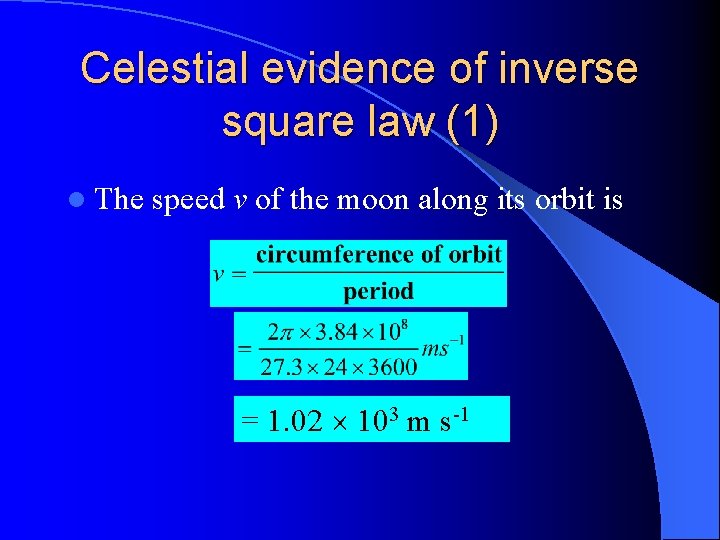
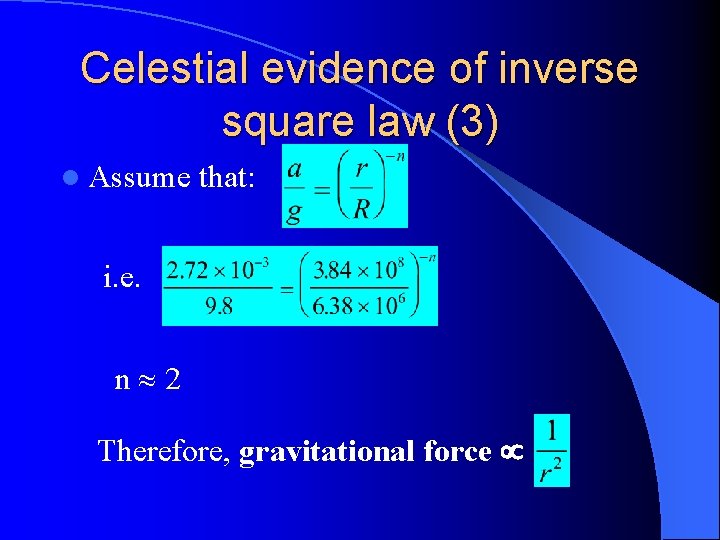
Celestial evidence of inverse square law (1) l The speed v of the moon along its orbit is = 1. 02 103 m s-1
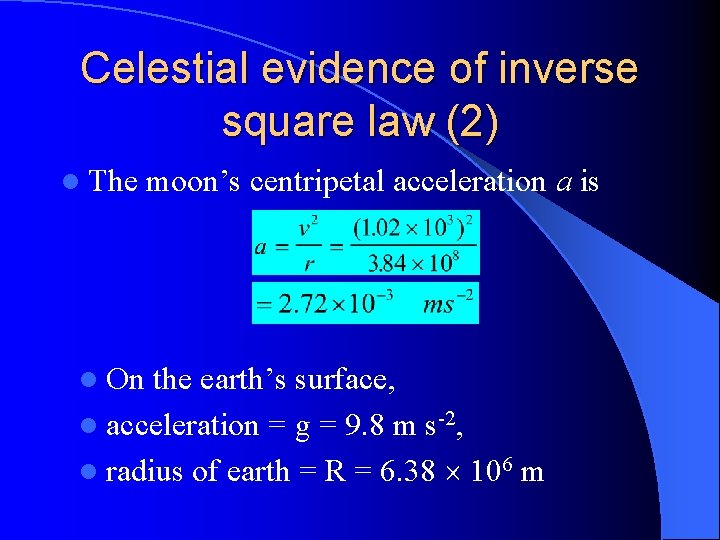
Celestial evidence of inverse square law (2) l The l On moon’s centripetal acceleration a is the earth’s surface, l acceleration = g = 9. 8 m s-2, l radius of earth = R = 6. 38 106 m
Celestial evidence of inverse square law (3) l Assume that: i. e. n 2 Therefore, gravitational force
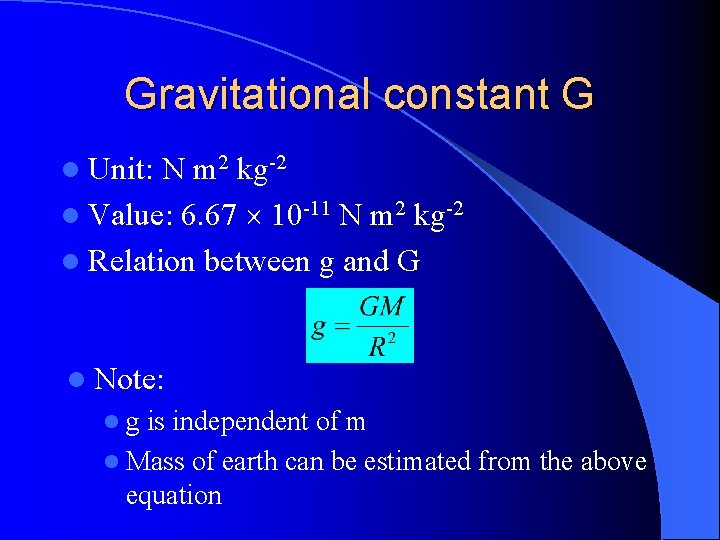
Gravitational constant G l Unit: N m 2 kg-2 l Value: 6. 67 10 -11 N m 2 kg-2 l Relation between g and G l Note: lg is independent of m l Mass of earth can be estimated from the above equation
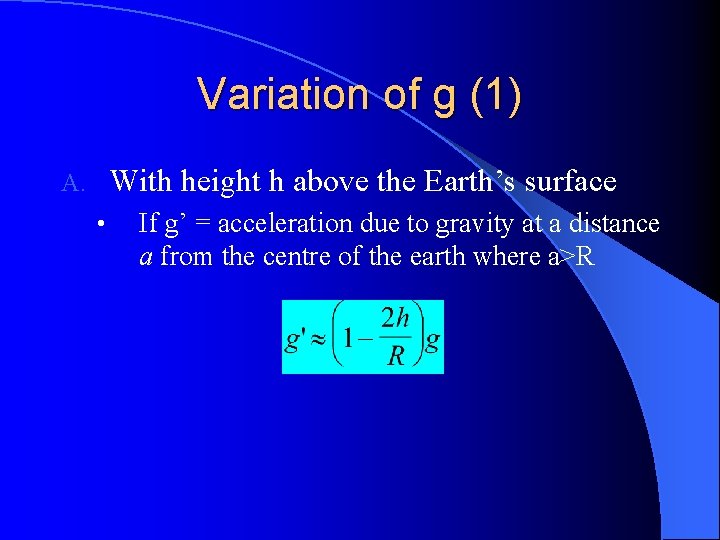
Variation of g (1) With height h above the Earth’s surface A. • If g’ = acceleration due to gravity at a distance a from the centre of the earth where a>R
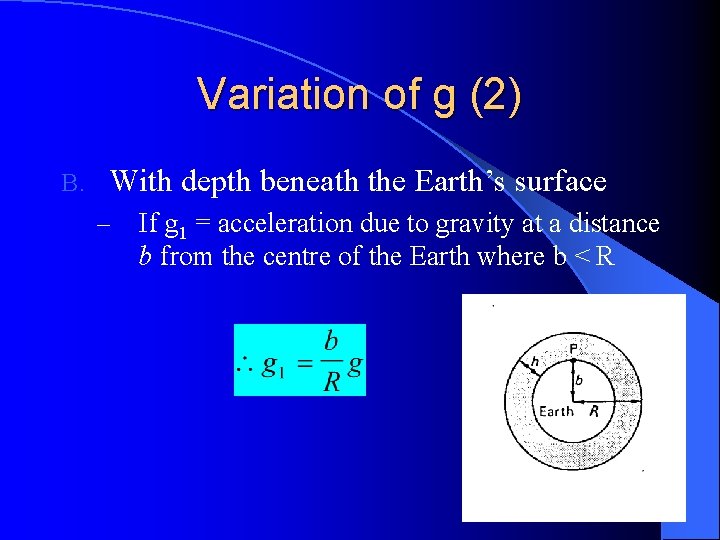
Variation of g (2) B. With depth beneath the Earth’s surface – If g 1 = acceleration due to gravity at a distance b from the centre of the Earth where b < R
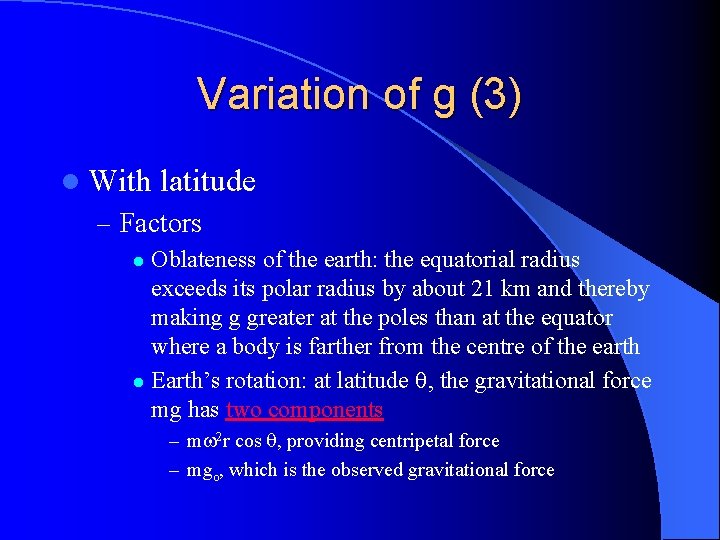
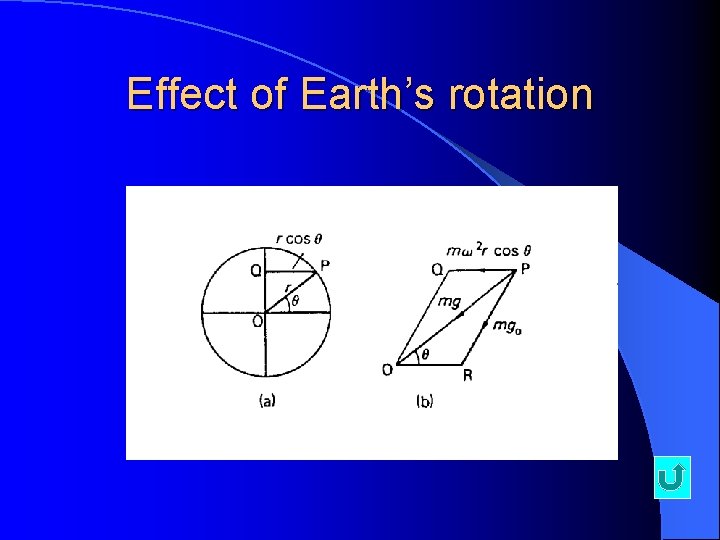
Variation of g (3) l With latitude – Factors Oblateness of the earth: the equatorial radius exceeds its polar radius by about 21 km and thereby making g greater at the poles than at the equator where a body is farther from the centre of the earth l Earth’s rotation: at latitude , the gravitational force mg has two components l – m 2 r cos , providing centripetal force – mgo, which is the observed gravitational force
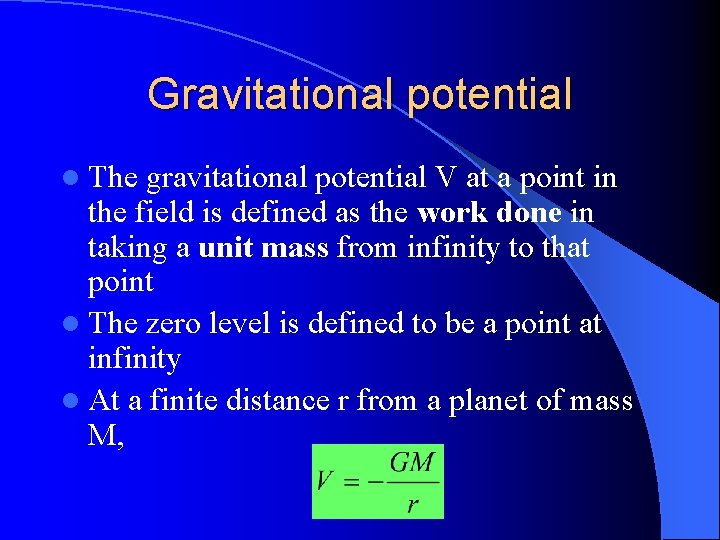
Gravitational potential l The gravitational potential V at a point in the field is defined as the work done in taking a unit mass from infinity to that point l The zero level is defined to be a point at infinity l At a finite distance r from a planet of mass M,
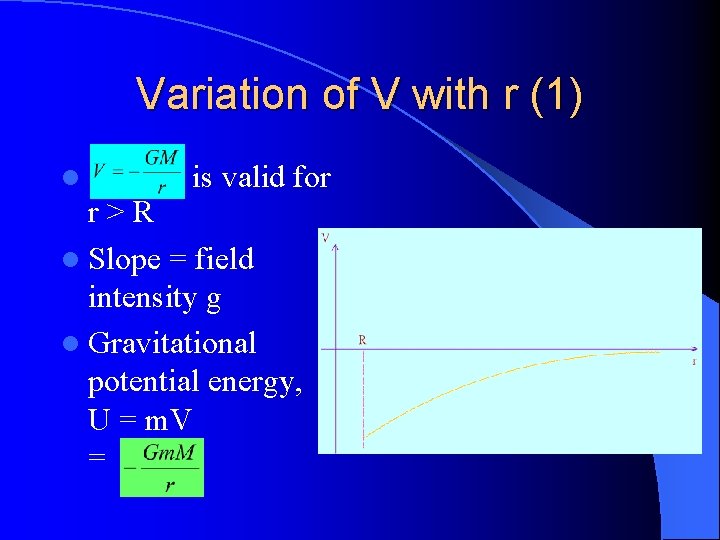
Variation of V with r (1) l is valid for r>R l Slope = field intensity g l Gravitational potential energy, U = m. V =
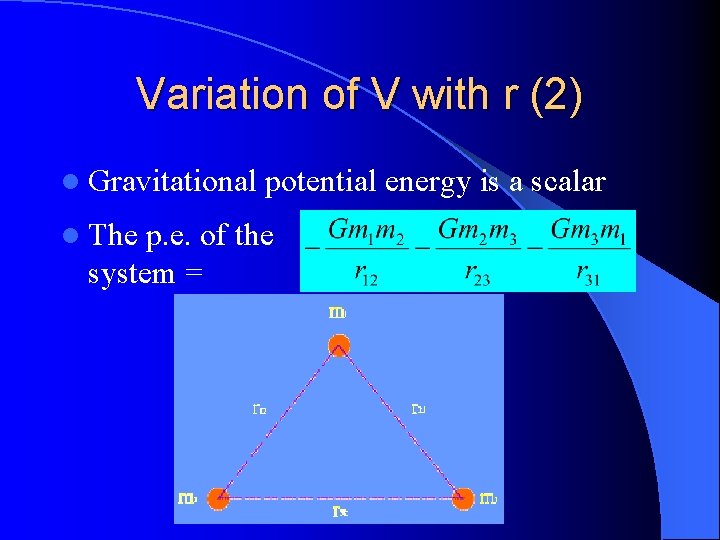
Variation of V with r (2) l Gravitational l The potential energy is a scalar p. e. of the system =
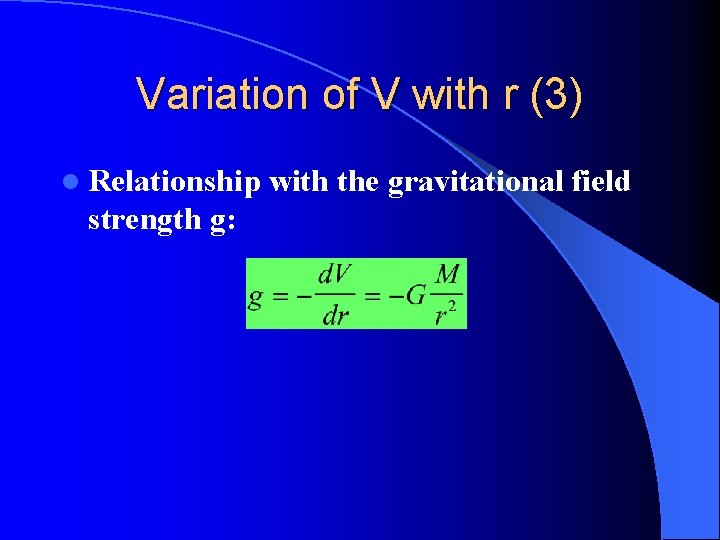
Variation of V with r (3) l Relationship strength g: with the gravitational field
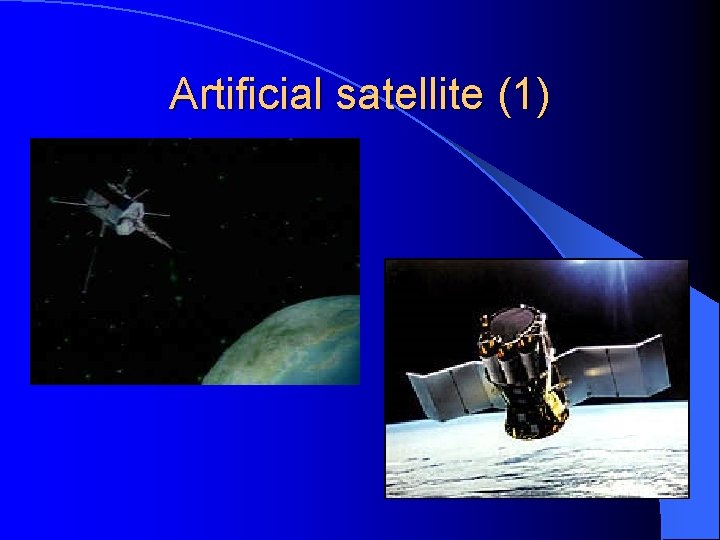
Artificial satellite (1)
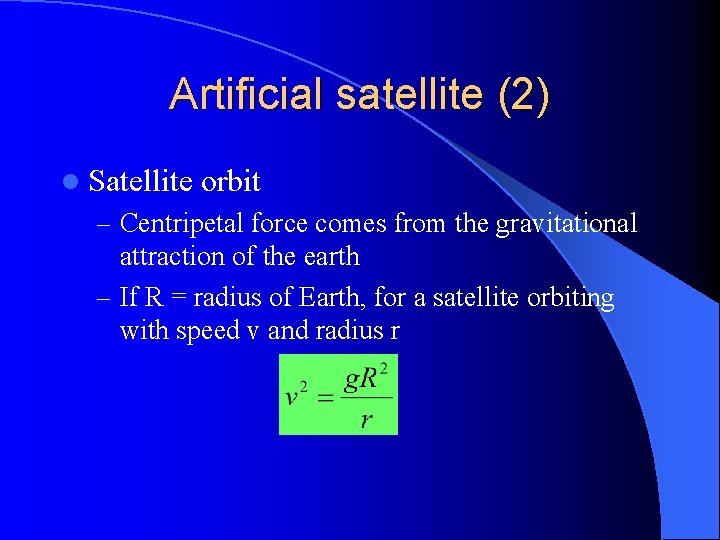
Artificial satellite (2) l Satellite orbit – Centripetal force comes from the gravitational attraction of the earth – If R = radius of Earth, for a satellite orbiting with speed v and radius r
Artificial satellite (3) l each orbit requires a certain speed of flight of the satellite l the greater the orbit radius r the smaller the speed v
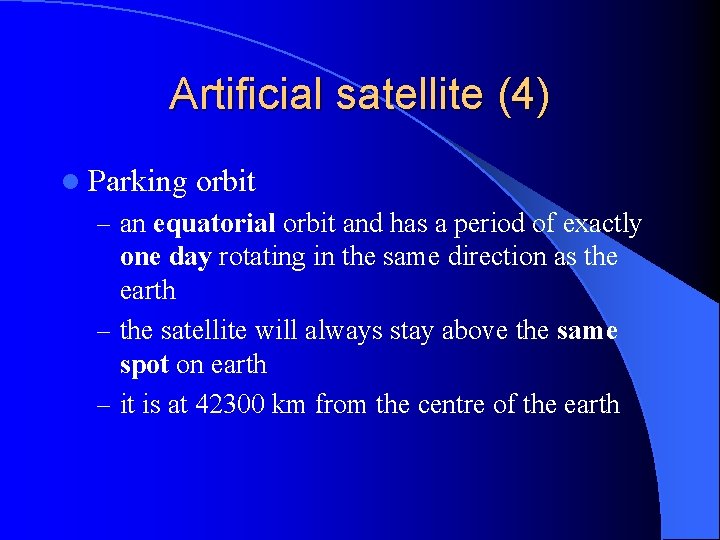
Artificial satellite (4) l Parking orbit – an equatorial orbit and has a period of exactly one day rotating in the same direction as the earth – the satellite will always stay above the same spot on earth – it is at 42300 km from the centre of the earth
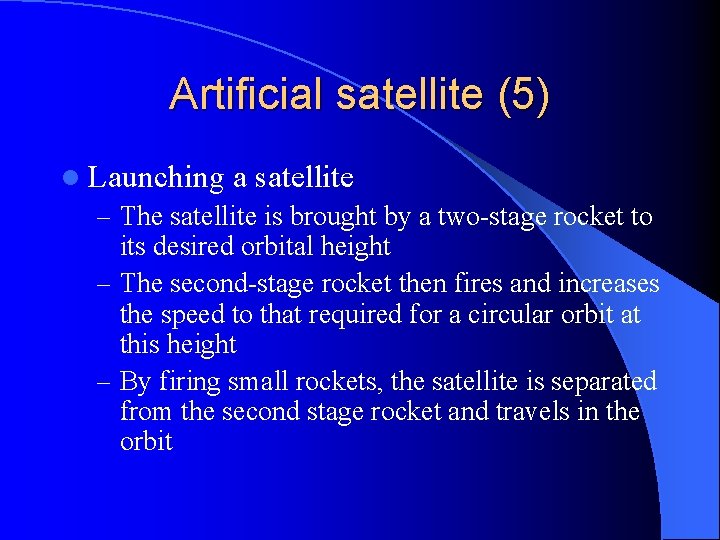
Artificial satellite (5) l Launching a satellite – The satellite is brought by a two-stage rocket to its desired orbital height – The second-stage rocket then fires and increases the speed to that required for a circular orbit at this height – By firing small rockets, the satellite is separated from the second stage rocket and travels in the orbit
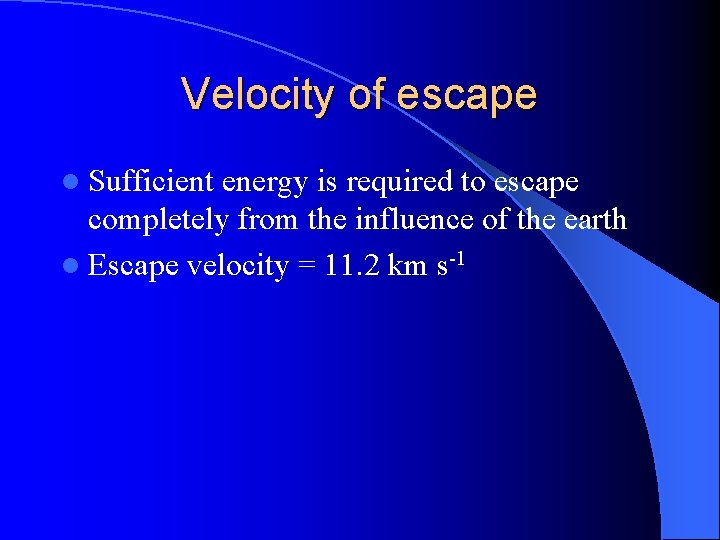
Velocity of escape l Sufficient energy is required to escape completely from the influence of the earth l Escape velocity = 11. 2 km s-1
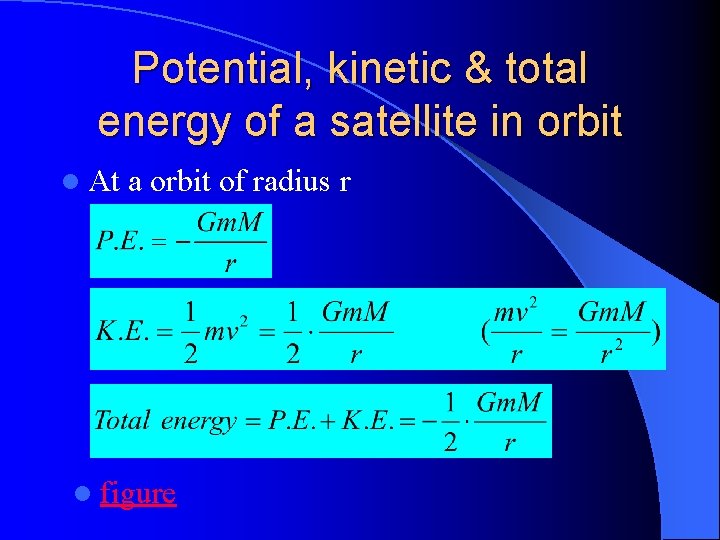
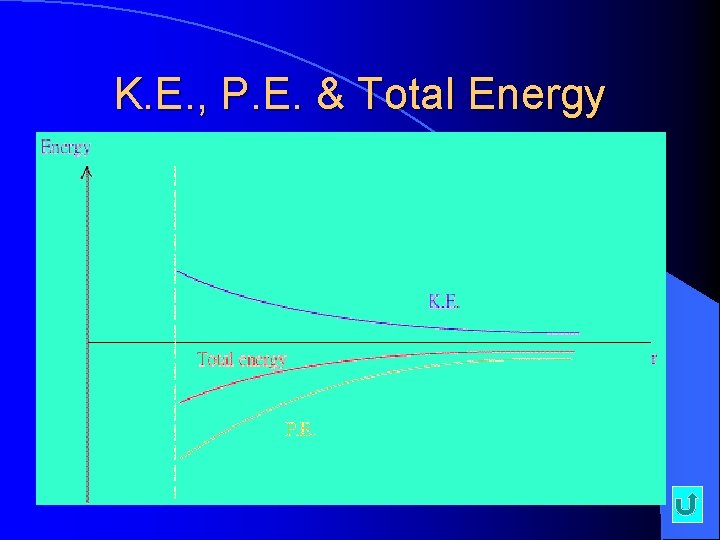
Potential, kinetic & total energy of a satellite in orbit l At a orbit of radius r l figure
Weightlessness l True weightlessness occurs only when an object is not subjected to any gravitational force l an object may appear to be `weightless’ if there is no reaction force giving the sensation of weight. e. g. free fall, projectile motion and satellite motion
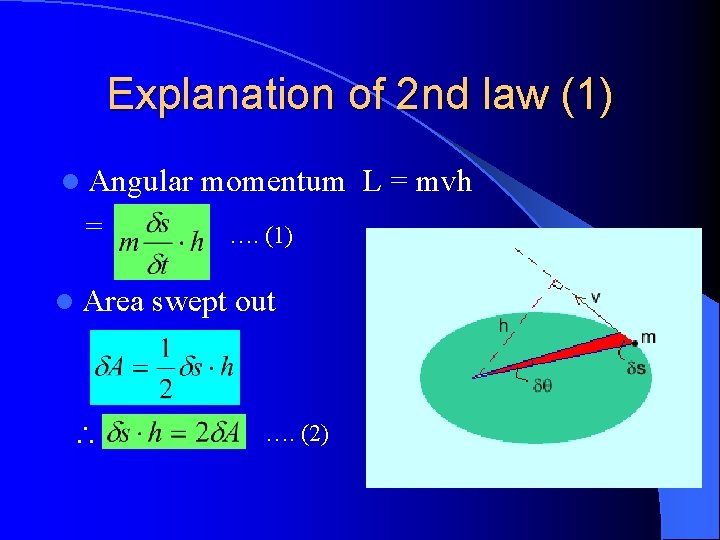
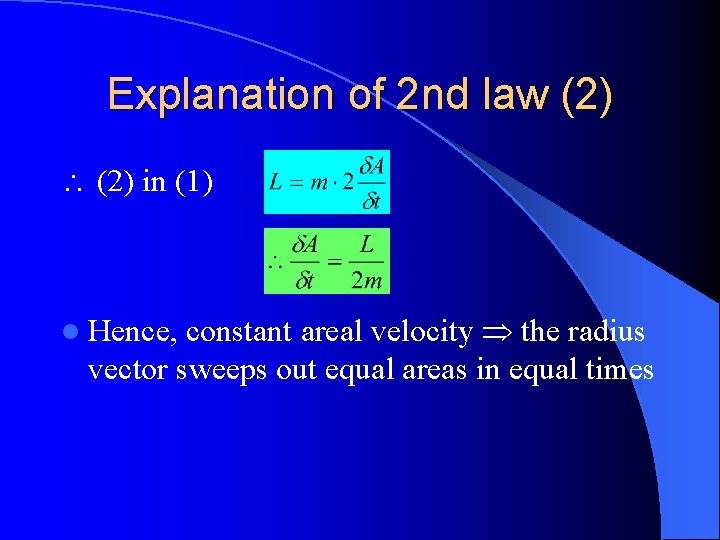
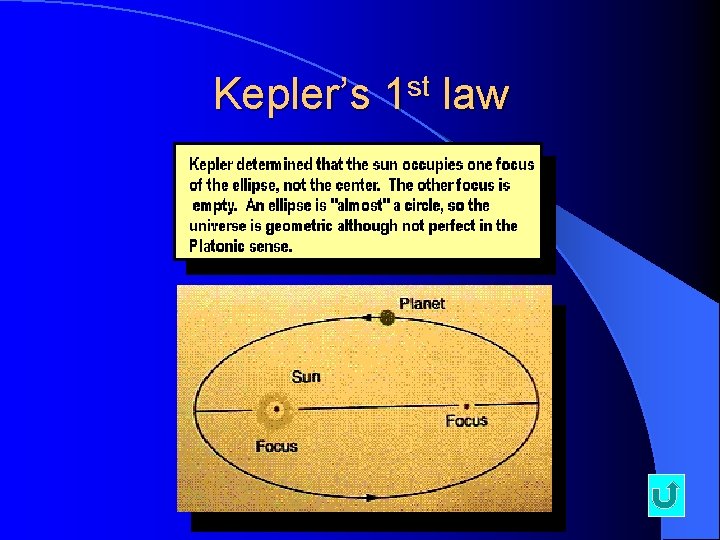
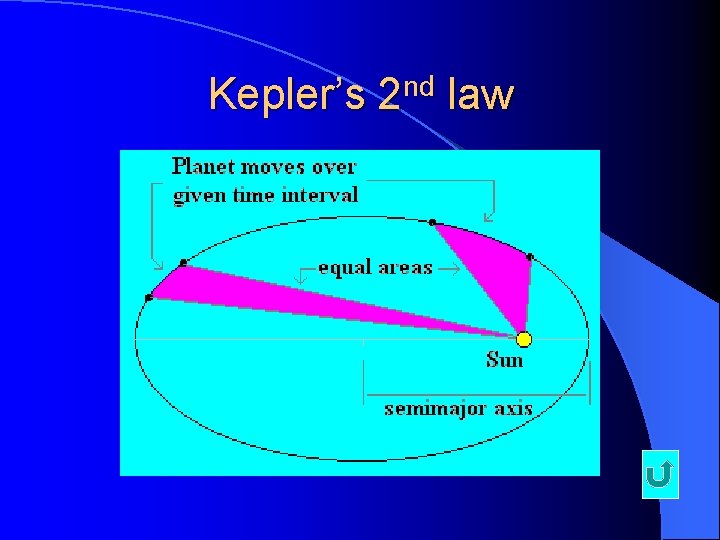
Kepler’s laws (1) l First law (The law of orbits) – Each planet moves in an ellipse which has the sun at one focus – Figure l Second law (The law of areas) – The line joining the sun to the moving planet sweeps out equal areas in equal times – Figure
Kepler’s laws (2) – According to the 2 nd law: The motion of a planet is faster when it is closer to the sun l It is a consequence of the law of conservation of angular momentum l
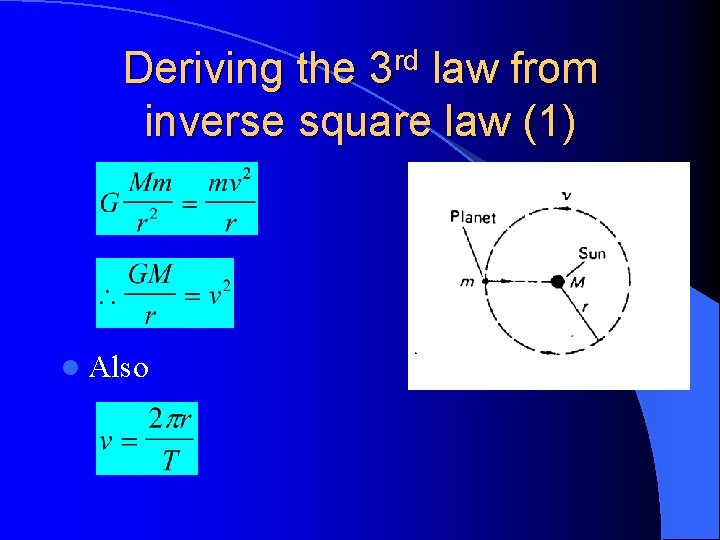
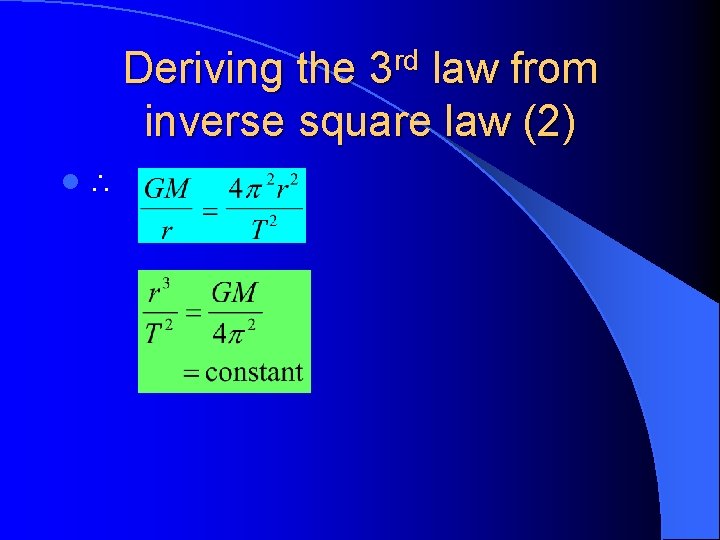
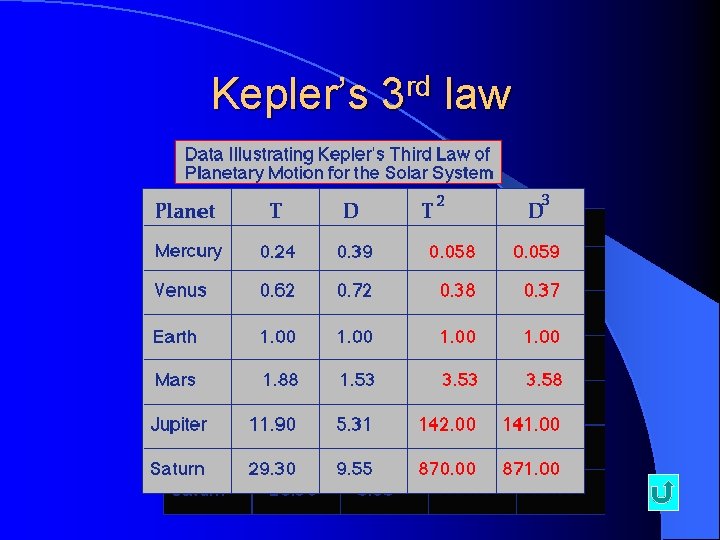
Kepler’s laws (3) l Third law (The harmonic law) – The squares of the periods of revolution of the planets about the sun are proportional to the cubes of their mean distance from it (i. e. T 2 r 3 ) – Figure Further reading
Deriving the 3 rd law from inverse square law (1) l Also
Deriving the 3 rd law from inverse square law (2) l
Explanation of 2 nd law (1) l Angular = l Area momentum L = mvh …. (1) swept out …. (2)
Explanation of 2 nd law (2) in (1) constant areal velocity the radius vector sweeps out equal areas in equal times l Hence,
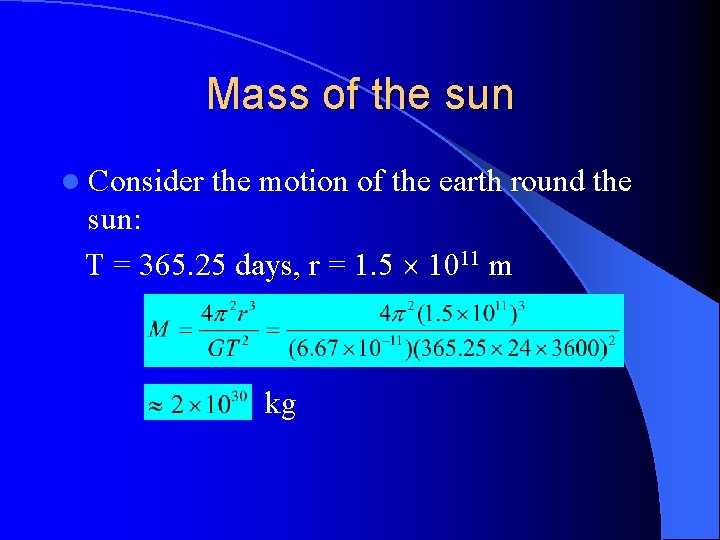
Mass of the sun l Consider the motion of the earth round the sun: T = 365. 25 days, r = 1. 5 1011 m kg
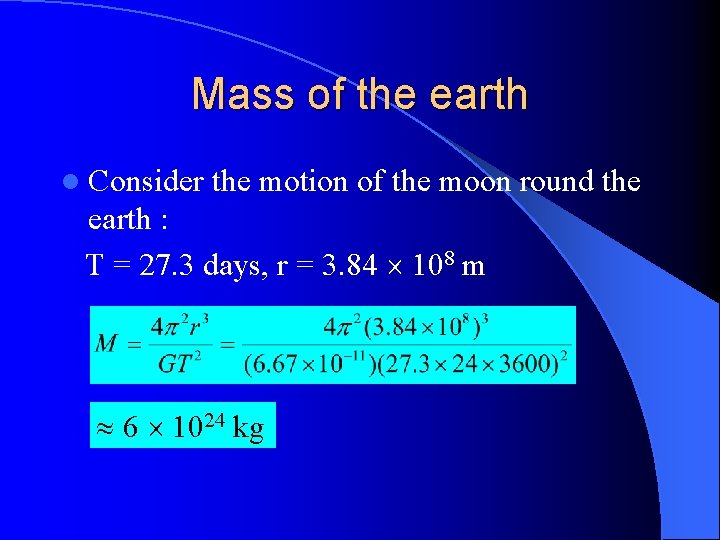
Mass of the earth l Consider the motion of the moon round the earth : T = 27. 3 days, r = 3. 84 108 m 6 1024 kg
Nicholas Copernicus Details
Field lines Radial field Uniform field
Equipotential surface: uniform field
Equipotential surface: radial field
Effect of Earth’s rotation
K. E. , P. E. & Total Energy
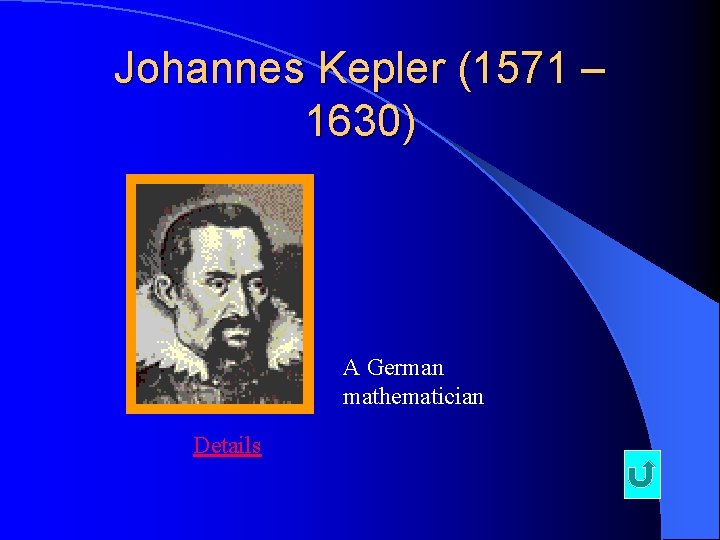
Johannes Kepler (1571 – 1630) A German mathematician Details
Kepler’s 1 st law
Kepler’s 2 nd law
Kepler’s 3 rd law