
Gravitational deflection of light What else can the
- Slides: 27
Gravitational deflection of light: What else can the Eddington experiment tell us about gravity? Sergei Kopeikin Department of Physics and Astronomy, University of Missouri-Columbia 08/21/2017 The Great American Solar Eclipse Physics Conference 1
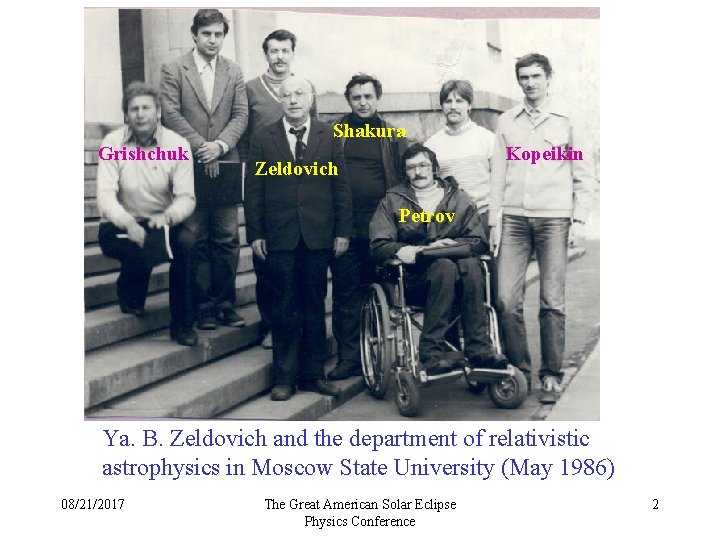
Shakura Grishchuk Kopeikin Zeldovich Petrov Ya. B. Zeldovich and the department of relativistic astrophysics in Moscow State University (May 1986) 08/21/2017 The Great American Solar Eclipse Physics Conference 2
Abstract. Standard textbook treatment of the Eddington experiment is given in a static reference frame. However, the observations of the solar eclipse are done from the Earth which moves around the Sun. Effectively, it allows to test the Lorentz-invariance of the gravitational interaction during the solar eclipse. We discuss the mathematical framework of the Eddington experiment from the point of view of a moving observer and the results of testing of the Lorentz-invariance of the gravitational interaction in VLBI experiments with the major planets of the solar system. 08/21/2017 The Great American Solar Eclipse Physics Conference 3
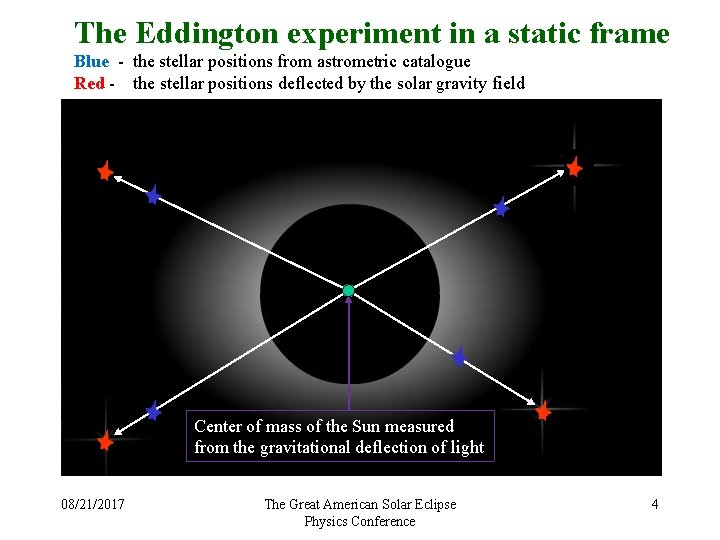
The Eddington experiment in a static frame Blue - the stellar positions from astrometric catalogue Red - the stellar positions deflected by the solar gravity field Center of mass of the Sun measured from the gravitational deflection of light 08/21/2017 The Great American Solar Eclipse Physics Conference 4
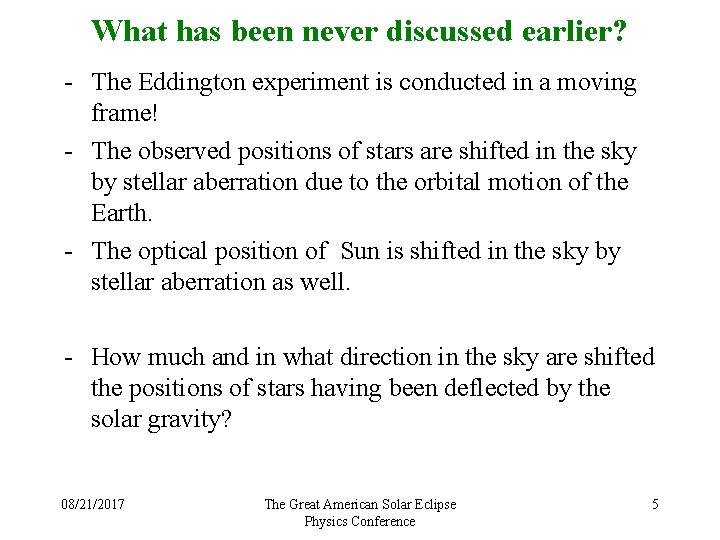
What has been never discussed earlier? - The Eddington experiment is conducted in a moving frame! - The observed positions of stars are shifted in the sky by stellar aberration due to the orbital motion of the Earth. - The optical position of Sun is shifted in the sky by stellar aberration as well. - How much and in what direction in the sky are shifted the positions of stars having been deflected by the solar gravity? 08/21/2017 The Great American Solar Eclipse Physics Conference 5
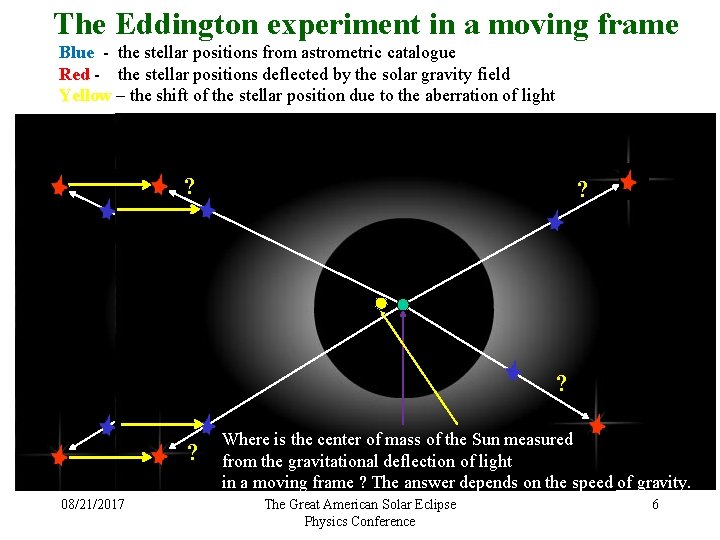
The Eddington experiment in a moving frame Blue - the stellar positions from astrometric catalogue Red - the stellar positions deflected by the solar gravity field Yellow – the shift of the stellar position due to the aberration of light ? ? ? Where the. Sun center of mass of the Sun measured Center of mass ofisthe measured from the gravitational from ? the gravitational deflection of light in a moving frame ? The answer depends on the speed of gravity. 08/21/2017 The Great American Solar Eclipse Physics Conference 6
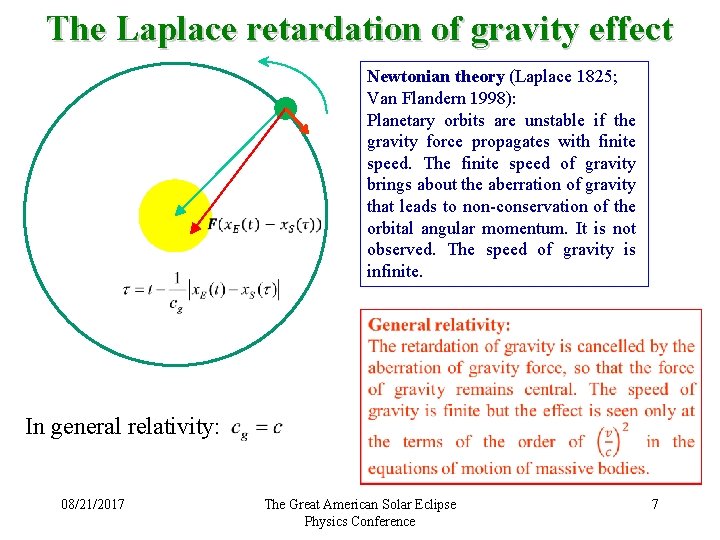
The Laplace retardation of gravity effect Newtonian theory (Laplace 1825; Van Flandern 1998): Planetary orbits are unstable if the gravity force propagates with finite speed. The finite speed of gravity brings about the aberration of gravity that leads to non-conservation of the orbital angular momentum. It is not observed. The speed of gravity is infinite. In general relativity: 08/21/2017 The Great American Solar Eclipse Physics Conference 7
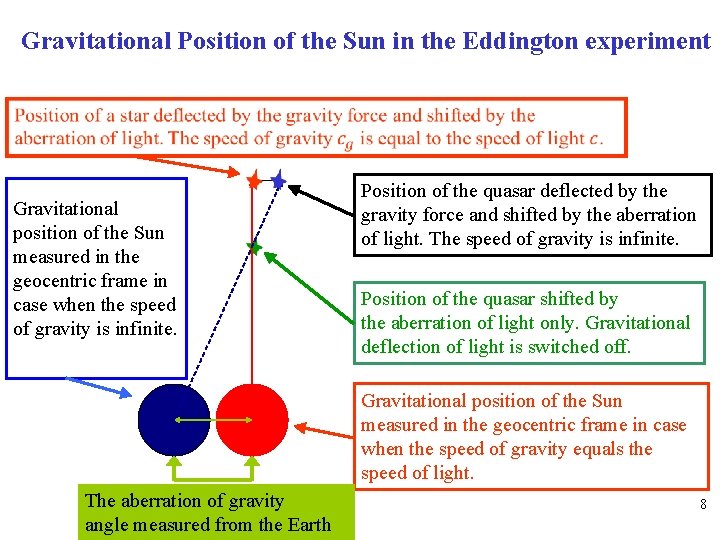
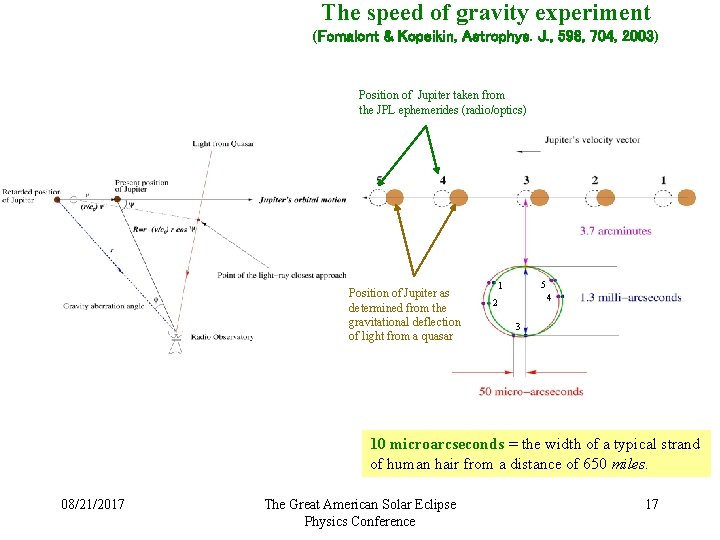
Gravitational Position of the Sun in the Eddington experiment Gravitational position of the Sun measured in the geocentric frame in case when the speed of gravity is infinite. Position of the quasar deflected by the gravity force and shifted by the aberration of light. The speed of gravity is infinite. Position of the quasar shifted by the aberration of light only. Gravitational deflection of light is switched off. Gravitational position of the Sun measured in the geocentric frame in case when the speed of gravity equals the speed of light. The aberration of gravity angle measured from the Earth 8
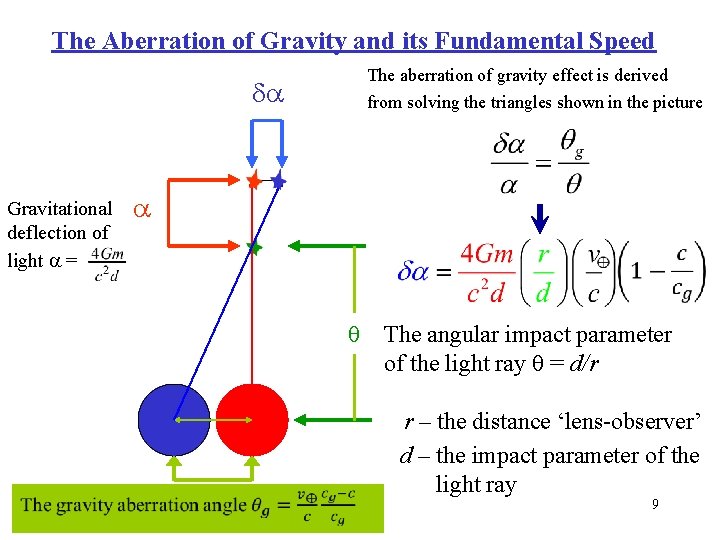
The Aberration of Gravity and its Fundamental Speed Gravitational deflection of light = The aberration of gravity effect is derived from solving the triangles shown in the picture The angular impact parameter of the light ray = d/r r – the distance ‘lens-observer’ d – the impact parameter of the light ray 9
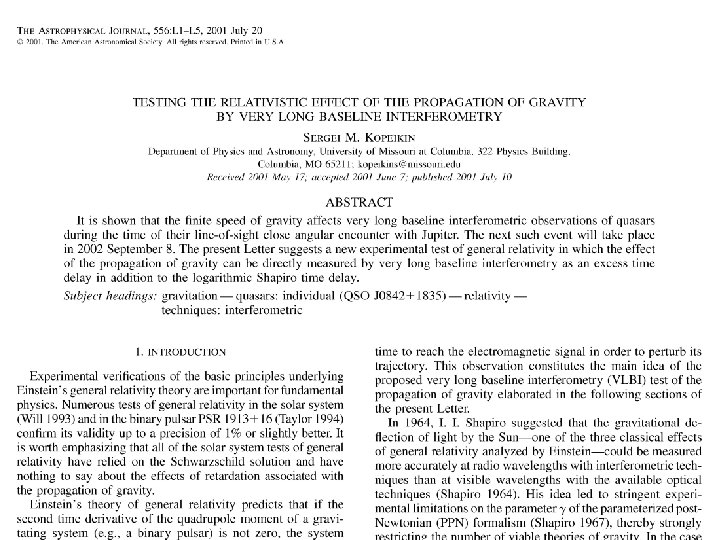
Abstract of my APJL paper 08/21/2017 The Great American Solar Eclipse Physics Conference 10
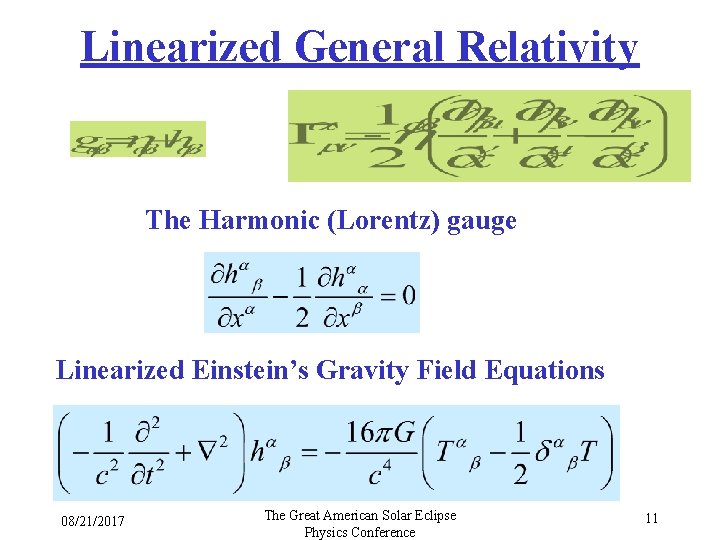
Linearized General Relativity The Harmonic (Lorentz) gauge Linearized Einstein’s Gravity Field Equations 08/21/2017 The Great American Solar Eclipse Physics Conference 11
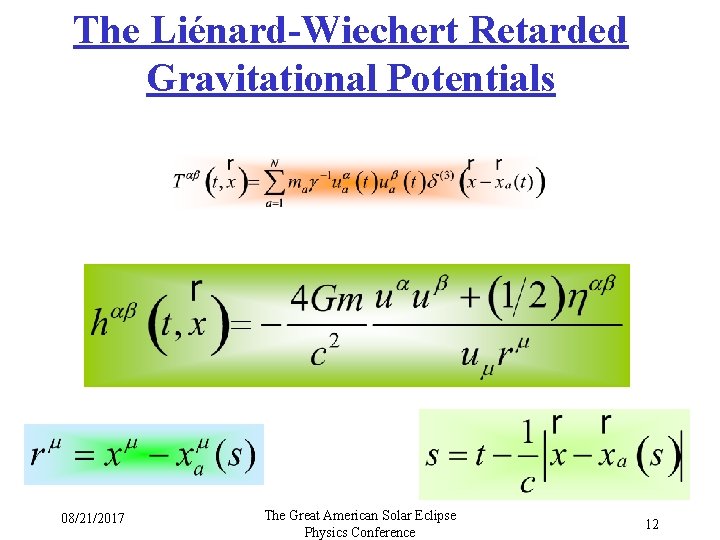
The Liénard-Wiechert Retarded Gravitational Potentials 08/21/2017 The Great American Solar Eclipse Physics Conference 12
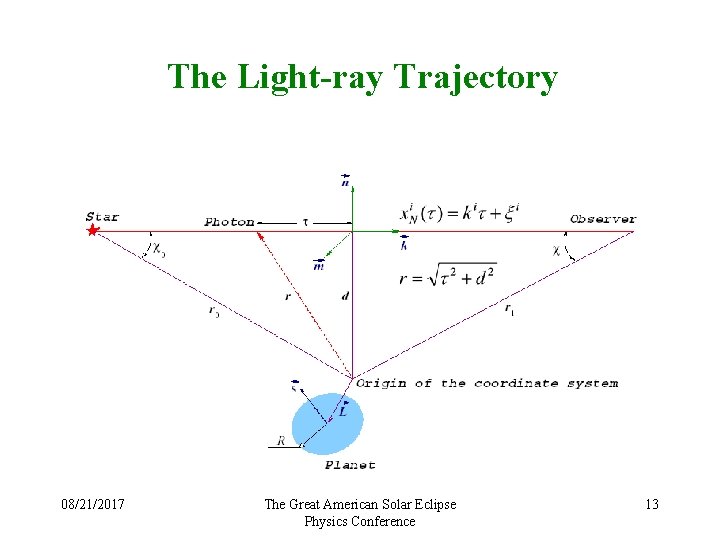
The Light-ray Trajectory 08/21/2017 The Great American Solar Eclipse Physics Conference 13
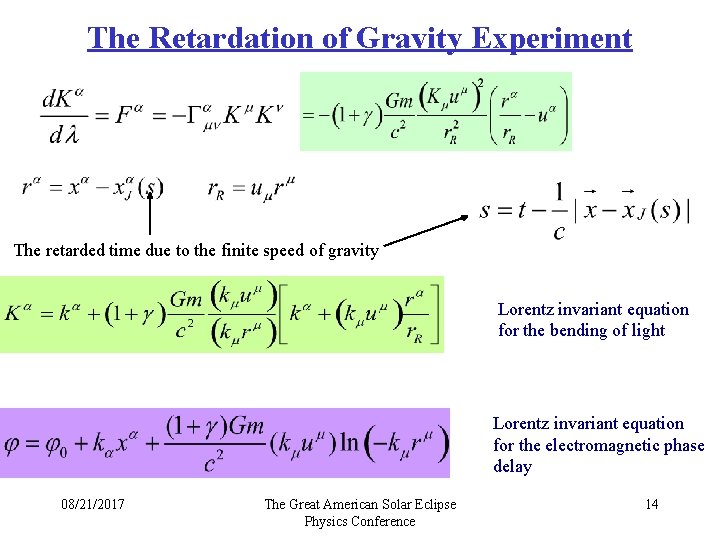
The Retardation of Gravity Experiment The retarded time due to the finite speed of gravity Lorentz invariant equation for the bending of light Lorentz invariant equation for the electromagnetic phase delay 08/21/2017 The Great American Solar Eclipse Physics Conference 14
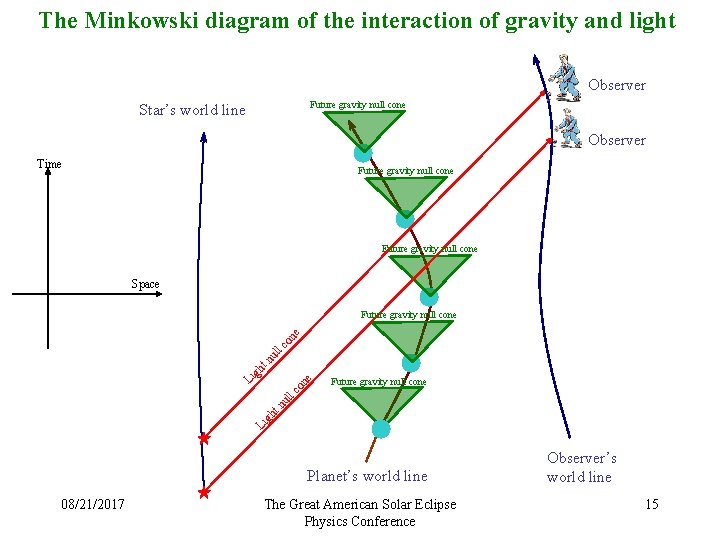
The Minkowski diagram of the interaction of gravity and light Observer Future gravity null cone Star’s world line Observer Time Future gravity null cone Space Future gravity null cone Li gh tn ul lc on e Future gravity null cone Planet’s world line 08/21/2017 The Great American Solar Eclipse Physics Conference Observer’s world line 15
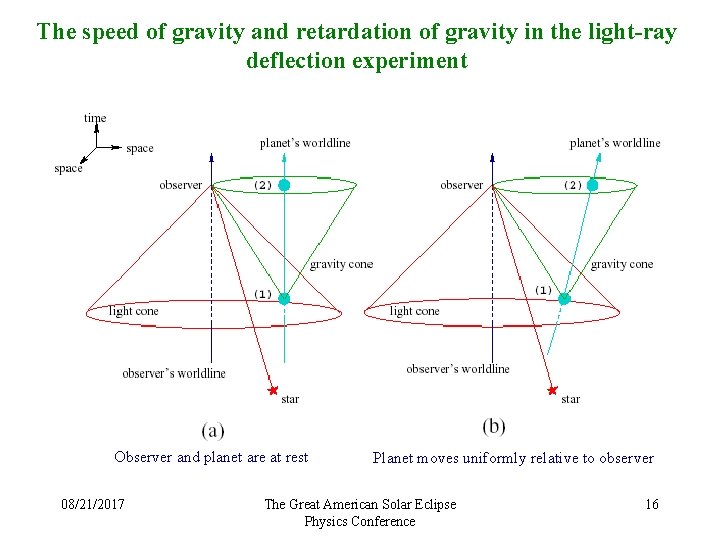
The speed of gravity and retardation of gravity in the light-ray deflection experiment Observer and planet are at rest 08/21/2017 Planet moves uniformly relative to observer The Great American Solar Eclipse Physics Conference 16
The speed of gravity experiment (Fomalont & Kopeikin, Astrophys. J. , 598, 704, 2003) Position of Jupiter taken from the JPL ephemerides (radio/optics) Position of Jupiter as determined from the gravitational deflection of light from a quasar 5 1 4 2 3 10 microarcseconds = the width of a typical strand of human hair from a distance of 650 miles. 08/21/2017 The Great American Solar Eclipse Physics Conference 17
With Ed Fomalont in Albuquerque, NM, June 2002 Picture is taken during my visit to VLA, Socorro, NM 08/21/2017 The Great American Solar Eclipse Physics Conference 18
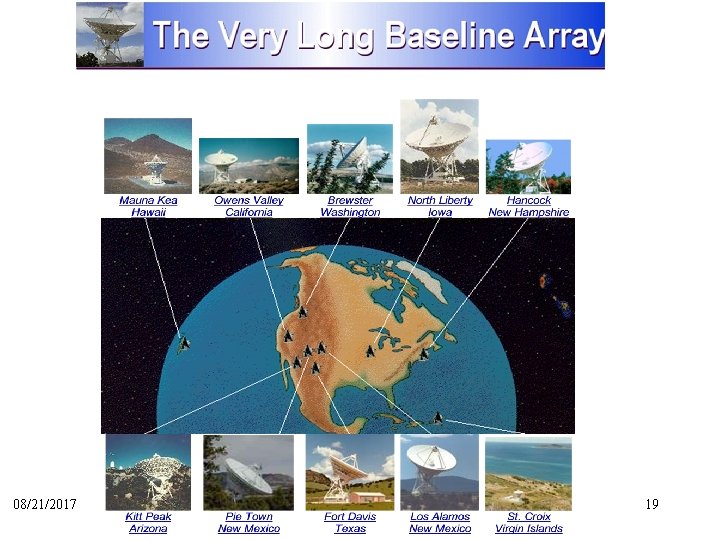
08/21/2017 19
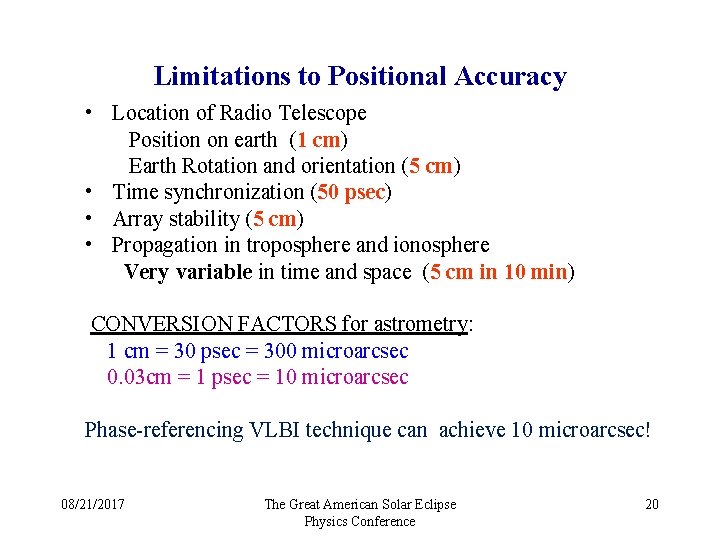
Limitations to Positional Accuracy • Location of Radio Telescope Position on earth (1 cm) Earth Rotation and orientation (5 cm) • Time synchronization (50 psec) • Array stability (5 cm) • Propagation in troposphere and ionosphere Very variable in time and space (5 cm in 10 min) CONVERSION FACTORS for astrometry: 1 cm = 30 psec = 300 microarcsec 0. 03 cm = 1 psec = 10 microarcsec Phase-referencing VLBI technique can achieve 10 microarcsec! 08/21/2017 The Great American Solar Eclipse Physics Conference 20
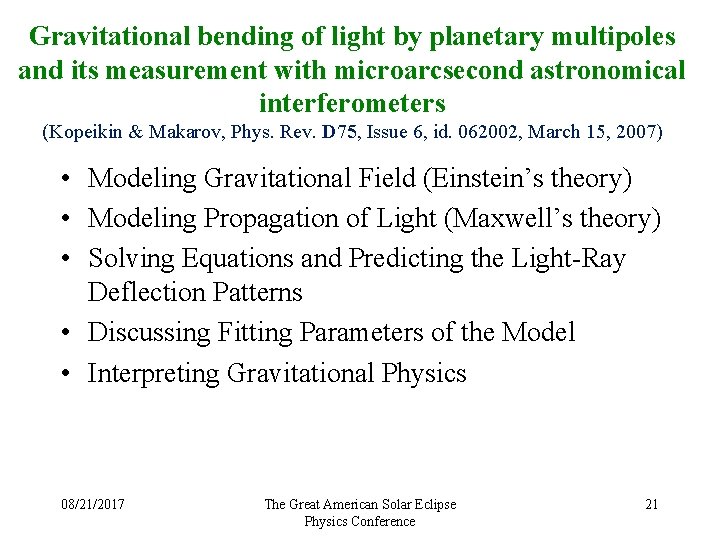
Gravitational bending of light by planetary multipoles and its measurement with microarcsecond astronomical interferometers (Kopeikin & Makarov, Phys. Rev. D 75, Issue 6, id. 062002, March 15, 2007) • Modeling Gravitational Field (Einstein’s theory) • Modeling Propagation of Light (Maxwell’s theory) • Solving Equations and Predicting the Light-Ray Deflection Patterns • Discussing Fitting Parameters of the Model • Interpreting Gravitational Physics 08/21/2017 The Great American Solar Eclipse Physics Conference 21
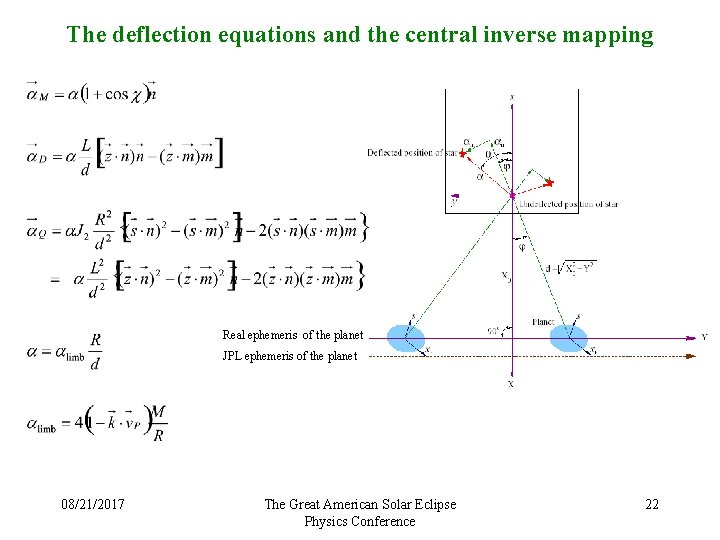
The deflection equations and the central inverse mapping Real ephemeris of the planet JPL ephemeris of the planet 08/21/2017 The Great American Solar Eclipse Physics Conference 22
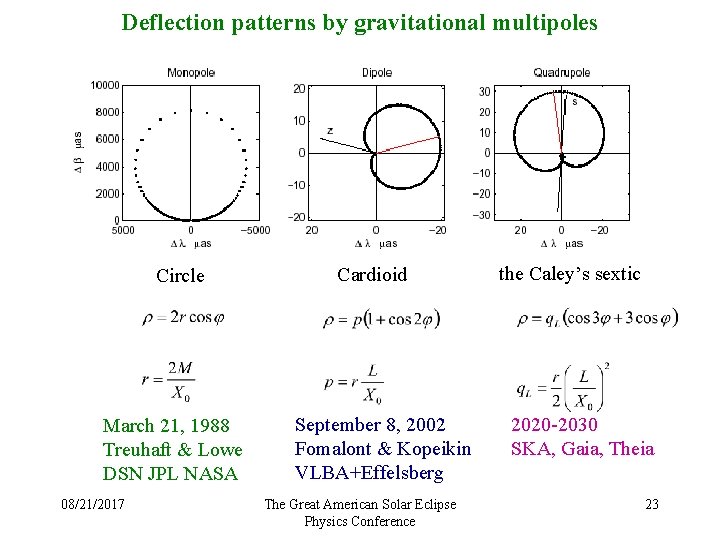
Deflection patterns by gravitational multipoles Circle March 21, 1988 Treuhaft & Lowe DSN JPL NASA 08/21/2017 Cardioid September 8, 2002 Fomalont & Kopeikin VLBA+Effelsberg The Great American Solar Eclipse Physics Conference the Caley’s sextic 2020 -2030 SKA, Gaia, Theia 23
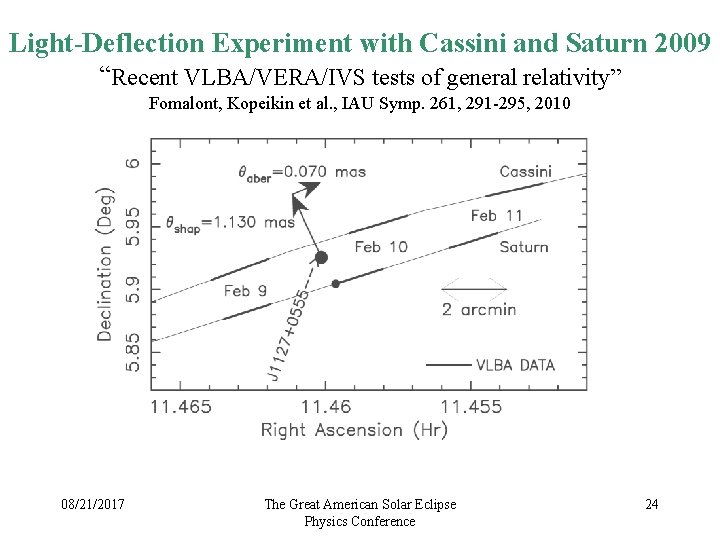
Light-Deflection Experiment with Cassini and Saturn 2009 “Recent VLBA/VERA/IVS tests of general relativity” Fomalont, Kopeikin et al. , IAU Symp. 261, 291 -295, 2010 08/21/2017 The Great American Solar Eclipse Physics Conference 24
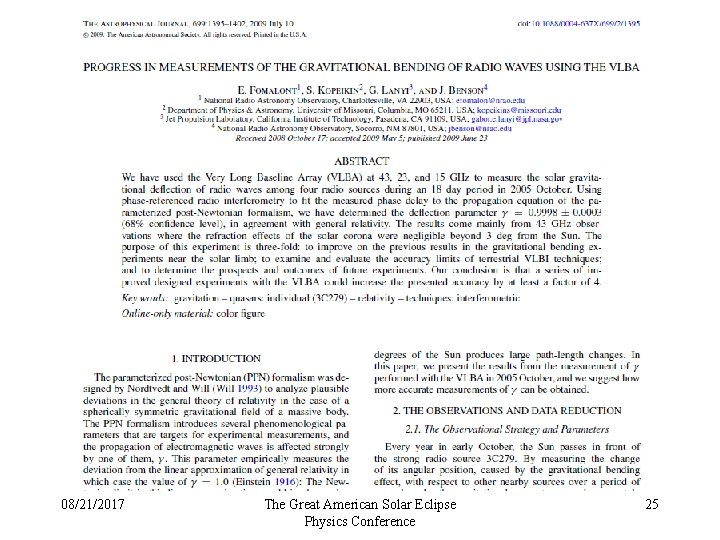
08/21/2017 The Great American Solar Eclipse Physics Conference 25
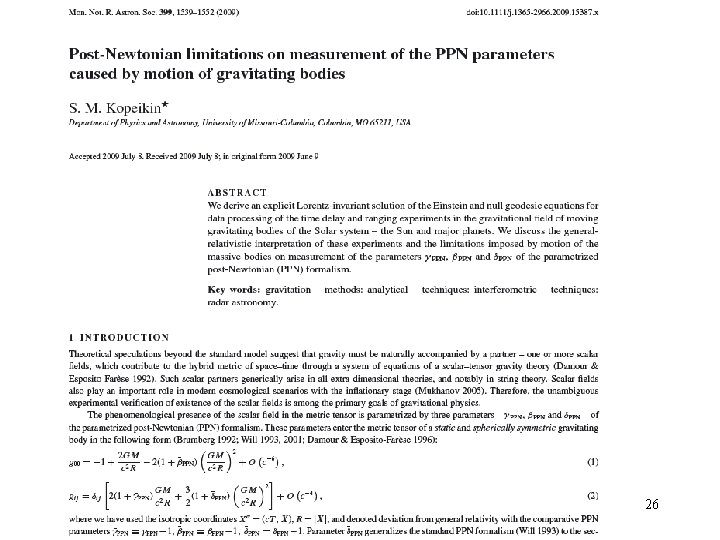
08/21/2017 The Great American Solar Eclipse Physics Conference 26
08/21/2017 The Great American Solar Eclipse Physics Conference 27