
Gravitation v Circular motion and centripetal force v



- Slides: 18
Gravitation v Circular motion and centripetal force v Kepler’s laws v Newton’s universal law of gravitation v Acceleration due to the gravitational force of the Earth v Free fall v Escape velocity
Circular motion and Centripetal force
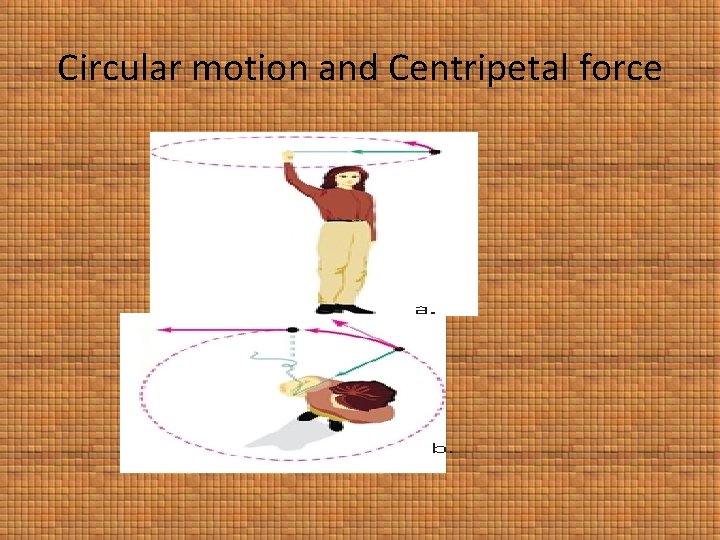
q As long as we are holding the string, we are pulling the stone towards us. . towards the centre of the circle and are applying a force towards it. q The force stops acting if we release the string. In this case, the stone will fly off along a straight line which is the tangent to the circle at the position of the stone when the string is released, because that is the direction of its velocity at that instant of time q a force acts on any object moving along a circle and it is directed towards the centre of the circle. q This is called the Centripetal force. `Centripetal’ means centre seeking, q i. e. the object tries to go towards the centre of the circle because of this force.
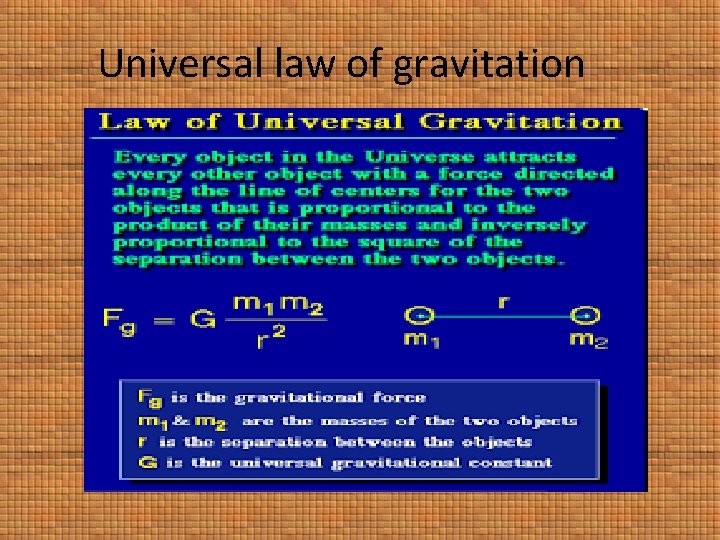
Newton’s universal law of gravitation • All the above considerations including Kepler’s laws led Newton to formulate his theory of Universal gravity. • According to this theory, every object in the Universe attracts every other object with a definite force. • This force is directly proportional to the product of the masses of the two objects and is inversely proportional to the square of the distance between them.
Universal law of gravitation
Variation in value of g q. Variation in value of “ g “. q. Change along the surface of the earth q. Change with depth qchange with height
Moon & the earth q the moon, which is the natural satellite of the earth, goes round it in a definite orbit. q The direction of motion of the moon as well as its speed constantly changes during this motion. q Do you think some force is constantly acting on the moon? What must be the direction of this force? q How would its motion have been if no such force acted on it? q Do the other planets in the solar system revolve around the Sun in a similar fashion? q Is similar force acting on them? q What must be its direction? q From the above questions it is clear that for the moon to go around the earth, there must be a force which is exerted on the moon and this force must be exerted by the earth which attracts the moon towards itself. q Similarly, the Sun must be attracting the planets, including the earth, towards itself.
Keplers laws q Planetary motion had been observed by astronomers since ancient times. q Before Galileo, all observations of the planet’s positions were made with naked eyes. q By the 16 th century a lot of data were available about planetary positions and motion. q Johannes Kepler, studied these data. q He noticed that the motion of planets follows certain laws. q He stated three laws describing planetary motion. These are known as Kepler’s laws which are given below.
Keplers laws • . Kepler noticed that the motion of planets follows certain laws. He stated three laws describing planetary motion. These are known as Kepler’s laws which are given below. • The orbit of a planet is an ellipse with the Sun at one of the foci. • The line joining the planet and the Sun sweeps equal areas in equal intervals of time. • The square of its period of revolution around the Sun is directly proportional to the cube of the mean distance of a planet from the Sun.
potential energy • The energy stored in an object because of its position or state is called potential energy. • This energy is relative and increases as we go to greater heights from the surface of the earth. • We know that the potential energy of an object from ground is mgh and on the ground it is zero. • When h is small compared to the radius R of the earth, we can assume g to be constant and can use the above formula (mgh) •
Gravitational potential energy • But for large values of h, the value of g decreases with increase in h. • For an object at infinite distance from the earth, the value of g is zero and earth’s gravitational force does not act on the object. • So it is more appropriate to assume the value of potential energy to be zero there. Thus, for smaller distances, i. e. heights, the potential energy is less than zero, i. e. it is negative. • When an object is at a height h from the surface of the earth, its potential energy is –GMm/R+h • here, M and R are earth’s mass and radius respectively.
upward velocity • We have studied in 9 th std that when a ball is thrown upwards, its velocity decreases because of the gravitation of the earth. The velocity becomes zero after reaching a certain height and after that the stone starts falling down. Its maximum height depends on its initial velocity. Thus, higher the initial velocity u, the larger is the height reached by the ball. • The reason for this is that the higher the initial velocity, the ball will oppose the gravity of the earth more and larger will be the height to which it can reach. • We have seen above that the value of g keeps decreasing as we go higher above the surface of the earth. • Thus, the force pulling the ball downward, decreases as the ball goes up. •
Escape velocity • The spacecrafts which are sent to the moon or other planets have to have their initial velocity larger than the escape velocity so that they can overcome earth’s gravitational attraction and can travel to these objects. We have seen above that the value of g keeps decreasing as we go higher above the surface of the earth. • Thus, the force pulling the ball downward, decreases as the ball goes up. • If we keep increasing the initial velocity of the ball, it will reach larger and larger heights and above a particular value of initial velocity of the ball, the ball is able to overcome the downward pull by the earth and can escape the earth forever and will not fall back on the earth. • This velocity is called escape velocity. •
High tides & low tides • You must be knowing about the high and low tides that occur regularly in the sea. • The level of sea water at any given location along sea shore increases and decreases twice a day at regular intervals. • High and low tides occur at different times at different places. • The level of water in the sea changes because of the gravitational force exerted by the moon. • Water directly under the moon gets pulled towards the moon and the level of water there goes up causing high tide at that place. • At two places on the earth at 90 o from the place of high tide, the level of water is minimum and low tides occur there.
Earth’s gravitational acceleration q According to Newton’s second law of motion, a force acting on a body results in its acceleration. q Thus, the gravitational force due to the earth on a body results in its acceleration. q This is called acceleration due to gravity and is denoted by ‘g’. q Acceleration is a vector. q As the gravitational force on any object due to the earth is directed towards the centre of the earth. q the direction of the acceleration due to grav- ity is also directed towards the centre of the earth i. e. vertically downwards
Home Assignment Ø Is there a gravitational force between two objects kept on a table or between you and your friend sitting next to you? If yes, why don’t the two move towards each other? Ø Collect information about high and low tides from geography books Ø What would happen if there were no gravity? Ø What would happen if the value of G was twice as large? Ø Will your weight remain constant as you go above the surface of the earth Ø Explain why the value of g is zero at the centre of the earth. Ø What is the difference between mass and weight of an object. Will the mass and weight of an object on the earth be same as their values on Mars? Why Ø What are (i) free fall, (ii) acceleration due to gravity (iii) escape velocity (iv) centripetal force ? Ø Write three laws given by Kepler