
Gravitation Cavendish Experiment l What do you need
- Slides: 20
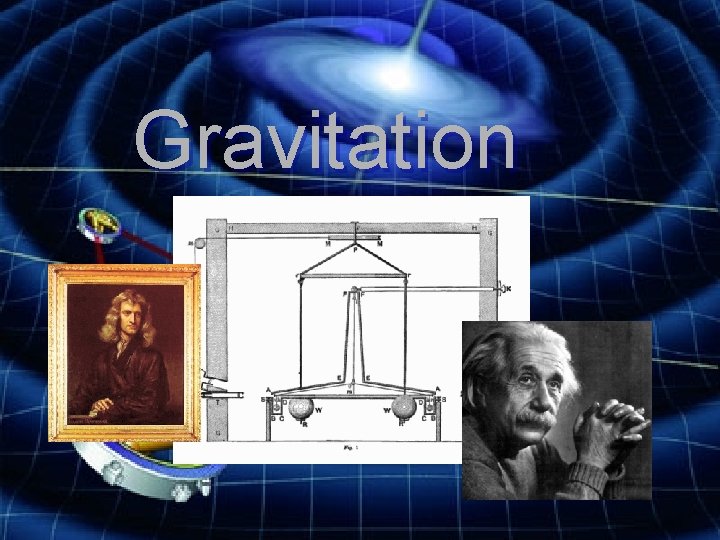
Gravitation
Cavendish Experiment l What do you need to calculate the force of attraction between two bodies? l the masses of the two objects the distance between the two objects the gravitational constant. l l l Therefore, to be able to prove the law of gravitation you need to be able to calculate the gravitational constant (G).
The Problem l l The strength of attraction between two small masses will be extremely small! Therefore, hard to measure in a laboratory. Despite the weakness of the attraction, Henry Cavendish was able to perform an experiment to measure the force between two small objects which led to the calculation of the gravitational constant (G).
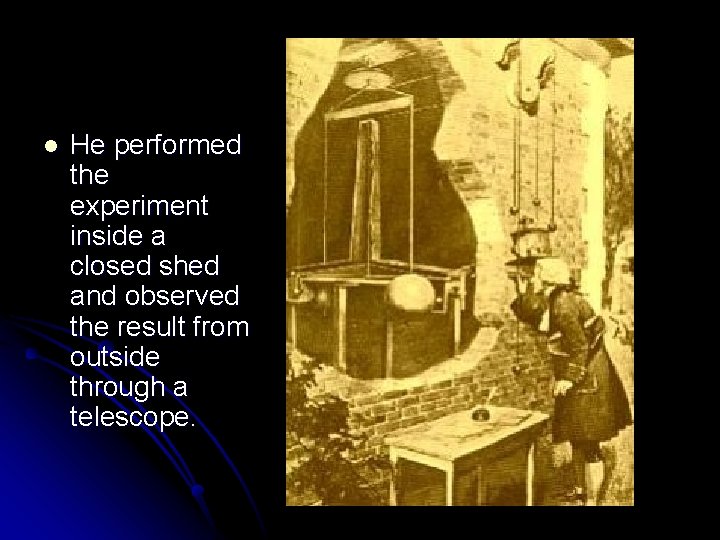
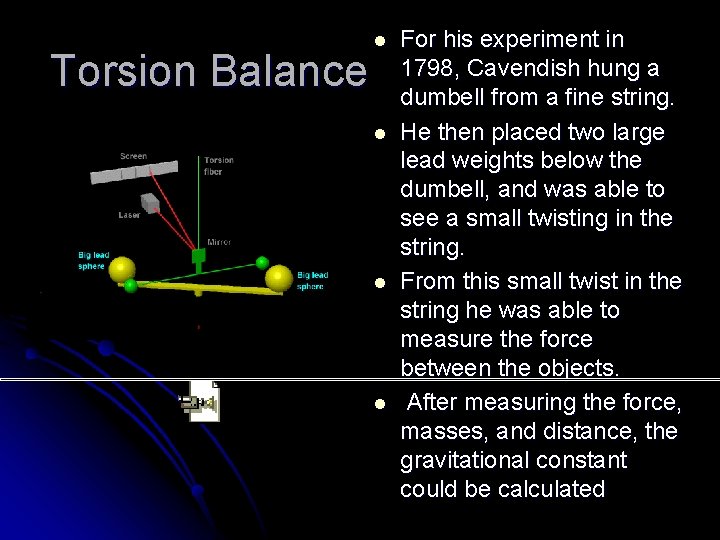
l He performed the experiment inside a closed shed and observed the result from outside through a telescope.
Torsion Balance l l For his experiment in 1798, Cavendish hung a dumbell from a fine string. He then placed two large lead weights below the dumbell, and was able to see a small twisting in the string. From this small twist in the string he was able to measure the force between the objects. After measuring the force, masses, and distance, the gravitational constant could be calculated
Did Cavendish determine G? l l In actuality, Cavendish's only goal was to measure the density of the Earth; he called it 'weighing the world'. The method Cavendish used to calculate the Earth's density consists in measuring the force on a small ball caused by a large ball of known mass, and comparing it with the force on the small ball caused by the Earth, so the Earth can be calculated to be N times more massive than the large ball without the need to obtain a numeric value for G. The gravitational constant does not appear in Cavendish's paper, and there is no indication that he regarded it as a goal of his experiment. One of the first references to G is in 1873, 75 years after Cavendish's work.
What is the difference between mass and weight? l l Mass The amount of matter in an object Mass is measured in kg or g Measured using a balance l l l Weight The force of gravity on an object Weight is measured in Newtons (N) Measured using a scale What does weight depend on? mass gravity What does gravity depend on? mass of planet distance to planet gravitational constant
Gravitational Force Weight is another name for the gravitational force from the Earth. l What can we use to measure the gravitational force acting on an object? l A spring balance/ Newton meter l People often use the word ‘weight’ when they really mean ‘mass’ l
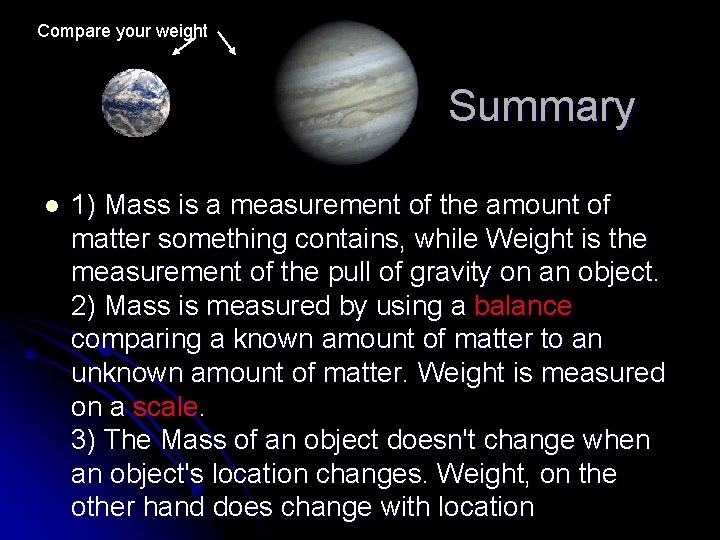
Compare your weight Summary l 1) Mass is a measurement of the amount of matter something contains, while Weight is the measurement of the pull of gravity on an object. 2) Mass is measured by using a balance comparing a known amount of matter to an unknown amount of matter. Weight is measured on a scale. 3) The Mass of an object doesn't change when an object's location changes. Weight, on the other hand does change with location
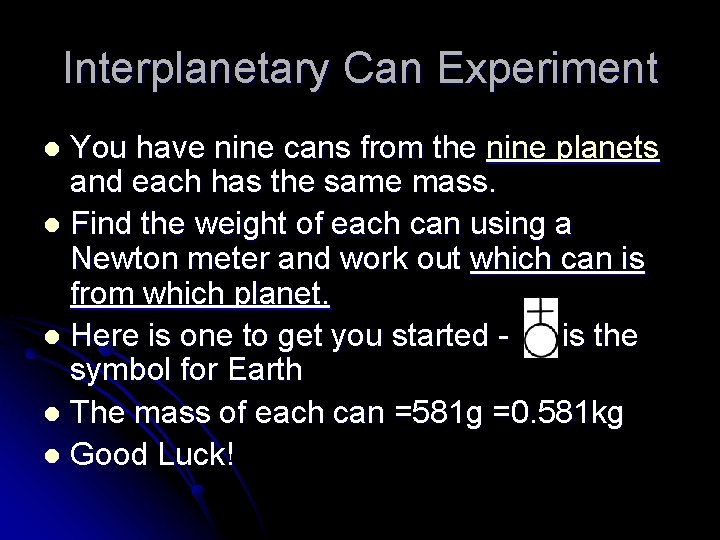
Interplanetary Can Experiment You have nine cans from the nine planets and each has the same mass. l Find the weight of each can using a Newton meter and work out which can is from which planet. l Here is one to get you started is the symbol for Earth l The mass of each can =581 g =0. 581 kg l Good Luck! l
What is gravity? We don't really know. l We can define what it is as a field of influence, because we know how it operates in the Universe. l Some scientists think that it is made up of particles called gravitons which travel at the speed of light. l If we are to be honest, we do not know what gravity "is" in any fundamental way - we only know how it behaves. l
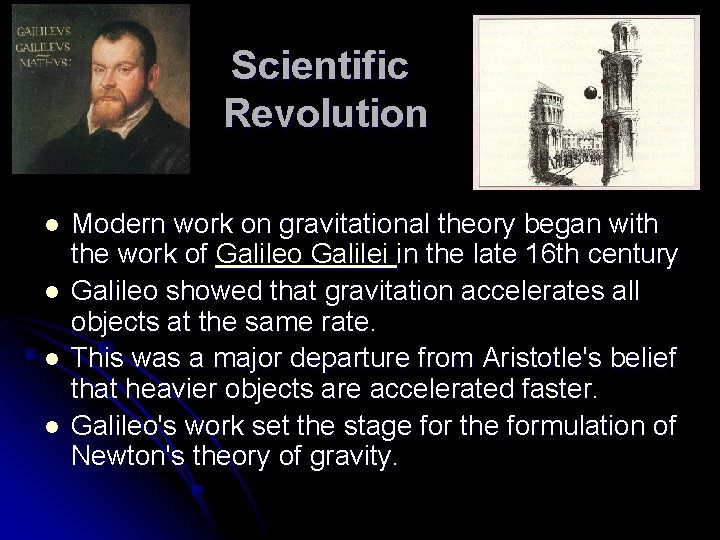
Scientific Revolution l l Modern work on gravitational theory began with the work of Galileo Galilei in the late 16 th century Galileo showed that gravitation accelerates all objects at the same rate. This was a major departure from Aristotle's belief that heavier objects are accelerated faster. Galileo's work set the stage for the formulation of Newton's theory of gravity.
Is there a link? On Earth, the acceleration of free fall is 10 m/s 2 l On the Earth, there is a gravitational force of 10 newtons on every kilogram l These two facts are connected
l l Here is what we do know. . . Gravity is a force of attraction that exists between any two masses. Sir Isaac Newton (1642 -- 1727) realized that the force called "gravity" must make an apple fall from a tree. Newton's "law" of gravity is a mathematical description of the way bodies are observed to attract one another, based on many scientific experiments and observations. The effect of gravity extends from each object out into space in all directions, and for an infinite distance. However, the strength of the gravitational force reduces quickly with distance.
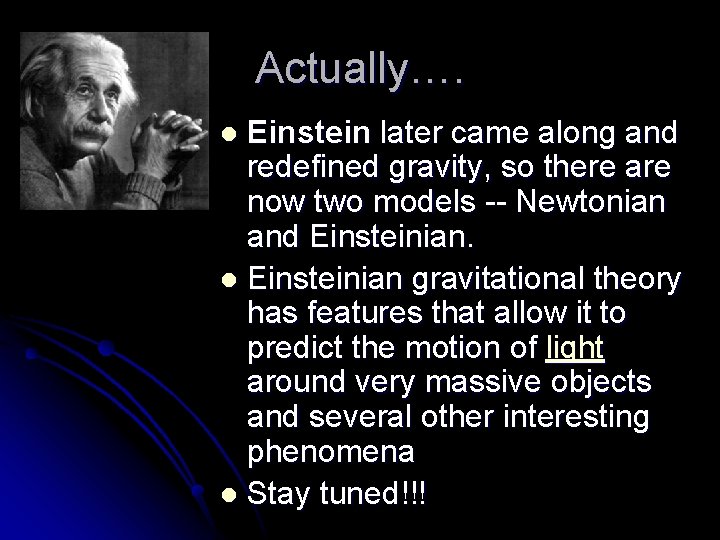
Actually…. Einstein later came along and redefined gravity, so there are now two models -- Newtonian and Einsteinian. l Einsteinian gravitational theory has features that allow it to predict the motion of light around very massive objects and several other interesting phenomena l Stay tuned!!! l
l Unfortunately, Newtonian gravity falls apart when we try to combine it with what we've learned about Special Relativity.
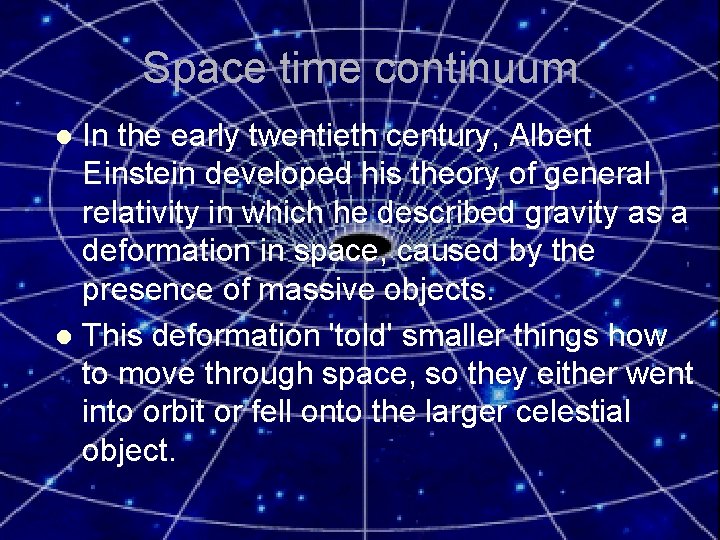
Space time continuum In the early twentieth century, Albert Einstein developed his theory of general relativity in which he described gravity as a deformation in space, caused by the presence of massive objects. l This deformation 'told' smaller things how to move through space, so they either went into orbit or fell onto the larger celestial object. l
ric b a f a e k i l as w as e w c e a p rs e m t v i i t a n h e t U a e ac e h p t d s i ' s he os n's t i r e t c i t a s d led e l Ein h a c c t e '. H m stre. u y r a nu i n t o n i t o c lu revo
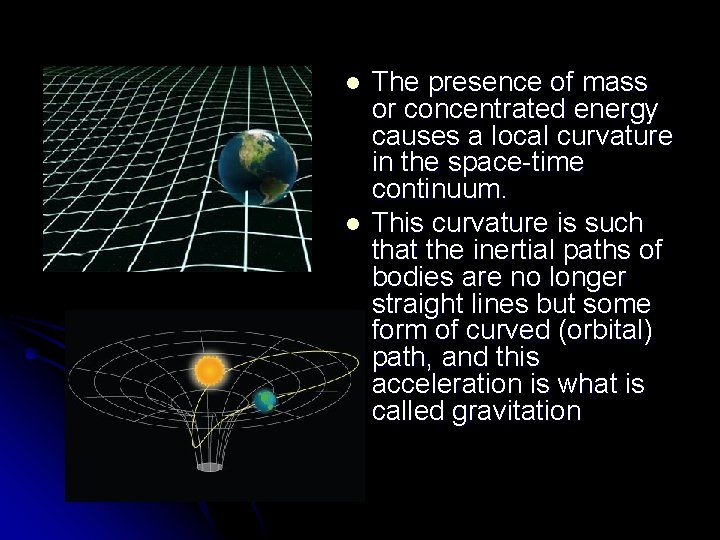
l l The presence of mass or concentrated energy causes a local curvature in the space-time continuum. This curvature is such that the inertial paths of bodies are no longer straight lines but some form of curved (orbital) path, and this acceleration is what is called gravitation
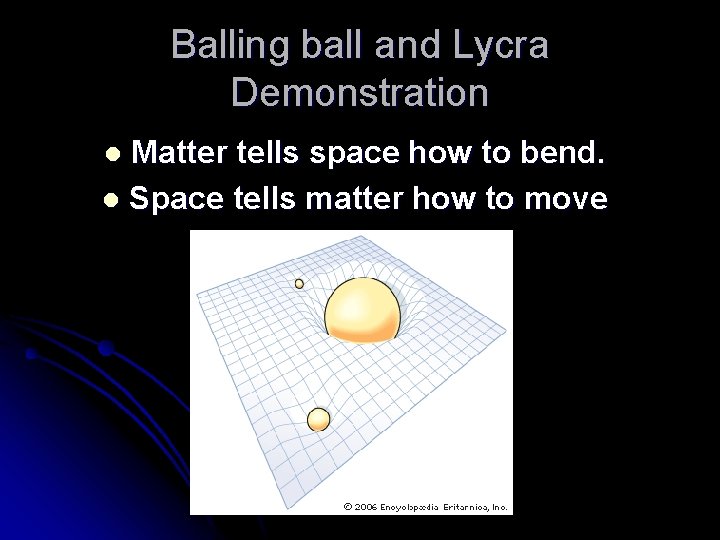
Balling ball and Lycra Demonstration Matter tells space how to bend. l Space tells matter how to move l