
Grass Fur and all things hairy Nicolas Thibieroz
Grass, Fur and all things hairy Nicolas Thibieroz Gaming Engineering Manager, AMD Karl Hillesland Senior Research Engineer, AMD
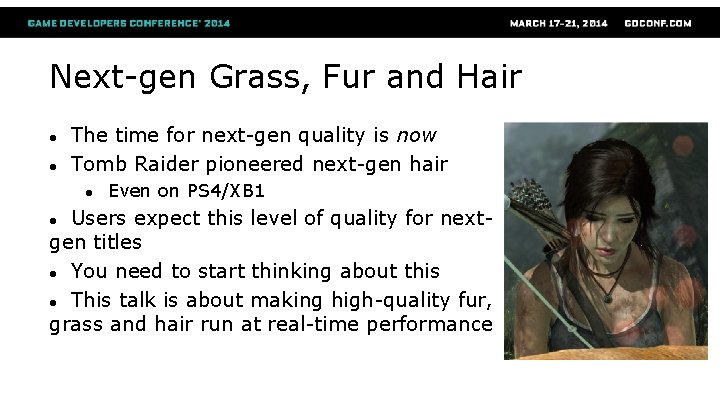
Next-gen Grass, Fur and Hair ● ● The time for next-gen quality is now Tomb Raider pioneered next-gen hair ● Even on PS 4/XB 1 Users expect this level of quality for nextgen titles ● You need to start thinking about this ● This talk is about making high-quality fur, grass and hair run at real-time performance ●
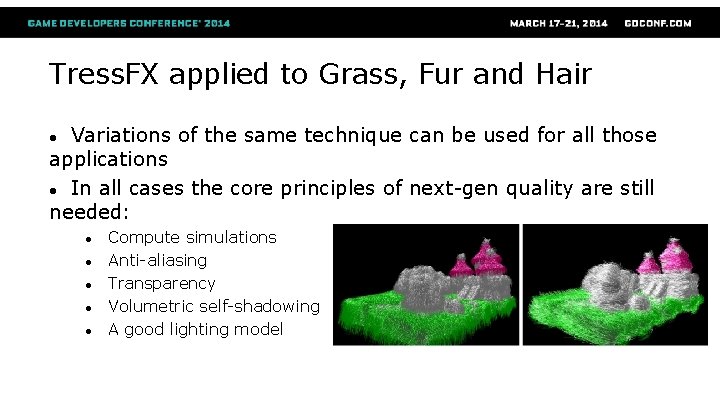
Tress. FX applied to Grass, Fur and Hair Variations of the same technique can be used for all those applications ● In all cases the core principles of next-gen quality are still needed: ● ● ● Compute simulations Anti-aliasing Transparency Volumetric self-shadowing A good lighting model
Forward Rendering Pipeline – a refresher ● Consists of three steps: ● ● ● Hair simulation Shade and store fragments into buffers Fetch shaded fragments, sort and render
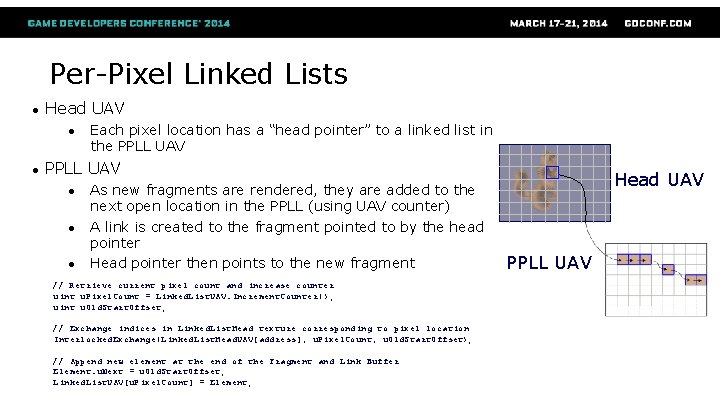
Per-Pixel Linked Lists ● Head UAV ● ● Each pixel location has a “head pointer” to a linked list in the PPLL UAV ● ● ● As new fragments are rendered, they are added to the next open location in the PPLL (using UAV counter) A link is created to the fragment pointed to by the head pointer Head pointer then points to the new fragment // Retrieve current pixel count and increase counter uint u. Pixel. Count = Linked. List. UAV. Increment. Counter(); uint u. Old. Start. Offset; // Exchange indices in Linked. List. Head texture corresponding to pixel location Interlocked. Exchange(Linked. List. Head. UAV[address], u. Pixel. Count, u. Old. Start. Offset); // Append new element at the end of the Fragment and Link Buffer Element. u. Next = u. Old. Start. Offset; Linked. List. UAV[u. Pixel. Count] = Element; Head UAV PPLL UAV
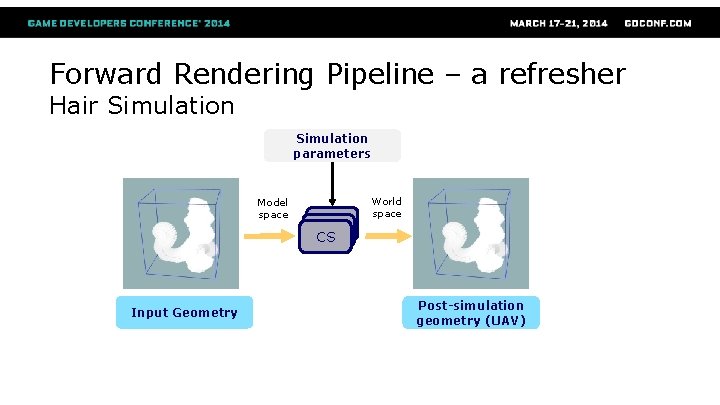
Forward Rendering Pipeline – a refresher Hair Simulation parameters Model space Input Geometry CS CS CS World space Post-simulation geometry (UAV)
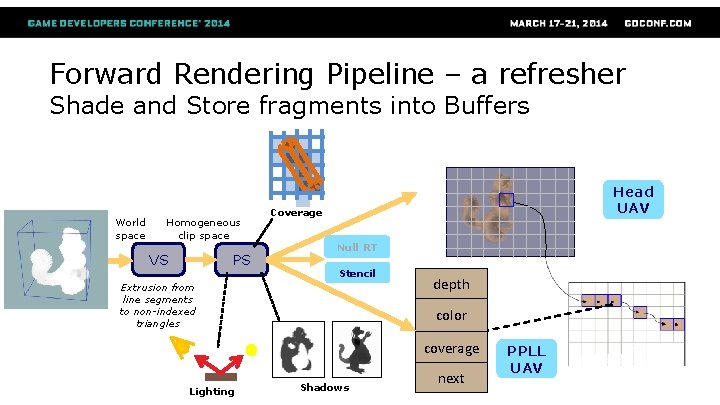
Forward Rendering Pipeline – a refresher Shade and Store fragments into Buffers World space Homogeneous clip space VS PS Head UAV Coverage Null RT Stencil Extrusion from line segments to non-indexed triangles depth color coverage Lighting Shadows next PPLL UAV
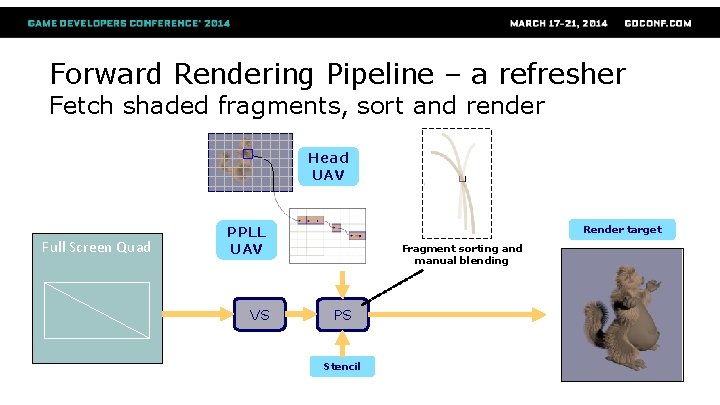
Forward Rendering Pipeline – a refresher Fetch shaded fragments, sort and render Head UAV Full Screen Quad PPLL UAV VS Render target Fragment sorting and manual blending PS Stencil
Forward Rendering Performance Main cost in forward rendering mode is in the shading part ● ● Don’t need maximum quality on all fragments ● ● All fragments are lit and shadowed before being stored PPLL storing is typically not the bottleneck! “tail” fragments need only “good enough” quality Solution: Use shader LOD
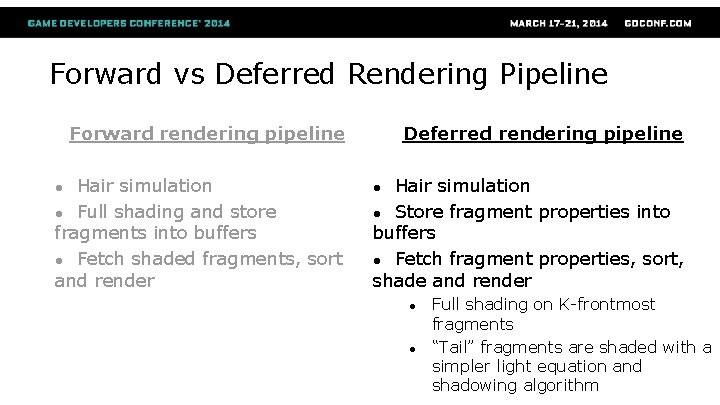
Forward vs Deferred Rendering Pipeline Forward rendering pipeline Hair simulation ● Full shading and store fragments into buffers ● Fetch shaded fragments, sort and render ● Deferred rendering pipeline Hair simulation ● Store fragment properties into buffers ● Fetch fragment properties, sort, shade and render ● ● ● Full shading on K-frontmost fragments “Tail” fragments are shaded with a simpler light equation and shadowing algorithm
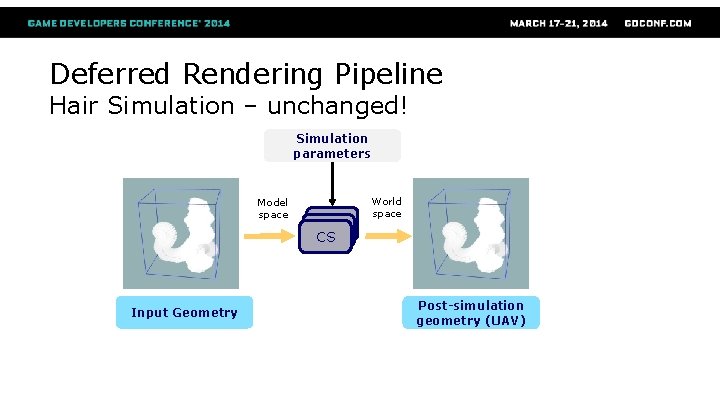
Deferred Rendering Pipeline Hair Simulation – unchanged! Simulation parameters Model space Input Geometry CS CS CS World space Post-simulation geometry (UAV)
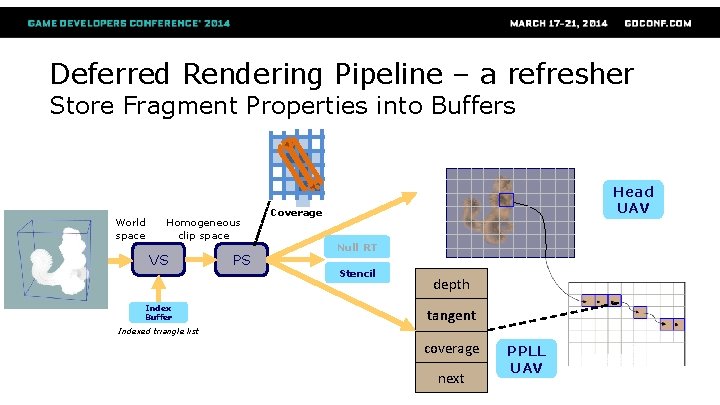
Deferred Rendering Pipeline – a refresher Store Fragment Properties into Buffers World space Homogeneous clip space VS Index Buffer PS Head UAV Coverage Null RT Stencil depth tangent Indexed triangle list coverage next PPLL UAV
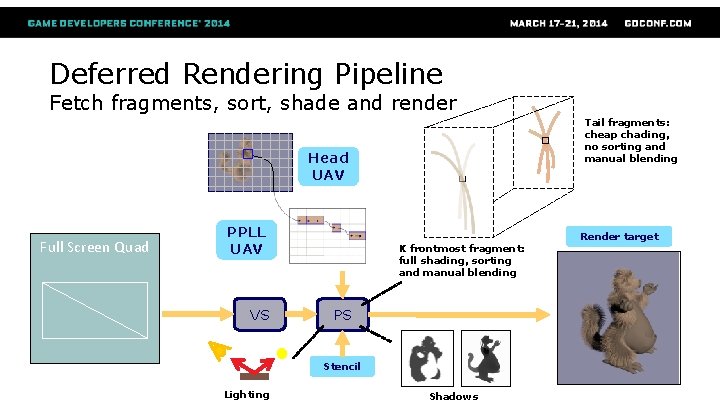
Deferred Rendering Pipeline Fetch fragments, sort, shade and render Tail fragments: cheap chading, no sorting and manual blending Head UAV Full Screen Quad PPLL UAV VS K frontmost fragment: full shading, sorting and manual blending PS Stencil Lighting Shadows Render target
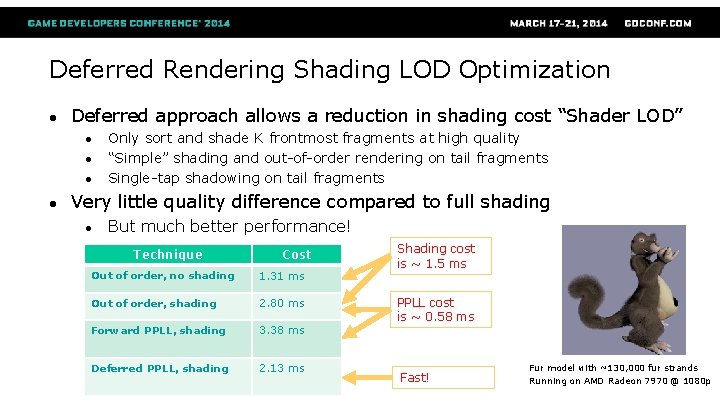
Deferred Rendering Shading LOD Optimization ● Deferred approach allows a reduction in shading cost “Shader LOD” ● ● Only sort and shade K frontmost fragments at high quality “Simple” shading and out-of-order rendering on tail fragments Single-tap shadowing on tail fragments Very little quality difference compared to full shading ● But much better performance! Technique Cost Out of order, no shading 1. 31 ms Out of order, shading 2. 80 ms Forward PPLL, shading 3. 38 ms Deferred PPLL, shading 2. 13 ms Shading cost is ~ 1. 5 ms PPLL cost is ~ 0. 58 ms Fast! Fur model with ~130, 000 fur strands Running on AMD Radeon 7970 @ 1080 p
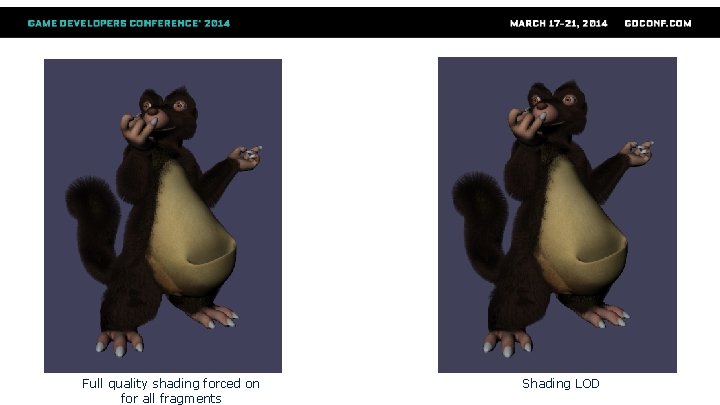
Full quality shading forced on for all fragments Shading LOD
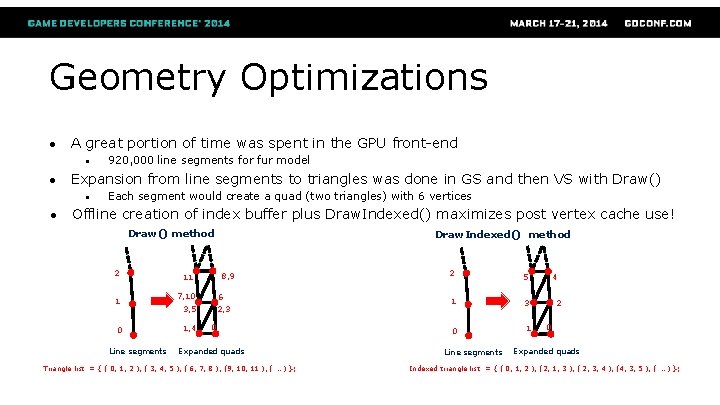
Geometry Optimizations ● A great portion of time was spent in the GPU front-end ● ● Expansion from line segments to triangles was done in GS and then VS with Draw() ● ● 920, 000 line segments for fur model Each segment would create a quad (two triangles) with 6 vertices Offline creation of index buffer plus Draw. Indexed() maximizes post vertex cache use! Draw() method 2 1 0 Line segments 8, 9 11 7, 10 6 2, 3 3, 5 1, 4 Draw. Indexed() method 0 Expanded quads Triangle list = { ( 0, 1, 2 ), ( 3, 4, 5 ), ( 6, 7, 8 ), (9, 10, 11 ), ( … ) }; 2 5 1 3 0 Line segments 1 4 2 0 Expanded quads Indexed triangle list = { ( 0, 1, 2 ), (2, 1, 3 ), ( 2, 3, 4 ), (4, 3, 5 ), ( … ) };
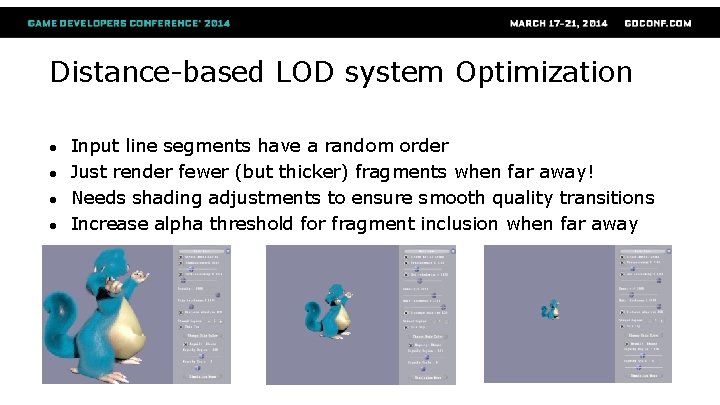
Distance-based LOD system Optimization ● ● Input line segments have a random order Just render fewer (but thicker) fragments when far away! Needs shading adjustments to ensure smooth quality transitions Increase alpha threshold for fragment inclusion when far away
Other Optimizations ● PPLL Head UAV uses a RWTexture 2 D instead of a Buffer ● ● Avoid GPR indexing for sorting ● ● ● Results in more efficient caching for UAV accesses Sorting K frontmost fragments required array of Generic Purpose Registers with random indexing into it Used an ALU-based indexing approach to improve performance TO DO: compute shader simulation optimizations ● ● Currently a set of multiple compute shaders Looking at combining some of these, optimizing shaders and output formats
Per-Pixel Linked Lists UAV Memory Considerations ● How much memory is needed? ● ● ● What happens when I run out? ● ● Guesstimate for a given usage model Max (hair pixels x average overdraw) fragments Missing fragments What can be done about it?

k-Buffer in Memory
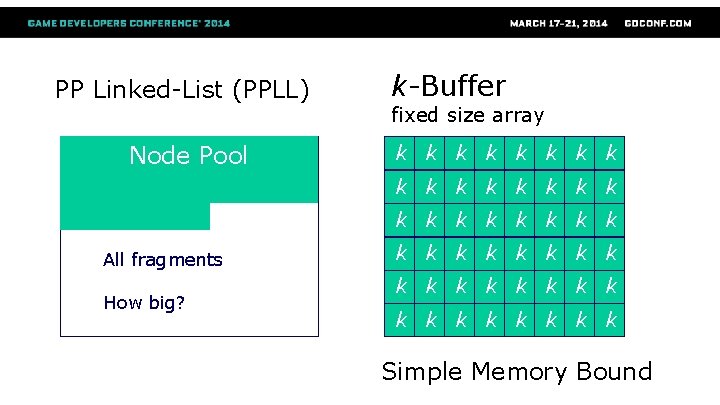
PP Linked-List (PPLL) Node Pool k-Buffer fixed size array k k k k k k All fragments How big? k k k k k k Simple Memory Bound
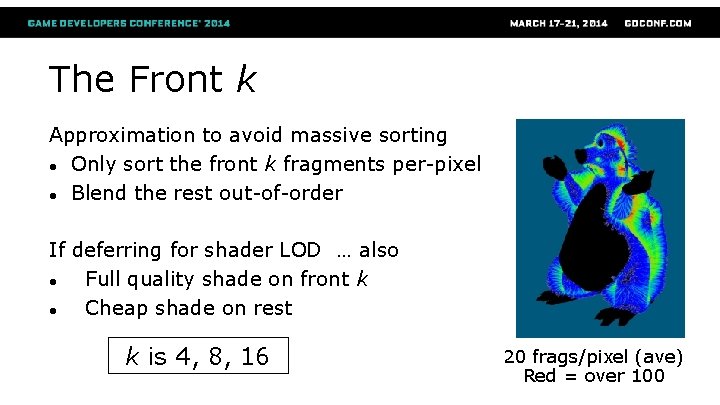
The Front k Approximation to avoid massive sorting ● Only sort the front k fragments per-pixel ● Blend the rest out-of-order If deferring for shader LOD … also ● Full quality shade on front k ● Cheap shade on rest k is 4, 8, 16 20 frags/pixel (ave) Red = over 100
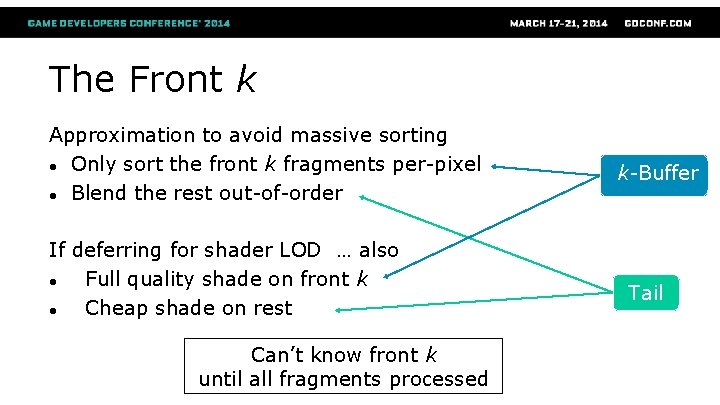
The Front k Approximation to avoid massive sorting ● Only sort the front k fragments per-pixel ● Blend the rest out-of-order If deferring for shader LOD … also ● Full quality shade on front k ● Cheap shade on rest Can’t know front k until all fragments processed k-Buffer Tail
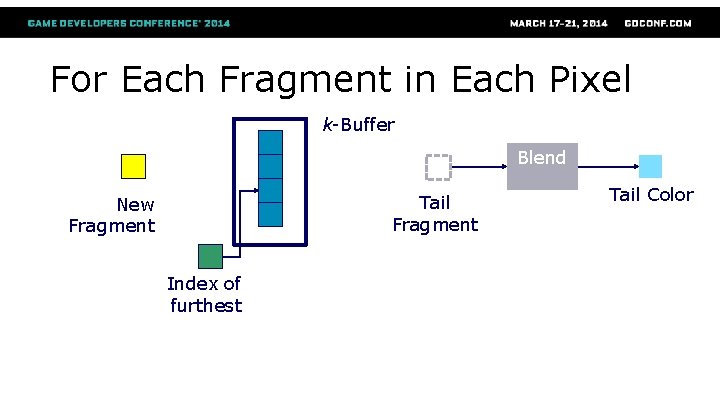
For Each Fragment in Each Pixel k-Buffer Blend Tail Fragment New Fragment Index of furthest Tail Color
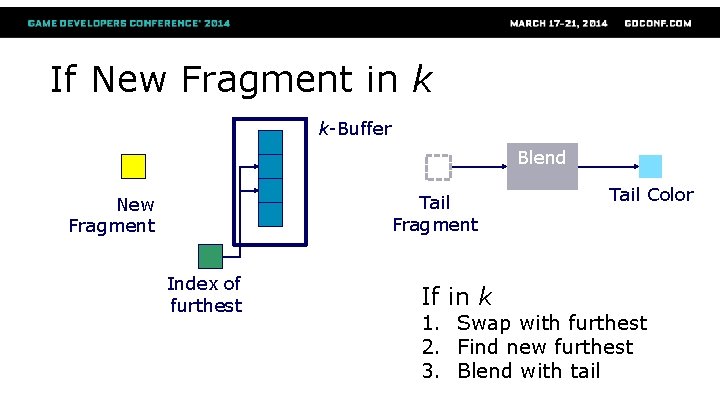
If New Fragment in k k-Buffer Blend Tail Fragment New Fragment Index of furthest If in k Tail Color 1. Swap with furthest 2. Find new furthest 3. Blend with tail
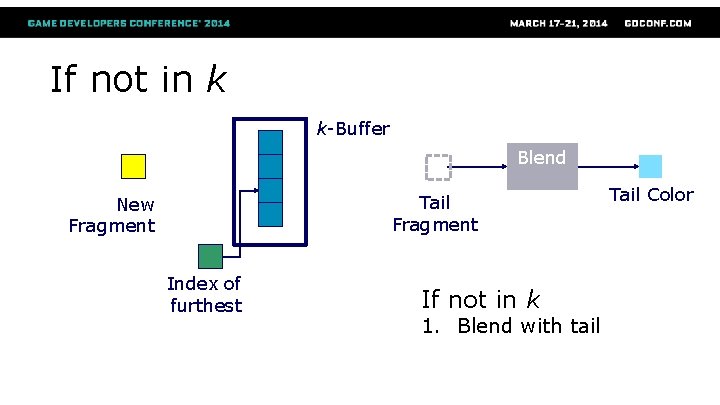
If not in k k-Buffer Blend Tail Fragment New Fragment Index of furthest If not in k 1. Blend with tail Tail Color
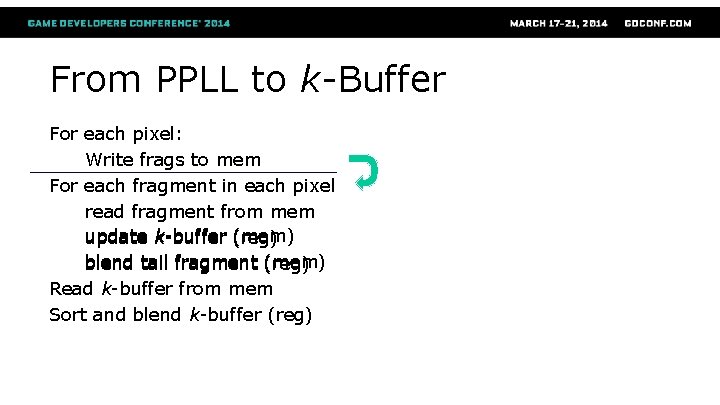
From PPLL to k-Buffer For each pixel: Write frags to mem For each fragment in each pixel read fragment from mem update k-buffer (reg) (mem) blend tail fragment (reg) (mem) Read k-buffer from mem Sort and blend k-buffer (reg)
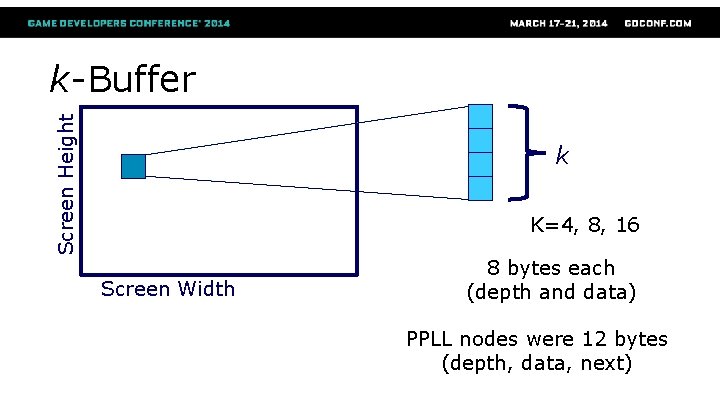
Screen Height k-Buffer k K=4, 8, 16 Screen Width 8 bytes each (depth and data) PPLL nodes were 12 bytes (depth, data, next)
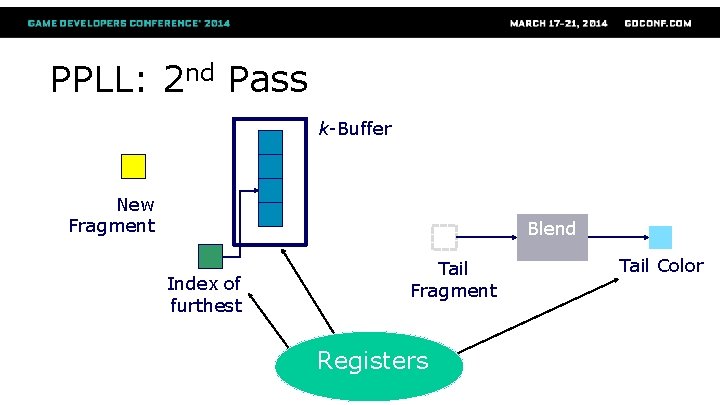
PPLL: 2 nd Pass k-Buffer New Fragment Blend Index of furthest Tail Fragment Registers Tail Color
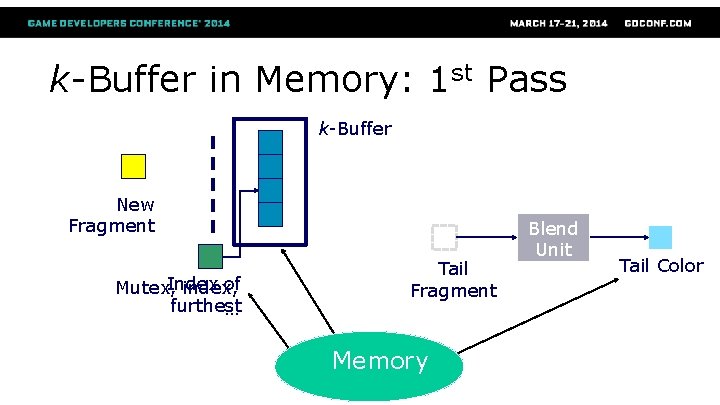
k-Buffer in Memory: 1 st Pass k-Buffer New Fragment Index of Mutex, index, furthest … Tail Fragment Memory Blend Unit Tail Color
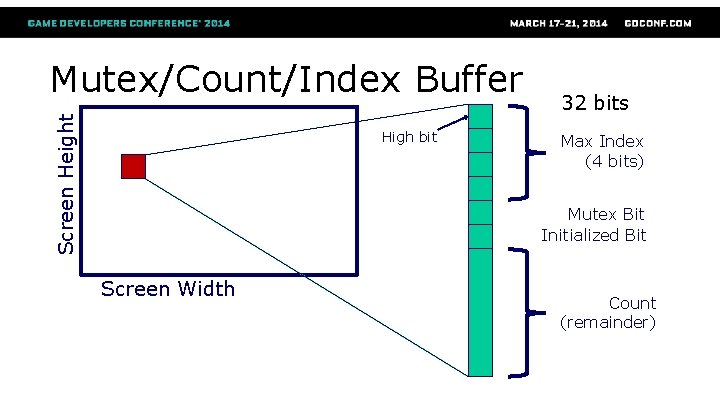
Screen Height Mutex/Count/Index Buffer High bit 32 bits Max Index (4 bits) Mutex Bit Initialized Bit Screen Width Count (remainder)
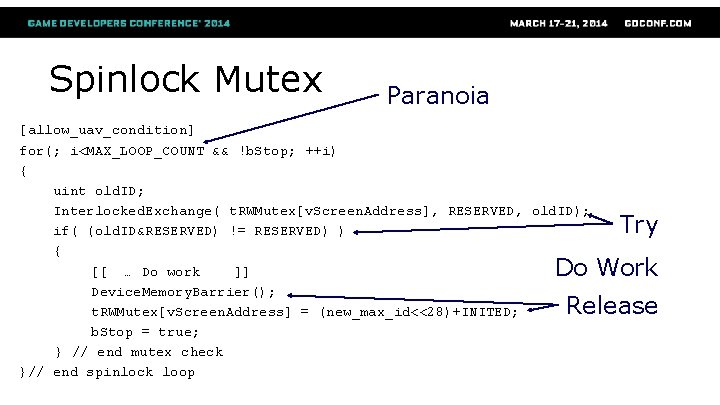
Spinlock Mutex Paranoia [allow_uav_condition] for(; i<MAX_LOOP_COUNT && !b. Stop; ++i) { uint old. ID; Interlocked. Exchange( t. RWMutex[v. Screen. Address], RESERVED, old. ID); if( (old. ID&RESERVED) != RESERVED) ) { [[ … Do work ]] Device. Memory. Barrier(); t. RWMutex[v. Screen. Address] = (new_max_id<<28)+INITED; b. Stop = true; } // end mutex check }// end spinlock loop Try Do Work Release
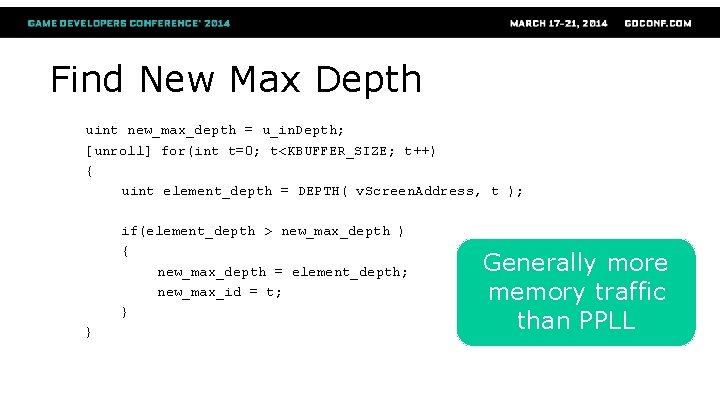
Find New Max Depth uint new_max_depth = u_in. Depth; [unroll] for(int t=0; t<KBUFFER_SIZE; t++) { uint element_depth = DEPTH( v. Screen. Address, t ); if(element_depth > new_max_depth ) { new_max_depth = element_depth; new_max_id = t; } } Generally more memory traffic than PPLL
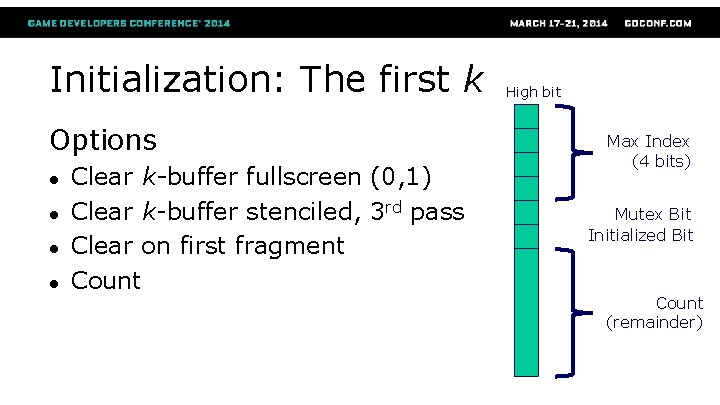
Initialization: The first k Options ● ● Clear k-buffer fullscreen (0, 1) Clear k-buffer stenciled, 3 rd pass Clear on first fragment Count High bit Max Index (4 bits) Mutex Bit Initialized Bit Count (remainder)
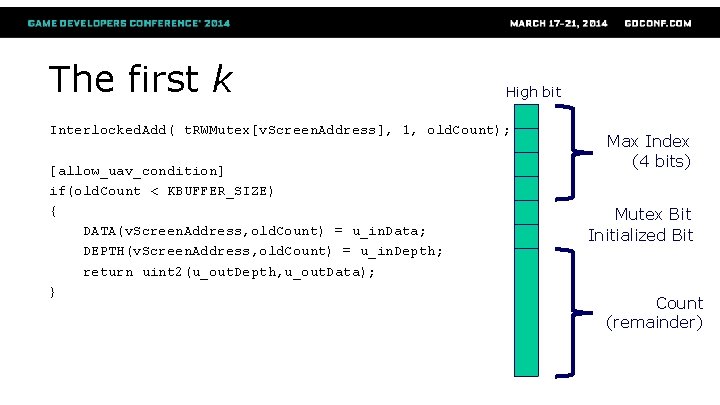
The first k High bit Interlocked. Add( t. RWMutex[v. Screen. Address], 1, old. Count); [allow_uav_condition] if(old. Count < KBUFFER_SIZE) { DATA(v. Screen. Address, old. Count) = u_in. Data; DEPTH(v. Screen. Address, old. Count) = u_in. Depth; return uint 2(u_out. Depth, u_out. Data); } Max Index (4 bits) Mutex Bit Initialized Bit Count (remainder)
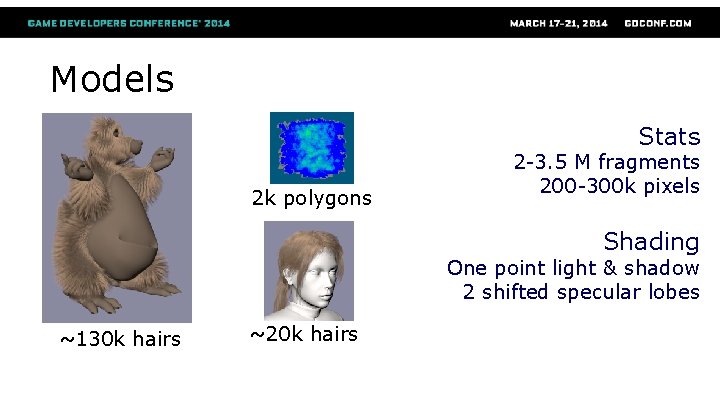
Models Stats 2 k polygons 2 -3. 5 M fragments 200 -300 k pixels Shading One point light & shadow 2 shifted specular lobes ~130 k hairs ~20 k hairs
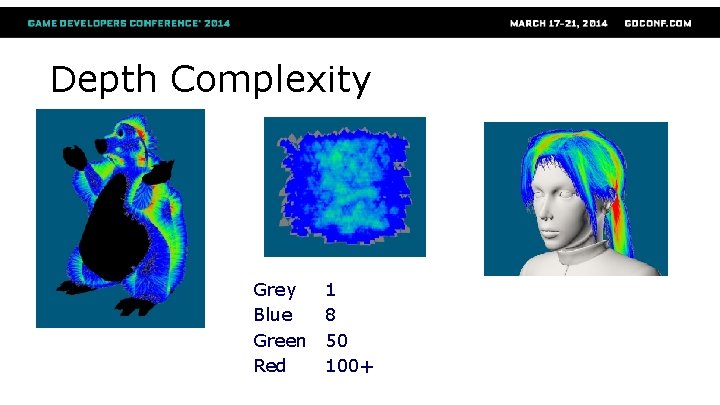
Depth Complexity Grey Blue Green Red 1 8 50 100+
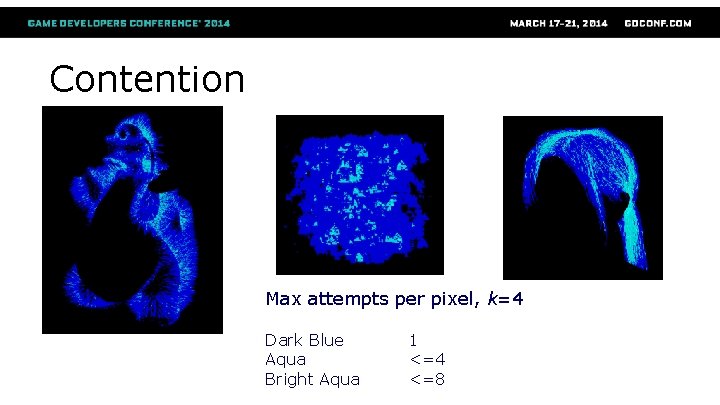
Contention Max attempts per pixel, k=4 Dark Blue Aqua Bright Aqua 1 <=4 <=8
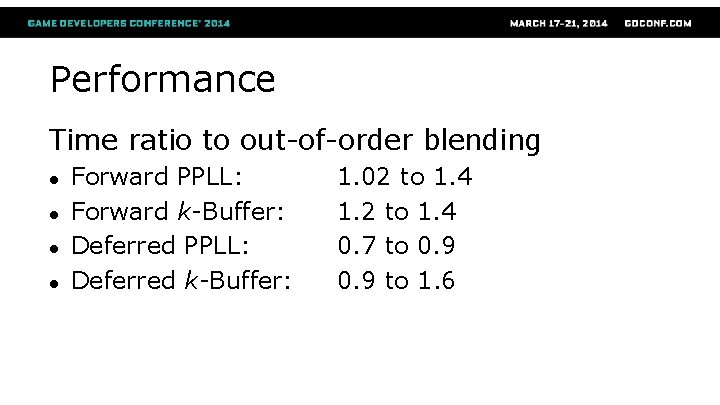
Performance Time ratio to out-of-order blending ● ● Forward PPLL: Forward k-Buffer: Deferred PPLL: Deferred k-Buffer: 1. 02 to 1. 4 1. 2 to 1. 4 0. 7 to 0. 9 to 1. 6
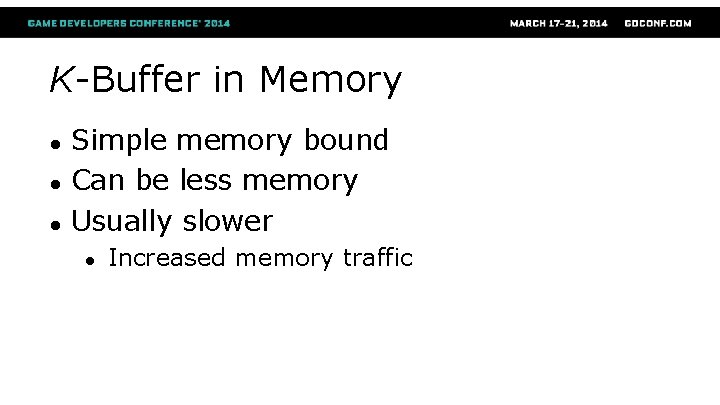
K-Buffer in Memory ● ● ● Simple memory bound Can be less memory Usually slower ● Increased memory traffic
Simulation
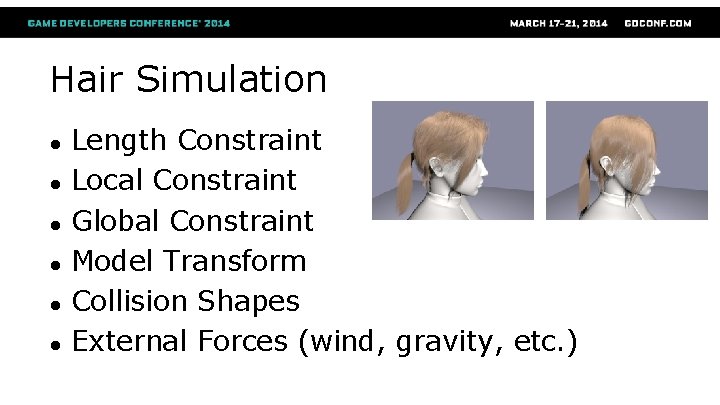
Hair Simulation ● ● ● Length Constraint Local Constraint Global Constraint Model Transform Collision Shapes External Forces (wind, gravity, etc. )
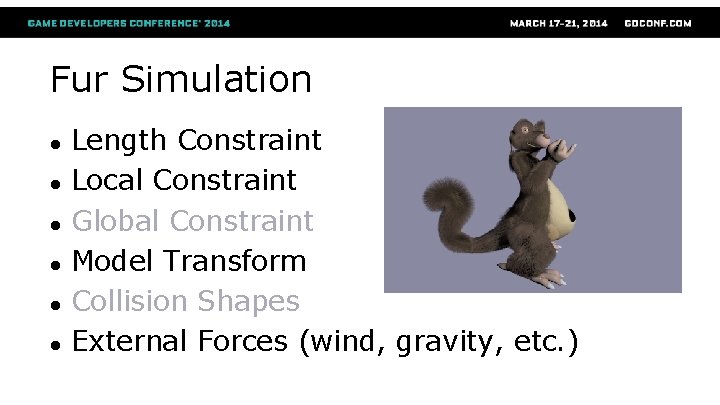
Fur Simulation ● ● ● Length Constraint Local Constraint Global Constraint Model Transform Collision Shapes External Forces (wind, gravity, etc. )
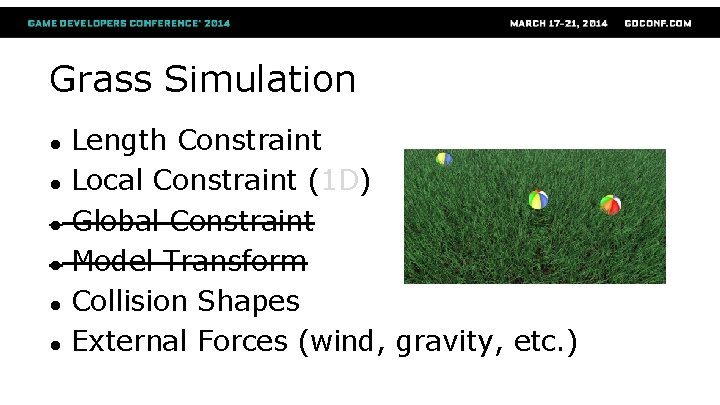
Grass Simulation ● ● ● Length Constraint Local Constraint (1 D) Global Constraint Model Transform Collision Shapes External Forces (wind, gravity, etc. )
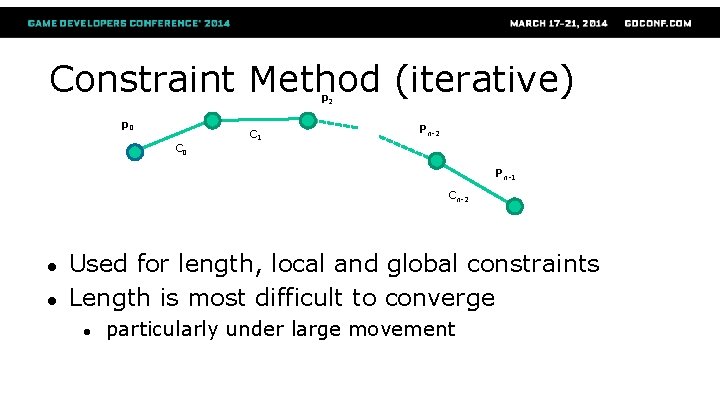
Constraint Method (iterative) p 2 p 0 C 1 Pn-2 Pn-1 Cn-2 ● ● Used for length, local and global constraints Length is most difficult to converge ● particularly under large movement
Tridiagonal Matrix Formulation ● Direct solve for length constraint ● ● ● Almost zero stretch Limited to smaller time steps (stability) Still cheap ● ● Leverages matrix structure of strands Two sweeps of strand
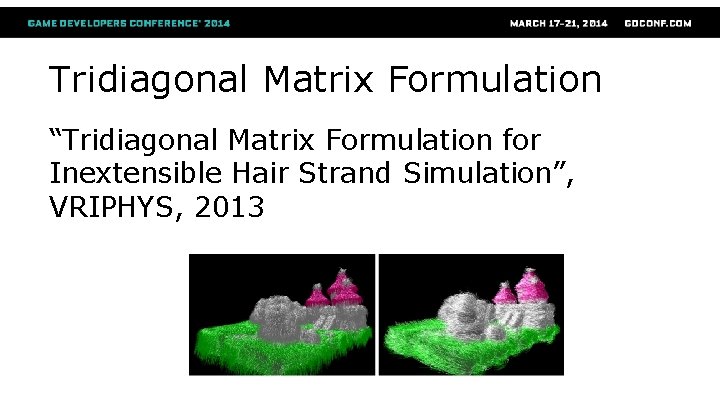
Tridiagonal Matrix Formulation “Tridiagonal Matrix Formulation for Inextensible Hair Strand Simulation”, VRIPHYS, 2013
Demos
Summary Next-gen look is possible now! ● Deferred Rendering for shading LOD is fastest ● k-buffer in memory is an option for memory-constrained situations ● High-quality grass and fur simulation with compute ● Upcoming Tress. FX 2 SDK sample update with fur scenario at http: //developer. amd. com/tools-and-sdks/graphicsdevelopment/amd-radeon-sdk/
Questions?

Extras
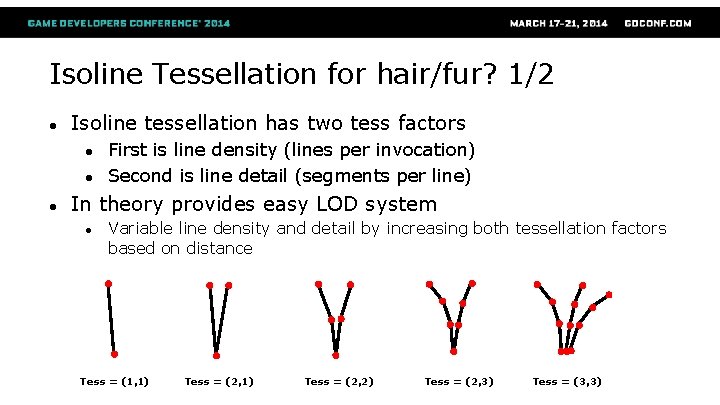
Isoline Tessellation for hair/fur? 1/2 ● Isoline tessellation has two tess factors ● ● ● First is line density (lines per invocation) Second is line detail (segments per line) In theory provides easy LOD system ● Variable line density and detail by increasing both tessellation factors based on distance Tess = (1, 1) Tess = (2, 2) Tess = (2, 3) Tess = (3, 3)
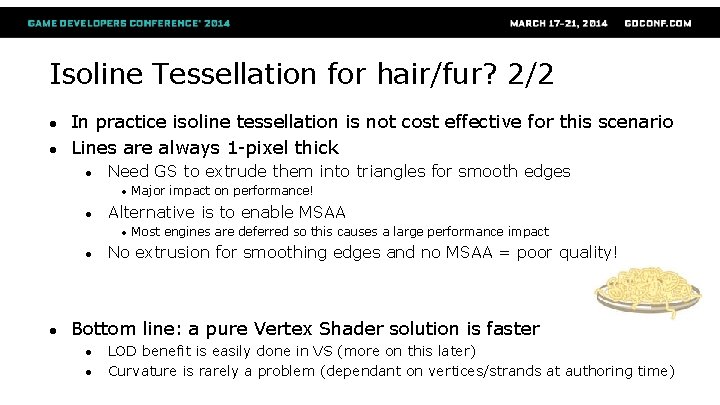
Isoline Tessellation for hair/fur? 2/2 ● ● In practice isoline tessellation is not cost effective for this scenario Lines are always 1 -pixel thick ● Need GS to extrude them into triangles for smooth edges ● ● Alternative is to enable MSAA ● ● ● Major impact on performance! Most engines are deferred so this causes a large performance impact No extrusion for smoothing edges and no MSAA = poor quality! Bottom line: a pure Vertex Shader solution is faster ● ● LOD benefit is easily done in VS (more on this later) Curvature is rarely a problem (dependant on vertices/strands at authoring time)
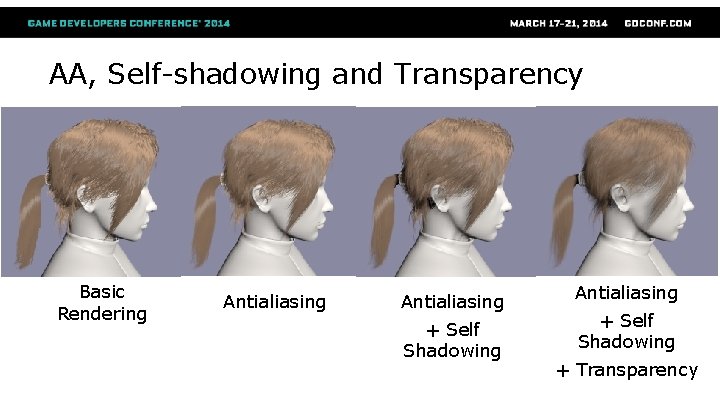
AA, Self-shadowing and Transparency Basic Rendering Antialiasing + Self Shadowing + Transparency
- Slides: 54