
GRASP Designing Objects with Responsibilities General Responsibility Assignment
* GRASP : Designing Objects with Responsibilities * General Responsibility Assignment Software Patterns Ch. 17 1

Responsibilities and Methods • The focus of object design is to identify classes and objects, decide what methods belong where and how these objects should interact. • Responsibilities are related to the obligations of an object in terms of its behavior. • Two types of responsibilities: • Doing something itself (e. g. creating an object, doing a calculation) • Initiating action in other objects. • Controlling and coordinating activities in other objects. • Knowing: • Knowing about private encapsulated data. • Knowing about related objects. • Knowing about things it can derive or calculate. 2

Responsibilities and Methods • Responsibilities are assigned to classes during object design. For example, we may declare the following: • “a Sale is responsible for creating Sales. Line. Items” (doing) • “a Sale is responsible for knowing its total” (knowing) • Responsibilities related to “knowing” are often inferable from the Domain Model (because of the attributes and associations it illustrates) 3
Responsibilities and Methods • The translation of responsibilities into classes and methods is influenced by the granularity of responsibility. • A responsibility is not the same thing as a method, but methods are implemented to fulfill responsibilities. • Methods either act alone, or collaborate with other methods and objects. 4

Responsibilities and Interaction Diagrams • Sale objects have been given the responsibility to create Payments, handled with the make. Payment method. : Sale make. Payment(…) create(…) : Payment 5
Patterns • We will emphasize principles (expressed in patterns) to guide choices in where to assign responsibilities. • A pattern is a named description of a problem and a solution that can be applied to new contexts; it provides advice in how to apply it in varying circumstances. For example, • Pattern name: • Problem: • Solution: Information Expert What is the most basic principle by which to assign responsibilities to objects? Assign a responsibility to the class that has the information needed to fulfil it. 6
Information Expert (or Expert) • Problem: what is a general principle of assigning responsibilities to objects? • Solution: Assign a responsibility to the information expert - the class that has the information necessary to fulfill the responsibility. • In the Next. Gen POS application, who should be responsible for knowing the grand total of a sale? • By Information Expert we should look for that class that has the information needed to determine the total. 7
Information Expert (or Expert) • Do we look in the Domain Model or the Design Model to analyze the classes that have the information needed? • A: Both. Assume there is no or minimal Design Model. Look to the Domain Model for information experts. 8
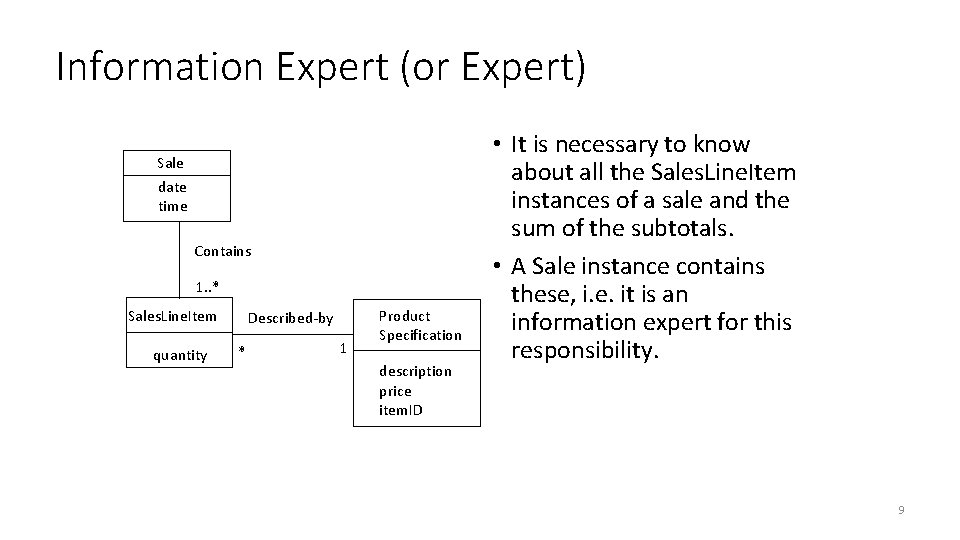
Information Expert (or Expert) Sale date time Contains 1. . * Sales. Line. Item quantity Described-by * 1 Product Specification description price item. ID • It is necessary to know about all the Sales. Line. Item instances of a sale and the sum of the subtotals. • A Sale instance contains these, i. e. it is an information expert for this responsibility. 9
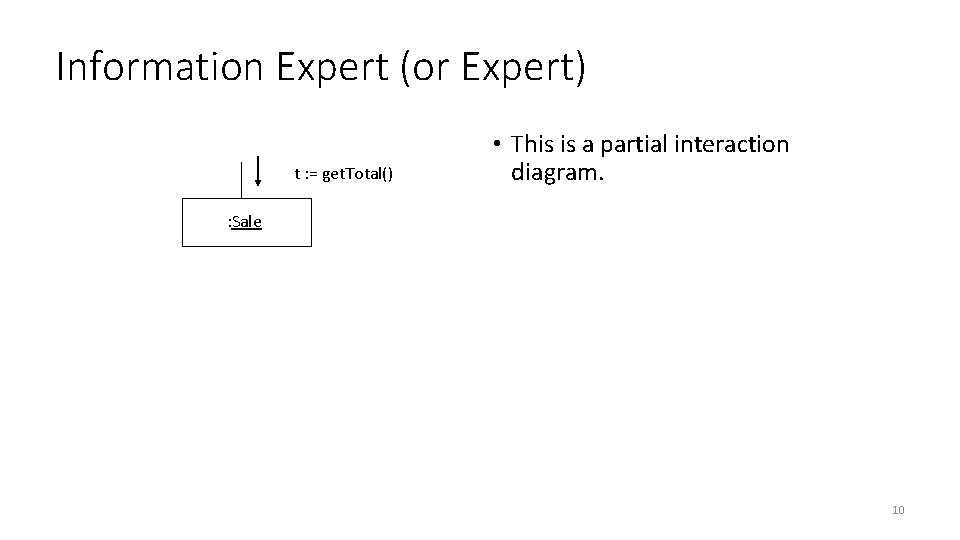
Information Expert (or Expert) t : = get. Total() • This is a partial interaction diagram. : Sale 10
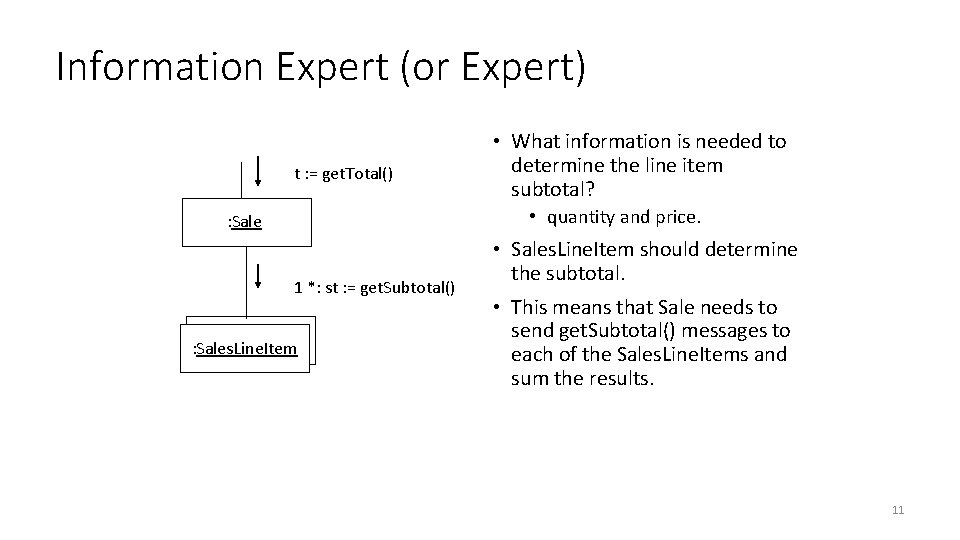
Information Expert (or Expert) t : = get. Total() • What information is needed to determine the line item subtotal? • quantity and price. : Sale 1 *: st : = get. Subtotal() : Sales. Line. Item • Sales. Line. Item should determine the subtotal. • This means that Sale needs to send get. Subtotal() messages to each of the Sales. Line. Items and sum the results. 11
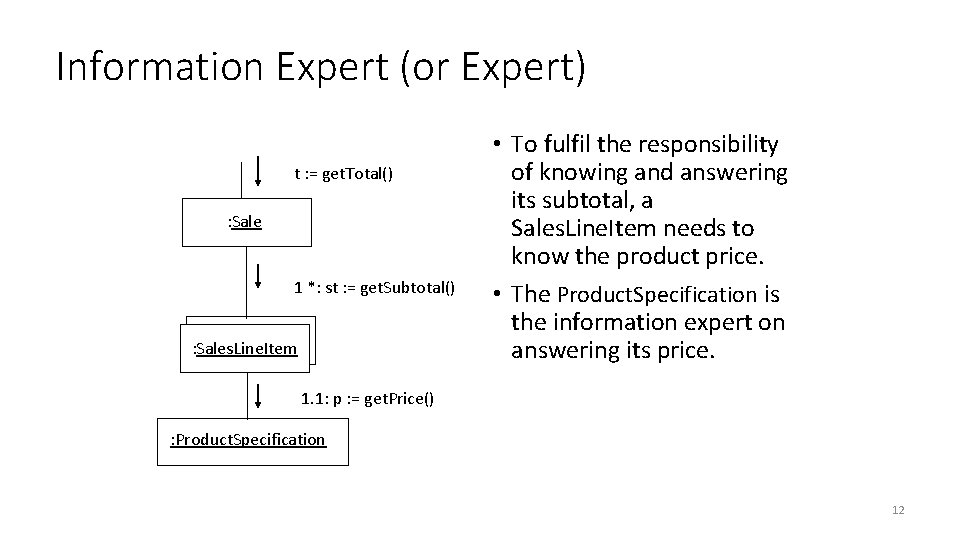
Information Expert (or Expert) t : = get. Total() : Sale 1 *: st : = get. Subtotal() : Sales. Line. Item • To fulfil the responsibility of knowing and answering its subtotal, a Sales. Line. Item needs to know the product price. • The Product. Specification is the information expert on answering its price. 1. 1: p : = get. Price() : Product. Specification 12
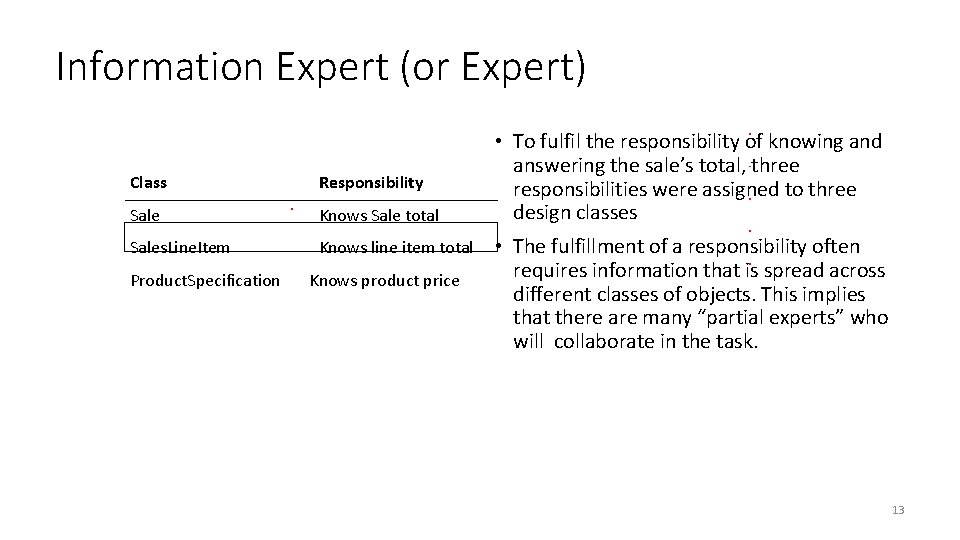
Information Expert (or Expert) Class Responsibility Sale Knows Sale total Sales. Line. Item Knows line item total Product. Specification Knows product price • To fulfil the responsibility of knowing and answering the sale’s total, three responsibilities were assigned to three design classes • The fulfillment of a responsibility often requires information that is spread across different classes of objects. This implies that there are many “partial experts” who will collaborate in the task. 13
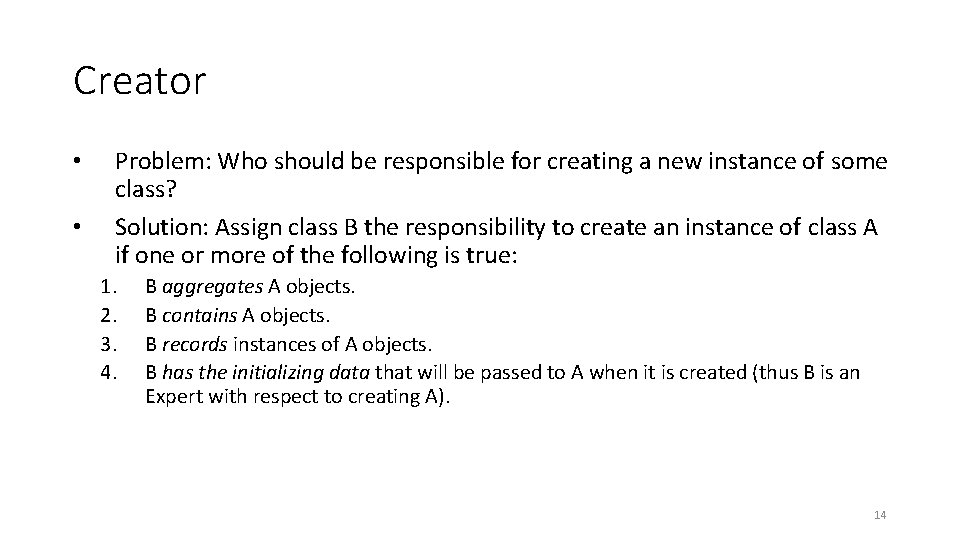
Creator • • Problem: Who should be responsible for creating a new instance of some class? Solution: Assign class B the responsibility to create an instance of class A if one or more of the following is true: 1. 2. 3. 4. B aggregates A objects. B contains A objects. B records instances of A objects. B has the initializing data that will be passed to A when it is created (thus B is an Expert with respect to creating A). 14
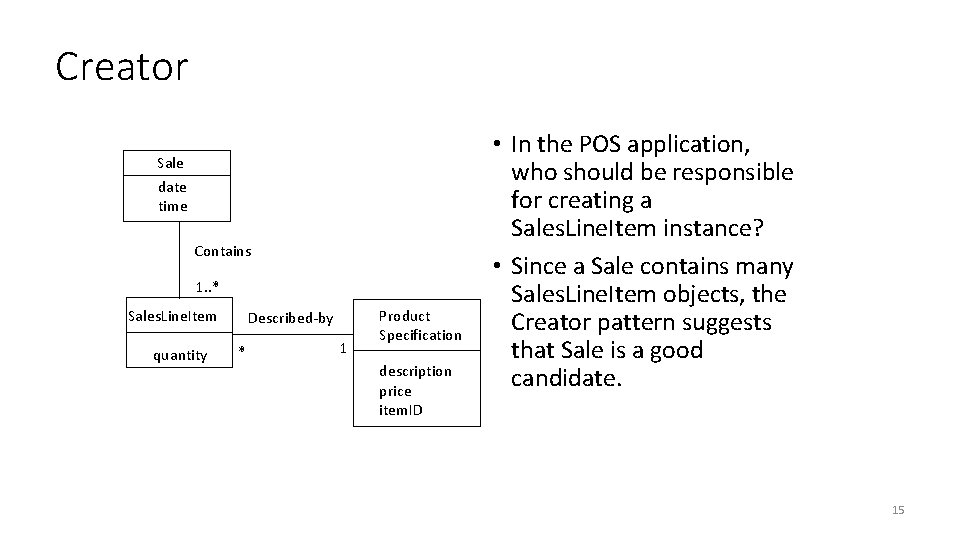
Creator Sale date time Contains 1. . * Sales. Line. Item quantity Described-by * 1 Product Specification description price item. ID • In the POS application, who should be responsible for creating a Sales. Line. Item instance? • Since a Sale contains many Sales. Line. Item objects, the Creator pattern suggests that Sale is a good candidate. 15
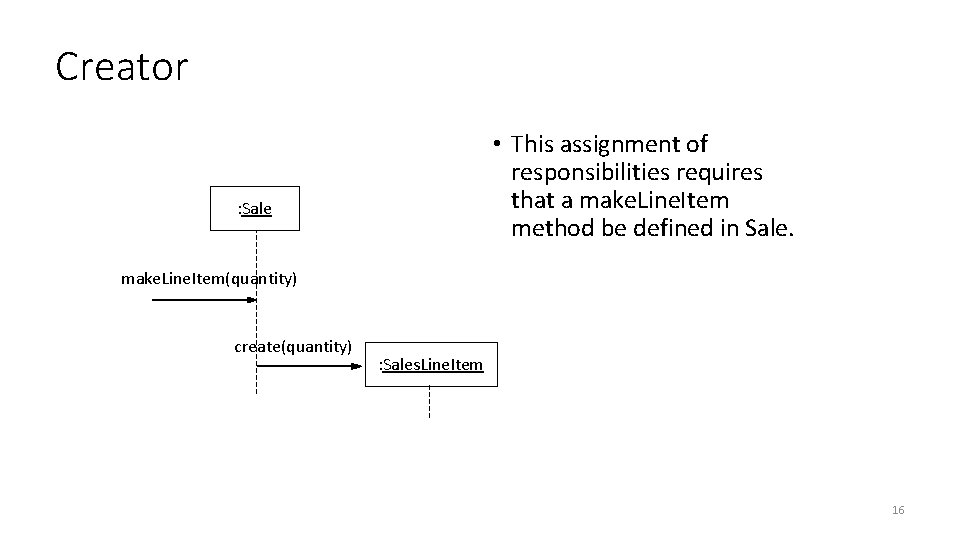
Creator • This assignment of responsibilities requires that a make. Line. Item method be defined in Sale. : Sale make. Line. Item(quantity) create(quantity) : Sales. Line. Item 16
Low Coupling • Coupling: it is a measure of how strongly one element is connected to, has knowledge of, or relies upon other elements. • A class with high coupling depends on many other classes (libraries, tools). • Problems because of a design with high coupling: • Changes in related classes force local changes. • Harder to understand in isolation; need to understand other classes. • Harder to reuse because it requires additional presence of other classes. • Problem: How to support low dependency, low change impact and increased reuse? • Solution: Assign a responsibility so that coupling remains low. 17
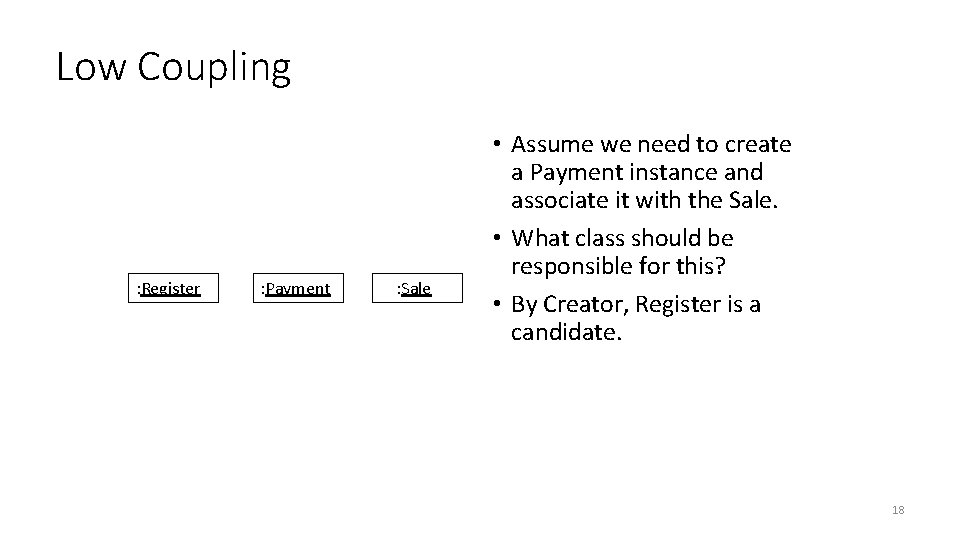
Low Coupling : Register : Payment : Sale • Assume we need to create a Payment instance and associate it with the Sale. • What class should be responsible for this? • By Creator, Register is a candidate. 18
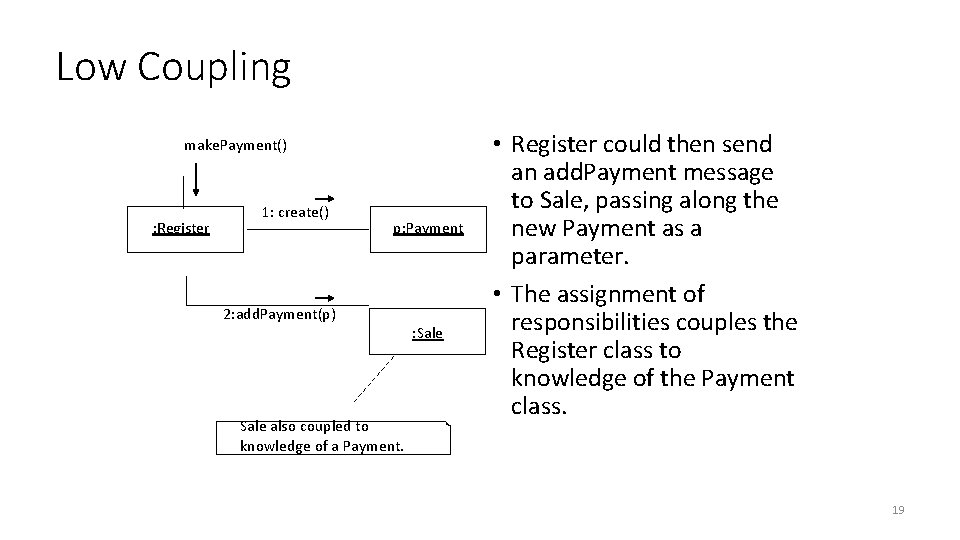
Low Coupling make. Payment() : Register 1: create() p: Payment 2: add. Payment(p) Sale also coupled to knowledge of a Payment. : Sale • Register could then send an add. Payment message to Sale, passing along the new Payment as a parameter. • The assignment of responsibilities couples the Register class to knowledge of the Payment class. 19
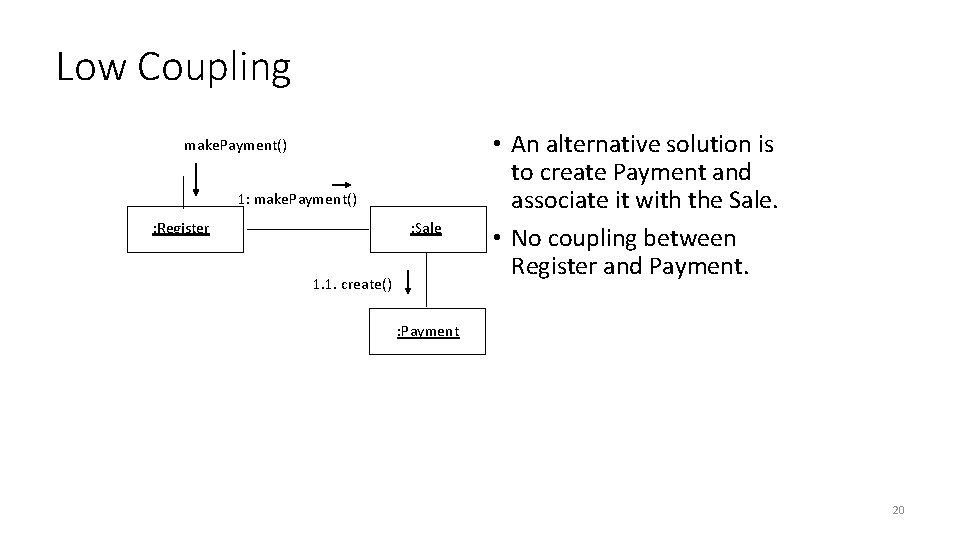
Low Coupling make. Payment() 1: make. Payment() : Register : Sale 1. 1. create() • An alternative solution is to create Payment and associate it with the Sale. • No coupling between Register and Payment. : Payment 20
Low Coupling • Some of the places where coupling occurs: • • Attributes: X has an attribute that refers to a Y instance. Methods: e. g. a parameter or a local variable of type Y is found in a method of X. Subclasses: X is a subclass of Y. Types: X implements interface Y. • There is no specific measurement for coupling, but in general, classes that are generic and simple to reuse have low coupling. • There will always be some coupling among objects, otherwise, there would be no collaboration. 21
High Cohesion • Cohesion: it is a measure of how strongly related and focused the responsibilities of an element are. • A class with low cohesion does many unrelated activities or does too much work. • Problems because of a design with low cohesion: • • Hard to understand. Hard to reuse. Hard to maintain. Delicate, affected by change. • Problem: How to keep complexity manageable? • Solution: Assign a responsibility so that cohesion remains high. 22
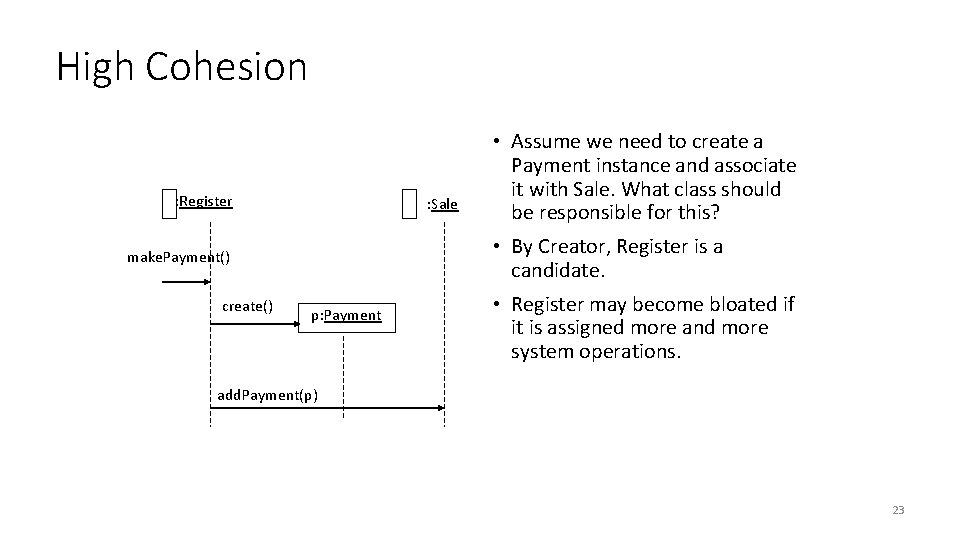
High Cohesion : Register : Sale • By Creator, Register is a candidate. make. Payment() create() • Assume we need to create a Payment instance and associate it with Sale. What class should be responsible for this? p: Payment • Register may become bloated if it is assigned more and more system operations. add. Payment(p) 23
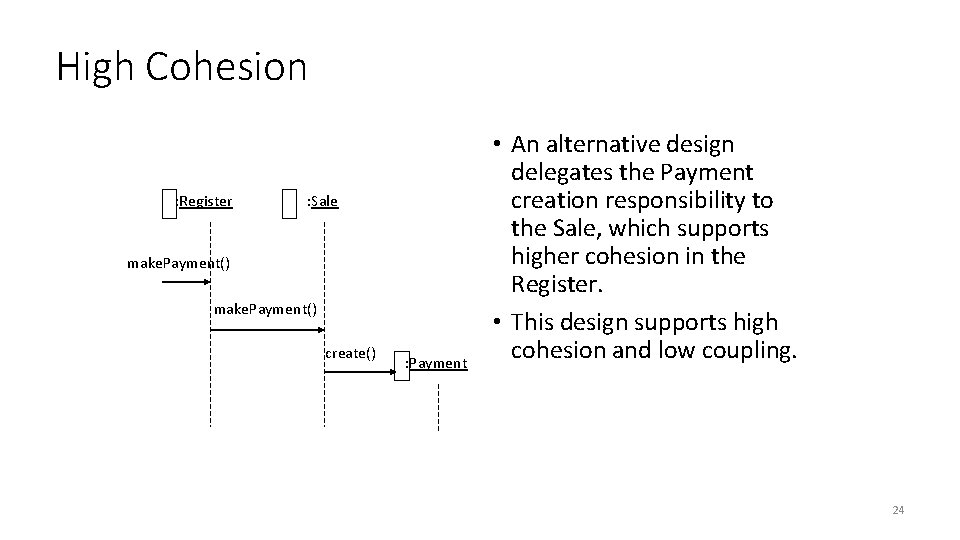
High Cohesion : Register : Sale make. Payment() create() : Payment • An alternative design delegates the Payment creation responsibility to the Sale, which supports higher cohesion in the Register. • This design supports high cohesion and low coupling. 24
High Cohesion • Scenarios that illustrate varying degrees of functional cohesion 1. Very low cohesion: class responsible for many things in many different areas. • e. g. : a class responsible for interfacing with a data base and remote-procedurecalls. 2. Low cohesion: class responsible for complex task in a functional area. • e. g. : a class responsible for interacting with a relational database. 25
High Cohesion 3. High cohesion: class has moderate responsibility in one functional area and it collaborates with other classes to fulfill a task. • • e. g. : a class responsible for one section of interfacing with a data base. Rule of thumb: a class with high cohesion has a relative low number of methods, with highly related functionality, and doesn’t do much work. It collaborates and delegates. 26
Controller • Problem: Who should be responsible for handling an input system event? • Solution: Assign the responsibility for receiving or handling a system event message to a class representing one of he following choices: • Represents the overall system. • Represents a use case scenario. • A Controller is a non-user interface object that defines the method for the system operation. Note that windows, applets, etc. typically receive events and delegate them to a controller. 27
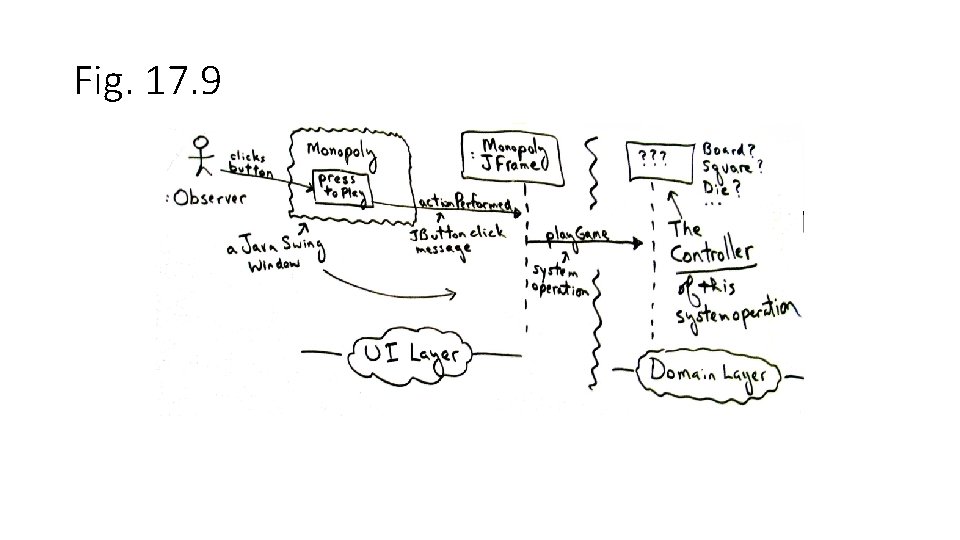
Fig. 17. 9
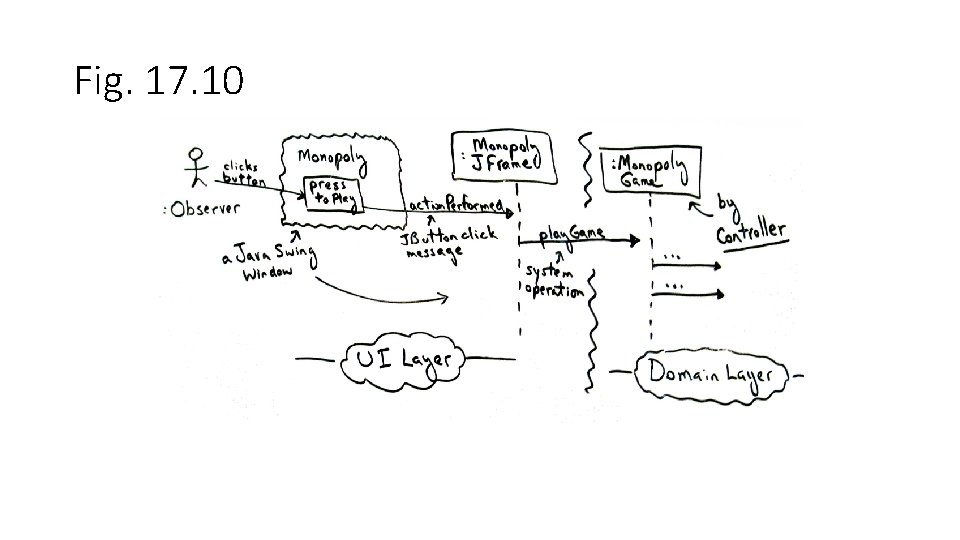
Fig. 17. 10

Fig. 17. 11
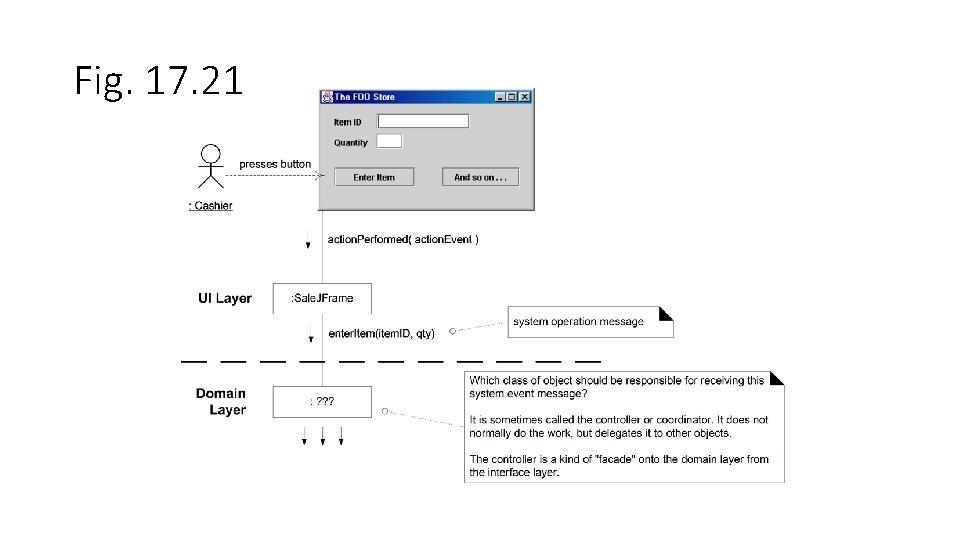
Fig. 17. 21
- Slides: 31