
Grappling with Grading Assessment Rubrics Introductions Introduce yourself
Grappling with Grading Assessment & Rubrics
Introductions • Introduce yourself • • • Please share Who you are The department you are in The courses you teach, have taught, or are planning to teach Your goals for students
Workshop Goals • Review best practices in integrating learning goals with assessments • Review different forms of assessment • Reflect on your teaching and assessment experiences • Apply assessment practices in your courses
Assessment • How much freedom do you have in designing your assessments? • Are there benefits to using an assessment someone else designed? • How well do the assessments you use fit with the learning goals for the course? • Discuss these with a partner for 5 minutes, then share with the class.
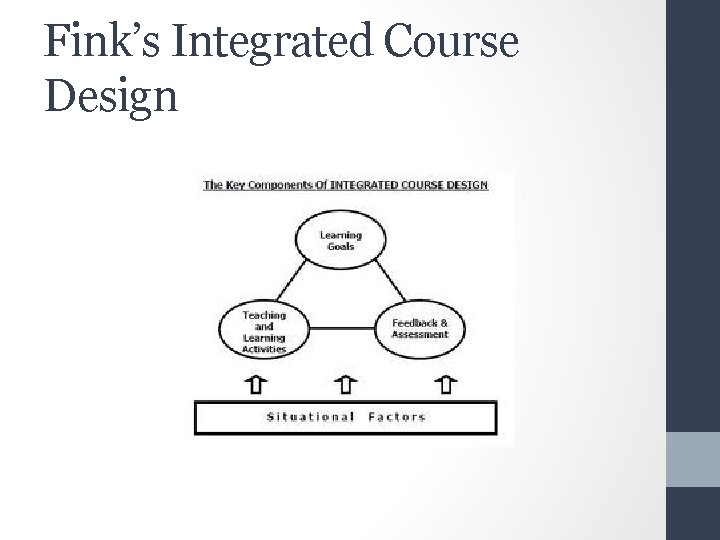
Fink’s Integrated Course Design

Fink’s Course Design Model • Fink asks: • What are the important situational factors in a particular course and learning situation? • What should our full set of learning goals be? • What kinds of feedback and assessment should we provide? • Are all the components connected and integrated? Are they consistent with and supportive of each other?
Assessment • The first step in designing assessments is …. • Identify the learning goals. • What do you expect students to learn by completing this assignment? • What kinds of intellectual skills do you expect them to practice or acquire by completing this assignment? • Are your goals for students, in terms of their learning, explicit?
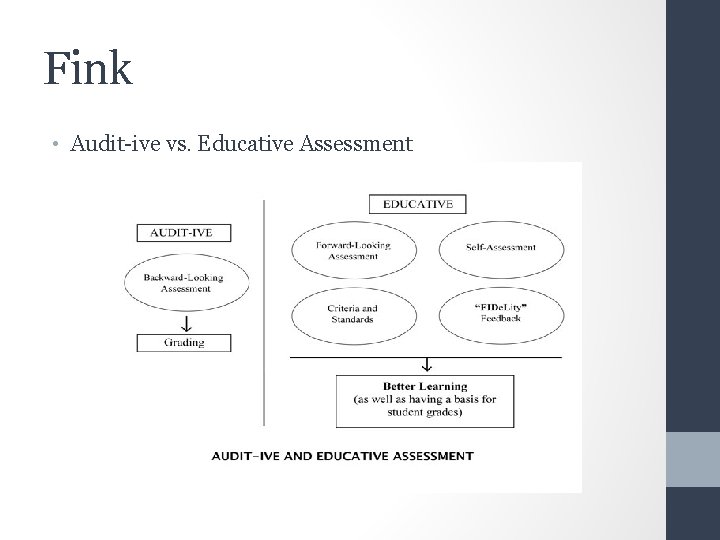
Fink • Audit-ive vs. Educative Assessment
Principles for Assessment (Steen, 1999) • • • Not a single event, but a continuous cycle. An open process. Promotes valid inferences. Employs multiple measures of performance. Measures what is worth learning, not just what is easy to measure. • Supports every student’s opportunity to learn important _______ (fill in the blank)
Fair Assessment Practices (Suskie, 2000) • Clearly stated learning outcomes; share them with students. • Match assessment to what you teach and vice versa. • Use multiple measures and different kinds of measures. • Teach students how to do the assessment task. • Engage and encourage your students. • Interpret assessment results appropriately. • Evaluate the outcomes of your assessments.

Assessment Practices • Knowing the principles and practices, do assessments you use fit these criteria? • Work with a partner and discuss how an assessment in your class either meets the criteria, or how it could be improved.
Authentic Assessment • Examine the two different assessments. • Which assessment do you think your students would prefer? Why? • Which assessment do you think you would prefer your students to complete? • Which assessment would give you a better indication of students’ mastery of learning goals? Why?
Authentic Assessment • Describes the multiple forms of assessment that reflect • • student learning achievement motivation and attitudes on instructionally relevant classroom activities • O’Malley & Valdez Pierce, 1996
Authentic Assessment • If you want to teach students how to swim, how would you evaluate their abilities and skills? • Likewise, if you want to teach students listening, speaking, reading or writing skills, how would you evaluate their performance? • What types of assessment would you use?
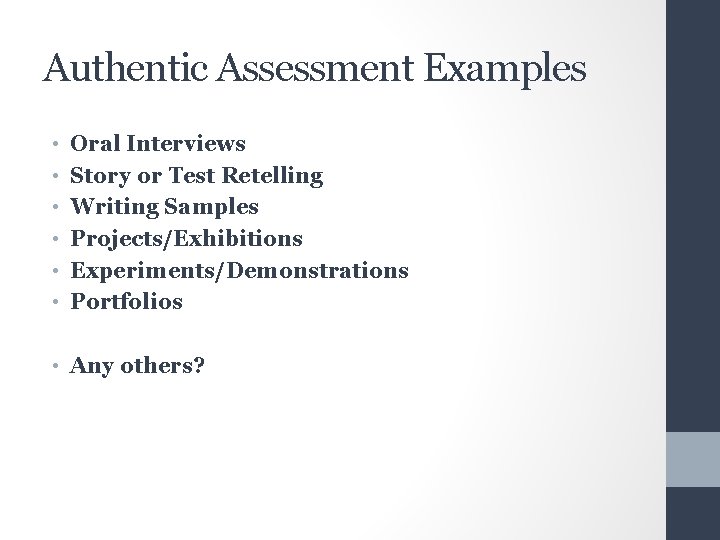
Authentic Assessment Examples • • • Oral Interviews Story or Test Retelling Writing Samples Projects/Exhibitions Experiments/Demonstrations Portfolios • Any others?
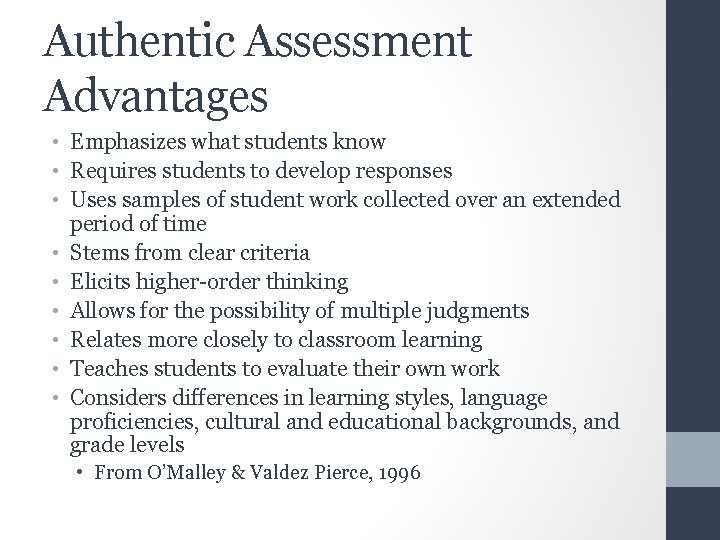
Authentic Assessment Advantages • Emphasizes what students know • Requires students to develop responses • Uses samples of student work collected over an extended period of time • Stems from clear criteria • Elicits higher-order thinking • Allows for the possibility of multiple judgments • Relates more closely to classroom learning • Teaches students to evaluate their own work • Considers differences in learning styles, language proficiencies, cultural and educational backgrounds, and grade levels • From O’Malley & Valdez Pierce, 1996
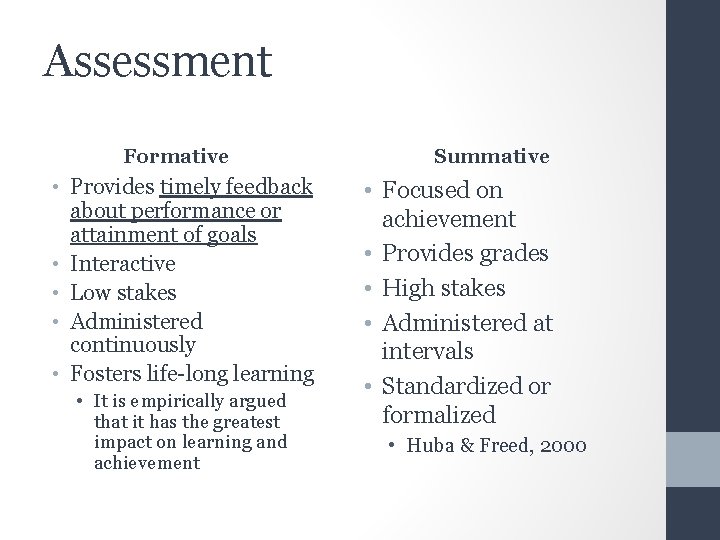
Assessment Formative • Provides timely feedback about performance or attainment of goals • Interactive • Low stakes • Administered continuously • Fosters life-long learning • It is empirically argued that it has the greatest impact on learning and achievement Summative • Focused on achievement • Provides grades • High stakes • Administered at intervals • Standardized or formalized • Huba & Freed, 2000
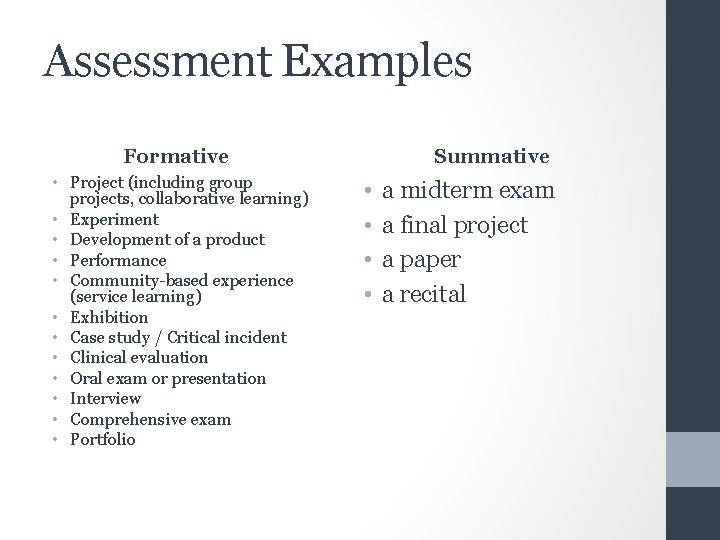
Assessment Examples Summative Formative • Project (including group projects, collaborative learning) • Experiment • Development of a product • Performance • Community-based experience (service learning) • Exhibition • Case study / Critical incident • Clinical evaluation • Oral exam or presentation • Interview • Comprehensive exam • Portfolio • • a midterm exam a final project a paper a recital
Assessment • • What is the value of summative assessments? What can they tell us? What is the value of formative assessments? What can they tell us? • How do you incorporate both types of assessments in your class? • Discuss these with a small group, and then share with the class.
Assessment • As a result, consider the following when planning assessment • Differentiate feedback from assessment • Make the focus on learning, not just summative assessment • Encourage students to reflect on their learning and experiences in class
Prior Knowledge • Consider assessing your students’ prior knowledge before giving out assessments. • Students come to class with a variety of learning experiences and different backgrounds. • These all should be considered before you plan your assessments.
Prior Knowledge • Questions to consider: • What facts and concepts should students know? • What procedures and steps should students be familiar with? • What metacognitive practices should students be aware of? • How is knowledge and skills applied in real world contexts and problems in my discipline? Do my assessments reflect the complexities of the field, or are students assessed out-ofcontext?
Classroom Assessment Techniques (CATs) • CATs are quick assessments that enable both you and students to check their comprehension of important information, concepts and details for your course. • CATs are easy to administer and relatively easy to grade. • Angelo & Cross, 1993
Examples of CATs • Knowledge & Skills • The Muddiest Point • The One-Minute Paper • Chain Notes • Student Generated Test Questions • Focused Listing • One Sentence Summary • Reflection & Self-Assessment • Journals • Blogs • Reactions to Instructional Methods • Exam Evaluations • Suggestion Box • Personal Course Feedback Forms • (Angelo & Cross, 1993; Haugen, 1999)
Examples of CATs • Reflection & Self-Assessment • Journals • Blogs • Reactions to Instructional Methods • • Exam Evaluations Suggestion Box Personal Course Feedback Forms (Angelo & Cross, 1993; Haugen, 1999)
Assessment • What types of assessment do you use in your classes? • What types of assessment that you are not using do you envision yourself using?
References • Angelo, T. A. & Cross, K. P. (1993). Classroom assessment techniques: A handbook for college teachers. San Francisco: Jossey-Bass. • Assess teaching & learning. Eberly Center for Teaching Excellence & Educational Innovation. Carnegie Mellon. Retrieved from https: //www. cmu. edu/teaching/assessment/index. html • Fink, L. D. (2003). Creating significant learning experiences: An integrated approach to designing college courses. San Francisco, CA: Jossey-Bass. • Gross-Davis, B. (2009). Tools for teaching. San Francisco: Jossey-Bass. • Huba, M. E. & Freed, J. E. (2000). Learner-Centered Assessment on College Campuses - Shifting the Focus from Teaching to Learning. Boston: Allyn and Bacon. • Steen, L. A. (1999). Assessing assessment. St. Olaf College. Retrieved from http: //www. stolaf. edu/people/steen/Papers/assessment. html • Suskie, L. (2000). Fair assessment practices: Giving students equitable opportunities to demonstrate learning. The American Association for Higher Education Bulletin, May. Retrieved from http: //uncw. edu/cas/documents/Fair. Assessment. Practices_Sus kie. pdf
Stay Engaged @Temple. TLC Post about your experience today using the hashtag #custom
- Slides: 28