
Graphs Paths and Circuits A walk in a


- Slides: 9
Graphs
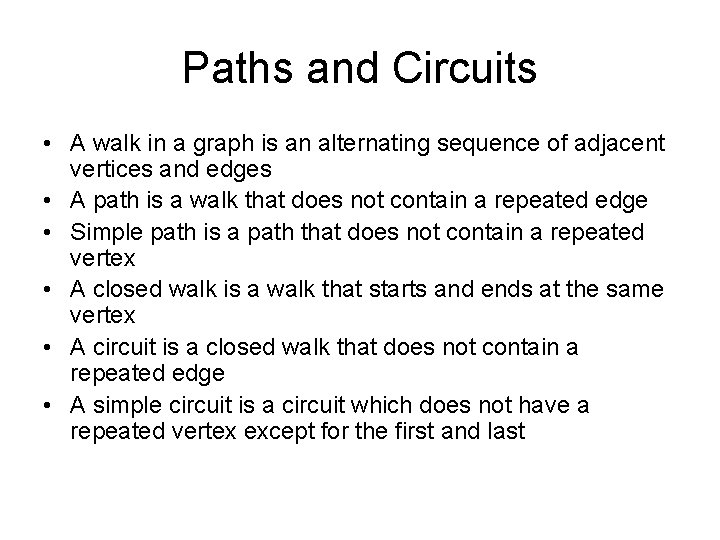
Paths and Circuits • A walk in a graph is an alternating sequence of adjacent vertices and edges • A path is a walk that does not contain a repeated edge • Simple path is a path that does not contain a repeated vertex • A closed walk is a walk that starts and ends at the same vertex • A circuit is a closed walk that does not contain a repeated edge • A simple circuit is a circuit which does not have a repeated vertex except for the first and last
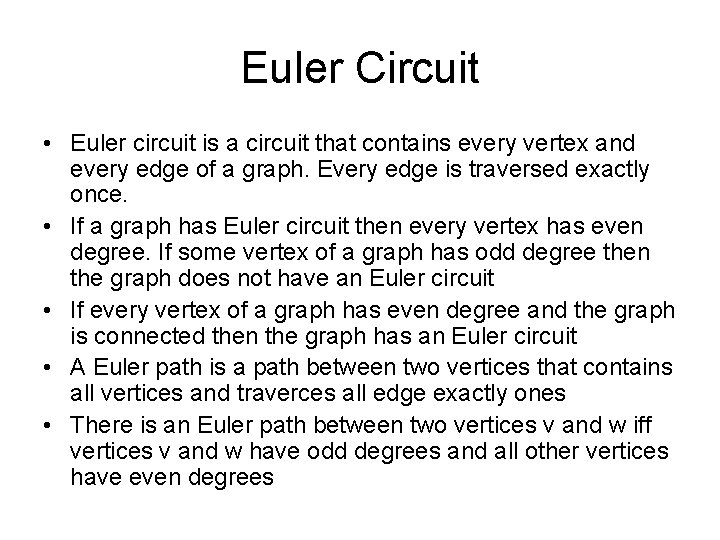
Euler Circuit • Euler circuit is a circuit that contains every vertex and every edge of a graph. Every edge is traversed exactly once. • If a graph has Euler circuit then every vertex has even degree. If some vertex of a graph has odd degree then the graph does not have an Euler circuit • If every vertex of a graph has even degree and the graph is connected then the graph has an Euler circuit • A Euler path is a path between two vertices that contains all vertices and traverces all edge exactly ones • There is an Euler path between two vertices v and w iff vertices v and w have odd degrees and all other vertices have even degrees
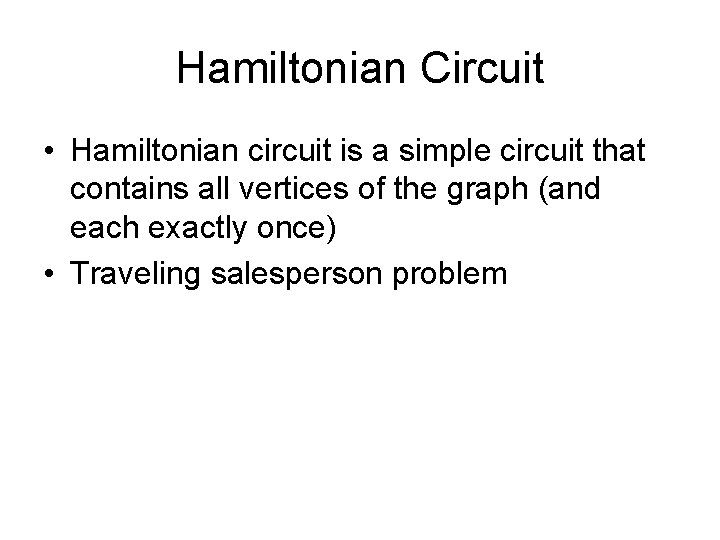
Hamiltonian Circuit • Hamiltonian circuit is a simple circuit that contains all vertices of the graph (and each exactly once) • Traveling salesperson problem
Rooted Trees • Rooted tree is a tree in which one vertex is distinguished and called a root • Level of a vertex is the number of edges between the vertex and the root • The height of a rooted tree is the maximum level of any vertex • Children, siblings and parent vertices in a rooted tree • Ancestor, descendant relationship between vertices
Exercise • If all edges in a graph have distinct weights, does this graph have a unique MST?
Binary Trees • Binary tree is a rooted tree where each internal vertex has at most two children: left and right. Left and right subtrees • Full binary tree • Representation of algebraic expressions • If T is a full binary tree with k internal vertices then T has a total of 2 k + 1 vertices and k + 1 of them are leaves • Any binary tree with t leaves and height h satisfies the following inequality: t 2 h