
Graphs Introduction n Graphs are a collection of
- Slides: 18
Graphs
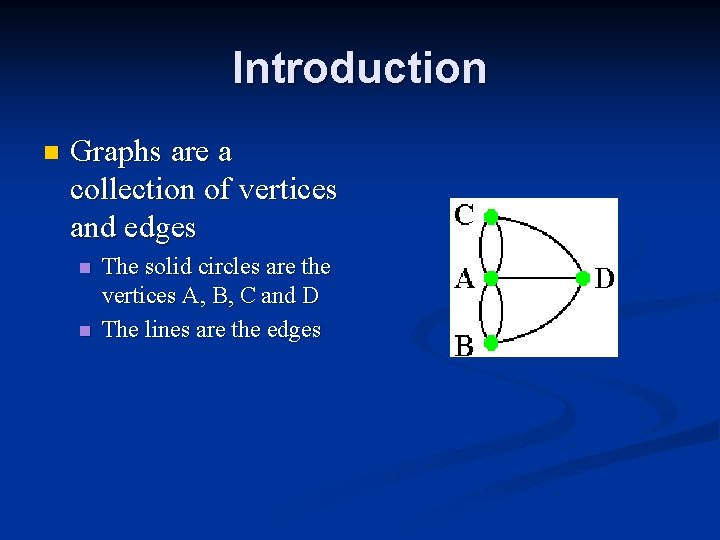
Introduction n Graphs are a collection of vertices and edges n n The solid circles are the vertices A, B, C and D The lines are the edges
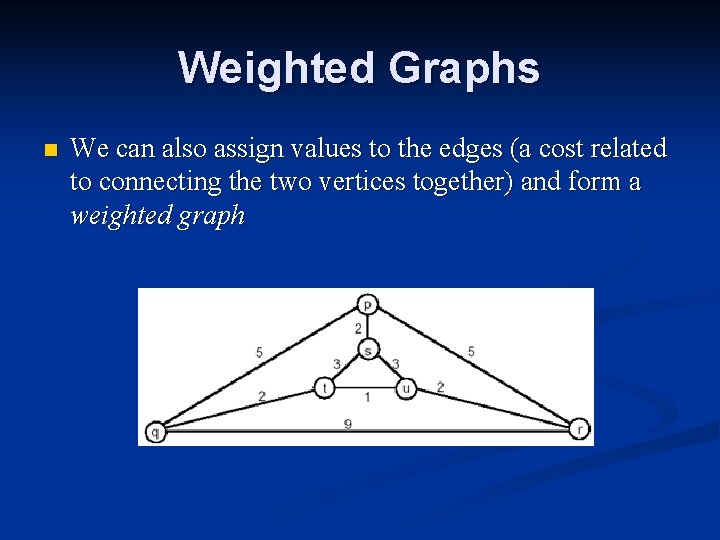
Weighted Graphs n We can also assign values to the edges (a cost related to connecting the two vertices together) and form a weighted graph
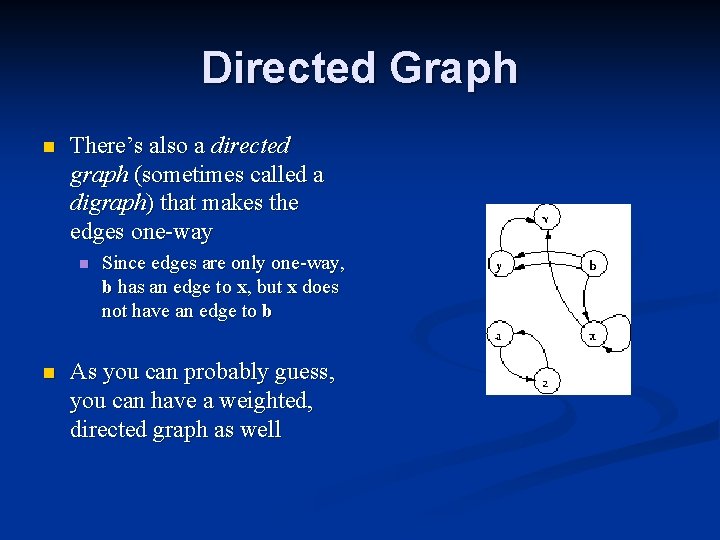
Directed Graph n There’s also a directed graph (sometimes called a digraph) that makes the edges one-way n n Since edges are only one-way, b has an edge to x, but x does not have an edge to b As you can probably guess, you can have a weighted, directed graph as well
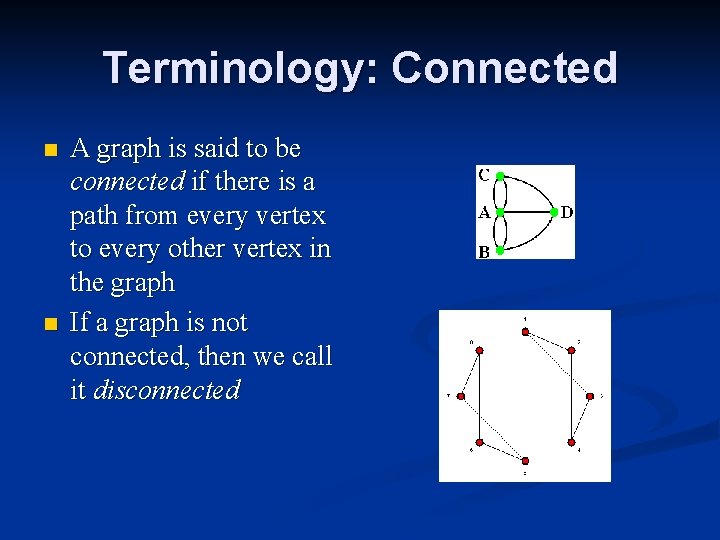
Terminology: Connected n n A graph is said to be connected if there is a path from every vertex to every other vertex in the graph If a graph is not connected, then we call it disconnected
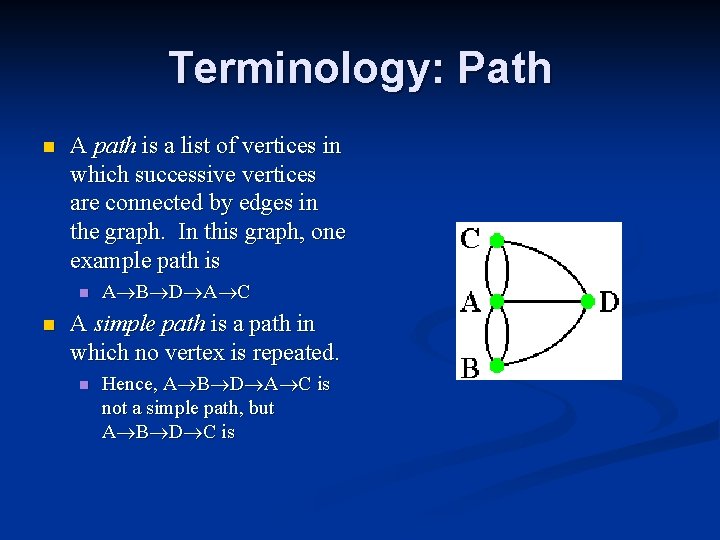
Terminology: Path n A path is a list of vertices in which successive vertices are connected by edges in the graph. In this graph, one example path is n n A B D A C A simple path is a path in which no vertex is repeated. n Hence, A B D A C is not a simple path, but A B D C is
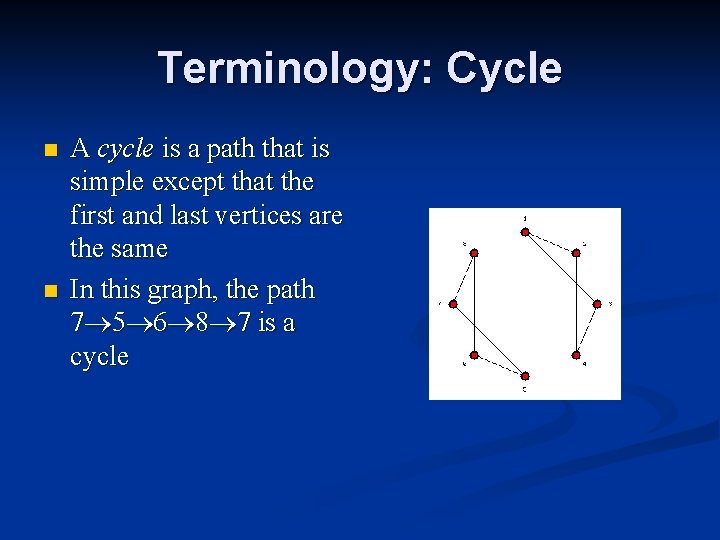
Terminology: Cycle n n A cycle is a path that is simple except that the first and last vertices are the same In this graph, the path 7 5 6 8 7 is a cycle
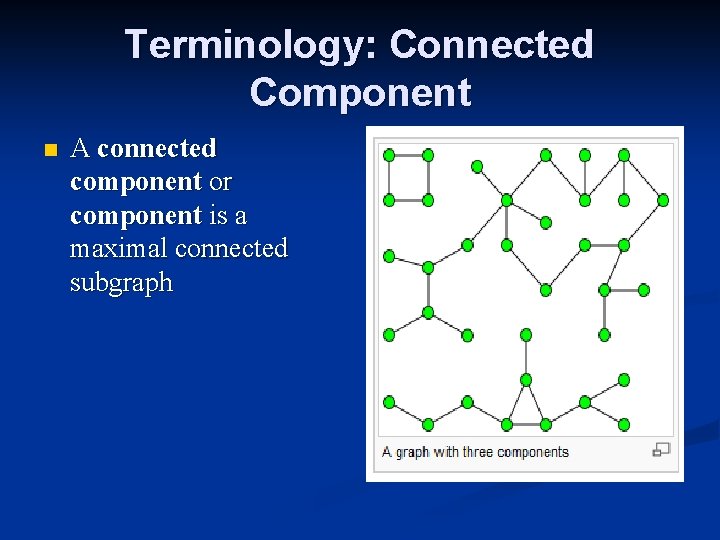
Terminology: Connected Component n A connected component or component is a maximal connected subgraph
Graph Representation Adjacency Matrix n Adjacency List n
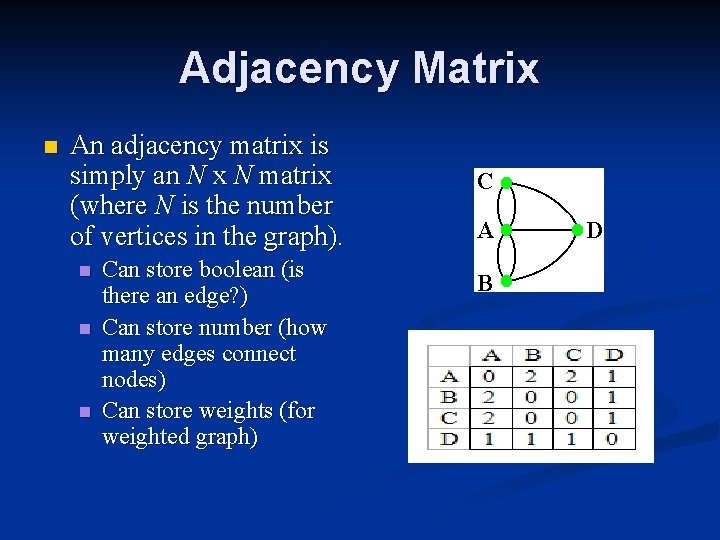
Adjacency Matrix n An adjacency matrix is simply an N x N matrix (where N is the number of vertices in the graph). n n n Can store boolean (is there an edge? ) Can store number (how many edges connect nodes) Can store weights (for weighted graph)
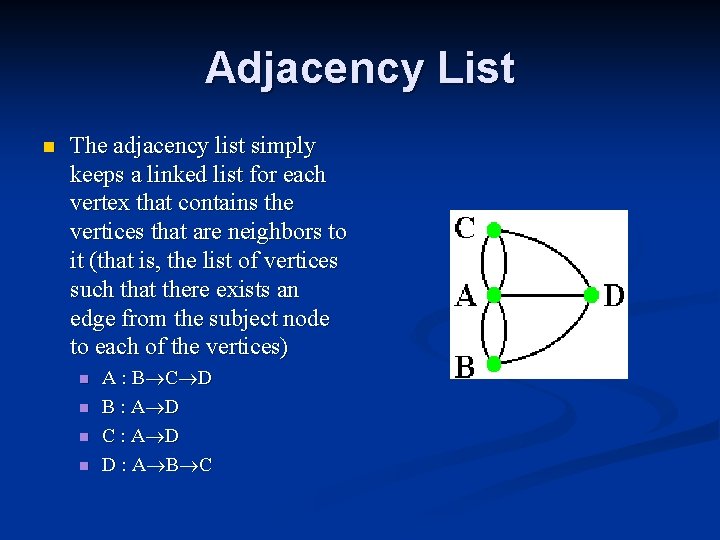
Adjacency List n The adjacency list simply keeps a linked list for each vertex that contains the vertices that are neighbors to it (that is, the list of vertices such that there exists an edge from the subject node to each of the vertices) n n A : B C D B : A D C : A D D : A B C
Motivation n Graphs are very useful for representing a large array of problems and for solving everyday “real world” problems, on which the contest loves to focus. n n n Map intersections to vertices and roads to edges, and now you have a representation to help you route fire trucks to fires. Map a network of computers and routers to vertices, physical connections to edges, and you have a way to find the minimum number of hops between two given computers. Map a set of rooms that need water to vertices, all combinations of distances between pairs of rooms to the edges, and then you can determine the smallest amount of pipe needed to connect all the rooms together. Map the buildings on the UCF campus to vertices, the sidewalks between the buildings to vertices, and then you’ll be able to find the shortest walking distance from the Computer Science Building to any other building. Many, many others!
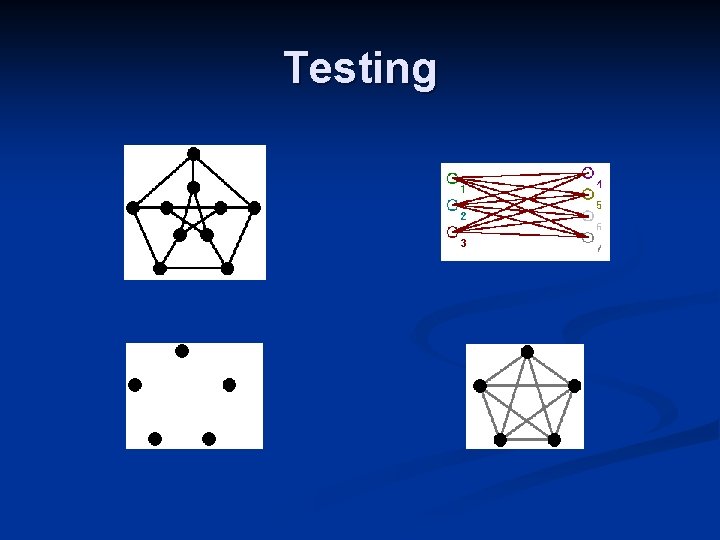
Testing
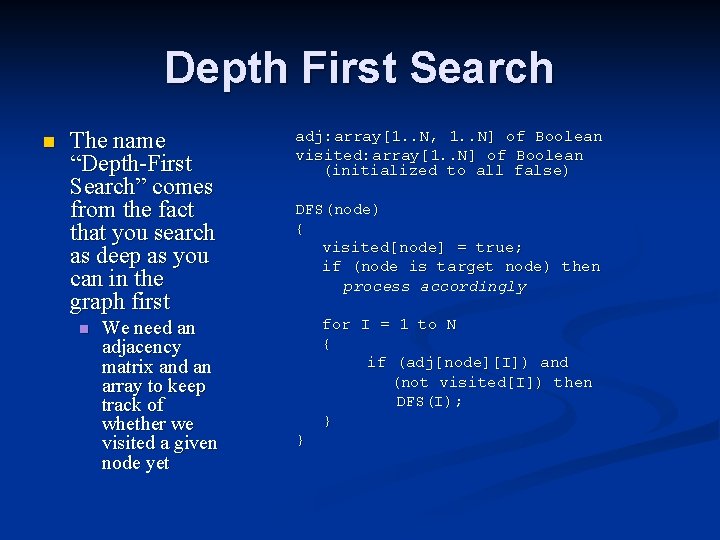
Depth First Search n The name “Depth-First Search” comes from the fact that you search as deep as you can in the graph first n We need an adjacency matrix and an array to keep track of whether we visited a given node yet adj: array[1. . N, 1. . N] of Boolean visited: array[1. . N] of Boolean (initialized to all false) DFS(node) { visited[node] = true; if (node is target node) then process accordingly for I = 1 to N { if (adj[node][I]) and (not visited[I]) then DFS(I); } }
DFS Motivation Most basic searching algorithm n Mazes n Path finding n Cycle detection n
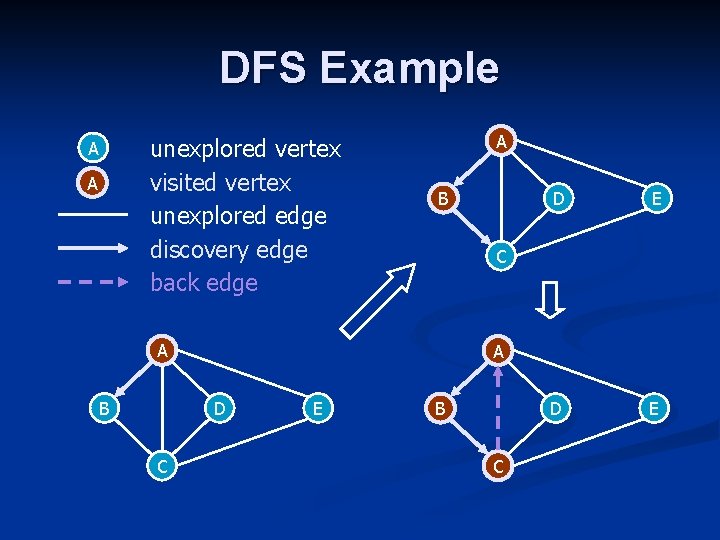
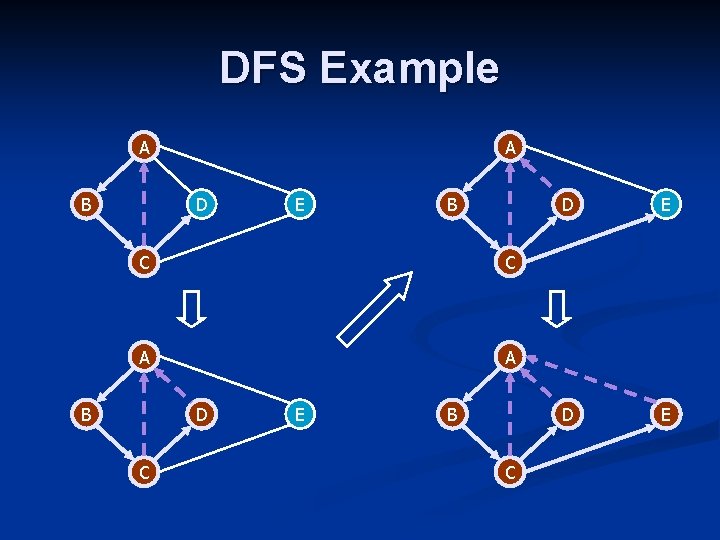
DFS Example unexplored vertex visited vertex unexplored edge discovery edge back edge A A A B D E A D C E C A B D E B C
DFS Example A B A D E B C C A A B D C E B C D E
Thanks! n Thanks for images and other information to: Wikipedia n Changhui (Charles) Yan n n http: //www. cs. usu. edu/~cyan/CS 5050/