
Graphs Graph definitions There are two kinds of
- Slides: 23
Graphs
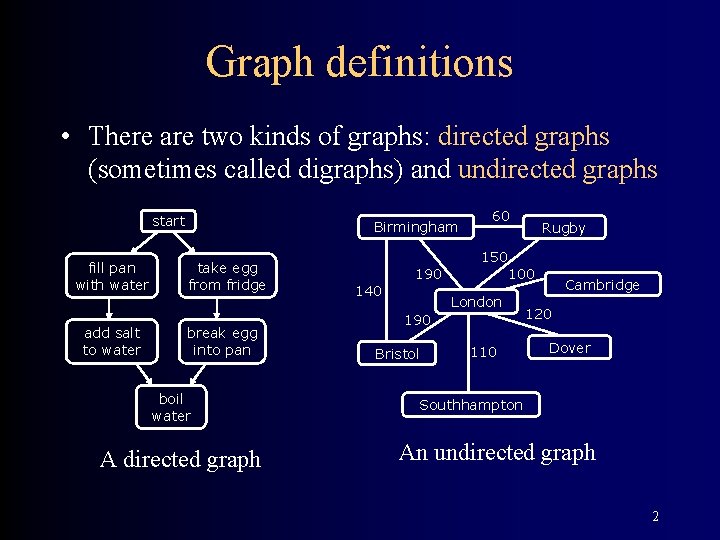
Graph definitions • There are two kinds of graphs: directed graphs (sometimes called digraphs) and undirected graphs start fill pan with water add salt to water Birmingham take egg from fridge break egg into pan boil water A directed graph 60 Rugby 150 190 140 100 London 190 Bristol 110 Cambridge 120 Dover Southhampton An undirected graph 2
Graph terminology I • A graph is a collection of nodes (or vertices, singular is vertex) and edges (or arcs) – Each node contains an element – Each edge connects two nodes together (or possibly the same node to itself) and may contain an edge attribute • A directed graph is one in which the edges have a direction • An undirected graph is one in which the edges do not have a direction – Note: Whether a graph is directed or undirected is a logical distinction—it describes how we think about the graph – Depending on the implementation, we may or may not be able to follow a directed edge in the “backwards” direction 3
Graph terminology II • The size of a graph is the number of nodes in it • The empty graph has size zero (no nodes) • If two nodes are connected by an edge, they are neighbors (and the nodes are adjacent to each other) • The degree of a node is the number of edges it has • For directed graphs, – If a directed edge goes from node S to node D, we call S the source and D the destination of the edge • The edge is an out-edge of S and an in-edge of D • S is a predecessor of D, and D is a successor of S – The in-degree of a node is the number of in-edges it has – The out-degree of a node is the number of out-edges it has 4
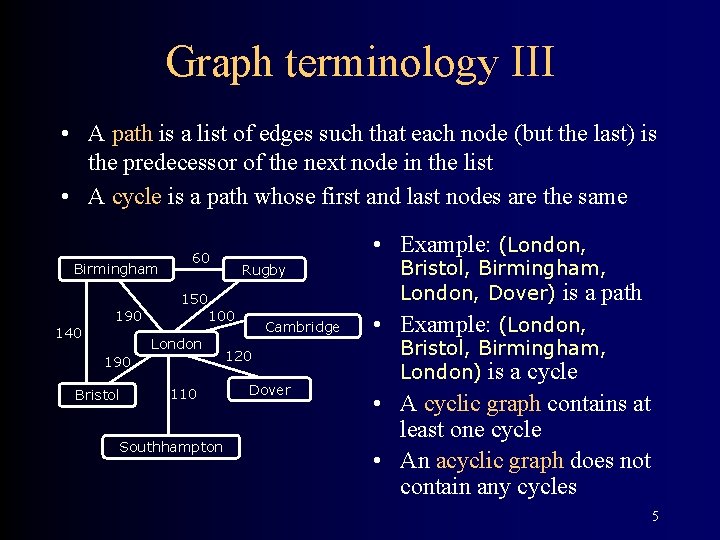
Graph terminology III • A path is a list of edges such that each node (but the last) is the predecessor of the next node in the list • A cycle is a path whose first and last nodes are the same Birmingham • Example: (London, 60 Rugby 150 190 140 100 London 190 Bristol 110 Southhampton Cambridge 120 Dover Bristol, Birmingham, London, Dover) is a path • Example: (London, Bristol, Birmingham, London) is a cycle • A cyclic graph contains at least one cycle • An acyclic graph does not contain any cycles 5
Graph terminology IV • An undirected graph is connected if there is a path from every node to every other node • A directed graph is strongly connected if there is a path from every node to every other node • A directed graph is weakly connected if the underlying undirected graph is connected • Node X is reachable from node Y if there is a path from Y to X • A subset of the nodes of the graph is a connected component (or just a component) if there is a path from every node in the subset to every other node in the subset 6
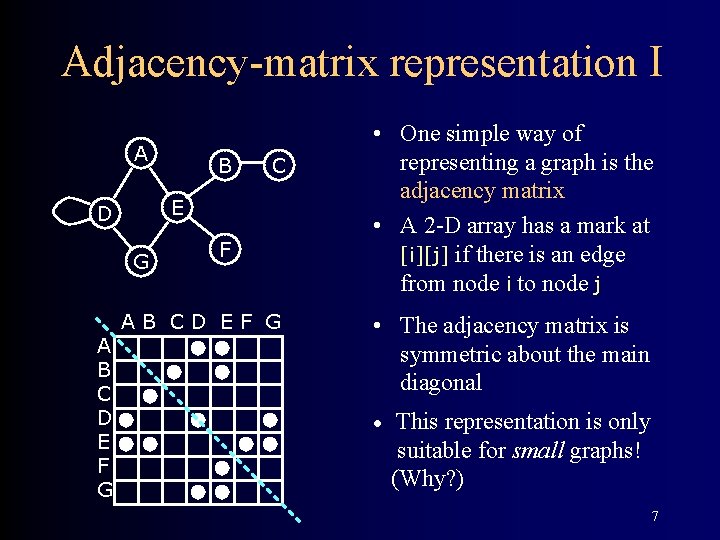
Adjacency-matrix representation I A C E D G A B C D E F G B F AB CD EF G • One simple way of representing a graph is the adjacency matrix • A 2 -D array has a mark at [i][j] if there is an edge from node i to node j • The adjacency matrix is symmetric about the main diagonal • This representation is only suitable for small graphs! (Why? ) 7
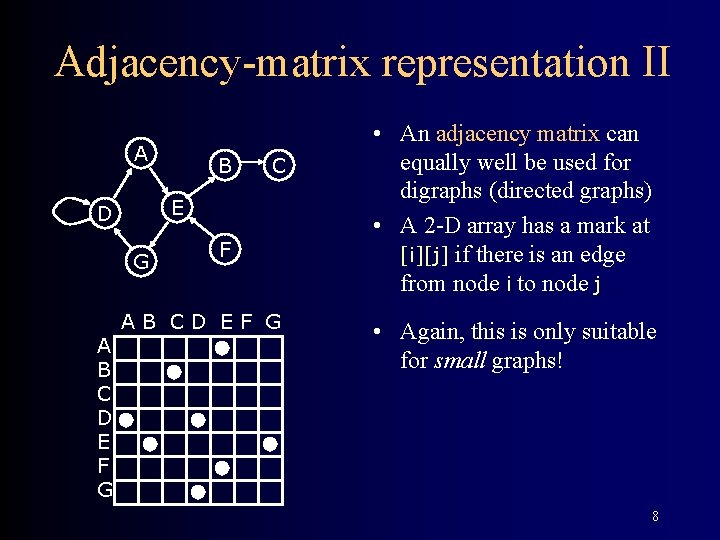
Adjacency-matrix representation II A C E D G A B C D E F G B F AB CD EF G • An adjacency matrix can equally well be used for digraphs (directed graphs) • A 2 -D array has a mark at [i][j] if there is an edge from node i to node j • Again, this is only suitable for small graphs! 8
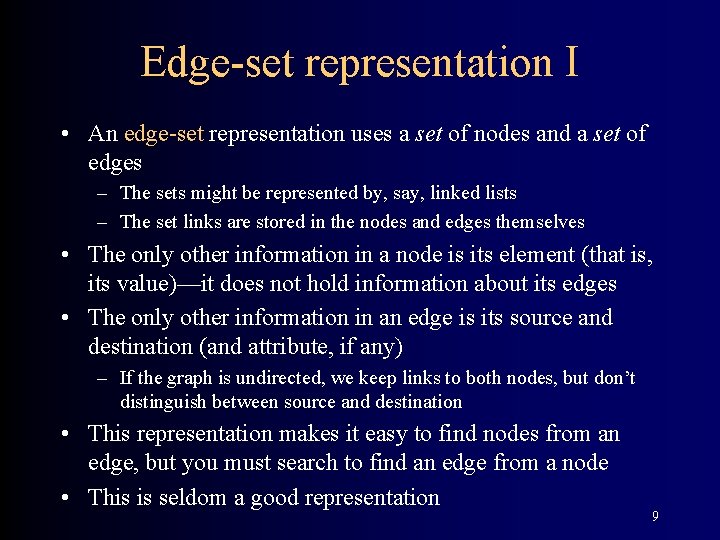
Edge-set representation I • An edge-set representation uses a set of nodes and a set of edges – The sets might be represented by, say, linked lists – The set links are stored in the nodes and edges themselves • The only other information in a node is its element (that is, its value)—it does not hold information about its edges • The only other information in an edge is its source and destination (and attribute, if any) – If the graph is undirected, we keep links to both nodes, but don’t distinguish between source and destination • This representation makes it easy to find nodes from an edge, but you must search to find an edge from a node • This is seldom a good representation 9
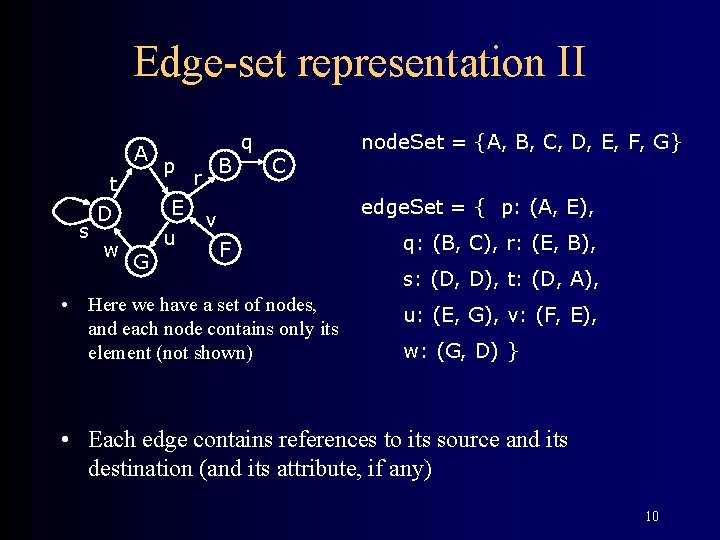
Edge-set representation II A s t D w p E G u B r q C node. Set = {A, B, C, D, E, F, G} edge. Set = { p: (A, E), v F • Here we have a set of nodes, and each node contains only its element (not shown) q: (B, C), r: (E, B), s: (D, D), t: (D, A), u: (E, G), v: (F, E), w: (G, D) } • Each edge contains references to its source and its destination (and its attribute, if any) 10
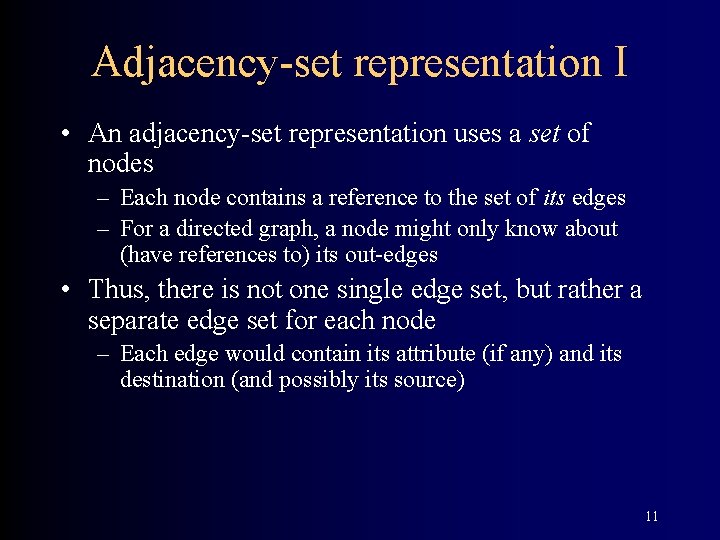
Adjacency-set representation I • An adjacency-set representation uses a set of nodes – Each node contains a reference to the set of its edges – For a directed graph, a node might only know about (have references to) its out-edges • Thus, there is not one single edge set, but rather a separate edge set for each node – Each edge would contain its attribute (if any) and its destination (and possibly its source) 11
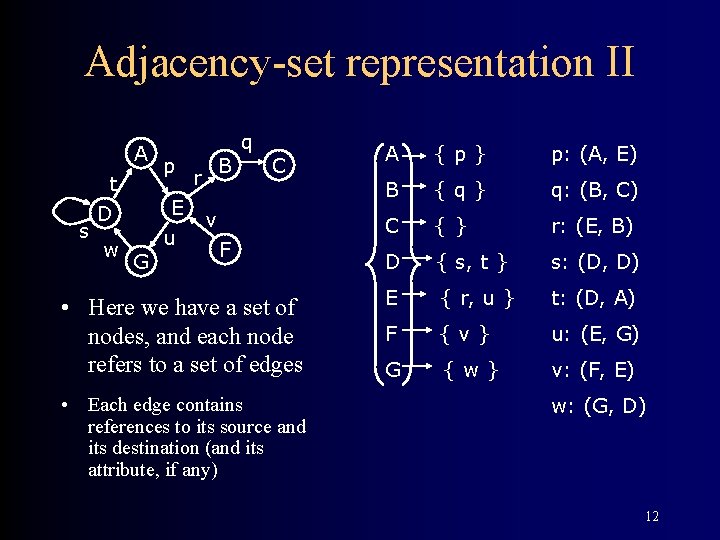
Adjacency-set representation II A s t D w p E G u B r q C v F • Here we have a set of nodes, and each node refers to a set of edges • Each edge contains references to its source and its destination (and its attribute, if any) A {p} p: (A, E) B {q} q: (B, C) C {} r: (E, B) D { s, t } s: (D, D) E { r, u } t: (D, A) F {v} u: (E, G) G {w} v: (F, E) w: (G, D) 12
Adjacency-set representation III • If the edges have no associated attribute, there is no need for a separate Edge class – Instead, each node can refer to a set of its neighbors – In this representation, the edges would be implicit in the connections between nodes, not a separate data structure • For an undirected graph, the node would have references to all the nodes adjacent to it • For a directed graph, the node might have: – references to all the nodes adjacent to it, or – references to only those adjacent nodes connected by an out-edge from this node 13
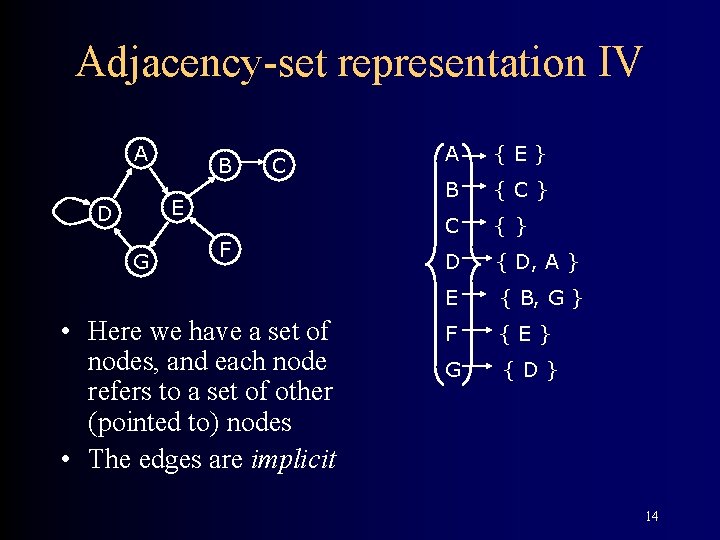
Adjacency-set representation IV A B C E D G F • Here we have a set of nodes, and each node refers to a set of other (pointed to) nodes • The edges are implicit A {E} B {C} C {} D { D, A } E { B, G } F {E} G {D} 14
Searching a graph • With certain modifications, any tree search technique can be applied to a graph – This includes depth-first, breadth-first, depth-first iterative deepening, and other types of searches • The difference is that a graph may have cycles – We don’t want to search around in a cycle • To avoid getting caught in a cycle, we must keep track of which nodes we have already explored • There are two basic techniques for this: – Keep a set of already explored nodes, or – Mark the node itself as having been explored 15
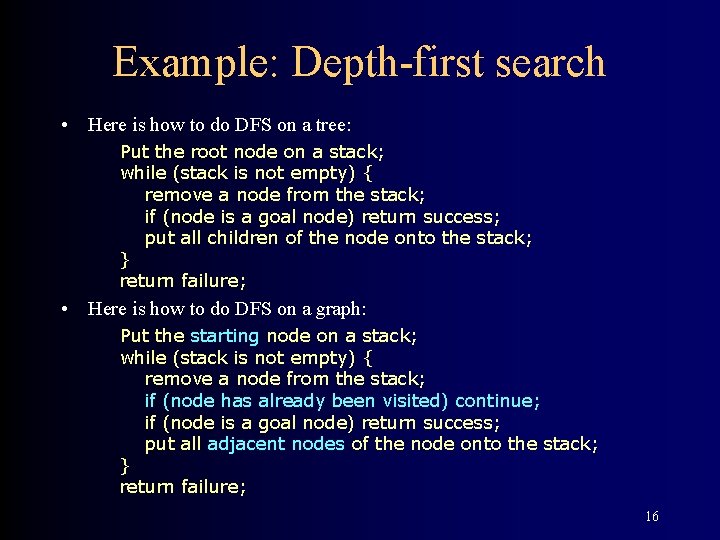
Example: Depth-first search • Here is how to do DFS on a tree: Put the root node on a stack; while (stack is not empty) { remove a node from the stack; if (node is a goal node) return success; put all children of the node onto the stack; } return failure; • Here is how to do DFS on a graph: Put the starting node on a stack; while (stack is not empty) { remove a node from the stack; if (node has already been visited) continue; if (node is a goal node) return success; put all adjacent nodes of the node onto the stack; } return failure; 16
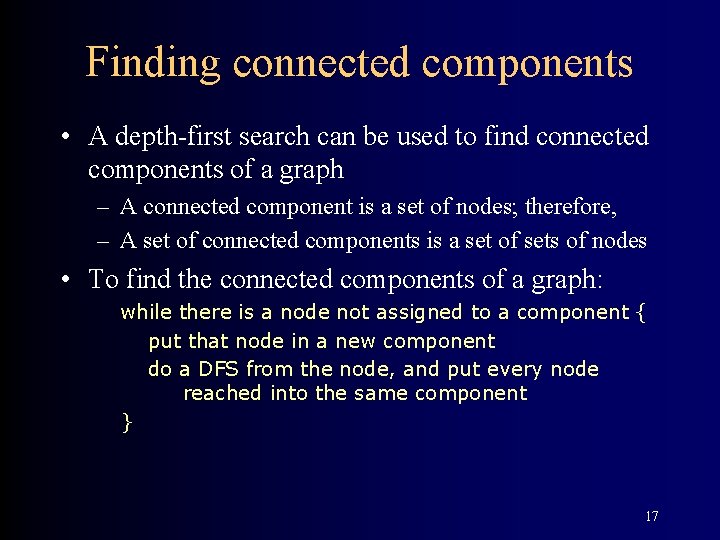
Finding connected components • A depth-first search can be used to find connected components of a graph – A connected component is a set of nodes; therefore, – A set of connected components is a set of sets of nodes • To find the connected components of a graph: while there is a node not assigned to a component { put that node in a new component do a DFS from the node, and put every node reached into the same component } 17
Graph applications • Graphs can be used for: – – – Finding a route to drive from one city to another Finding connecting flights from one city to another Determining least-cost highway connections Designing optimal connections on a computer chip Implementing automata Implementing compilers Doing garbage collection Representing family histories Doing similarity testing (e. g. for a dating service) Pert charts Playing games 18
Shortest-path • Suppose we want to find the shortest path from node X to node Y • It turns out that, in order to do this, we need to find the shortest path from X to all other nodes – Why? – If we don’t know the shortest path from X to Z, we might overlook a shorter path from X to Y that contains Z • Dijkstra’s Algorithm finds the shortest path from a given node to all other reachable nodes 19
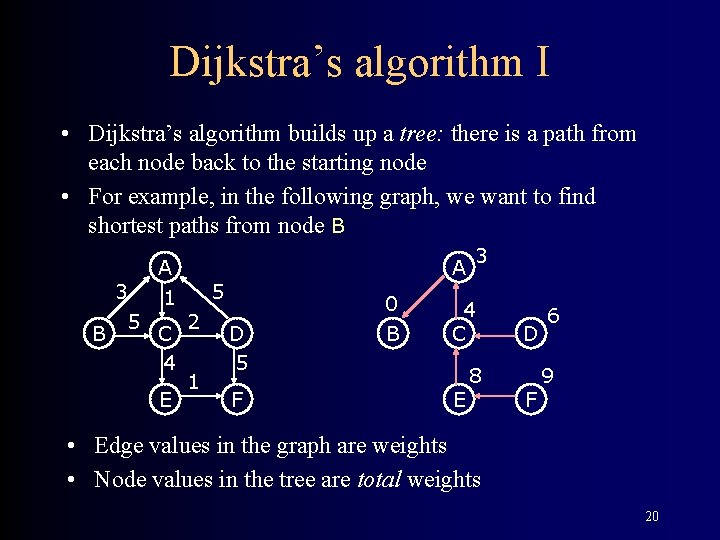
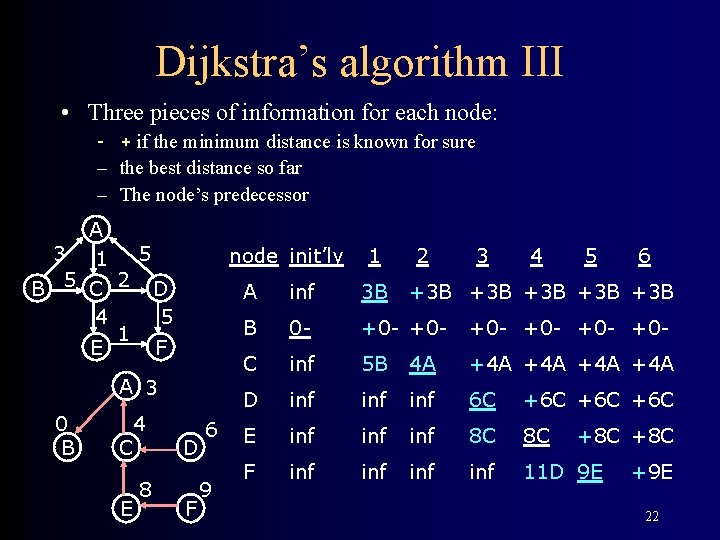
Dijkstra’s algorithm I • Dijkstra’s algorithm builds up a tree: there is a path from each node back to the starting node • For example, in the following graph, we want to find shortest paths from node B A B 3 5 1 C 4 E A 5 2 1 D 5 F 0 B 3 4 C E 8 D F 6 9 • Edge values in the graph are weights • Node values in the tree are total weights 20
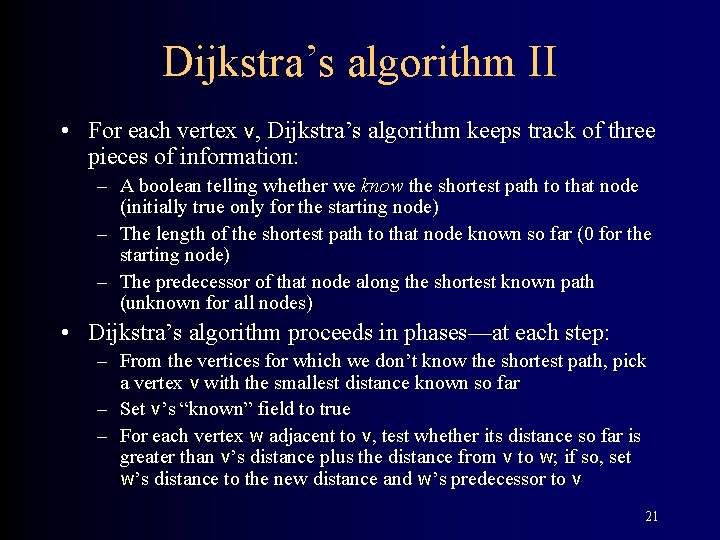
Dijkstra’s algorithm II • For each vertex v, Dijkstra’s algorithm keeps track of three pieces of information: – A boolean telling whether we know the shortest path to that node (initially true only for the starting node) – The length of the shortest path to that node known so far (0 for the starting node) – The predecessor of that node along the shortest known path (unknown for all nodes) • Dijkstra’s algorithm proceeds in phases—at each step: – From the vertices for which we don’t know the shortest path, pick a vertex v with the smallest distance known so far – Set v’s “known” field to true – For each vertex w adjacent to v, test whether its distance so far is greater than v’s distance plus the distance from v to w; if so, set w’s distance to the new distance and w’s predecessor to v 21
Dijkstra’s algorithm III • Three pieces of information for each node: – + if the minimum distance is known for sure – the best distance so far – The node’s predecessor A 3 5 1 B 5 C 2 D 4 5 1 E F node init’ly A 3 0 B 4 C E 8 D F 6 9 1 2 3 4 5 6 A inf 3 B +3 B +3 B +3 B B 0 - +0 - +0 - +0 - C inf 5 B 4 A +4 A +4 A D inf inf 6 C +6 C +6 C E inf inf 8 C 8 C F inf inf 11 D 9 E +8 C +9 E 22
The End 23