
GRAPHS CSC 172 SPRING 2002 LECTURE 25 Structure



![Adjacency Matrices Node names must be integers [0…MAX-1] M[k][j]= true iff there is an](https://slidetodoc.com/presentation_image_h2/3cc16e04141c2a6d15a144d5a5181e57/image-14.jpg "Adjacency Matrices Node names must be integers [0…MAX-1] M[k][j]= true iff there is an")







- Slides: 34
GRAPHS CSC 172 SPRING 2002 LECTURE 25
Structure of the Internet NAP Europe Backbone 1 NAP Backbone 4, 5, N Backbone 2 NAP Backbone 3 Japan Regional A NAP Australia Regional B SOURCE: CISCO SYSTEMS
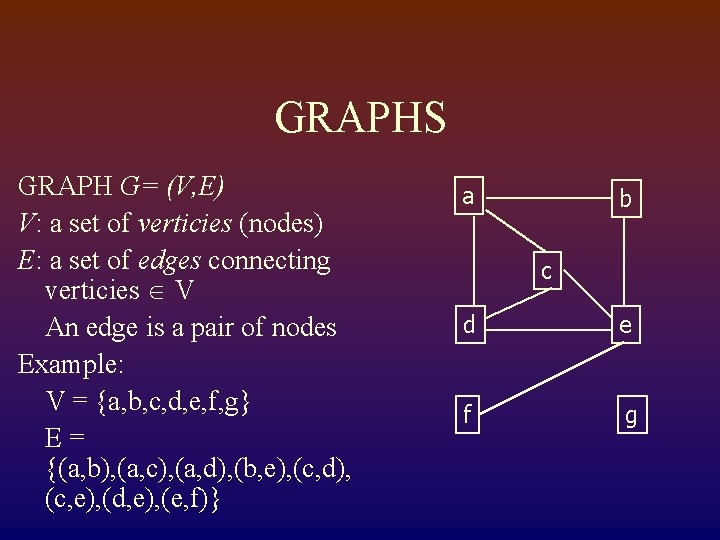
GRAPHS GRAPH G= (V, E) V: a set of verticies (nodes) E: a set of edges connecting verticies V An edge is a pair of nodes Example: V = {a, b, c, d, e, f, g} E= {(a, b), (a, c), (a, d), (b, e), (c, d), (c, e), (d, e), (e, f)} a b c d e f g
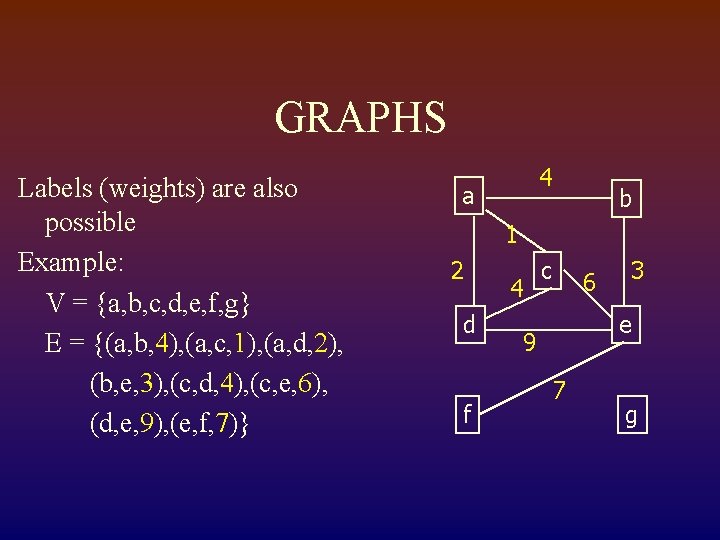
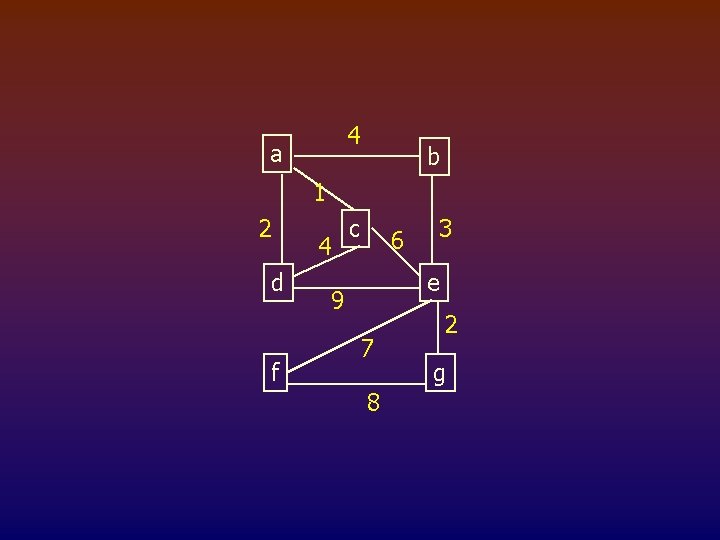
GRAPHS Labels (weights) are also possible Example: V = {a, b, c, d, e, f, g} E = {(a, b, 4), (a, c, 1), (a, d, 2), (b, e, 3), (c, d, 4), (c, e, 6), (d, e, 9), (e, f, 7)} 4 a b 1 2 d f 4 c 6 3 e 9 7 g
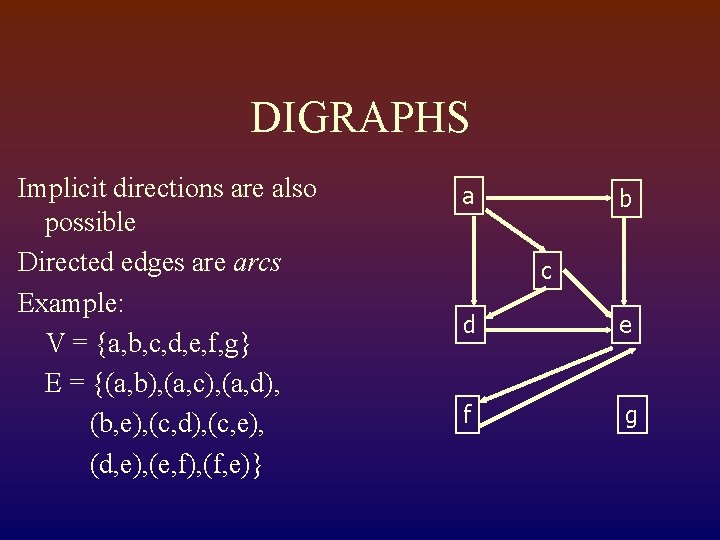
DIGRAPHS Implicit directions are also possible Directed edges are arcs Example: V = {a, b, c, d, e, f, g} E = {(a, b), (a, c), (a, d), (b, e), (c, d), (c, e), (d, e), (e, f), (f, e)} a b c d e f g
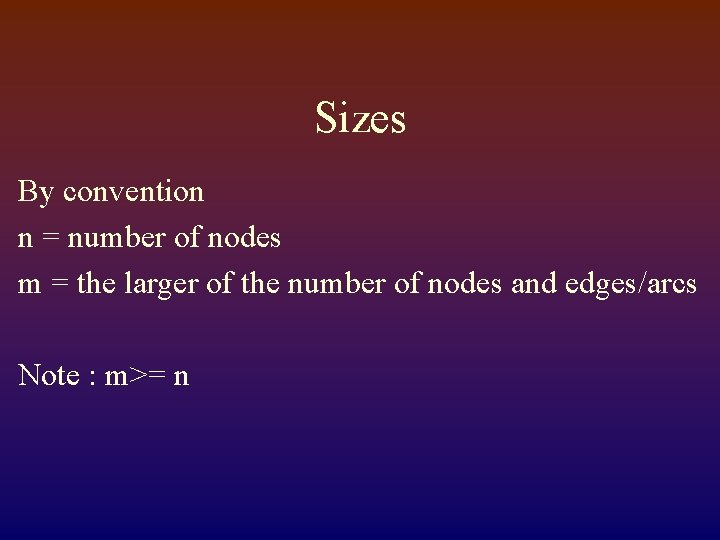
Sizes By convention n = number of nodes m = the larger of the number of nodes and edges/arcs Note : m>= n
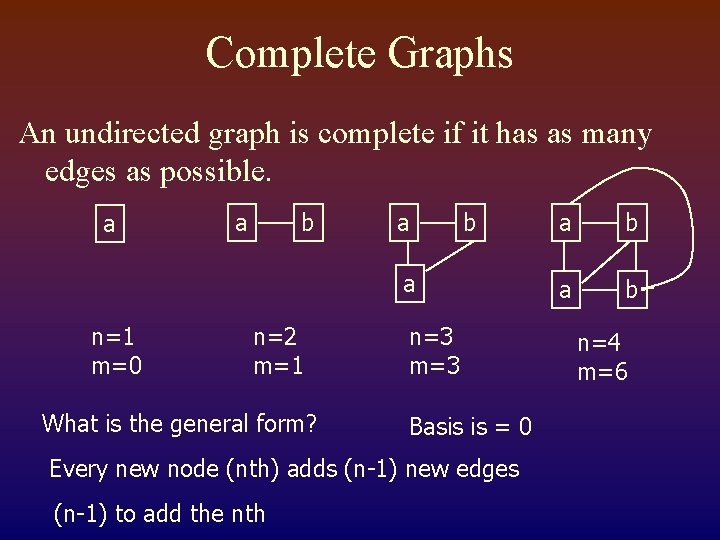
Complete Graphs An undirected graph is complete if it has as many edges as possible. a a b a n=1 m=0 n=2 m=1 What is the general form? n=3 m=3 Basis is = 0 Every new node (nth) adds (n-1) new edges (n-1) to add the nth a b n=4 m=6
In general
Paths In directed graphs, sequence of nodes with arcs from each node to the next. In an undirected graph: sequence of nodes with an edge between two consecutive nodes Length of path – number of edges/arcs If edges/arcs are labeled by numbers (weights) we can sum the labels along a path to get a distance.
Cycles Directed graph: path that begins and ends at the same node Simple cycle: no repeats except the ends The same cycle has many paths representing it, since the beginning/end point may be any node on the cycle Undirected graph Simple cycle = sequence of 3 or more nodes with the same beginning/end, but no other repetigions
Representations of Graphs Adjacency List Adjacency Matrices
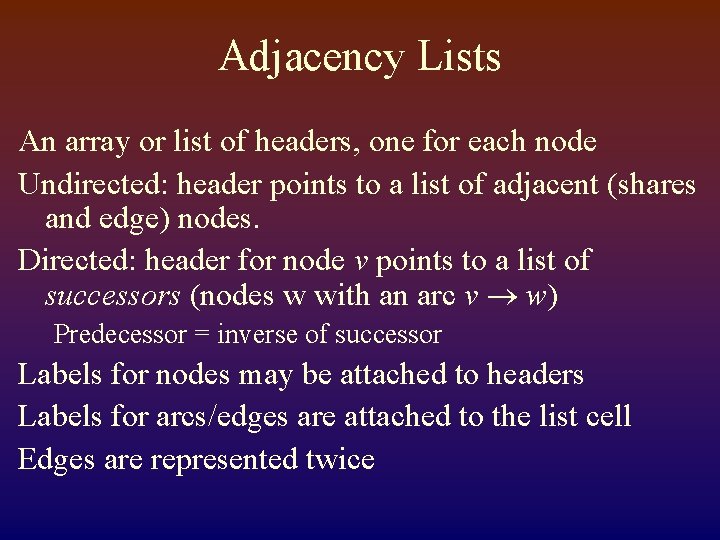
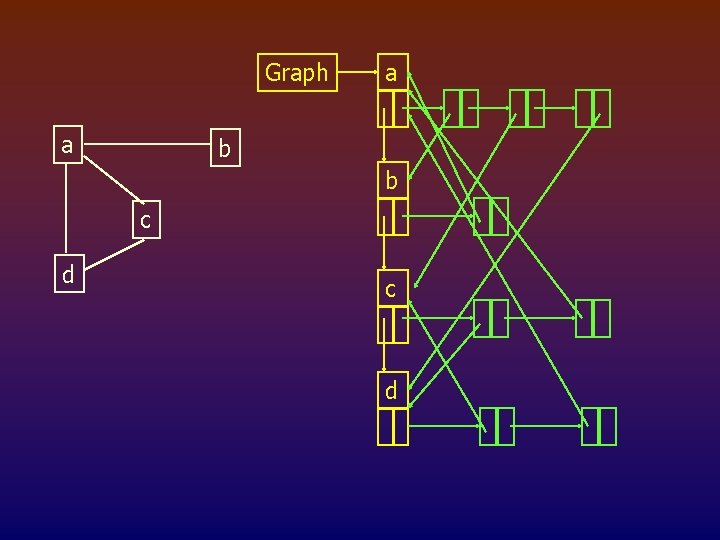
Adjacency Lists An array or list of headers, one for each node Undirected: header points to a list of adjacent (shares and edge) nodes. Directed: header for node v points to a list of successors (nodes w with an arc v w) Predecessor = inverse of successor Labels for nodes may be attached to headers Labels for arcs/edges are attached to the list cell Edges are represented twice
Graph a a b b c d
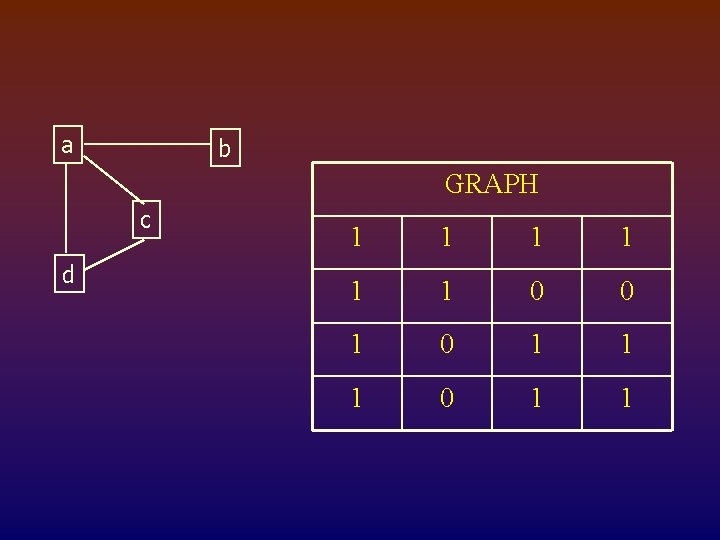
Adjacency Matrices Node names must be integers [0…MAX-1] M[k][j]= true iff there is an edge between nodes k and j (arc k j for digraphs) Node labels in separate array Edge/arc labels can be values M[k][j] Needs a special label that says “no edge”
a b GRAPH c d 1 1 1 0 0 1 1 1 0 1 1
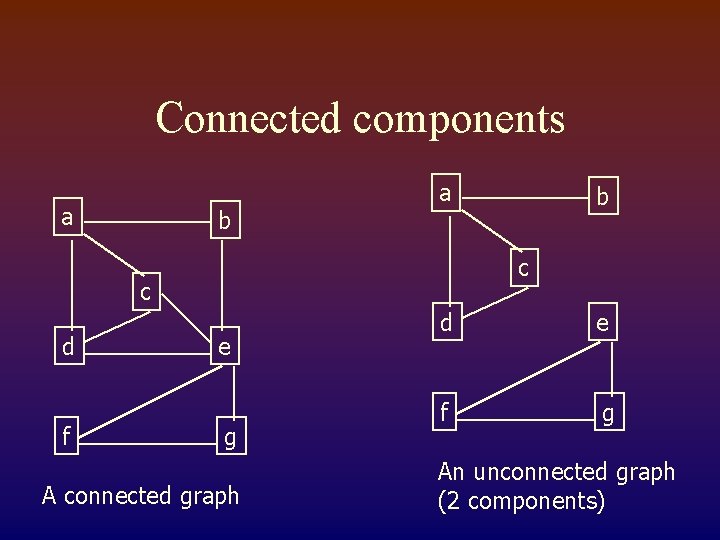
Connected Components
Connected components a b a c c d f b e g A connected graph d e f g An unconnected graph (2 components)
Why Connected Components? Silicon “chips” are built from millions of rectangles on multiple layers of silicon Certain layers connect electrically Nodes = rectangles CC = electrical elements all on one current Deducing electrical ements is essential for simulation (testing) of the design
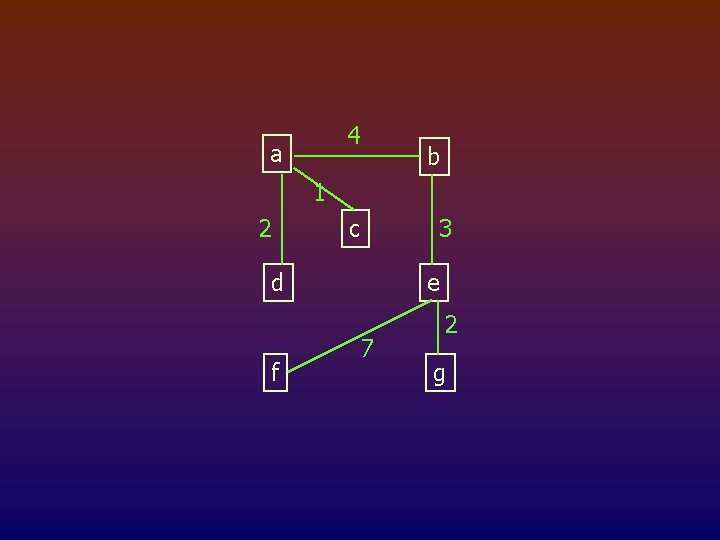
Minimum-Weight Spanning Trees Attach a numerical label to the edges Find a set of edges of minimum total weight that connect (via some path) every connectable pair of nodes To represent Connected Components we can have a tree
4 a b 1 2 d f 4 c 6 3 e 9 7 8 2 g
4 a b 1 2 d f 4 c 6 3 e 9 7 8 2 g
4 a b 1 2 c 3 d f e 7 2 g
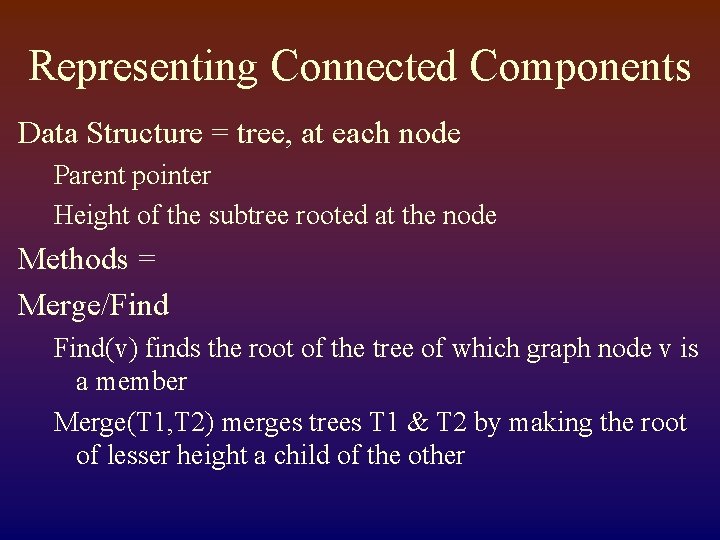
Representing Connected Components Data Structure = tree, at each node Parent pointer Height of the subtree rooted at the node Methods = Merge/Find(v) finds the root of the tree of which graph node v is a member Merge(T 1, T 2) merges trees T 1 & T 2 by making the root of lesser height a child of the other
Connected Component Algorithm 1. 2. Start with each graph node in a tree by itself Look at the edges in some order If edge {u, v} has ends in different trees (use find(u) & find(v)) then merge the trees Once we have considered all edges, each remaining tree will be one CC
Run Time Analysis Every time a node finds itself on a tree of greater height due to a merge, the tree also has at least twice as many nodes as its former tree Tree paths never get longer than log 2 n If we consider each of m edges in O(log n) time we get O(m log n) Merging is O(1)
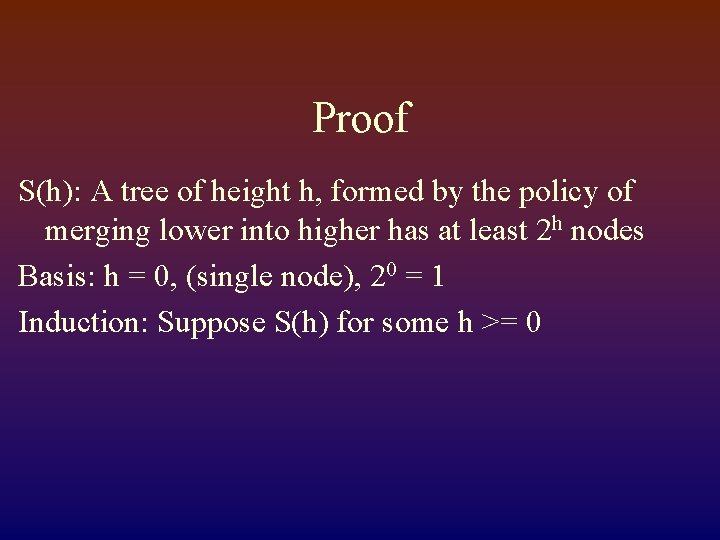
Proof S(h): A tree of height h, formed by the policy of merging lower into higher has at least 2 h nodes Basis: h = 0, (single node), 20 = 1 Induction: Suppose S(h) for some h >= 0
Consider a tree of height h+1 t 2 Each have height of At least h t 1 BTIH: T 1 & T 2 have at least 2 h nodes, each 2 h + 2 h = 2 h+1
Kruskal’s Algorithm An example of a “greedy” algorithm “do what seems best at the moment” Use the merge/find MWST algorithm on the edges in ascending order O(m log m) Since m <= n 2, log m <= 2 log n, so O(m log n) time
Traveling Salesman Problem Find a simple cycle, visiting all nodes, of minimum weight Does “greedy” work?
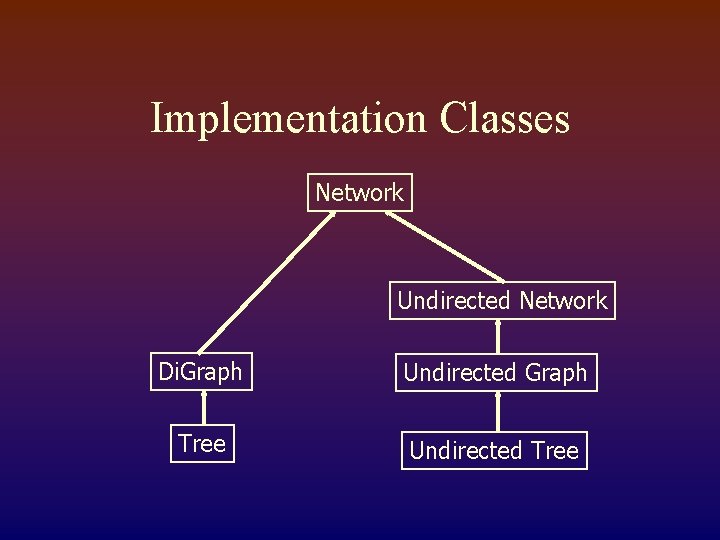
Implementation Classes Network Undirected Network Di. Graph Undirected Graph Tree Undirected Tree
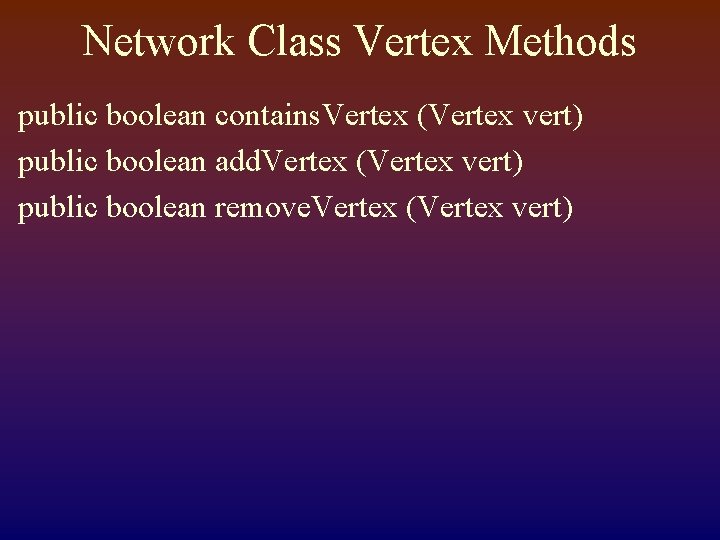
Network Class Vertex Methods public boolean contains. Vertex (Vertex vert) public boolean add. Vertex (Vertex vert) public boolean remove. Vertex (Vertex vert)
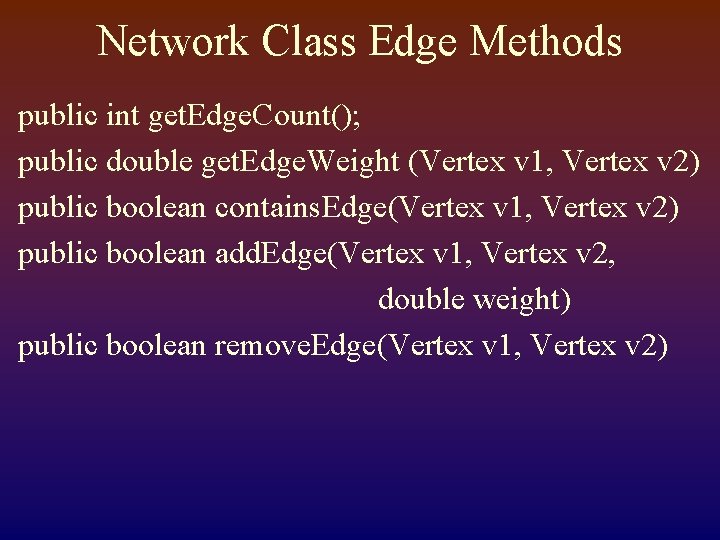
Network Class Edge Methods public int get. Edge. Count(); public double get. Edge. Weight (Vertex v 1, Vertex v 2) public boolean contains. Edge(Vertex v 1, Vertex v 2) public boolean add. Edge(Vertex v 1, Vertex v 2, double weight) public boolean remove. Edge(Vertex v 1, Vertex v 2)
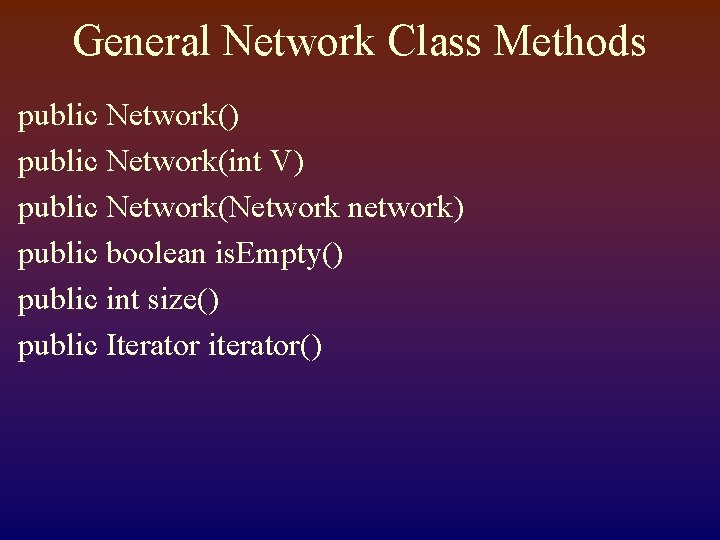
General Network Class Methods public Network() public Network(int V) public Network(Network network) public boolean is. Empty() public int size() public Iterator iterator()