
Graphs and Topology Yao Zhao Background of Graph

Graphs and Topology Yao Zhao
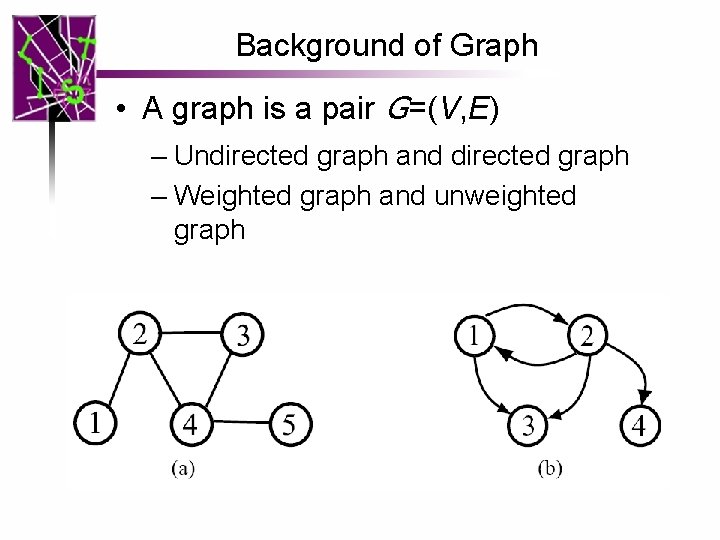
Background of Graph • A graph is a pair G=(V, E) – Undirected graph and directed graph – Weighted graph and unweighted graph
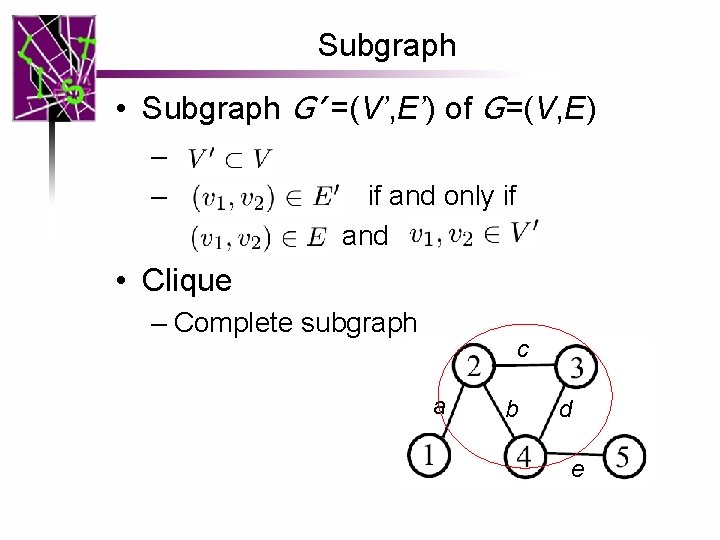
Subgraph • Subgraph G’ =(V’, E’) of G=(V, E) – – if and only if and • Clique – Complete subgraph c a b d e
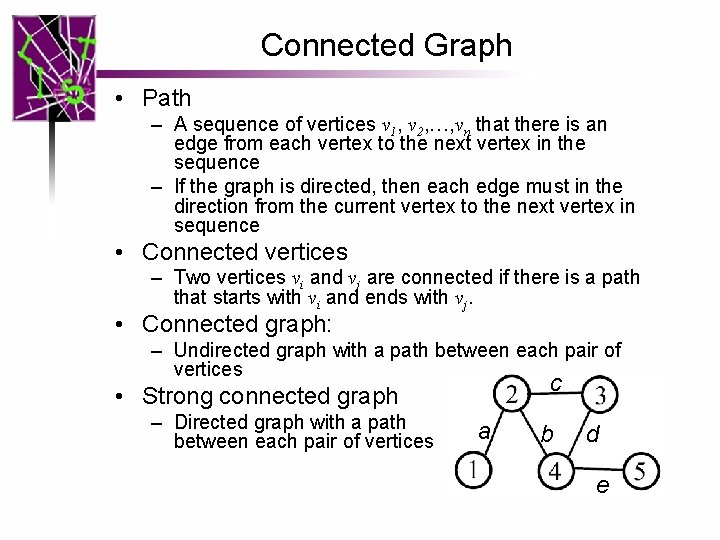
Connected Graph • Path – A sequence of vertices v 1, v 2, …, vn that there is an edge from each vertex to the next vertex in the sequence – If the graph is directed, then each edge must in the direction from the current vertex to the next vertex in sequence • Connected vertices – Two vertices vi and vj are connected if there is a path that starts with vi and ends with vj. • Connected graph: – Undirected graph with a path between each pair of vertices c • Strong connected graph – Directed graph with a path between each pair of vertices a b d e
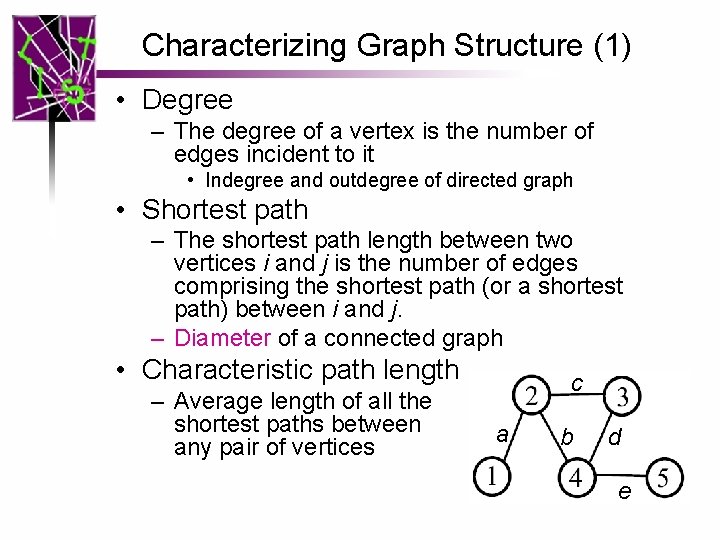
Characterizing Graph Structure (1) • Degree – The degree of a vertex is the number of edges incident to it • Indegree and outdegree of directed graph • Shortest path – The shortest path length between two vertices i and j is the number of edges comprising the shortest path (or a shortest path) between i and j. – Diameter of a connected graph • Characteristic path length – Average length of all the shortest paths between any pair of vertices c a b d e
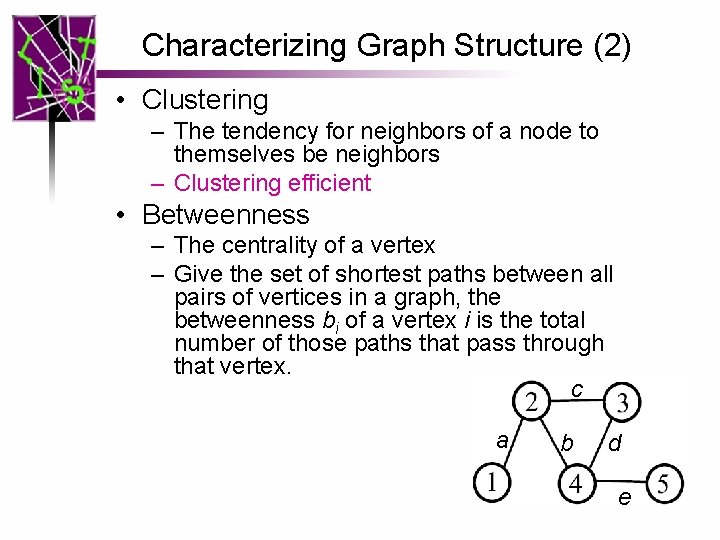
Characterizing Graph Structure (2) • Clustering – The tendency for neighbors of a node to themselves be neighbors – Clustering efficient • Betweenness – The centrality of a vertex – Give the set of shortest paths between all pairs of vertices in a graph, the betweenness bi of a vertex i is the total number of those paths that pass through that vertex. c a b d e
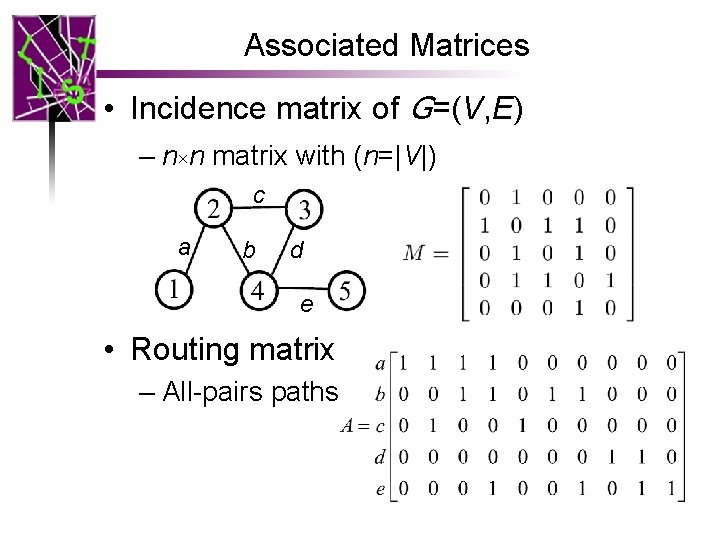
Associated Matrices • Incidence matrix of G=(V, E) – n×n matrix with (n=|V|) c a b d e • Routing matrix – All-pairs paths
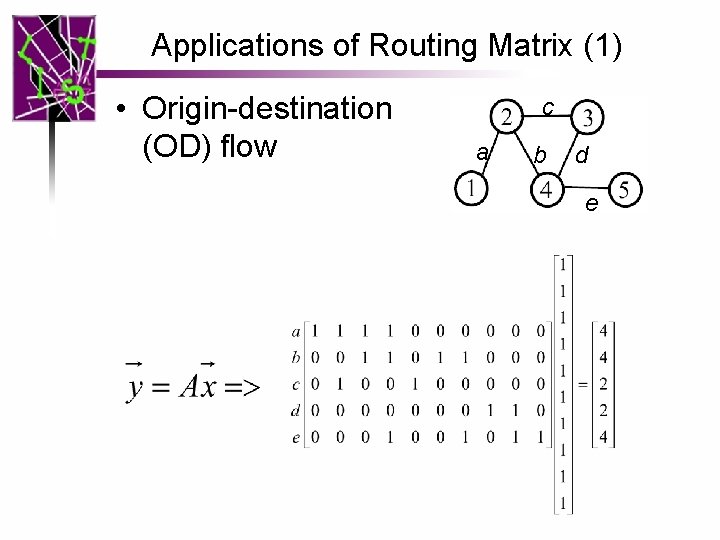
Applications of Routing Matrix (1) • Origin-destination (OD) flow c a b d e
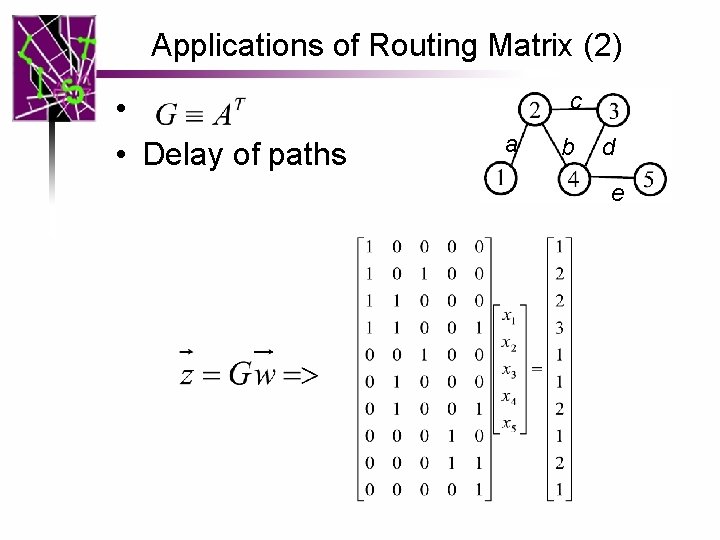
Applications of Routing Matrix (2) • • Delay of paths c a b d e
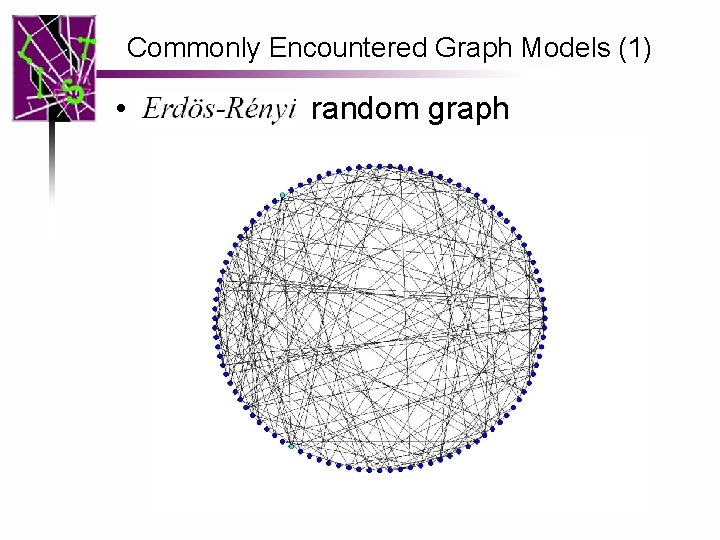
Commonly Encountered Graph Models (1) • random graph – GN, p • N vertices, (N 2 -N)/2 possible edges • Each edge is present with probability of p independently • Expected number of edges: • Expected vertex degree (Poisson distribution)
Commonly Encountered Graph Models (2) • Generalized random graph – Given fixed degree sequence {di, i=1, …, N} – Each degree di is assigned to one of the N vertices – Edge are constructed randomly to satisfy the degree of each vertex – Self-loop and duplicate links may occur
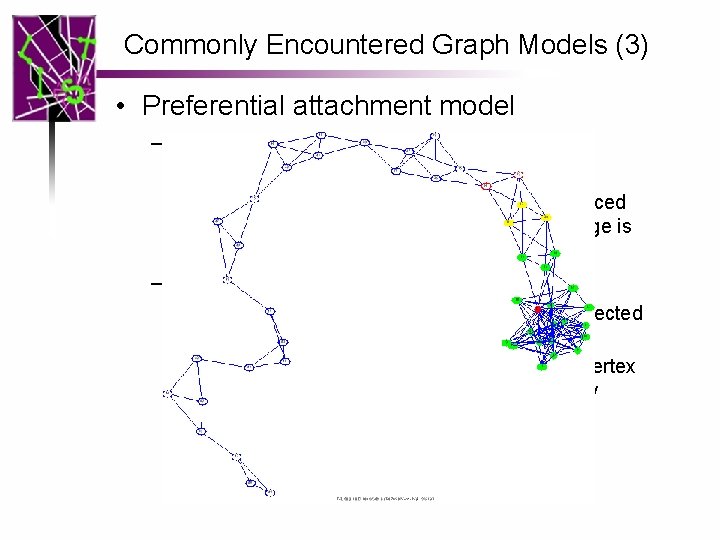
Commonly Encountered Graph Models (3) • Preferential attachment model – Ideas: • Growing network model • The addition of edges to the graph is influenced by the degree distribution at the time the edge is added – Implementation • The graph starts with a small set of m 0 connected vertices • For each added edge, the choice of which vertex to connect is made randomly with probability proportional to di • E. g. power law distribution of the degree
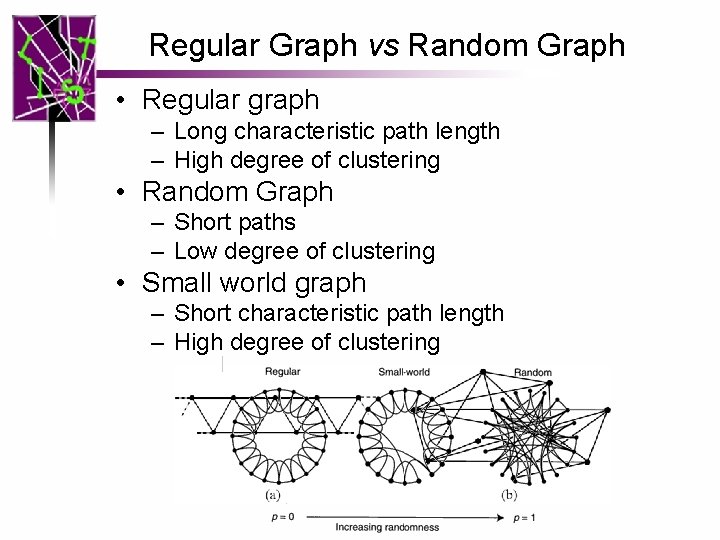
Regular Graph vs Random Graph • Regular graph – Long characteristic path length – High degree of clustering • Random Graph – Short paths – Low degree of clustering • Small world graph – Short characteristic path length – High degree of clustering
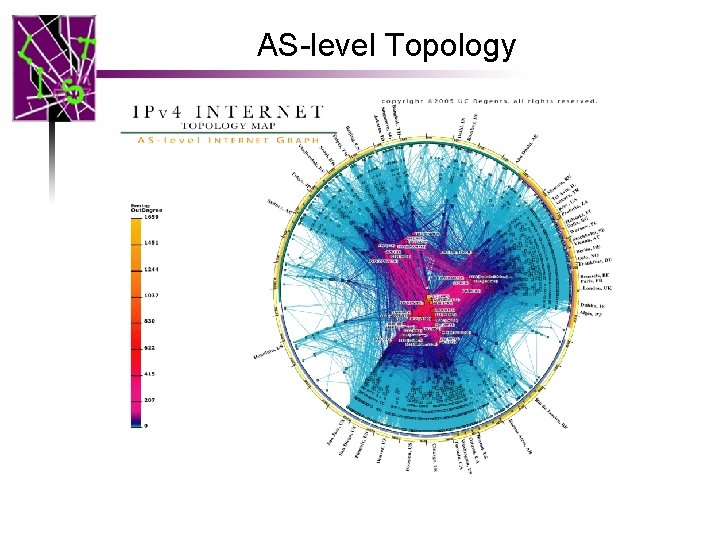
AS-level Topology
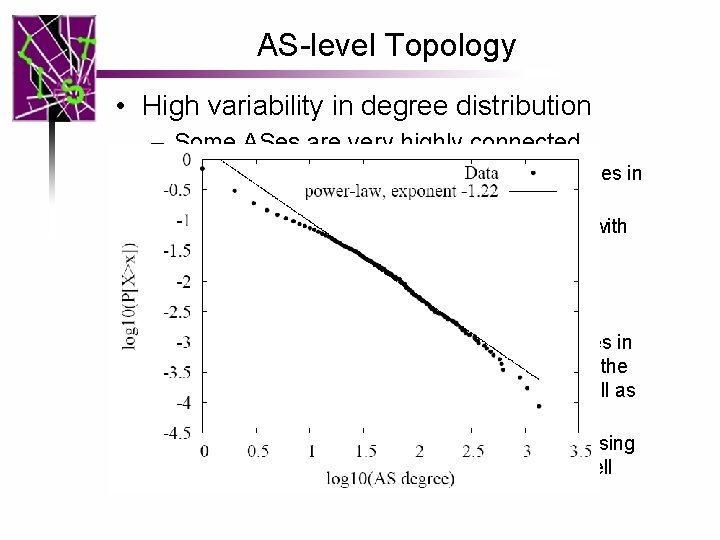
AS-level Topology • High variability in degree distribution – Some ASes are very highly connected • Different ASes have dramatically different roles in the network • Node degree seems to be highly correlated with AS size – Generative models of AS graph • “Rich get richer” model • Newly added nodes connect to existing nodes in a way that tends to simultaneously minimize the physical length of the new connection, as well as the average number of hops to other nodes • New ASes appear at an exponentially increasing rate, and each AS grows exponentially as well
AS Graph Is Small World Graph • AS graph taken in Jan 2002 containing 12, 709 ASes and 27, 384 edges – Average path length is 3. 6 – Clustering coefficient is 0. 46 (0. 0014 in random graph) – It appears that individual clusters can contain ASes with similar geographic location or business interests
AS Relationships • Four relationships – Customer-provider – Peering • Exchange only non-transit traffic – Mutual transit • typically between two administrative domains such as small ISPs who are located close to each other – Mutual backup • Hierarchical structure?
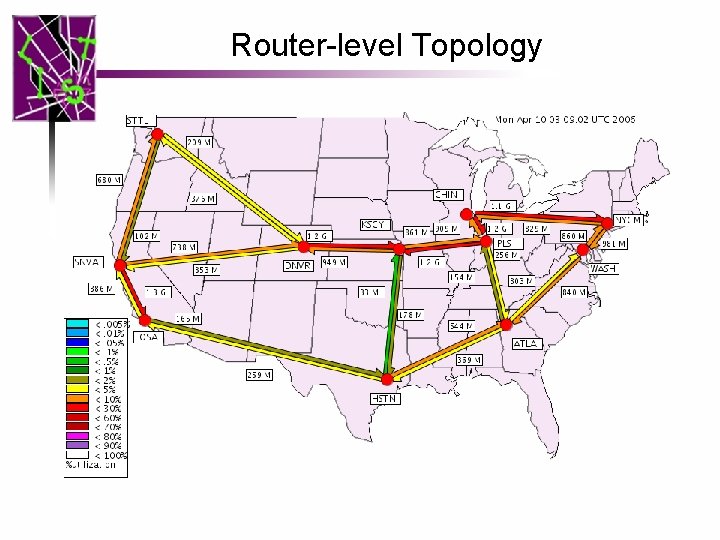
Router-level Topology
Router-level Topology • High variability in degree distribution – Impossible to obtain a complete Internet topology – Most nodes have degree less than 5 but some can have degrees greater than 100 • High degree nodes tend to appear close to the network edge • Network cores are more likely to be meshes – Sampling bias (Mercator and Rocketful) • Proactive measurement (Passive measurement for AS graph) • Nodes and links closest to the sources are explored much more thoroughly • Artificially increase the proportion of low-degree nodes in the sampled graph • Path properties – Average length around 16, rare paths longer than 30 hops – Path inflation
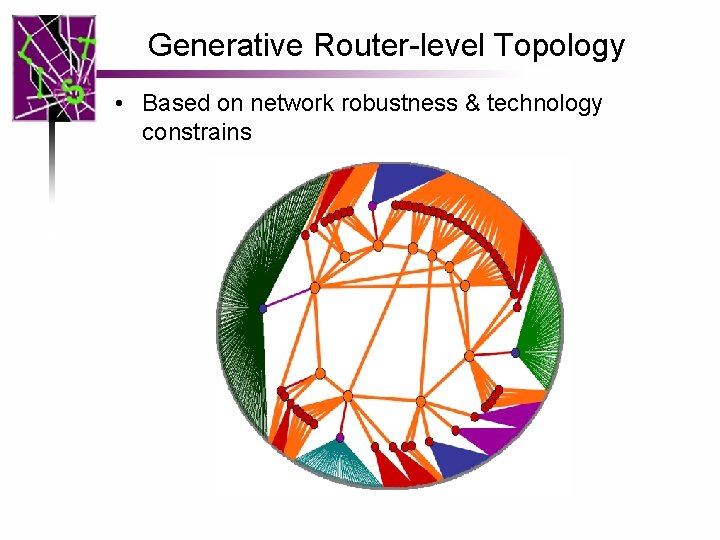
Generative Router-level Topology • Based on network robustness & technology constrains
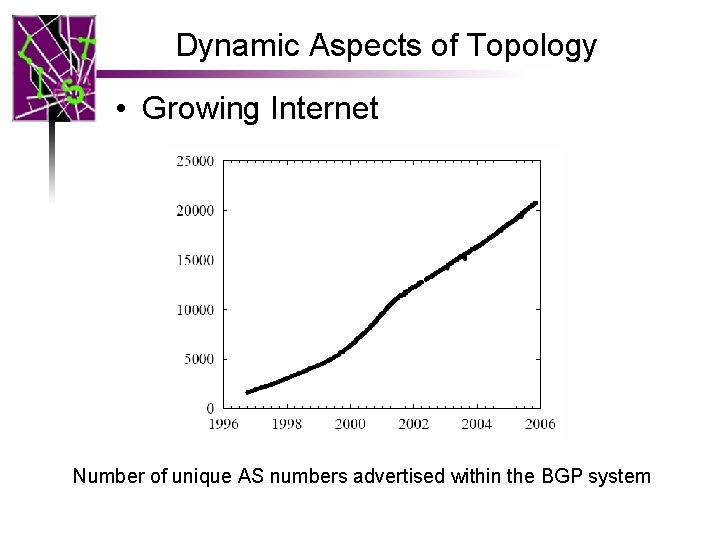
Dynamic Aspects of Topology • Growing Internet Number of unique AS numbers advertised within the BGP system
Dynamic Aspects of Topology • Difficult to measure the number of routers – DNS is decentralized – Router-level graph changes rapidly • Difficult measurement on endsystems – Intermittent connection – Network Address Translation (NAT) – No single centralized host registry
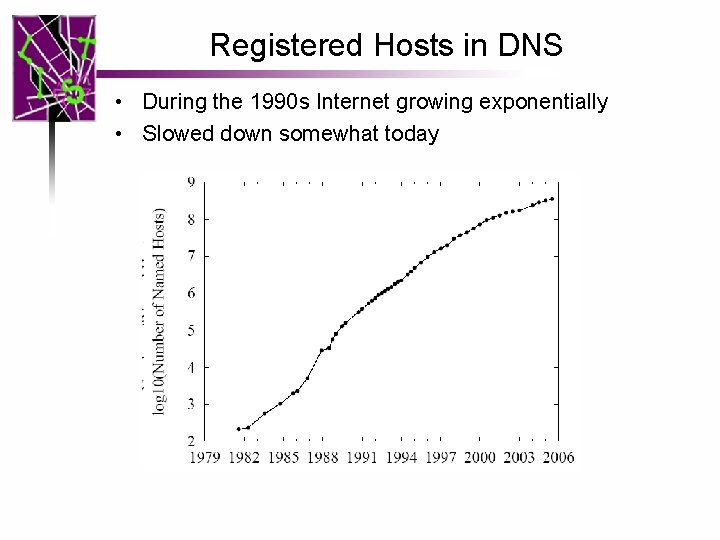
Registered Hosts in DNS • During the 1990 s Internet growing exponentially • Slowed down somewhat today
Stability of Internet • BGP instability – Equipment failure, reconfiguration or misconfiguration, policy change – Long sequences of BGP updates • Repeated announcements and withdrawals of routers • Loop or increased delay and loss rates – Although most BGP routes are highly available, route stability in the interdoman system has declined over time – Instable BGP route affects a small fraction of Internet traffic – Unavailable duration can be highly variable
Stability of Internet • Router level instability – Some routes do exhibit significant fluctuation • The trend may be increasing slightly • Consistent with the behavior AS-level paths • High variability of route stability – Majority of routes going days or weeks without change • High variability of route unavailable duration – Causes of instability of the router graph • Failure of links – Majority of link failures are concentrated on a small subset of the links – Marjority of link failures are short-lived (<10 min) • Router failure
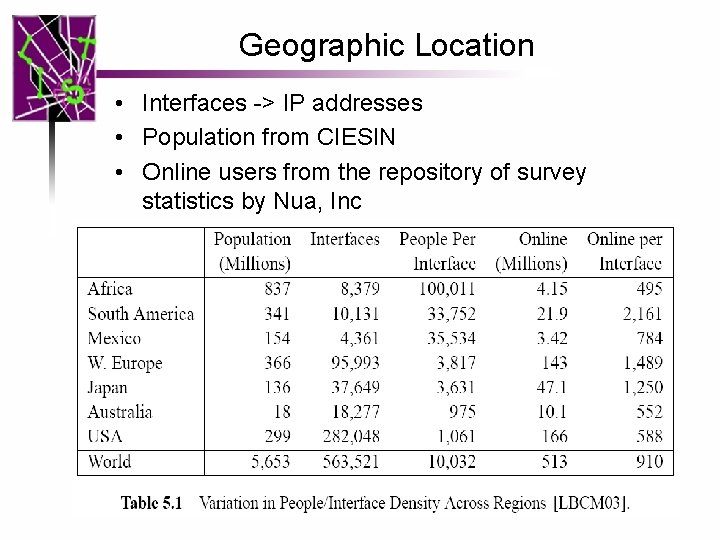
Geographic Location • Interfaces -> IP addresses • Population from CIESIN • Online users from the repository of survey statistics by Nua, Inc
- Slides: 26