
Graphing Data Basic Concepts Bar Graph Data nominal
Graphing Data: Basic Concepts
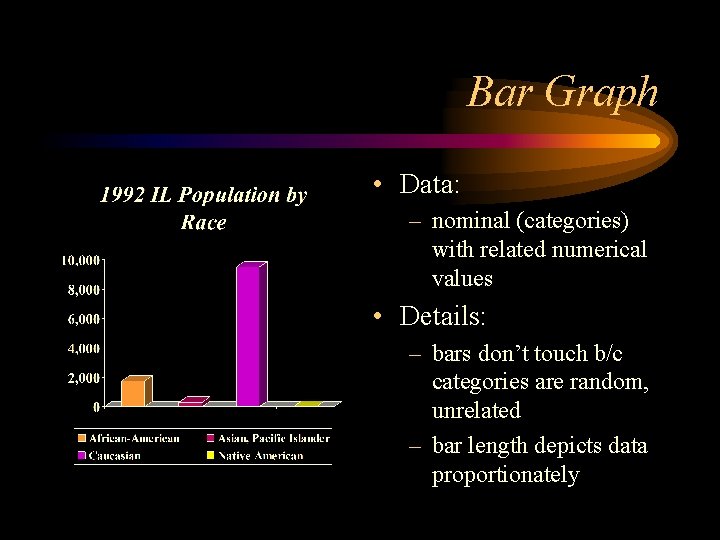
Bar Graph • Data: – nominal (categories) with related numerical values • Details: – bars don’t touch b/c categories are random, unrelated – bar length depicts data proportionately
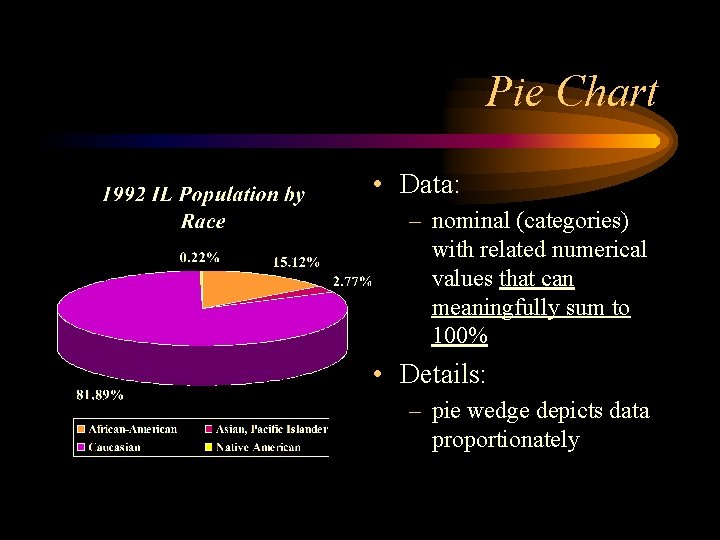
Pie Chart • Data: – nominal (categories) with related numerical values that can meaningfully sum to 100% • Details: – pie wedge depicts data proportionately

Histogram • Data: – ordinal data (i. e. , order of points is meaningful) with related numerical values • Details: – bars touch and follow an ordered progression – bars can represent a range of values (e. g. , 1985 -1988) – bar length depicts data proportionately
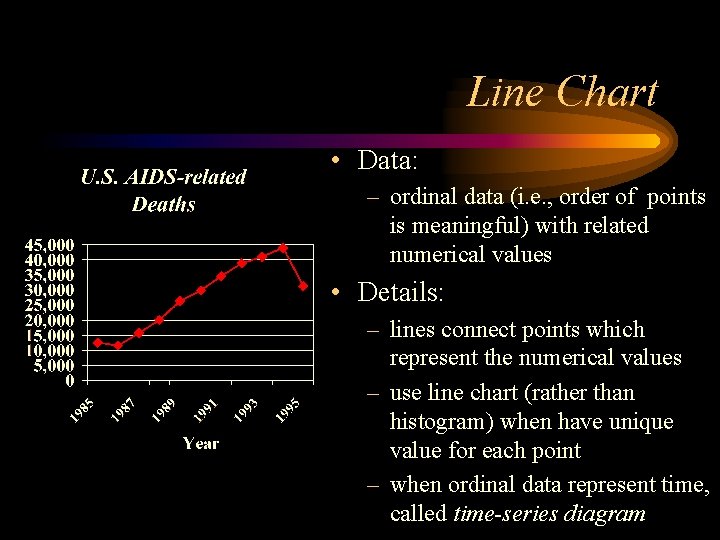
Line Chart • Data: – ordinal data (i. e. , order of points is meaningful) with related numerical values • Details: – lines connect points which represent the numerical values – use line chart (rather than histogram) when have unique value for each point – when ordinal data represent time, called time-series diagram
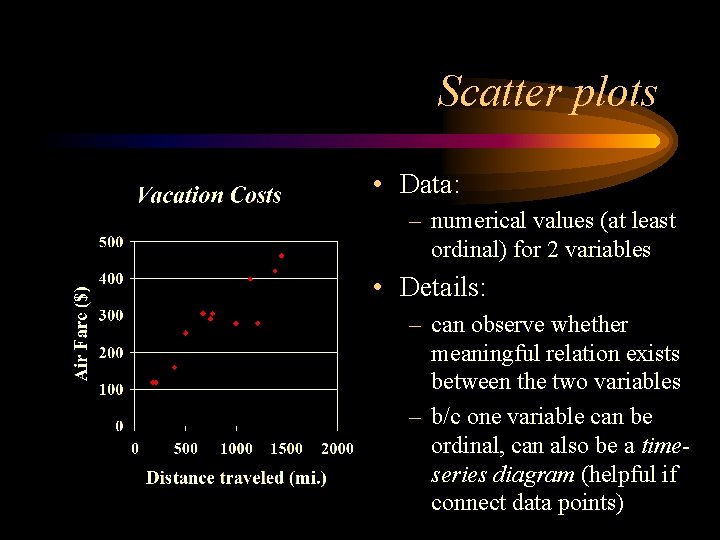
Scatter plots • Data: – numerical values (at least ordinal) for 2 variables • Details: – can observe whether meaningful relation exists between the two variables – b/c one variable can be ordinal, can also be a timeseries diagram (helpful if connect data points)
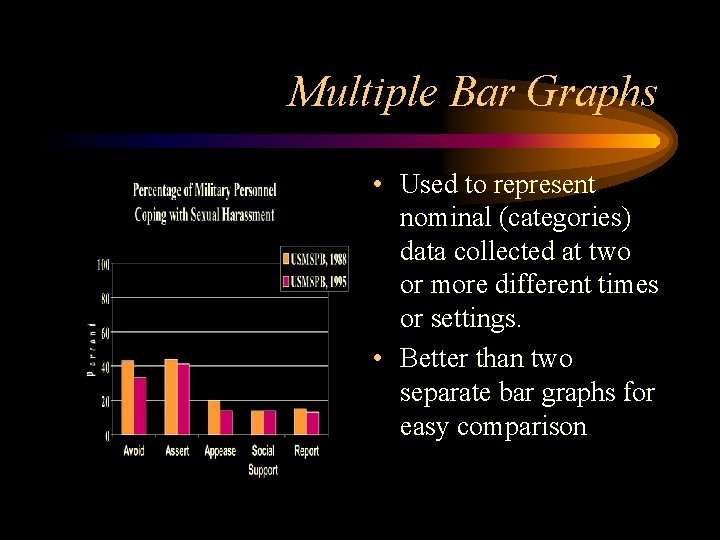
Multiple Bar Graphs • Used to represent nominal (categories) data collected at two or more different times or settings. • Better than two separate bar graphs for easy comparison
Some Things to Remember • Use pie graphs when categories adding up to 100% is meaningful. • Otherwise, use bar graphs • Bar and pie graphs are mostly for nominal data (can be ordered). • Line graph, histograms are mostly for ordinal data (can be ordered)
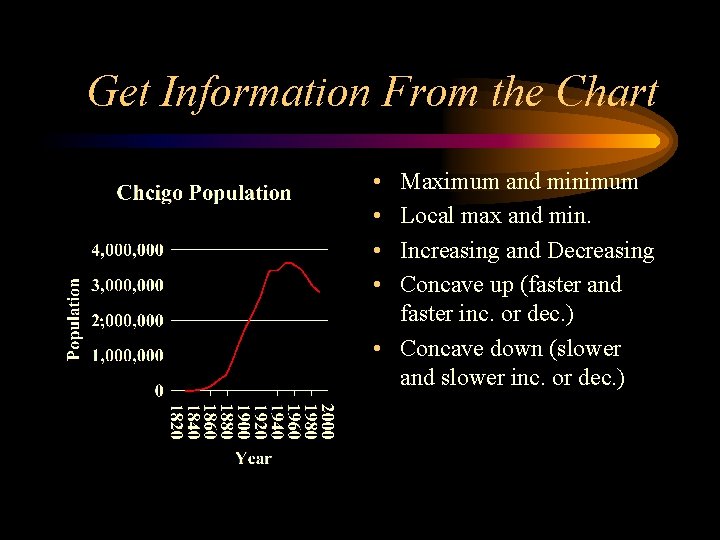
Get Information From the Chart • • Maximum and minimum Local max and min. Increasing and Decreasing Concave up (faster and faster inc. or dec. ) • Concave down (slower and slower inc. or dec. )
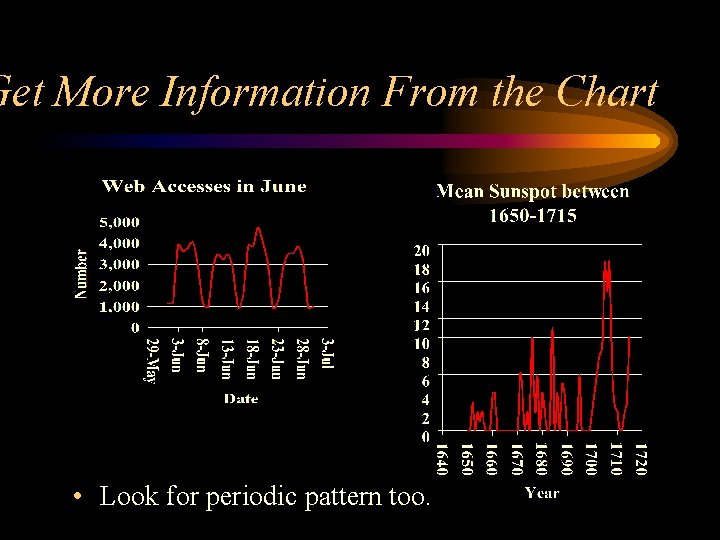
Get More Information From the Chart • Look for periodic pattern too.
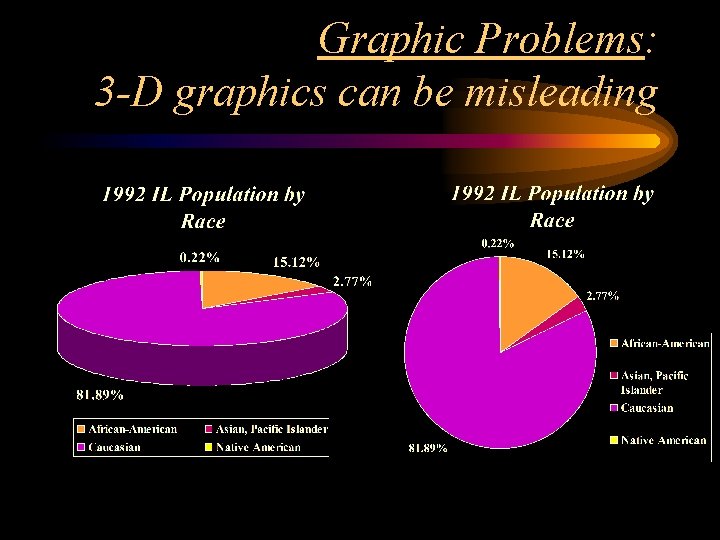
Graphic Problems: 3 -D graphics can be misleading
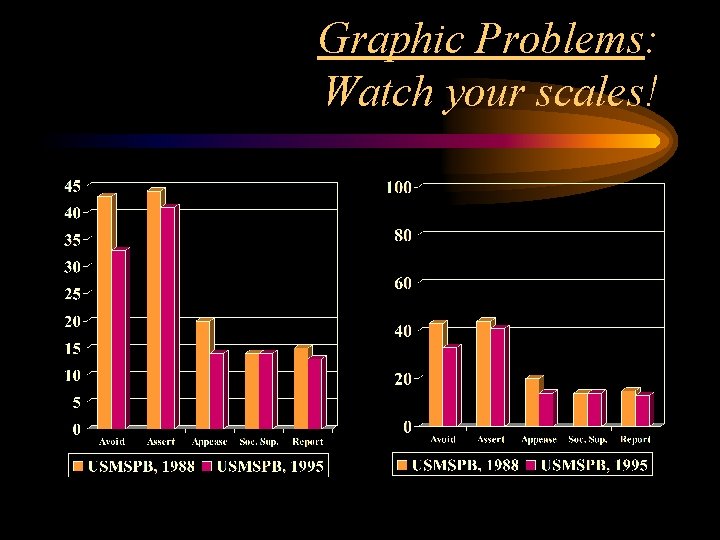
Graphic Problems: Watch your scales!
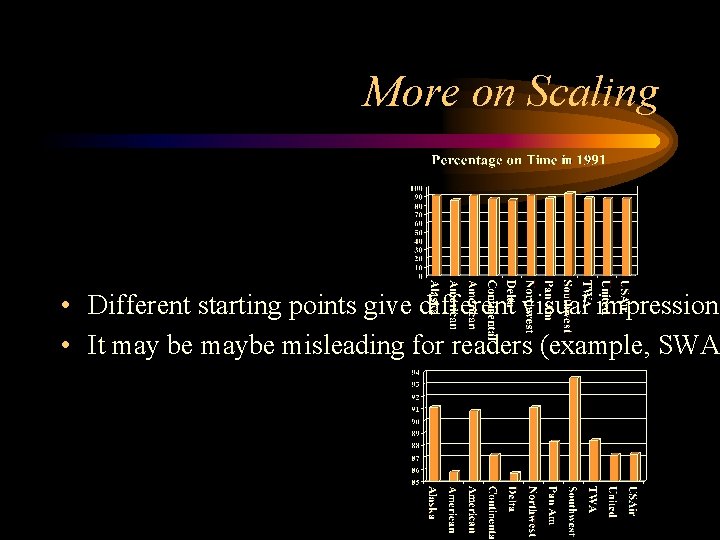
More on Scaling • Different starting points give different visual impressions • It may be maybe misleading for readers (example, SWA
- Slides: 13