
Graphing and Analyzing the Periodic Table Chemistry GT

Graphing and Analyzing the Periodic Table Chemistry GT 11/17/14

Drill • Use a textbook or your notes to define: – Atomic Radius – Ionic Radius – Electronegativity – Electron Affinity – Ionization Energy • HW: Ch 5 – Trends Practice
Objectives • IWBAT – Graph and analyze one periodic trend – Report to my group and analyze the other two periodic trends – Use the periodic trends to solve problems
Periodic Trends • We’re going to do some work with the Periodic Trends. • You will be working in groups of three. • Each group will be graphing – Atomic Radius – Electronegativity – Ionization Energy • Each person will answer questions on Periodic Table WS.
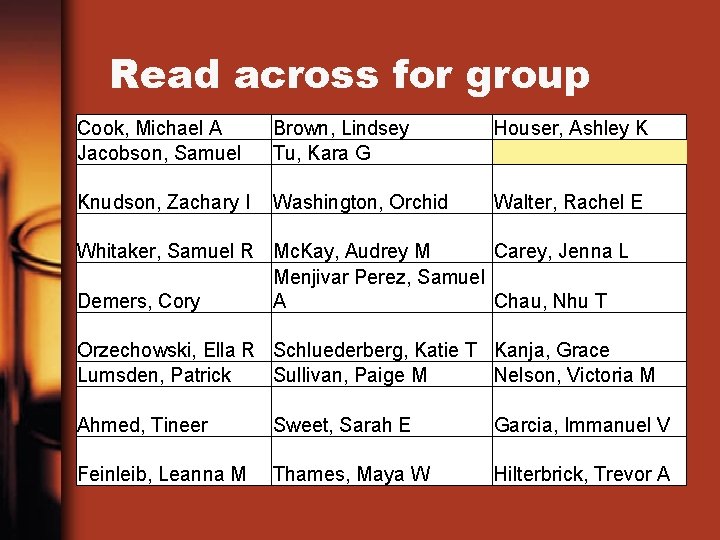
Read across for group Cook, Michael A Jacobson, Samuel Brown, Lindsey Tu, Kara G Houser, Ashley K Knudson, Zachary I Washington, Orchid Walter, Rachel E Whitaker, Samuel R Mc. Kay, Audrey M Carey, Jenna L Menjivar Perez, Samuel Demers, Cory A Chau, Nhu T Orzechowski, Ella R Schluederberg, Katie T Kanja, Grace Lumsden, Patrick Sullivan, Paige M Nelson, Victoria M Ahmed, Tineer Sweet, Sarah E Garcia, Immanuel V Feinleib, Leanna M Thames, Maya W Hilterbrick, Trevor A
When done with graphs • Help each other to analyze the graphs: – What are the trends? What do they mean? • Find the alkali metals on each graph. Highlight their points in red, and connect them with a red line. • Find the third period on each graph. Highlight the 3 rd period with a blue line.

When done… • Turn in three graphs stapled together. – Make sure each has a title and labels • Turn in worksheets separately.
Effective Nuclear Charge • Why does the Atomic radius get smaller as we go across the Periodic Table? ?
Zeff • Let’s imagine a Bohr model of an atom. • Let’s calculate the charge on one of the outermost electrons: – Na vs. Cl – B vs. O • Greater charge on non-metal!
Ionic Radius • Group trend – same as atomic radius, increases as you go down the periodic table • Periodic trend – Within an isoelectric series, size decreases with increasing number of protons. • Isoelectric? ? What does that mean? – N 3 -, O 2 -, F-, Ne, Na+, Mg 2+, Al 3+, Si 4+ : size increases left-to-right
Ionic Radius • Within a period – the size of the cations decreases left-to-right because of increased Zeff. • Increase as type of ions changes from cations to anions because of the addition of an energy level – The size of the anions decreases left-to-right, again because of increasing Zeff.

Let’s Practice • Over the next few days, you will be visiting the stations in the back of the room, and completing the problems that you can do. Each day, you will do some more. By Wednesday, you should have them all done.
- Slides: 12