
Graphics Processing Unit GertJan v d Braak Henk
Graphics Processing Unit Gert-Jan v. d. Braak Henk Corporaal 5 SIA 0, TU/e, 2019 Background image: Nvidia Tesla P 100 with Pascal architecture. Slides by Zhenyu Ye
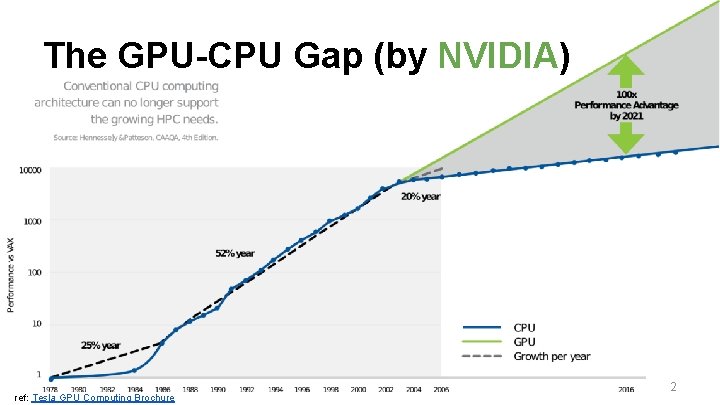
The GPU-CPU Gap (by NVIDIA) ref: Tesla GPU Computing Brochure 2
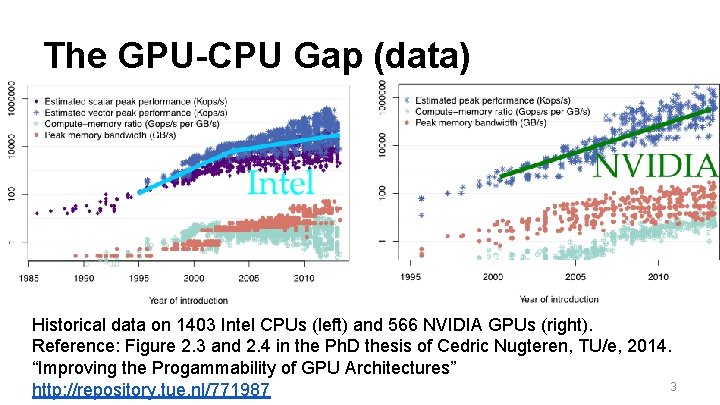
The GPU-CPU Gap (data) Historical data on 1403 Intel CPUs (left) and 566 NVIDIA GPUs (right). Reference: Figure 2. 3 and 2. 4 in the Ph. D thesis of Cedric Nugteren, TU/e, 2014. “Improving the Progammability of GPU Architectures” 3 http: //repository. tue. nl/771987
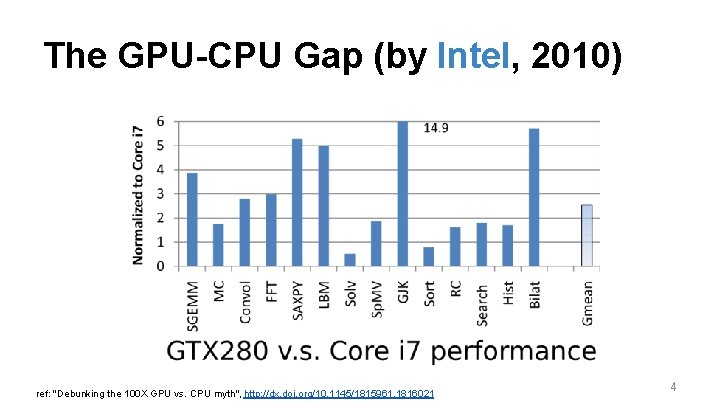
The GPU-CPU Gap (by Intel, 2010) ref: "Debunking the 100 X GPU vs. CPU myth", http: //dx. doi. org/10. 1145/1815961. 1816021 4
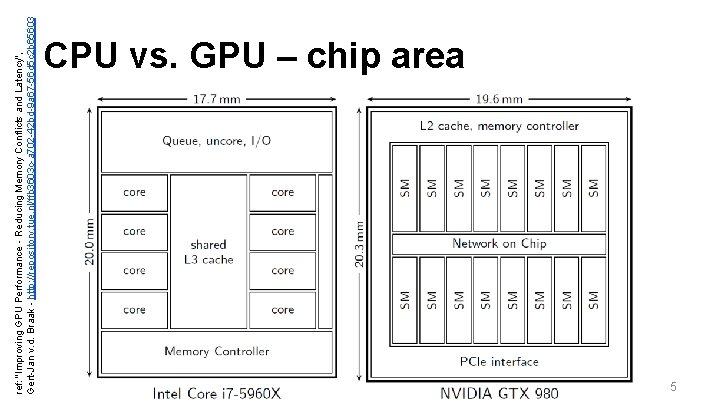
ref: "Improving GPU Performance - Reducing Memory Conflicts and Latency", Gert-Jan v. d. Braak - http: //repository. tue. nl/ffb 3603 c-a 702 -42 bd-9 a 67 -56 d 5 c 2 b 65603 CPU vs. GPU – chip area 5
In This Lecture, We Will Find Out ● The architecture of GPUs o o Single Instruction Multiple Thread Memory hierarchy ● The program model of GPUs o o The threading hierarchy Memory space 6
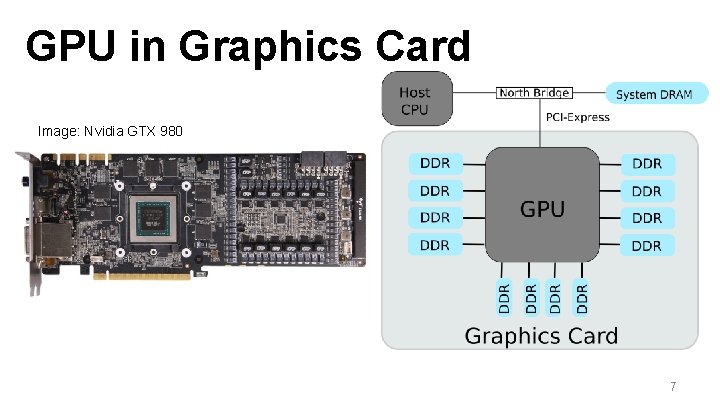
GPU in Graphics Card Image: Nvidia GTX 980 7
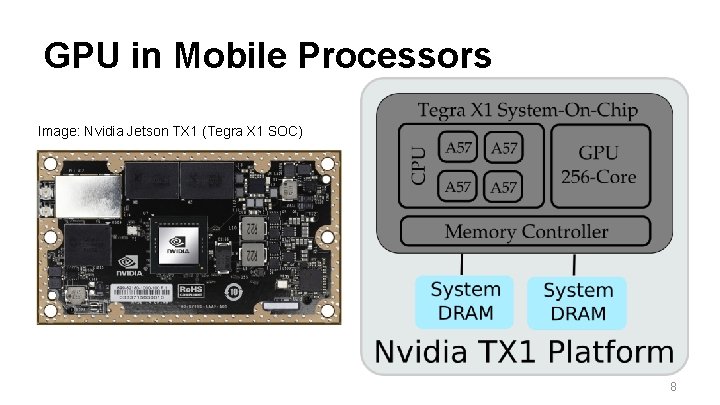
GPU in Mobile Processors Image: Nvidia Jetson TX 1 (Tegra X 1 SOC) 8
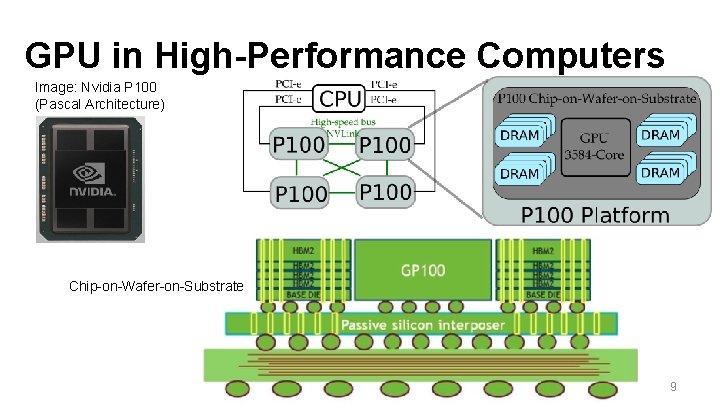
GPU in High-Performance Computers Image: Nvidia P 100 (Pascal Architecture) Chip-on-Wafer-on-Substrate 9
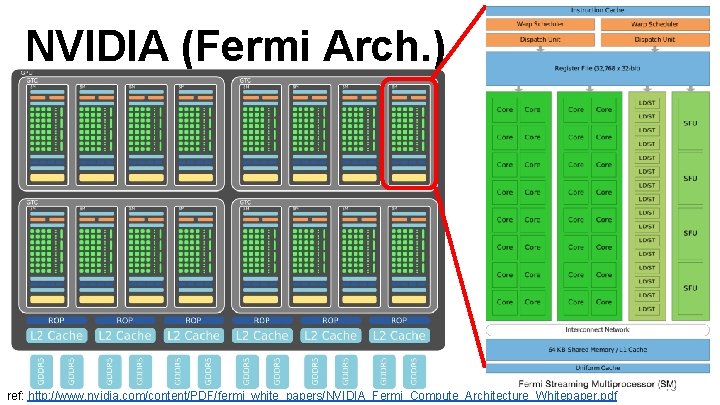
NVIDIA (Fermi Arch. ) ref: http: //www. nvidia. com/content/PDF/fermi_white_papers/NVIDIA_Fermi_Compute_Architecture_Whitepaper. pdf 10
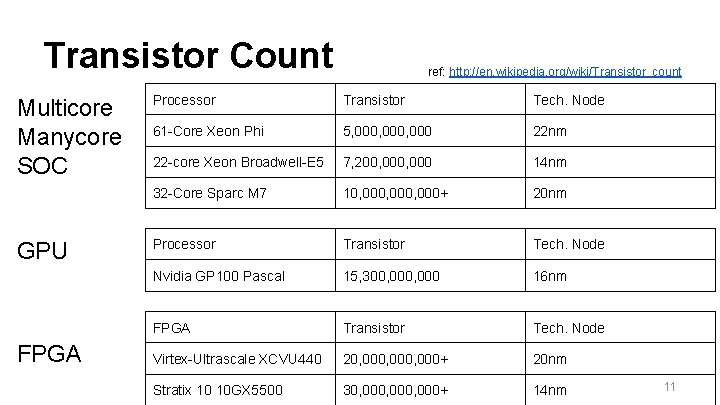
Transistor Count Multicore Manycore SOC GPU FPGA ref: http: //en. wikipedia. org/wiki/Transistor_count Processor Transistor Tech. Node 61 -Core Xeon Phi 5, 000, 000 22 nm 22 -core Xeon Broadwell-E 5 7, 200, 000 14 nm 32 -Core Sparc M 7 10, 000, 000+ 20 nm Processor Transistor Tech. Node Nvidia GP 100 Pascal 15, 300, 000 16 nm FPGA Transistor Tech. Node Virtex-Ultrascale XCVU 440 20, 000, 000+ 20 nm Stratix 10 10 GX 5500 30, 000, 000+ 14 nm 11
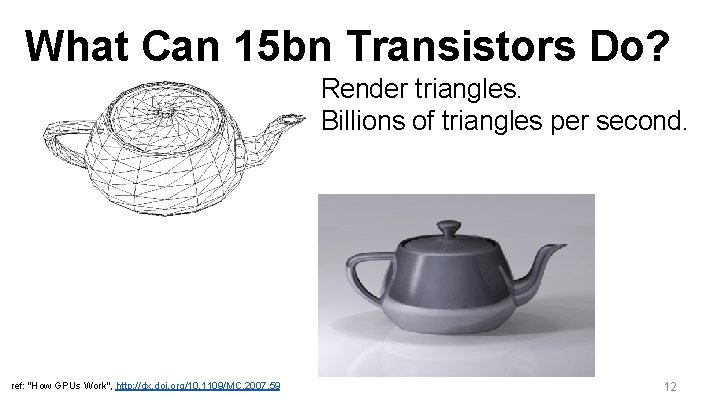
What Can 15 bn Transistors Do? Render triangles. Billions of triangles per second. ref: "How GPUs Work", http: //dx. doi. org/10. 1109/MC. 2007. 59 12
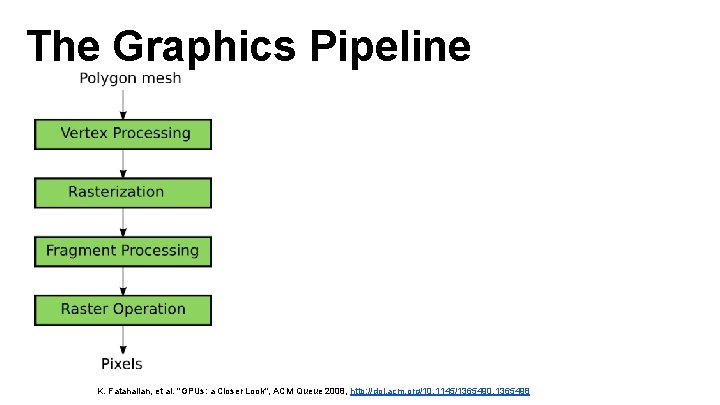
The Graphics Pipeline K. Fatahalian, et al. "GPUs: a Closer Look", ACM Queue 2008, http: //doi. acm. org/10. 1145/1365490. 1365498
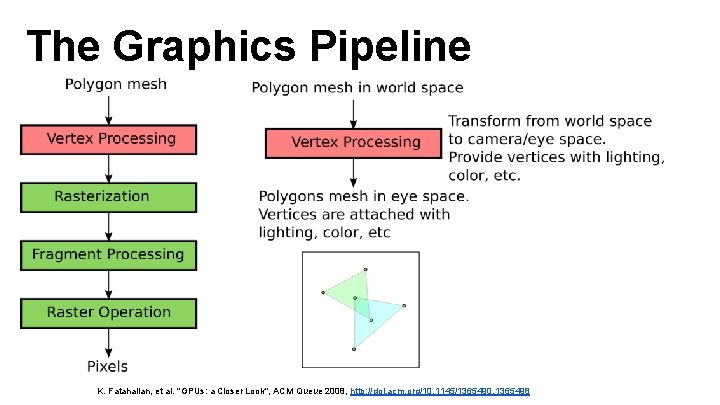
The Graphics Pipeline K. Fatahalian, et al. "GPUs: a Closer Look", ACM Queue 2008, http: //doi. acm. org/10. 1145/1365490. 1365498
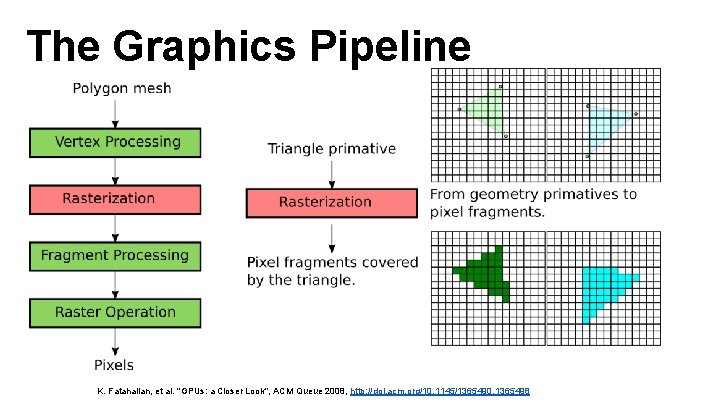
The Graphics Pipeline K. Fatahalian, et al. "GPUs: a Closer Look", ACM Queue 2008, http: //doi. acm. org/10. 1145/1365490. 1365498
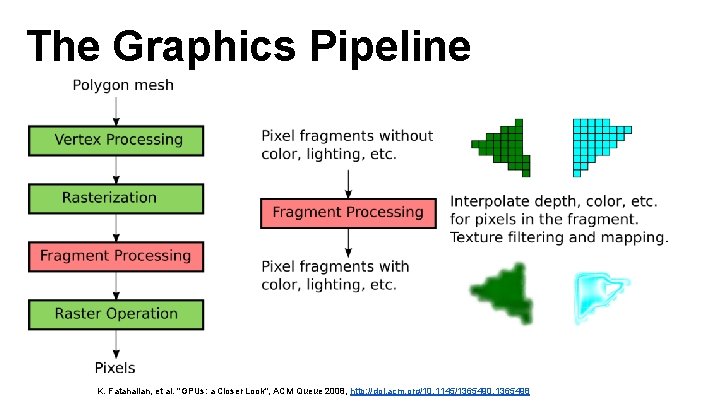
The Graphics Pipeline K. Fatahalian, et al. "GPUs: a Closer Look", ACM Queue 2008, http: //doi. acm. org/10. 1145/1365490. 1365498
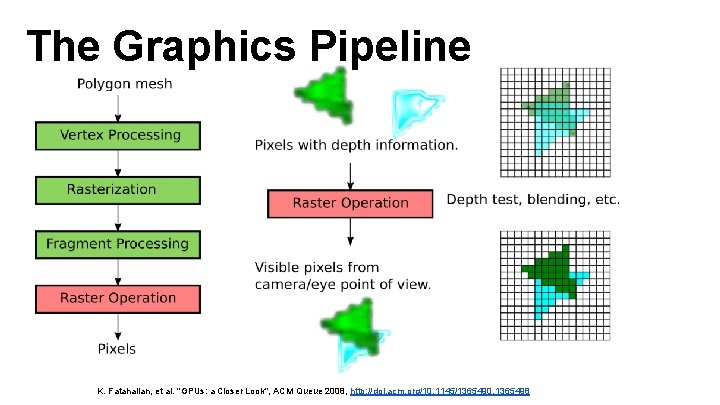
The Graphics Pipeline K. Fatahalian, et al. "GPUs: a Closer Look", ACM Queue 2008, http: //doi. acm. org/10. 1145/1365490. 1365498
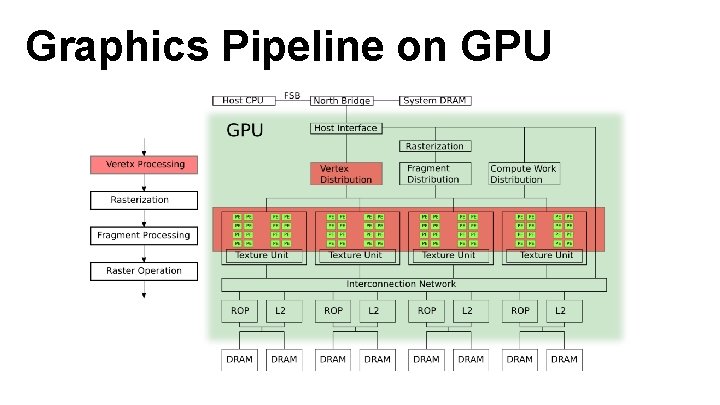
Graphics Pipeline on GPU
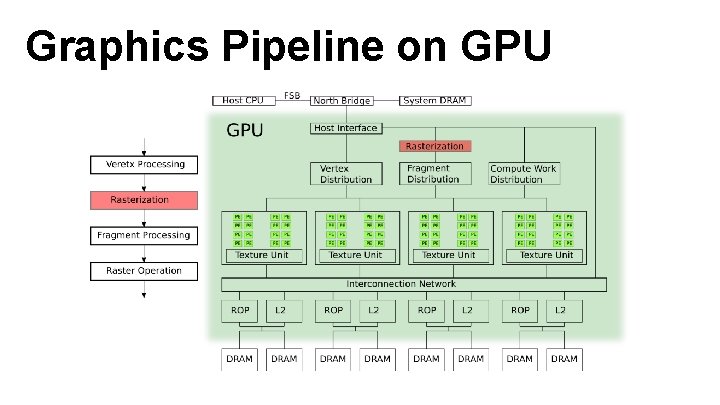
Graphics Pipeline on GPU
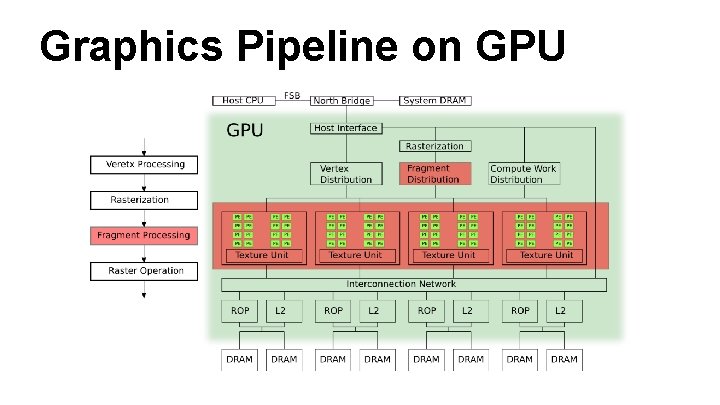
Graphics Pipeline on GPU
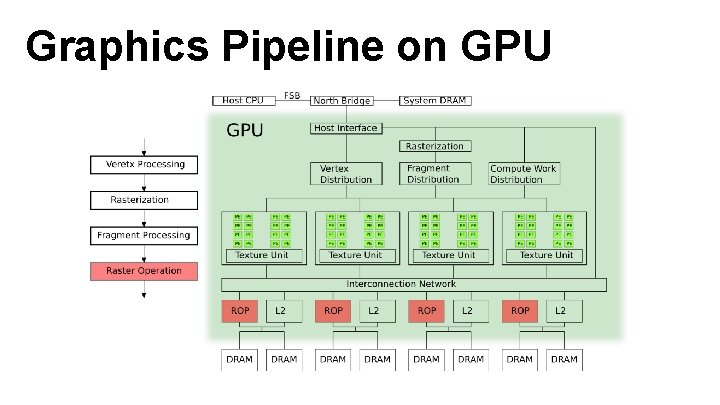
Graphics Pipeline on GPU
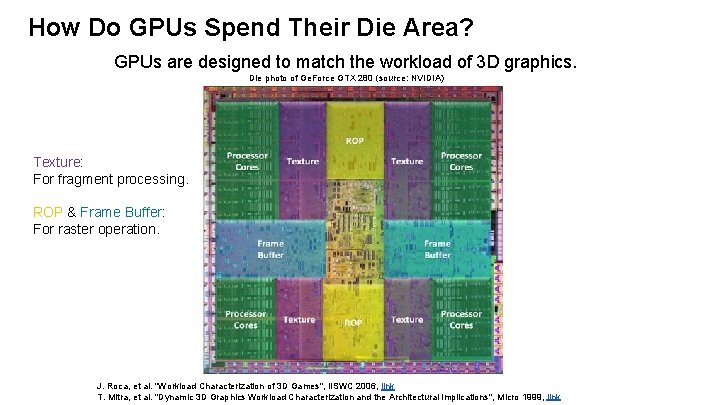
How Do GPUs Spend Their Die Area? GPUs are designed to match the workload of 3 D graphics. Die photo of Ge. Force GTX 280 (source: NVIDIA) Texture: For fragment processing. ROP & Frame Buffer: For raster operation. J. Roca, et al. "Workload Characterization of 3 D Games", IISWC 2006, link T. Mitra, et al. "Dynamic 3 D Graphics Workload Characterization and the Architectural Implications", Micro 1999, link
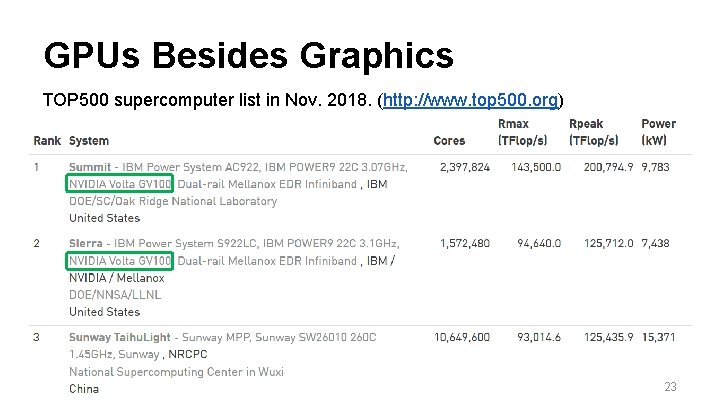
GPUs Besides Graphics TOP 500 supercomputer list in Nov. 2018. (http: //www. top 500. org) 23
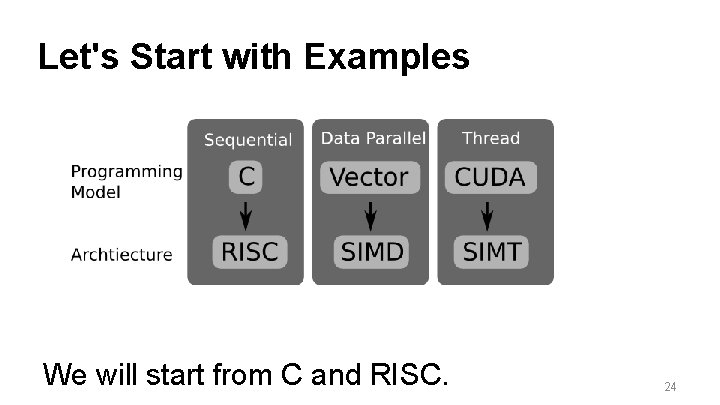
Let's Start with Examples We will start from C and RISC. 24
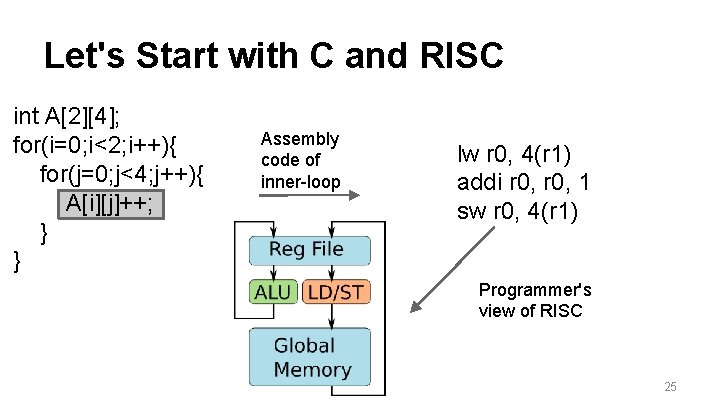
Let's Start with C and RISC int A[2][4]; for(i=0; i<2; i++){ for(j=0; j<4; j++){ A[i][j]++; } } Assembly code of inner-loop lw r 0, 4(r 1) addi r 0, 1 sw r 0, 4(r 1) Programmer's view of RISC 25
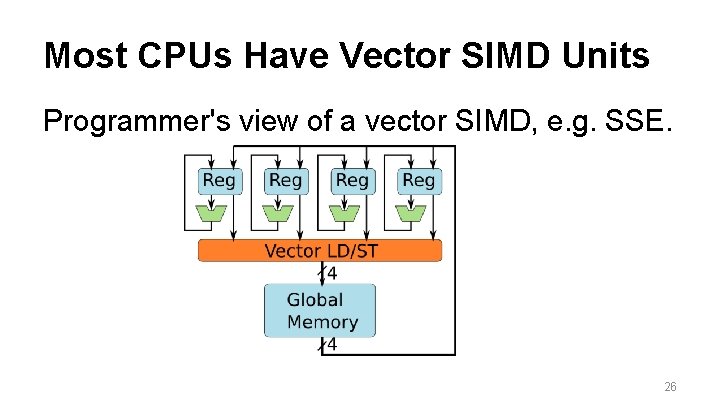
Most CPUs Have Vector SIMD Units Programmer's view of a vector SIMD, e. g. SSE. 26
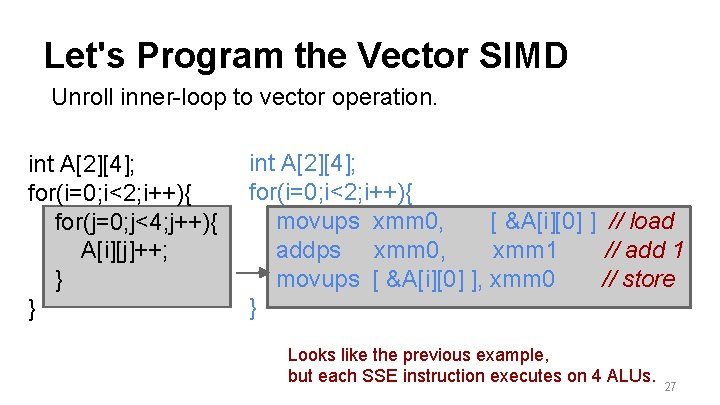
Let's Program the Vector SIMD Unroll inner-loop to vector operation. int A[2][4]; for(i=0; i<2; i++){ for(j=0; j<4; j++){ A[i][j]++; } } int A[2][4]; for(i=0; i<2; i++){ movups xmm 0, [ &A[i][0] ] // load addps xmm 0, xmm 1 // add 1 movups [ &A[i][0] ], xmm 0 // store } Looks like the previous example, but each SSE instruction executes on 4 ALUs. 27
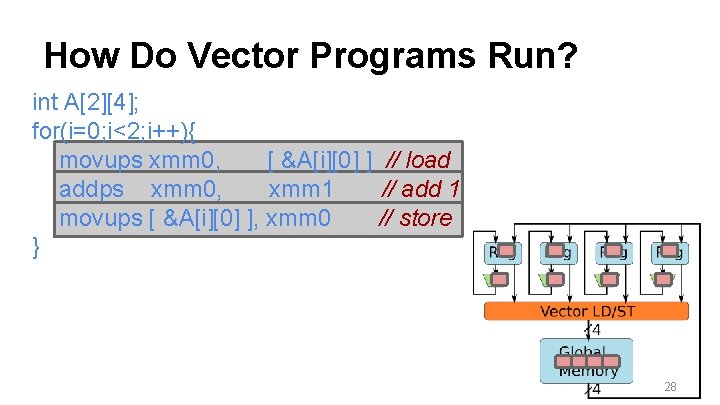
How Do Vector Programs Run? int A[2][4]; for(i=0; i<2; i++){ movups xmm 0, [ &A[i][0] ] // load addps xmm 0, xmm 1 // add 1 movups [ &A[i][0] ], xmm 0 // store } 28
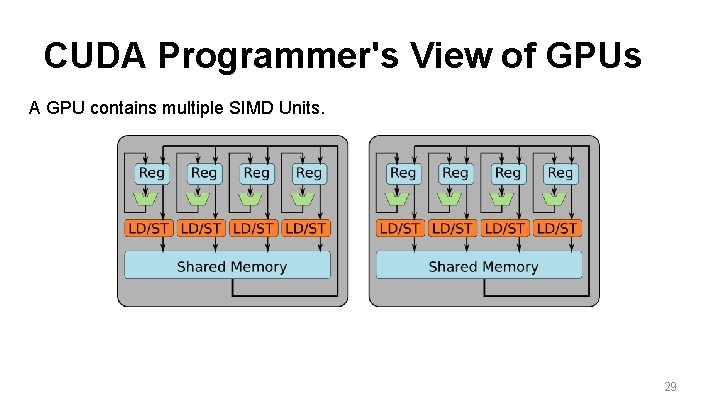
CUDA Programmer's View of GPUs A GPU contains multiple SIMD Units. 29
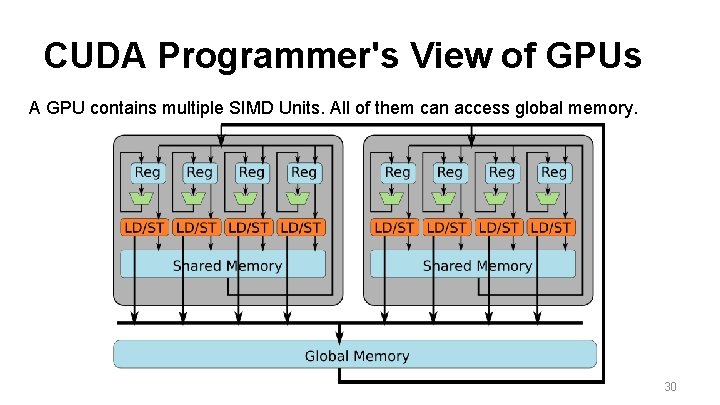
CUDA Programmer's View of GPUs A GPU contains multiple SIMD Units. All of them can access global memory. 30
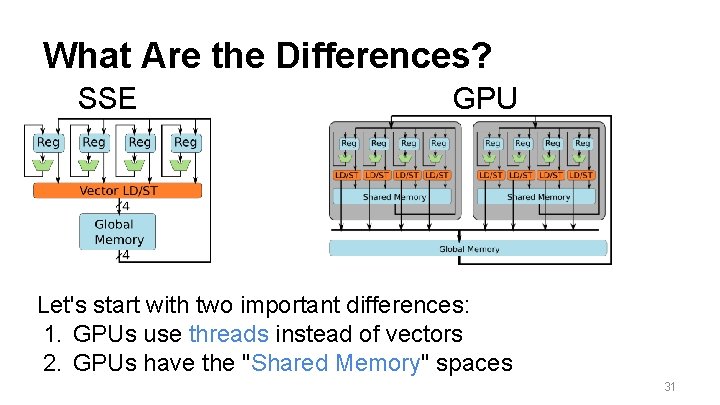
What Are the Differences? SSE GPU Let's start with two important differences: 1. GPUs use threads instead of vectors 2. GPUs have the "Shared Memory" spaces 31
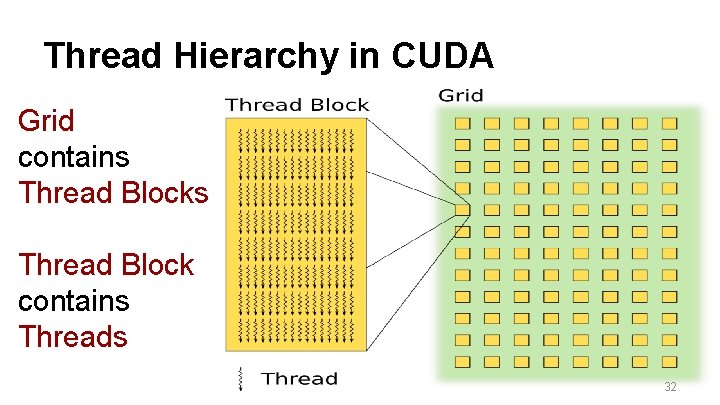
Thread Hierarchy in CUDA Grid contains Thread Block contains Threads 32
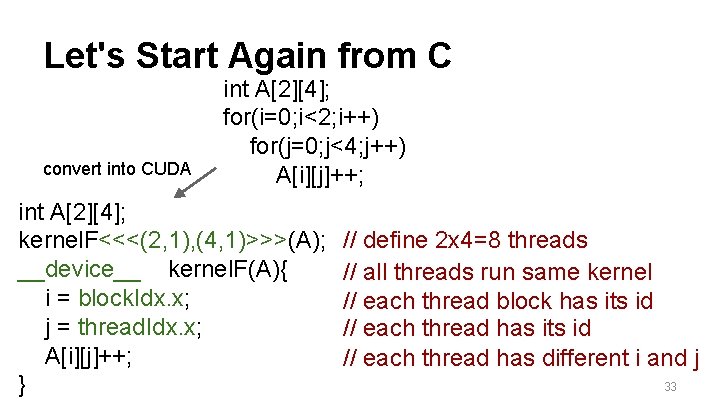
Let's Start Again from C convert into CUDA int A[2][4]; for(i=0; i<2; i++) for(j=0; j<4; j++) A[i][j]++; int A[2][4]; kernel. F<<<(2, 1), (4, 1)>>>(A); __device__ kernel. F(A){ i = block. Idx. x; j = thread. Idx. x; A[i][j]++; } // define 2 x 4=8 threads // all threads run same kernel // each thread block has its id // each thread has different i and j 33
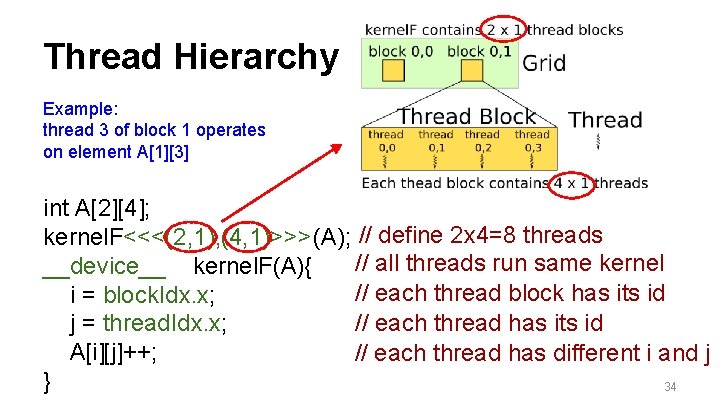
Thread Hierarchy Example: thread 3 of block 1 operates on element A[1][3] int A[2][4]; kernel. F<<<(2, 1), (4, 1)>>>(A); // define 2 x 4=8 threads // all threads run same kernel __device__ kernel. F(A){ // each thread block has its id i = block. Idx. x; // each thread has its id j = thread. Idx. x; A[i][j]++; // each thread has different i and j } 34
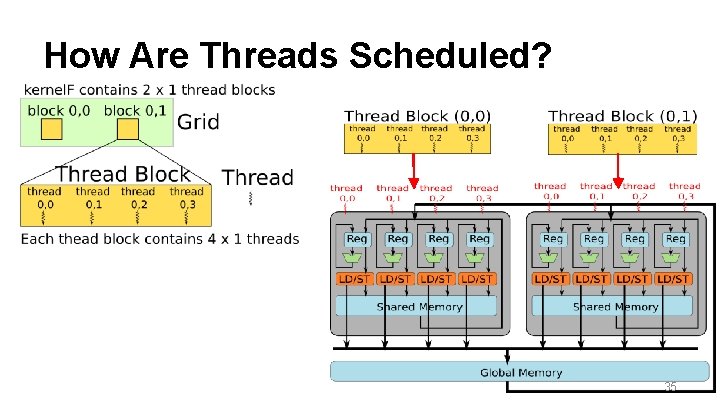
How Are Threads Scheduled? 35
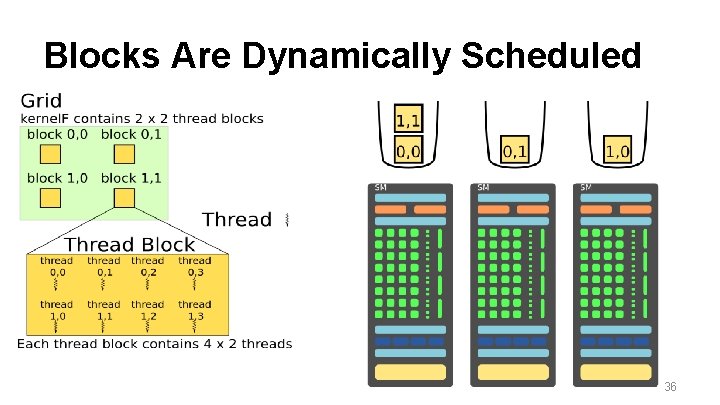
Blocks Are Dynamically Scheduled 36
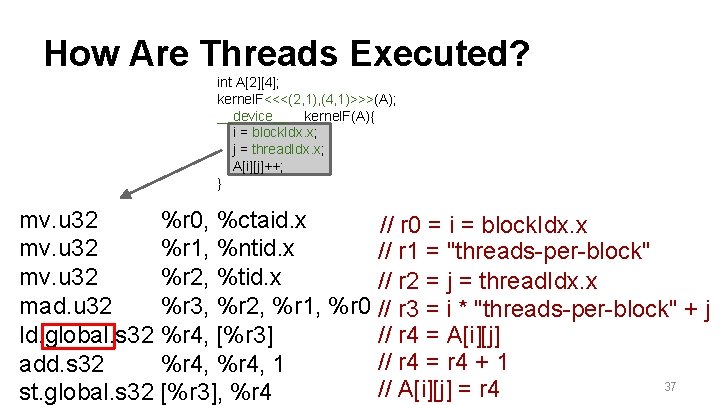
How Are Threads Executed? int A[2][4]; kernel. F<<<(2, 1), (4, 1)>>>(A); __device__ kernel. F(A){ i = block. Idx. x; j = thread. Idx. x; A[i][j]++; } mv. u 32 %r 0, %ctaid. x // r 0 = i = block. Idx. x mv. u 32 %r 1, %ntid. x // r 1 = "threads-per-block" mv. u 32 %r 2, %tid. x // r 2 = j = thread. Idx. x mad. u 32 %r 3, %r 2, %r 1, %r 0 // r 3 = i * "threads-per-block" + j // r 4 = A[i][j] ld. global. s 32 %r 4, [%r 3] // r 4 = r 4 + 1 add. s 32 %r 4, 1 37 // A[i][j] = r 4 st. global. s 32 [%r 3], %r 4
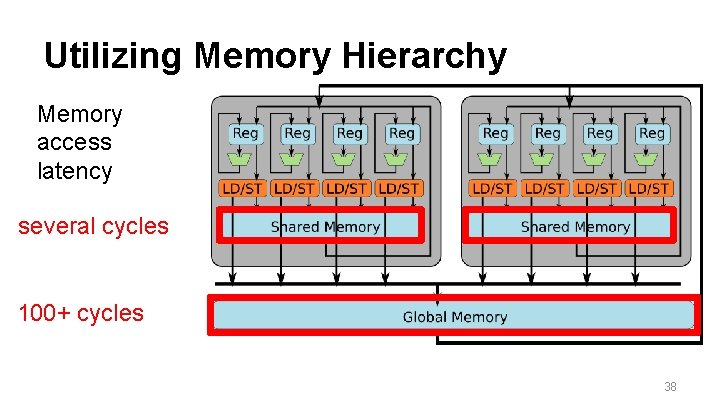
Utilizing Memory Hierarchy Memory access latency several cycles 100+ cycles 38
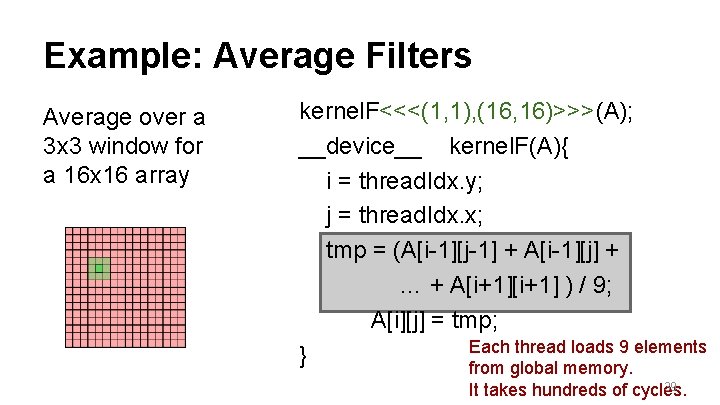
Example: Average Filters Average over a 3 x 3 window for a 16 x 16 array kernel. F<<<(1, 1), (16, 16)>>>(A); __device__ kernel. F(A){ i = thread. Idx. y; j = thread. Idx. x; tmp = (A[i-1][j-1] + A[i-1][j] + … + A[i+1] ) / 9; A[i][j] = tmp; Each thread loads 9 elements } from global memory. 39 It takes hundreds of cycles.
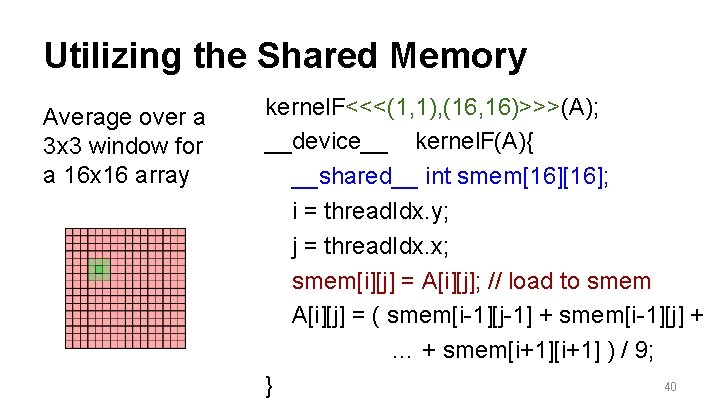
Utilizing the Shared Memory Average over a 3 x 3 window for a 16 x 16 array kernel. F<<<(1, 1), (16, 16)>>>(A); __device__ kernel. F(A){ __shared__ int smem[16]; i = thread. Idx. y; j = thread. Idx. x; smem[i][j] = A[i][j]; // load to smem A[i][j] = ( smem[i-1][j-1] + smem[i-1][j] + … + smem[i+1] ) / 9; 40 }
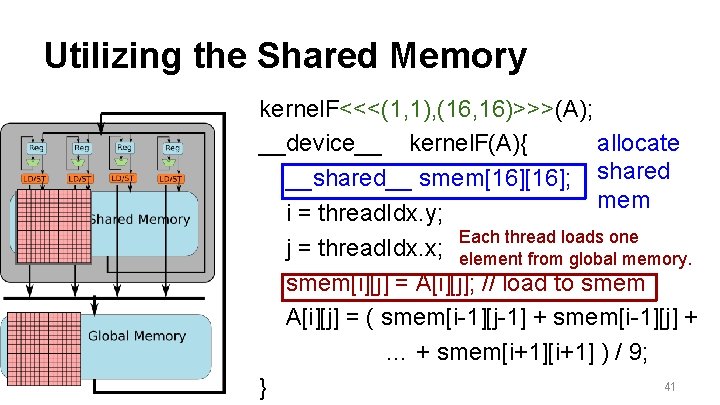
Utilizing the Shared Memory kernel. F<<<(1, 1), (16, 16)>>>(A); allocate __device__ kernel. F(A){ __shared__ smem[16]; shared mem i = thread. Idx. y; Each thread loads one j = thread. Idx. x; element from global memory. smem[i][j] = A[i][j]; // load to smem A[i][j] = ( smem[i-1][j-1] + smem[i-1][j] + … + smem[i+1] ) / 9; 41 }
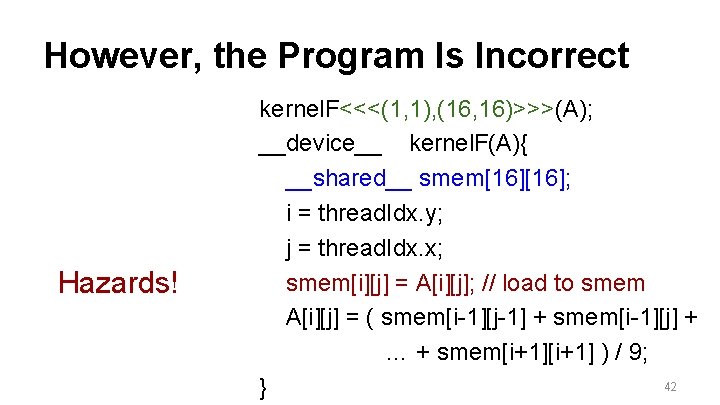
However, the Program Is Incorrect Hazards! kernel. F<<<(1, 1), (16, 16)>>>(A); __device__ kernel. F(A){ __shared__ smem[16]; i = thread. Idx. y; j = thread. Idx. x; smem[i][j] = A[i][j]; // load to smem A[i][j] = ( smem[i-1][j-1] + smem[i-1][j] + … + smem[i+1] ) / 9; 42 }
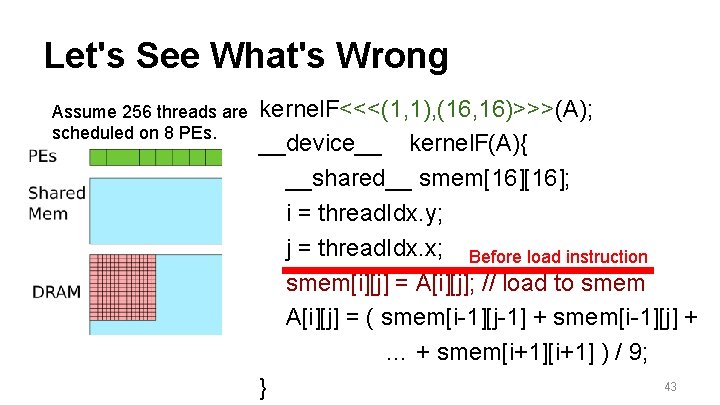
Let's See What's Wrong Assume 256 threads are scheduled on 8 PEs. kernel. F<<<(1, 1), (16, 16)>>>(A); __device__ kernel. F(A){ __shared__ smem[16]; i = thread. Idx. y; j = thread. Idx. x; Before load instruction smem[i][j] = A[i][j]; // load to smem A[i][j] = ( smem[i-1][j-1] + smem[i-1][j] + … + smem[i+1] ) / 9; 43 }
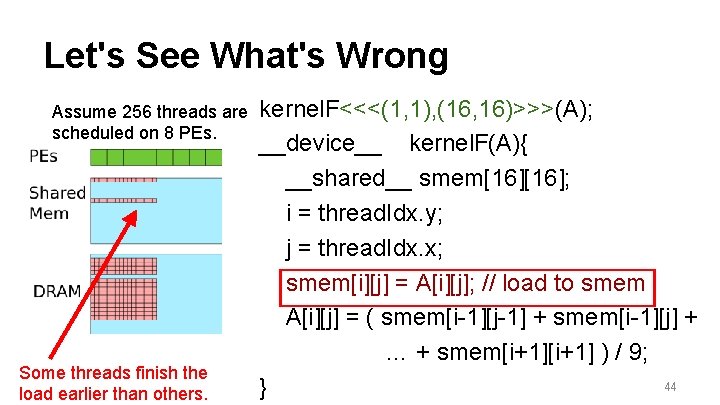
Let's See What's Wrong Assume 256 threads are scheduled on 8 PEs. Some threads finish the load earlier than others. kernel. F<<<(1, 1), (16, 16)>>>(A); __device__ kernel. F(A){ __shared__ smem[16]; i = thread. Idx. y; j = thread. Idx. x; smem[i][j] = A[i][j]; // load to smem A[i][j] = ( smem[i-1][j-1] + smem[i-1][j] + … + smem[i+1] ) / 9; 44 }
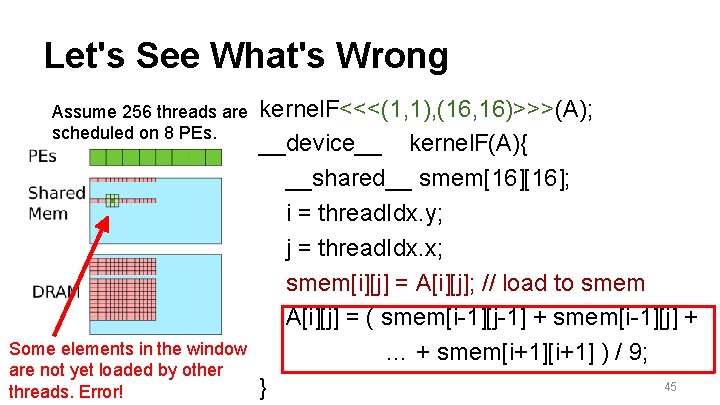
Let's See What's Wrong kernel. F<<<(1, 1), (16, 16)>>>(A); __device__ kernel. F(A){ __shared__ smem[16]; i = thread. Idx. y; j = thread. Idx. x; smem[i][j] = A[i][j]; // load to smem A[i][j] = ( smem[i-1][j-1] + smem[i-1][j] + Some elements in the window … + smem[i+1] ) / 9; are not yet loaded by other 45 } threads. Error! Assume 256 threads are scheduled on 8 PEs.
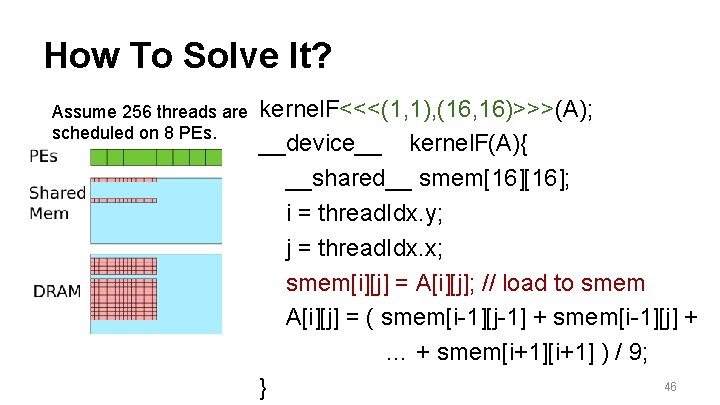
How To Solve It? Assume 256 threads are scheduled on 8 PEs. kernel. F<<<(1, 1), (16, 16)>>>(A); __device__ kernel. F(A){ __shared__ smem[16]; i = thread. Idx. y; j = thread. Idx. x; smem[i][j] = A[i][j]; // load to smem A[i][j] = ( smem[i-1][j-1] + smem[i-1][j] + … + smem[i+1] ) / 9; 46 }
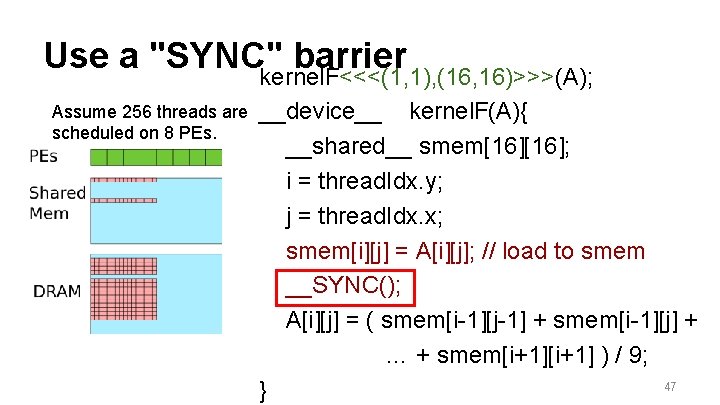
Use a "SYNC" barrier kernel. F<<<(1, 1), (16, 16)>>>(A); Assume 256 threads are scheduled on 8 PEs. __device__ kernel. F(A){ __shared__ smem[16]; i = thread. Idx. y; j = thread. Idx. x; smem[i][j] = A[i][j]; // load to smem __SYNC(); A[i][j] = ( smem[i-1][j-1] + smem[i-1][j] + … + smem[i+1] ) / 9; 47 }
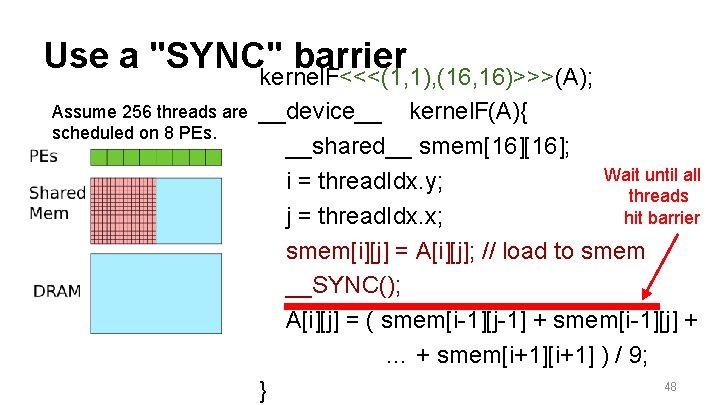
Use a "SYNC" barrier kernel. F<<<(1, 1), (16, 16)>>>(A); Assume 256 threads are scheduled on 8 PEs. __device__ kernel. F(A){ __shared__ smem[16]; Wait until all i = thread. Idx. y; threads j = thread. Idx. x; hit barrier smem[i][j] = A[i][j]; // load to smem __SYNC(); A[i][j] = ( smem[i-1][j-1] + smem[i-1][j] + … + smem[i+1] ) / 9; 48 }
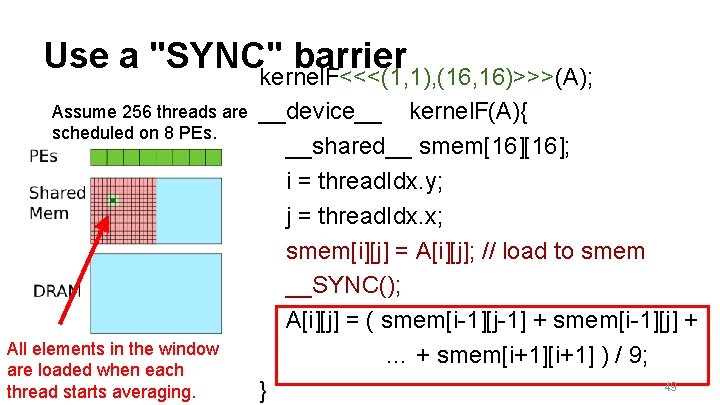
Use a "SYNC" barrier kernel. F<<<(1, 1), (16, 16)>>>(A); Assume 256 threads are scheduled on 8 PEs. All elements in the window are loaded when each thread starts averaging. __device__ kernel. F(A){ __shared__ smem[16]; i = thread. Idx. y; j = thread. Idx. x; smem[i][j] = A[i][j]; // load to smem __SYNC(); A[i][j] = ( smem[i-1][j-1] + smem[i-1][j] + … + smem[i+1] ) / 9; 49 }
Review What We Have Learned 1. Single Instruction Multiple Thread (SIMT) 2. Shared memory Q: What are the pros and cons of explicitly managed memory? Q: What are the fundamental differences between SIMT and vector SIMD programming model? 50
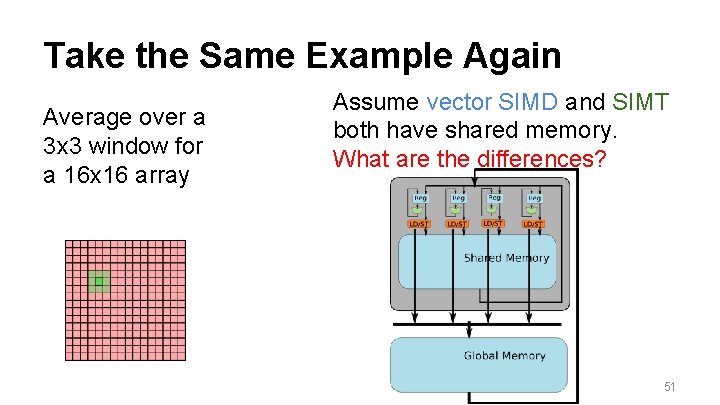
Take the Same Example Again Average over a 3 x 3 window for a 16 x 16 array Assume vector SIMD and SIMT both have shared memory. What are the differences? 51
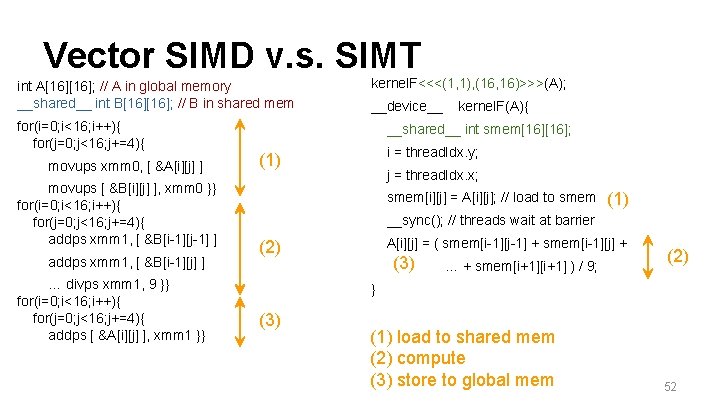
Vector SIMD v. s. SIMT int A[16]; // A in global memory __shared__ int B[16]; // B in shared mem kernel. F<<<(1, 1), (16, 16)>>>(A); for(i=0; i<16; i++){ for(j=0; j<16; j+=4){ __shared__ int smem[16]; movups xmm 0, [ &A[i][j] ] movups [ &B[i][j] ], xmm 0 }} for(i=0; i<16; i++){ for(j=0; j<16; j+=4){ addps xmm 1, [ &B[i-1][j-1] ] addps xmm 1, [ &B[i-1][j] ] … divps xmm 1, 9 }} for(i=0; i<16; i++){ for(j=0; j<16; j+=4){ addps [ &A[i][j] ], xmm 1 }} (1) __device__ kernel. F(A){ i = thread. Idx. y; j = thread. Idx. x; smem[i][j] = A[i][j]; // load to smem (1) __sync(); // threads wait at barrier (2) A[i][j] = ( smem[i-1][j-1] + smem[i-1][j] + (3) … + smem[i+1] ) / 9; (2) } (3) (1) load to shared mem (2) compute (3) store to global mem 52
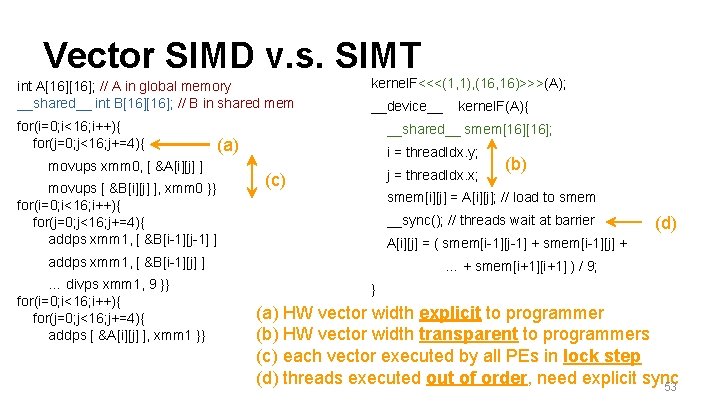
Vector SIMD v. s. SIMT int A[16]; // A in global memory __shared__ int B[16]; // B in shared mem kernel. F<<<(1, 1), (16, 16)>>>(A); for(i=0; i<16; i++){ for(j=0; j<16; j+=4){ __shared__ smem[16]; movups xmm 0, [ &A[i][j] ] movups [ &B[i][j] ], xmm 0 }} for(i=0; i<16; i++){ for(j=0; j<16; j+=4){ addps xmm 1, [ &B[i-1][j-1] ] (a) __device__ kernel. F(A){ i = thread. Idx. y; (c) j = thread. Idx. x; (b) smem[i][j] = A[i][j]; // load to smem __sync(); // threads wait at barrier (d) A[i][j] = ( smem[i-1][j-1] + smem[i-1][j] + addps xmm 1, [ &B[i-1][j] ] … + smem[i+1] ) / 9; … divps xmm 1, 9 }} for(i=0; i<16; i++){ for(j=0; j<16; j+=4){ addps [ &A[i][j] ], xmm 1 }} } (a) HW vector width explicit to programmer (b) HW vector width transparent to programmers (c) each vector executed by all PEs in lock step (d) threads executed out of order, need explicit sync 53
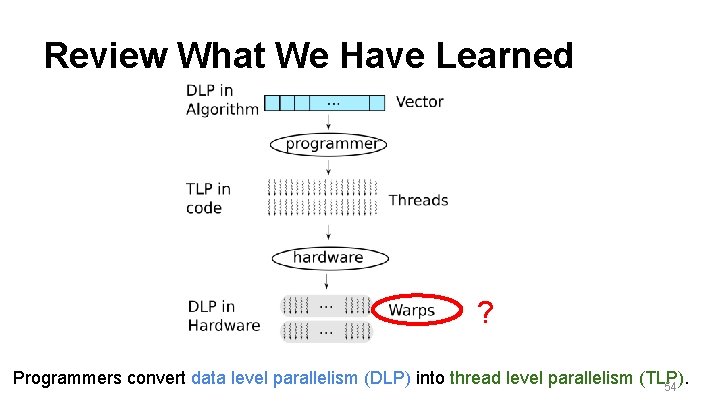
Review What We Have Learned ? Programmers convert data level parallelism (DLP) into thread level parallelism (TLP). 54
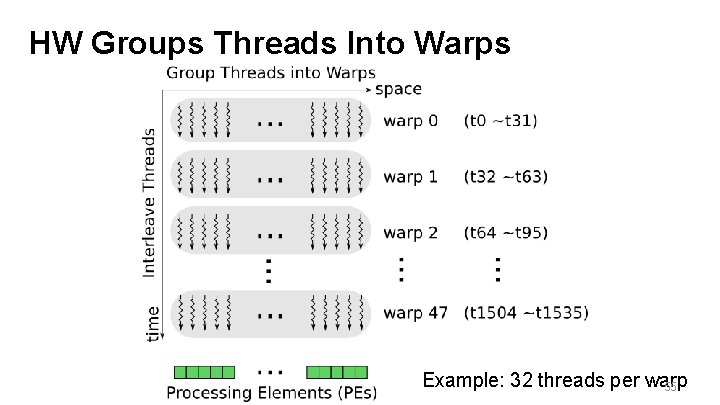
HW Groups Threads Into Warps Example: 32 threads per warp 55
Execution of Threads and Warps Let's start with an example. 56
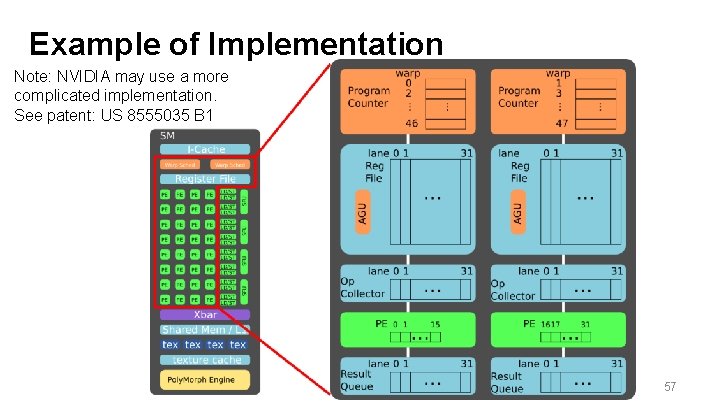
Example of Implementation Note: NVIDIA may use a more complicated implementation. See patent: US 8555035 B 1 57
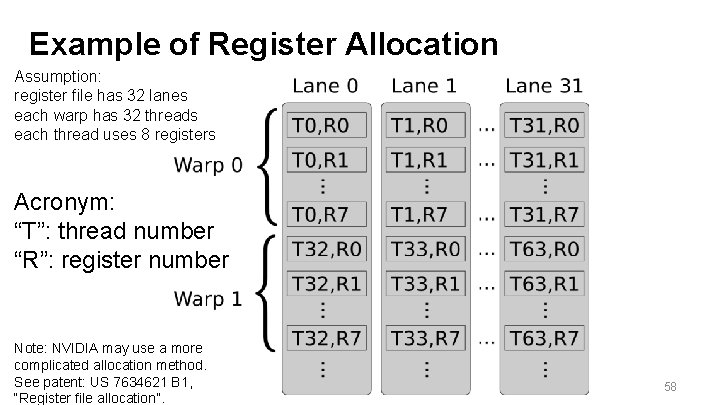
Example of Register Allocation Assumption: register file has 32 lanes each warp has 32 threads each thread uses 8 registers Acronym: “T”: thread number “R”: register number Note: NVIDIA may use a more complicated allocation method. See patent: US 7634621 B 1, “Register file allocation”. 58
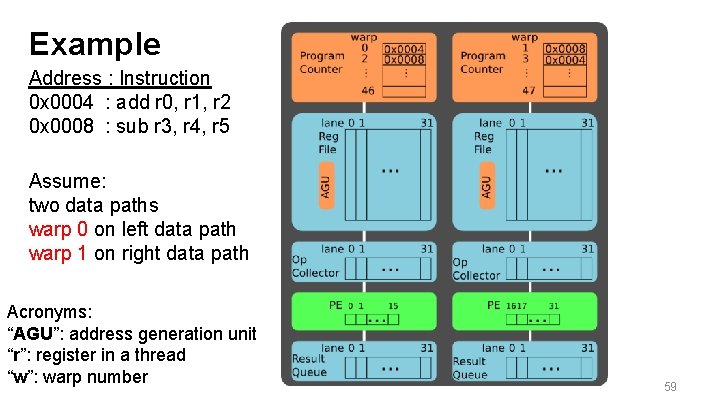
Example Address : Instruction 0 x 0004 : add r 0, r 1, r 2 0 x 0008 : sub r 3, r 4, r 5 Assume: two data paths warp 0 on left data path warp 1 on right data path Acronyms: “AGU”: address generation unit “r”: register in a thread “w”: warp number 59
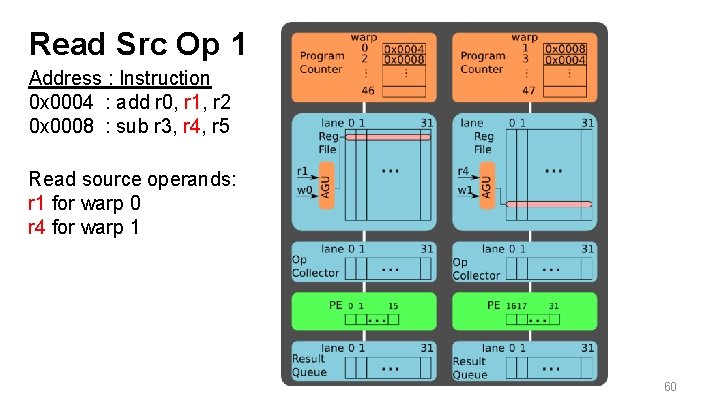
Read Src Op 1 Address : Instruction 0 x 0004 : add r 0, r 1, r 2 0 x 0008 : sub r 3, r 4, r 5 Read source operands: r 1 for warp 0 r 4 for warp 1 60
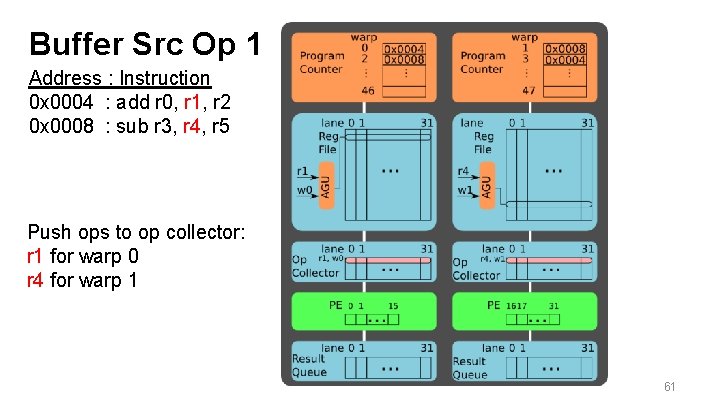
Buffer Src Op 1 Address : Instruction 0 x 0004 : add r 0, r 1, r 2 0 x 0008 : sub r 3, r 4, r 5 Push ops to op collector: r 1 for warp 0 r 4 for warp 1 61
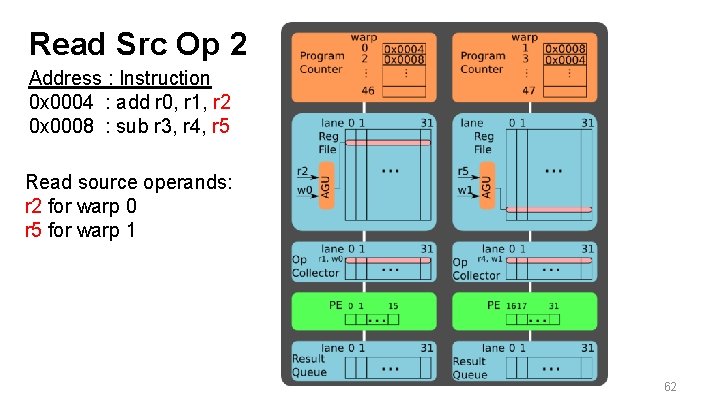
Read Src Op 2 Address : Instruction 0 x 0004 : add r 0, r 1, r 2 0 x 0008 : sub r 3, r 4, r 5 Read source operands: r 2 for warp 0 r 5 for warp 1 62
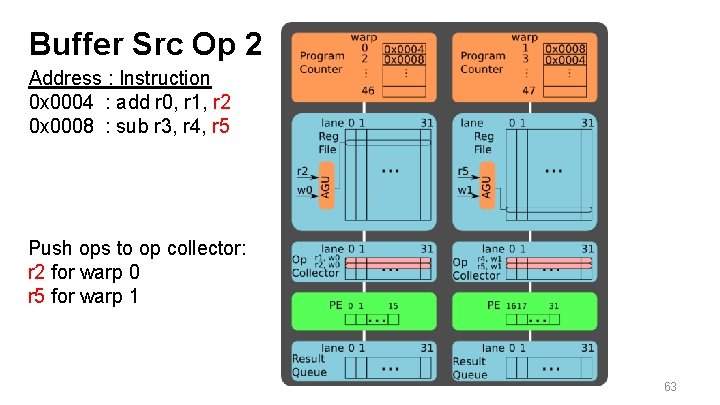
Buffer Src Op 2 Address : Instruction 0 x 0004 : add r 0, r 1, r 2 0 x 0008 : sub r 3, r 4, r 5 Push ops to op collector: r 2 for warp 0 r 5 for warp 1 63
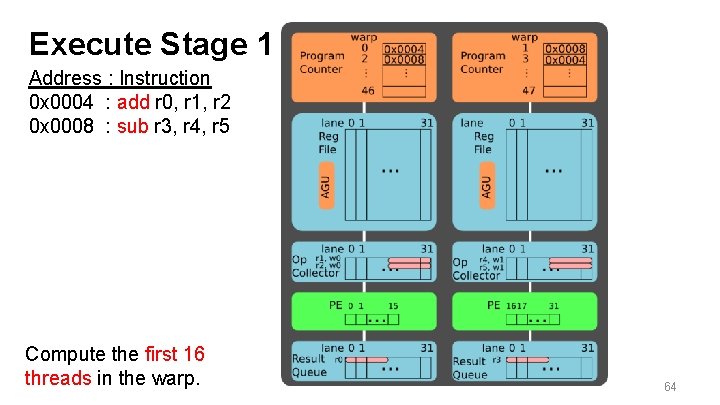
Execute Stage 1 Address : Instruction 0 x 0004 : add r 0, r 1, r 2 0 x 0008 : sub r 3, r 4, r 5 Compute the first 16 threads in the warp. 64
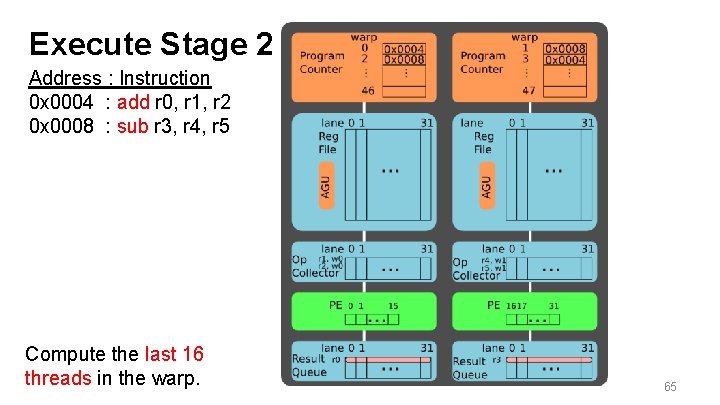
Execute Stage 2 Address : Instruction 0 x 0004 : add r 0, r 1, r 2 0 x 0008 : sub r 3, r 4, r 5 Compute the last 16 threads in the warp. 65
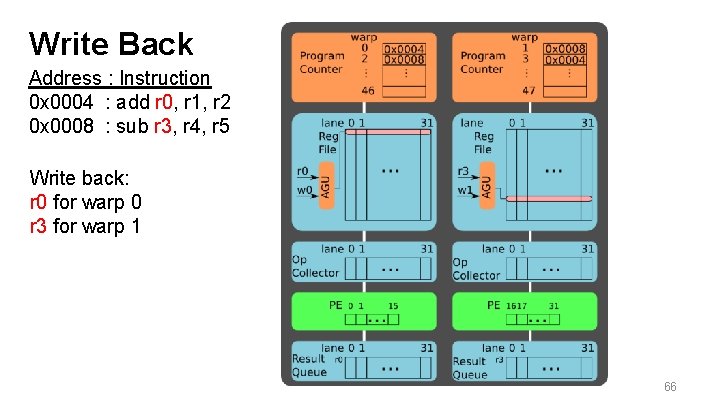
Write Back Address : Instruction 0 x 0004 : add r 0, r 1, r 2 0 x 0008 : sub r 3, r 4, r 5 Write back: r 0 for warp 0 r 3 for warp 1 66
Recap What we have learned so far: ● Pros and cons of massive threading ● How threads are executed on GPUs Next: variations of GPU multiprocessor cluster. 67
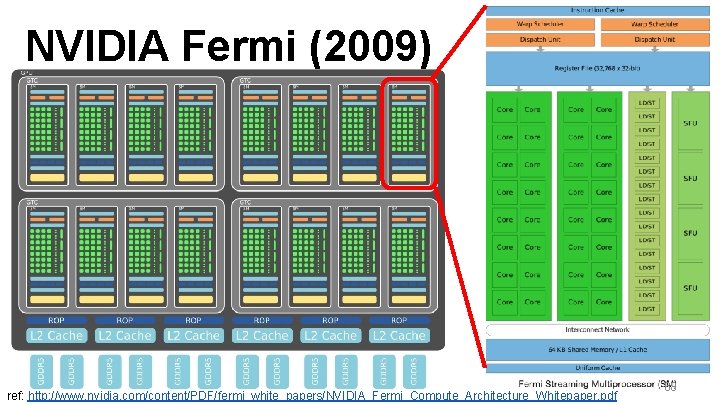
NVIDIA Fermi (2009) ref: http: //www. nvidia. com/content/PDF/fermi_white_papers/NVIDIA_Fermi_Compute_Architecture_Whitepaper. pdf 68
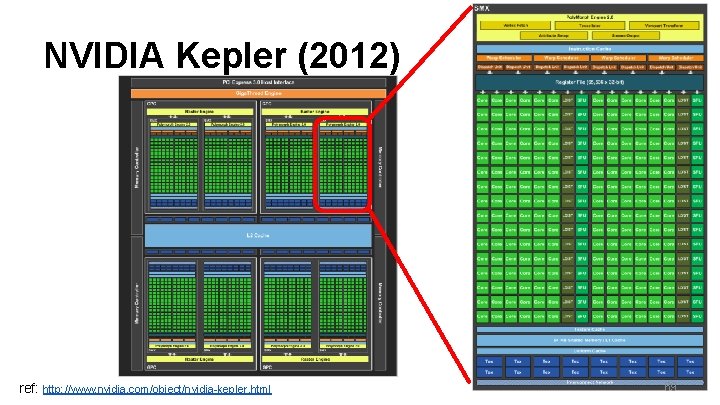
NVIDIA Kepler (2012) ref: http: //www. nvidia. com/object/nvidia-kepler. html 69
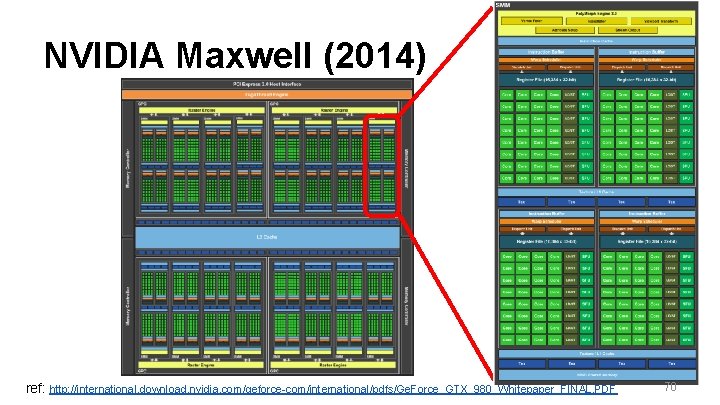
NVIDIA Maxwell (2014) ref: http: //international. download. nvidia. com/geforce-com/international/pdfs/Ge. Force_GTX_980_Whitepaper_FINAL. PDF 70
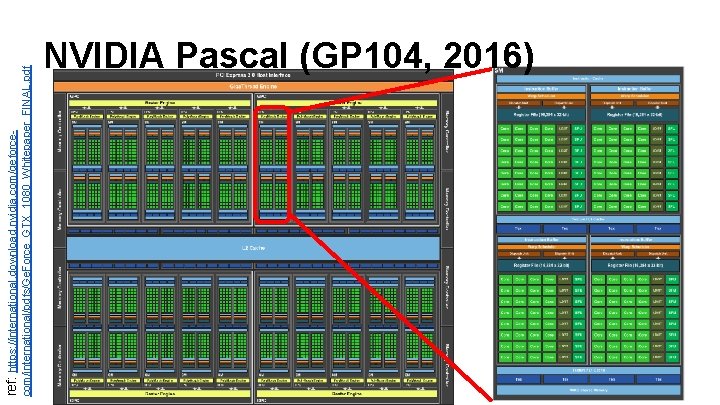
com/international/pdfs/Ge. Force_GTX_1080_Whitepaper_FINAL. pdf ref: https: //international. download. nvidia. com/geforce- NVIDIA Pascal (GP 104, 2016) 71
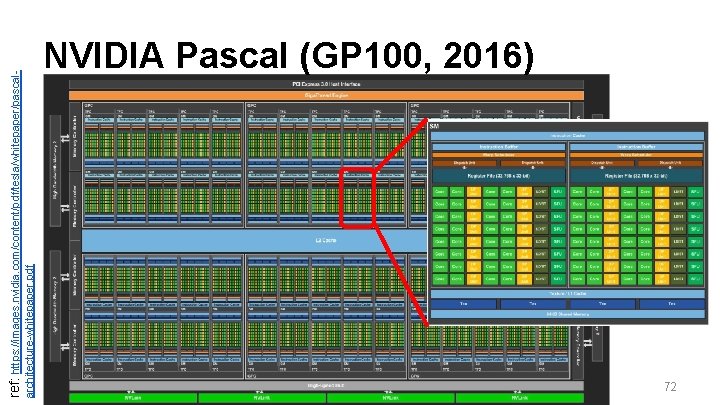
architecture-whitepaper. pdf ref: https: //images. nvidia. com/content/pdf/tesla/whitepaper/pascal- NVIDIA Pascal (GP 100, 2016) 72
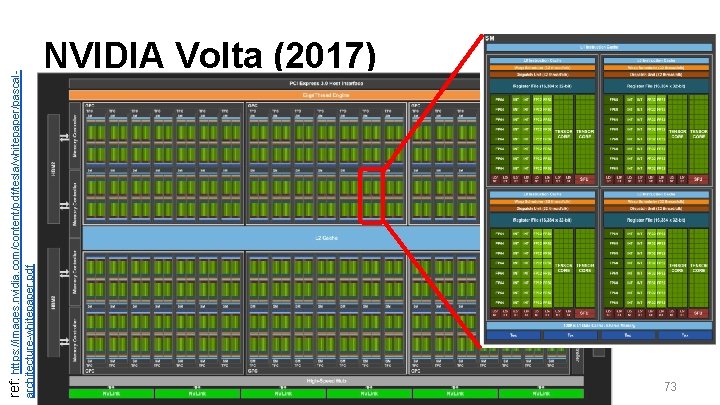
architecture-whitepaper. pdf ref: https: //images. nvidia. com/content/pdf/tesla/whitepaper/pascal- NVIDIA Volta (2017) 73
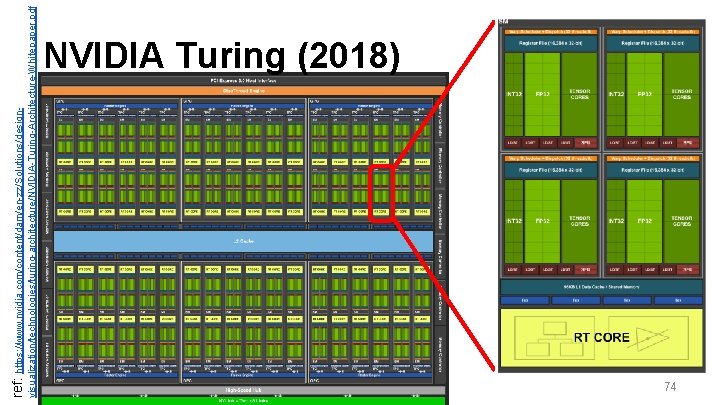
visualization/technologies/turing-architecture/NVIDIA-Turing-Architecture-Whitepaper. pdf ref: https: //www. nvidia. com/content/dam/en-zz/Solutions/design- NVIDIA Turing (2018) 74
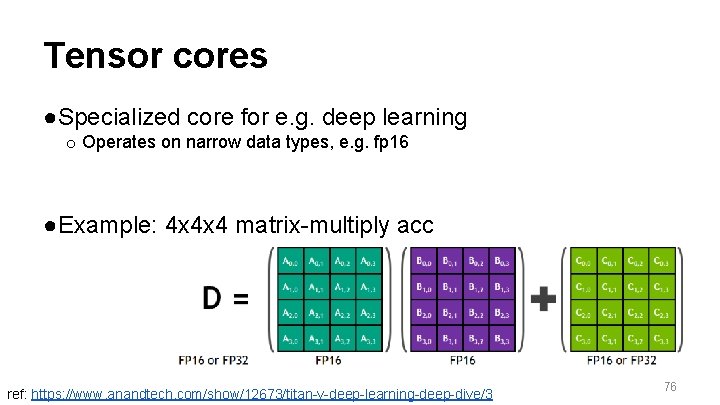
Tensor cores ●Specialized core for e. g. deep learning o Operates on narrow data types, e. g. fp 16 ●Example: 4 x 4 x 4 matrix-multiply acc ref: https: //www. anandtech. com/show/12673/titan-v-deep-learning-deep-dive/3 76
What Are the Possible Hazards? Three types of hazards we have learned earlier: ● Structural hazards ● Data hazards ● Control hazards 77
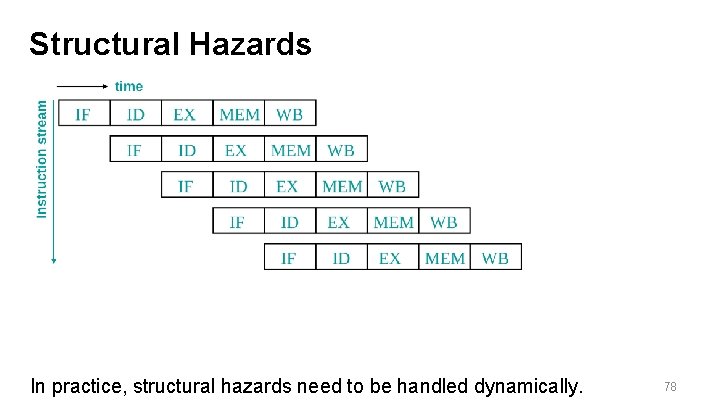
Structural Hazards In practice, structural hazards need to be handled dynamically. 78
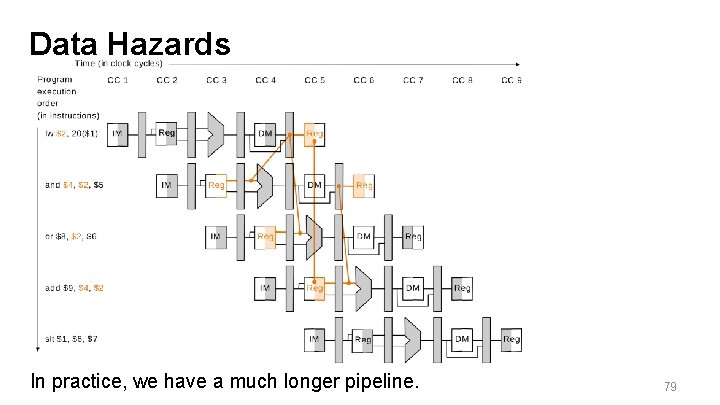
Data Hazards In practice, we have a much longer pipeline. 79
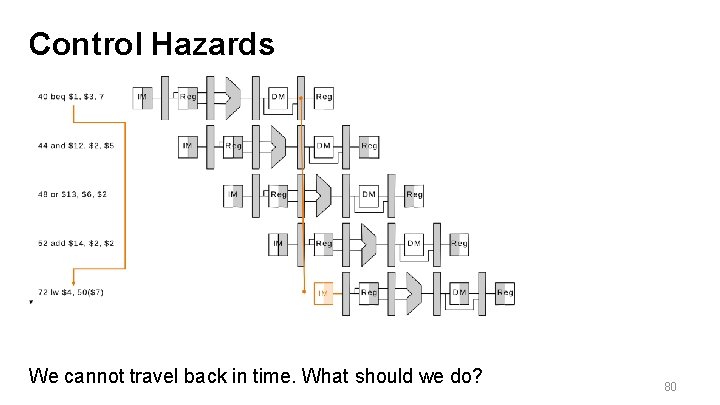
Control Hazards We cannot travel back in time. What should we do? 80
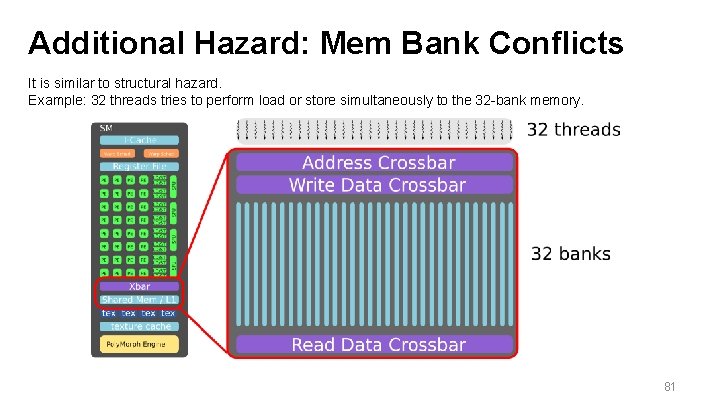
Additional Hazard: Mem Bank Conflicts It is similar to structural hazard. Example: 32 threads tries to perform load or store simultaneously to the 32 -bank memory. 81
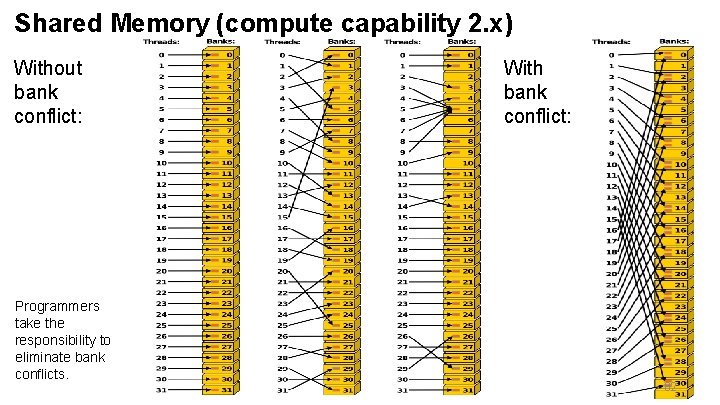
Shared Memory (compute capability 2. x) Without bank conflict: Programmers take the responsibility to eliminate bank conflicts. With bank conflict: 82
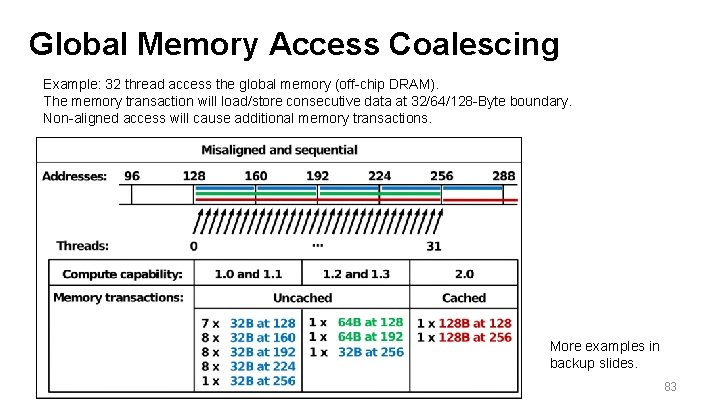
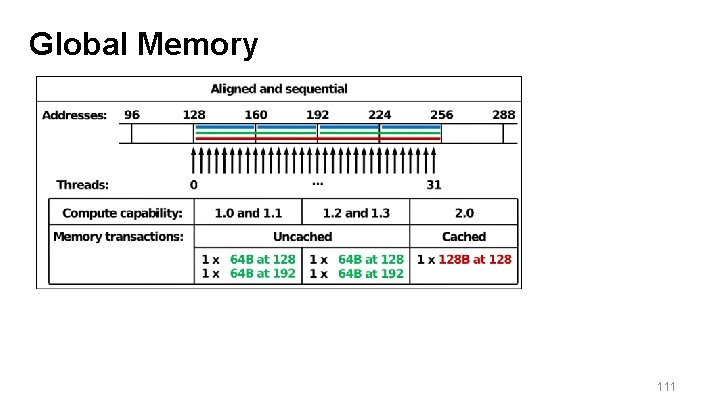
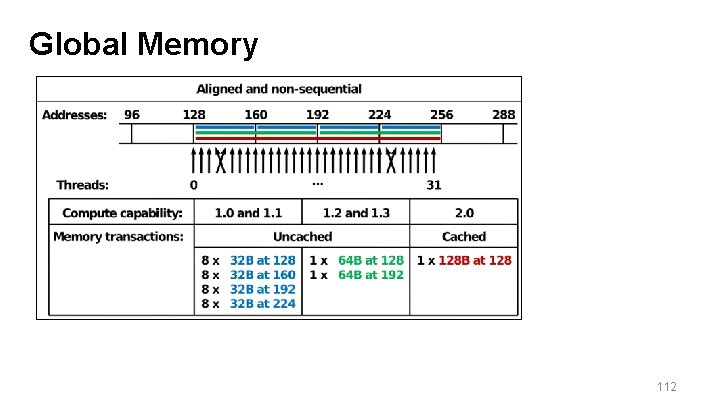
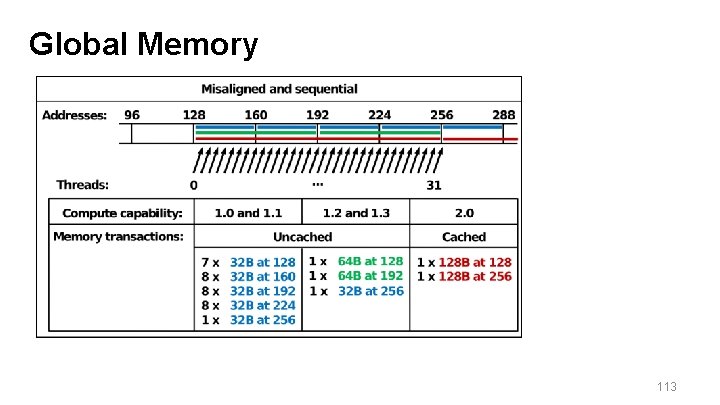
Global Memory Access Coalescing Example: 32 thread access the global memory (off-chip DRAM). The memory transaction will load/store consecutive data at 32/64/128 -Byte boundary. Non-aligned access will cause additional memory transactions. More examples in backup slides. 83
Additional Hazards: Branch Divergence GPUs (and SIMDs in general) have additional challenges: branch divergence. 84
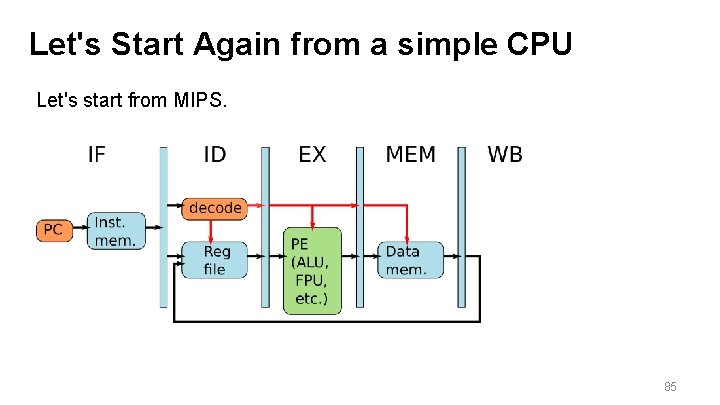
Let's Start Again from a simple CPU Let's start from MIPS. 85
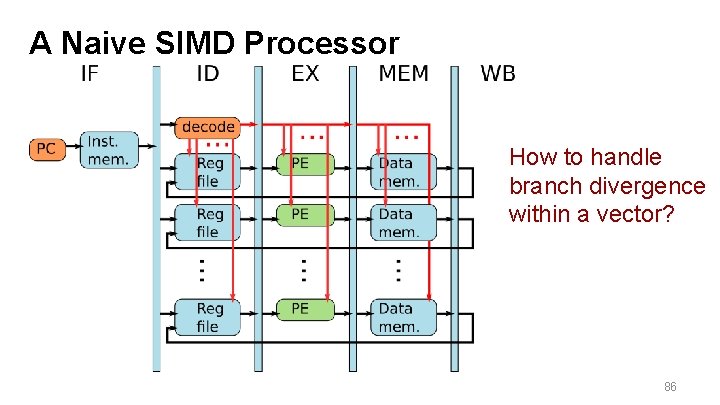
A Naive SIMD Processor How to handle branch divergence within a vector? 86
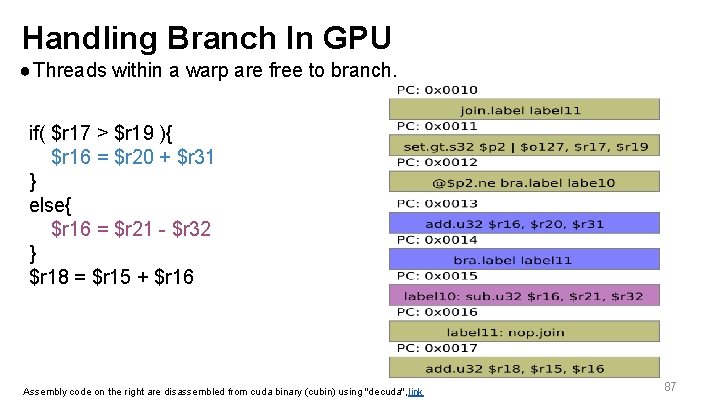
Handling Branch In GPU ● Threads within a warp are free to branch. if( $r 17 > $r 19 ){ $r 16 = $r 20 + $r 31 } else{ $r 16 = $r 21 - $r 32 } $r 18 = $r 15 + $r 16 Assembly code on the right are disassembled from cuda binary (cubin) using "decuda", link 87
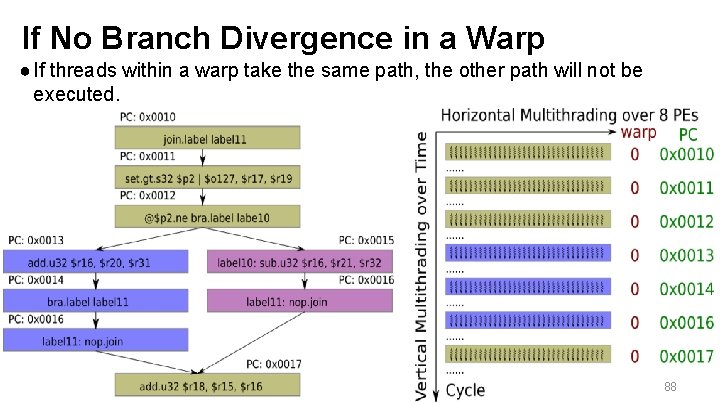
If No Branch Divergence in a Warp ● If threads within a warp take the same path, the other path will not be executed. 88
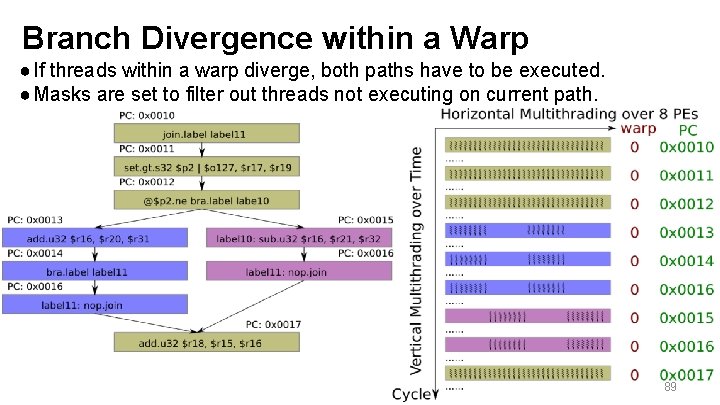
Branch Divergence within a Warp ● If threads within a warp diverge, both paths have to be executed. ● Masks are set to filter out threads not executing on current path. 89
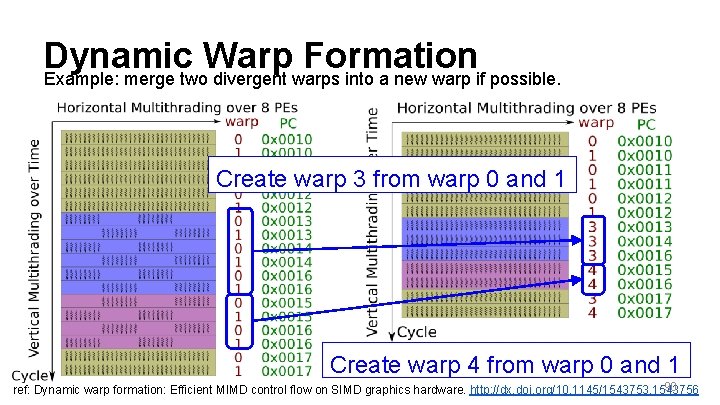
Dynamic Warp Formation Example: merge two divergent warps into a new warp if possible. Create warp 3 from warp 0 and 1 Create warp 4 from warp 0 and 1 90 ref: Dynamic warp formation: Efficient MIMD control flow on SIMD graphics hardware. http: //dx. doi. org/10. 1145/1543753. 1543756
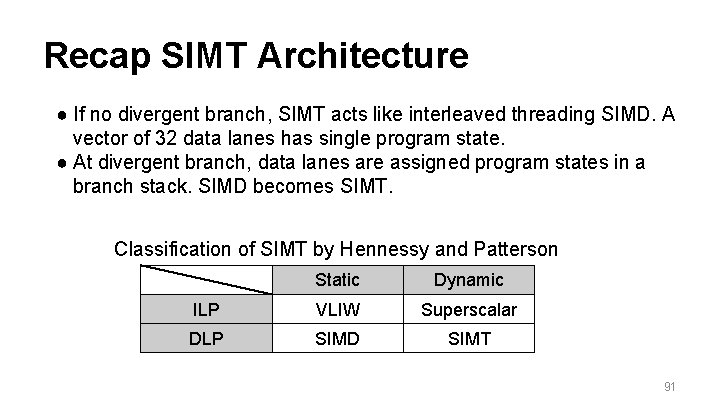
Recap SIMT Architecture ● If no divergent branch, SIMT acts like interleaved threading SIMD. A vector of 32 data lanes has single program state. ● At divergent branch, data lanes are assigned program states in a branch stack. SIMD becomes SIMT. Classification of SIMT by Hennessy and Patterson Static Dynamic ILP VLIW Superscalar DLP SIMD SIMT 91
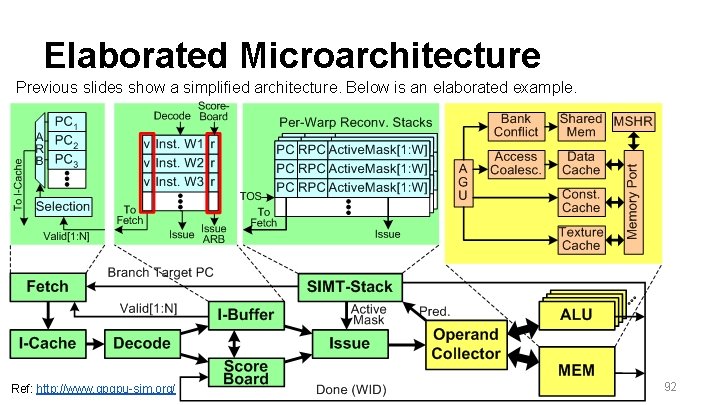
Elaborated Microarchitecture Previous slides show a simplified architecture. Below is an elaborated example. Ref: http: //www. gpgpu-sim. org/ 92
Performance Modeling What are the bottlenecks? 93
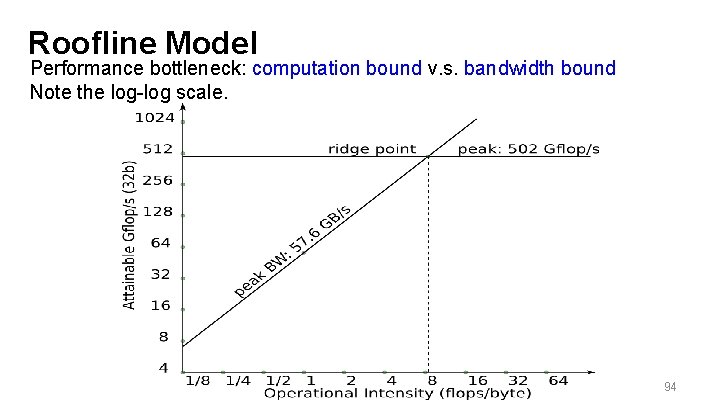
Roofline Model Performance bottleneck: computation bound v. s. bandwidth bound Note the log-log scale. 94
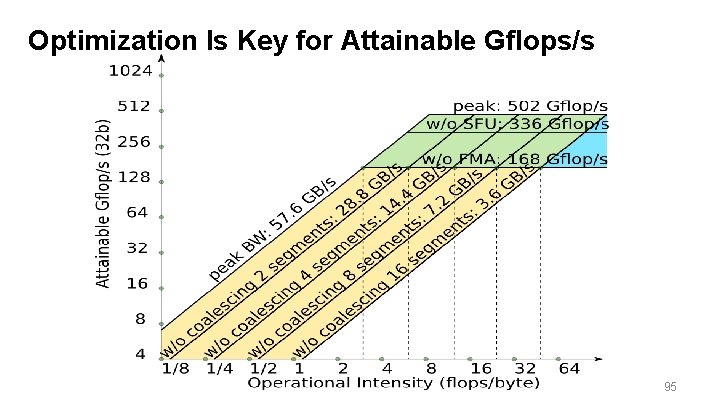
Optimization Is Key for Attainable Gflops/s 95
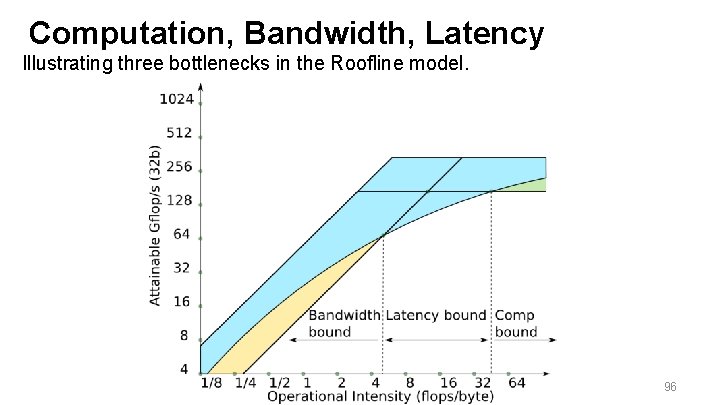
Computation, Bandwidth, Latency Illustrating three bottlenecks in the Roofline model. 96
Program Optimization If I know the bottleneck, how to optimize? Optimization techniques for NVIDIA GPUs: "Best Practices Guide" http: //docs. nvidia. com/cuda/ 97
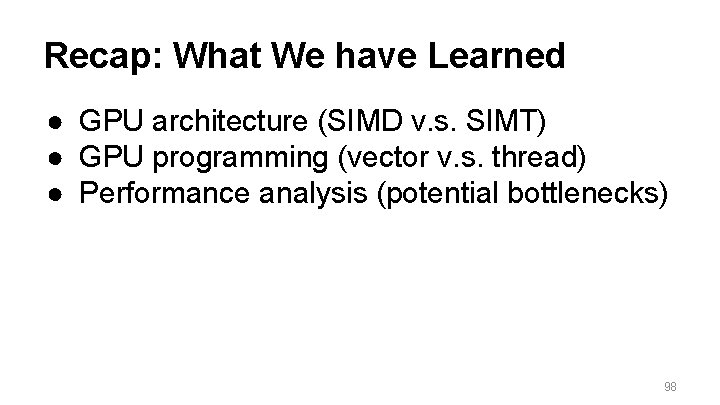
Recap: What We have Learned ● GPU architecture (SIMD v. s. SIMT) ● GPU programming (vector v. s. thread) ● Performance analysis (potential bottlenecks) 98
Further Reading GPU architecture and programming: ● NVIDIA Tesla: A unified graphics and computing architecture, in IEEE Micro 2008. (http: //dx. doi. org/10. 1109/MM. 2008. 31) ● Scalable Parallel Programming with CUDA, in ACM Queue 2008. (http: //dx. doi. org/10. 1145/1365490. 1365500) ● Understanding throughput-oriented architectures, in Communications of the ACM 2010. (http: //dx. doi. org/10. 1145/1839676. 1839694) 99
Recommended Reading (Optional) Performance modeling: ● Roofline: an insightful visual performance model for multicore architectures, in Communications of the ACM 2009. (http: //dx. doi. org/10. 1145/1498765. 1498785) Handling branch divergence in SIMT: ● Dynamic warp formation: Efficient MIMD control flow on SIMD graphics hardware, in ACM Transactions on Architecture and Code Optimization 2009. (http: //dx. doi. org/10. 1145/1543753. 1543756) 100

Thank You Questions? Disclaimer: The opinions expressed in this presentation are solely from the presenter, and do not express the views or opinions of his/her employer. 101
Backup Slides 102
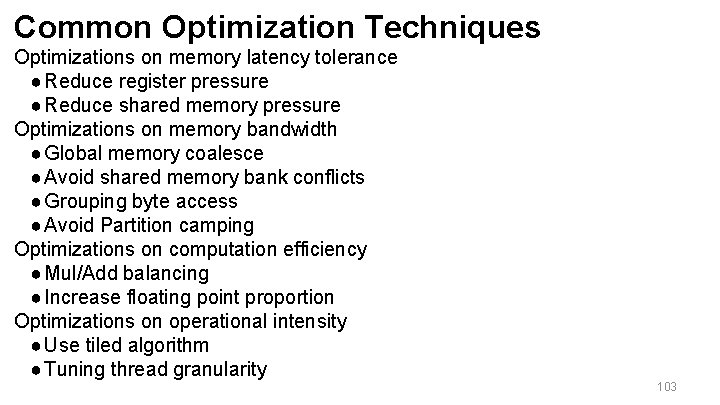
Common Optimization Techniques Optimizations on memory latency tolerance ● Reduce register pressure ● Reduce shared memory pressure Optimizations on memory bandwidth ● Global memory coalesce ● Avoid shared memory bank conflicts ● Grouping byte access ● Avoid Partition camping Optimizations on computation efficiency ● Mul/Add balancing ● Increase floating point proportion Optimizations on operational intensity ● Use tiled algorithm ● Tuning thread granularity 103
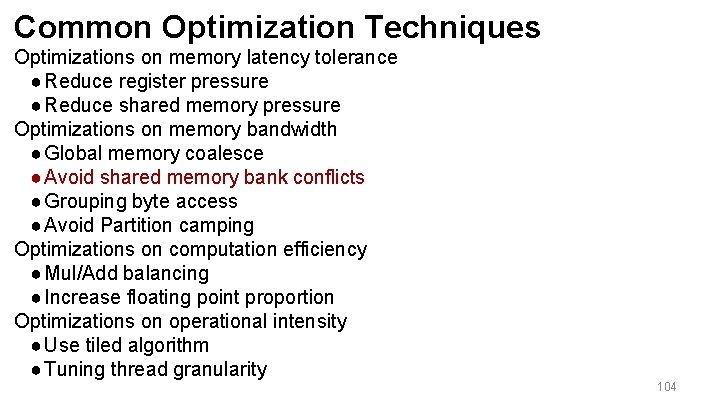
Common Optimization Techniques Optimizations on memory latency tolerance ● Reduce register pressure ● Reduce shared memory pressure Optimizations on memory bandwidth ● Global memory coalesce ● Avoid shared memory bank conflicts ● Grouping byte access ● Avoid Partition camping Optimizations on computation efficiency ● Mul/Add balancing ● Increase floating point proportion Optimizations on operational intensity ● Use tiled algorithm ● Tuning thread granularity 104
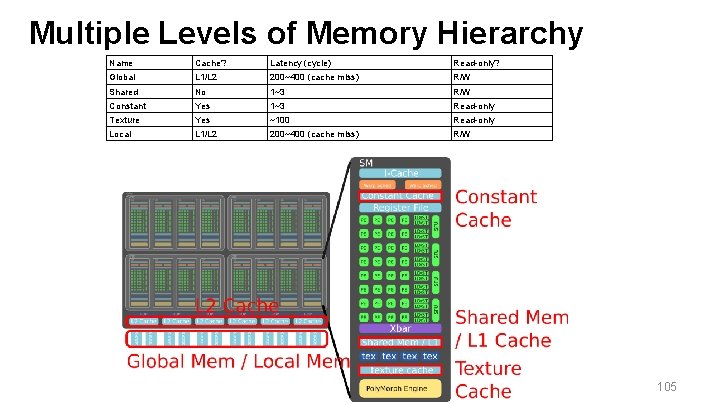
Multiple Levels of Memory Hierarchy Name Cache? Latency (cycle) Read-only? Global L 1/L 2 200~400 (cache miss) R/W Shared No 1~3 R/W Constant Yes 1~3 Read-only Texture Yes ~100 Read-only Local L 1/L 2 200~400 (cache miss) R/W 105
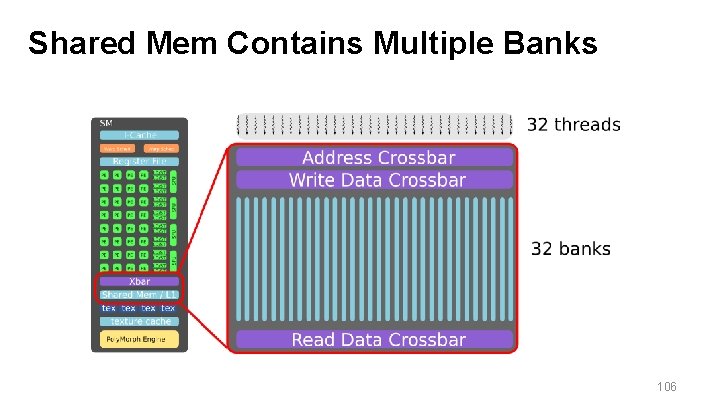
Shared Mem Contains Multiple Banks 106
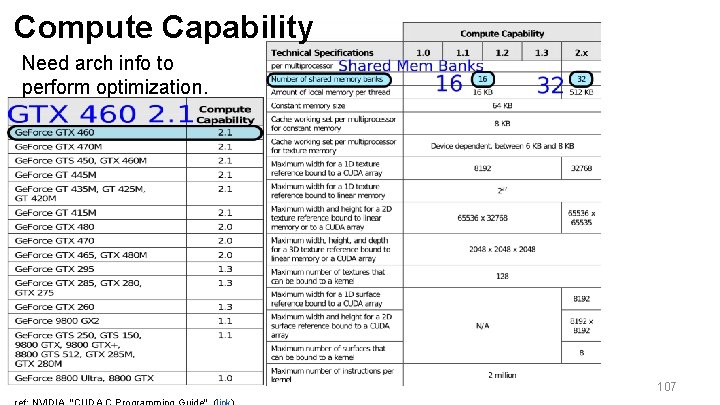
Compute Capability Need arch info to perform optimization. 107
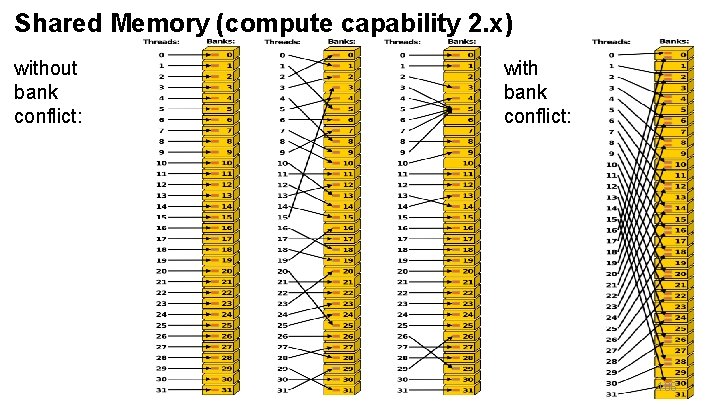
Shared Memory (compute capability 2. x) without bank conflict: with bank conflict: 108
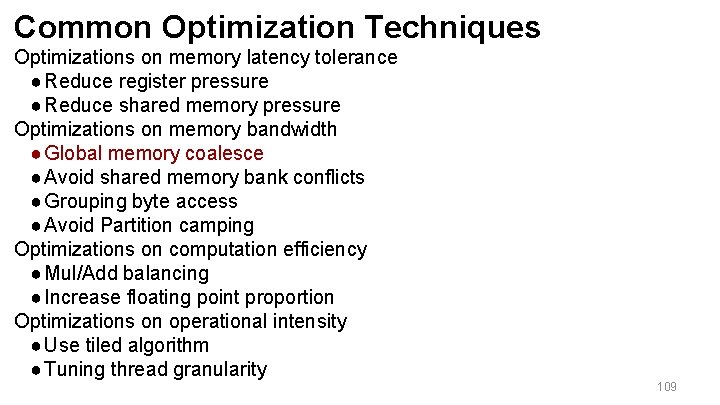
Common Optimization Techniques Optimizations on memory latency tolerance ● Reduce register pressure ● Reduce shared memory pressure Optimizations on memory bandwidth ● Global memory coalesce ● Avoid shared memory bank conflicts ● Grouping byte access ● Avoid Partition camping Optimizations on computation efficiency ● Mul/Add balancing ● Increase floating point proportion Optimizations on operational intensity ● Use tiled algorithm ● Tuning thread granularity 109
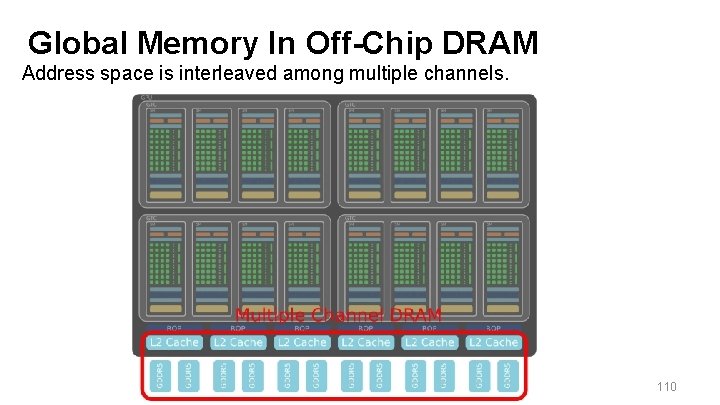
Global Memory In Off-Chip DRAM Address space is interleaved among multiple channels. 110
Global Memory 111
Global Memory 112
Global Memory 113
- Slides: 112