
Graphics Pipeline Clipping CMSC 435634 Graphics Pipeline Objectorder
Graphics Pipeline Clipping CMSC 435/634
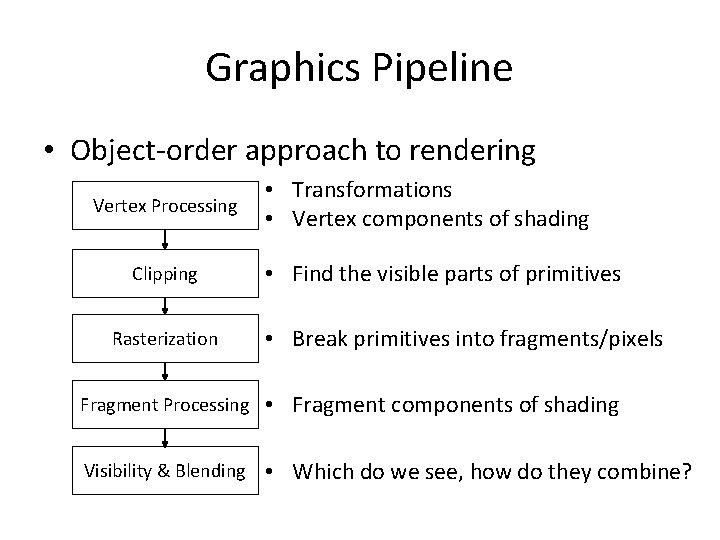
Graphics Pipeline • Object-order approach to rendering Vertex Processing Clipping Rasterization • Transformations • Vertex components of shading • Find the visible parts of primitives • Break primitives into fragments/pixels Fragment Processing • Fragment components of shading Visibility & Blending • Which do we see, how do they combine?
Why Clip? • Window sides – Draw less – Some rasterization algorithms need everything on screen • Near – Draw less – Don’t divide by 0 – Don’t divide by negative z • Far – Draw less – Constrain Z range
Clipping & Culling • • Cull: decide not to draw an object at all Clip: slice to keep just the visible parts Trivial Reject: Entirely off-screen Trivial Accept: Entirely on screen 4
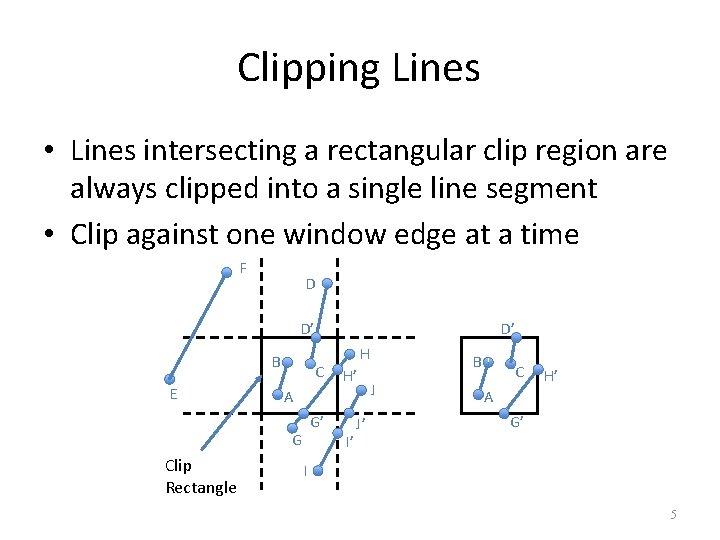
Clipping Lines • Lines intersecting a rectangular clip region are always clipped into a single line segment • Clip against one window edge at a time F D D’ B E C H H’ A G’ G Clip Rectangle D’ I’ J’ B J C H’ A G’ I 5
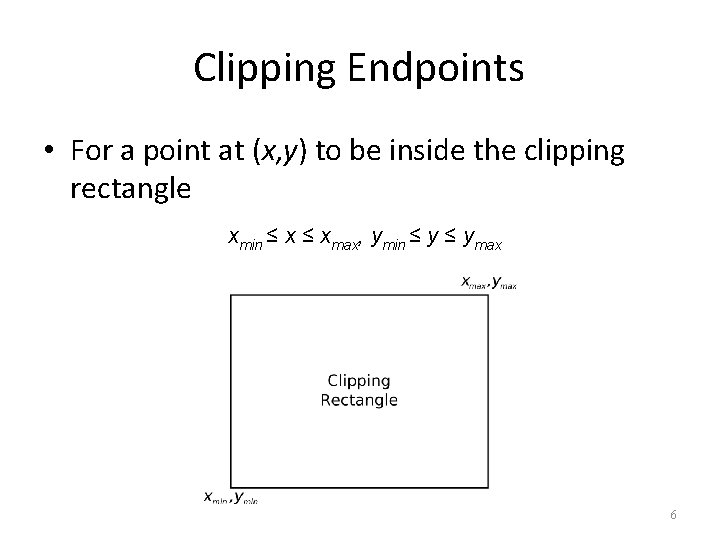
Clipping Endpoints • For a point at (x, y) to be inside the clipping rectangle xmin ≤ xmax, ymin ≤ ymax 6
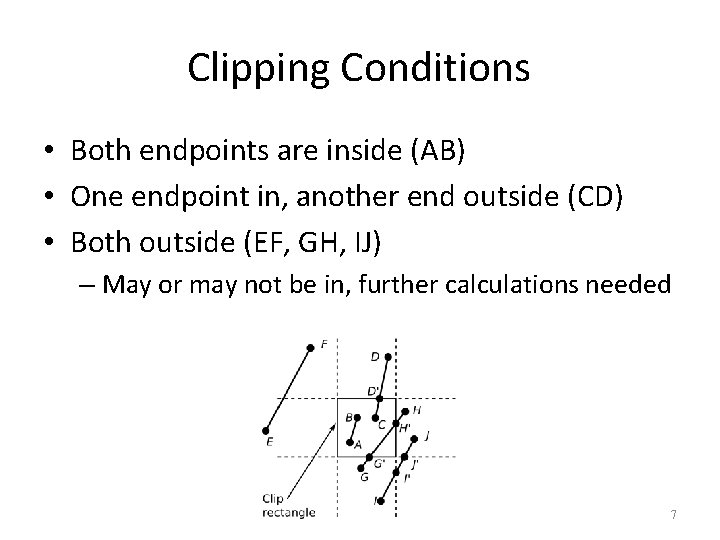
Clipping Conditions • Both endpoints are inside (AB) • One endpoint in, another end outside (CD) • Both outside (EF, GH, IJ) – May or may not be in, further calculations needed 7
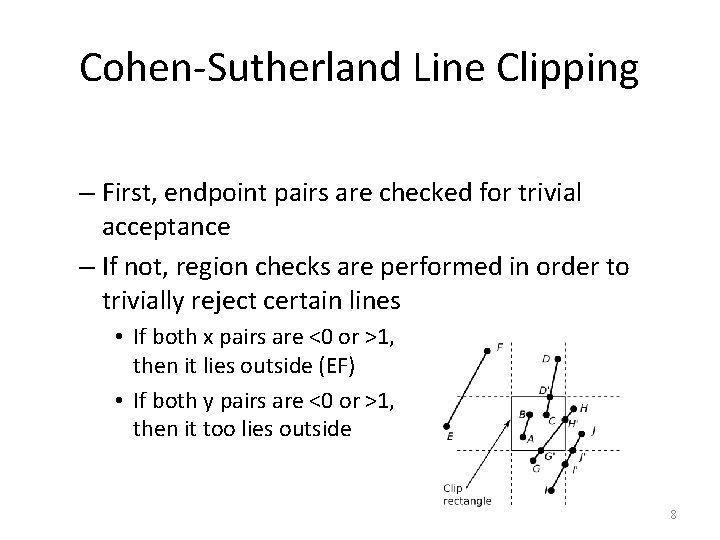
Cohen-Sutherland Line Clipping – First, endpoint pairs are checked for trivial acceptance – If not, region checks are performed in order to trivially reject certain lines • If both x pairs are <0 or >1, then it lies outside (EF) • If both y pairs are <0 or >1, then it too lies outside 8
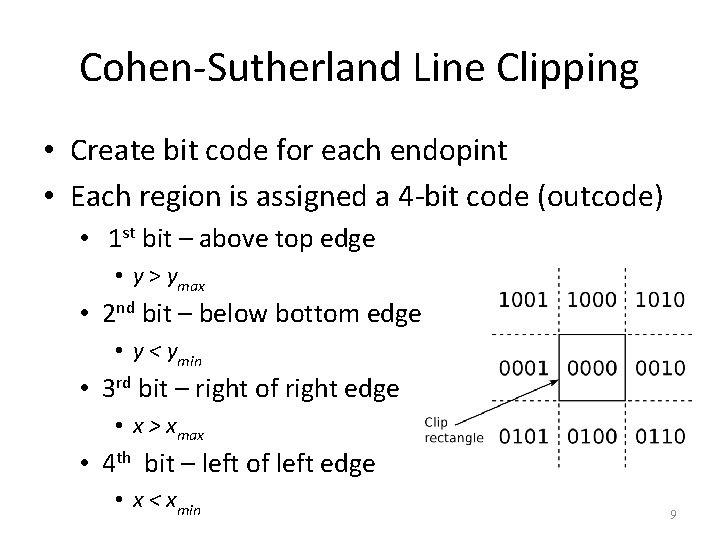
Cohen-Sutherland Line Clipping • Create bit code for each endopint • Each region is assigned a 4 -bit code (outcode) • 1 st bit – above top edge • y > ymax • 2 nd bit – below bottom edge • y < ymin • 3 rd bit – right of right edge • x > xmax • 4 th bit – left of left edge • x < xmin 9
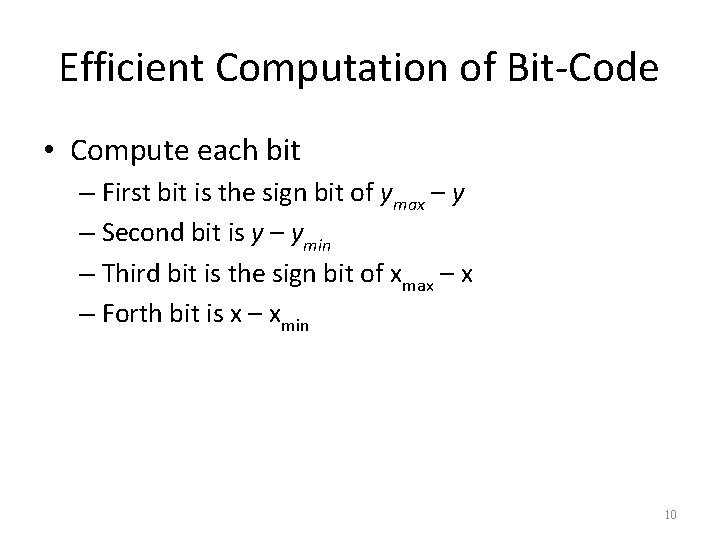
Efficient Computation of Bit-Code • Compute each bit – First bit is the sign bit of ymax – y – Second bit is y – ymin – Third bit is the sign bit of xmax – Forth bit is x – xmin 10
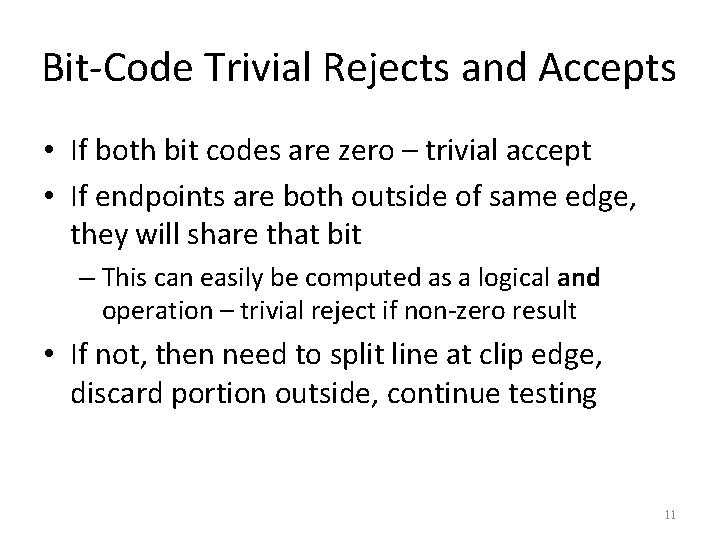
Bit-Code Trivial Rejects and Accepts • If both bit codes are zero – trivial accept • If endpoints are both outside of same edge, they will share that bit – This can easily be computed as a logical and operation – trivial reject if non-zero result • If not, then need to split line at clip edge, discard portion outside, continue testing 11
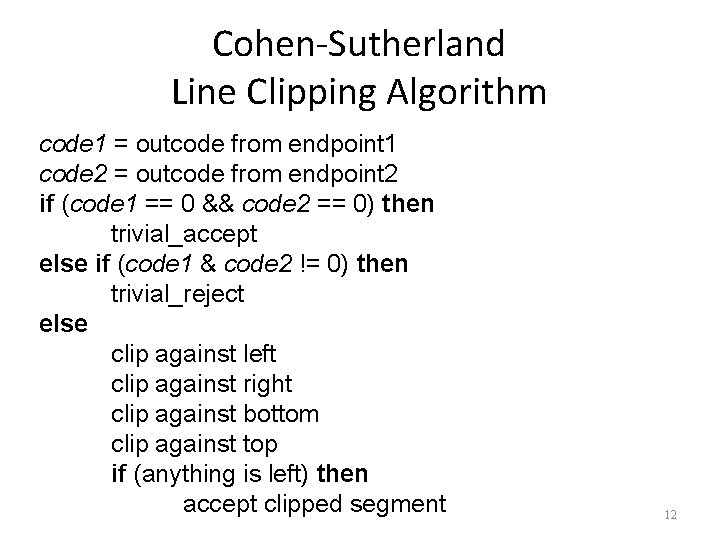
Cohen-Sutherland Line Clipping Algorithm code 1 = outcode from endpoint 1 code 2 = outcode from endpoint 2 if (code 1 == 0 && code 2 == 0) then trivial_accept else if (code 1 & code 2 != 0) then trivial_reject else clip against left clip against right clip against bottom clip against top if (anything is left) then accept clipped segment 12
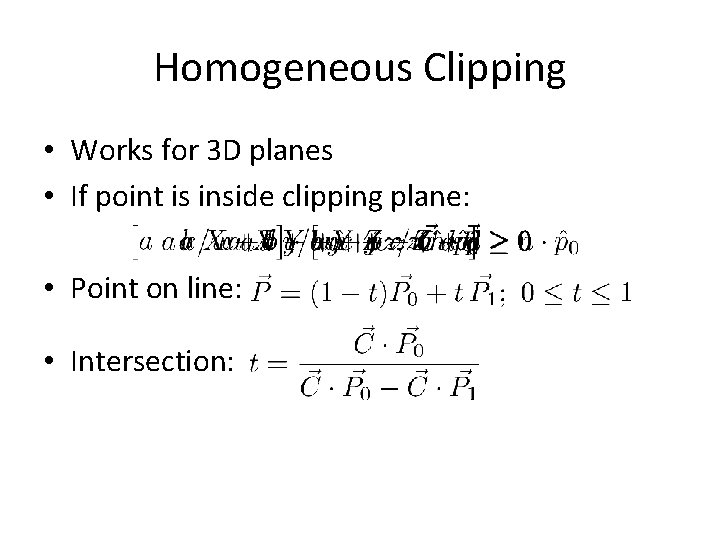
Homogeneous Clipping • Works for 3 D planes • If point is inside clipping plane: • Point on line: • Intersection:
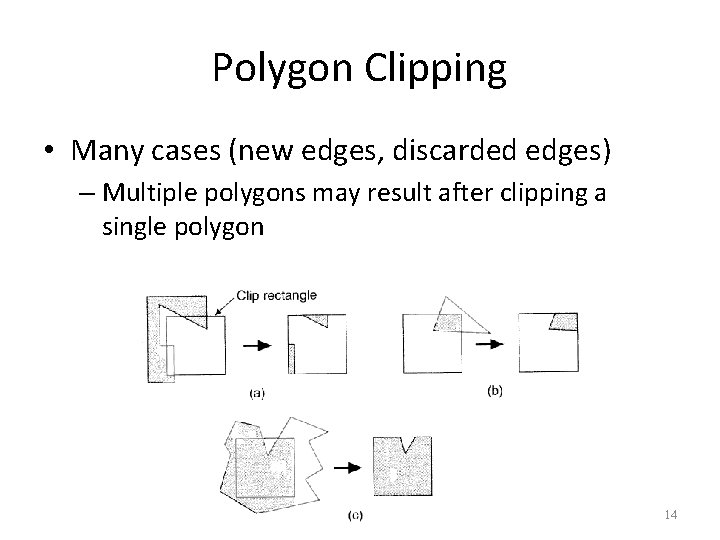
Polygon Clipping • Many cases (new edges, discarded edges) – Multiple polygons may result after clipping a single polygon 14
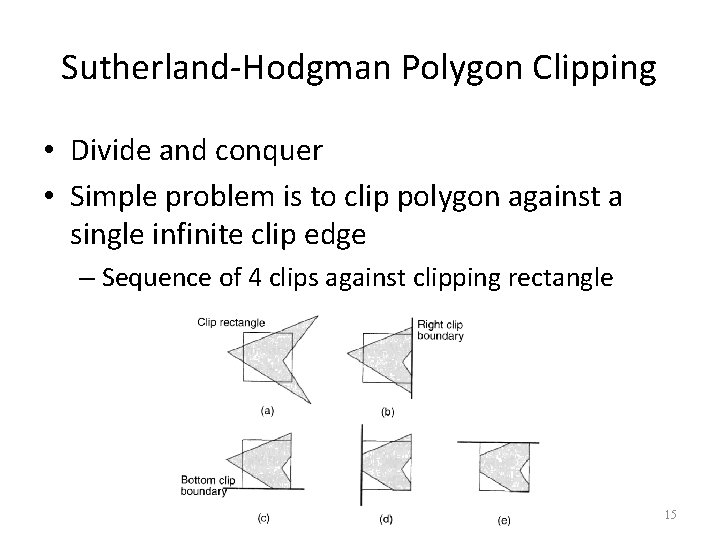
Sutherland-Hodgman Polygon Clipping • Divide and conquer • Simple problem is to clip polygon against a single infinite clip edge – Sequence of 4 clips against clipping rectangle 15
Sutherland-Hodgman Polygon Clipping • Algorithm moves around the polygon from vn to v 1 and then on back to vn • At each step – Check (vi to vi+1) line against the clip edge – Add zero, one, or two vertices to the output 16
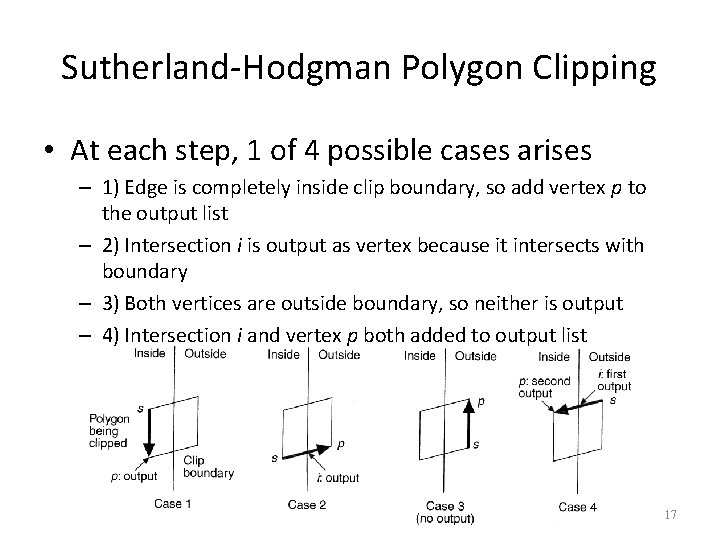
Sutherland-Hodgman Polygon Clipping • At each step, 1 of 4 possible cases arises – 1) Edge is completely inside clip boundary, so add vertex p to the output list – 2) Intersection i is output as vertex because it intersects with boundary – 3) Both vertices are outside boundary, so neither is output – 4) Intersection i and vertex p both added to output list 17
![Sutherland-Hodgman Algorithm Sutherland-Hodgman(array) vertex S = array[ length(array) - 1 ] for ( j](http://slidetodoc.com/presentation_image_h/116d887b202c952c1a8793e0a738d5aa/image-18.jpg "Sutherland-Hodgman Algorithm Sutherland-Hodgman(array) vertex S = array[ length(array) - 1 ] for ( j")
Sutherland-Hodgman Algorithm Sutherland-Hodgman(array) vertex S = array[ length(array) - 1 ] for ( j = 0 ; j < length(array) ; j++ ) do vertex P = array[ j ] if ( P is inside clip plane ) then if ( S is inside clip plane ) then /* case 1 */ Output( P ) else /* case 2 */ Output( Compute. Intersection( S, P, clip plane )) Output( P ) else if ( S is inside clip plane ) then /* case 2 */ Output( Compute. Intersection( P, S, clip plane ) ) else /* case 3 */ no op S=P 18
- Slides: 18