
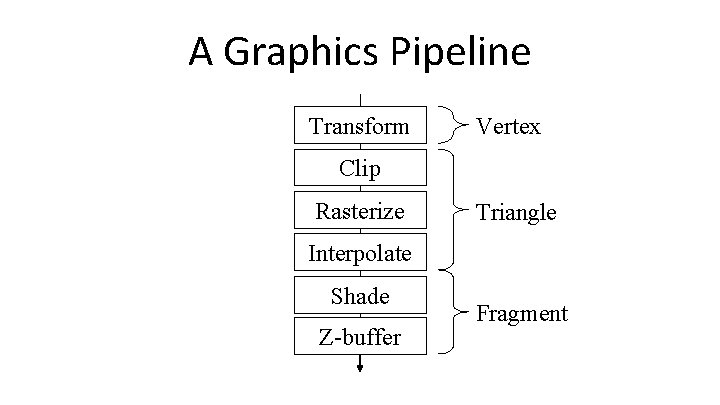
Graphics Hardware CMSC 435634 A Graphics Pipeline Transform

![NVIDIA Ge. Force 6 Vertex Rasterize Fragment Z-Buffer [Kilgaraff and Fernando, GPU Gems 2]](https://slidetodoc.com/presentation_image_h2/9736f7b6c9b50bf5a538520d14e308b6/image-15.jpg "NVIDIA Ge. Force 6 Vertex Rasterize Fragment Z-Buffer [Kilgaraff and Fernando, GPU Gems 2]")
![NVIDIA Maxwell [NVIDIA, NVIDIA Ge. Force GTX 980 Whitepaper, 2014]](https://slidetodoc.com/presentation_image_h2/9736f7b6c9b50bf5a538520d14e308b6/image-19.jpg "NVIDIA Maxwell [NVIDIA, NVIDIA Ge. Force GTX 980 Whitepaper, 2014]")
![NVIDIA Volta [NVIDIA, NVIDIA TESLA V 100 GPU ARCHITECTURE]](https://slidetodoc.com/presentation_image_h2/9736f7b6c9b50bf5a538520d14e308b6/image-25.jpg "NVIDIA Volta [NVIDIA, NVIDIA TESLA V 100 GPU ARCHITECTURE]")
- Slides: 25
Graphics Hardware CMSC 435/634
A Graphics Pipeline Transform Vertex Clip Rasterize Triangle Interpolate Shade Z-buffer Fragment
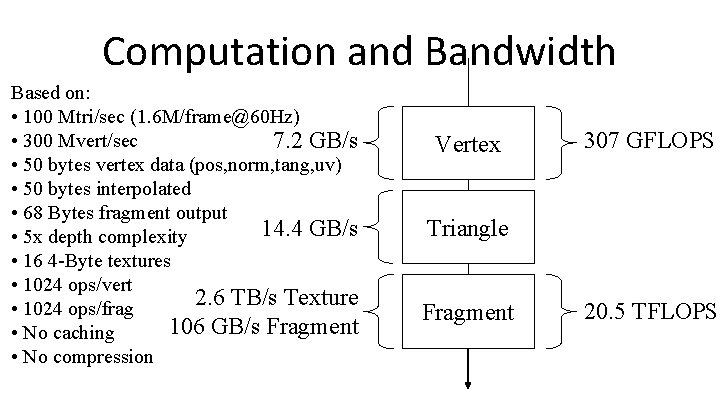
Computation and Bandwidth Based on: • 100 Mtri/sec (1. 6 M/frame@60 Hz) • 300 Mvert/sec 7. 2 GB/s • 50 bytes vertex data (pos, norm, tang, uv) • 50 bytes interpolated • 68 Bytes fragment output 14. 4 GB/s • 5 x depth complexity • 16 4 -Byte textures • 1024 ops/vert 2. 6 TB/s Texture • 1024 ops/frag 106 GB/s Fragment • No caching • No compression Vertex 307 GFLOPS Triangle Fragment 20. 5 TFLOPS
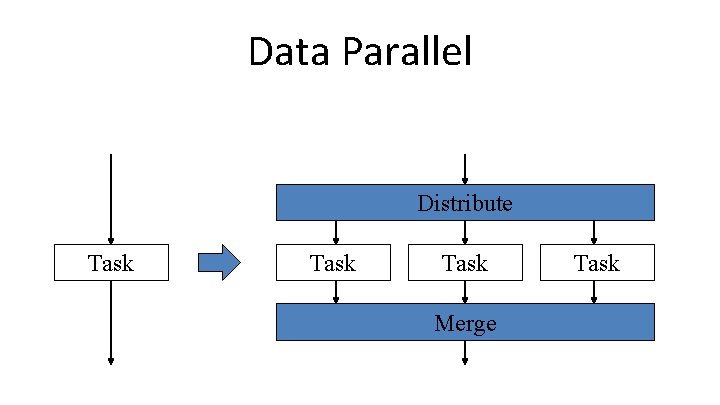
Data Parallel Distribute Task Merge Task
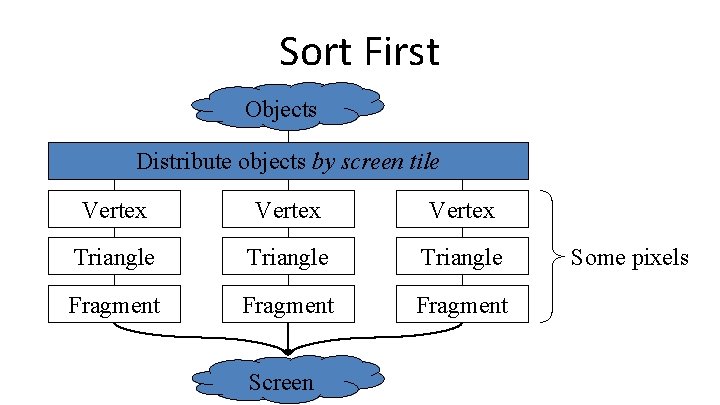
Sort First Objects Distribute objects by screen tile Vertex Triangle Fragment Screen Some pixels
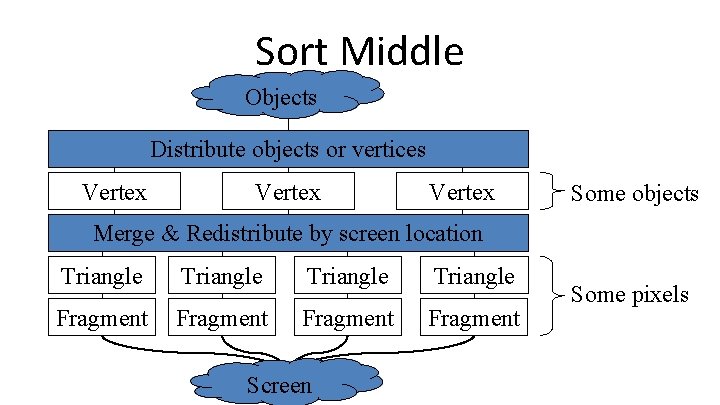
Sort Middle Objects Distribute objects or vertices Vertex Some objects Merge & Redistribute by screen location Triangle Fragment Screen Some pixels
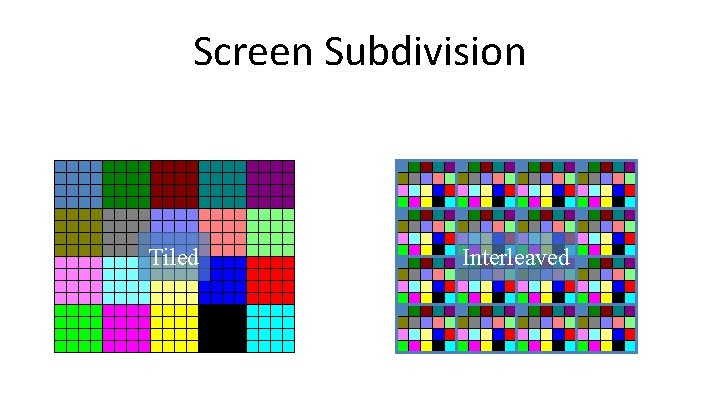
Screen Subdivision Tiled Interleaved
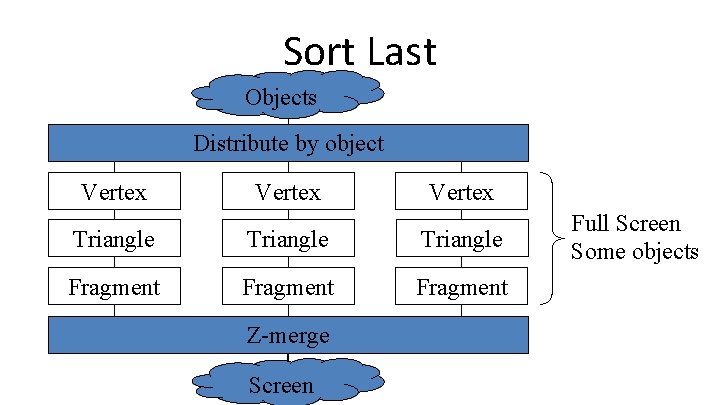
Sort Last Objects Distribute by object Vertex Triangle Fragment Z-merge Screen Full Screen Some objects
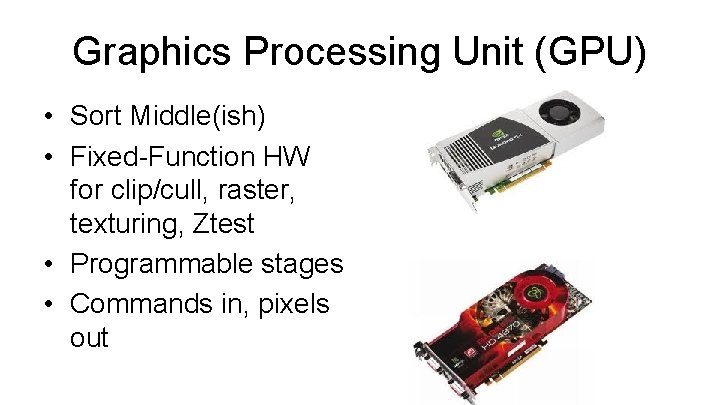
Graphics Processing Unit (GPU) • Sort Middle(ish) • Fixed-Function HW for clip/cull, raster, texturing, Ztest • Programmable stages • Commands in, pixels out
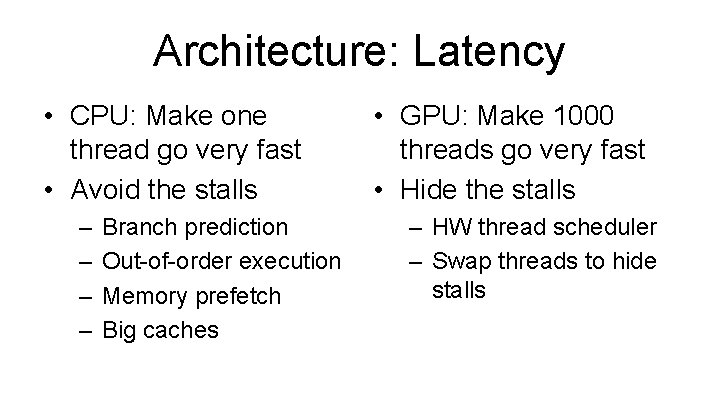
Architecture: Latency • CPU: Make one thread go very fast • Avoid the stalls – – Branch prediction Out-of-order execution Memory prefetch Big caches • GPU: Make 1000 threads go very fast • Hide the stalls – HW thread scheduler – Swap threads to hide stalls
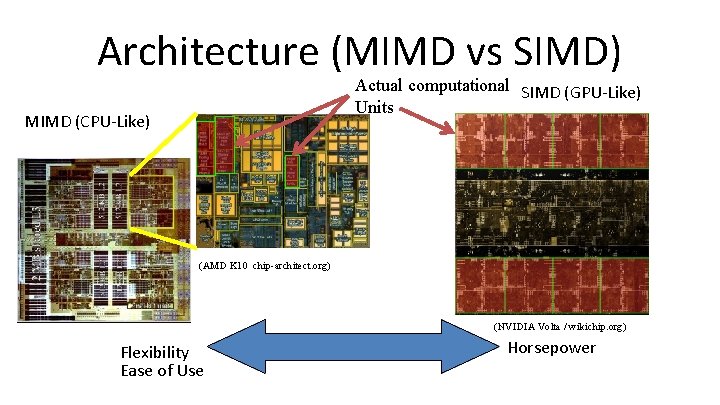
Architecture (MIMD vs SIMD) Actual computational SIMD (GPU-Like) Units MIMD (CPU-Like) (AMD K 10 chip-architect. org) (NVIDIA Volta / wikichip. org) Flexibility Ease of Use Horsepower
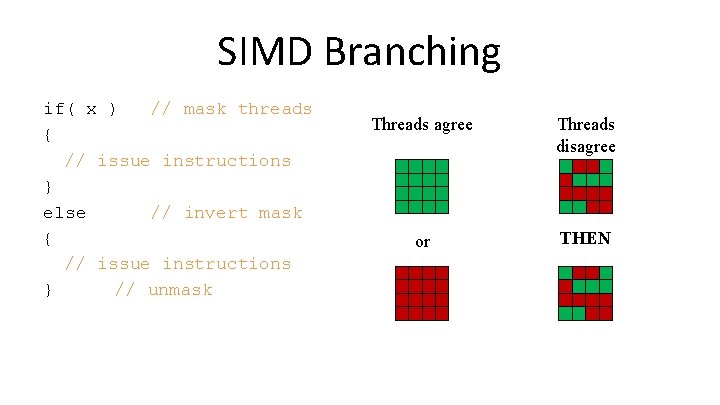
SIMD Branching if( x ) // mask threads { // issue instructions } else // invert mask { // issue instructions } // unmask Threads agree Threads disagree or THEN
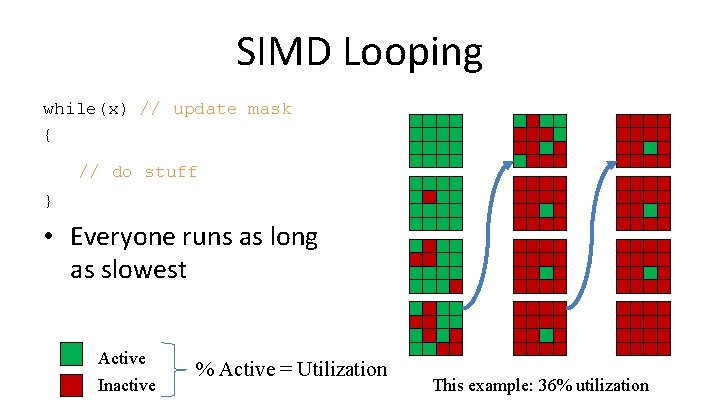
SIMD Looping while(x) // update mask { // do stuff } • Everyone runs as long as slowest Active Inactive % Active = Utilization This example: 36% utilization
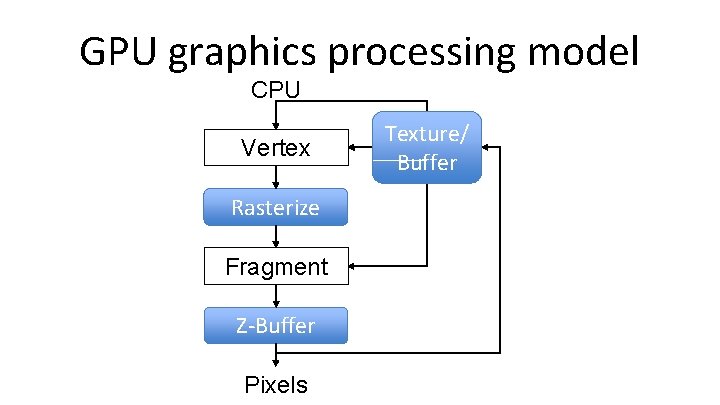
GPU graphics processing model CPU Vertex Rasterize Fragment Z-Buffer Pixels Texture/ Buffer
NVIDIA Ge. Force 6 Vertex Rasterize Fragment Z-Buffer [Kilgaraff and Fernando, GPU Gems 2] Displayed Pixels
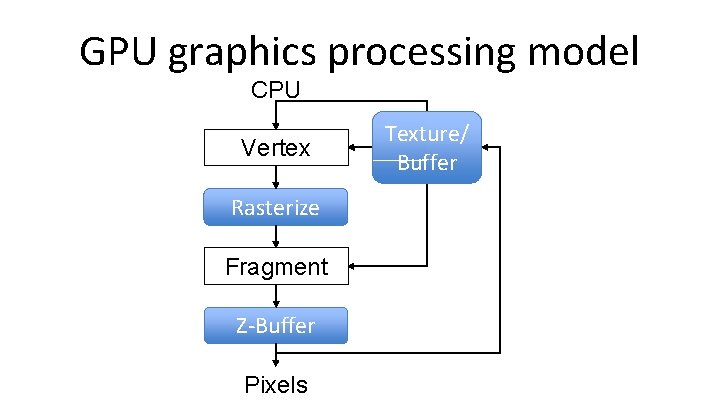
GPU graphics processing model CPU Vertex Rasterize Fragment Z-Buffer Pixels Texture/ Buffer
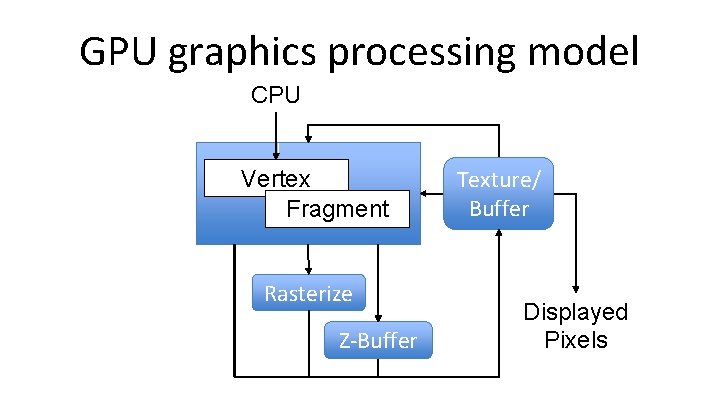
GPU graphics processing model CPU Vertex Fragment Rasterize Z-Buffer Texture/ Buffer Displayed Pixels
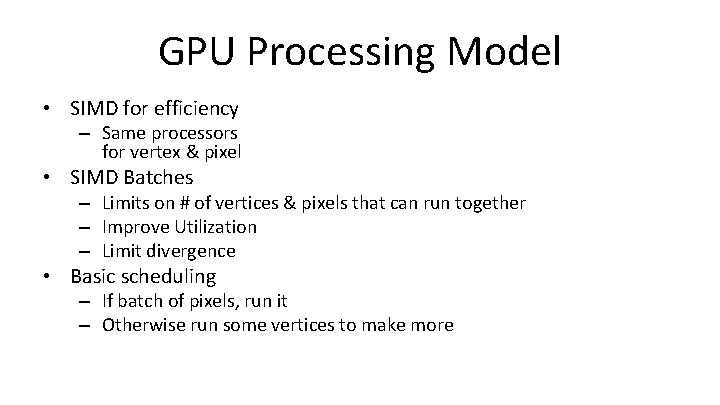
GPU Processing Model • SIMD for efficiency – Same processors for vertex & pixel • SIMD Batches – Limits on # of vertices & pixels that can run together – Improve Utilization – Limit divergence • Basic scheduling – If batch of pixels, run it – Otherwise run some vertices to make more
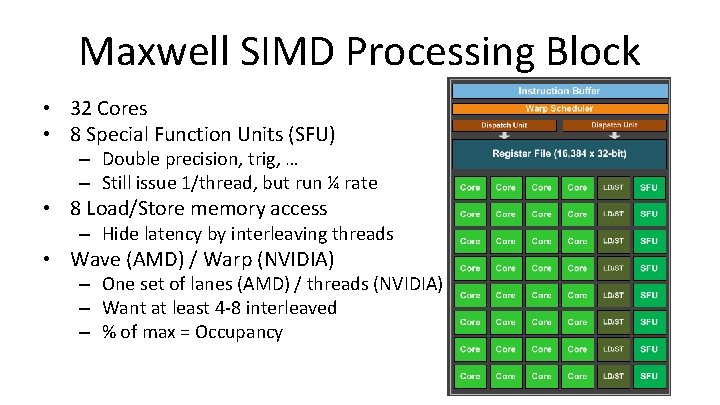
NVIDIA Maxwell [NVIDIA, NVIDIA Ge. Force GTX 980 Whitepaper, 2014]
Maxwell SIMD Processing Block • 32 Cores • 8 Special Function Units (SFU) – Double precision, trig, … – Still issue 1/thread, but run ¼ rate • 8 Load/Store memory access – Hide latency by interleaving threads • Wave (AMD) / Warp (NVIDIA) – One set of lanes (AMD) / threads (NVIDIA) – Want at least 4 -8 interleaved – % of max = Occupancy
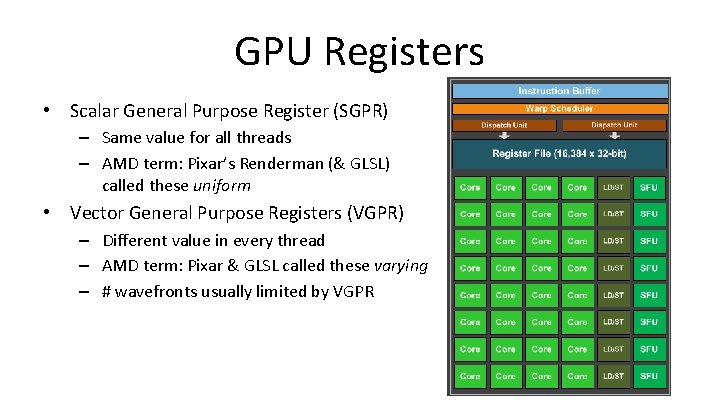
GPU Registers • Scalar General Purpose Register (SGPR) – Same value for all threads – AMD term: Pixar’s Renderman (& GLSL) called these uniform • Vector General Purpose Registers (VGPR) – Different value in every thread – AMD term: Pixar & GLSL called these varying – # wavefronts usually limited by VGPR
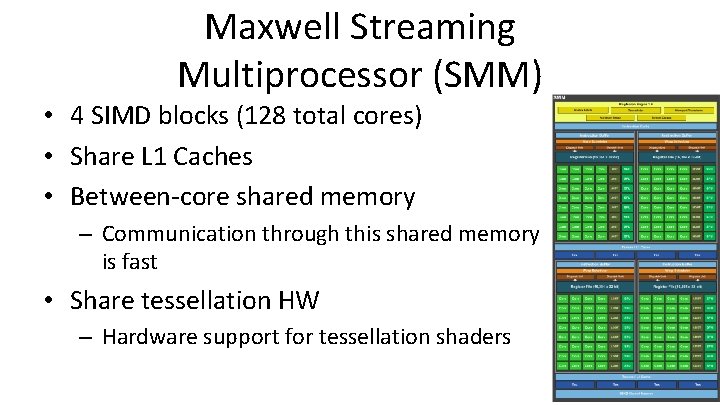
Maxwell Streaming Multiprocessor (SMM) • 4 SIMD blocks (128 total cores) • Share L 1 Caches • Between-core shared memory – Communication through this shared memory is fast • Share tessellation HW – Hardware support for tessellation shaders
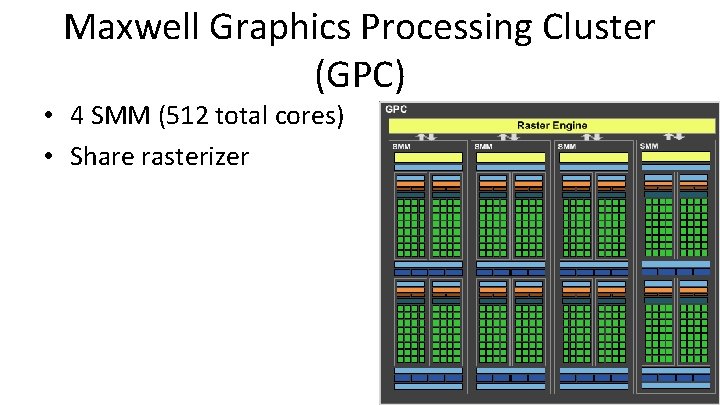
Maxwell Graphics Processing Cluster (GPC) • 4 SMM (512 total cores) • Share rasterizer
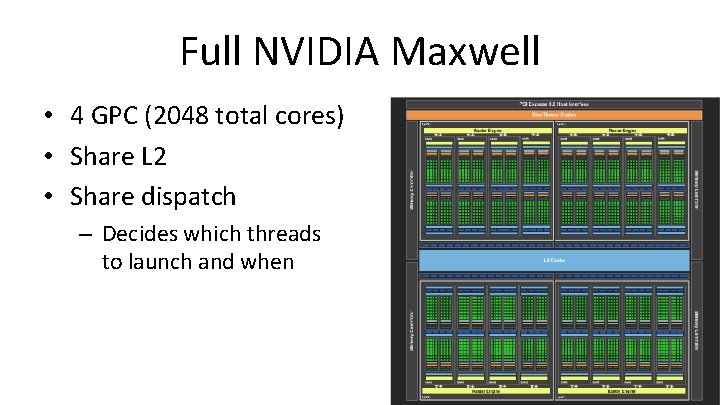
Full NVIDIA Maxwell • 4 GPC (2048 total cores) • Share L 2 • Share dispatch – Decides which threads to launch and when
NVIDIA Volta [NVIDIA, NVIDIA TESLA V 100 GPU ARCHITECTURE]