
Graphical skills in GCSE Geography Charlotte Foster Session
- Slides: 19
Graphical skills in GCSE Geography Charlotte Foster
Session aims Using geographical contexts we will engage with a range of data presentation techniques to: • Choose and justify appropriate methods of data presentation • Evaluate strengths & weaknesses of a range of graphs • Read and interpret graphs © Geographical Association, 2020
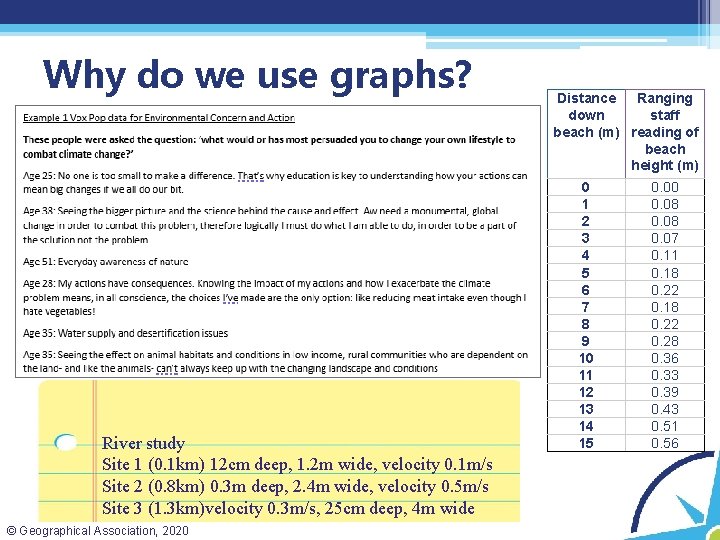
Why do we use graphs? River study Site 1 (0. 1 km) 12 cm deep, 1. 2 m wide, velocity 0. 1 m/s Site 2 (0. 8 km) 0. 3 m deep, 2. 4 m wide, velocity 0. 5 m/s Site 3 (1. 3 km)velocity 0. 3 m/s, 25 cm deep, 4 m wide © Geographical Association, 2020 Distance Ranging down staff beach (m) reading of beach height (m) 0 1 2 3 4 5 6 7 8 9 10 11 12 13 14 15 0. 00 0. 08 0. 07 0. 11 0. 18 0. 22 0. 28 0. 36 0. 33 0. 39 0. 43 0. 51 0. 56
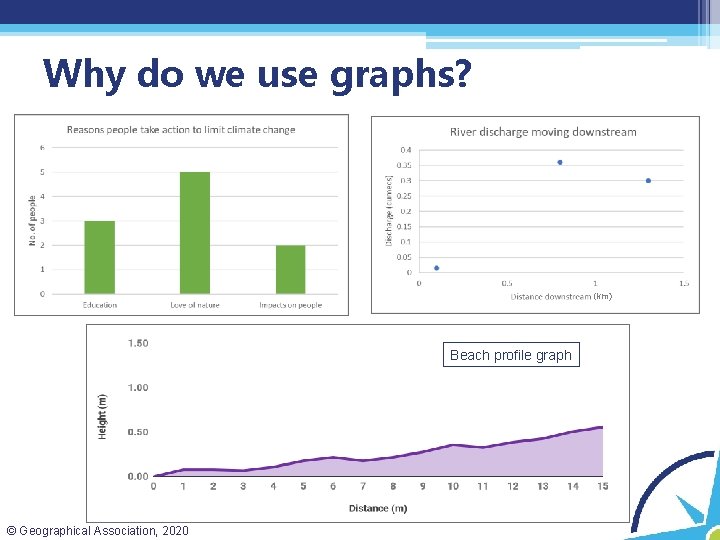
Why do we use graphs? (km) Beach profile graph © Geographical Association, 2020
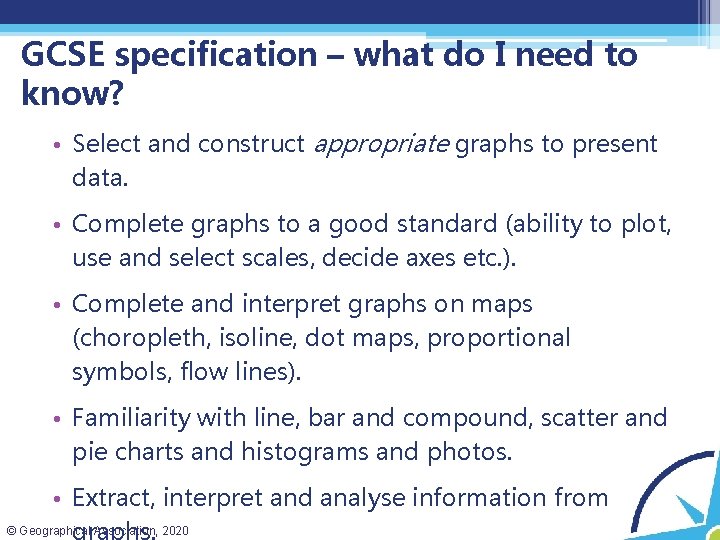
GCSE specification – what do I need to know? • Select and construct appropriate graphs to present data. • Complete graphs to a good standard (ability to plot, use and select scales, decide axes etc. ). • Complete and interpret graphs on maps (choropleth, isoline, dot maps, proportional symbols, flow lines). • Familiarity with line, bar and compound, scatter and pie charts and histograms and photos. • Extract, interpret and analyse information from © Geographical Association, 2020
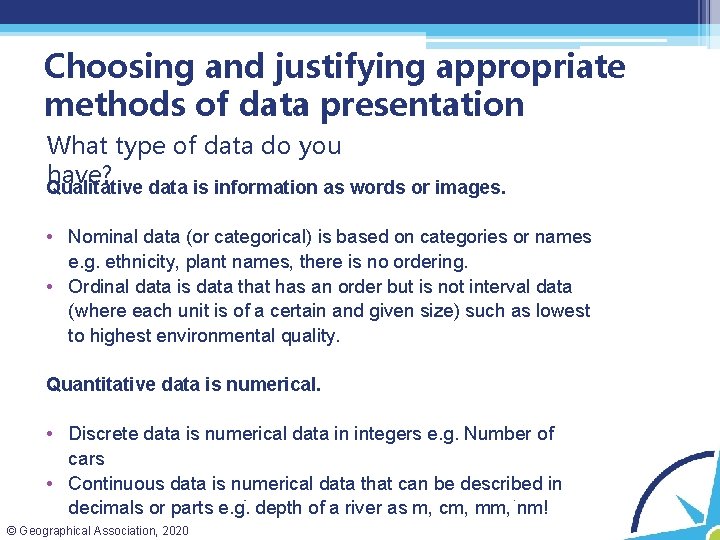
Choosing and justifying appropriate methods of data presentation What type of data do you have? Qualitative data is information as words or images. • Nominal data (or categorical) is based on categories or names e. g. ethnicity, plant names, there is no ordering. • Ordinal data is data that has an order but is not interval data (where each unit is of a certain and given size) such as lowest Key term: Data is a to highest environmental quality. collective term for any information you Quantitative data is numerical. collect or are given about something • Discrete data is numerical data in integers e. g. Number of cars • Continuous data is numerical data that can be described in decimals or parts e. g. depth of a river as m, cm, mm, nm! © Geographical Association, 2020
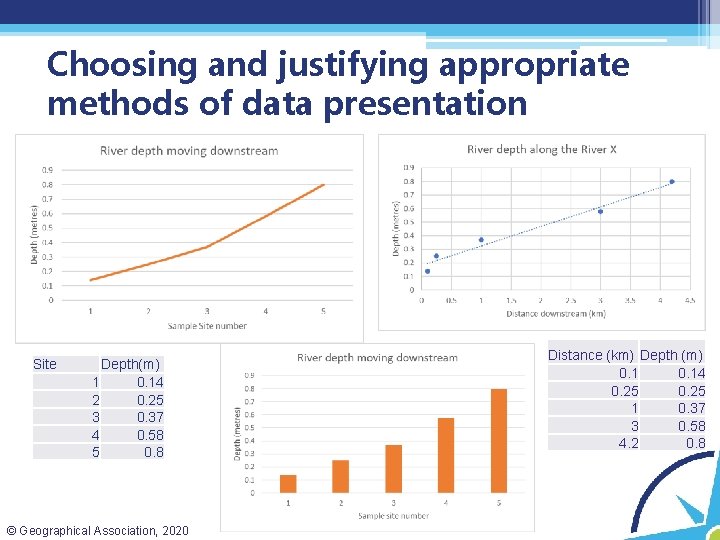
Choosing and justifying appropriate methods of data presentation Why does this matter? Site Depth(m) 1 0. 14 2 0. 25 3 0. 37 4 0. 58 5 0. 8 © Geographical Association, 2020 Distance (km) Depth (m) 0. 14 0. 25 1 0. 37 3 0. 58 4. 2 0. 8
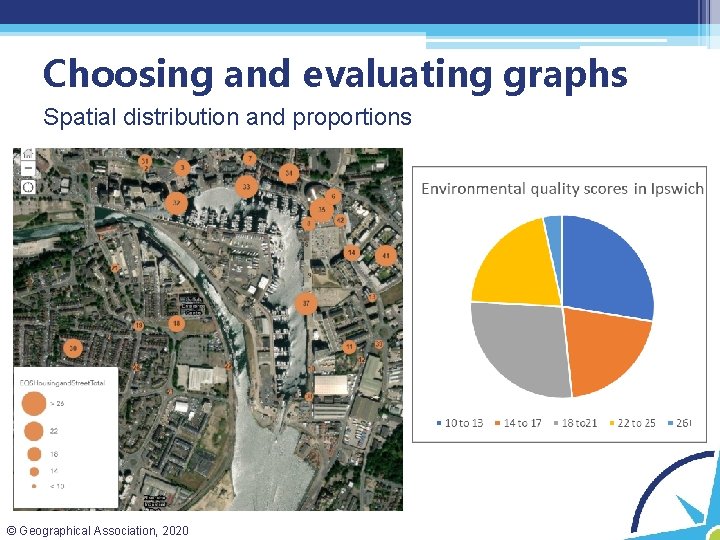
Choosing and evaluating graphs Spatial distribution and proportions © Geographical Association, 2020
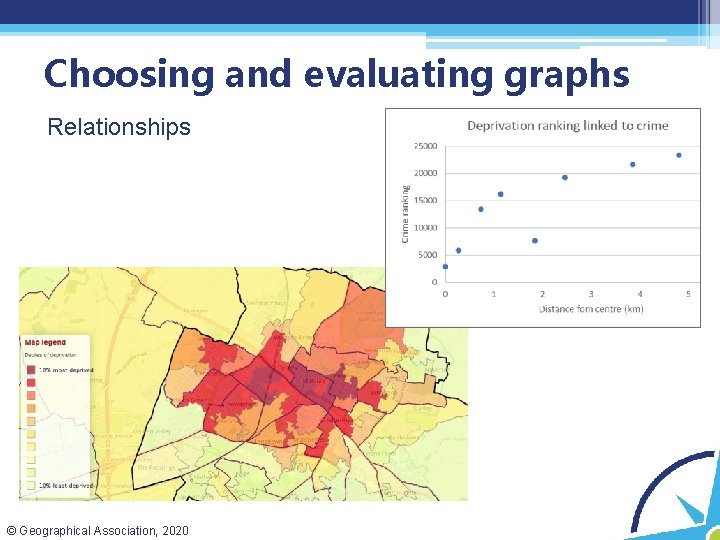
Choosing and evaluating graphs Relationships © Geographical Association, 2020
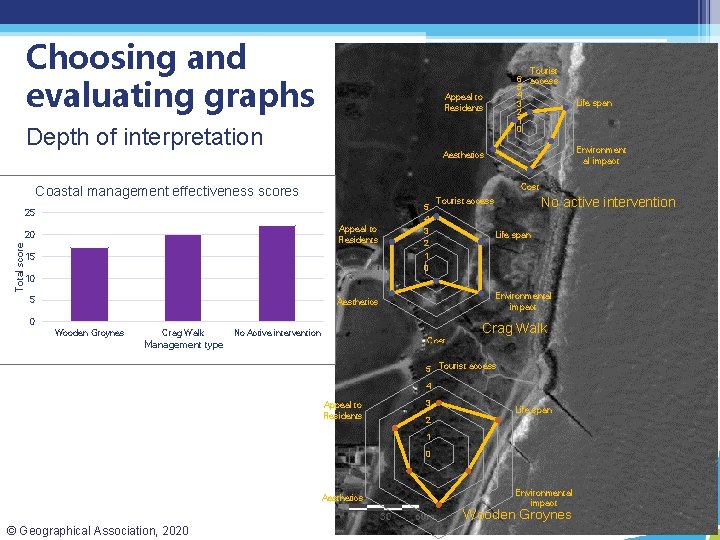
Choosing and evaluating graphs Appeal to Residents Depth of interpretation Cost 25 Appeal to Residents Total score 15 5 4 3 2 1 0 No active intervention Tourist access Life span 10 5 Environmental impact Aesthetics 0 Wooden Groynes Crag Walk No Active intervention Cost Management type Crag Walk 5 Tourist access 4 Appeal to Residents 3 2 Life span 1 0 Aesthetics Environmental impact Wooden Groynes © Geographical Association, 2020 Life span Environment al impact Aesthetics Coastal management effectiveness scores 20 Tourist 6 access 5 4 3 2 1 0
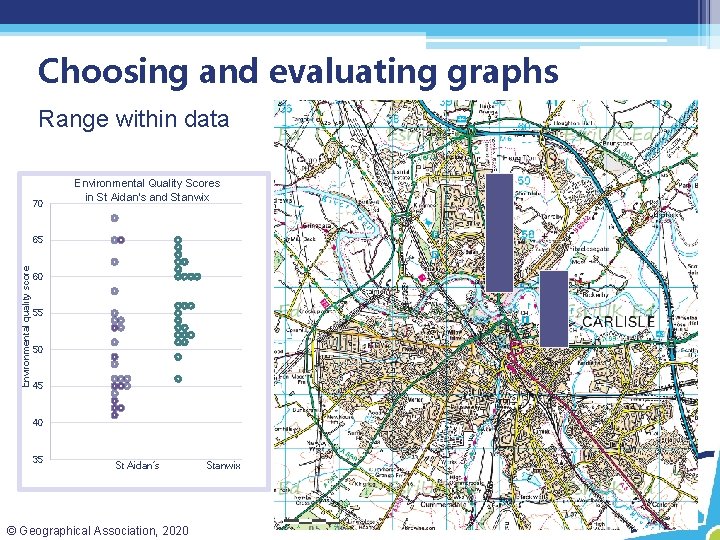
Choosing and evaluating graphs Range within data 70 Environmental Quality Scores in St Aidan’s and Stanwix Environmental quality score 65 60 55 50 45 40 35 St Aidan’s © Geographical Association, 2020 Stanwix
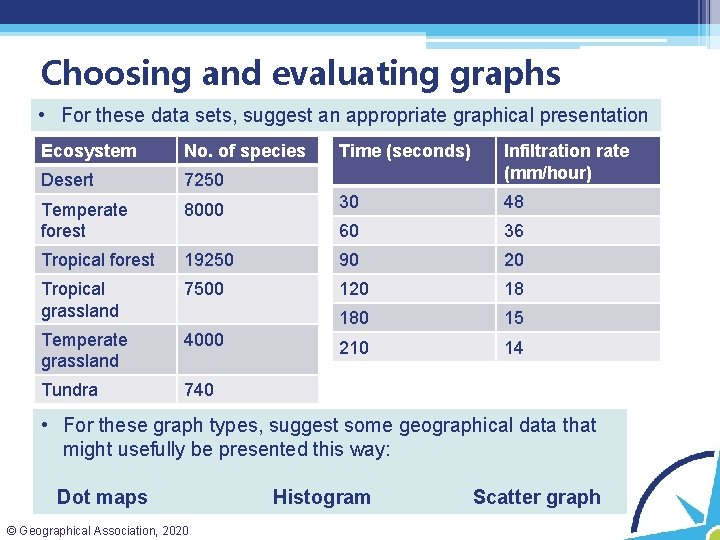
Choosing and evaluating graphs • For these data sets, suggest an appropriate graphical presentation Ecosystem No. of species Time (seconds) Infiltration rate (mm/hour) Desert 7250 Temperate forest 8000 30 48 60 36 Tropical forest 19250 90 20 Tropical grassland 7500 120 18 180 15 Temperate grassland 4000 210 14 Tundra 740 • For these graph types, suggest some geographical data that might usefully be presented this way: Dot maps © Geographical Association, 2020 Histogram Scatter graph
Completing a good quality graph • Write a list of success criteria for completing a good graph • A meaningful title, clearly showing what the graph is about • Axis labels with units • Effective scales: an appropriate min and max, not misleading comparisons • Plot with a sharp pencil for accuracy • Use a ruler rather than sketch straight lines • Scale or key if required • Ultimately, the graph choice or construction should not mislead the reader’s interpretation of the data © Geographical Association, 2020
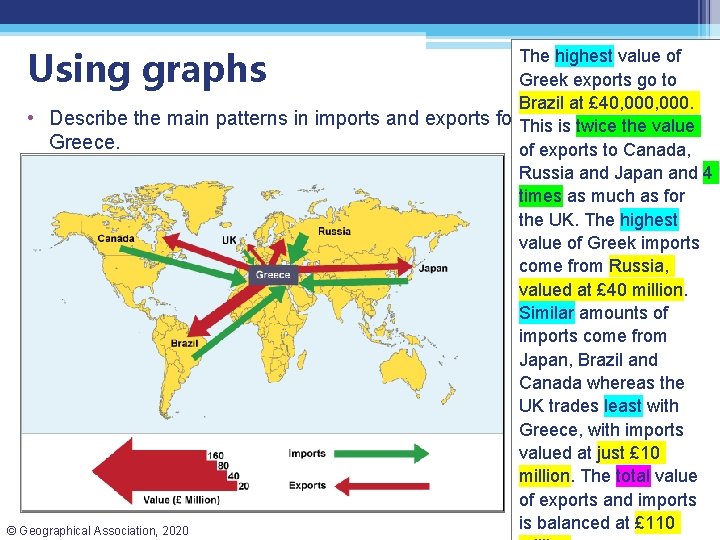
Using graphs The highest value of Greek exports go to Brazil at £ 40, 000. • Describe the main patterns in imports Interpret and exports for. This is twice Extract Analyse the value Greece. of exports to Canada, Russia and Japan and 4 times as much as for the UK. The highest value of Greek imports come from Russia, valued at £ 40 million. Similar amounts of imports come from Japan, Brazil and Canada whereas the UK trades least with Greece, with imports valued at just £ 10 million. The total value of exports and imports is balanced at £ 110 © Geographical Association, 2020
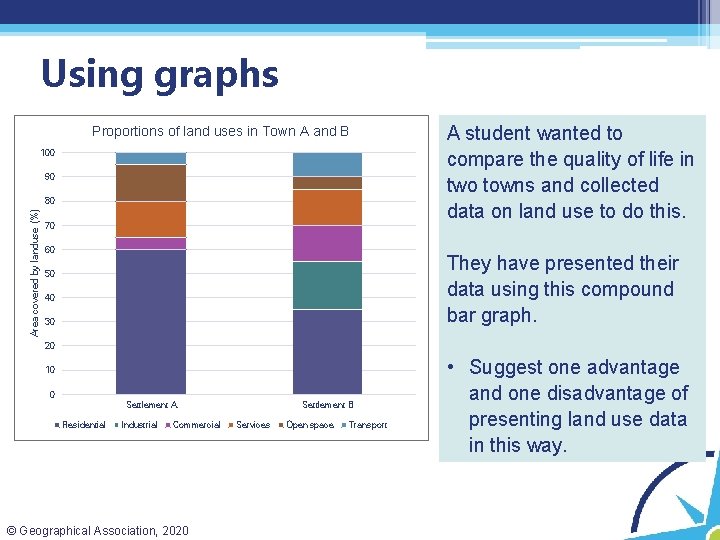
Using graphs Proportions of land uses in Town A and B 100 90 Area covered by landuse (%) 80 70 60 A student wanted to compare the quality of life in two towns and collected data on land use to do this. They have presented their data using this compound bar graph. 50 40 30 20 10 0 Settlement A Residential Industrial Commercial © Geographical Association, 2020 Settlement B Services Open space Transport • Suggest one advantage and one disadvantage of presenting land use data in this way.
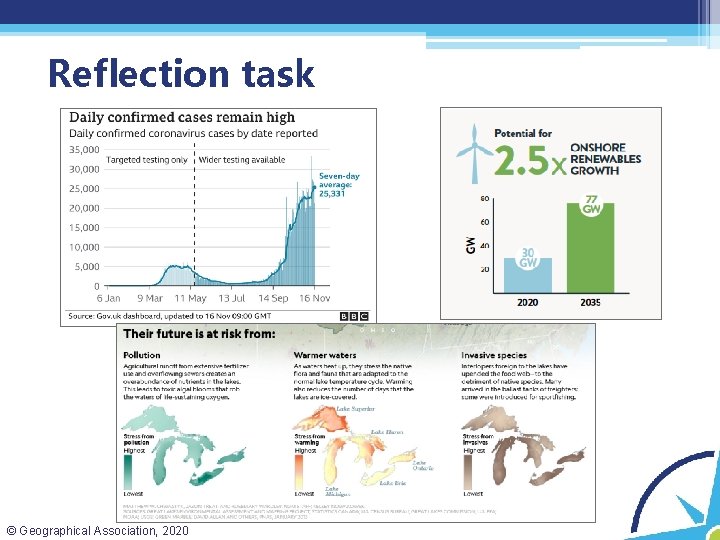
Reflection task © Geographical Association, 2020
Session aims Using geographical contexts we will engage with a range of data presentation techniques to: • Choose and justify appropriate methods of data presentation • Evaluate strengths & weaknesses of a range of graphs • Read and interpret graphs © Geographical Association, 2020
Links to further support • The Field Studies Council are offering a range of packages of support for GCSE geography students. With outreach and digital packages sitting alongside their more traditional day and residential course offer there is a solution to suit everyone. • Find out more https: //www. field-studiescouncil. org/secondary-and-further-educationcourses/ © Geographical Association, 2020
Links From the awarding bodies: • • GA specs summary AQA specification CCEA specification Eduqas specification Edexcel specification OCR specification WJEC specification © Geographical Association, 2020 From the GA and the FSC: • Methods of statistical analysis of fieldwork data, GA • Methods of presenting fieldwork data, GA For teachers, from the FSC: • Exam Ready fieldwork digital preparation (includes graphical skills)