
Graphical RuleBased Modeling of SignalTransduction Systems Fangyong Yan
Graphical Rule-Based Modeling of Signal-Transduction Systems Fangyong Yan Department of Chemistry University of Pittsburgh, PA 15260, fay 4@pitt. edu
Signal-transduction systems • Signal-transduction is a process by which a cell converts one kind of signal or stimulus into another. The behavior of a signal-transduction system depends on the protein-protein interactions. 1, 2 • Because of their multi-component composition, proteins can interact in a number of ways to generate many kinds of protein complexes (combinatorial complexity). This is a major barrier to understanding protein-protein interactions. 3, 4 • Mathematical models have been used to acquire a quantitative and predictive understanding of these complex dynamic systems. However, these models often fail to account for the complexities of protein-protein interactions. 1, 5 • Rule-based modeling has been developed to solve the problem of combinatorial complexity, in cases where the rules simplify the specification of a model when the reactivity of a component in a system is determined by only a subset of its possible features. 1 1. Hlavacek, et al. Sci. STKE 2006, 1 -18 2. Blinov, et al. Trans. On Comput. Syst. Biol. VII 2006 (LNBI 4230), 89 -106 3. Yang, et al. Phys. Rev. E 2008 (78), 031910 4. Hlavacek, et al. Biotechnol. Bioeng. 2003 (84), 783 -794 5. Eungdamrong, et al. Trends Cell Biol. 2004 (14), 661 -669

Combinatorial Complexity (b) • Combinatorial Complexity is mainly caused by conditional multivalent binding. • (a) Complex formation around EGFR (epidermal growth factor receptor). The cytosolic adapters Grb 2 and Shc are recruited to the membrane when EGFR tyrosines (YY) are autophosphorylated. Grb 2 also binds phosphorylated Shc and interacts constitutively with Sos, a guanine nucleutide exchange factor. PTK is protein tyrosine kinase. • (b) Multisite Phosphorylation of EGFR 1. Blinov, et al. Trans. On Comput. Syst. Biol. 2. VII 2006 (LNBI 4230), 89 -106 2. Hlavacek, et al. Sci. STKE 2006, 1 -18
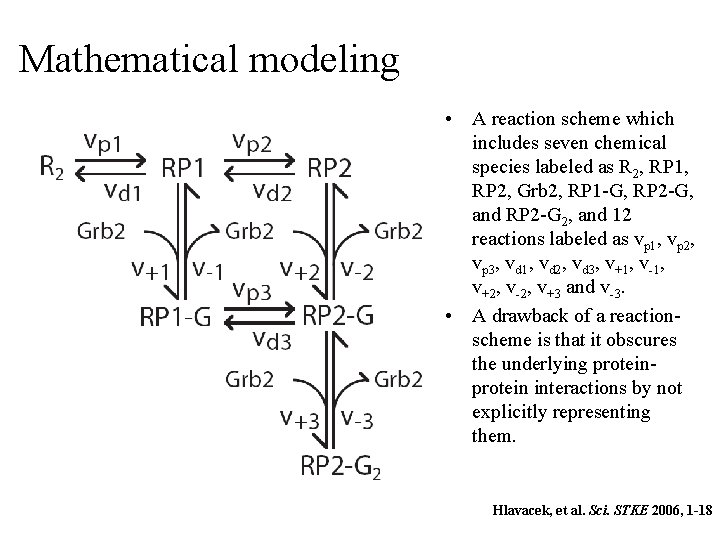
Mathematical modeling • A reaction scheme which includes seven chemical species labeled as R 2, RP 1, RP 2, Grb 2, RP 1 -G, RP 2 -G, and RP 2 -G 2, and 12 reactions labeled as vp 1, vp 2, vp 3, vd 1, vd 2, vd 3, v+1, v-1, v+2, v-2, v+3 and v-3. • A drawback of a reactionscheme is that it obscures the underlying protein interactions by not explicitly representing them. Hlavacek, et al. Sci. STKE 2006, 1 -18
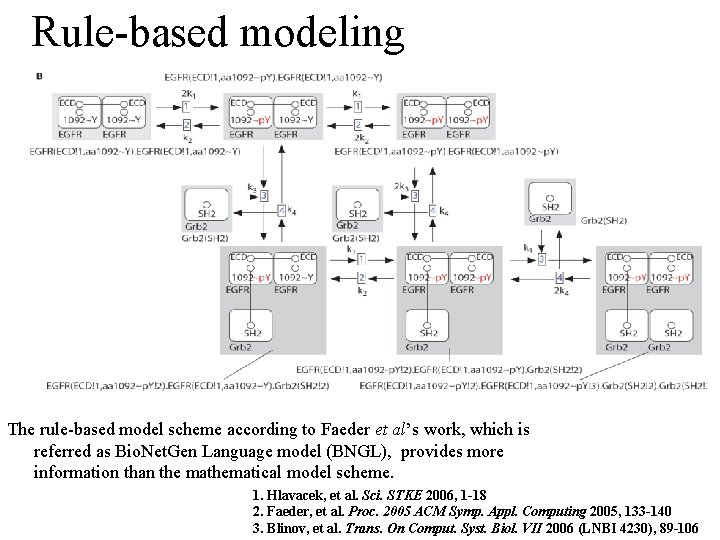
Rule-based modeling The rule-based model scheme according to Faeder et al’s work, which is referred as Bio. Net. Gen Language model (BNGL), provides more information than the mathematical model scheme. 1. Hlavacek, et al. Sci. STKE 2006, 1 -18 2. Faeder, et al. Proc. 2005 ACM Symp. Appl. Computing 2005, 133 -140 3. Blinov, et al. Trans. On Comput. Syst. Biol. VII 2006 (LNBI 4230), 89 -106
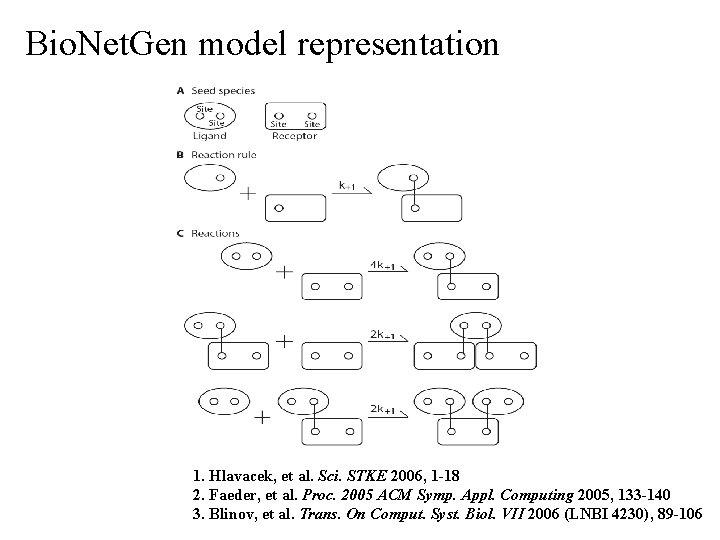
Bio. Net. Gen model representation 1. Hlavacek, et al. Sci. STKE 2006, 1 -18 2. Faeder, et al. Proc. 2005 ACM Symp. Appl. Computing 2005, 133 -140 3. Blinov, et al. Trans. On Comput. Syst. Biol. VII 2006 (LNBI 4230), 89 -106
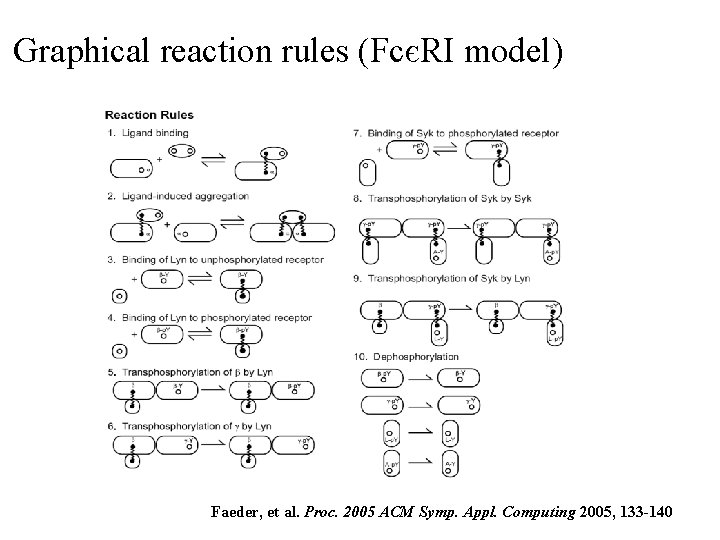
Graphical reaction rules (FcєRI model) Faeder, et al. Proc. 2005 ACM Symp. Appl. Computing 2005, 133 -140
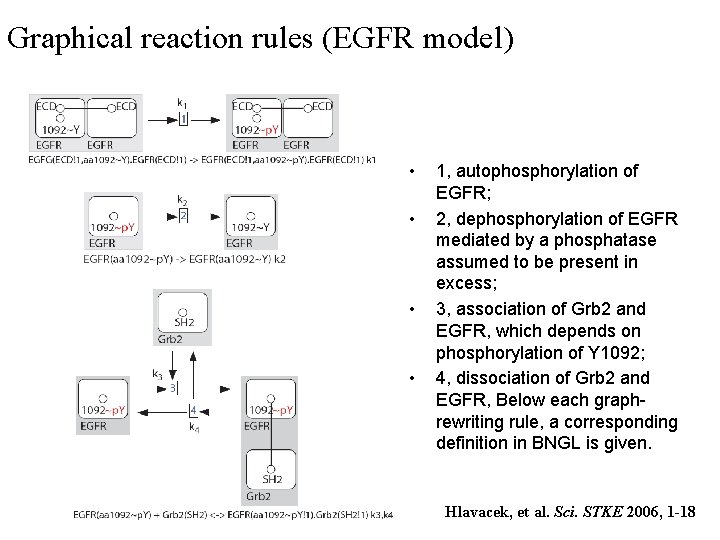
Graphical reaction rules (EGFR model) • • 1, autophosphorylation of EGFR; 2, dephosphorylation of EGFR mediated by a phosphatase assumed to be present in excess; 3, association of Grb 2 and EGFR, which depends on phosphorylation of Y 1092; 4, dissociation of Grb 2 and EGFR, Below each graphrewriting rule, a corresponding definition in BNGL is given. Hlavacek, et al. Sci. STKE 2006, 1 -18
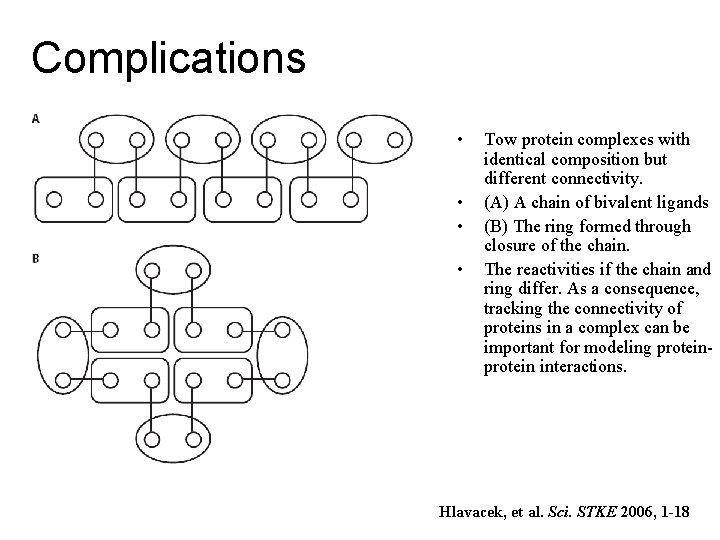
Complications • • Tow protein complexes with identical composition but different connectivity. (A) A chain of bivalent ligands (B) The ring formed through closure of the chain. The reactivities if the chain and ring differ. As a consequence, tracking the connectivity of proteins in a complex can be important for modeling protein interactions. Hlavacek, et al. Sci. STKE 2006, 1 -18
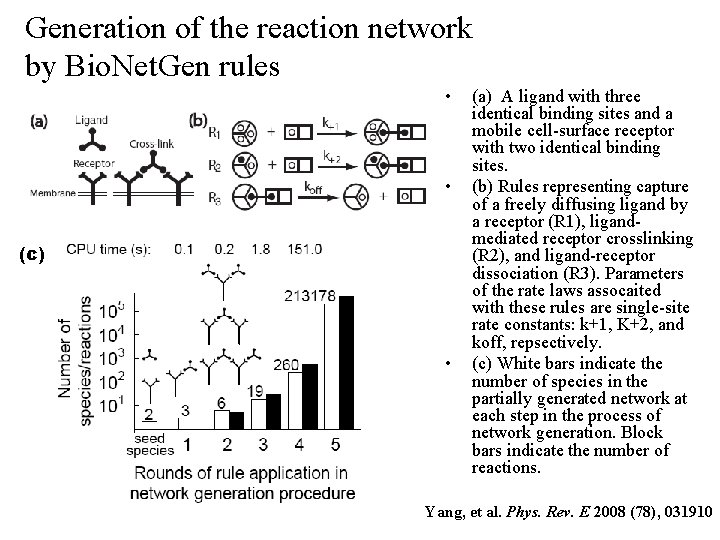
Generation of the reaction network by Bio. Net. Gen rules • • (c) • (a) A ligand with three identical binding sites and a mobile cell-surface receptor with two identical binding sites. (b) Rules representing capture of a freely diffusing ligand by a receptor (R 1), ligandmediated receptor crosslinking (R 2), and ligand-receptor dissociation (R 3). Parameters of the rate laws assocaited with these rules are single-site rate constants: k+1, K+2, and koff, repsectively. (c) White bars indicate the number of species in the partially generated network at each step in the process of network generation. Block bars indicate the number of reactions. Yang, et al. Phys. Rev. E 2008 (78), 031910
KMC method simulating Bio. Net. Gen model systems • Monte Carlo simulation method is a method which uses random numbers to solve problems. Unlike Metropolis Monte Carlo simulations, which are familiar to us and deals with generating a sampling of states appropriate for a desired physical ensemble, such as the canonical ensemble; Kinetic Monte Carlo simulation methods deal with systems evolving dynamically from state to state. • Kinetic Monte Carlo simulation method (KMC) has been applied to Bio. Net. Gen model systems • The computational cost of simulation is O(log 2 M) per reaction event for efficient KMC, where M is the number of reactions, which can be prohibitive for large-scale model systems. • To save the computational cost, reaction rules have been used to propagate the KMC simulation because the number of rules m is much less than the number of reactions M. Yang, et al. Phys. Rev. E 2008 (78), 031910 Voter, Introduction to the Kinetic Monte Carlo Method, 2005
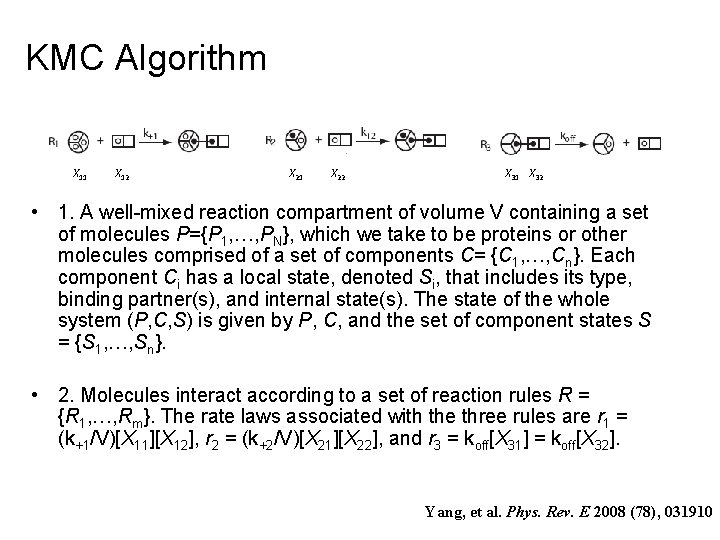
KMC Algorithm X 11 X 12 X 21 X 22 X 31 X 32 • 1. A well-mixed reaction compartment of volume V containing a set of molecules P={P 1, …, PN}, which we take to be proteins or other molecules comprised of a set of components C= {C 1, …, Cn}. Each component Ci has a local state, denoted Si, that includes its type, binding partner(s), and internal state(s). The state of the whole system (P, C, S) is given by P, C, and the set of component states S = {S 1, …, Sn}. • 2. Molecules interact according to a set of reaction rules R = {R 1, …, Rm}. The rate laws associated with the three rules are r 1 = (k+1/V)[X 11][X 12], r 2 = (k+2/V)[X 21][X 22], and r 3 = koff[X 31] = koff[X 32]. Yang, et al. Phys. Rev. E 2008 (78), 031910
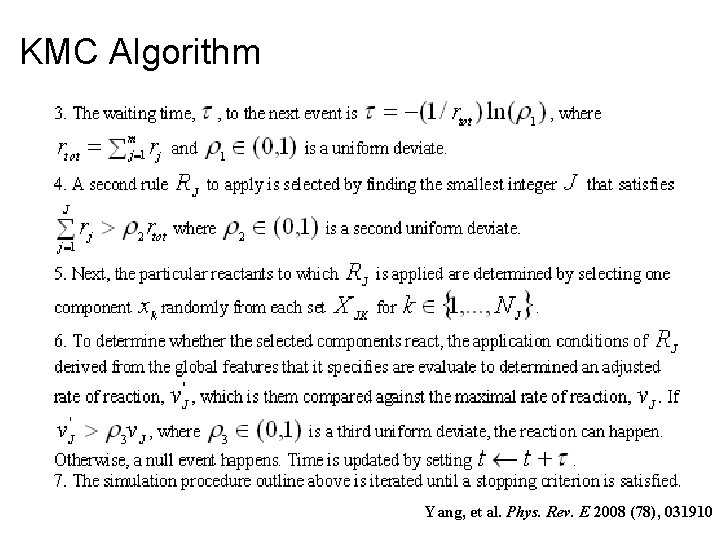
KMC Algorithm Yang, et al. Phys. Rev. E 2008 (78), 031910
Summary 1. Compared with general mathematical representation, graphic rule-based stochastic schemes can gain more information, which is important for protein-protein interactions 2. Graphic rule-based can be easily incorporated with KMC. Other KMC methods have also been used for rule-based signal-transduction systems.

Thanks!
- Slides: 15